
SLIDE 1
1
CSC 4103 - Operating Systems Spring 2008
Tevfik Koar
Louisiana State University
April 3rd, 2008
Lecture - XVII
Virtual Memory - III
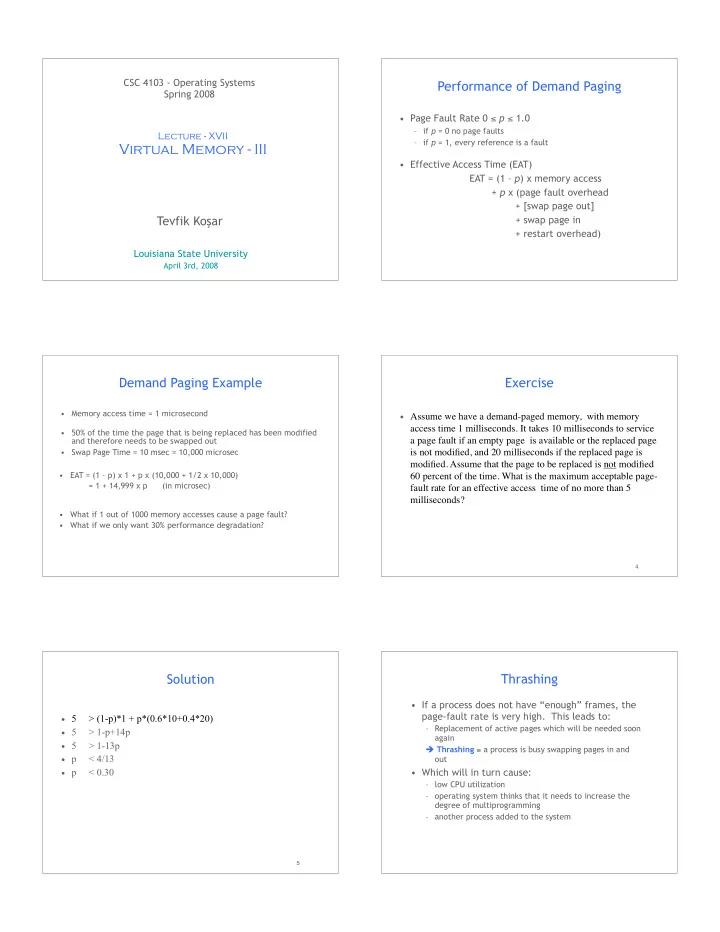
Performance of Demand Paging
- Page Fault Rate 0 p 1.0
– if p = 0 no page faults – if p = 1, every reference is a fault
- Effective Access Time (EAT)
EAT = (1 – p) x memory access + p x (page fault overhead + [swap page out] + swap page in + restart overhead)
Demand Paging Example
- Memory access time = 1 microsecond
- 50% of the time the page that is being replaced has been modified
and therefore needs to be swapped out
- Swap Page Time = 10 msec = 10,000 microsec
- EAT = (1 – p) x 1 + p x (10,000 + 1/2 x 10,000)
= 1 + 14,999 x p (in microsec)
- What if 1 out of 1000 memory accesses cause a page fault?
- What if we only want 30% performance degradation?
Exercise
- Assume we have a demand-paged memory, with memory
access time 1 milliseconds. It takes 10 milliseconds to service a page fault if an empty page is available or the replaced page is not modified, and 20 milliseconds if the replaced page is
- modified. Assume that the page to be replaced is not modified
60 percent of the time. What is the maximum acceptable page- fault rate for an effective access time of no more than 5 milliseconds?
4
Solution
- 5
> (1-p)*1 + p*(0.6*10+0.4*20)
- 5
> 1-p+14p
- 5
> 1-13p
- p
< 4/13
- p
< 0.30
5
Thrashing
- If a process does not have “enough” frames, the
page-fault rate is very high. This leads to:
– Replacement of active pages which will be needed soon again Thrashing a process is busy swapping pages in and
- ut
- Which will in turn cause: