Virtual Memory Concept A mechanism for hiding the details of how - - PowerPoint PPT Presentation

virtual memory concept
SMART_READER_LITE
LIVE PREVIEW

Virtual Memory Concept A mechanism for hiding the details of how - - PowerPoint PPT Presentation

1 2 Virtual Memory Concept A mechanism for hiding the details of how much physical memory exists and how its being shared Allows the OS to EE 457 Unit 7c Efficiently share the physical memory between several _______ ___________


slide-1
SLIDE 1

1

EE 457 Unit 7c

Virtual Memory

2

Virtual Memory Concept

  • A mechanism for hiding the details of how much physical

memory exists and how it’s being shared

  • Allows the OS to

– Efficiently share the physical memory between several _______ ___________ and provide ___________ against each other – Remove the need of the programmer to know _______________ is physically present and/or give the illusion of ____________ physical memory than is present

  • Use MM as a cache for multiple programs and their data as they

run using ________________________ as the home location

3

Memory Hierarchy & Caching

  • Lower levels act as a cache for upper levels

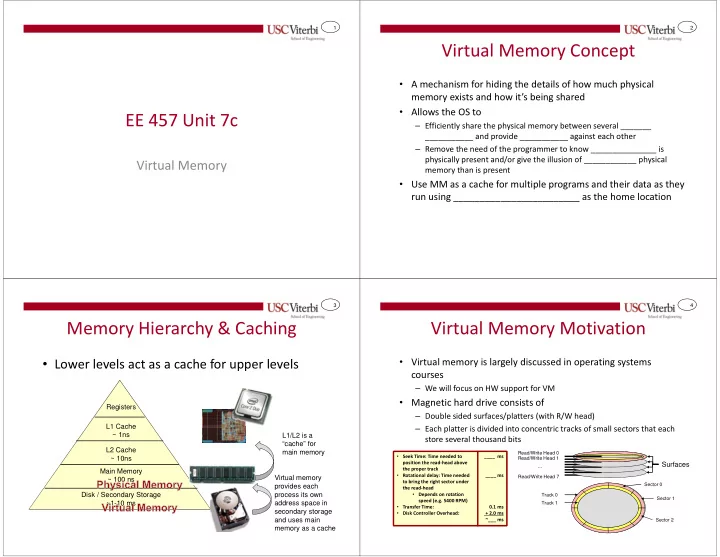
Disk / Secondary Storage ~1-10 ms Main Memory ~ 100 ns L2 Cache ~ 10ns L1 Cache ~ 1ns Registers L1/L2 is a “cache” for main memory Virtual memory provides each process its own address space in secondary storage and uses main memory as a cache

4

Virtual Memory Motivation

  • Virtual memory is largely discussed in operating systems

courses

– We will focus on HW support for VM

  • Magnetic hard drive consists of

– Double sided surfaces/platters (with R/W head) – Each platter is divided into concentric tracks of small sectors that each store several thousand bits

Surfaces

Read/Write Head 0 Read/Write Head 7 Read/Write Head 1 … Track 0 Track 1 Sector 0 Sector 1 Sector 2

  • Seek Time: Time needed to

position the read-head above the proper track

  • Rotational delay: Time needed

to bring the right sector under the read-head

  • Depends on rotation

speed (e.g. 5400 RPM)

  • Transfer Time:
  • Disk Controller Overhead:

____ ms ____ ms 0.1 ms + 2.0 ms ~___ ms

slide-2
SLIDE 2

5

Address Spaces

  • Physical address spaces

corresponds to the actual system address bus width and range (i.e. main memory and I/O)

  • Each process/program runs in its
  • wn private “virtual” address

space

– Virtual address space can be larger (or smaller) than physical memory – Virtual address spaces are protected from each other

32-bit _________ Address Space w/

  • nly 1 GB of Mem

0x00000000 0xffff ffff Mem. I/O Not used 0x3fffffff Not used 0x80000000 0xbfffffff Mem. 0x00000000 0xffff ffff

32-bit ____________ Address Spaces ( > 1GB Mem)

I/O Mem

Program/Process 1,2,3,…

6

Virtual Address Spaces

  • Virtual address spaces are

broken into blocks called ____________

  • Depending on the

program, much of the virtual address space will _____________

  • All ______ pages are

“housed” in secondary storage (hard drive)

1 2 3

unused

1 2 1 2 3

Secondary Storage

… unused … unused … unused

1 2 3 1 2 1 2 3

Used/Unused Blocks in Virtual Address Space

Mem. 0x0000000 0xffff ffff

Fictitious Virtual Address Spaces

I/O Mem

Program/Process 1,2,3,…

7

Physical Address Space

  • Physical memory is broken

into page-size blocks called _________ ______________

  • Multiple programs are run

concurrently and their pages (code & data) need to reside in physical memory

  • Physical memory acts as a

_____ for pages from the secondary storage as each program executes

0x00000000 0x3fffffff frame

1GB Physical Memory and 32-bit Address Space

… frame I/O and un- used area 0xffffffff 1 2 3

unused

1 2 1 2 3

Secondary Storage

… unused … unused … unused

1 2 3 1 2 1 2 3

Fictitious Virtual Address Spaces

8

Physical Memory Usage

  • HW & the OS will _____ the

virtual addresses used by the program to the physical address where that page resides

  • If an attempt is made to

access a page that is not in physical memory, a __________________ is declared and the ____ brings in the page to physical memory (possibly evicting another page)

0x00000000 0x3fffffff frame 1

Physical Memory and Address Space

3 2 frame I/O and un- used area 0xffffffff 1 2 3

unused

1 2 1 2 3

Secondary Storage

… unused … unused … unused

1 2 3 1 2 1 2 3

Fictitious Virtual Address Spaces

slide-3
SLIDE 3

9

Page Size and Address Translation

  • Usually pages are _________ in size to amortize the large access time
  • Example: 32-bit virtual & physical address, 1 GB physical memory,

4 KB pages

  • Virtual page number to physical page frame translation performed by HW

unit = MMU (Mem. Management Unit)

Offset within page

Virtual Address

Virtual Page Number

31 __ __

Offset within page

Physical Address

____________________

31 30 __ __

00

Copied

12

Translation Process

29 __ __ 10

VM Design Implications

  • SLOW secondary storage access on page faults (10 ms)

– Implies page size should be ___________ (i.e. once we’ve taken the time to find data on disk, make it worthwhile by accessing a reasonably large amount of data) – Implies the placement of pages in main memory should be __________ to reduce ___________ and maximize page hit rates – Implies a “page fault” is going to take so much time to even access the data that we can handle them in _______ (via an exception) rather than using HW like typical cache misses – Implies eviction algorithms like ______ can be used since reducing page miss rates will pay off greatly – Implies _________ (write-______ would be too expensive)

11

Address Translation Issues

  • A virtual page with 20-bit VPN can be sitting anywhere in the

256K = 218 page frames in physical memory

– TAG = 20 + 1 = 21 bits, _________ comparators

  • This is impractical
  • Instead, most systems implement full associativity using a

look-up table = PAGE TABLE

Frame 2 Frame 1 Frame 0 … Frame n VPN Tag (VPN) V M

Page Frame #

… Tag (VPN) V M Tag (VPN) V M Tag (VPN) V M 2 1 n

Virtual Address

  • ffset

= = = = =

12

Analogy for Page Tables

  • Suppose we want to build a caller-ID mechanism for your

contacts on your cell phone

– Let us assume 1000 contacts represented by a 3-digit integer (0-999) by the cell phone (this ID can be used to look up their names) – We want to use a simple Look-Up Table (LUT) to translate phone numbers to contact ID’s, how shall we organize/index our LUT

213-745-9823

LUT indexed w/ contact ID

000

LUT indexed w/ all possible phone #’s

626-454-9985 … 323-823-7104 818-329-1980 001 002 999 null 000-000-0000 .. … null 000 213-745-9823 999-999-9999

Sorted LUT indexed w/ used phone #’s

436 213-745-9823 000 … 002 999 323-823-7104 213-730-2198 818-329-1980

Does / Doesn’t Work Does / Doesn’t Work Does / Doesn’t Work 1 2 3

slide-4
SLIDE 4

13

Analogy for Page Tables

  • Can we use the table indexed using all possible phone numbers (because it only

requires 1 access) but somehow reduce the size especially since much of it is unused?

  • Do you have friends from every ________? Likely contacts are clustered in only a few.
  • Use a 2-level organization

– 1st level LUT is indexed on __________ and contains pointers to 2nd level tables – 2nd level LUT’s indexed on __________ numbers and contains contact ID entries LUT indexed w/ all possible phone #’s

null … … 000 ____ ___

1st Level Index = _________

Area Code null 000-000-0000 .. … null 000 213-745-9823 999-999-9999 … ____ Table

2nd Level Index = ______________

000-0000 999-9999 ____ Table 000-0000 999-9999

If only 2 used area codes then only ____ ___________ entries rather than 1010 entries

14

Analogy for Page Tables

  • Could extend to 3 levels if desired

– 1st Level = Area code and pointers to 2nd level tables – 2nd Level = First 3-digits of local phone and pointers to 3rd level tables – 3rd Level = Contact ID’s

null … … 000 213 323

1st Level Index = Area Code

Area Code …

2nd Level Index = Local Phone #

000 999 000 999 323 Table 213 Table null null 745 823 null null

3rd Level Index = Local Phone #

000 999 213-745 Table null 000 null 9823 000 999 323-823 Table null 999 null 7104 15

Analogy for Page Tables

  • If we add a friend from area code 408 we would have to add a second and

third level table for just this entry

null … … 000 213 323

1st Level Index = Area Code

Area Code …

2nd Level Index = Local Phone #

000 999 000 999 323 Table 213 Table null null 745 823 null null

3rd Level Index = Local Phone #

000 999 213-745 Table null 000 null 9823 000 999 323-823 Table null 999 null 7104 16

Page Tables

  • Page table is built by the OS and maintained in the _______________ at some

chosen place by the OS

– Allows virtual memory page placement to be fully associative in physical memory

– One page table per process and indexed on virtual address – PTBR is a ____________ register pointing to the start address of currently executing process’ page table

VA

Offset w/in page Virtual Page Number

31 12 11

Page Table Size = ____ entries * ___ bits = approx. _______________

PTBR = Page Table Base Reg. Offset w/in page

PA

  • Phys. Frame #

31 12 11

00

Page Frame Number … Valid / Present 20

CPU Memory

18

slide-5
SLIDE 5

17

Multi-Level Page Table

  • VPN is broken into fields to index each level of

the multi-level page table

Offset w/in page

Virtual Address

Level Index 1

31 12 11 22 21

Level Index 2 PTBR Offset w/in page

Physical Address

  • Phys. Frame #

31 12 11

00

18 29 10 10

1st Level Table 2nd Level Table

18

Another View

1 2 1023 1 2 1023 1 2 1023 1 2 1023

Offset w/in page Level Index 1

31 12 11 22 21

Level Index 2

10 10

Pointer to start of 2nd Level Table PPFN’s

frame I/O and un- used area frame

0x0

Entries whose pages are not in physical memory essentially “point” to where that page’s data ______________________ 19

To Tag or Not?

  • Fully associative caches needed to store

TAGs to check if the block is present.

  • Do we need to store tags with the PPFN in

the page table?

  • Consider a book, assuming we start

numbering pages at 1, do we need to print the page number along with the page content?

– ____ since every page exists we can just __________________ – Since we have an entry in the Page Table for every Virtual Page Number, we _____ _____________ to tag our entries

Page Table Size = 220 entries * 19 bits = approx. 220*4bytes = 4MB

Page Frame Number … Valid / Present

Memory

20

Handling Page Faults

  • Valid bit (1 = desired page in memory / 0 = page not present / page fault)
  • Referenced = To implement ___________________________
  • Protection: Read/Write/eXecute

Page Frame Number Valid / Present Modified / Dirty Referenced Protection Cacheable

slide-6
SLIDE 6

21

Page Fault Steps

  • HW will…

– Record the offending address, the EPC, and cause (page fault)

  • SW will…

– Pick an empty frame or ____________________ – __________ the evicted page if it has been _______

  • May block process while waiting and yield processor

– Bring in the desired page and update the _________

  • May block process while waiting and yield processor

– Restart the offending instruction

22

Page Replacement Policies

  • Possible algorithms: LRU, FIFO, Random
  • Since page misses are so costly (slow) we can afford to spend sometime

keeping statistics to implement LRU

  • Implementing exact LRU would require updating statistics every access (using

some kind of timestamp). This is too much to do in HW and we don’t want to use SW when we have hits

  • HW will implement simple mechanism that allows SW to implement a

_______________ algorithm

– HW will set the “Referenced” bit when a page is used – At certain intervals, SW will use these reference bits to keep _________ on which pages have been used in that interval and then ______ the reference bits – On _____________, these statistics can be used to find the pseudo-LRU page

23

Cache & VM Comparison

Cache Virtual Memory Block Size 16-64B 4 KB – 64 MB Mapping Schemes Direct or Set Associative Fully Associative Miss handling and replacement HW SW Replacement Policy Full LRU if low associativity / Random is also used Pseudo-LRU can be implemented

24

SPARC VM Implementation

Offset w/in page

Index 1 8 11 6 Index 2 Process ID Index 3 6

4095 MMU holds 4096 entry table (one entry per context/process) [Essentially, PTBR for each process] Context Table First Level Second Level Third Level 4K Page Desired word PPFN _____ bytes ______ bytes _______ bytes

How many accesses to memory does it take to get the desired word that corresponds to the given virtual address? Would that change for a 1- or 2- level table? Virtual Address:

slide-7
SLIDE 7

25

Performance Issues

  • Let cache hits = 10ns, memory accesses=100ns
  • Assume a program makes an access to data located in cache…

– Without VM, only requires __________ cache access time – With VM, address must first be translated via the page table (recall page table is in memory)

  • If a single-level, one access to the page table (MM) = 100ns
  • If two-levels, two access to the page tables = 200ns
  • If three-levels, three access to the page tables = 300ns
  • Finally, physical address can access cache = 10 ns (if hit)
  • Total time equals __________ (where L=# of Level of Page Table)
  • Translation is _____________ as currently implemented!!!

26

Translation Lookaside Buffer (TLB)

  • Solution: Let’s create a cache for translations = Translation

Lookaside Buffer (TLB)

  • Needs to be small (64-128 entries) so it can be fast, with high degree of

___________ (at least _______ and many times _________________) to avoid conflicts – On hit, the PPFN is produced and concatenated with the offset – On miss, a page table walk is needed

TLB Cache

CPU

VA ___ _____________ _____ PA data 10 ns 10 ns 10+10=20 ns 27

Translation Lookaside Buffer (TLB)

Offset w/in page

Virtual Address

Virtual Page Number

31 12 11 Page Frame #

Offset w/in page

Physical Address

  • Phys. Frame #

31 12 11 V M Tag = VPN

= = = =

TLB Fully Direct Set-Assoc.

20 12 TLB only has a few entries so now we need to store tags.

  • Phys. Tag

Index

Byte Offset

Data Data Data Data Tag V

=

1,

Hit

Desired Word 8 8 8 8 32 14 16

TLB Data Cache Data Cache Fully Direct Set-Assoc.

28

TLB Block Size

  • A block in cache may be

– 1 word – 2 words – 4 words

  • Consider a direct mapped cache mapping can the

word field be 0-bits?

  • But an entry in the TLB is _____________

– ____________…TLB mappings have ____________

Tag Block

Word Byte Offset

18 10 2 2

slide-8
SLIDE 8

29

A 4-Way Set Associative TLB

  • 64 entry 4-way SA TLB (wet field indexes each “way”)

– On hit, page frame # supplied quickly w/o page table access

Offset w/in page

Virtual Address

Virtual Page Number

31 12 11

Offset w/in page

Physical Address

  • Phys. Frame #

31 12 11

Set Tag

Tag PF# Tag PF# Tag PF# Tag PF#

= = = =

Way 1 Way 0 Way 2 Way 3

__ __ What is the page size? _____ Tag size? __________ Comparator Width? _______ 30

Virtual Memory System Examples

Microprocessor AMD Opteron P4 PPC 7447a Virtual Address 48-bit 32- or 48-bit 52-bit Physical Address 40-bit 36-bit 32- or 36-bit TLB Entries (I/D/L2 TLB) L1: 40/40 L2: 512/512 L1: 128/128 L1: 128 / 128 TLB Mapping L1: Fully L2: 4-way SA Fully (? 4-way) 2-way set associative

  • Min. Page Size

4 KB 4 KB 4 KB

Notes: Large VA’s include ASID (process ID’s) and other segment information Sources: H&P, “CO&D”, 3rd ed., Freescale.com,

31

TLB Issues

  • Because of high degree of associativity and limited working set
  • f pages (usually) we can get VERY HIGH hit rates for the TLB

– Variable page size settable by OS to allow for different working set sizes – Example: 64 TLB entries and 4 KB pages = 256KB

  • Often times, separate TLB’s for instruction and data address

translation

32

TLB Miss Process

  • On a TLB miss, there is some division of work between the hardware (MMU) and

OS

  • Option 1

– MMU can perform the TLB search followed by a page table walk if needed – If page fault occurs, OS takes over to bring in the page

  • Option 2

– MMU performs TLB Search – If TLB miss, OS can perform page table walk and bring in page if necessary

  • When we want to remove a page from MM

– First flush blocks from ______ belonging to that page (writing back if necessary) – ________________ of those blocks – ________________ entry (if any) corresponding to that page

  • If D=1, set dirty bit in page table

– If page is dirty, copy page back to the disk – Simple way to remember this…

  • If _____________ leave a party then the _____________ (cache blocks & TLB entries) must

leave too

slide-9
SLIDE 9

33

Other Issues

  • Property of Inclusion

– Cache contents are a (subset / superset) of main memory contents – Main memory contents are a (subset / superset) of page/swap file on disk – TLB contents are a (subset / superset) of _______________________

34

Cache, VM, and Main Memory

TLB VM Cache Possible Y/N & Description Hit Hit Hit Hit Hit Miss Miss Hit Hit Miss Hit Miss Miss Miss Miss Hit Miss Miss Hit Miss Hit Miss Miss Hit

Taken from H & P, “Computer Organization” 3rd, Ed.

35

Cache Addressing with VM

  • Cache review

– Set or block field indexes LUT holding tags – 2 steps to determine hit:

  • Index (lookup) to find tags (using block or set bits)
  • Compare tags to determine hit
  • Sequential connection between indexing and tag comparison
  • Rather than waiting for address translation and then

performing this two step hit process, can we overlap the translation and portions of the hit sequence?

– Yes if we choose page size, block size, and set/direct mapping carefully

36

Cache Index/Tag Options

  • Physically indexed, physically tagged (PIPT)

– Wait for full address translation – Then use physical address for both indexing and tag comparison

  • Virtually indexed, physically tagged (VIPT)

– Use portion of the virtual address for indexing then wait for address translation and use physical address for tag comparisons – Easiest when index portion of virtual address w/in offset (page size) address bits, otherwise aliasing may occur

  • Virtually indexed, virtually tagged (VIVT)

– Use virtual address for both indexing and tagging…No TLB access unless cache miss – Requires invalidation of cache lines on context switch or use of process ID as part of tags

Offset

VA

VPN

31 12 11

Offset

PA

PFN

31 12 11

Set/Blk Tag

PIPT

Offset

VA

VPN

31 12 11

Offset

PA

PFN

31 12 11

Tag Set/Blk Offset

VA

VPN

31 12 11

Offset

PA

PFN

31 12 11

Set/Blk Tag

VIPT VIVT

slide-10
SLIDE 10

37

Multiple Processes

  • Recall each process has its own virtual address space, page

table, and translations

  • How does TLB handle context switch

– Can choose to only hold translations for _______________ and thus ______________ all entries on context switch – Can hold translations for _______________ concurrently by concatenating a process or address space _____________ to the VPN tag

Offset

VA

VPN

31 12 11

________

Unique ID for each process

Page Frame # V M Tag

= = = =

____ 38

Shared Memory

  • In current system, all memory is

private to each process

  • To share memory between two

processes, the OS can allocate an entry in each process’ page table to point to the same physical page

  • Can use different protection

bits for each page table entry (e.g. P1 can be R/W while P2 can be read only)

1 2 3 1 2

… …

1 2

Physical Memory Virtual Address Spaces P1 P2

39

A Complete VM / Cache Example

  • Use the following specification for the following questions

– 64-bit data, 32-bit virtual/physical address – Page Size: 128KB – TLB Size: 256 entry 4-way set associative – Page Table Org.: 3-levels

  • A 64 entry A-Table (page directory) followed by several 32 entry B-Tables

(2nd level tables) followed by some number of C-Tables (3rd level)

– Cache Organization

  • Cache Size: 512KB
  • 8-way set associative
  • Block size: 2 words [Word = 64-bits = 8 bytes]

40

Address Bus and Interleaving

  • Use the following specification for the following questions

– 64-bit data, 32-bit virtual/physical address – Cache Organization: Block size: 2 words [1 Word = 64-bits = 8 bytes]

  • How many banks would you suggest for interleaving purposes?

2 Banks so we can quickly get _______ to the ________ when a block is transferred

Physical Address

Word 31 Byte

Proc.

Bank 0 (____) Bank 1 (____)

/BE_______ 64 28 A31-A_ Block ID 8 8 31 __ ____ Byte 31

Logical Address Bus Logical Address Bus

__ __ ____

64-bit Data bus = ___ bytes = ___ Byte enables (/BE[____])

slide-11
SLIDE 11

41

TLB Mapping

  • Use the following specification for the following questions

– 64-bit data, 32-bit virtual/physical address – Page Size: 128KB – TLB Size: 256 entry 4-way set associative

Logical Address Bus

Page Size = # of TLB Sets: Offset VPN

31 __ __

Tag Set

42

Page Table Mapping

  • Use the following specification for the following questions

– Page Size: 128KB – Page Table Org.: 3-levels

  • A 64 entry A-Table (page directory)

32 entry B-Tables (2nd level tables) some number of C-Tables (3rd level)

Virtual Address

VPN = ___-bits Level 1 Page Table = Level 2 Page Table = Level 3 Page Table = Offset=___-bits VPN=___-bits

31 __ _ Level 1 Level 2 Level 3 43

Data Cache Design

  • Use the following specification for the following questions

– Cache Organization

  • Cache Size: 512KB
  • 8-way set associative
  • Clock size: 2 words [Word = 64-bits = 8 bytes]

64-bit data = 8 (23) bytes per word Block Size = # of Cache blocks = # of Sets = # of Tag bits =

Logical Address Bus

Word

3 Tag Set

31 Byte 44

Data Cache Implementation

  • How many comparators and of what size are needed to

determine cache hit or miss?

  • What is the size of the TAG RAM’s?

__ comparators of __-bits Tag RAM Size = ____

Logical Address Bus

Word

3 Tag Set

31 Byte

Set Tag RAM DI[__:0] DO[__:0] A____ A______ + V-bit A[__:0]

=

Hit/Miss Tag

x 8

__ __ __