Variable responses of a California grassland to the reintroduction - - PowerPoint PPT Presentation

variable responses of a california grassland to the
SMART_READER_LITE
LIVE PREVIEW

Variable responses of a California grassland to the reintroduction - - PowerPoint PPT Presentation

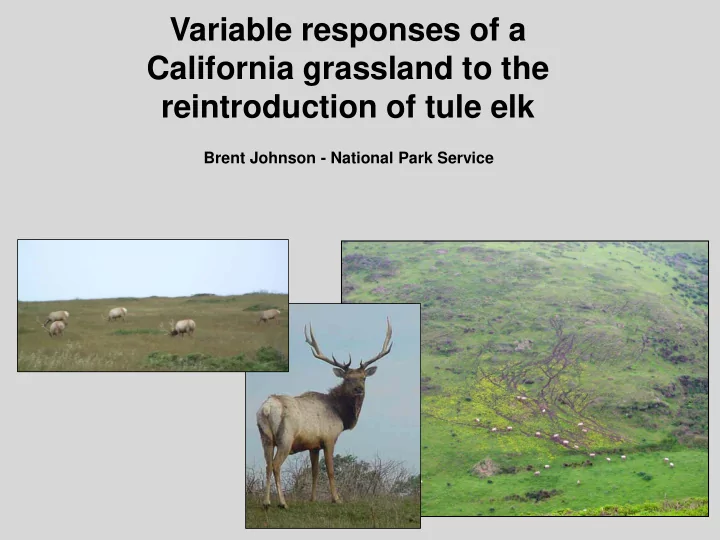
Variable responses of a California grassland to the reintroduction of tule elk Brent Johnson - National Park Service large mammalian herbivores effects of large herbivores consuming & trampling plants changing nutrient cycles

slide-1
SLIDE 1

Variable responses of a California grassland to the reintroduction of tule elk

Brent Johnson - National Park Service

slide-2
SLIDE 2

large mammalian herbivores

slide-3
SLIDE 3
  • consuming & trampling plants
  • changing nutrient cycles

effects of large herbivores

  • alter competition between plants
  • modify successional processes
slide-4
SLIDE 4

human impacts on herbivores

  • altered distribution and abundance
  • 10,000+ years in N. America
  • negative impacts increased with the arrival
  • f Europeans
  • increased hunting and habitat loss
  • conservation efforts
  • species and habitat protection
  • reintroductions are often necessary
  • many herbivore populations are now

increasing

slide-5
SLIDE 5

human impacts

  • bison
  • 1800: 30-60 million
  • 1889: fewer than 1,000
  • protection & reintroduction
  • presently 5,000–6,000 in U.S
  • still increasing
slide-6
SLIDE 6

prevailing focus of reintroduction

  • target species
  • population size
  • genetic diversity
  • health of population
  • less emphasis on recipient community
slide-7
SLIDE 7

reintroduction into altered landscapes

  • fragmented
  • movement patterns changed
  • reduction of predator populations
  • transformed plant communities
  • non-native species
slide-8
SLIDE 8

Tule Elk (Cervus elaphus nannodes)

  • endemic to California
  • subspecies of North

American elk

slide-9
SLIDE 9

tule elk through the years

  • 1769 – 500,000 tule elk in California
  • 1850 – <10 tule elk in California’s Central Valley
  • 1873 – protected species
  • 1905 – reintroduction efforts began
  • 1970 – 500 tule elk throughout CA
  • Present – 2,700 individuals in 22 sites
  • 1978 – 13 tule elk to Tomales Point Elk Reserve
slide-10
SLIDE 10

elk population on Tomales Point

100 200 300 400 500

1978 1981 1984 1987 1990 1993 1996 1999

Year Number of Elk

slide-11
SLIDE 11

Tomales Point Elk Reserve

  • Point Reyes National Seashore, Marin Co.
  • 1030 ha enclosed reserve
slide-12
SLIDE 12

Tule Elk in an altered landscape

  • movements restricted to the point
  • large predators absent
  • transformed by introduced plant species
  • unclear consequences
slide-13
SLIDE 13

research questions

  • Does an invasive grass avoid elk

herbivory by associating with a native shrub species?

  • Do elk play a critical role in maintaining

grasslands by slowing the colonization of shrubs?

  • How does herbivory by reintroduced elk

alter plant communities, and does this vary with habitat type?

slide-14
SLIDE 14

experimental design

  • large scale exclosure experiment
  • established in 1998 by National Park Service
  • 24 plots: 12 fenced and 12 unfenced
  • 36 x 36 m

36 m

slide-15
SLIDE 15

experimental plots on Tomales Point

N

P lo t L ayo u t

% B

a cc h aris

% Lu

p in us

% O

pe n 0.5 0.5 Kilometers

Baccharis

  • pen

Lupinus

slide-16
SLIDE 16

experimental plots on Tomales Point

N

P lo t L ayo u t

% B

a cc h aris

% Lu

p in us

% O

pe n 0.5 0.5 Kilometers

Baccharis

  • pen

Lupinus

Baccharis grassland

slide-17
SLIDE 17

experimental plots on Tomales Point

N

P lo t L ayo u t

% B

a cc h aris

% Lu

p in us

% O

pe n 0.5 0.5 Kilometers

Baccharis

  • pen

Lupinus

Lupinus grassland

slide-18
SLIDE 18

experimental plots on Tomales Point

N

P lo t L ayo u t

% B

a cc h aris

% Lu

p in us

% O

pe n 0.5 0.5 Kilometers

Baccharis

  • pen

Lupinus

  • pen

grassland

slide-19
SLIDE 19

neighborhood effects

  • Does an invasive grass avoid elk

herbivory by associating with a native shrub species?

  • Holcus lanatus (velvet grass)
  • non-native perennial grass
  • invasive in California’s coastal

grasslands

  • Baccharis pilularis
  • native shrub
  • widespread
slide-20
SLIDE 20

neighborhood effects

  • only in Baccharis plots
  • abundance (2003) and

biomass (2002) of Holcus

elk excluded elk present

X X X X X X X X

slide-21
SLIDE 21

10 20 30 40

neighborhood effects: abundance

shrub x elk interaction, p=0.0478

  • pen

shrub

Association Holcus Abundance/m2/Plot

elk present elk excluded

slide-22
SLIDE 22

200 400 600

neighborhood effects: biomass

shrub x elk interaction, p=0.0033

  • pen

shrub

Association Holcus Biomass/Plot (g/m2)

elk present elk excluded

slide-23
SLIDE 23

neighborhood effects

  • native shrubs provide refuge for an exotic

grass by protecting it from elk herbivory

slide-24
SLIDE 24

shrub cover

  • Do elk play a critical role in maintaining

grasslands by slowing the colonization of shrubs?

slide-25
SLIDE 25

20 40 60 80

shrub cover

p=0.083

Shrub Percent Cover/Plot

Baccharis Lupinus Open

Habitat Type

elk present elk excluded

slide-26
SLIDE 26

community composition

  • How does herbivory by reintroduced elk

alter plant communities, and does this vary with habitat type?

slide-27
SLIDE 27

community composition

  • 2002
  • harvested aboveground living and dead

biomass

  • 2003
  • abundance (number of individuals)
  • species richness
slide-28
SLIDE 28

multivariate analysis

  • complexity of community data
  • reduce dimensionality of data set
  • non-metric multidimensional scaling

(NMS or nMDS)

  • multi-response blocked permutation

procedure (MRBP)

slide-29
SLIDE 29

multivariate analysis

Axis 1 Axis 2

elk present elk excluded

stress=12.17

MRBP: A=0.35, p<0.0004 NMS

slide-30
SLIDE 30

community: statistical analysis

  • multifactorial MANOVAs & ANOVAs
  • elk treatment (present or absent)
  • grassland type (Baccharis, Lupinus, open)
  • plot pair, nested within grassland type
  • response variables
slide-31
SLIDE 31

plant functional groups/life forms

  • annual dicots
  • native and exotic
  • annual monocots
  • exotic
  • perennial dicots
  • native and exotic
  • perennial monocots
  • native and exotic
slide-32
SLIDE 32

200 400 600 800 1000 1200 1400 1600 1800 2000

total abundance

elk present elk excluded

Mean Abundance/m2/Plot

Baccharis Lupinus Open

Habitat Type

slide-33
SLIDE 33

Exotic Monocot 250 500 750 1000 1250 1500 Exotic Dicot 20 40 60 80 20 40 60 80 100 Native Dicot

abundance: annuals

elk present elk excluded

Mean Abundance/m2/Plot p=0.002 p=0.071 p=0.048

Baccharis Lupinus Open

Habitat Type

Baccharis Lupinus Open

Habitat Type

slide-34
SLIDE 34

Exotic Monocot 100 200 300 400 25 50 75 100 Native Monocot Exotic Dicot 50 100 150 200 5 10 15 20 25 30 Native Dicot

abundance: perennials

elk present elk excluded Baccharis Lupinus Open

Habitat Type

Baccharis Lupinus Open

Habitat Type Mean Abundance/m2/Plot p=0.77 p=0.83 p=0.46 p=0.34

slide-35
SLIDE 35

10 20 30 40 50 60

total species richness

Baccharis Lupinus Open

Habitat Type

elk present elk excluded

Mean Species Richness/Plot

slide-36
SLIDE 36

species richness: annuals

Exotic Monocot 2 4 6 8 10 Exotic Dicot 3 6 9 12 15 3 6 9 12 15 Native Dicot

Baccharis Lupinus Open

Habitat Type

Baccharis Lupinus Open

Habitat Type

elk present elk excluded

Mean Species Richness/Plot p=0.044 p=0.002 p=0.396

slide-37
SLIDE 37

2 4 6 8 10 12 Native Dicot Exotic Dicot 1 2 3 4 5 6

species richness: perennials

Baccharis Lupinus Open

Habitat Type

Baccharis Lupinus Open

Habitat Type

elk present elk excluded

Exotic Monocot 1 2 3 4 5 2 4 6 8 10 12 Native Monocot Mean Species Richness/Plot p=0.343 p=0.152 p=0.021 p=0.0869

slide-38
SLIDE 38
  • A. Annual

50 100 150 200 250 300

  • B. Perennial

100 200 300 400 500 600

biomass: annuals and perennials

p=0.008 p=0.0256

Baccharis Lupinus Open

Habitat Type Mean Aboveground Dry Biomass/Plot (g/m2)

elk present elk excluded

slide-39
SLIDE 39

100 200 300 400 500 600

biomass: thatch

Mean thatch/Plot (g/m2)

Baccharis Open

Habitat Type

treatment x veg. type p=0.0045

elk present elk excluded

slide-40
SLIDE 40

making sense of responses

  • shrub cover
  • richness [native perennial dicots]
  • thatch biomass
  • living biomass [perennials]
  • biomass [annuals]
  • richness [annuals] & [native per. monocots]
  • abundance [annuals]
  • Holcus lanatus

X

slide-41
SLIDE 41

conclusions

  • they’re back!
  • complex
  • elk have +/- effects on natives and exotics
  • no easy answers
  • potential solutions
  • manage for mosaic of states
slide-42
SLIDE 42

acknowledgements

advisor: Hall Cushman field assistants: Catherine Cumberland, Amy Nadell, Trisha Tierney National Park Staff: Natalie Gates, Michelle Coppoletta & Dave Schirokauer defense committee: Dan Crocker & David Stokes statistical advice and consoling: Karina Nielsen & Nathan Rank the Cushman lab: Michelle Cooper, Jim Coleman, Emiko Stevens, Melina Kazanitas & Jeff Amaral

slide-43
SLIDE 43
slide-44
SLIDE 44

Tomales Point Elk Reserve