Vanilla Meta-interpreter prove ( G ) is true when base-level body G - - PowerPoint PPT Presentation

vanilla meta interpreter
SMART_READER_LITE
LIVE PREVIEW

Vanilla Meta-interpreter prove ( G ) is true when base-level body G - - PowerPoint PPT Presentation

Vanilla Meta-interpreter prove ( G ) is true when base-level body G is a logical consequence of the base-level KB. prove ( true ). prove (( A & B )) prove ( A ) prove ( B ). prove ( H ) ( H B ) prove ( B ).


slide-1
SLIDE 1

Vanilla Meta-interpreter

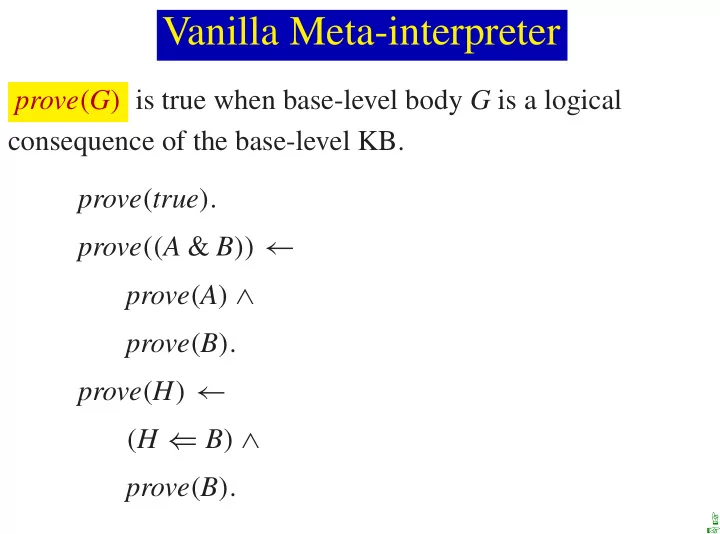
prove(G) is true when base-level body G is a logical consequence of the base-level KB. prove(true). prove((A & B)) ← prove(A) ∧ prove(B). prove(H) ← (H ⇐ B) ∧ prove(B).

☞ ☞
slide-2
SLIDE 2

Example base-level KB

live(W) ⇐ connected_to(W, W1) & live(W1). live(outside) ⇐ true. connected_to(w6, w5) ⇐ ok(cb2). connected_to(w5, outside) ⇐ true.

  • k(cb2) ⇐ true.

?prove(live(w6)).

☞ ☞ ☞

slide-3
SLIDE 3

Expanding the base-level

Adding clauses increases what can be proved.

➤ Disjunction Let a; b be the base-level representation for

the disjunction of a and b. Body a; b is true when a is true, or b is true, or both a and b are true.

➤ Built-in predicates You can add built-in predicates such

as N is E that is true if expression E evaluates to number N.

☞ ☞ ☞

slide-4
SLIDE 4

Expanded meta-interpreter

prove(true). prove((A & B)) ← prove(A) ∧ prove(B). prove((A; B)) ← prove(A). prove((A; B)) ← prove(B). prove((N is E)) ← N is E. prove(H) ← (H ⇐ B) ∧ prove(B).

☞ ☞ ☞

slide-5
SLIDE 5

Depth-Bounded Search

➤ Adding conditions reduces what can be proved.

bprove(G, D) is true if G can be proved with a proof tree %

  • f depth less than or equal to number D.

% bprove(true, D). bprove((A & B), D) ← bprove(A, D) ∧ bprove(B, D). bprove(H, D) ← D ≥ 0 ∧ D1 is D − 1 ∧ (H ⇐ B) ∧ bprove(B, D1).

☞ ☞ ☞

slide-6
SLIDE 6

Delaying Goals

Some goals, rather than being proved, can be collected in a list.

➤ To delay subgoals with variables, in the hope that

subsequent calls will ground the variables.

➤ To delay assumptions, so that you can collect

assumptions that are needed to prove a goal.

➤ To create new rules that leave out intermediate steps. ➤ To reduce a set of goals to primitive predicates.

☞ ☞ ☞

slide-7
SLIDE 7

Delaying Meta-interpreter

dprove(G, D0, D1) is true if D0 is an ending of list of % delayable atoms D1 and KB ∧ (D1 − D0) | = G. % dprove(true, D, D). dprove((A & B), D1, D3) ← dprove(A, D1, D2) ∧ dprove(B, D2, D3). dprove(G, D, [G|D]) ← delay(G). dprove(H, D1, D2) ← (H ⇐ B) ∧ dprove(B, D1, D2).

☞ ☞ ☞

slide-8
SLIDE 8

Example base-level KB

live(W) ⇐ connected_to(W, W1) & live(W1). live(outside) ⇐ true. connected_to(w6, w5) ⇐ ok(cb2). connected_to(w5, outside) ⇐ ok(outside_connection). delay(ok(X)). ?dprove(live(w6), [ ], D).

☞ ☞