V = IR V : electrical potential difference (voltage) in volts (V) I : - - PowerPoint PPT Presentation

v ir
SMART_READER_LITE
LIVE PREVIEW

V = IR V : electrical potential difference (voltage) in volts (V) I : - - PowerPoint PPT Presentation

Voltage, current, and resistance in a circuit are related by Ohms law. Ohms Law The electrical potential difference between two points in a circuit is equal to the current times the resistance between those two points. V = IR V :


slide-1
SLIDE 1

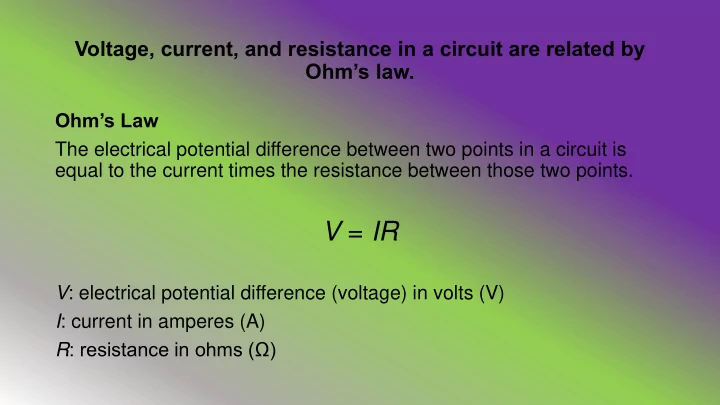
Voltage, current, and resistance in a circuit are related by Ohm’s law.

Ohm’s Law The electrical potential difference between two points in a circuit is equal to the current times the resistance between those two points.

V = IR

V: electrical potential difference (voltage) in volts (V) I: current in amperes (A) R: resistance in ohms (Ω)

slide-2
SLIDE 2

Using Ohm’s Law You can rearrange the variables in Ohm’s law to calculate any of the other variables if you know the value of the other two.

V = IR

  • To find resistance: R = V/I
  • To find current: I = V/R
slide-3
SLIDE 3

Using Ohm’s Law: Sample Problem

The filament of a light bulb has a resistance of 20 Ω. A 5.0 V battery is used in the circuit. What is the current? 1) Rearrange Ohm’s law (V = IR) into the formula to find current (I). V = IR I = V/R 2) Substitute the values for R and V into the formula: I = 5.0 V / 20 Ω I = 0.20 A The current is 0.20 A.

slide-4
SLIDE 4

Discussion Questions

  • 1. List the three symbols used in Ohm’s law. Explain what each

symbol represents and give the units for each of the variables.

slide-5
SLIDE 5

Activity

  • Looking at Current, Voltage and Resistance