Utility-Scale Solar 2016 An Empirical Analysis of Project Cost, - - PowerPoint PPT Presentation

utility scale solar 2016
SMART_READER_LITE
LIVE PREVIEW

Utility-Scale Solar 2016 An Empirical Analysis of Project Cost, - - PowerPoint PPT Presentation

Utility-Scale Solar 2016 An Empirical Analysis of Project Cost, Performance, and Pricing Trends in the United States Mark Bolinger, Joachim Seel, Kristina Hamachi LaCommare Lawrence Berkeley National Laboratory September 2017 This research


slide-1
SLIDE 1

Project Site: http://utilityscalesolar.lbl.gov @BerkeleyLabEMP

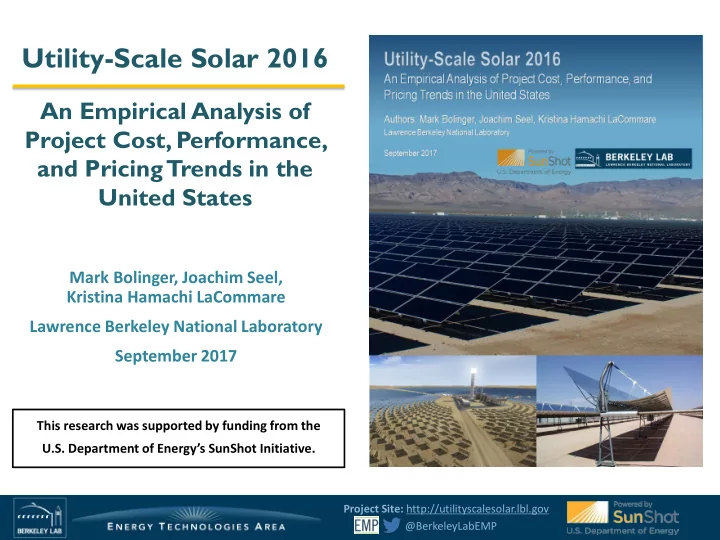
Utility-Scale Solar 2016

An Empirical Analysis of Project Cost, Performance, and Pricing Trends in the United States

Mark Bolinger, Joachim Seel, Kristina Hamachi LaCommare Lawrence Berkeley National Laboratory September 2017

This research was supported by funding from the U.S. Department of Energy’s SunShot Initiative.

slide-2
SLIDE 2

Project Site: http://utilityscalesolar.lbl.gov @BerkeleyLabEMP

Presentation Outline

Strong growth of the utility-scale solar market provides increasing amounts of empirical project-level data that are ripe for analysis

  • 1. Solar deployment trends (and utility-scale’s relative contribution)
  • 7. Future outlook

2

Key findings from analysis of the data samples (first for PV, then for CSP):

2.

Project design, technology, and location

3.

Installed project prices

4.

Operation and maintenance (O&M) costs

5.

Performance (capacity factors)

6.

Power purchase agreement (“PPA”) prices

slide-3
SLIDE 3

Project Site: http://utilityscalesolar.lbl.gov @BerkeleyLabEMP

Utility-scale projects have the greatest capacity share in the U. S. solar market

 The utility-scale sector accounted for 72% of all new solar capacity added in 2016 and

61% of cumulative solar capacity at the end of 2016

3 Sources: GTM/SEIA Solar Market Insight Reports, Berkeley Lab

We define “utility-scale” as any ground-mounted project that is larger than 5 MWAC Smaller systems are analyzed in LBNL’s “Tracking the Sun” series (trackingthesun.lbl.gov)

9 22 70 267 784 1,803 2,855 3,922 4,149 10,636 8,672 6,337 7,084 8,735 10,445 10,612 69 75 250 877 110

25 50 75 100 125 4,000 8,000 12,000 16,000 20,000 2007 2008 2009 2010 2011 2012 2013 2014 2015 2016 2017E 2018E 2019E 2020E 2021E 2022E Cumulative Solar Capacity (GW) Annual Solar Capacity Additions (MW) Utility-Scale CSP Utility-Scale PV Commercial PV Residential PV

Columns show annual capacity additions, area shows cumulative capacity PV is shown in WDC while CSP is in WAC

slide-4
SLIDE 4

Project Site: http://utilityscalesolar.lbl.gov @BerkeleyLabEMP

Solar power was the largest source of U.S. electric- generating capacity additions in 2016

Led by the utility-scale sector, solar power has comprised >25% of all generating capacity additions in the United States in each of the past four years

In 2016, solar made up 38% of all U.S. capacity additions (with utility-scale accounting for 26%), and was the largest source of new capacity, ahead of both natural gas and wind

4

0% 5% 10% 15% 20% 25% 30% 35% 40% 5 10 15 20 25 30 35 40 2007 2008 2009 2010 2011 2012 2013 2014 2015 2016 Solar Capacity Additions (% of Total) Total Annual Capacity Additions (GWAC) Utility-Scale Solar Distributed Solar Wind Other RE Gas Coal Other non-RE

Total Solar (right axis) Distributed Solar (right axis) Utility-Scale Solar (right axis) Sources: ABB, AWEA, GTM/SEIA Solar Market Insight Reports, Berkeley Lab

Note: This graph follows GTM/SEIA’s split between distributed and utility- scale solar, rather than

  • ur 5 MWAC

threshold

slide-5
SLIDE 5

Project Site: http://utilityscalesolar.lbl.gov @BerkeleyLabEMP

Solar penetration rates approaching

  • r exceeding 10% in several states

5

  • Solar penetration rate

varies considerably depending on whether calculated as a percentage of generation or load (e.g., see Vermont)

  • Contribution of utility-

scale also varies (a minority in northeast states and Hawaii, a majority in other states and overall)

slide-6
SLIDE 6

Project Site: http://utilityscalesolar.lbl.gov @BerkeleyLabEMP

Utility-Scale PV

6 Photo Credit: Community Solar Amazon Solar Farm US East 1

slide-7
SLIDE 7

Project Site: http://utilityscalesolar.lbl.gov @BerkeleyLabEMP

Historically heavy concentration in the Southwest and mid- Atlantic, but now spreading to Southeast and Northwest

7

Primarily fixed-tilt c-Si projects in the East Tracking (c-Si and, increasingly, thin- film) is more common in the Southwest

State Cumulative Capacity MW-AC % 2016 2015 CA 54% 56% AZ 9% 12% NV 8% 7% GA 6% 3% NC 5% 6%

2015

slide-8
SLIDE 8

Project Site: http://utilityscalesolar.lbl.gov @BerkeleyLabEMP

Historically heavy concentration in the Southwest and mid- Atlantic, but now spreading to Southeast and Northwest

8

Primarily fixed-tilt c-Si projects in the East Tracking (c-Si and, increasingly, thin- film) is more common in the Southwest

State Cumulative Capacity MW-AC % 2016 2015 CA 54% 56% AZ 9% 12% NV 8% 7% GA 6% 3% NC 5% 6%

2016

slide-9
SLIDE 9

Project Site: http://utilityscalesolar.lbl.gov @BerkeleyLabEMP

Utility-scale PV continues to expand beyond California and the Southwest

 Strong percentage growth outside the established markets:

 7 new states added their first utility-scale solar project: OR, ID, MN, VA, AL, KY, SC  Georgia added 726 MWAC – the second-largest amount of new solar capacity among all states in 2016  Texas doubled its annual new capacity with 263 MWAC  Florida started growth spree with 229 MWAC – with substantially more planned for coming years

9

69% 76% 47% 40% 55% 20% 16% 24% 29% 22% 21% 8% 4% 7% 9%

2 4 6 8 10 12 14 16 1 2 3 4 5 6 7 8 <=2010 2011 2012 2013 2014 2015 2016 Annual PV Capacity Additions (GWAC) Installation Year All Other States Southeast Southwest California Cumulative PV Capacity (GWAC) Columns show annual capacity additions (left scale) Areas show cumulative capacity (right scale)

PV project population: 427 projects totaling 16,439 MWAC

slide-10
SLIDE 10

Project Site: http://utilityscalesolar.lbl.gov @BerkeleyLabEMP

The eastward expansion is reflected in the buildout

  • f lower-insolation sites

2016 was the 3rd year of declining median solar resource (measured in long-term global horizontal irradiance (GHI)) as the market expands to less-sunny states

Fixed-tilt PV is increasingly relegated to lower-insolation sites (note the decline in its 80th percentile), while tracking PV is increasingly pushing into those same areas (note the decline in its 20th percentile)

All else equal, the buildout of lower-GHI sites will dampen sample-wide capacity factors (reported later)

10 3.5 4.0 4.5 5.0 5.5 6.0 2010 n=10 175 MW 2011 n=34 478 MW 2012 n=43 946 MW 2013 n=38 1,344 MW 2014 n=64 3,166 MW 2015 n=87 2,870 MW 2016 n=146 7,385 MW

Annual GHI (kWh/m2/day) Installation Year All PV Fixed-Tilt PV Tracking PV Median values shown, with error bars indicating 20th and 80th percentiles

slide-11
SLIDE 11

Project Site: http://utilityscalesolar.lbl.gov @BerkeleyLabEMP

PV project population broken out by tracking vs. fixed-tilt, module type, and installation year

2016 Trends:

 Increasing dominance of tracking projects (79% of newly installed capacity) relative to fixed-tilt projects (21%)  Continued strong growth in c-Si capacity (77%) relative to thin-film capacity (23%). Largest c-Si manufacturers are

Trina (22%), and Jinko (14%), Canadian Solar (14%) and SunPower (8%), while the thin-film market is dominated by First Solar (97% of the installed capacity).

11

PV project population: 427 projects totaling 16,439 MWAC

2 4 6 8 10 12 14 16 2007-2009 2010 2011 2012 2013 2014 2015 2016 1 2 3 4 5 6 7 8 Cumulative Capacity (GWAC) Installation Year Annual Capacity Additions (GWAC) Tracking Thin-Film Tracking c-Si Fixed-Tilt Thin-Film Fixed-Tilt c-Si Columns show annual capacity additions (left scale) Areas show cumulative capacity (right scale) 0.62 0.92 4.74 1.11 3.45 2.02 2.42 8.48

slide-12
SLIDE 12

Project Site: http://utilityscalesolar.lbl.gov @BerkeleyLabEMP

The median inverter loading ratio (ILR) has risen

  • ver time, though not much since 2013

12 

As module prices have fallen (faster than inverter prices), developers have oversized the DC array capacity relative to the AC inverter capacity (i.e., the ILR) to enhance revenue

The ILR (DC:AC ratio) seems to have stabilized around 1.3 on average, though considerable variation remains

Fixed-tilt PV has more to gain from a higher ILR than does tracking PV; the highest ILR projects tend to be fixed-tilt

All else equal, a higher ILR should boost capacity factors (reported later)

1.00 1.05 1.10 1.15 1.20 1.25 1.30 1.35 1.40 1.45 2010 n=10 175 MW 2011 n=34 478 MW 2012 n=43 946 MW 2013 n=38 1,344 MW 2014 n=64 3,166 MW 2015 n=87 2,870 MW 2016 n=144 7,325 MW

Inverter Loading Ratio (ILR) Installation Year All PV Fixed-Tilt PV Tracking PV Median values shown, with error bars indicating 20th and 80th percentiles

slide-13
SLIDE 13

Project Site: http://utilityscalesolar.lbl.gov @BerkeleyLabEMP

Median installed price of PV has fallen steadily, by over 65%, to around $2.2/WAC ($1.7/WDC) in 2016

13

Installed prices are shown here in both DC and AC terms, but because AC is more relevant to the utility sector, all metrics used in the rest of this slide deck are expressed solely in AC terms

The lowest 20th percentile fell from $2.2/WAC ($1.6/WDC) in 2015 to $2.0/WAC ($1.5/WDC) in 2016

Minimum price among our 88 projects in 2016 was $1.5/WAC ($1.1/WDC)

This sample is backward-looking and may not reflect the price of projects built in 2017/2018

1 2 3 4 5 6 7 8 9 10 2007-2009 n=5 75 MW 2010 n=10 175 MW 2011 n=29 428 MW 2012 n=40 915 MW 2013 n=38 1,344 MW 2014 n=64 3,166 MW 2015 n=87 2,870 MW 2016 n=88 5,497 MW Installed Price (2016 $/W) Installation Year Median (DC) Individual Projects (DC) Median (AC) Individual Projects (AC)

1.0 1.5 2.0 2.5 3.0 3.5 4.0 2016

Installed Price (2016 $/W)

slide-14
SLIDE 14

Project Site: http://utilityscalesolar.lbl.gov @BerkeleyLabEMP

Pricing distributions have continuously moved towards lower prices over the last 5 years

14

Both medians and modes have continued to fall (moving towards the left) each year

Share of relatively high-cost systems decreases steadily each year while share of low-cost systems increases

Price spread is the smallest in 2016, pointing to a reduction in underlying heterogeneity of prices across all installed projects

0% 10% 20% 30% 40% 50% 60%

≥ $1.25 < $1.75 ≥ $1.75 < $2.25 ≥ $2.25 < $2.75 ≥ $2.75 < $3.25 ≥ $3.25 < $3.75 ≥ $3.75 < $4.25 ≥ $4.25 < $4.75 ≥ $4.75 < $5.25 ≥ $5.25 < $5.75 ≥ $5.75 < $6.25

Installed Price Interval (2016 $/WAC)

2016 n=88 5,497 MW 2015 n=87 2,870 MW 2014 n=64 3,166 MW 2013 n=38 1,344 MW 2012 n=40 915 MW

Project Share of Annual Price Sample

slide-15
SLIDE 15

Project Site: http://utilityscalesolar.lbl.gov @BerkeleyLabEMP

Tracking projects were $0.15/WAC more costly (at the median) than fixed-tilt projects in 2016

Tracking’s empirical cost premium has varied somewhat over time, but in general has declined considerably since 2010

Upfront cost premium usually compensated by higher annual generation

15

1 2 3 4 5 6 7 8 9 2007-2009 n=5 75 MW 2010 n=10 175 MW 2011 n=29 428 MW 2012 n=40 915 MW 2013 n=38 1,344 MW 2014 n=64 3,166 MW 2015 n=87 2,870 MW 2016 n=88 5,483 MW

Installed Price (2016 $/WAC) Installation Year All PV Fixed-Tilt PV Tracking PV Median values shown, with error bars indicating 20th and 80th percentiles

slide-16
SLIDE 16

Project Site: http://utilityscalesolar.lbl.gov @BerkeleyLabEMP

2016 project sample hints at possible economies of scale (at least up to 100 MW)

Modest economies of scale evident in the sample, from $2.3/WAC for projects smaller than 20MWAC to $2.1/WAC for projects between 50 and 100MWAC

But higher costs for the 100+ MW projects, several of which have been under construction for several years, possibly reflecting a higher-cost past. In addition, larger projects may face greater development, regulatory, and interconnection costs that could outweigh any economies of scale.

16 0.0 0.5 1.0 1.5 2.0 2.5 3.0 3.5 4.0 5-20 MW n=35 505 MW 20-50 MW n=13 455 MW 50-100 MW n=25 1,952 MW >100 MW n=15 2,585 MW

Installed Price (2016 $/WAC) Project Size Range (MWAC) All PV Fixed-Tilt PV Tracking PV Median values shown, with error bars indicating 20th and 80th percentiles. Figure only includes 2016-vintage projects.

slide-17
SLIDE 17

Project Site: http://utilityscalesolar.lbl.gov @BerkeleyLabEMP

Project prices vary by region

 Price differences driven in part by technology ubiquity (e.g., higher-priced

tracking projects are more prevalent in the Southwest and California)

 Other factors may include labor costs and share of union labor, land costs, soil

conditions or snow load, and balance of supply and demand

17

Southwest: NV, UT, CO, AZ, NM Southeast: AR, AL, FL, GA, KY, MD, NC, SC, VA Northeast: NJ, NY Midwest: IN, MN Northwest: ID, OR Not included: HI, TX

3.0 2.4 2.4 3.1 3.7 #N/A 2.4 2.1 2.1 #N/A 1.9 2.5 1 2 3 4 California n=67 3,544 MW-AC Southwest n=33 2,303 MW-AC Southeast n=52 1,816 MW-AC Northeast n=6 57 MW-AC Midwest n=8 143 MW-AC Northwest n=3 98 MW-AC Installed Price (2016 $/WAC) Select Regions of the United States 2015 2016 U.S. national median 2016 Bars show median values, with 20th and 80th percentiles.

slide-18
SLIDE 18

Project Site: http://utilityscalesolar.lbl.gov @BerkeleyLabEMP

Bottom-up models roughly consistent with LBNL’s top-down findings

LBNL’s top-down empirical prices are fairly close to modelled bottom-up prices

GTM project represents only turn-key EPC costs and excludes permitting, interconnection, transmission, developer overhead, fees, and profit margins

Difficult to ensure consistency of scope in cost categories and time horizon (under construction vs. operation date)

18

Prices are presented here in $/WDC for consistency with how they are presented by NREL, BNEF, and GTM

0.64 0.64 0.64 0.48 0.53 0.64 0.64 0.64 0.48 0.53 0.10 0.10 0.10 0.07 0.11 0.09 0.09 0.09 0.07 0.11 0.20 0.27 0.27 0.20 0.15 0.26 0.32 0.32 0.25 0.25 0.32 0.38 0.55 0.29 0.36 0.34 0.41 0.60 0.32 0.40 0.16 0.27 0.29 0.18 0.16 0.28 0.31 0.18

1.42 1.66 1.85 1.23 1.14 1.49 1.75 1.96 1.30 1.28

LBNL Fixed-Tilt: 1.55 LBNL Tracking: 1.73

$0.0 $0.5 $1.0 $1.5 $2.0 NREL 2016 100 MW-DC National Average Non-Union Labor NREL 2016 25 MW-DC National Average Non-Union Labor NREL 2016 25 MW-DC National Average Union Labor BNEF 2016 National Average c-Si GTM 2016 10 MW-DC National Average EPC Only NREL 2016 100 MW-DC National Average Non-Union Labor NREL 2016 25 MW-DC National Average Non-Union Labor NREL 2016 25 MW-DC National Average Union Labor BNEF 2016 National Average c-Si GTM 2016 10 MW-DC National Average EPC Only Fixed-Tilt Tracking

Project Cost or Price (2016 $/WDC)

Other (Developer Overhead + Margin, Contingencies, Sales Tax) Design, EPC, Labor, Permitting, Interconnection, Transmission, Land Tracker / Racking, BOS Inverter Module

slide-19
SLIDE 19

Project Site: http://utilityscalesolar.lbl.gov @BerkeleyLabEMP

O&M cost data still very thin

Only a few utilities report solar O&M costs, slow emergence of project-specific O&M costs

O&M costs appear to be declining over time, to $17.8/kW- year and $8.2/MWh in 2016 (slight increase from 2015)

Cost declines may reflect economies of scale

Cost range among utilities continues to be large

19

Year PG&E PNM Nevada Power Georgia Power APS PSEG FP&L MWAC project # MWAC project # MWAC project # MWAC project # MWAC project # MWAC project # MWAC project # 2011 #N/A #N/A #N/A #N/A #N/A #N/A #N/A #N/A 51 3 #N/A #N/A 110 3 2012 50 3 8 2 #N/A #N/A #N/A #N/A 96 4 #N/A #N/A 110 3 2013 100 6 30 4 #N/A #N/A #N/A #N/A 136 6 #N/A #N/A 110 3 2014 #N/A #N/A 55 7 #N/A #N/A #N/A #N/A 168 7 #N/A #N/A 110 3 2015 150 9 95 11 #N/A #N/A #N/A #N/A 191 9 #N/A #N/A 110 3 2016 150 9 95 11 16 1 36 2 237 10 44 3 110 3 predominant technology Fixed-Tilt c-Si 4 Fixed-Tilt, 7 Tracking Tracking c-Si Fixed-Tilt c-Si Tracking c-Si Fixed-Tilt c-Si mix of c-Si and CSP

slide-20
SLIDE 20

Project Site: http://utilityscalesolar.lbl.gov @BerkeleyLabEMP

25.8% average sample-wide PV net capacity factor, but with large project-level range (from 15.4%-35.5%)

Project-level variation in PV capacity factor driven by:

Solar Resource (GHI): Highest resource quartile has ~8 percentage point higher capacity factor than lowest

Tracking: Adds ~4 percentage points to capacity factor on average across all four resource quartiles

Inverter Loading Ratio (ILR): Highest ILR quartiles have ~4 percentage point higher capacity factor than lowest

20 0% 5% 10% 15% 20% 25% 30% 35% 40% 1 ILR 2 ILR 3 ILR 4 ILR 1 2 3 4 1 2 3 4 1 2 3 4 1 2 3 4 1 2 3 4 1 2 3 4 1 2 3 4 Fixed-Tilt Tracking Fixed-Tilt Tracking Fixed-Tilt Tracking Fixed-Tilt Tracking 1st Quartile Solar Resource 2nd Quartile Solar Resource 3rd Quartile Solar Resource 4th Quartile Solar Resource

Cumulative Net AC Capacity Factor Simple Mean Individual Project

14 projects, 165 MW 8 projects, 120 MW 15 projects, 202 MW 3 projects, 37 MW 4 projects, 54 MW 7 projects, 114 MW 10 projects, 170 MW 4 projects, 89 MW 11 projects, 237 MW 8 projects, 311 MW 13 projects, 332 MW 1 project, 23 MW 4 projects, 605 MW 8 projects, 106 MW 16 projects, 945 MW 12 projects, 580 MW 6 projects, 61 MW 13 projects, 146 MW 3 projects, 53 MW 9 projects, 325 MW 2 projects, 274 MW 10 projects, 323 MW 15 projects, 464 MW 14 projects, 183 MW 6 projects, 736 MW 10 projects, 1,173 MW 4 projects, 79 MW 14 projects, 350 MW 4 projects, 158 MW 4 projects, 132 MW

Sample includes 260 projects totaling 8,733 MWAC that came online from 2007-2015

ILR Quartile ILR Quartile ILR Quartile ILR Quartile ILR Quartile ILR Quartile ILR Quartile ILR Quartile

7 projects, 176 MW 1 project, 10 MW
slide-21
SLIDE 21

Project Site: http://utilityscalesolar.lbl.gov @BerkeleyLabEMP

For those who prefer to think geographically rather than in terms of insolation quartiles…

 Not surprisingly, capacity factors are highest in California and the Southwest, and lowest in the

Northeast and Midwest

 Although sample size is small in some regions, the greater benefit of tracking in the high-insolation

regions is evident, as are the greater number of tracking projects in those regions

21

Regions are defined in the map on slide 8

18.0% 19.0% 20.7% 21.0% 21.6% 25.9% 25.2% 18.8% 20.5% 23.7% 24.0% 29.3% 30.2% 0% 5% 10% 15% 20% 25% 30% 35% Northeast Midwest Southeast Hawaii Texas Southwest California Average Cumulative Net AC Capacity Factor

Fixed-Tilt Tracking

21 projects, 219 MW 1 project, 6 MW 10 projects, 96 MW 3 projects, 26 MW 27 projects, 474 MW 15 projects, 375 MW 3 projects, 30 MW 15 projects, 1,069 MW 2 projects, 44 MW 10 projects, 262 MW 33 projects, 2,236 MW 70 projects, 2,760 MW 50 projects, 1,136 MW

No tracking projects in HI yet

slide-22
SLIDE 22

Project Site: http://utilityscalesolar.lbl.gov @BerkeleyLabEMP

More recent PV project vintages have higher capacity factors on average

 Average capacity factors driven higher from 2010- to 2013-vintage projects by an increase in ILR

(from 1.17 to 1.28), tracking (from 14% to 54%) and average site-level GHI (from 4.97 to 5.29).

 But since 2013, average long-term site-level GHI has decreased while tracking has increased (with ILR

roughly unchanged), leading to stagnation in capacity factors among 2014 and 2015 projects.

22

21.5% 23.6% 24.6% 26.7% 26.4% 26.5% 22.0% 24.1% 24.8% 26.9% 26.2% 26.5% 0% 5% 10% 15% 20% 25% 30% 2010 Vintage 2011 Vintage 2012 Vintage 2013 Vintage 2014 Vintage 2015 Vintage 7 Projects 30 Projects 37 Projects 48 Projects 53 Projects 78 Projects 144 MW-AC 440 MW-AC 892 MW-AC 1,720 MW-AC 2,785 MW-AC 2,660 MW-AC 2016 Cumulative

Mean Net AC Capacity Factor ILR = 1.17 14% Tracking GHI = 4.97 ILR = 1.23 49% Tracking GHI = 5.13 ILR = 1.18 50% Tracking GHI = 5.17 ILR = 1.28 54% Tracking GHI = 5.29 ILR = 1.29 60% Tracking GHI = 5.19 ILR = 1.30 67% Tracking GHI = 5.11

slide-23
SLIDE 23

Project Site: http://utilityscalesolar.lbl.gov @BerkeleyLabEMP

Performance degradation is evident, but difficult to assess and attribute at the project-level

 Fleetwide degradation appears to exceed the 0.5%/year benchmark commonly assumed in PPAs and

pro forma models

 Contributing factors (other than actual degradation) could include inter-year resource variability (e.g.,

several bad solar years in a row), curtailment (which has become an issue in California – the largest market), and an inconsistent sample (which drops off quickly) in each successive year

23

Graph shows indexed capacity factors in each full calendar year following COD. No attempt has been made to correct for inter- year resource variation or other factors.

80% 85% 90% 95% 100% 105% 1 2 3 4 5 6 7 8 9 260 182 129 81 43 13 6 3 1 8,733 6,073 3,288 1,567 667 227 83 29 7 Median (with 20th/80th percentile error bars) Capacity-Weighted Average Simple Average Representative 0.5%/year degradation rate

Years post-COD: Sample projects: Sample MWAC:

Indexed Capacity Factor (Year 1=100%) Sample includes projects with COD from 2007-2015

slide-24
SLIDE 24

Project Site: http://utilityscalesolar.lbl.gov @BerkeleyLabEMP

Combination of falling installed prices and better project performance enables lower PPA prices

 PPA prices are levelized over the full

term of each contract, after accounting for any escalation rates and/or time-

  • f-delivery factors, and are shown in

real 2016 dollars

 Top graph shows the full sample;

bottom graph shows a sub-sample of PPAs signed post-2014

 CA and the Southwest dominate the

sample, but in recent years the market has expanded to other regions

 Hawaii projects (included here for the

first time) show a consistent and significant premium over the mainland

 Three PPAs featuring PV plus long-

duration battery storage do not seem to be priced at a prohibitive premium to their PV-only counterparts

 Smaller projects (e.g., 20-50 MW) are

seemingly no less competitive

 >90% of the sample is currently

  • perational

24

$0 $50 $100 $150 $200 $250 Jan-06 Jan-07 Jan-08 Jan-09 Jan-10 Jan-11 Jan-12 Jan-13 Jan-14 Jan-15 Jan-16 Jan-17

PPA Execution Date

California Southwest Texas Southeast Midwest Hawaii

Levelized PPA Price (Real 2016 $/MWh)

550 MW 210 MW 50 MW

Sample includes 189 contracts totaling 11.7 GWAC

12 MW

$0 $20 $40 $60 $80 $100 $120 $140 Jan-15 Feb-15 Mar-15 Apr-15 May-15 Jun-15 Jul-15 Aug-15 Sep-15 Oct-15 Nov-15 Dec-15 Jan-16 Feb-16 Mar-16 Apr-16 May-16 Jun-16 Jul-16 Aug-16 Sep-16 Oct-16 Nov-16 Dec-16 Jan-17 Feb-17 Mar-17 Apr-17 May-17 Jun-17 Jul-17 Aug-17 Sep-17

PPA Execution Date California Southwest Texas Southeast Midwest Hawaii Levelized PPA Price (Real 2016 $/MWh)

100 MW

Sample includes 52 PPAs totaling 3,276 MWAC that were signed since the start of 2015

12 MW includes battery storage 50 MW

slide-25
SLIDE 25

Project Site: http://utilityscalesolar.lbl.gov @BerkeleyLabEMP

On average, levelized PPA prices fell by >75% from 2009 through 2016

 Top figure presents the same data as

previous slide, but in a different way: each circle is an individual contract, and the blue columns show the average levelized PPA price each year

 Steady downward trend in the average

PPA price over time has slowed in recent years as average prices approached and then fell below $50/MWh

 Price decline over time is more erratic

when viewed by COD (orange bars in bottom graph) rather than by PPA execution date (blue bars)

 Though the average levelized price of

PPAs signed in 2016 is ~$35/MWh, the average levelized PPA price among projects that came online in 2016 is significantly higher, at ~$60/MWh

 2017 is provisional and currently reflects

a very small sample and a high proportion of high-priced Hawaiian PPAs, plus several PPAs with long-duration battery storage

25

50 100 150 200 250 2006 1 7 2007 1 5 2008 3 770 2009 16 1,030 2010 30 1,746 2011 20 1,790 2012 17 1,073 2013 19 478 2014 30 1,503 2015 39 2,383 2016 6 556 2017 7 337

Generation-Weighted Average Individual PPA (Hawaii PPAs shaded orange)

PPA Year: Contracts: MW: Levelized PPA Price (Real 2016 $/MWh) $0 $50 $100 $150 $200 $250 2006 2007 2008 2009 2010 2011 2012 2013 2014 2015 2016 2017 Generation-weighted average based on the year in which commercial operation was fully achieved Generation-weighted average based on the year in which the PPA was executed Levelized PPA Price (Real 2016 $/MWh) 2017 is provisional

slide-26
SLIDE 26

Project Site: http://utilityscalesolar.lbl.gov @BerkeleyLabEMP

The value of solar has declined in America’s largest solar market

 With increasing solar penetration

in California, solar curtailment has increased and solar’s wholesale energy value has declined

 In 2012, when solar penetration

was ~2%, solar earned 126% of the average wholesale power price

 In 2016, with solar penetration at

~12%, solar earned just 83% of the average wholesale power price

 Based on data for the first half of

the year, this value decline is likely to continue in 2017 (1Q17 was particularly bad – bottom graph)

 Most other markets are not yet

facing this value decline, due to lower levels of solar penetration

26

0% 15% 30% 45% 60% 75% 90% 105% 120% 135% 0% 2% 4% 6% 8% 10% 12% 14% 16% 18%

2012 2013 2014 2015 2016 1H2017 Solar Penetration Rate (left axis) Solar Curtailment Rate (left axis) Solar Value Factor (right axis) Energy Value of Solar Relative to a 24x7 Flat Block CAISO Solar Penetration and Curtailment Rates CAISO curtailment data not available prior to 2015

0% 10% 20% 30% 40% 50% 60% 70% 80% 90% 100% 0% 2% 4% 6% 8% 10% 12% 14% 16% 18% 20% 2015 2016 2017 2015 2016 2017 2015 2016 2017 2015 2016 2017 1Q 2Q 3Q 4Q Solar Penetration Rate (left scale) Solar Curtailment Rate (left scale) Solar Value Factor (right scale)

Solar Curtailment and Penetration Rates Energy Value of Solar Relative to 24x7 Flat Block

slide-27
SLIDE 27

Project Site: http://utilityscalesolar.lbl.gov @BerkeleyLabEMP

Levelized PPA prices track the LCOE of utility-scale PV reasonably well

 Using empirical data from elsewhere in the report, along with a number of assumptions (e.g., about financing), we

calculated project-level LCOEs for the entire sample of projects for which we have CapEx data (14.3 GWAC)

 Central estimates of LCOE track median PPA prices (levelized over 30 years in this case, and shown by COD rather

than by execution date) reasonably well, suggesting a fairly competitive PPA market

 PPAs are lower than LCOEs because they reflect receipt of the 30% ITC and perhaps also state-level incentives 27

NOTE: LCOE calculations do NOT include the 30% ITC (whereas PPA prices do reflect the ITC, and perhaps also state-level incentives)

50 100 150 200 250 300 350 2010 10 175 2011 28 423 2012 38 863 2013 38 1,344 2014 63 3,160 2015 86 2,883 2016 83 5,407 2017 TBD TBD 2016 $/MWh Capacity-Weighted Average LCOE Median LCOE Simple Average LCOE Individual Project LCOE Median Levelized PPA Price (by COD) COD: Projects: MW-AC:

slide-28
SLIDE 28

Project Site: http://utilityscalesolar.lbl.gov @BerkeleyLabEMP

PV PPA prices generally decline over time in real dollar terms, in contrast to fuel cost projections

 Two-thirds of PV sample has flat

annual PPA pricing (in nominal dollars), while the rest escalate at low rates

 Thus, average PPA prices tend to

decline over time in real dollar terms (top graph)

 Bottom graph compares recent

PPA prices to range of gas price projections from AEO 2017, showing that…

 …although PV is currently priced

higher than the cost of burning fuel in a combined-cycle unit, over longer terms PV is perhaps likely to be more competitive, and can help protect against fuel price risk

28

$0 $50 $100 $150 $200 $250 2006 2008 2010 2012 2014 2016 2018 2020 2022 2024 2026 2028 2030 2032 2034 2036 2038 2040 2042 2044 2046 2048 2050 Gen-Weighted Average PPA Price (2016 $/MWh)

2006 (7 MW, 1 PPA) 2008 (770 MW, 3 PPAs) 2010 (1,746 MW, 30 PPAs) 2014 (1,503 MW, 30 PPAs) 2007 (5 MW, 1 PPA) 2015 (2,383 MW, 39 PPAs) 2016 (566 MW, 6 PPAs)

10 20 30 40 50 60 70 80 2017 2018 2019 2020 2021 2022 2023 2024 2025 2026 2027 2028 2029 2030 2031 2032 2033 2034 2035 2036 2037 2038 2039 2040 2041 2042 2043 2044 2045 2046 2047 2048 2049 2050 2016 $/MWh Overall range of AEO 2017 gas price projections (converted to $/MWh terms) AEO 2017 reference case gas price projection (converted to $/MWh terms) Generation-weighted average PV PPA price over time Median PV PPA price (and 20th/80th percentile bars) over time PV PPA sample includes 29 PPAs signed 7/2015-8/2017 and totaling 2,184 MWAC (PPA sample excludes Hawaiian projects)

slide-29
SLIDE 29

Project Site: http://utilityscalesolar.lbl.gov @BerkeleyLabEMP

Utility-Scale Concentrating Solar Thermal Power (CSP)

29 Photo Credit: Solar Reserve: Crescent Dunes

slide-30
SLIDE 30

Project Site: http://utilityscalesolar.lbl.gov @BerkeleyLabEMP

Sample description of CSP projects

 After nearly 400 MWAC built in

the late-1980s (and early- 1990s), no new CSP was built in the U.S. until 2007 (68 MWAC), 2010 (75 MWAC), and 2013-2015 (1,237 MWAC)

 Prior to the large 2013-15

build-out, all utility-scale CSP projects in the U.S. used parabolic trough collectors

 The five 2013-2015 projects

include 3 parabolic troughs (one with 6 hours of storage) totaling 750 MWAC (net) and two “power tower” projects (one with 10 hours of storage) totaling 487 MWAC (net)

30

CSP project population: 16 projects totaling 1,781 MWAC

slide-31
SLIDE 31

Project Site: http://utilityscalesolar.lbl.gov @BerkeleyLabEMP

Not much movement in the installed price of CSP

 Small sample of 7 projects (5 built in 2013-15) using different technologies makes it hard to identify trends  That said, there does not appear to be much of a trend (in contrast to PV’s steady downward trend)  To be fair, newest projects are much larger, and include thermal storage and/or new technology (power

tower) in some cases, making comparisons difficult

31

1 2 3 4 5 6 7 8 9 10 11 2006 2007 2008 2009 2010 2011 2012 2013 2014 2015 2016 Installed Price (2016 $/WAC) Installation Year CSP Trough CSP Tower Median PV (for reference) 68 MWAC 250 MWAC with 6 hours of storage 75 MWAC 250 MWAC each 377 MWAC 110 MWAC with 10 hours of storage

slide-32
SLIDE 32

Project Site: http://utilityscalesolar.lbl.gov @BerkeleyLabEMP

Several newer CSP projects continued to underperform relative to long-term expectations

32

The two “power tower” projects (Ivanpah and Crescent Dunes) were hit with closures in 2016 that negatively impacted capacity factors. The Crescent Dunes closure lasted into 2017.

Solana was at reduced capacity for part of 2016 due to micro-burst storm damage, and for part of 2017 due to a transformer fire.

Genesis and Mojave were both largely on target in 2016

Most newer CSP projects generally performing better than older CSP projects, but not necessarily any better than (and in some cases worse than) local PV projects

0% 5% 10% 15% 20% 25% 30% 35% 2008 2009 2010 2011 2012 2013 2014 2015 2016 SEGS I & II SEGS III-IX Genesis Solana Ivanpah Mojave Nevada Solar One (dashed) For reference: average PV in CA, NV, AZ (red diamonds) Crescent Dunes Net Capacity Factor (solar portion only)

slide-33
SLIDE 33

Project Site: http://utilityscalesolar.lbl.gov @BerkeleyLabEMP

Though once competitive, CSP PPA prices have failed to keep pace with PV’s price decline

 When PPAs for the most recent batch of CSP projects (with CODs of 2013-15) were

signed back in 2009-2011, they were still mostly competitive with PV

 But CSP has not been able to keep pace with PV’s price decline  Partly as a result, no new PPAs for CSP projects have been signed in the U.S. since 2011

– though the technology continues to advance overseas

33 $0 $50 $100 $150 $200 $250 Jan-07 Jan-08 Jan-09 Jan-10 Jan-11 Jan-12 Jan-13 Jan-14 Jan-15 Jan-16 Jan-17

PPA Execution Date

PV in CA, NV, AZ (for comparison) CSP trough w/o storage CSP trough w/ storage CSP tower w/o storage CSP tower w/ storage

Levelized PPA Price (Real 2016 $/MWh)

250 MW

slide-34
SLIDE 34

Project Site: http://utilityscalesolar.lbl.gov @BerkeleyLabEMP 5 10 15 20 25 30 35 40 California Southeast Southwest Northeast Texas Central Northwest 2013 2014 2015 2016

Solar in Queues at Year-End (GW)

20 40 60 80 100 120 140 Wind Solar Gas Other Storage Nuclear Coal

Entered queues in that year

2016

GW in Queues at Year-End

Entered queues in prior years

Looking ahead: long-term ITC extension should support continued growth in the utility-scale solar pipeline

121.4 GW of solar was in the queues at the end of 2016—up from 56.8 GW at end of 2015, and more than six times the amount of installed capacity at the end of 2016

83.3 GW of the 121.4 GW total first entered the queues in 2016

Very strong solar growth in all regions, with the possible exception of the Northwest

The Southeast moved ahead of the Southwest for the number two position behind California

34

Graphs show solar and other capacity in 35 interconnection queues across the US:

  • Inset compares solar to
  • ther resources (2016 only)
  • Main graph shows location
  • f solar (2013-2016)
  • Not all of these projects will

ultimately be built!

slide-35
SLIDE 35

Project Site: http://utilityscalesolar.lbl.gov @BerkeleyLabEMP

Questions?

Download the full report, a data file, and this slide deck at:

http://utilityscalesolar.lbl.gov

Download all of our other solar and wind work at:

http://emp.lbl.gov/reports/re Follow the Electricity markets & Policy Group on Twitter:

@BerkeleyLabEMP

35

Contact:

Mark Bolinger: MABolinger@lbl.gov Joachim Seel: JSeel@lbl.gov

This research was supported by funding from the U.S. Department of Energy’s SunShot Initiative.