UTA Service Choices Difgerent Goals Result in Difgerent Service - - PDF document

uta service choices
SMART_READER_LITE
LIVE PREVIEW

UTA Service Choices Difgerent Goals Result in Difgerent Service - - PDF document

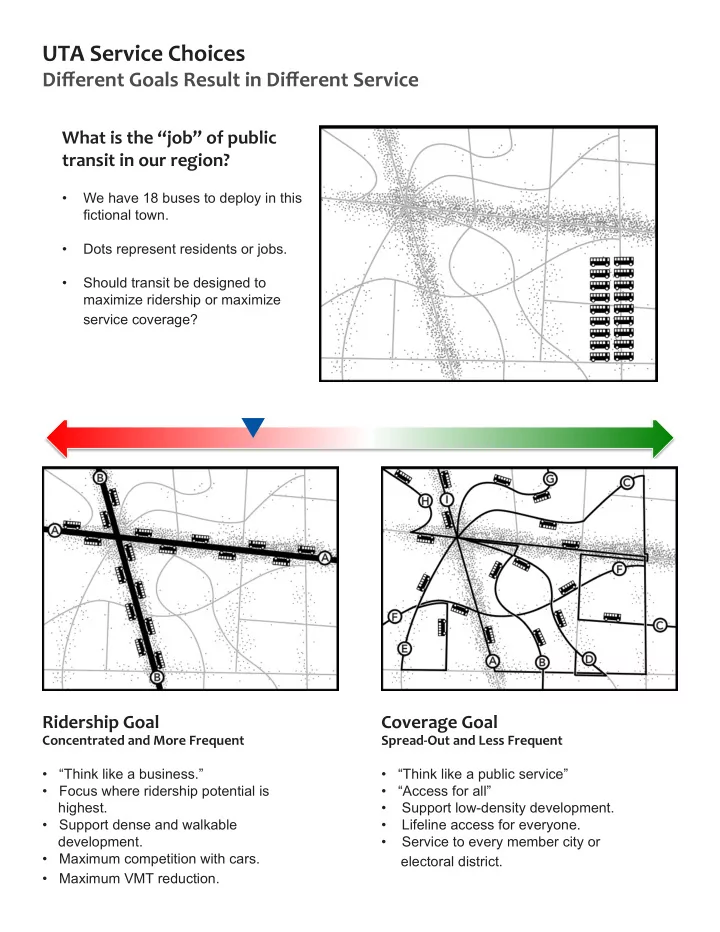
UTA Service Choices Difgerent Goals Result in Difgerent Service What is the job of public transit in our region? We have 18 buses to deploy in this fjctional town. Dots represent residents or jobs. Should transit be


slide-1
SLIDE 1

Ridership Goal

Concentrated and More Frequent

  • “Think like a business.”
  • Focus where ridership potential is

highest.

  • Support dense and walkable

development.

  • Maximum competition with cars.
  • Maximum VMT reduction.

Coverage Goal

Spread-Out and Less Frequent

  • “Think like a public service”
  • “Access for all”
  • Support low-density development.
  • Lifeline access for everyone.
  • Service to every member city or

electoral district.

What is the “job” of public transit in our region?

  • We have 18 buses to deploy in this

fjctional town.

  • Dots represent residents or jobs.
  • Should transit be designed to

maximize ridership or maximize service coverage?

UTA Service Choices

Difgerent Goals Result in Difgerent Service

slide-2
SLIDE 2

Ut Utah County Ser ervi vice Agree eemen ent Key C Consider erations fo for Servi vice e Agreemen ent a and S Ser ervi vice e Plan annin ing D Decis isio ions

  • 1. UTA’s service performance evaluation process is rigorous and includes both quantitative and qualitative

considerations, including the following:

  • Integration with both UTA and local long-range visions, plans and policies
  • Health, environmental, social, economic, and land use impacts
  • System connectivity
  • Service classification
  • Service quality
  • Market factors
  • Resource availability
  • Service efficiency
  • Operational feasibility
  • Travel time
  • Paratransit performance
  • Title VI and Environmental Justice compliance
  • “Transit Propensity Index,” an evaluation of population and employment density, street connectivity,

and favorable characteristics and demographics

  • 2. UTA provides monthly and annual data to the Federal Transit Administration (FTA) for inclusion in the

National Transit Database (NTD). NTD data provides a method for measuring UTA’s performance on a variety of factors in comparison with other transit agencies around the country. UTA also participates in the American Bus Benchmarking Group (ABBG), and the American Rail Benchmarking Group (ARBG) as well as the Benchmarking Group of North American Light Rail Systems (GOAL). Membership in both

  • rganizations provides a mechanism for an independent, third-party review and comparison of UTA’s

performance against similar sized transit agencies.

  • 3. UTA’s is transitioning to a new service design and service change process, which includes four phases

ranging from high-level and long-range visioning to changes in specific route schedules. This process will be highly collaborative and incorporates input and formal action milestones for Utah County, the Mountainland Association of Governments, and UTA Boards. It also includes multiple engagement

  • pportunities with local municipalities, community stakeholders and the general public within all four

phases.

  • Phase I – Regional Transportation Plan Update
  • Phase II – Five Year Mobility Plan Update
  • Phase III – Annual Service Planning Process
  • Phase IV – Service Implementation
  • 4. UTA may reallocate existing service within Utah County through the process described in #3 (above) to

reflect changing needs. However the total amount of service available for Utah County will not increase until new funding becomes available.

  • 5. The final routing and implementation of the UTA transit service within Utah County shall be determined in

accordance with all applicable laws, regulations and policies regarding transit service planning (including, without limitation, Title VI of the Civil Rights Act) and operational considerations shall be addressed in consultation with the County.

slide-3
SLIDE 3

D R A F T

UTA Service Planning and Service Implementation Process

December & April Change Days Ski Service & Emergency Changes Community Engagement Opportunity Five-Year Mobility Plan Update Establish Goals Develop Scenarios & Local Stakeholder Input Draft Preferred Scenario Endorse Vision Draft Plan Outreach Finalize Plan Service Planning Operations Planning Public Hearing Operations Planning Title VI Analysis

Phase II Phase III

Annual Service Implementation

Phase I

Regional Transportation Plan Update Establish Goals Develop Scenarios & Local Stakeholder Input Draft Preferred Scenario Endorse Vision Draft Plan Outreach Finalize Plan

Phase IV

4-Year Cycle 2-Year Cycle Annual Cycle Annual Cycle Capital Development Process Afgected Local

  • Govt. Meetings

Major Transit Projects:

  • Bus Rapid Transit
  • Light Rail
  • Commuter Rail

August Change Day Major Service Changes County Consultation UTA Advisory Board Approval UTA Board of Trustees Approval MAG Regional Planning Committee Approval MAG Technical Advisory Committee Approval UTA Board of Trustees Approval