Using Multibeam Echo Sounders Christian Zwanzig Wrtsil ELAC Nautik, - - PowerPoint PPT Presentation

using multibeam echo sounders
SMART_READER_LITE
LIVE PREVIEW

Using Multibeam Echo Sounders Christian Zwanzig Wrtsil ELAC Nautik, - - PowerPoint PPT Presentation

Improved Capabilities of Submarines Using Multibeam Echo Sounders Christian Zwanzig Wrtsil ELAC Nautik, Kiel (Germany) Email: christian.zwanzig@elac-wartsila.de 15 May 2019 #UDT2019 Content Introduction Features of Multibeam


slide-1
SLIDE 1

#UDT2019

Christian Zwanzig Wärtsilä ELAC Nautik, Kiel (Germany) Email: christian.zwanzig@elac-wartsila.de 15 May 2019
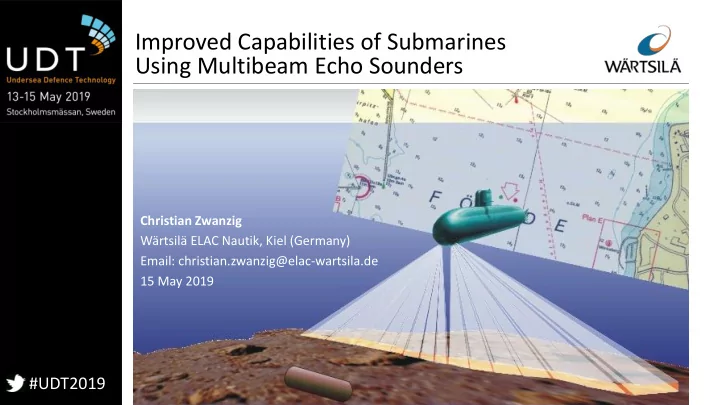
Improved Capabilities of Submarines Using Multibeam Echo Sounders

slide-2
SLIDE 2

#UDT2019

Content

  • Introduction
  • Features of Multibeam Echo

Sounders

  • Benefits of Multibeam Data
  • Interoperability
  • Open System Architecture
  • Processing Environments
  • Ruggedizing
  • Conclusions
slide-3
SLIDE 3

#UDT2019

Introduction (1/2)

Submarines include several types of sonar systems.

Communication Towed Array Sonar Radar Flank Array Sonar Cylindrical Sonar Intercept Sonar Mine Avoidance Sonar ESM Missile Decoy Torpedo Data Fusion Fire Control Situation Picture TMA

slide-4
SLIDE 4

#UDT2019

Introduction (2/2)

In recent tenders for submarine new buildings and retrofits, also multibeam echo sounders (MBES) have been requested. They may replace the single-beam echo sounders usually installed on submarines.

slide-5
SLIDE 5

#UDT2019

Features of Multibeam Echo Sounders

  • Very popular in the commercial maritime business
  • Very accurate high-resolution data:
  • Bottom depth data
  • Side scan data
  • Bottom backscatter data
  • Water column imaging (WCI) data
  • Cost-efficient, especially compared to systems which

are solely dedicated to military use

  • Low probability of intercept due to a small along-track

beam width.

slide-6
SLIDE 6

#UDT2019

Benefits of Multibeam Data

Accurate and up-to-date multibeam data of the seafloor and the water column are beneficial for the following submarine applications:

  • 1. Terrain contour matching
  • 2. Covert ISR missions in hostile waters
  • 3. Mission planning in confined waters
  • 4. Sonar performance predictions
  • 5. Bottoming procedures
slide-7
SLIDE 7

#UDT2019

  • 1. Terrain Contour Matching

Terrain contour matching (TERCOM) compares pre- recorded bottom maps with bottom data, acquired during the mission. TERCOM can significantly increase navigation accuracy, compared to solely using an inertial navigation system (INS).

slide-8
SLIDE 8

#UDT2019

  • 2. Covert ISR Missions

Covert ISR missions in unknown hostile waters require a precise knowledge of the bottom topography. Especially in areas where nautical charts are not available, multibeam data are of great importance.

Multibeam data, acquired by ELAC SeaBeam 3050 on R/V POSEIDON during cruise POS526 in 2018

slide-9
SLIDE 9

#UDT2019

  • 3. Mission Planning

In order to avoid hazardous situations, mission planning in confined and shallow waters requires precise seafloor information.

Main window of HYPACK software

MBES can provide the required data.

slide-10
SLIDE 10

#UDT2019

  • 4. Sonar Performance Predictions

Sonar performance predictions are essential for an overview

  • f the true situation. They require information on the bottom

topography which can be provided by MBES.

slide-11
SLIDE 11

#UDT2019

  • 5. Bottoming Procedures (1/2)

The risk of damaging a submarine during bottoming is high, especially in uncharted or inaccurately charted areas with a rugged topography.

slide-12
SLIDE 12

#UDT2019

  • 5. Bottoming Procedures (2/2)

Objects lying on a flat and sandy bottom are difficult to detect with a conventional echo sounder, leading to an increased risk. Bathymetric multibeam data and WCI data, based upon cyclical transmit swath steering, can provide detailed information on the seabed within a dedicated area below the submarine before bottoming is started. This information increases the safety of the submarine especially in unknown waters.

slide-13
SLIDE 13

#UDT2019

Water Column Imaging (WCI)

Water column imaging (WCI) is a standard functionality of modern multibeam echo sounders. WCI data are very helpful for identifying objects on the bottom or in the water column beneath a submarine.

WCI data with a gas flare from the North Sea, acquired by ELAC SeaBeam 3050 on R/V POSEIDON in October 2017

slide-14
SLIDE 14

#UDT2019

Cyclical Transmit Swath Steering

Modern MBES provide an automatic cyclical steering of the transmitted swaths from bow to aft and vice versa. Herewith, an area below the submarine can be automatically insonified, without requiring any movement of the submarine.

slide-15
SLIDE 15

#UDT2019

Interoperability

Interoperability of all systems onboard a submarine is

  • essential. Therefore, the MBES must have at least a

CMS interface for the following purposes:

  • Data exchange
  • Receiving control messages like the captain’s key message,

initiating an immediate disruption of active pulse transmission.

MBES CMS

Data Control Messages

slide-16
SLIDE 16

#UDT2019

Open System Architecture (1/2)

For an extensive interoperability, it is advantageous if the interfaces and the internal structure of the MBES are based upon an open system architecture. A common middleware standard is the Data Distribution Service for Real-Time Systems (DDS), released by the Object Management Group (OMG).

slide-17
SLIDE 17

#UDT2019

Open System Architecture (2/2)

DDS defines a data- centric publish- subscribe (DCPS) service for efficiently distributing data between participants in a distributed application.

Data Writer Publisher Topic Data Structure Application 1 Application 2 Subscriber Data Reader Domain QoS Participant Participant

QoS Quality of Service

slide-18
SLIDE 18

#UDT2019

Processing Environments (1/2)

There is an increasing trend that system integrators provide an open system architecture processing environment (e.g. ARCI from Lockheed Martin) which should be used by all onboard sonar systems.

ARCI Acoustics Rapid COTS Insertion

On the processing environments, “big sonar data” are available, comprising all sonar information for maximum customer value of current and future applications.

slide-19
SLIDE 19

#UDT2019

Processing Environments (2/2)

Comprehensive onboard processing environments call for a new MBES system architecture in the future:

Smart Transducer Smart Transducer

Smart Transducer

Ethernet, DDS Power Processing Environment Virtual Machines …

Multibeam App

  • Smart hydroacoustic

transducers will include signal conditioning with minimum information loss.

  • The other multibeam

functions will be included in software applications (“apps”), installed on the processing environment.

slide-20
SLIDE 20

#UDT2019

Ruggedizing

MBES are usually COTS products which are installed on commercial vessels. For submarines, ruggedized and pressure-tight multibeam transducers have to be provided. If an existing open system processing environment is utilized, then the costs for ruggedizing electronic devices are eliminated.

slide-21
SLIDE 21

#UDT2019

Conclusions

MBES have high benefits for the operational capabilities of submarines. The trend towards open system processing environments will increase the benefits and the integration of multibeam data into the overall onboard systems. In the future, there may be “multibeam apps” available on the market which utilize already existing onboard sonar transducers instead of specific multibeam transducers.

slide-22
SLIDE 22

#UDT2019

Thank You