USER PREFERENCES IN RECOMMENDATION ALGORITHMS The Influence Of User - - PowerPoint PPT Presentation

user preferences in recommendation algorithms
SMART_READER_LITE
LIVE PREVIEW

USER PREFERENCES IN RECOMMENDATION ALGORITHMS The Influence Of User - - PowerPoint PPT Presentation

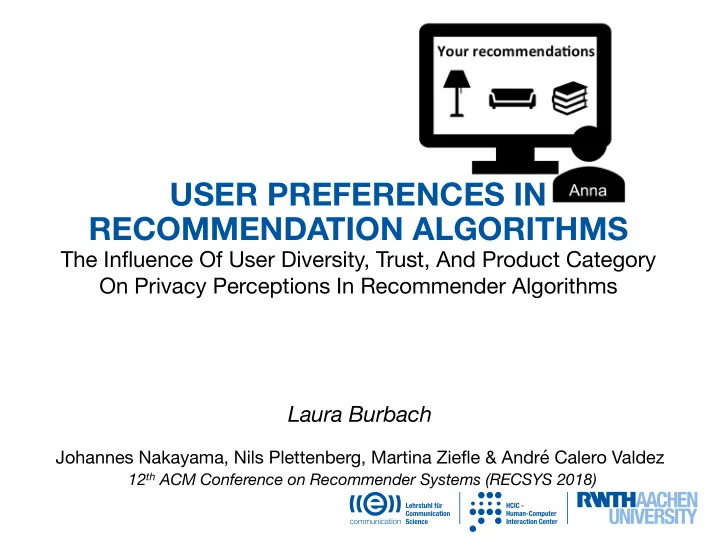
USER PREFERENCES IN RECOMMENDATION ALGORITHMS The Influence Of User Diversity, Trust, And Product Category On Privacy Perceptions In Recommender Algorithms Laura Burbach Johannes Nakayama, Nils Plettenberg, Martina Ziefle & Andr Calero


slide-1
SLIDE 1

2 von 14

USER PREFERENCES IN RECOMMENDATION ALGORITHMS

Laura Burbach

Johannes Nakayama, Nils Plettenberg, Martina Ziefle & André Calero Valdez

12th ACM Conference on Recommender Systems (RECSYS 2018)

The Influence Of User Diversity, Trust, And Product Category On Privacy Perceptions In Recommender Algorithms

slide-2
SLIDE 2

User Preferences in Recommendation Algorithms| | Laura Burbach, M. A. | | 03.10.2018

Introduction

slide-3
SLIDE 3

User Preferences in Recommendation Algorithms| | Laura Burbach, M. A. | | 03.10.2018

Spread of Recommender systems

Domains:

  • E-Commerce, tourism, e-learning, people

recommendation, group recommendation, information retrieval, search, media and communications, health, news recommendation

slide-4
SLIDE 4

User Preferences in Recommendation Algorithms| | Laura Burbach, M. A. | | 03.10.2018

Different recommender systems

  • content-based recommendation,
  • collaborative filtering,
  • hybrid forms,
  • trust-based recommendation,
  • social recommendation.
  • Rely on:
  • data from endusers,
  • meta-data on items.
slide-5
SLIDE 5

User Preferences in Recommendation Algorithms| | Laura Burbach, M. A. | | 03.10.2018

How much information do I want to share? Novel approaches:

  • more accurate
  • more sensitive

data Risk: data-misuse Trade-off:

Useful recommendation vs. distrust?

Different recommender systems

How do I get useful recommen- dations?

slide-6
SLIDE 6

User Preferences in Recommendation Algorithms| | Laura Burbach, M. A. | | 03.10.2018

How do different product types and user diversity factors influence the acceptance of recommender systems?

Key Question

Age Gender CSE Privacy concerns Institution- based Disposition to Trust

Product-Type Collaborative Hybrid Social Trust-based Content-based Recommender algorithm Fear Data usage Trust technical Distrust personal data

slide-7
SLIDE 7

User Preferences in Recommendation Algorithms| | Laura Burbach, M. A. | | 03.10.2018

ØPreference for different recommender systems Willingness to share individual information depends on:

  • product-type
  • user diversity factors

Core-Hypotheses

Age Gender CSE Privacy concerns Institution- based Disposition to Trust

Product-Type Collaborative Hybrid Social Trust-based Content-based Recommender algorithm Fear Data usage Trust technical Distrust personal data

slide-8
SLIDE 8

User Preferences in Recommendation Algorithms| | Laura Burbach, M. A. | | 03.10.2018

Research Design

Age Gender CSE Privacy concerns Institution- based Disposition to Trust

Product-Type Collaborative Hybrid Social Trust-based Content-based Recommender algorithm Fear Data usage Trust technical Distrust personal data

slide-9
SLIDE 9

User Preferences in Recommendation Algorithms| | Laura Burbach, M. A. | | 03.10.2018

Method – scenario-based online-survey

Age Gender CSE Privacy concerns Institution- based Disposition to Trust

Product-Type Collaborative Hybrid Social Trust-based Content-based Recommender algorithm Fear Data usage Trust technical Distrust personal data

Age Gender CSE Privacy concerns Institution- based Disposition to Trust

Product-Type Collaborative Hybrid Social Trust-based Content-based Recommender algorithm Fear Data usage Trust technical Distrust personal data

Age Gender CSE Privacy concerns Institution- based Disposition to Trust

Product-Type Collaborative Hybrid Social Trust-based Content-based Recommender algorithm Fear Data usage Trust technical Distrust personal data

Age Gender CSE Privacy concerns Institution- based Disposition to Trust

Product-Type Collaborative Hybrid Social Trust-based Content-based Recommender algorithm Fear Data usage Trust technical Distrust personal data

Age Gender CSE Privacy concerns Institution- based Disposition to Trust

Product-Type Collaborative Hybrid Social Trust-based Content-based Recommender algorithm Fear Data usage Trust technical Distrust personal data

book mobile phone contraceptives
slide-10
SLIDE 10

User Preferences in Recommendation Algorithms| | Laura Burbach, M. A. | | 03.10.2018

Method – recommendation algorithms

I would like products that are similar to be recommended to me. I would like to be recommended products that users like me have liked. I would like to be recommended products that are both similar and liked by other users.

Content-based Recommendation Collaborative Filtering Hybrid Recommendation

slide-11
SLIDE 11

User Preferences in Recommendation Algorithms| | Laura Burbach, M. A. | | 03.10.2018

Method – recommendation algorithms

Trust-based Recommendation Social Recommendation

Saving my preferences of other users whose recommendations I like may be used for better product recommendations. The connections with my friends from my social media profile may be used for future recommendations.

Strongly disagree Disagree Slightly disagree Slightly agree Agree Strongly agree 1 2 3 4 5 6

slide-12
SLIDE 12

User Preferences in Recommendation Algorithms| | Laura Burbach, M. A. | | 03.10.2018

Sample (N = 197)

Study Online Survey N 197 Men | Women 50.8 % | 49.2 % Age 18 – 62 years; M = 31.2 years Computer self-efficacy M = 3.93 (SD = 0.81) Privacy Concerns fear M = 2.90 (SD = 0.96) Privacy Concerns data usage M = 2.23 (SD = 1.01) Institution-based trust technical M = 3.03 (SD = 0.88) Disposition to trust M = 3.08 (SD = 0.64)

slide-13
SLIDE 13

User Preferences in Recommendation Algorithms| | Laura Burbach, M. A. | | 03.10.2018

Mixed effects model

Within-subject factors:

  • product categories
  • recommendation algorithms

Between-subject factors:

  • user diversity factors
slide-14
SLIDE 14

User Preferences in Recommendation Algorithms| | Laura Burbach, M. A. | | 03.10.2018

Results – Effects of product category on algorithm

  • 1

2 3 4 5 6 collaborative content hybrid social trust

Algorithm

  • Avg. agreement

Product

  • book

contraceptive mobile

Acceptance of algorithms by product

Error bars indicate 95% confidence intervall (Within-Subject)

slide-15
SLIDE 15

User Preferences in Recommendation Algorithms| | Laura Burbach, M. A. | | 03.10.2018

Results – User diversity and Acceptance for recommendation

  • higher acceptance of recommendation ( : M = 3.1,
  • : M = 2.78, p < .001)
  • Age (r = -.05, p < .01)
  • Computer self-efficacy (r = -.13, p < .001)
  • Privacy concerns (r = -.35, p < .001)
  • Trust in technical infrastructure (r = .34, p < .001)
slide-16
SLIDE 16

User Preferences in Recommendation Algorithms| | Laura Burbach, M. A. | | 03.10.2018

Key Results & Discussion

different acceptance patterns

  • The more sensitive the product, the higher the preference for

content-based and collaborative filtering

  • Trust-based and social approaches = generally rejected
  • No user-factors influence the preference for any algorithms

Age Gender CSE Privacy concerns Institution- based Disposition to Trust

Product-Type Collaborative Hybrid Social Trust-based Content-based Recommender algorithm Fear Data usage Trust technical Distrust personal data

slide-17
SLIDE 17

User Preferences in Recommendation Algorithms| | Laura Burbach, M. A. | | 03.10.2018

  • Users never saw a working system
  • Understanding of „real“ requirements?
  • Is the data required for good recommendations?
  • Cultural bias

☛ Future steps:

§ Translation to other cultural groups and other countries, § Explanations in recommendations, § Other methods e.g. Conjoint-studies, § More product categories.

Discussion – Limitations & Further Research

slide-18
SLIDE 18

Thank you for your attention!

Any questions?

Contact: Laura Burbach, M.A. Human-Computer Interaction Center (HCIC) RWTH Aachen University 52074 Aachen, Germany burbach@comm.rwth-aachen.de

Recommender systems should use the least amount of data and should give useful recommendations From a user perspective some products are more sensitive than others Different recommendation algorithms are accepted for different products

slide-19
SLIDE 19

User Preferences in Recommendation Algorithms| | Laura Burbach, M. A. | | 03.10.2018

Scales

Computer self-efficacy

  • 1. Technical equipment is inscrutable and difficult to control.
  • 2. Before I work on a task with the help of technical equipment, I

try to solve it in a different way.

  • 3. I really enjoy cracking a technical problem.
  • 4. I often have the feeling that technical devices do what they

want.

  • 5. I solve many technical problems rather by luck.
  • 6. Most technical problems are so complicated that it makes little

sense to deal with them.

  • 7. It mainly depends on me and my abilities whether I solve a

technical problem or not.

  • 8. Even if resistances occur, I continue to work on a technical

problem.

slide-20
SLIDE 20

User Preferences in Recommendation Algorithms| | Laura Burbach, M. A. | | 03.10.2018

Scales

Privacy Concerns fear

  • 1. I enter my personal data unwillingly in general.
  • 2. I am afraid that my data is being misused.
  • 3. I am afraid that my data is not secure.
  • 4. I have made bad experiences with sharing my data.

Privacy Concerns data usage

  • 1. I often do not understand why online services need certain data.
  • 2. I do not know what happens with my data.
  • 3. I do not know who has access to my data.
slide-21
SLIDE 21

User Preferences in Recommendation Algorithms| | Laura Burbach, M. A. | | 03.10.2018

Scales

Institution-based trust personal data

  • 1. It is not safe to provide personal information on the Internet.
  • 2. I would hesitate to provide personal information such as name,

address and telephone number on the Internet. Institution-based trust technical

  • 1. The Internet is secure enough to make private transfers.
  • 2. I am sure that legal and technical structures will protect me

equally from problems on the Internet.

  • 3. I rely on encryption and other technical advances on the Internet

to do my business.

  • 4. In general, the Internet today is a safe environment for doing

business.

slide-22
SLIDE 22

User Preferences in Recommendation Algorithms| | Laura Burbach, M. A. | | 03.10.2018

Scales

Disposition to trust

  • 1. People in general worry about the lives of others.
  • 2. People mostly worry about others instead of themselves.
  • 3. Most people tend to keep their promises.
  • 4. Most people are honest with other people.
  • 5. Most employees do a very good job at their work.
slide-23
SLIDE 23

User Preferences in Recommendation Algorithms| | Laura Burbach, M. A. | | 03.10.2018

Additional analyses

slide-24
SLIDE 24

User Preferences in Recommendation Algorithms| | Laura Burbach, M. A. | | 03.10.2018

Method – product types and recommender algorithms

User who bought this, also bought…

slide-25
SLIDE 25

User Preferences in Recommendation Algorithms| | Laura Burbach, M. A. | | 03.10.2018

Recommendation algorithms: content-based

slide-26
SLIDE 26

User Preferences in Recommendation Algorithms| | Laura Burbach, M. A. | | 03.10.2018

Recommendation algorithms: collaborative filtering

slide-27
SLIDE 27

User Preferences in Recommendation Algorithms| | Laura Burbach, M. A. | | 03.10.2018

Recommendation algorithms: hybrid recommendation

slide-28
SLIDE 28

User Preferences in Recommendation Algorithms| | Laura Burbach, M. A. | | 03.10.2018

Recommendation algorithms: trust-based recommendation

slide-29
SLIDE 29

User Preferences in Recommendation Algorithms| | Laura Burbach, M. A. | | 03.10.2018

Recommendation algorithms: social recommendation