SLIDE 1 CS140, 2014 I-1
✬ ✫ ✩ ✪
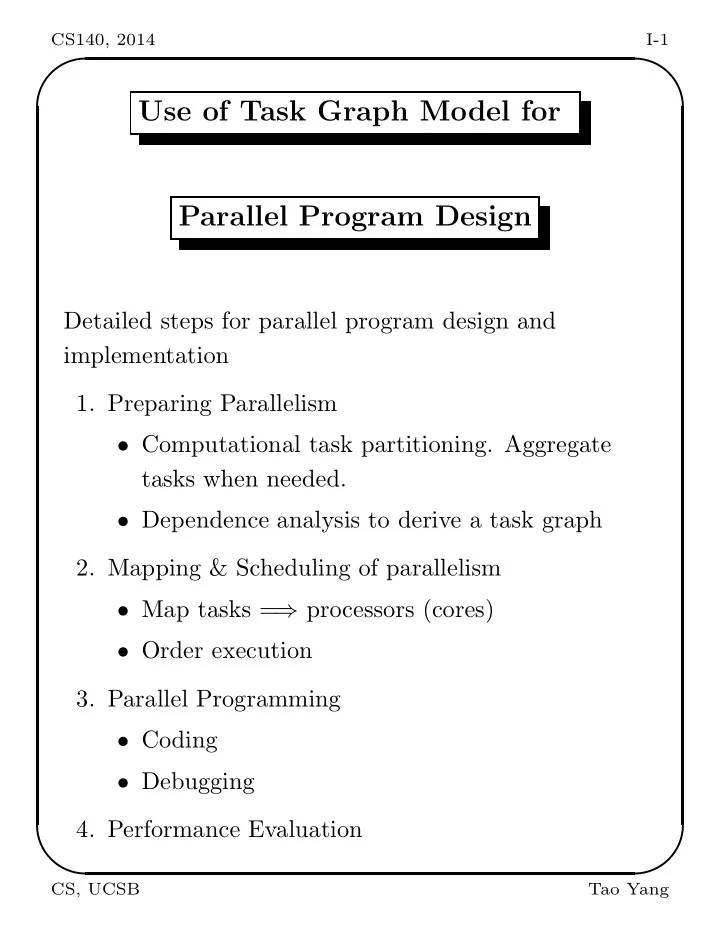
Use of Task Graph Model for Parallel Program Design
Detailed steps for parallel program design and implementation
- 1. Preparing Parallelism
- Computational task partitioning. Aggregate
tasks when needed.
- Dependence analysis to derive a task graph
- 2. Mapping & Scheduling of parallelism
- Map tasks =
⇒ processors (cores)
- Order execution
- 3. Parallel Programming
- Coding
- Debugging
- 4. Performance Evaluation
CS, UCSB Tao Yang
SLIDE 2 CS140, 2014 I-2
✬ ✫ ✩ ✪ Example
x = a1 + a2 + a3 + a4 + a5 + a6 + a7 + a8
a1 a2 a3 a4 a5 a6 a7 a8 + + + + + + +
- 2. Processor mapping and scheduling
a1 a2 a3 a4 a5 a6 a7 a8 + + + P0 P1 P2 P3
1 2 3 4 5 6 7
+ + + +
Schedule 1 2 3 4 5 6 7
CS, UCSB Tao Yang
SLIDE 3 CS140, 2014 I-3
✬ ✫ ✩ ✪
Task Graphs with Scheduling A Simple Model for Parallel Computation
♥ ♥ ♥ ♥
- Data dependence among tasks
♥ Tx ✲ ♥ Ty m
w = y z a1 a 2 a 3 a4 a1 a 2 a 3 a1 a4 a 2 x x y z x = + y = x + z = x + * w =( + + )( + + )
CS, UCSB Tao Yang
SLIDE 4
CS140, 2014 I-4
✬ ✫ ✩ ✪
Scheduling of task graph
Use a gantt chart to represent a schedule. I) Assign tasks to processors. II) Order execution within each processor. Each task 1) Receives data from parents. 2) Executes computation. 3) Sends data to children.
T1 T2 T3 T4 T1 T2 T3 T4 T1 T2 T3 T4 c = 0.5 τ =1 c = 0 τ = 1 1 1
The left schedule can be expressed as: T1 T2 T3 T4 Proc Assign. 1 Start time 1 1 2
CS, UCSB Tao Yang
SLIDE 5 CS140, 2014 I-5
✬ ✫ ✩ ✪
Performance Evaluation
- Seq — Sequential Time ( task weights)
- PTp — Parallel Time ( Length of the schedule)
Speedup = Seq PTp Efficiency = Speedup p Ex.
T1 T2 T3 T4 1
Seq = 4 p = 2, PTp = 4 Speedup = 1 Efficiency = 1 2 = 50%
CS, UCSB Tao Yang
SLIDE 6 CS140, 2014 I-6
✬ ✫ ✩ ✪
Performance Limited by
- Parallelism availability
- Task granularity (
Computation Cost Communication Cost)
Revisit Amdahl’s Law: Given sequential time Seq, define α as fraction of computation that has to be done sequentially. Parallel time is modeled as PTp = α Seq + (1 − α)Seq p Speedup = Seq PTp = 1 α + (1 − α)/p Example: α = 0, Speedup = p α = 0.5, Speedup = 2 1 + p−1 < 2
CS, UCSB Tao Yang
SLIDE 7 CS140, 2014 I-7
✬ ✫ ✩ ✪
Performance bounds for task graph execution
Define
- Critical path is the longest path (including
computation weights). The length of critical path is also called Span.
- Degree of parallelism be the maximum size of
independent task sets in the graph.
- Seq = Sequential time (or called work load)
Span Law PT ≥ Length of the critical path. Work Law PT ≥ Seq p Additionally Speedup ≤ Degree of parallelism
CS, UCSB Tao Yang
SLIDE 8
CS140, 2014 I-8
✬ ✫ ✩ ✪ Example.
x 2 x1 x 3 x 4 x 5 τ z y c
No of processors p = 2. Task weight τ = 1. Sequential time Seq = 9. Communication cost c = 0. Maximum independent set = {x3, y, z}. Degree of parallelism =3. CP = critical path = { x, x2, x3, x4, x5}. Length(CP) = 5. PT ≥ max(Length(CP), seq
p ) = max(5, 9 2) = 5.
Speedup ≤ Seq
5 = 9 5 = 1.8
Speedup ≤ 3 Degree of parallelism
CS, UCSB Tao Yang
SLIDE 9 CS140, 2014 I-9
✬ ✫ ✩ ✪
Pseudo Parallel Code
- SPMD - Single Program / Multiple Data
– Data and program are distributed among processors, code is executed based on a predetermined schedule. – Each processor executes the same program but
- perates on different data based on processor
identification.
- Master/slaves: One control process is called the
master (or host). There are a number of slaves working for this master. These slaves can be coded using an SPMD style.
CS, UCSB Tao Yang
SLIDE 10 CS140, 2014 I-10
✬ ✫ ✩ ✪
Pseudo Library Functions
Return the processor ID. p processors are numbered as 0, 1, 2, · · · , p − 1.
- numnodes(). Return the number of processors
allocated.
Send data to a destination processor.
- recv(data buffer, source id) or
recv(data buffer). Executing recv() will get a message from a processor (or any processor) and store it in the space specified by data buffer.
Broadcast a message to all processors.
CS, UCSB Tao Yang
SLIDE 11 CS140, 2014 I-11
✬ ✫ ✩ ✪
Two examples of SPMD Code
Print “hello”; Execute in 4 processors. The screen is: hello hello hello hello
x=mynode(); If x > 0, then Print “hello from ” x. Screen: hello from 1 hello from 2 hello from 3
CS, UCSB Tao Yang
SLIDE 12
CS140, 2014 I-12
✬ ✫ ✩ ✪
Example 3: Parallel Programming Steps
Sequential program: x = a1 + a2; y = x + a3; z = x + a4; w = y ∗ z; Task Graph:
w = y z a1 a 2 a 3 a4 a1 a 2 a 3 a1 a4 a 2 x x y z x = + y = x + z = x + * w =( + + )( + + )
Schedule:
T1 T2 T3 T4 1
CS, UCSB Tao Yang
SLIDE 13
CS140, 2014 I-13
✬ ✫ ✩ ✪ SPMD Code: int i, x, y, z, w, a[5]; i = mynode(); if (i==0) then { x=a[1]+a[2]; send(x, 1); y=x+a[3]; receive(z); w=y*z; } else{ receive(x); z=x+a[4]; send(z,0); }
CS, UCSB Tao Yang
SLIDE 14
CS140, 2014 I-14
✬ ✫ ✩ ✪
Example 4: Parallel Programming Steps
Sequential program: x=3 For i = 0 to p-1. y(i)= i*x; Endfor Task Graph:
0 x 1 x 2 x (p-1)x x = 3 . . . .
Schedule:
x = 3 (p-1)x 0 x 1 x 2 x send receive . . . . . .
CS, UCSB Tao Yang
SLIDE 15
CS140, 2014 I-15
✬ ✫ ✩ ✪ SPMD Code: int x,y,i; i = mynode(); if (i==0) then { x=3; broadcast(x); } else receive(x); y = i*x; Evaluation: Assume that each task takes one unit W and broadcasting takes C. Seq = (p + 1)W, PT = W + C + W. Speedup = (p + 1)W 2W + C .
CS, UCSB Tao Yang
SLIDE 16 CS140, 2014 I-16
✬ ✫ ✩ ✪
Partial SPMD Code for Tree Summation
a1 a2 a3 a4 a5 a6 a7 a8 + + + P0 P1 P2 P3
1 2 3 4 5 6 7
+ + + +
Schedule 1 2 3 4 5 6 7
me=mynode(); p= 4; sum = sum of local numbers at this processor; if(?for some leaf node?) Send sum to node ?f(me)?; for i= 1 to tree depth do{ if(?I am still used in this depth?){ x=receive partial sum from node ?f(me)?; sum = sum +x if (?I will not be used in next depth?) Send sum to node ?f(me)?; }}
CS, UCSB Tao Yang