USACE REGULATORY PROGRAM PORTLAND DISTRICT 237 217 200 80 252 - - PowerPoint PPT Presentation

usace regulatory program portland district
SMART_READER_LITE
LIVE PREVIEW

USACE REGULATORY PROGRAM PORTLAND DISTRICT 237 217 200 80 252 - - PowerPoint PPT Presentation

USACE REGULATORY PROGRAM PORTLAND DISTRICT 237 217 200 80 252 83 237 217 200 119 174 36 237 217 200 27 .59 118 255 0 163 131 239 110 112 62 102 130 255 0 163 132 65 135 92 102 56 120 255 0 163 122 53 120


slide-1
SLIDE 1

217 217 217 200 200 200 255 255 255 163 163 163 131 132 122 239 65 53 110 135 120 112 92 56 62 102 130 102 56 48 130 120 111 237 237 237 80 119 27 252 174 .59 83 36 118 1
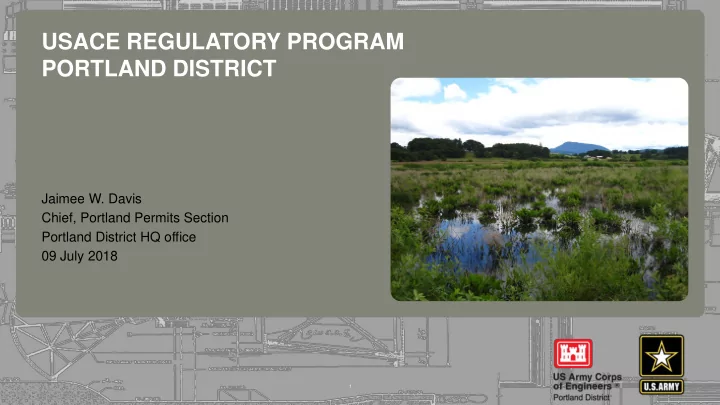
Jaimee W. Davis Chief, Portland Permits Section Portland District HQ office 09 July 2018

USACE REGULATORY PROGRAM PORTLAND DISTRICT

slide-2
SLIDE 2

TOPICS

– Regulatory Mission – Corps Regulatory Program structure/leadership – Authorities – Waters of the United States – Regulated Activities – Exemptions

2

slide-3
SLIDE 3

REGULATORY MISSION

“To protect the nation’s aquatic resources, while allowing reasonable development through fair, flexible and balanced permit decisions”

3

slide-4
SLIDE 4

4

ARMY CORPS LOCATIONS

slide-5
SLIDE 5

USACE, PORTLAND DISTRICT REGULATORY BRANCH

5

Area of responsibility is the state of Oregon, Ports on both sides of the Columbia River in Oregon & Washington and BPA-funded restoration projects on the Washington side of the Columbia River

slide-6
SLIDE 6

AUTHORITIES

– Section 404, Clean Water Act – Section 10, Rivers and Harbors Act of 1899 – Section 103, Marine Protection, Research and Sanctuaries Act

6

slide-7
SLIDE 7

WATERS OF THE U.S. (WOUS) – SECTION 10

Navigable waters of the U.S. (33 CFR Part 329): Subject to the ebb and flow of the tide and/or are presently used, or have been used in the past, or may be susceptible for use to transport interstate or foreign commerce –on Navigable list for state of Oregon; and/or – tidally influenced waterway

7

slide-8
SLIDE 8

WOUS – SECTION 404

Section 404 of the Clean Water Act (33 CFR, Part 328): (1) All waters which are currently used, or were used in the past, or may be susceptible to use in interstate or foreign commerce, including all waters which are subject to the ebb and flow of the tide; (2) All interstate waters including interstate wetlands;

8

slide-9
SLIDE 9

SECTION 404 (CONT.)

Section 404 of the Clean Water Act (33 CFR, Part 328): (3) All other waters such as intrastate lakes, rivers, streams, (including intermittent streams), mudflats, sandflats, wetlands, sloughs, prairie potholes, wet meadows, playa lakes, or natural ponds, the use, degradation or destruction of which could affect interstate or foreign commerce including any such waters: –(i) which are or could be used by interstate or foreign travelers for recreational or other purposes; or –(ii) from which fish or shellfish are or could be taken and sold in interstate commerce; or –(iii) which are used or could be used for industrial purpose by industries in interstate commerce;

9

slide-10
SLIDE 10

SECTION 404 (CONT.)

Section 404 of the Clean Water Act (33 CFR, Part 328): (4) All impoundments of waters otherwise defined as WOUS under the definition; (5) Tributaries of waters identified in (a)(1) through (4); (6) The territorial seas (7) Wetland adjacent to WOUS identified in (a)(1) through (6). (8) WOUS do not include prior converted cropland Waste treatment systems, including treatment ponds or lagoons designed to meet the requirements of CWA which also meet the criteria of this definition are not WOUS

10

slide-11
SLIDE 11

WATERS OF THE U.S. – SECTION 10 AND SECTION 404

11

slide-12
SLIDE 12

REGULATED ACTIVITIES

Section 10 – “in, over or under” Section 10 waterways Includes, but is not limited to: – Piling – Wharf – Boat docks – Boat ramps – Dolphins – Permanently moored vessel – Bank stabilization –Dredging – Aerial electric power transmission lines – Directional drilling

12

slide-13
SLIDE 13

REGULATED ACTIVITIES

Section 404 – “discharge of dredged or fill material” Includes, but is not limited to: – Depositing fill, dredged or excavated material – Using fill for residential, commercial or recreational developments – Placing riprap, road fills and bank stabilization – Grading or mechanized land clearing of wetlands – Placing materials from ditch excavation activities in wetlands (side-casting) –Backfilling trenches in wetlands – Habitat restoration – large wood

13

slide-14
SLIDE 14

EXEMPTIONS

Note: No exemptions under Section 10 Exemptions are for Section 404 only (33 CFR 323.4(a): (1) Normal farming, silviculture and ranching activities such as plowing, seeding, cultivating, minor drainage, and harvesting for the production of food, fiber and forest products…” (2) Maintenance, including emergency reconstruction

  • f recently damaged parts of currently serviceable

structures such as dikes, dams, levees, groins, riprap, breakwaters, causeways, bridge abutments

  • r approaches and transportation structures.”

14

slide-15
SLIDE 15

EXEMPTIONS (CONT.)

15

(3) Construction or maintenance of farm or stock ponds or irrigation ditches, or the maintenance (but not construction)

  • f drainage ditches. Discharges associated with siphons,

pumps, headgates, wingwalls, weirs, diversion structures, and such other facilities as are appurtenant and functionally related to irrigation ditches are included in this exemption.” (4) Construction of temporary sedimentation basins on a construction site which does not include placement of fill material into waters of the U.S. (5) Any activity with respect to which a State has an approved program under Section 208(b)(4) of the CWA.

slide-16
SLIDE 16

EXEMPTIONS (CONT.)

(6) Construction or maintenance of farm roads, forest roads, or temporary roads for moving mining equipment, where such roads are constructed and maintained in accordance with the Best Management Practices (BMPs) to assure flow and circulation patterns and chemical and biological characteristics of waters of the U.S. is not reduced…”

16

slide-17
SLIDE 17

FEDERAL/STATE COORDINATION

– JPA – Kaizen meetings – recent Wetland Delineation discussions – enforcement cases

17

slide-18
SLIDE 18

QUESTIONS?

18