SLIDE 1 12/6/19 1
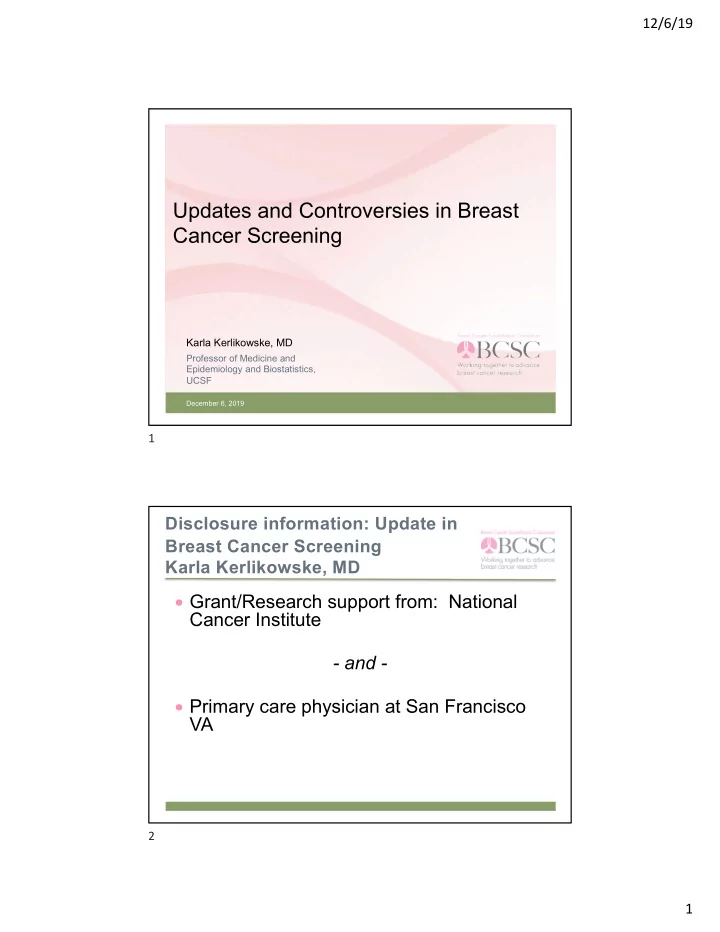
Updates and Controversies in Breast Cancer Screening
Karla Kerlikowske, MD
Professor of Medicine and Epidemiology and Biostatistics, UCSF
December 6, 2019
1
Disclosure information: Update in Breast Cancer Screening Karla Kerlikowske, MD
- Grant/Research support from: National
Cancer Institute
- and -
- Primary care physician at San Francisco
VA
2
SLIDE 2 12/6/19 2
- Screening mammography based on age
- When to start
- How often to screen
- When to stop
- Risk-based screening
- Screening women with dense breasts
- Screening women with breast MRI
- Evaluation of breast pain
- Screening women with breast implants
Outline
3
Women at average breast cancer risk
- Do not have
- Personal history of breast cancer
- Previously diagnosed high-risk breast
lesion
- Any genetic mutation known to increase
the risk for breast cancer
- History of exposure to radiation to the
chest in childhood
4
SLIDE 3 12/6/19 3
When to start mammography screening and how often
- ACR -- annual starting at 40
- ACOG, ACS, USPSTF, ACP -- discuss 40s,
- ffer screening based on value of benefit vs.
harm, biennial or 1-2 years
- ACS -- annual 45-54, biennial starting at 55
- USPSTF, AAFP, WHO, ACOG, ACP --
biennial starting at age 50
- European countries and Canada -- biennial
starting at age 50; Canada q2-3; UK q3
Schunemann et al, Ann Intern Med, 2019
5
Benefit Reduced breast cancer mortality Harm False-positives Benign biopsies Overdiagnosis
Do the benefits of screening
6
SLIDE 4
12/6/19 4
Meta-analyses of screening mammography trials -- film
Age RR (95% CI) NNS* 39-49 0.92 (0.75-1.02) 3333 50-59 0.86 (0.68-0.97) 1300 60-69 0.64 (0.45-0.92) 470 70-74 0.80 (0.51-1.28) 800
*Number women screened for 10 years to avert a breast cancer death Myers et al, Jama, 2015; Nelson et al, Ann Intern Med, 2016
All cause 0.99 (0.97-1.002) mortality
7
Advanced disease reduced in screened women ages >50
Ages 39-49 Ages >50
Nelson et al, Ann Intern Med, 2016
8
SLIDE 5 12/6/19 5
ACS rationale for starting screening at age 45
- Observational studies – 20-40% reduction
in breast cancer mortality
- Breast cancer mortality similar 45 vs. 50
- 40-44 -- 13.2 per 100,000
- 45-49 -- 20.6 per 100,000
- 50-54 --
30.8 per 100,000
41.3 per 100,000
Oeffinger et al, Jama, 2015
9
Breast Cancer Surveillance Consortium – 1996-2022
Active registries Historic registries
10
SLIDE 6 12/6/19 6
BCSC outcomes per 10,000 digital screens
Nelson et al, Ann Intern Med, 2016
Outcomes 40–49 50–59 60–69 70–74 False-positives (false alarms) 1,212 932 808 696
invasive breast cancer diagnosed 100 60 30 30 False-negatives (missed cancers) 10 11 12 13 Invasive cancer 22 35 58 72 DCIS 16 18 21 23
11
Overdiagnosis & overtreatment from screening mammography
- Cases (ductal carcinoma in situ or low grade
invasive cancer) not clinically detected in the absence of screening because of lack of progression or death from other causes
– Canadian National Breast Screening Studies
- 22% of invasive cancers
- 37% invasive + DCIS
– UK independent panel
Miller et al, BMJ, 2014; Mandelblatt et al, Ann Intern Med, 2016
12
SLIDE 7
12/6/19 7
CISNET models
6 different breast cancer models Background Trends -- SEER Screening - BCSC Treatment -- RCT BC incidence, mortality, life years gained (LYG), false positives Common inputs Unique simulation or analytical model Other common inputs Outputs
13
Model estimates of digital screening mammogram effectiveness by interval
Mandelblatt et al, Ann Intern Med, 2016
Age & Interval Deaths* averted Benign biopsy* False- positive* Overdiag- nosis* 50-74 y 1 y 9 228 1,798 25 2 y 7 146 953 19 40-49 y 1 y 1.3 99 1,143 5 2 y 1.0 58 576 2
*per 1,000 women screened over screening period
14
SLIDE 8 12/6/19 8
Risk of late stage disease with 2 vs. 1 year screening interval
Advanced Tumor stage† >15mm Premenopausal +28%* +21%* Postmenopausal
+11%*
†Stage IIB or higher *P< 0.05 White, JNCI, 2004; Hubbard, Ann Intern Med, 2011; Miglioretti, Jama Oncol, 2015
15
Lifetime risk of breast cancer death
Deaths Risk % averted†
2.70
2.00 7
1.88 8
1.90 8 biennial
16
†per 1,000 women screened Kerlikowske et al, Jama Intern Med, 2015; Moss et al, Lancet Oncol, 2015
16
SLIDE 9 12/6/19 9
- Screening most efficient if strategy based on risk
- Target fixed number of women at high risk
- Decreases harms for low risk women
- Decreases costs
- Breast cancer risk used to determine
- When to start screening
- Screening frequency
- Supplemental imaging
Improving benefit-harm ratio with risk-based screening
17
BCSC Risk Calculator FREE iPhone & iPad app
Tice J, et al., JCO, 2015
18
SLIDE 10 12/6/19 10
Breast Imaging Reporting and Data System (BI-RADS)
Almost entirely fat 12% Scattered fibroglandular densities 41% Heterogeneously dense 39% Extremely dense 8%
a b c d
a b c d
Kerlikowske et al, Ann Intern Med, 2015
47% of women have dense breasts (heterogeneously or extremely dense)
19
Common risk factors account for breast cancers
Engmann and Kerlikowske, et al., Jama Oncol, 2017
Population Attributable Risk %
(Shift obese & overweight to normal weight) (Shift c & d to b)
Combined PAR = 43%
Premenopausal Postmenopausal
5 10 15 20 25 30 35 Dense breasts BMI Family history of breast cancer History of breast biopsy Nulliparous or age at first live birth >30 years
29% 9% 16% 14% 3% 8% 7% 9% 9% 5%
20
SLIDE 11 12/6/19 11
Breast cancer risk assessment models
General
assessment tool
- BCSC* -- 5y, 10y
- Tyrer-Cuzick* – 10y
Family risk
BRCA carrier
BRCA carrier +
- varian cancer
- Tyrer-Cuzick* –
10y – BRCA carrier
*includes breast density measure McCarthy, JNCI, 2019
BCSC model highest calibration and discrimination > Gail > TC in average-risk population
21
BCSC No Family Hx Family Hx Density 5-yr risk No bx Bx No bx Bx
Tice et al, Ann Intern Med, 2008; Tice et al, JCO, 2015
a .4 .3 .5 .8 b 0.8 0.7 1.0 1.7 c 1.2 1.0 1.7 2.6 d 1.6 1.3 2.1 3.3 .5 1.0 1.6 2.1
Average 5-year risk >1.3% for 50- year-old – 16% of women 40-49
5-year risk (%) for 45-49y women
22
SLIDE 12 12/6/19 12
BCSC No Family Hx Family Hx Density 5-yr risk No bx Bx No bx Bx
Tice, Ann Intern Med, 2008; Tice, JCO, 2015
a .5 .4 .7 1.1 b 1.0 0.9 1.4 2.2 c 1.6 1.3 2.2 3.4 d 2.1 1.7 2.8 4.4 0.7 1.4 2.1 2.7
5-year risk (%) for 50-54y women
32% of 50 year old women average risk less than average risk 40-year old
23
4.1 5.3 8 13.8 5.2 6.5 9.2 14.7 6.3 7.7 10.6 15.8 6.5 8 10.8 15.4
2 4 6 8 10 12 14 16 18 a b c d Deaths averted per 1000 women BI-RADS Breast Density
Deaths averted vary by risk if screen women 50-74 biennial
1.0 1.3 RR = 4.0 2.0
Trentham-Dietz and Kerlikowske, et al. Annals of Internal Medicine (2016)
1.0 1.3 RR = 4.0 2.0 1.0 1.3 RR = 4.0 2.0 1.0 1.3 RR = 4.0 2.0 Almost entirely fat
Scattered densities Heterogeneously dense
Extremely dense
24
SLIDE 13 12/6/19 13
Triennial screening for low density and average risk
3.4 4 4.8 5.1 4.4 5.1 6 6.2 6.4 7.2 8.3 8.4 11 11.5 12.4 12 2 4 6 8 10 12 14 Almost entirely fat Scattered densities Heterogeneously dense Extremely dense
Deaths averted per 1000 women
1.0 1.3 RR = 4.0 2.0 1.0 1.3 RR = 4.0 2.0 1.0 1.3 RR = 4.0 2.0 1.0 1.3 RR = 4.0 2.0
Fewer false-positives (21-23%), benign biopsies (13-17%), overdiagnosis (8%-20%) compared to biennial screening
Trentham-Dietz and Kerlikowske, et al. Annals of Internal Medicine (2016)
25
Annual screening if high risk regardless of breast density
4.7 6.9 8.4 8.9 6 8.7 10.4 10.9 9.1 12.3 14.3 14.7 17.2 19.4 21 20.5 5 10 15 20 25 Almost entirely fat Scattered densities Heterogeneously dense Extremely dense
Deaths averted per 1000 women
1.0 1.3 RR = 4.0 2.0 1.0 1.3 RR = 4.0 2.0 1.0 1.3 RR = 4.0 2.0 1.0 1.3 RR = 4.0 2.0
Trentham-Dietz and Kerlikowske, et al. Annals of Internal Medicine (2016)
More deaths averted with annual vs biennial screening among women at high breast cancer risk
26
SLIDE 14 12/6/19 14
Breast Cancer Risk Factors
RR= 1.3-1.9
- >25g alcohol/day
- Postmenopausal HT
- Nulliparous or age first birth >30
- Body mass index >30 kg/m2
- First-degree relative with breast cancer
- Hx of breast biopsy
RR= 2.0
- Two first-degree relatives with breast cancer
- History of proliferative disease without atypia
RR= 4.0
Trentham-Dietz and Kerlikowske, et al, Ann Intern Med, 2016
27
When to stop screening mammography
- ACR -- if life expectancy <5-7 years
- ACS -- if life expectancy <10 years
- ACOG – to age 75, shared decision-making
- USPSTF, WHO, AAFP, ACP – age 75
- Most European countries and Canada stop
at age 70-75
28
SLIDE 15 12/6/19 15
Breast cancer deaths averted per 1000 women screened
Lee, BMJ, 2013; Demb, JNCI, 2019
75-84 yo 10-year non-breast cancer
- vs. breast cancer death 36% vs. 0.29%
29
New federal law for breast density notification - 2019
Low density for BI-RADS a and b High density for BI-RADS c and d
30
SLIDE 16 12/6/19 16
High breast density masks interval invasive tumors
BI-RADS Screen- Density detected* Interval cancer* a 1.8 0.21 b 3.3 0.38 c 4.8 0.84 d 5.1 1.11
Kerlikowske, Ann Intern Med, 2011; Kerlikowske, Ann Intern Med, 2015
64% of interval cancers in women with BI-RADS c or d
*per 1,000 women 40-74 screened
31
12/6/19 Breast Cancer Surveillance Consortium 32
Half of women with dense breasts have low 5-year risk
Almost entirely fat Scattered densities Hetero. Dense Extremely dense Low: 0-1 67 38 23 19 Average: >1-1.66 23 30 28 34 Intermediate: 1.67-2.49 9 21 29 22 High: >2.5 1 11 20 25 10 20 30 40 50 60 70 Percentage in 5-Year Risk Group BCSC 5-year risk %
50% of women with dense breasts have low to average risk
Kerlikowske, Ann Intern Med, 2015
32
SLIDE 17
12/6/19 17
Almost entirely fat Scattered densities Hetero. dense Extremely dense Low: 0-1 0.14 0.21 0.63 0.72 Average: >1-1.66 0.31 0.38 0.58 0.89 Intermediate: 1.67-2.49 0.48 0.43 0.83 1.17 High: >2.5% 0.90 1.49 1.62 0.0 0.5 1.0 1.5 2.0 Interval Cancer Rate (Per 1,000 Screens)
High risk, high density – interval cancer rate >1 per 1000 exams
N/A 1.62 1.17 1.48 BCSC 5-year risk %
24% of women with dense breasts at high risk of missed cancer
Kerlikowske, Ann Intern Med, 2015
33
High density and risk– rate of advanced rate elevated
Almost entirely fat Scattered densities Hetero. dense Extremely dense Low 0-1 0.13 0.26 0.31 0.17 Average >1 -1.66 0.17 0.31 0.35 0.61 Intermediate 1.67-2.49 0.41 0.6 0.56 0.68 High >2.5 0.6 1.08 1.25 0.2 0.4 0.6 0.8 1 1.2 1.4 Advanced cancer stage IIB or higher rate per 1000 screens
Kerlikowske, JAMA Intern Med, 2019
27% of women with dense breasts at high risk of advanced cancer
34
SLIDE 18 12/6/19 18
Alternative imaging strategies for women with dense breasts
- Change screening frequency
- Tomosynthesis or DBT (3D)
- Supplemental screening ultrasound --
hand held; whole breast
35
Odds of advanced stage with 2
- vs. 1yr screening interval
Age Heterogeneously Extremely group dense dense 40-49 1.32 (0.93-1.88) 1.89 (1.06-3.39)
Kerlikowske, Jama Intern Med, 2013
Higher advanced stage with biennial vs. annual screening in extremely dense group
36
SLIDE 19 12/6/19 19
Cancer detection by extent of density for digital vs. DBT Digital Digital + DBT Exams 278,906 173,414 Invasive cancer rate* Non-dense 3.0 4.0 Dense 2.9 4.2 Recall rate* Non-dense 90 79 Dense 127 109
*per 1,000 exams, P< 0.001 Rafferty et al, JAMA, 2016; Conant, JAMA Oncol, 2019; Hovda, Eur Radiol, 2019
*Biopsy rate: 18.1 vs. 19.3
- Decrease recall and increase cancer
detection -- mostly density b and c
- No difference in interval cancer rate
- verall or by breast density category
37
J-START ultrasound trial
- Randomized trial of average-risk women
age 40-49 years
- Annual digital mammography + screening
ultrasound vs. annual digital mammography
- Outcome = interval cancer
- 18 interval cancers in intervention group vs.
35 in control group
- Rate of 0.5 per 1000 vs. 0.97 per 1000
Ohuchi, Lancet, 2016
38
SLIDE 20 12/6/19 20
MRI in women with dense breasts
- RCT of women with extremely dense breasts
- Age 50-75 years (mean 54 years)
- 59% participation (N=4756)
- Negative mammogram
- Biennial MRI vs. biennial mammography
- Outcome= 2.5 vs. 5.0 interval cancer/1000
screens – node positive rate no different
- False-positive rate MRI group 79.8/1000
screens
de Lange, Clinical Radiology, 2018; Bakker, NEJM, 2019
39
Supplemental breast imaging
Test Incremental breast cancer detection per 1,000 exams Biopsy rate per 1,000 exams Radiation dose (location) Digital mammography NA 22 0.5 mSv (breast) Ultrasound 2 to 4 50 to 57 None Digital breast tomosynthesis 1 to 2 28 1.0 mSv (breast) Breast MRI 10 to 16 44 None Molecular breast imaging 8 to 9 32 to 37 2.4 mSv (whole body)
Kerlikowske, Jama, 2019
40
SLIDE 21 12/6/19 21
Cost-effectiveness of mammography + MRI in BRCA1/2 mutation carriers Mortality Deaths ICER reduction averted* Clinical ref ref Mammography 16.4% 87 $16,751 MRI 17.8% 95 $206,384 Mammography 22.3% 118 $69,125 + MRI
*per 1000 women diagnosed with breast cancer Lee, Radiology, 2010
41
MRI + mammography in other intermediate/high-risk women
- TP53, PTEN, STK11, CDH1 mutation
carrier
- ATM, PALB2, or CHEK2 mutation carrier
with positive family history of breast cancer
- Women with a history of mantle radiation
between ages 10–30 years
Esserman, NPJ Breast Cancer, 2017
42
SLIDE 22 12/6/19 22
Consider referral to genetic testing
- Breast cancer before age 50
- Bilateral breast cancer
- >2 premenopausal breast cancer
- >3 family members, >1 premenopausal breast
cancer
- Ovarian cancer + premenopausal breast cancer
- Ovarian cancer + 2 breast cancers
- >2 Ovarian cancer
- Male breast cancer + female breast cancer or
- varian cancer
43
Women with history of early- stage breast cancer
Measure Mammography MRI Biopsy rate* 24 57 Cancer yield% 40 27 High-risk benign lesions*† 52 75
*Per 1,000 screening episodes †ADH, LCIS Buist, JAMA Intern Med, 2018; Wernli, Radiology, 2019
2-fold higher biopsy rates with MRI, with lower cancer yield and no difference in interval cancer rate
44
SLIDE 23 12/6/19 23
Risk of breast cancer with breast pain <1%
Imaging not needed
- Bilateral, non-focal
- Cyclic
- Age <40
Consider diagnostic mammography
- Non-cyclic
- Unilateral, focal, persistent
- Age >40
Jokich, J Am Coll Radiol, 2017
45
Breast implants decrease detection on mammograms
- Order displacement views
- Lower mammography sensitivity
compared to women without implants
- Type and location of implant similar impact
- n mammography detection
- More likely to undergo excisional biopsy
- vs. core biopsy
Miglioretti, JAMA, 2004; Sosin, Plast Reconstr Surg, 2018
46
SLIDE 24 12/6/19 24
- Offer biennial screening ages 50-74 or 13
mammograms in a woman’s lifetime
- Consider triennial screening if low density & low
to average risk
- Consider annual screening if high density & risk
- Stop screening before 74 for women with
moderate to severe comorbidities
- Consider biennial screening age 40-49 if 5-year
breast cancer risk >1.3%, i.e., average-risk of fifty year old woman
Summary
47
- Digital mammography for most women, consider
DBT if heterogeneously dense breasts
- Women with dense breasts at high risk of
advanced breast cancer, consider supplemental screening ultrasound or MRI
- BRCA1 and 2 mutation carriers -- breast MRI and
annual mammogram
- History of breast cancer -- annual mammogram
- Breast pain rarely requires breast imaging
- Displacement views for women with implants
Summary
48
SLIDE 25 12/6/19 25
Primary prevention of breast cancer matters
- Maintain ideal body weight
- Alcohol in moderation
- Exercise regularly
- Limit postmenopausal E+P hormone
therapy to 5 years or less
49
Thank you
50