UPDATE ON TELEHEALTH BEHAVIORAL HEALTH PERSPECTIVE Presentation to - - PowerPoint PPT Presentation

update on telehealth behavioral health perspective
SMART_READER_LITE
LIVE PREVIEW

UPDATE ON TELEHEALTH BEHAVIORAL HEALTH PERSPECTIVE Presentation to - - PowerPoint PPT Presentation

UPDATE ON TELEHEALTH BEHAVIORAL HEALTH PERSPECTIVE Presentation to the Interim Joint Committee on Health, Welfare & Family Services June 25, 2020 Sheila A. Schuster, Ph.D. Licensed Psychologist, Executive Director, Kentucky Mental


slide-1
SLIDE 1

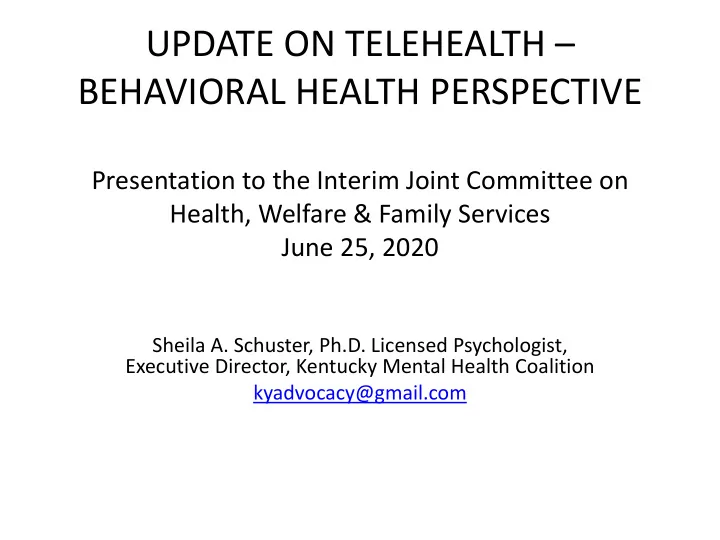
UPDATE ON TELEHEALTH – BEHAVIORAL HEALTH PERSPECTIVE

Presentation to the Interim Joint Committee on Health, Welfare & Family Services June 25, 2020

Sheila A. Schuster, Ph.D. Licensed Psychologist, Executive Director, Kentucky Mental Health Coalition kyadvocacy@gmail.com

slide-2
SLIDE 2

Sources of Information

Informal, time-limited feedback requests:

  • Community Mental Health Centers (CMHC’s)
  • Child-Caring and Foster Agencies
  • Free-Standing Behavioral Health Facilities, Agencies

and Clinics

  • Behavioral Health Professionals including Psychiatrists,

Addiction Medicine Specialists, MH/Psych APRNs, Psychologists, Social Workers, Counselors, Substance Use Disorder Providers, ABI Providers

  • Family, Consumer and Advocacy Organizations
slide-3
SLIDE 3

Current Clients Reached via Telehealth?

CMHCs: The reported percentages range from 47% to 100%, many providers reporting in the 75% to 85% range. Private Providers: The ranges reported were from 20% to 100%, with most in the 85+% range. Not unusual to see initial %ages very low, with significant growth in telehealth usage over time.

slide-4
SLIDE 4

Kinds of Clients Most Able to Use Telehealth?

  • Clients ranging from adolescence to mid-50’s
  • Clients with depression, anxiety, PTSD, chronic

pain

  • Clients with substance use disorders
  • Clients with comorbid health conditions who

are reluctant to be exposed to the virus

  • Clients with ongoing transportation problems

(long identified as a major barrier to access)

slide-5
SLIDE 5

Kinds of Clients Least Able to Use Telehealth?

  • Very young children
  • Elderly, especially with limited technology

experience

  • Individuals with cognitive impairment
  • Patients with paranoid symptomatology
  • Patients with language and cultural barriers
  • Patients on the autism spectrum
  • Homeless patients
  • Patients who were resistant to treatment are still

resistant!

slide-6
SLIDE 6
  • Lack of reliable internet connection; no

internet in rural areas

  • Lack of smart phone or limited phone minutes
  • r data
  • Reluctance of patients to try it or to engage
  • Lack of confidentiality/privacy for the session
  • Discomfort of staff in utilizing the technology
  • Some clients lose interest or struggle to focus

What Are the Major Barriers to Using Telehealth?

slide-7
SLIDE 7
  • Learning curve initially for both MCOs and

providers

  • Confusion over correct location code
  • Medicaid lifting Prior Authorization

requirements was a huge help

  • Occasionally, not receiving the same

reimbursement rate as would have been paid for an in-person service

What Have Been the Billing/Reimbursement Issues?

slide-8
SLIDE 8
  • Maintain telehealth changes currently in place to ensure

access to needed services and supports

  • Maintain moratorium on prior authorizations for behavioral

health services

  • Keep telephonic services as an alternative for some clients
  • Relaxation of HIPAA rules made services easier to use, more

accessible

  • Licensure boards should allow licensed associate level

providers to use telehealth for delivery of services

  • Allowance of both telephone and telehealth encounters to

establish patient-provider relationship

  • Reciprocal licensure with bordering states

What Policy Changes Made During COVID Pandemic Should Stay in Place?

slide-9
SLIDE 9
  • Telehealth is an important tool in the toolbox and should be

available as a choice for consumers and providers. It is not new, but the lifting of barriers has really “put it on the map”.

  • Assuming the technology is available and working, telehealth

works best when there is a match between the provider, the patient, the presenting problem, the service that is needed.

  • It also is very useful (particularly via telephone) for PSS and

CSWs to intervene quickly in a developing crisis situation.

  • Telehealth can actually provide a modality that allows patients

to be more open and engaged, particularly adolescent boys…a real breakthrough! It can also provide more information for the therapist in terms of issues at home, etc.

Lessons Learned from Telehealth

slide-10
SLIDE 10
  • Telehealth can help address transportation issues, lack of

childcare, difficulty taking time off from work to go to a session, lack of services in the evening.

  • Unfortunately, telehealth also has the capacity to widen the

health equity gap, particularly for rural Kentuckians and for those in poverty who likely do not have access to broadband, smart phones, etc., and for those who have limited English proficiency (LEP) for whom accommodations must be made to include an interpreter.

  • Telehealth is not completely a 1:1 replacement for in-person

delivery of services, especially where medical procedures and lab work are needed or for the client who is very young or very old, has limited cognitive ability, hearing or vision issues,

  • r needs services not easily delivered by telehealth.

Lessons Learned from Telehealth

slide-11
SLIDE 11
  • It appears that clients like using the telehealth option, as no-

shows and same-day cancellations have all but disappeared in many clinical settings.

  • Clients and family members have expressed their appreciation

for telehealth services, particularly delivered via telephone.

  • We need to systematically gather more input from providers,

consumers, family members and payers in order to assess

  • utcomes before any significant changes in telehealth

availability are made.

  • Post-COVID-19, continued access to telehealth – including

telephonic-delivered services – without barriers and on parity with in-person service reimbursement is critical to continue expanded outreach and to deal with anticipated post- pandemic increased needs for behavioral health services.

Lessons Learned from Telehealth

slide-12
SLIDE 12

UPDATE ON TELEHEALTH – BEHAVIORAL HEALTH PERSPECTIVE

QUESTIONS??

Sheila A. Schuster, Ph.D. kyadvocacy@gmail.com