SLIDE 1
Update on Lake States Forest Management Bat Habitat Conservation - - PowerPoint PPT Presentation
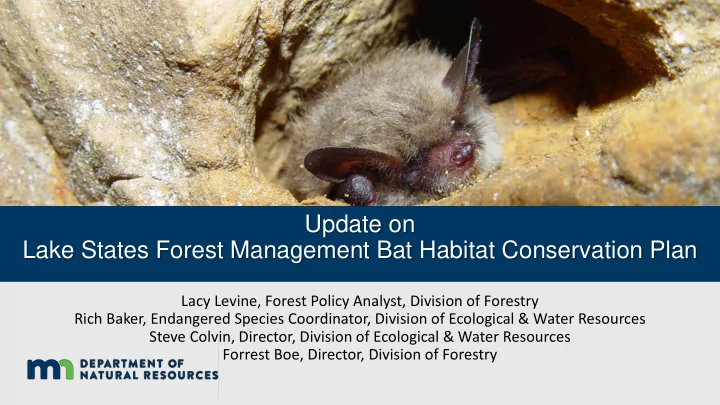
Update on Lake States Forest Management Bat Habitat Conservation Plan Lacy Levine, Forest Policy Analyst, Division of Forestry Rich Baker, Endangered Species Coordinator, Division of Ecological & Water Resources Steve Colvin, Director,
SLIDE 2
SLIDE 3
- White Nose Syndrome
- Has been spreading since 2006
- First mortalities in Minnesota in March
2016
- Up to 98% mortality in Minnesota as of
2020
- All cave-hibernating bats are impacted
- WNS causes bats to wake from hibernation
and deplete energy reserves
Why bats are in trouble
SLIDE 4
Bats and Forest Management Activities
- Many of Minnesota's bats spend spring, summer and fall in forests
- Female bats give birth to young in tree roosts.
- Before they are able to fly, young bats may be vulnerable to impact by normal forest
management activities that include tree removal.
SLIDE 5
- Indiana Bat: Listed as endangered by USFWS
(found in Michigan only)
Tri-colored Bat: Petitioned for listing (found in all 3 states) Little Brown Bat: Under status review by USFWS (found in all 3 states) Northern Long-Eared Bat: Listed as threatened with 4(d) Rule by USFWS (found in all 3 states)
Covered Bats
SLIDE 6
Current Federal Regulations
- Northern Long-eared Bat was designated as a threatened species under the
federal Endangered Species Act (ESA) in 2015
- Threatened status provides exemption: special regulation (“4(d) Rule”) that
allows tree removal that might otherwise result in take (finalized 2016)
- The term take means to harass, harm, pursue, hunt, shoot, wound, kill, trap,
capture, or collect, or to attempt to engage in any such conduct.
- Other bat species covered by the HCP could be listed as threatened or
endangered if declines continue
SLIDE 7
- If any covered bat species are listed as
endangered, an ITP or consultation with USFWS would be required to continue activities that might result in a “take” of the species
- ITP application must include an HCP
- Minnesota, Wisconsin, and Michigan working
jointly on an HCP
- Proposed Permit Term – 50 years
HCP Reasoning
SLIDE 8
Available soon (summer 2020)
- Ch. 4 & 5 now available
for stakeholder input Initial comments received in 2018
- Ch 1: Introduction
- Ch 2: Covered Activities
- Ch 3: Environmental Setting
- Ch 4: Impacts Analysis
- Ch 5: Conservation Strategy
- Appendix E: Attributes of High-Quality Bat Habitat
in Managed Lake State Forests
- Ch 6: Implementation
- Ch 7: Funding
- Ch 8: Alternatives
Contents of the HCP & Where We Are
SLIDE 9
Relationship Between HCP Ch. 4 & 5
- Ch. 4 analysis shows covered activities
result in take (~3 bats/year)
- Ch. 5 demonstrates that this take is
- ffset by the conservation objectives of
the HCP
- Appendix E describes habitat features
that constitute high quality habitat for covered bats
SLIDE 10
HCP Chapter 4: Impacts Analysis
- Analyzed where both bats and
covered activities occur
- Direct effects of covered activities on
bats is ~3 bats per year over 50 years in Minnesota
- Indirect effects of covered activities
are neutral or beneficial Bats are Present Covered Activities
SLIDE 11
HCP Chapter 5: Conservation Strategy Overview
- Conservation strategy is organized by:
- Biological Goals – guiding principles
- Biological Objectives – how goals will be accomplished; what DNRs are
promising to do and report on annually
- Conservation Measures – potential actions that can be taken to achieve the
Biological Objectives
- Take is offset by the conservation strategy
SLIDE 12
HCP Chapter 5: Conservation Strategy
- Biological Goal #1: Maintain Healthy Forests
- Objective 1.1: Continue to manage DNR forests sustainably
- Biological Goal #2: Protect Roosts and Foraging Habitat
- Objective 2.1: Continue to implement Minnesota Forest Resources Council’s
Voluntary Site Level Forest Management Guidelines
- Objective 2.2: Protect all known maternity roost trees with 150-ft. buffer year-round
- Biological Goal #3: Promote stewardship on other lands
- Objective 3.1: Implement Landowner Enrollment Program
- Objective 3.2: Implement Bat Conservation Outreach Program
SLIDE 13
HCP Chapter 5: Conservation Strategy (continued)
- Biological Goal #4: Protect Hibernacula
- Objective 4.1: Remove obstructions from hibernacula entrances
- Objective 4.2: Protect all known hibernacula entrances with 0.25 mile buffer
year-round
- Objective 4.3: Maintain gates at hibernacula entrances
- Objective 4.4: Develop and collaborate on White-nose Syndrome Response Plan
- Biological Goal #5: Avoid/Minimize Negative Effects of Covered Activities
- Objective 5.1: Incorporate bat concerns into prescribed burn plans
- Objective 5.2: Restrict tree removal associated with road and trail construction
and maintenance when bats are present (seasonally)
SLIDE 14
Next Steps
- Ch. 4 & 5 Stakeholder Review:
- March 16 – April 30: 45 day stakeholder review period
- Chapters available at: Minnesota DNR Bat HCP Project Webpage
- Submit comments to: bathcp.dnr@state.mn.us
Moving forward:
- Ch. 6–8 will be made available for stakeholder review in ~Summer 2020
- Once all chapters of the HCP are compiled, the HCP will go through the NEPA
- process. The compiled HCP will be made available through the Federal Register
for public comment.
SLIDE 15