
SLIDE 1
unpacking the buyer decision process
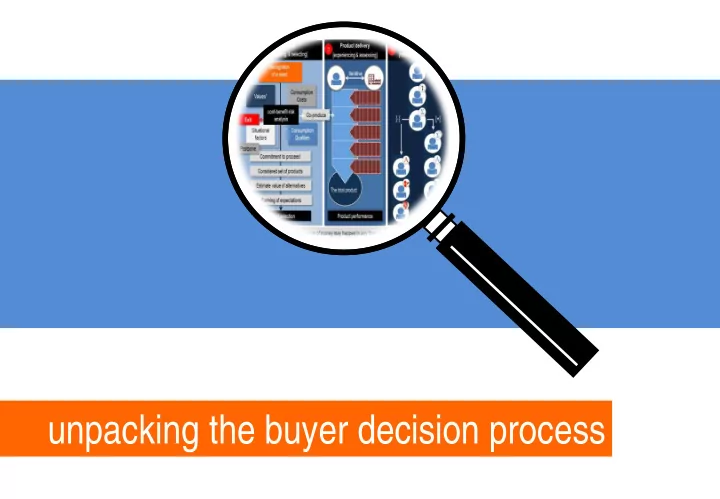
unpacking the buyer decision process Products have 3 time zones 1. - - PowerPoint PPT Presentation
unpacking the buyer decision process Products have 3 time zones 1. The purchase decision - searching & estimating The recognition of an unmet need Analysing costs - benefits - risks A commitment to proceed postpone or exit
unpacking the buyer decision process
1. The purchase decision - searching & estimating
2. The product delivery - experiencing & assessing
3. Post-purchase - reflecting & evaluating
Products have 3 time zones
Consumers act differently in the different time zones Search Experience Reflect Purchase behaviour Product delivery Post purchase Estimate Assess Evaluate
1 2 3
Consumption Costs Values1 Consumption Qualities Situational factors Commitment to proceed Considered set of products Estimate value of alternatives cost-benefit-risk analysis Recognition
Product selection Exchange of money may happen in any time-zone Postpone Exit Forming of expectations Co-create iterative Product performance
[+] [-]
Purchase behaviour Post-purchase behaviour Product delivery 3 2 1 [searching, estimating, & selecting] [experiencing & assessing] [reflecting & evaluating]
Consumption costs Values1 Consumption Qualities Situational factors cost-benefit-risk analysis Product selection Exit Market Characteristics Product Characteristics Organisation Characteristics Customer Characteristics Human Values1 Cultural Values1 Personal Values1 Money Costs Time Costs Effort Costs Functional Qualities Social Qualities Epistemic Qualities Emotional Qualities Spiritual Qualities Physical Qualities Temporal Qualities Sensory Qualities
1
Consumption costs Values1 Consumption Qualities Situational factors cost-benefit-risk analysis Product selection Exit Market Characteristics Product Characteristics Organisation Characteristics Customer Characteristics Human Values1 Cultural Values1 Personal Values1 Money Costs Time Costs Effort Costs Functional Qualities Social Qualities Epistemic Qualities Emotional Qualities Spiritual Qualities Physical Qualities Temporal Qualities Sensory Qualities
1
human cultural personal
for money Purchase behaviour is about estimating
Purchase behaviour is about estimating
qualities of value
[e.g., nutritional value of orange juice]
Consumption costs Values1 Consumption Qualities Situational factors cost-benefit-risk analysis Product selection Exit Market Characteristics Product Characteristics Organisation Characteristics Customer Characteristics Human Values1 Cultural Values1 Personal Values1 Money Costs Time Costs Effort Costs Functional Qualities Social Qualities Epistemic Qualities Emotional Qualities Spiritual Qualities Physical Qualities Temporal Qualities Sensory Qualities
1
Consumption costs Values1 Consumption Qualities Situational factors cost-benefit-risk analysis Product selection Exit Market Characteristics Product Characteristics Organisation Characteristics Customer Characteristics Human Values1 Cultural Values1 Personal Values1 Money Costs Time Costs Effort Costs Functional Qualities Social Qualities Epistemic Qualities Emotional Qualities Spiritual Qualities Physical Qualities Temporal Qualities Sensory Qualities
1
Consumption costs Consumption qualities Perceived value
When evaluating consumers estimate risks
Risk management involves the customer predicting possible negative
Cost-benefit-risk analysis The likelihood & probability of positive qualities The likelihood & probability of negative qualities
Exit Proceed
Types of risks
Costs-benefits-risk analysis Risk management strategies Acceptable risk Unacceptable risk Questionable risk
Customer characteristics Organisation characteristics Market characteristics Product characteristics
1
Recognition
Enter buyer decision process Exit the buyer decision process Continue the product selection process
Risk & situational factors [COMP]
Risk management strategies
trusted people
know....]
process
Organisations build brands to reduce the consumer’s perceptions of risk
A purpose of a brand is to reduce the risk for customers and organisations
Pre-purchase risks often become product qualities
Functional Social Epistemic Emotional Spiritual Physical Temporal Sensory
Consumption costs Values1 Consumption Qualities Situational factors cost-benefit-risk analysis Product selection Exit Market Characteristics Product Characteristics Organisation Characteristics Customer Characteristics Human Values1 Cultural Values1 Personal Values1 Money Costs Time Costs Effort Costs Functional Qualities Social Qualities Epistemic Qualities Emotional Qualities Spiritual Qualities Physical Qualities Temporal Qualities Sensory Qualities
1
Decision-making roles
The initiator: a person[s] who identifies the product as a
means to satisfying a need
The influencer: a person[s] who encourages or discourages
further consideration
The decider: a person who has the final say regarding
if/what/when/where/how a product will be purchased
The purchaser: the person who completes the exchange The user: the person[s] who consumes/uses the product syncretic decision
= autocratic decision
Consumption costs Values1 Consumption Qualities Situational factors cost-benefit-risk analysis Product selection Exit Market Characteristics Product Characteristics Organisation Characteristics Customer Characteristics Human Values1 Cultural Values1 Personal Values1 Money Costs Time Costs Effort Costs Functional Qualities Social Qualities Epistemic Qualities Emotional Qualities Spiritual Qualities Physical Qualities Temporal Qualities Sensory Qualities
1
Consumption costs Values1 Consumption Qualities Situational factors cost-benefit-risk analysis Product selection Exit Market Characteristics Product Characteristics Organisation Characteristics Customer Characteristics Human Values1 Cultural Values1 Personal Values1 Money Costs Time Costs Effort Costs Functional Qualities Social Qualities Epistemic Qualities Emotional Qualities Spiritual Qualities Physical Qualities Temporal Qualities Sensory Qualities
1
Consumption costs Values1 Consumption Qualities Situational factors cost-benefit-risk analysis Product selection Exit Market Characteristics Product Characteristics Organisation Characteristics Customer Characteristics Human Values1 Cultural Values1 Personal Values1 Money Costs Time Costs Effort Costs Functional Qualities Social Qualities Epistemic Qualities Emotional Qualities Spiritual Qualities Physical Qualities Temporal Qualities Sensory Qualities
1
Consumption costs Values1 Consumption Qualities Situational factors cost-benefit-risk analysis Product selection Exit Market Characteristics Product Characteristics Organisation Characteristics Customer Characteristics Human Values1 Cultural Values1 Personal Values1 Money Costs Time Costs Effort Costs Functional Qualities Social Qualities Epistemic Qualities Emotional Qualities Spiritual Qualities Physical Qualities Temporal Qualities Sensory Qualities
1
Consumption costs Values1 Consumption Qualities Situational factors cost-benefit-risk analysis Product selection Exit Market Characteristics Product Characteristics Organisation Characteristics Customer Characteristics Human Values1 Cultural Values1 Personal Values1 Money Costs Time Costs Effort Costs Functional Qualities Social Qualities Epistemic Qualities Emotional Qualities Spiritual Qualities Physical Qualities Temporal Qualities Sensory Qualities
1
Consumption costs Values1 Consumption Qualities Situational factors cost-benefit-risk analysis Product selection Exit Market Characteristics Product Characteristics Organisation Characteristics Customer Characteristics Human Values1 Cultural Values1 Personal Values1 Money Costs Time Costs Effort Costs Functional Qualities Social Qualities Epistemic Qualities Emotional Qualities Spiritual Qualities Physical Qualities Temporal Qualities Sensory Qualities
1
Routine decision making Limited decision making Extensive decision making
Low involvement, low costs, frequently purchased, familiar, generally low risk Higher involvement, higher costs, infrequently purchased, unfamiliar, generally higher risk
varies with product & influences consumer decision-making
Impulse decision making
involvement
Product selection
Routine decision making Limited decision making Extensive decision making
Low involvement, low costs, frequently purchased, familiar, generally low risk Higher involvement, higher costs, infrequently purchased, unfamiliar, generally higher risk
Product selection
Impulse decision making Peripheral route of persuasion Central route of persuasion
Communication strategy will vary according to customer decision-making
Consumers search for information to make
Searching & decision-making
All possible products/brands
discovered products/brands known products/brands unacceptable undiscovered products/brands ‘Listed’ acceptable indifference
Refined ‘considered set’
Estimate the value
alternatives Product selection
[decision-making]
Positive attitude Positive expectations
2 3
&
Searching for information
What do I already know What do I need to know I am unfamiliar with the product & need further information I am familiar with the product & need no further information
Internal search External search What do I need to know? Who/what/where are the best sources
?
Searching previous experiences
Retrieving familiar products/brands:
Internal search
attitudes
social print television billboards sponsorship email mobile direct mail website POP brochures SEO
External search may include a wide spectrum of media
Considered set of products
are worth further consideration
are then removed from ‘the list’
in the list of ‘alternative products’ for further analysis
Create brand awareness
the ability of the consumer to recollect a product/brand after obtaining further information the ability of the consumer to link their need to a product/brand without obtaining further information
Brand recall Brand recognition
Th The or
anisa sation
ve i is to to
Decision-making rules
adapt their decision-making to suit the situation
elements
perceptions of values2,3
Multi-attribute attitude model
consumer can identify as being embedded within the product
benefits of the product attributes[+-] based on their perceived product
estimation the more likely the product will be considered.
importance [hierarchy] of each attribute to a particular consumer.
Searching & decision-making
All possible products/brands
discovered products/brands known products/brands unacceptable undiscovered products/brands ‘Listed’ acceptable indifference
Refined ‘considered set’
Estimate the value
alternatives Product selection
[decision-making]
Positive attitude Positive expectations
2 3
&
[decision-making rules]
performance attribute score to identify acceptable products. It is referred to as ‘compensatory’ as consumers will cognitively ‘compensate’ each product across all the embedded attributes – calculate an average across all product attributes
including products that have unacceptable money, time, or effort costs. The disjunctive rule is considering products that have acceptable product attributes
across relevant attributes, then estimates the product attributes and removes the products with the lowest performance attribute score until one product stands out
products have equal ranking then the consumer searches further to determine the product with the highest overall rating across all attributes plus one determinant attribute
perceived trust
[decision-making rules]
marketers call this the expected product consumers enter every exchange with
Based on this information
Product selection creates expectations
✓
✘ ✘ ✘ ✘ ✘ ✘
Consumer expectations of a best satisfying product The product selection process creates
During the product selection step customer predict expectation scenarios
Ideal Equitable
[augmented product]
Predictive[expected product] Adequate
[core product]
Unacceptable
No one would enter an exchange with an expected an overall negative outcome
A consumer would not enter an exchange if they expected a negative outcome.
Satisfaction is about reflecting & evaluating