
SLIDE 1
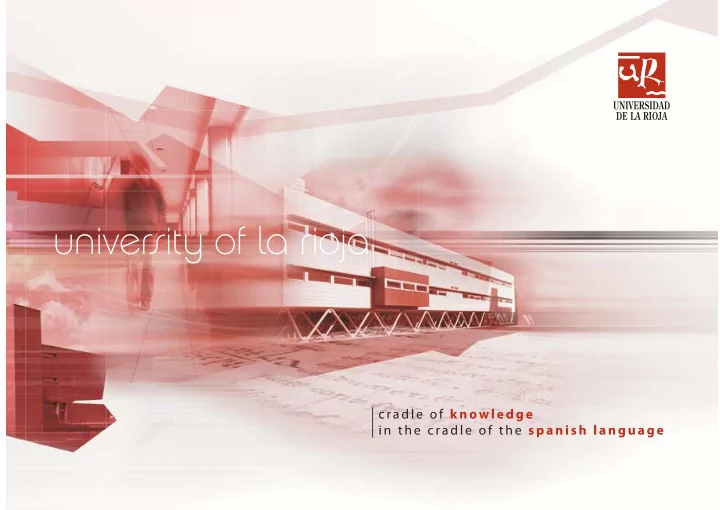
university of la rioja university of la rioja The University of La - - PowerPoint PPT Presentation
university of la rioja university of la rioja The University of La Rioja (UR) currently It is the only Higher Education institution teaches 7,500 students enrolled in one in the Autonomous Region of La Rioja of its 26 officially recognised
The University of La Rioja (UR) currently teaches 7,500 students enrolled in one
courses and postgraduate courses and programmes for master’s degrees and
que area within the city of Logroño, ca- pital of La Rioja, and it is an ideal size for the integral training and development
It is the only Higher Education institution in the Autonomous Region of La Rioja devoted to the multiple tasks of tea- ching, research, dissemination of culture and innovation. Located in the North of Spain, La Rioja is a modern, hospitable region with a very high quality of life, best known for its famous wine and as being regarded as the cradle of the Spa- nish language. Some time between the 10th and 11th centuries, in the Monasteries of San Millán de la Cogolla, declared a World Heritage Site in 1996, the first known words in Spanish language were written by monks –preserved in the Codices 60 and 46– and it was here that the first known poet, Gonzalo de Berceo lived. Our emblem is formed by the initials of the University of La Rioja using the calli- graphy of the two codices.
The University of La Rioja (UR) currently teaches 7,500 students enrolled in one of its 26 officially recognised degree courses and postgraduate courses and programmes for master’s degrees and doctorates. It is the only campus in the Autonomous Region
Founded in 1992, the University of La Rioja has established a campus model which is specially designed to benefit the conditions of study of its alumni, as well as the teaching and research work of its almost five hundred teachers. The campus is located on a 200,000 square metre site a stone’s throw from the centre
together all the University buildings, from the administration building to the library, sports centre or classrooms and lecture halls. Teachers and students can easily get around it on foot. Thus, the University of La Rioja
close contacts with teachers, free access to computer rooms in each building, newly inaugurated sports facilities, and special discounts in shops for university students.
The key to our teaching system is the creation of the conditions necessary for the individualised, integral training of
we instil professionals with the critical spirit that today’s world demands. At the beginning of their studies, each student is assigned a personal tutor or supervisor, a teacher from his degree course who provides guidance and su- pport during the period of study. Mo- reover, during the so-called Induction Programme for new students, they recei- ve information and guidance regarding the services and facilities available on campus (library, computer rooms, study areas, sports hall, multimedia laboratory, language laboratory, etc.) and the cha- racteristics of their courses. Throughout their courses, students at the University of La Rioja can choose a series of studies that make up the vario- us different Curricular skills (Legal, Scien- tific and Technical English, Information Technology, Communication and Mana- gerial Skills) while, with the support of a personal supervisor, they can design their own professional profile by taking advantage of the offer of subsidiary and
The University of La Rioja complements the theoretical training of the students with period of practical work placements in companies, evaluated as part of the academic curriculum. The campus has agreements with 1,000 local companies and bodies with which it has links to provide, in practice, work experience to 75% of all students. It is the first step to access to the jobs market.
The University of La Rioja participates in international student mobility schemes, such as Socrates (Erasmus, Leonardo da Vinci) or Americampus, and has also signed bilateral agreements with
to complement their studies in 94 universities in around thirty regions of Europe, America and Australia.
The University of La Rioja only requires that its students who want to study abroad shall have passed a third of the academic content of their degree course. In return, the experience gives them courses to improve their knowledge of the language of the country they will be studying in, advice on accommodation and maintenance, as well as a grant co-funded by the European Union and Caja Rioja savings bank. The European Credit Transfer System grew out of the Socrates-Erasmus programme, but it has equivalence for students from outside Europe. It includes the time dedicated to attending classes, private study, preparation and sitting of examinations, etc. The ECTS scheme allows the University of La Rioja and the rest of the campuses, to guarantee the education of those students who travel from their country of origin. Based on the students’ workload, it facilitates student mobility by making the programmes of study comprehensible and comparable for local and foreign students.
The size of the campus, located within the boundaries of a city of just 147,000 inhabitants, guarantees an ideal atmos- phere of cultural immersion for learning Spanish as a Foreign Language. The Au- tonomous Region of La Rioja has the honour of being the home of the monas- teries of Yuso and Suso in San Millán de la Cogolla. In around the 10th or 11th centuries, in these monasteries, declared a World Heritage Site in 1996, the first known words in our language were written by monks in the Codices 60 and 46. La Rioja is the cradle of the Spanish language, a booming language which is today spoken by over 400 million people around the world. The University of La Rioja, heirs of the thousand-year-old legacy of this medie- val scriptorium, today fosters research into the roots of the Spanish language and study of the Spanish language and
examination centres of the Cervantes Institute, which allows you to obtain the DELE, and delivers courses in Spanish language and culture at various levels as well as a Master’s degree in metho- dology for Spanish teachers in foreign teaching centres. Two teachers from the University of La Rioja presented a study which placed the date of the origin of the Spanish language a century earlier than previo- usly thought, as a result of their resear- ch on Codex 46, an invaluable medieval encyclopaedia with marginal notes writ- ten in a form of Low Latin full of errors and vulgarisms, which can be regarded as the earliest form of the Castilian language.
Research at the University of La Rioja has its roots in the distinguishing featu- res of our Autonomous Region. The qua- lity of Rioja appellation wines led to the creation of a degree in Oenology, ma- king the University of La Rioja the first in Spain to offer a university course in this area. The facilities of the modern Science and Technology Complex, inaugurated by the King and Queen of Spain, include an experimental winery in which stu- dents and teachers grow vines, make and bottle their own wine. These facili- ties, currently being expanded, permit research and innovation projects to be undertaken for the most important eco- nomic sector of the Autonomous Region
The University of La Rioja manages 90%
ticipates in the subsidised projects of the R&D Plan of La Rioja promoted by the regional Government.
The University Library is located at the heart of the campus, only a short distance from each building. It has been awarded one of the very few Quality Certificates given by the Ministry of Education to Spanish universities in general. As well as access to reference books in special rooms, personal and group study stations or the European Documentation Centre, the University has also joined the DIALNET project. DIALNET is the biggest data base of freely accessible scientific articles in the Spanish
and has a stock of 400,000 articles and 10,000 subscribers from the scientific community worldwide. The buildings of the University of La Rioja are equipped with computer rooms which are freely available to students. These rooms have PCs with useful applications for the students’ personal work and access to Internet. The whole
Fi technology permitting access to the net without cables and lap-top computers can also be borrowed. The University of La Rioja has understo-
integrated the use of New Information Technologies as something natural. It is the first public Spanish University to deliver official qualifications entirely via
ted and, at the present time, one fifth of its students follow their courses on-line through the virtual campus, without any need to travel physically to the university. This pioneering experience has served for the development of other initiatives, such as the Mixed teaching model, which combines the traditional system of tea- ching with resources made available to the students on the Internet. Or the Sha- red Virtual Campus, in which the Univer- sity of La Rioja and eight other Spanish campuses offer subjects jointly to over 200,000 students.
In the University of La Rioja we are aware that the integral preparation of our students requires complements to academic study, such as sports or cultural activities. The University Sports Centre is the heart of the campus sporting spirit. Here it is possible to take part in official and high performance sports activities –individual and team sports–, do activities such as yoga, tai chi, aikido dance, aerobics, keep-fits or excursions for skiing, canoeing, etc. Our student Sara Martínez was World University Games Champion in Taekwondo in Berkeley (USA) in 2002. The Iberdrola Centre for Mineralogy and Palaeontology is a place for disseminating information about fossil remains from sites with dinosaur prints in La Rioja, considered to be the most abundant in the world. In summer, students take part in work camps for the restoration and preservation of these prints. Leading figures from the world of culture, science and politics pass through the classrooms of the University of La Rioja over the course of the academic year, for conferences, seminars and workshops. During the summer, activity transfers to other venues, such as Geneva (Switzerland), Calahorra –birthplace of the Roman orator Quintilian-, Santo Domingo de la Calzada– key stopping place on the St. James’ Way-
Students can choose to live in university residences, on the campus itself or in the centre of the city. The University of La Rioja also provides a web page service with details of privately-owned shared flats and rooms to rent for students.
The University of La Rioja is on the outskirts of the city, but only a stone’s throw from the centre. Logroño, capital of La Rioja, has a population of 147,000 in its metropolitan area, and all the services and amenities of a modern capital, but with a comfortable, human size. Logroño is about an hour’s drive from neighbouring cities such as Bilbao or Pamplona. By air, in the same time, there are various daily flights from the local airport to Barcelona or Madrid, Spain’s capital city, connecting with international flights.
La Rioja is one of the 17 Autonomous Communities into which the Spanish state is divided. Its 300,000 inhabitants enjoy good quality of life, with an eco- nomy approaching full employment and a high level of public safety. La Rioja is a region rich in history, culture, heritage and traditions. In addition it is only a short distance from cities like Bilbao, with the impressive Guggenheim Mu- seum designed by Frank O.Gehry, or Pamplona, whose bull-runs during the fiestas of San Fermín were made world famous by Ernest Hemingway. La Rioja is a fertile region, world famous for its wines, crossed by the River Ebro which gives the Iberian Peninsula its name and the St. James’ Way, the most important pilgrims’ route in all Christen-
for their open, cheerful, hospitable cha- racter with all those who visit them. They shower their guests with the best of the region’s cuisine, in which the calle Laurel is the most typical and liveliest place to meet in Logroño, offering its wines and a range of original bar snacks or ‘tapas’. Logroño is culturally a lively city. The Actual Festival is a date not to be missed by all those who, with the arrival of the New Year, want to know the latest trends in music, films and art. In addition, throughout the year, the city’s Bretón Theatre plays host to the best theatrical companies and shows of the season (with student discounts). “Rioja and the Five Senses” is a cultural festival devoted to wine, right in the middle of harvest time, with talks, concerts, exhibitions, tastings, etc. The sixty cinema screens with the best new films, the shows at the Riojaforum Congress Centre and Auditorium, the route of the monasteries (Cañas, Nájera, Valvanera) or the Dinastía Vivanco Mu- seum of the Culture of Wine – including exhibits from Ancient Egypt - offer op- portunities to enjoy culture in Logroño and the rest of La Rioja. Calahorra, the second biggest city in La Rioja after Logroño, was an important enclave of the Roman Empire. Nájera, cradle of kings, was the ancient capital
wine capital, is home to most of the
can be visited as part of an itinerary (like the monasteries). Alfaro has the largest colony of storks in Europe. Enciso and Igea have some of the most important dinosaur fossil print sites in the world. In Ezcaray, a lovely town which sits at the foot of the mountains, you can go skiing in winter and listen to jazz in the summer. There is much more, but you will have to come and find it for yourself. We are waiting for you.