SLIDE 1
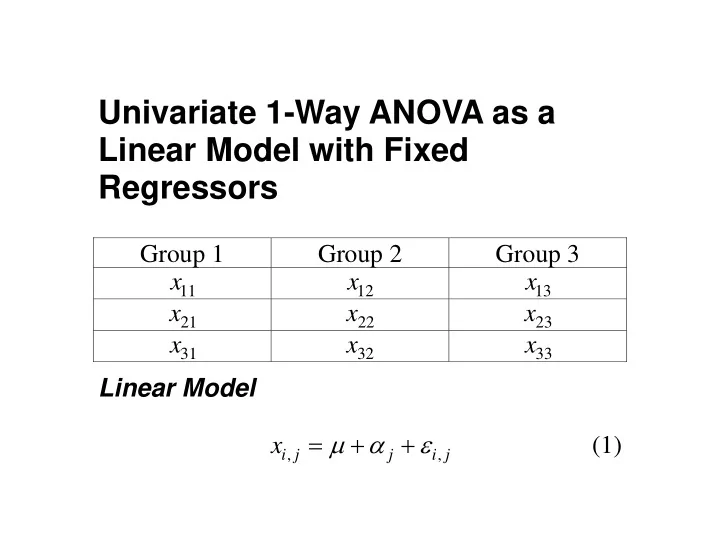
Univariate 1-Way ANOVA as a Linear Model with Fixed Regressors
Group 1 Group 2 Group 3
11
x
12
x
13
x
21
x
22
x
23
x
31
x
32
x
33
x Linear Model
, , i j j i j
x μ α ε = + + (1)
SLIDE 2 Reparameterized Linear Model
, , i j j i j
x μ ε = + (2) Matrix Form = x D ε μ + (3) D is a “design matrix” with 1’s and 0’s, and
[ ]
1 2 J
α α α μ ′ μ =
SLIDE 3
Example.
1,1 1,1 2,1 2,1 3,1 3,1 1 1,2 1,2 2 2,2 2,2 3 3,2 3,2 1,3 1,3 2,3 2,3 3,3 3,3
1 1 1 1 1 1 1 1 1 1 1 1 1 1 1 1 1 1 x x x x x x x x x ε ε ε α ε α ε α ε μ ε ε ε ⎡ ⎤ ⎡ ⎤ ⎡ ⎤ ⎢ ⎥ ⎢ ⎢ ⎥ ⎢ ⎥ ⎢ ⎢ ⎥ ⎢ ⎥ ⎢ ⎢ ⎥ ⎡ ⎤ ⎢ ⎥ ⎢ ⎢ ⎥ ⎢ ⎥ ⎢ ⎥ ⎢ ⎢ ⎥ ⎢ ⎥ ⎢ ⎥ ⎢ = + ⎢ ⎥ ⎢ ⎥ ⎢ ⎥ ⎢ ⎢ ⎥ ⎢ ⎥ ⎢ ⎥ ⎢ ⎢ ⎥ ⎣ ⎦ ⎢ ⎥ ⎢ ⎢ ⎥ ⎢ ⎥ ⎢ ⎢ ⎥ ⎢ ⎥ ⎢ ⎢ ⎥ ⎢ ⎥ ⎢ ⎢ ⎥ ⎣ ⎦ ⎣ ⎦ ⎣ ⎥ ⎥ ⎥ ⎥ ⎥ ⎥ ⎥ ⎥ ⎥ ⎥ ⎥ ⎥ ⎦ (5)
SLIDE 4
Notice that the D matrix is not of full rank. (Why not? C.P.) D is of rank 3. We can partition D into two sub- matrices, one of which is full rank, and the other of which contains columns that are “superfluous” in the sense that they are linearly dependent.
[ ]
1 2
= D D D (6) We can similarly partition
SLIDE 5
⎡ ⎤ ⎢ ⎥ ⎣ ⎦
1 2
μ μ = μ (7) Note that we could redefine μ as
1 1 2 2 3 3
μ α μ μ α μ μ α μ + ⎡ ⎤ ⎡ ⎤ ⎢ ⎥ ⎢ ⎥ = + = ⎢ ⎥ ⎢ ⎥ + ⎢ ⎥ ⎢ ⎥ ⎣ ⎦ ⎣ ⎦
∗
μ (8) In which case
1
= + x D
∗
μ ε (9)
SLIDE 6
The null hypothesis in ANOVA can be expressed as a “general linear hypothesis” of the form ′ H
∗
μ = 0 (10) Let’s try it. Suppose 1 1 1 1 − ⎡ ⎤ ′ = ⎢ ⎥ − ⎣ ⎦ H (11) Then
SLIDE 7
1 3 1 3 2 3 2 3
α μ α μ α α α μ α μ α α + − − − ⎡ ⎤ ⎡ ⎤ ′ = = ⎢ ⎥ ⎢ ⎥ + − − − ⎣ ⎦ ⎣ ⎦ H
∗
μ (12) Notice that if both elements of the expression on the right in Equation (12) are equal, then all 3
j
α must be equal, and the null hypothesis of equal means must be true. Notice also that there are infinitely many ways you can write a “hypothesis matrix” H that expresses
SLIDE 8 the same null hypothesis. All of them will be of rank 2, or, in the case of J groups, 1 J − . Let ′ H be of order p q × , and let x have N
- elements. (Note that this N is the total N in the case
- f ANOVA.)
Under H , the following statistic has an F distribution:
SLIDE 9 ( ) ( ) ( ) ( )
1 1 1 1 1 1 1 1 1 1 1 1 , 1 1 1 1 1 p N q
p F N q
− − − − − −
⎡ ⎤ ′ ′ ′ ′ ′ ′ ′ ⎢ ⎥ ⎣ ⎦ = ⎡ ⎤ ′ ′ ′ − ⎢ ⎥ ⎣ ⎦ − x D D D H H D D H H D D D x x I D D D D x
(13) This looks incomprehensible at first glance! Let’s examine the formula with reference to our simple 3 group ANOVA example, and let’s assume that sample sizes are equal in all groups. Look closely at the denominator. Note that it is the complementary projection operator for the column
SLIDE 10 space of
1
D . So the entire denominator can be written as
* *
′ ′ =
1 1
D D
x Q Q x x x . So it is a sum of squares of the projection of x into the space
- rthogonal simultaneously to all the columns of
1
D . If you study
1
D , you will see that in order for x to simultaneously be orthogonal to all the columns
1
D , each group of 3 scores must have a sum of zero for its group. So this is just a fancy way of computing mean square within. Now consider the matrix expression in the
- numerator. Recognizing that
SLIDE 11
( )
1 1 1 1 −
′ ′ = D D D x x (14) On the left and the right, we have expressions of the form ′ x and x. Now, with equal n per group, it is easy to see that
1 1
n ′ = D D I (15) and so we can write the entire numerator matrix expression as
SLIDE 12
( )
1 1
n n
− −
′ ′ ′ ′ =
H
x H H IH H x x P x (16) At this point, deciphering the meaning of Equation (16) requires us to take a step back and look at
H
P . It is a column space projector for H, which has two columns in 3 dimensional space. But note that these two columns are both orthogonal to the unit vector 1, and are linearly independent. Consequently, they span the space orthogonal to 1, and so it must be that ′ = = − = − ′
H 1 1
11 P Q I P I 1 1. Consequently, the matrix quantity in Equation (16)
SLIDE 13
is simply n times the sum of squared deviations of the sample means around their overall mean. Since p in equation (13) is one less than the number of groups, we recognize that the entire expression is simply
2 2
ˆ nS F σ =
x
(17)
SLIDE 14
Two-Way ANOVA Notice that in the model
1
= x D ε
∗
μ + , all the scores in the experiment are in a single vector x, and in the hypothesis statement of Equation (10), all the means are in a single vector. Moreover, the F statistic depends on the data, N, and just two matrix quantities, i.e., the hypothesis matrix H and the design matrix
1
D . The design matrix is a simple function of the linear model in scalar form (i.e., Equation (2). However, it is less obvious how to
SLIDE 15
construct the hypothesis matrices for row, column, and interaction, effects. We need a heuristic! Constructing the Hypothesis Matrix For simplicity, suppose we have a 2 2 × ANOVA, with 2 observations per cell. The cell means are
1,1 1,2 2,1 2,2
μ μ μ μ ⎡ ⎤ = ⎢ ⎥ ⎣ ⎦ U (18)
SLIDE 16 Notice that it is easy to write the null hypothesis in the form = AUB
hypothesis for rows as
[ ]
1,1 1,2 2,1 2,2 1,1 1,2 2,1 2,2
1 : 1 1 1 ( ) H μ μ μ μ μ μ μ μ ⎡ ⎤ ⎡ ⎤ − ⎢ ⎥ ⎢ ⎥ ⎣ ⎦ ⎣ ⎦ = + − + = (19) This can be written
0 :
H = OU1 (20)
SLIDE 17
We call O an omnibus contrast matrix, and it is always of the same basic form, i.e.,
[ ]
= − O I 1 (21) (Examples. C.P.) In a similar vein, we can write the column effect null hypothesis as
[ ]
1,1 1,2 2,1 2,2 1,1 2,1 1,2 2,2
1 : 1 1 1 ( ) H μ μ μ μ μ μ μ μ ⎡ ⎤ ⎡ ⎤ ⎢ ⎥ ⎢ ⎥ − ⎣ ⎦ ⎣ ⎦ = + − + = (22)
SLIDE 18
This is of the form
0 :
H ′ ′ = 1 UO (23) The interaction null hypothesis is that there are no differences of differences, and consequently is of the form
0 :
H ′ = OUO (24) (C.P. Write the null hypotheses for a 3 2 × Anova row effect.)
SLIDE 19 (C.P. Write the null hypothesis for a simple main effect for columns at level 1 of the row effect.) As straightforward as this system is, unfortunately the null hypothesis requires all the means in a single vector μ, not in a matrix, and there is only
- ne hypothesis matrix, not two as in the examples
- above. So how do we proceed?
First, we need to define the Kronecker Product.
SLIDE 20 Kronecker (Direct) Product The Kronecker product of two matrices A and B is denoted ⊗ A B, and can be written in partitioned form as
1,1 1,2 1, 2,1 2,2 2, ,1 ,2 , q q p q r s p p p q
a a a a a a a a a ⎡ ⎤ ⎢ ⎥ ⎢ ⎥ ⊗ = ⎢ ⎥ ⎢ ⎥ ⎣ ⎦ B B B B B B A B B B B
SLIDE 21 The Kronecker product above is of order pq rs × . Kronecker products have some interesting
c X be a column vector
consisting of the columns of X stacked on top of each other. Let vec ( )
r X be a column vector
consisting of the rows of X transposed into columns and stacked on top of each other. Then
( )
vec ( ) vec ( )
c c
′ = ⊗ BSA A B S (26) and, since vec ( ) vec ( )
r c
′ = S S , we also have
SLIDE 22
( )
vec ( ) vec ( )
r r
′ = ⊗ ASB A B S (27)
( )
vec ( ) vec ( )
r r
′ = ⊗ ASB A B S (28) Consider the null hypothesis of Equation (20). This can be written as
0 :
H = OU1 0, or as
( ) ( )
0 :
vecr H ′ ⊗ = O 1 U (29)
SLIDE 23
- Example. Consider the null hypothesis of no row
effect in the 2 2 × ANOVA.
( ) [ ] [ ]
( )
[ ]
1,1 1,2 2,1 2,2 1,1 1,2 2,1 2,2
1 1 1 1 1 1 1 1 μ μ μ μ μ μ μ μ ⎡ ⎤ ⎢ ⎥ ⎢ ⎥ ′ ⊗ = − ⊗ ⎢ ⎥ ⎢ ⎥ ⎣ ⎦ ⎡ ⎤ ⎢ ⎥ ⎢ ⎥ = − − ⎢ ⎥ ⎢ ⎥ ⎣ ⎦ O 1 μ
(30)
SLIDE 24
Equation (30) gives (
) ( )
1,1 1,2 2,1 2,2
μ μ μ μ + − + , which is the quantity that is zero when there is no row main effect.
SLIDE 25 General Specification of the Hypothesis Matrix in Factorial Anova
- 1. Call the effects A, B, C etc.
- 2. A conformable Omnibus Matrix for effect A is
denoted
A
O .
- 3. A conformable Summing Vector for effect A is
denoted
A
′ 1 .
, A j
′ s is a row vector conformable with factor A with a 1 in position j, and zeroes elsewhere.
SLIDE 26
- 1. To construct an H for a main effect, use an O
matrix for that effect and a summing vector for all
- ther effects.
- 2. To construct an H for an interaction effect, use
an O matrix for all effects in the interaction, and a summing vector for all effects not in the interaction.
- 3. To construct the H for a simple main effect, use
selection vector(s) to select the levels for the
SLIDE 27 simple main, then use an O matrix for the main effect tested.
) A B × ANOVA A Main Effect
A B
′ ⊗ O 1 B Main Effect
A B
′ ⊗ 1 O AB Interaction Effect
A B
⊗ O O Simple Main Effect of A at Level 1 of B
,1 A B
′ ⊗ O s
SLIDE 28
)
A B C × × ANOVA ABC Interaction Effect
A B C
⊗ ⊗ O O O A Main Effect
A B C
′ ′ ⊗ ⊗ O 1 1 Now that we understand how to express univariate ANOVA in matrix notation, we move on to MANOVA.