SLIDE 1
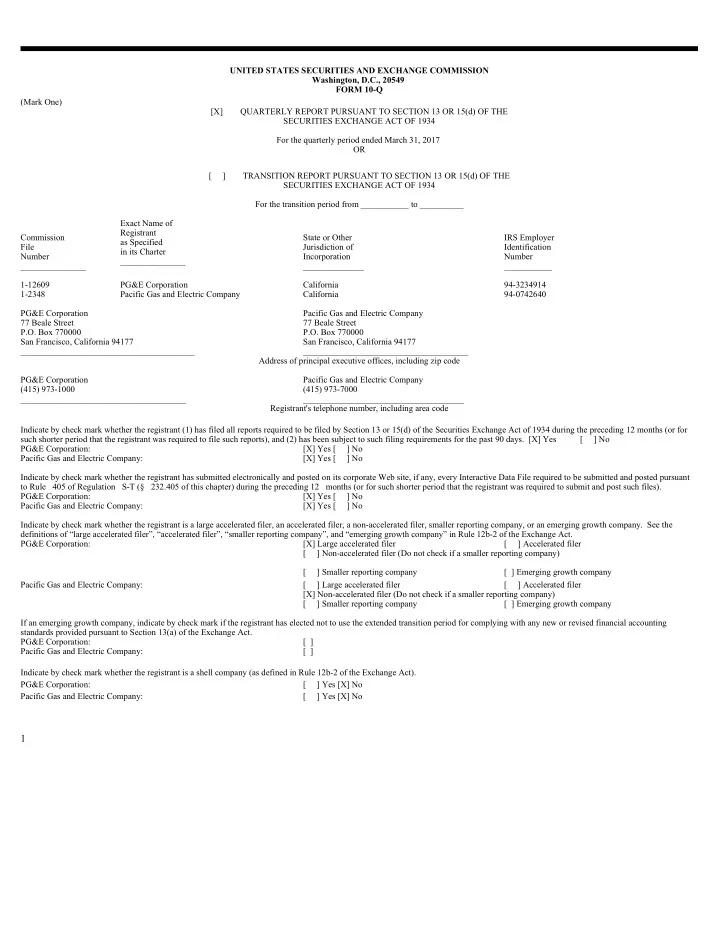
UNITED STATES SECURITIES AND EXCHANGE COMMISSION Washington, D.C., 20549 FORM 10-Q (Mark One) [X] QUARTERLY REPORT PURSUANT TO SECTION 13 OR 15(d) OF THE SECURITIES EXCHANGE ACT OF 1934 For the quarterly period ended March 31, 2017 OR [ ] TRANSITION REPORT PURSUANT TO SECTION 13 OR 15(d) OF THE SECURITIES EXCHANGE ACT OF 1934 For the transition period from ___________ to __________ Commission File Number _______________ Exact Name of Registrant as Specified in its Charter _______________ State or Other Jurisdiction of Incorporation ______________ IRS Employer Identification Number ___________ 1-12609 PG&E Corporation California 94-3234914 1-2348 Pacific Gas and Electric Company California 94-0742640 PG&E Corporation 77 Beale Street P.O. Box 770000 San Francisco, California 94177 ________________________________________ Pacific Gas and Electric Company 77 Beale Street P.O. Box 770000 San Francisco, California 94177 ______________________________________ Address of principal executive offices, including zip code PG&E Corporation (415) 973-1000 ______________________________________ Pacific Gas and Electric Company (415) 973-7000 _____________________________________ Registrant's telephone number, including area code Indicate by check mark whether the registrant (1) has filed all reports required to be filed by Section 13 or 15(d) of the Securities Exchange Act of 1934 during the preceding 12 months (or for such shorter period that the registrant was required to file such reports), and (2) has been subject to such filing requirements for the past 90 days. [X] Yes [ ] No PG&E Corporation: [X] Yes [ ] No Pacific Gas and Electric Company: [X] Yes [ ] No Indicate by check mark whether the registrant has submitted electronically and posted on its corporate Web site, if any, every Interactive Data File required to be submitted and posted pursuant to Rule 405 of Regulation S-T (§ 232.405 of this chapter) during the preceding 12 months (or for such shorter period that the registrant was required to submit and post such files). PG&E Corporation: [X] Yes [ ] No Pacific Gas and Electric Company: [X] Yes [ ] No Indicate by check mark whether the registrant is a large accelerated filer, an accelerated filer, a non-accelerated filer, smaller reporting company, or an emerging growth company. See the definitions of “large accelerated filer”, “accelerated filer”, “smaller reporting company”, and “emerging growth company” in Rule 12b-2 of the Exchange Act. PG&E Corporation: [X] Large accelerated filer [ ] Accelerated filer [ ] Non-accelerated filer (Do not check if a smaller reporting company) [ ] Smaller reporting company [ ] Emerging growth company Pacific Gas and Electric Company: [ ] Large accelerated filer [ ] Accelerated filer [X] Non-accelerated filer (Do not check if a smaller reporting company) [ ] Smaller reporting company [ ] Emerging growth company If an emerging growth company, indicate by check mark if the registrant has elected not to use the extended transition period for complying with any new or revised financial accounting standards provided pursuant to Section 13(a) of the Exchange Act. PG&E Corporation: [ ] Pacific Gas and Electric Company: [ ] Indicate by check mark whether the registrant is a shell company (as defined in Rule 12b-2 of the Exchange Act). PG&E Corporation: [ ] Yes [X] No Pacific Gas and Electric Company: [ ] Yes [X] No
1
SLIDE 2
Indicate the number of shares outstanding of each of the issuer's classes of common stock, as of the latest practicable date. Common stock outstanding as of April 24 , 2017 : PG&E Corporation: 511,000,943 Pacific Gas and Electric Company: 264,374,809
2
SLIDE 3
PG&E CORPORATION AND PACIFIC GAS AND ELECTRIC COMPANY FORM 10-Q FOR THE QUARTERLY PERIOD ENDED MARCH 31, 2017 TABLE OF CONTENTS GLOSSARY PART I. FINANCIAL INFORMATION ITEM 1. CONDENSED CONSOLIDATED FINANCIAL STATEMENTS PG&E CORPORATION CONDENSED CONSOLIDATED STATEMENTS OF INCOME CONDENSED CONSOLIDATED STATEMENTS OF COMPREHENSIVE INCOME CONDENSED CONSOLIDATED BALANCE SHEETS CONDENSED CONSOLIDATED STATEMENTS OF CASH FLOWS PACIFIC GAS AND ELECTRIC COMPANY CONDENSED CONSOLIDATED STATEMENTS OF INCOME CONDENSED CONSOLIDATED STATEMENTS OF COMPREHENSIVE INCOME CONDENSED CONSOLIDATED BALANCE SHEETS CONDENSED CONSOLIDATED STATEMENTS OF CASH FLOWS NOTES TO THE CONDENSED CONSOLIDATED FINANCIAL STATEMENTS (Unaudited) NOTE 1: ORGANIZATION AND BASIS OF PRESENTATION NOTE 2: SIGNIFICANT ACCOUNTING POLICIES NOTE 3: REGULATORY ASSETS, LIABILITIES, AND BALANCING ACCOUNTS NOTE 4: DEBT NOTE 5: EQUITY NOTE 6: EARNINGS PER SHARE NOTE 7: DERIVATIVES NOTE 8: FAIR VALUE MEASUREMENTS NOTE 9: CONTINGENCIES AND COMMITMENTS ITEM 2. MANAGEMENT’S DISCUSSION AND ANALYSIS OF FINANCIAL CONDITION AND RESULTS OF OPERATIONS OVERVIEW RESULTS OF OPERATIONS LIQUIDITY AND FINANCIAL RESOURCES ENFORCEMENT AND LITIGATION MATTERS REGULATORY MATTERS LEGISLATIVE AND REGULATORY INITIATIVES ENVIRONMENTAL MATTERS CONTRACTUAL COMMITMENTS RISK MANAGEMENT ACTIVITIES CRITICAL ACCOUNTING POLICIES ACCOUNTING STANDARDS ISSUED BUT NOT YET ADOPTED FORWARD-LOOKING STATEMENTS ITEM 3. QUANTITATIVE AND QUALITATIVE DISCLOSURES ABOUT MARKET RISK ITEM 4. CONTROLS AND PROCEDURES PART II. OTHER INFORMATION ITEM 1. LEGAL PROCEEDINGS ITEM 1A. RISK FACTORS ITEM 2. UNREGISTERED SALES OF EQUITY SECURITIES AND USE OF PROCEEDS ITEM 5. OTHER INFORMATION ITEM 6. EXHIBITS SIGNATURES 3
SLIDE 4 GLOSSARY The following terms and abbreviations appearing in the text of this report have the meanings indicated below. 2016 Form 10-K PG&E Corporation and Pacific Gas and Electric Company's combined Annual Report on Form 10-K for the year ended December 31, 2016 AB Assembly Bill AFUDC allowance for funds used during construction ALJ administrative law judge ARO asset retirement obligation ASU accounting standard update issued by the FASB (see below) CAISO California Independent System Operator Cal Fire California Department of Forestry and Fire Protection CARB California Air Resources Board CCA Community Choice Aggregator Central Coast Board Central Coast Regional Water Quality Control Board CEC California Energy Resources Conservation and Development Commission CO 2 carbon dioxide CPUC California Public Utilities Commission CRRs congestion revenue rights DER distributed energy resources Diablo Canyon Diablo Canyon nuclear power plant DOE U.S. Department of Energy DOGGR Division of Oil, Gas, and Geothermal Resources DOI U.S. Department of the Interior DTSC Department of Toxic Substances Control EMANI European Mutual Association for Nuclear Insurance EPA Environmental Protection Agency EPS earnings per common share EV electric vehicle FASB Financial Accounting Standards Board FERC Federal Energy Regulatory Commission GAAP U.S. Generally Accepted Accounting Principles GHG greenhouse gas GRC general rate case GT&S gas transmission and storage GWH gigawatt-hours IOU(s) investor-owned utility(ies) IRS Internal Revenue Service LTIP long-term incentive plan MD&A Management’s Discussion and Analysis of Financial Condition and Results of Operations set forth in Item 2, of this Form 10-Q MOU memorandum of understanding NAV net asset value NDCTP Nuclear Decommissioning Cost Triennial Proceedings NEIL Nuclear Electric Insurance Limited NEM net energy metering NERC North American Electric Reliability Corporation NRC Nuclear Regulatory Commission NTSB National Transportation Safety Board OEM
- riginal equipment manufacturer
OII
- rder instituting investigation
ORA Office of Ratepayer Advocates 4
SLIDE 5
PD proposed decision PHSMA Pipeline and Hazardous Materials Safety Administration QF qualifying facility Regional Board California Regional Water Quality Control Board, Lahontan Region RFO requests for offers ROE return on equity RPS renewable portfolio standards SB Senate Bill SEC U.S. Securities and Exchange Commission SED Safety and Enforcement Division of the CPUC TE transportation electrification TO transmission owner TURN The Utility Reform Network Utility Pacific Gas and Electric Company VIE(s) variable interest entity(ies) WECC Western Electricity Coordinating Council Westinghouse Westinghouse Electric Company, LLC 5
SLIDE 6
PART I. FINANCIAL INFORMATION ITEM 1. CONDENSED CONSOLIDATED FINANCIAL STATEMENTS PG&E CORPORATION CONDENSED CONSOLIDATED STATEMENTS OF INCOME (Unaudited) Three Months Ended March 31, (in millions, except per share amounts) 2017 2016 Operating Revenues Electric $ 3,065 $ 3,131 Natural gas 1,203 843 Total operating revenues 4,268 3,974 Operating Expenses Cost of electricity 847 950 Cost of natural gas 325 222 Operating and maintenance 1,504 2,010 Depreciation, amortization, and decommissioning 712 697 Total operating expenses 3,388 3,879 Operating Income 880 95 Interest income 5 4 Interest expense (218) (203) Other income, net 21 27 Income (Loss) Before Income Taxes 688 (77) Income tax provision (benefit) 109 (187) Net Income 579 110 Preferred stock dividend requirement of subsidiary 3 3 Income Available for Common Shareholders $ 576 $ 107 Weighted Average Common Shares Outstanding, Basic 508 493 Weighted Average Common Shares Outstanding, Diluted 511 495 Net Earnings Per Common Share, Basic $ 1.13 $ 0.22 Net Earnings Per Common Share, Diluted $ 1.13 $ 0.22 Dividends Declared Per Common Share $ 0.49 $ 0.46 See accompanying Notes to the Condensed Consolidated Financial Statements. 6
SLIDE 7 PG&E CORPORATION CONDENSED CONSOLIDATED STATEMENTS OF COMPREHENSIVE INCOME (Unaudited) Three Months Ended March 31, (in millions) 2017 2016 Net Income $ 579 $ 110 Other Comprehensive Income Pension and other postretirement benefit plans obligations (net of taxes of $0 and $0, at respective dates)
- Total other comprehensive income (loss)
- Comprehensive Income
579 110 Preferred stock dividend requirement of subsidiary 3 3 Comprehensive Income Attributable to Common Shareholders $ 576 $ 107 See accompanying Notes to the Condensed Consolidated Financial Statements. 7
SLIDE 8
PG&E CORPORATION CONDENSED CONSOLIDATED BALANCE SHEETS (Unaudited) Balance At March 31, December 31, (in millions) 2017 2016 ASSETS Current Assets Cash and cash equivalents $ 164 $ 177 Restricted cash 7 7 Accounts receivable: Customers (net of allowance for doubtful accounts of $59 and $58 at respective dates) 1,197 1,252 Accrued unbilled revenue 773 1,098 Regulatory balancing accounts 1,655 1,500 Other 799 801 Regulatory assets 486 423 Inventories: Gas stored underground and fuel oil 96 117 Materials and supplies 369 346 Income taxes receivable 160 160 Other 274 283 Total current assets 5,980 6,164 Property, Plant, and Equipment Electric 53,074 52,556 Gas 18,045 17,853 Construction work in progress 2,446 2,184 Other 2 2 Total property, plant, and equipment 73,567 72,595 Accumulated depreciation (22,487) (22,014) Net property, plant, and equipment 51,080 50,581 Other Noncurrent Assets Regulatory assets 8,089 7,951 Nuclear decommissioning trusts 2,701 2,606 Income taxes receivable 70 70 Other 1,244 1,226 Total other noncurrent assets 12,104 11,853 TOTAL ASSETS $ 69,164 $ 68,598 See accompanying Notes to the Condensed Consolidated Financial Statements. 8
SLIDE 9
PG&E CORPORATION CONDENSED CONSOLIDATED BALANCE SHEETS (Unaudited) Balance At March 31, December 31, (in millions, except share amounts) 2017 2016 LIABILITIES AND EQUITY Current Liabilities Short-term borrowings $ 763 $ 1,516 Long-term debt, classified as current 700 700 Accounts payable: Trade creditors 1,117 1,495 Regulatory balancing accounts 908 645 Other 632 433 Disputed claims and customer refunds 236 236 Interest payable 168 216 Other 2,014 2,323 Total current liabilities 6,538 7,564 Noncurrent Liabilities Long-term debt 16,813 16,220 Regulatory liabilities 6,991 6,805 Pension and other postretirement benefits 2,666 2,641 Asset retirement obligations 4,716 4,684 Deferred income taxes 10,488 10,213 Other 2,347 2,279 Total noncurrent liabilities 44,021 42,842 Commitments and Contingencies (Note 9) Equity Shareholders' Equity Common stock, no par value, authorized 800,000,000 shares; 510,610,267 and 506,891,874 shares outstanding at respective dates 12,292 12,198 Reinvested earnings 6,070 5,751 Accumulated other comprehensive loss (9) (9) Total shareholders' equity 18,353 17,940 Noncontrolling Interest - Preferred Stock of Subsidiary 252 252 Total equity 18,605 18,192 TOTAL LIABILITIES AND EQUITY $ 69,164 $ 68,598 See accompanying Notes to the Condensed Consolidated Financial Statements. 9
SLIDE 10 PG&E CORPORATION CONDENSED CONSOLIDATED STATEMENTS OF CASH FLOWS (Unaudited) Three Months Ended March 31, (in millions) 2017 2016 Cash Flows from Operating Activities Net income $ 579 $ 110 Adjustments to reconcile net income to net cash provided by
Depreciation, amortization, and decommissioning 712 697 Allowance for equity funds used during construction (19) (27) Deferred income taxes and tax credits, net 252 117 Disallowed capital expenditures
Other 8 73 Effect of changes in operating assets and liabilities: Accounts receivable 373 210 Butte-related insurance receivable (7)
(2) (14) Accounts payable (13) (65) Butte-related third-party claims (44)
- Income taxes receivable/payable
- (75)
Other current assets and liabilities (137) 179 Regulatory assets, liabilities, and balancing accounts, net (176) (87) Other noncurrent assets and liabilities 48 (117) Net cash provided by operating activities 1,574 1,088 Cash Flows from Investing Activities Capital expenditures (1,216) (1,229) Proceeds from sales and maturities of nuclear decommissioning trust investments 470 439 Purchases of nuclear decommissioning trust investments (493) (463) Other 4 3 Net cash used in investing activities (1,235) (1,250) Cash Flows from Financing Activities Net issuances (repayments) of commercial paper, net of discount of $2 and $1 at respective dates (755) (577) Short-term debt financing 250 250 Short-term debt matured (250)
- Proceeds from issuance of long-term debt, net of discount and
issuance costs of $10 and $6 at respective dates 590 594 Common stock issued 146 146 Common stock dividends paid (243) (219) Other (90) (13) Net cash provided by (used in) financing activities (352) 181 Net change in cash and cash equivalents (13) 19 Cash and cash equivalents at January 1 177 123 Cash and cash equivalents at March 31 $ 164 $ 142 10
SLIDE 11 Supplemental disclosures of cash flow information Cash received (paid) for: Interest, net of amounts capitalized $ (246) $ (242) Income taxes, net 1
- Supplemental disclosures of noncash investing and financing activities
Common stock dividends declared but not yet paid $ 250 $ 226 Capital expenditures financed through accounts payable 237 373 Noncash common stock issuances 4 6 See accompanying Notes to the Condensed Consolidated Financial Statements. 11
SLIDE 12
P ACIFIC GAS AND ELECTRIC COMPANY CONDENSED CONSOLIDATED STATEMENTS OF INCOME (Unaudited) Three Months Ended March 31, (in millions) 2017 2016 Operating Revenues Electric $ 3,067
$
3,132 Natural gas 1,204 843 Total operating revenues 4,271 3,975 Operating Expenses Cost of electricity 847 950 Cost of natural gas 325 222 Operating and maintenance 1,504 2,011 Depreciation, amortization, and decommissioning 712 696 Total operating expenses 3,388 3,879 Operating Income 883 96 Interest income 5 4 Interest expense (216) (201) Other income, net 17 24 Income (Loss) Before Income Taxes 689 (77) Income tax provision (benefit) 120 (185) Net Income 569 108 Preferred stock dividend requirement 3 3 Income Available for Common Stock $ 566
$
105 See accompanying Notes to the Condensed Consolidated Financial Statements. 12
SLIDE 13 PACIFIC GAS AND ELECTRIC COMPANY CONDENSED CONSOLIDATED STATEMENTS OF COMPREHENSIVE INCOME (Unaudited) Three Months Ended March 31, (in millions) 2017 2016 Net Income $ 569 $ 108 Other Comprehensive Income Pension and other postretirement benefit plans obligations (net of taxes of $0 and $0, at respective dates ) 1
- Total other comprehensive income (loss)
1
$ 570 $ 108 See accompanying Notes to the Condensed Consolidated Financial Statements. 13
SLIDE 14
PACIFIC GAS AND ELECTRIC COMPANY CONDENSED CONSOLIDATED BALANCE SHEETS (Unaudited) Balance At March 31, December 31, (in millions) 2017 2016 ASSETS Current Assets Cash and cash equivalents $ 60 $ 71 Restricted cash 7 7 Accounts receivable: Customers (net of allowance for doubtful accounts of $59 and $58 at respective dates) 1,197 1,252 Accrued unbilled revenue 773 1,098 Regulatory balancing accounts 1,655 1,500 Other 850 801 Regulatory assets 486 423 Inventories: Gas stored underground and fuel oil 96 117 Materials and supplies 369 346 Income taxes receivable 159 159 Other 274 282 Total current assets 5,926 6,056 Property, Plant, and Equipment Electric 53,074 52,556 Gas 18,045 17,853 Construction work in progress 2,446 2,184 Total property, plant, and equipment 73,565 72,593 Accumulated depreciation (22,485) (22,012) Net property, plant, and equipment 51,080 50,581 Other Noncurrent Assets Regulatory assets 8,089 7,951 Nuclear decommissioning trusts 2,701 2,606 Income taxes receivable 70 70 Other 1,125 1,110 Total other noncurrent assets 11,985 11,737 TOTAL ASSETS $ 68,991 $ 68,374 See accompanying Notes to the Condensed Consolidated Financial Statements. 14
SLIDE 15
PACIFIC GAS AND ELECTRIC COMPANY CONDENSED CONSOLIDATED BALANCE SHEETS (Unaudited) Balance At March 31, December 31, (in millions, except share amounts) 2017 2016 LIABILITIES AND SHAREHOLDERS' EQUITY Current Liabilities Short-term borrowings $ 763 $ 1,516 Long-term debt, classified as current 700 700 Accounts payable: Trade creditors 1,117 1,494 Regulatory balancing accounts 908 645 Other 661 453 Disputed claims and customer refunds 236 236 Interest payable 167 214 Other 1,774 2,072 Total current liabilities 6,326 7,330 Noncurrent Liabilities Long-term debt 16,464 15,872 Regulatory liabilities 6,991 6,805 Pension and other postretirement benefits 2,572 2,548 Asset retirement obligations 4,716 4,684 Deferred income taxes 10,793 10,510 Other 2,286 2,230 Total noncurrent liabilities 43,822 42,649 Commitments and Contingencies (Note 9) Shareholders' Equity Preferred stock 258 258 Common stock, $5 par value, authorized 800,000,000 shares; 264,374,809 shares outstanding at respective dates 1,322 1,322 Additional paid-in capital 8,175 8,050 Reinvested earnings 9,085 8,763 Accumulated other comprehensive income 3 2 Total shareholders' equity 18,843 18,395 TOTAL LIABILITIES AND SHAREHOLDERS' EQUITY $ 68,991 $ 68,374 See accompanying Notes to the Condensed Consolidated Financial Statements. 15
SLIDE 16 P ACIFIC GAS AND ELECTRIC COMPANY CONDENSED CONSOLIDATED STATEMENTS OF CASH FLOWS (Unaudited) Three Months Ended March 31, (in millions) 2017 2016 Cash Flows from Operating Activities Net income $ 569 $ 108 Adjustments to reconcile net income to net cash provided by
Depreciation, amortization, and decommissioning 712 696 Allowance for equity funds used during construction (19) (27) Deferred income taxes and tax credits, net 264 118 Disallowed capital expenditures
Other 57 68 Effect of changes in operating assets and liabilities: Accounts receivable 322 183 Butte-related insurance receivable (7)
(2) (14) Accounts payable (3) (37) Butte-related third-party claims (44)
- Income taxes receivable/payable
- (74)
Other current assets and liabilities (113) 184 Regulatory assets, liabilities, and balancing accounts, net (176) (87) Other noncurrent assets and liabilities 38 (109) Net cash provided by operating activities 1,598 1,096 Cash Flows from Investing Activities Capital expenditures (1,216) (1,229) Proceeds from sales and maturities of nuclear decommissioning trust investments 470 439 Purchases of nuclear decommissioning trust investments (493) (463) Other 4 3 Net cash used in investing activities (1,235) (1,250) Cash Flows from Financing Activities Net issuances (repayments) of commercial paper, net of discount of $2 and $1 at respective dates (755) (577) Short-term debt financing 250 250 Short-term debt matured (250)
- Proceeds from issuance of long-term debt, net of discount and
issuance costs of $10 and $6 at respective dates 590 594 Preferred stock dividends paid (3) (3) Common stock dividends paid (244) (179) Equity contribution from PG&E Corporation 125 65 Other (87) (11) Net cash provided by (used in) financing activities (374) 139 Net change in cash and cash equivalents (11) (15) Cash and cash equivalents at January 1 71 59 Cash and cash equivalents at March 31 $ 60 $ 44 16
SLIDE 17
Supplemental disclosures of cash flow information Cash received (paid) for: Interest, net of amounts capitalized $ (242) $ (237) Supplemental disclosures of noncash investing and financing activities Capital expenditures financed through accounts payable $ 237 $ 373 See accompanying Notes to the Condensed Consolidated Financial Statements. 17
SLIDE 18 NOTES TO THE CONDENSED CONSOLIDATED FINANCIAL STATEMENTS (Unaudited) NOTE 1: ORGANIZATION AND BASIS OF PRESENTATION PG&E Corporation is a holding company whose primary operating subsidiary is Pacific Gas and Electric Company, a public utility serving no rthern and central
- California. The Utility generates revenues mainly through the sale and delivery of electricity and natural gas to customers. The Utility is primarily regu lated by
the CPUC and the FERC. In addition, the NRC oversees the licensing, construction, operation, and decommissioning of the Utility’s nuclear generation facilities. This quarterly report on Form 10-Q is a combined report of PG& E Corporation and the Utility. PG&E Corporation’s Condensed Consolidated Financial Statements include the accounts of PG&E Corporation, the Utility, and other wholly own ed and controlled subsidiaries. The Utility’s Condensed Consolidated Financial Statements include the accounts of the Utility and its wholly own ed and controlled subsidiaries. All intercompany transactions have been eliminated in
- consolidation. The Notes to the Condensed Consolidated Financial Statements apply to both PG& E Corporation and the Utility. PG&E Corporation and the
Utility assess financial performance and allocate resources on a consolidated basis (i.e., the companies operate in one segment) . The accompanying Condensed Consolidated Financial Statements have been prepared in conformity with GAAP and in accordance with the interim period reporting requirements of Form 10-Q and reflect all adjustments (consisting only of normal recurring adjustments) that management believes are necessary for the fair presentation of PG&E Corporation ’s and the Utility’s financial condition, results of operations, and cash flows for the periods pre sented. The information at December 31, 201 6 in the Condensed Consolidated Balance Sheets included in this quarterly report was derived from the audited Consolidated Balance Sheets in the 201 6 Form 10-K. This quarterly report should be read in conjunction with the 201 6 Form 10-K. The preparation of financial statements in conformity with GAAP requires the use of estimates and assumptions that affect the re ported amounts of assets, liabilities, revenues and expenses and the disclosure of contingent asse ts and liabilities. Some of the more significant estimates and assumptions relate to the Utility’s regulatory assets and liabilities, legal and regulatory contingencies, insurance recoveries, environmental remediation liabilities, AROs , and pension and
- ther postretirem ent benefit plans obligations. Management believes that its estimates and assumptions reflected in the Condensed Consolidated Financial
Statements are appropriate and reasonable. A change in management’s estimates or assumptions could result in an adjustment that would have a material impact on PG&E Corporation’s and the Utility’s financial condition and results of operations during the period in which such change occurred. NOTE 2: SIGNIFICANT ACCOUNTING POLICIES The significant accounting policies used by PG&E Corporation and the Utility are discussed in Note 2 of the Notes to the Consolidated Financial Statements in the 2016 Form 10-K. Variable Interest Entities A VIE is an entity that does not have sufficient equity at risk to finance its activities without additional subordinated financial support from other parties, or whose equity investors lack any characteristics of a controlling financial interest. An enterprise that has a controlling financial interest in a VIE is a primary beneficiary and is required to consolidate the VIE. Some of the counterparties to the Utility’s power purchase agreements are considered VIEs. Each of these VIEs was designed to own a power plant that would generate electricity for sale to the Utility. To determine whether the Utility has a controlling interest or was the primary beneficiary of any of these VIEs at March 31, 2017 , the Utility assessed whether it absorbs any of the VIE’s expected losses or receives any portion of the VIE’s expected residual returns under the terms of the power purchase agreement, analyzed the variability in the VIE’s gross margin, and considered whether it had any decision-making rights associated with the activities that are most significant to the VIE’s performance, such as dispatch rights and operating and maintenance activities. The Utility’s financial obligation is limited to the amount the Utility pays for delivered electricity and capacity. The Utility did not have any decision-making rights associated with any of the activities that are most significant to the economic per formance of any of these VIEs. Since the Utility was not the primary beneficiary of any of these VIEs at March 31, 2017 , it did not consolidate any of them. Pension and Other Postretirement Benefits PG&E Corporation and the Utility sponsor a non-contributory defined benefit pension plan and cash balance plan. Both plans are included in “Pension Benefits”
- below. Post-retirement medical and life insurance plans are included in “Other Benefits” below.
18
SLIDE 19 The net periodic benefit costs reflected in PG&E Corporation’s Condensed Consolidated Financial Statements for the three months ended March 31, 2017 and 2016 were as follows: Pension Benefits Other Benefits Three Months Ended March 31, (in millions) 2017 2016 2017 2016 Service cost for benefits earned $ 118
$
113
$
15
$
13 Interest cost 179 179 19 19 Expected return on plan assets (193) (207) (24) (27) Amortization of prior service cost (2) 2 4 4 Amortization of net actuarial loss 6 6 1 1 Net periodic benefit cost 108 93 15 10 Regulatory account transfer (1) (23) (8)
$ 85
$
85
$
15
$
10
(1) The Utility recorded these amounts to a regulatory account since they are probable of recovery from, or refund to, customers in future rates.
There was no material difference between PG&E Corporation and the Utility for the information disclosed above. 19
SLIDE 20 Reporting of Amounts Reclassified Out of Accumulated Other Comprehensive Income (Loss) The changes, net of income tax, in PG&E Corporation’s accumulated other comprehensive income (loss) are summarized below: Pension Other Benefits Benefits Total (in millions, net of income tax) Three Months Ended March 31, 2017 Beginning balance $ (25)
$
16 $ (9) Amounts reclassified from other comprehensive income: (1) Amortization of prior service cost (net of taxes of $1 and $2, respectively) (1) 2 1 Amortization of net actuarial loss (net of taxes of $3 and $0, respectively) 3 1 4 Regulatory account transfer (net of taxes of $2 and $2, respectively) (2) (3) (5) Net current period other comprehensive gain (loss)
$ (25)
$
16
$
(9)
(1) These components are included in the computation of net periodic pension and other postretirement benefi t costs. (See the “Pension and O ther Postretirement Benefits” table above for
additional details.)
Pension Other Benefits Benefits Total (in millions, net of income tax) Three Months Ended March 31, 2016 Beginning balance $ (23)
$
16
$
(7) Amounts reclassified from other comprehensive income: (1) Amortization of prior service cost (net of taxes of $1 and $2, respectively) 1 2 3 Amortization of net actuarial loss (net of taxes of $2, and $0, respectively) 4 1 5 Regulatory account transfer (net of taxes of $3 and $2, respectively) (5) (3) (8) Net current period other comprehensive gain (loss)
$ (23)
$
16
$
(7)
(1) These components are included in the computation of net periodic pension and other postretirement benefit costs. (See the “Pension and Other Postretirement Benefits” table above for
additional details.)
There was no material difference between PG&E Corporation and the Utility for the information disclosed above . Recently Adopted Accounting Guidance Share- B ased Payment Accounting In March 2016, the FASB issued ASU No. 2016-09, Compensation – Stock Compensation (Topic 718) , which amends the existing guidance relating to the accounting for share-based payment awards issued to employees, including the income tax consequences, classification of awards as either equity or liabilities, and classification on the statements of cash flows. PG&E Corporation and the Utility have adopted this standard as of the fourth quarter of 2016. ASU 2016-09 requires, on a retrospective basis, that employee taxes paid for withheld shares be classified as cash flows from financing activities rather than as cash flows from operating activities. As such, the Condensed Consolidated Statements of Cash Flows for PG&E Corporation and the Utility for the prior periods presented were restated. This change resulted in an increase to cash flows from operating activities and a decrease to cash flows from financing activities of $32.6 million for the three months ended March 31, 2016. 20
SLIDE 21 Accounting Standards Issued But Not Yet Adopted Presentation of Net Periodic Pension Cost In March 2017, the FASB issued ASU 2017-07, Compensation – Retirement Benefits (Topic 715) , which amends the existing guidance relating to the presentation
- f net periodic pension cost and net periodic postretirement benefit cost. The amendment requires an employer to disaggregate the service cost component from the
- ther components of net benefit cost and provides explicit guidance on how to present the service cost component and other components in the income statement.
In addition, on a prospective basis, the ASU limits the component of net benefit cost eligible to be capitalized to service costs. The ASU will be effective for PG&E Corporation and the Utility on January 1, 2018, with early adoption permitted. PG&E Corporation and the Utility are currently evaluating the impact the guidance will have on their Condensed Consolidated Financial Statements and related disclosures. Restricted Cash In November 2016, the FASB issued ASU No. 2016-18, Statement of Cash Flows – Restricted Cash (Topic 230) , which amends the existing guidance relating to the disclosure of restricted cash and restricted cash equivalents on the statement of cash flows. The ASU will be effective for PG&E Corporation and the Utility on January 1, 2018, with early adoption permitted. As of March 31, 2017, PG&E Corporation and the Utility held immaterial balances within restricted cash . PG&E Corporation and the Utility are currently evaluating the impact the guidance will have on their Condensed Consolidated Statements of Cash Flows and related disclosures . Recognition of Lease Assets and Liabilities In February 2016, the FASB issued ASU No. 2016-02, Leases (Topic 842) , which amends the existing guidance relating to the recognition of lease assets and lease liabilities on the balance sheet and the disclosure of key information about leasing arrangements. Under the new standard, an entity must recognize an asset and liability for operating leases on the balance sheet, which were previously not recognized. The ASU will be effective for PG&E Corporation and the Utility on January 1, 2019 and will be applied on a modified retrospective basis . PG&E Corporation and the Utility are currently evaluating the impact the guidance will have on their Condensed Consolidated Financial Statements and related disclosures. Recognition and Measurement of Financial Assets and Financial Liabilities In January 2016, the FASB issued ASU No. 2016-01, Financial Instr uments – Overall (Subtopic 825-10): Recognition and Measurement of Financial Assets and Financial Liabilities , which amends the existing guidance relating to the recognition, measurement, presentation, and disclosure of financial instruments. The amendment s require equity investments (excluding those accounted for under the equity method or those that result in consolidation) to be measured at fair value, with changes in fair value recognized in net income. The majority of investments held by PG&E Corporation and the Utility are classified as “available-for-sale” and gains or losses are refundable, or recoverable, from customers through rates. The ASU will be effective for PG&E Corporation and the Utility on January 1,
- 2018. PG&E Corporation and the Utility do not anticipate a material impact to their Condensed Consolidated Financial Statements and related disclosures as a
result of this ASU. Revenue Recognition Standard In May 2014, the FASB issued ASU No. 2014-09, Revenue from Contracts with Customers , which amends existing revenue recognition guidance, effective January 1, 2018 . The objective of the new standard is to provide a single, comprehensive revenue recognition model for all contracts with customers to improve comparability across entities, industries, jurisdiction s , and capital markets and to provide more useful information to users of financial statements through improved and expanded disclosure requirements. PG&E Corporation and the Utility intend to use the modified retrospective method when adopting the new standard on January 1, 2018. PG&E Corporation and the Utility are currently reviewing all revenue streams and evaluating the impact the guidance will have on their Condensed Consolidated Financial Statements and related disclosures. While the Utility expects that most of its revenue will be included in the scope of ASU 2014-09, it has not yet fully completed its evaluation. The majority of the Utility’s revenue, including energy provided to customers, is from tariff offerings that provide natural gas or electricity without a defined contractual term. For such arrangements, the Utility generally expects that the revenue from contracts with these customers will continue to be equivalent to the electricity or natural gas supplied and billed in that period (including unbilled revenues) and the adoption of the new guidance will not result in a significant shift in the timing of revenue recognition for such sales. The Utility continues to consider the impacts of outstanding industry-related issues being addressed by the American Institute of CPAs’ Revenue Recognition Working Group and the FASB’s Transition Resource Group. Additionally, the Utility expects more detailed revenue disclosures related to the nature, timing and uncertainty in revenues upon adoption of ASU 2014-09. 21
SLIDE 22
NOTE 3: REGULATORY ASSETS, LIABILITIES, AND BALANCING ACCOUNTS Regulatory Assets Long-term regulatory assets are comprised of the following: Balance at (in millions) March 31, 2017 December 31, 2016 Pension benefits $ 2,448 $ 2,429 Deferred income taxes 4,049 3,859 Utility retained generation 352 364 Environmental compliance costs 716 778 Price risk management 92 92 Unamortized loss, net of gain, on reacquired debt 72 76 Other 360 353 Total long-term regulatory assets $ 8,089 $ 7,951 For more information, see Note 3 of the Notes to the Consolidated Financ ial Statements in Item 8 of the 201 6 Form 10-K . Regulatory Liabilities Long-term regulatory liabilities are comprised of the following: Balance at (in millions) March 31, 2017 December 31, 2016 Cost of removal obligations $ 5,186 $ 5,060 Recoveries in excess of AROs 682 626 Public purpose programs 546 567 Other 577 552 Total long-term regulatory liabilities $ 6,991 $ 6,805 For more information, see Note 3 of the Notes to the Consolidated Financ ial Statements in Item 8 of the 201 6 Form 10-K . 22
SLIDE 23 Regulatory Balancing Accounts Current regulatory balancing accounts receivable and payable are comprised of the following: Receivable Balance at (in millions) March 31, 2017 December 31, 2016 Electric distribution $ 339 $ 132 Electric transmission 235 244 Utility generation 248 48 Gas distribution and transmission 323 541 Energy procurement 7 132 Public purpose programs 116 106 Other 387 297 Total regulatory balancing accounts receivable $ 1,655 $ 1,500 Payable Balance at (in millions) March 31, 2017 December 31, 2016 Electric transmission $ 202 $ 99 Gas distribution and transmission 30 48 Energy procurement 102 13 Public purpose programs 334 264 Other 240 221 Total regulatory balancing accounts payable $ 908 $ 645 For more information, see Note 3 of the Notes to the Consolidated Financ ial Statements in Item 8 of the 201 6 Form 10-K . NOTE 4: DEBT Revolving Credit Facilities and Commercial Paper Program The following table summarizes PG&E Corporation’s and the Utility’s outstanding borrowings under their revolving credit facilities and commercial paper programs at March 31, 2017 : Letters of Termination Facility Credit Commercial Facility (in millions) Date Limit Outstanding Paper Availability PG&E Corporation April 2021 $ 300 (1) $
300 Utility April 2021 3,000 (2) 40 263 2,697 Total revolving credit facilities $ 3,300
$
40 $ 263
$
2,997
(1) Includes a $ 50 million lender commitment to the letter of credit sublimit and a $100 million commitment for swingline loans defined as loans that are made available on a same-day basis and
are repayable in full within 7 days.
(2) Includes a $500 million lender commitment to the letter of credit sublimit and a $75 million commitment for swingline loans.
Other Short-term Borrowings In February 2017, the Utility’s $250 million floating rate unsecured term loan, issued in March 2016, matured and was repaid. 23
SLIDE 24 Additionally, in February 2017, the Utility entered into a $250 million floating rate unsecured term loan that matures on February 22, 2018. The proceeds were used for general corporate purposes, including the repayment of a portion of the Utility’s outstanding commercial paper. Senior Notes Issuances In March 2017, the Utility issued $400 million principal amount of 3.30% Senior Notes due March 15, 2027 and $200 million principal amount of 4.00% Senior Notes due December 1, 2046. The proceeds were used for general corporate purposes, including the repayment of a portion of the Utility’s outstanding commercial paper. Variable Rate Interest At March 31, 2017, the interest rates on the $ 614 million principal amount of pollution control bonds Series 1996 C, E, F, and 1997 B and the related loan agreements ranged from 0.83 % to 0.90 % . At March 31, 2017, the interest rates on the $ 149 million principal amount of pollution control bonds Series 2009 A and B, and the related loan agreements , were 0.86%. NOTE 5: EQUITY PG&E Corporation’s and the Utility’s changes in equity for the three months ended March 31, 2017 were as follows: PG&E Corporation Utility Total Total (in millions) Equity Shareholders' Equity Balance at December 31, 2016 $ 18,192
$
18,395 Comprehensive income 579 570 Equity contributions
Common stock issued 150
(56)
- Common stock dividends declared
(257) (244) Preferred stock dividend requirement
Preferred stock dividend requirement of subsidiary (3)
- Balance at March 31, 2017
$ 18,605
$
18,843 In February 2017, PG&E Corporation amended its February 2015 equity distribution agreement providing for the sale of PG&E Corporation common stock having an aggregate gross price of up to $275 million. During the three months ended March 31, 2017 , PG&E Corporation sold 0.4 million shares of its common stock under the February 2017 equity distribution agreement for cash proceeds of $ 28 million, net of commissions paid of $ 0.2 million . As of March 31, 2017, the remaining gross sales available under this agreement were $ 246 million. PG&E Corporation also issued common stock under the PG&E Corporation 401(k) plan, the Dividend Reinvestment and Stock Purchase Plan, and share-based compensation plans. During the three months ended March 31, 2017 , 3.3 million shares were issued for cash proceeds of $ 117 million under these plans. 24
SLIDE 25 NOTE 6: EARNINGS PER SHARE PG&E Corporation’s basic EPS is calculated by dividing the income available for common shareholders by the weighted average number of common shares
- utstanding. PG&E Corporation applies the treasury stock method of reflecting the dilutive effect of outstanding share-based compensation in the calculation of
diluted EPS. The following is a reconciliation of PG&E Corporation’s income available for common shareholders and weighted average common shares
- utstanding for calculating diluted EPS:
Three Months Ended March 31, (in millions, except per share amounts) 2017 2016 Income available for common shareholders $ 576
$
107 Weighted average common shares outstanding, basic 508 493 Add incremental shares from assumed conversions: Employee share-based compensation 3 2 Weighted average common shares outstanding, diluted 511 495 Total earnings per common share, diluted $ 1.13 $ 0.22 For each of the periods presented above, the calculation of outstanding common shares on a diluted basis excluded an insignificant amount of options and securities that were antidilutive. NOTE 7: DERIVATIVES Use of Derivative Instruments The Utility is exposed to commodity price risk as a result of its electricity and natural gas procurement activities. Procurement costs are recovered through customer rates. The Utility uses both derivative and non-derivative contracts to manage volatility in customer rates due to fluctuating commodity prices. Derivatives include contracts, such as power purchase agreements, forwards, futures, swaps, options, and CRRs that are traded either on an exchange or over-the- counter. Derivatives are presented in the Utility’s Condensed Consolidated Balance Sheets recorded at fair value and on a net basis in accordance with master netting arrangements for each counterparty. The fair value of derivative instruments is further offset by cash collateral paid or received where the right of offset and the intention to offset exist. Price risk management activities that meet the definition of derivatives are recorded at fair value on PG&E Corporation’s and the Utility’s Condensed Consolidated Balance Sheets. These instruments are not held for speculative purposes and are subject to certain regulatory requirements. The Utility expects to fully recover in rates all costs related to derivatives under the applicable ratemaking mechanism in place as long as the Utility’s price risk management activities are carried out in accordance with CPUC directives. Therefore, all unrealized gains and losses associated with the change in fair value of these derivatives are deferred and recorded within the Utility’s regulatory assets and liabilities on the Condensed Consolidated Balance Sheets. Net realized gains or losses on commodity derivatives are recorded in the cost of electricity or the cost of natural gas with corresponding increases or decreases to regulatory balancing accounts for recovery from or refund to customers. The Utility elects the normal purchase and sale exception for eligible derivatives. Eligible derivatives are those that require physical delivery in quantities that are expected to be used by the Utility over a reasonable period in the normal course of business, and do not contain pricing provisions unrelated to the commodity
- delivered. These items are not reflected in the Condensed Consolidated Balance Sheets at fair value. Eligible derivatives are accounted for under the accrual
method of accounting. 25
SLIDE 26 Volume of Derivative Activity The volumes of the Utility’s outstanding derivatives were as follows: Contract Volume at March 31, December 31, Underlying Product Instruments 2017 2016 Natural Gas (1) (MMBtus (2) ) Forwards, Futures and Swaps 271,615,354 323,301,331 Options 67,861,423 96,602,785 Electricity (Megawatt-hours) Forwards, Futures and Swaps 3,233,931 3,287,397 Congestion Revenue Rights (3) 261,738,949 278,143,281
(1 ) Amounts shown are for the combined positions of the electric fuels and core gas supply portfolios. (2 ) Million British Thermal Units. (3) CRRs are financial instruments that enable the holders to manage variability in electric energy congestion charges due to transmission grid limitations.
Presentation of Derivative Instruments in the Financial Statements At March 31, 2017 , the Utility’s outstanding derivative balances were as follows: Commodity Risk Gross Derivative Total Derivative (in millions) Balance Netting Cash Collateral Balance Current assets – other $ 63 $ (16) $ 17 $ 64 Other noncurrent assets – other 134 (5)
Current liabilities – other (56) 16 2 (38) Noncurrent liabilities – other (97) 5 13 (79) Total commodity risk $ 44 $
32 $ 76 At December 31, 2016 , the Utility’s outstanding derivative balances were as follows: Commodity Risk Gross Derivative Total Derivative (in millions) Balance Netting Cash Collateral Balance Current assets – other $ 91 $ (10) $ 1 $ 82 Other noncurrent assets – other 149 (9)
Current liabilities – other (48) 10
Noncurrent liabilities – other (101) 9 3 (89) Total commodity risk $ 91 $
4 $ 95 Gains and losses associated with price risk management activities were recorded as follows: Commodity Risk Three Months Ended March 31 (in millions) 2017 2016 Net unrealized gain (loss) - regulatory assets and liabilities (1) $ (48)
$
(7) Realized loss - cost of electricity (2) (5) (29) Realized loss - cost of natural gas (2) (1) (1) Total commodity risk $ (54)
$
(37)
( 1) Unrealized gains and losses on commodity risk-related derivative instruments are recorded to regulatory liabilities or assets, respectively, rather than being recorded to the Condensed
Consolidated Statements of Income. These amounts exclude the impact of cash collateral postings.
( 2) These amounts are fully passed through to customers in rates. Accordingly, net income was not impacted by realized amounts on these instruments.
Cash inflows and outflows associated with derivatives are included in operating cash flows on the Utility’s Condensed Consolidated Statements of Cash Flows. 26
SLIDE 27 The majority of the Utility’s derivatives contain collateral posting provisions tied to the Utility’s credit rating from each of th e major credit rating agencies. At March 31, 2017 , the Utility’s credit rating was investment grade. If the Utility’s credit rating were to fall below investment grade, the Utility would be required to post additional cash immediately to fully collateralize some of its net liability derivative positions. The additional cash collateral that the Utility would be required to post if the credit risk-related contingency features were triggered was as follows: Balance at March 31, December 31, (in millions) 2017 2016 Derivatives in a liability position with credit risk-related contingencies that are not fully collateralized $ (35) $ (24) Related derivatives in an asset position 3 19 Collateral posting in the normal course of business related to these derivatives 31 4 Net position of derivative contracts/additional collateral posting requirements (1) $ (1) $ (1)
(1) This calculation excludes the impact of closed but unpaid positions, as their settlement is not impacted by any of the Utility’s credit risk-related contingencies.
NOTE 8: FAIR VALUE MEASUREMENTS PG&E Corporation and the Utility measure their cash equivalents, trust assets, and pri ce risk management instruments at fair value. A three-tier fair value hierarchy is established that prioritizes the inputs to valuation methodologies used to measure fair value: Level 1 – Observable inputs that reflect quoted prices (unadjusted) for identical assets or liabilities in active markets. Level 2 – Other inputs that are directly or indirectly observable in the marketplace. Level 3 – Unobservable inputs which are supported by little or no market activities. The fair value hierarchy requires an entity to maximize the use of observable inputs and minimize the use of unobservable inputs when measuring fair value. 27
SLIDE 28 Assets and liabilities measured at fair value on a recurring basis for PG&E Corporation and the Utility are summarized below. Assets held in rabbi trusts are held by PG&E C orporation and not the Utility. Fair Value Measurements At March 31, 2017 (in millions) Level 1 Level 2 Level 3 Netting (1) Total Assets: Short-term investments $ 104 $
104 Nuclear decommissioning trusts Short-term investments 8
Global equity securities 1,762
Fixed-income securities 721 553
Assets measured at NAV
Total nuclear decommissioning trusts (2) 2,491 553
Price risk management instruments (Note 7) Electricity 13 12 166 (6) 185 Gas 1 5
8 Total price risk management instruments 14 17 166 (4) 193 Rabbi trusts Fixed-income securities
Life insurance contracts
Total rabbi trusts
Long-term disability trust Short-term investments 5
Assets measured at NAV
Total long-term disability trust 5
TOTAL ASSETS $ 2,614 $ 702 $ 166 $ (4) $ 3,656 Liabilities: Price risk management instruments (Note 7) Electricity $ 14 $ 21 $ 117 $ (36) $ 116 Gas
TOTAL LIABILITIES $ 14 $ 22 $ 117 $ (36) $ 117
(1) Includes the effect of the contractual ability to settle contracts under master netting agreements and margin cash collateral.
(2) Represents amount before deducting $ 358 million, primarily related to deferred taxes on appreciation of investment value.
28
SLIDE 29 Fair Value Measurements At December 31, 2016 (in millions) Level 1 Level 2 Level 3 Netting (1) Total Assets: Short-term investments $ 105 $
105 Nuclear decommissioning trusts Short-term investments 9
Global equity securities 1,724
Fixed-income securities 665 527
Assets measured at NAV
Total nuclear decommissioning trusts (2) 2,398 527
Price risk management instruments (Note 9 in the 2016 Form 10-K) Electricity 30 18 181 (18) 211 Gas
Total price risk management instruments 30 29 181 (18) 222 Rabbi trusts Fixed-income securities
Life insurance contracts
Total rabbi trusts
Long-term disability trust Short-term investments 8
Assets measured at NAV
Total long-term disability trust 8
TOTAL ASSETS $ 2,541 $ 687 $ 181 $ (18) $ 3,575 Liabilities: Price risk management instruments (Note 9 in the 2016 Form 10-K) Electricity $ 9 $ 12 $ 126 $ (21) $ 126 Gas
1 TOTAL LIABILITIES $ 9 $ 14 $ 126 $ (22) $ 127
(1) Includes the effect of the contractual ability to settle contracts under master netting agreements and margin cash collateral. (2) Represents amount before deducting $3 33 million, primarily related to deferred taxes on appreciation of investment value.
Valuation Techniques The following describes the valuation techniques used to measure the fair value of the assets and liabi lities shown in the tables above. There are no restrictions on the terms and conditions upon which the investments may be redeemed. Transfers between levels in the fair value hierarchy are recognized as of th e end of the reporting period. There were no material transfers between any levels for the three months ended March 31, 2017 and 2016 . 29
SLIDE 30 Trust Assets Assets Measured at Fair Value In general, investments held in the trusts are exposed to various risks, such as interest rate, cred it, and market volatility risks. N uclear decommissioning trust assets and other trust assets are composed primarily of equity and fixed-income securities and also include short-term investments that are money market funds valued at Level 1. Global e quity securities primarily include i nvestments in common stock that are valued based on quoted prices in active markets and are classified as Level 1. Fixed-income securities are primarily composed of U.S. government and agency securities, municipal securities, and other fixed-income securities, including corporate debt securities. U.S. government and agency securities primarily consist of U.S. Treasury securities that are classified as Level 1 because the fair value is determined by observable market prices in active markets. A market approach is generally used to estimate the fair value of fixed-income securities classified as Level 2 using evaluated pricing data such as broker quotes, for similar securities adjusted for observable differences. Significant inputs used in the valuation model generally include benchmark yield curves and issuer spreads. The external credit ratings, coupon rate, and maturity of each security are considered in the valuation model, as applicable. Assets Measured at NAV Using Practical Expedient Investments in the nuclear decommissioning trusts and the long-term disability trust that are measured at fair value using the NAV per share practical expedient have not been classified in the fair value hierarchy tables above. The fair value amounts are included in the tables above in order to reconcile to the amounts presented in the Condensed Consolidated Balance Sheets. These investments include commingled funds that are composed of equity securities traded publicly on exchanges as well as fixed-income securities that are composed primarily of U.S. government securities and asset-backed securities. Price Risk Management Instruments Price risk management instruments include physical and financial derivative contracts, such as power purchase agreements, forwards, futures, swaps, options, and CRRs that are traded either on an exchange or over-the-counter. Power purchase agreements, forwards, and swaps are valued using a discounted cash flow model. Exchange-traded futures that are valued using observable market forward prices for the underlying commodity are classified as Level 1. Over-the-counter forwards and swaps that are identical to exchange-traded futures, or are valued using forward prices from broker quotes that are corroborated with market data are classified as Level 2. Exchange-traded options are valued using
- bservable market data and market-corroborated data and are classified as Level 2.
Long-dated power purchase agreements that are valued using significant unobservable data are classified as Level 3. These Level 3 contracts are valued using either estimated basis adjustments from liquid trading points or techniques, including extrapolation from observable prices, when a contract term extends beyond a period for which market data is available. Market and credit risk ma nagement utilizes models to derive pricing inputs for the valuation of the Utility’s Level 3 instruments using pricing inputs from br okers and historical data. The Utility holds CRRs to hedge the financial risk of CAISO-imposed congestion charges in the day-ahead market. Limited market data is available in the CAISO auction and between auction dates; therefore, the Utility utilizes historical prices to forecast forward prices. CRRs are classified as Level 3. Level 3 Measurements and Sensitivity Analysis The Utility’s market and credit risk management function, which reports to the Chief Financial Officer , is responsible for determining the fair value of the Utility’s price risk management derivatives. The Utility’s finance and risk management functions collaborate to determine the appropriate fair value methodologies and classification for each derivative. Inputs used and the fair value of Level 3 instruments are reviewed period-over-period and compared with market conditions to determine reasonableness. 30
SLIDE 31 Significant increases or decreases in any of those inputs would result in a significantly higher or lower fair value, respectively. All reasonable costs related to Level 3 instruments are expected to be recoverable through customer rates; therefore, there is no impact to net income resulting from changes in the fair value of these
- instruments. (See Note 7 above.)
Fair Value at (in millions) At March 31, 2017 Valuation Unobservable Fair Value Measurement Assets Liabilities Technique Input Range (1) Congestion revenue rights $ 166 $ 30 Market approach CRR auction prices $ (11.88) - 11.14 Power purchase agreements $
87 Discounted cash flow Forward prices $ 18.07 - 38.80
(1) Represents price per megawatt-hour
Fair Value at (in millions) At December 31, 2016 Valuation Unobservable Fair Value Measurement Assets Liabilities Technique Input Range (1) Congestion revenue rights $ 181 $ 35 Market approach CRR auction prices $ (11.88) - 6.93 Power purchase agreements $
91 Discounted cash flow Forward prices $ 18.07 - 38.80
(1) Represents price per megawatt-hour
Level 3 Reconciliation The following table present s the reconciliation for Level 3 price risk management instruments for the three months ended March 31, 2017 and 2016 : Price Risk Management Instruments (in millions) 2017 2016 Asset (liability) balance as of January 1 $ 55
$
89 Net realized and unrealized gains: Included in regulatory assets and liabilities or balancing accounts (1) (6) (14) Asset (liability) balance as of March 31 $ 49
$
75
(1) The costs related to price risk management activities are fully passed through to customers in rates . Accordingly, u nrealized gains and losses are deferred in re gulatory liabilities and assets
and net income is not impacted.
Financial Instruments PG&E Corporation and the Utility use the following methods and assumptions in estimating fair value for financial instruments: The fair values of cash, restricted cash, net accounts receivable, short-term borrowings, accounts payable, customer deposits, and the Utility’s variable rate pollution control bond loan agreements approximate their carrying values at March 31, 2017 and December 31, 2016 , as they are short-term in nature or have interest rates that reset daily. The fair values of the Utility’s fixed-rate senior notes and fixed-rate pollution control bonds and PG&E Corporation’s fixed-rate senior notes were based
- n quoted market prices at March 31, 2017 and December 31, 2016 .
The carrying amount and fair value of PG&E Corporation’s and the Utility’s debt instruments were as follows (the table below excludes financial instruments with carrying values that approximate their fair values): At March 31, 2017 At December 31, 2016 (in millions) Carrying Amount Level 2 Fair Value Carrying Amount Level 2 Fair Value PG&E Corporation $ 348 $ 352 $ 348 $ 352 Utility 16,405 18,407 15,813 17,790 31
SLIDE 32 Available for Sale Investments The following table provides a summary of available-for-sale investments: Total Total Amortized Unrealized Unrealized Total Fair (in millions) Cost Gains Losses Value As of March 31, 2017 Nuclear decommissioning trusts Short-term investments
$
8 $
8 Global equity securities 549 1,230 (2) 1,777 Fixed-income securities 1,233 50 (9) 1,274 Total (1)
$
1,790 $ 1,280 $ (11) $ 3,059 As of December 31, 2016 Nuclear decommissioning trusts Short-term investments
$
9 $
9 Global equity securities 584 1,157 (3) 1,738 Fixed-income securities 1,156 48 (12) 1,192 Total (1)
$
1,749 $ 1,205 $ (15) $ 2,939
(1) Represents amounts before deducting $ 358 million and $3 33 million at March 31, 2017 and December 31, 2016 , res pectively, primarily related to deferred taxes on appreciation of
investment value.
The fair value of fixed-income securities by contractual maturity is as follows: As of (in millions) March 31, 2017 Less than 1 year $ 13 1–5 years 444 5–10 years 302 More than 10 years 515 Total maturities of fixed-income securities $ 1,274 The following table provid es a summary of activity for fixed income and equity securities : Three Months Ended March 31, 2017 March 31, 2016 (in millions) Proceeds from sales and maturities of nuclear decommissioning trust investments $ 470
$
439 Gross realized gains on sales of securities held as available-for-sale 29 5 Gross realized losses on sales of securities held as available-for-sale (5) (2) 32
SLIDE 33 NOTE 9: CONTINGENCIES AND COMMITMENTS PG&E Corporation and the Utility have significant contingencies arising from their operations, including contingencies related to enforcement and litigation matters and environmental remediation. A provision for a loss contingency is recorded when it is both probable that a loss has been incurred and the amount of the loss can be reasonably estimated. A gain contingency is recorded in the period in which all uncertainties have been resolved. The Utility also has substantial financial commitments in connection with agreements entered into to support its operating activities. For more information, see Note 13 “Contingencies and Commitments” of the Notes to the Consolidated Financial Statements in the 2016 Form 10-K. PG&E Corporation’s and the Utility’s financial condition, results of
- perations, and cash flows may be materially affected by the outcome of the following matt ers.
Enforcement and Litigation Matters Butte Fire Litigation In September 2015, a wildfire (known as the “Butte fire”) ignited and spread in Amador and Calaveras Counties in Northern California. On April 28, 2016, Cal Fire released its report of the investigation of the origin and cause of the wildfire. According to Cal Fire’s report, the fire burned 70,868 acres, resulted in two fatalities, destroyed 549 homes, 368 outbuildings and four commercial properties, and damaged 44 structures. Cal Fire’s report concluded that the wildfire was caused when a gray p ine tree contacted the Utility’s electric line which ignited portions of the tree, and determined that the failure by the Utility and/or its vegetation management contractors, ACRT Inc. and Trees, Inc., to identify certain potential hazards during its vegetation management program ultimately led to the failure of the tree. In March 2017, the Utility received a demand from Cal Fire indicating that it will seek to recover firefighting costs of $87 million from the Utility, and on April 13, 2017, Cal Fire filed a complaint with the Superior Court of the State of California, County of Calaveras, seeking to recover its costs on the theory that the Utility and its vegetation management contractors were negligent, among other claims. While the Utility believes it was not negligent, there can be no assurance that a court or jury would agree with the Utility. In addition, the Utility anticipates that other agencies, including the California Governor’s Office of Emergency Services and the County of Calaveras, may also submit claims against the Utility. Also, on April 25, 2017, the SED issued two citations to the Utility in connection with the Butte fire, totaling $8.3 million. The SED’s investigation found that neither the Utility nor its vegetation management contractors took appropriate steps to prevent the gray p ine from leaning and contacting the Utility’s electric line, which created an unsafe and dangerous condition that resulted in t hat tree leaning and making contact with the electric line, thus causing a fire. (See “Potential Safety Citations” below .) As previously disclosed, o n May 23, 2016, individual plaintiffs filed a master complaint against the Utility and its two vegetation management contractors in the Superior Court of California for Sacramento County. Subrogation insurers also filed a separate master complaint on the same date. The California Judicial Council had previously authorized the coordination of all cases in Sacramento County. As of March 31, 2017 , approximately 55 complaints have been filed against the Utility and its two vegetation management contractors in the Superior Court of California in the Counties of Calaveras, San Francisco, Sacramento, and Amador involving approximately 2,000 individual plaintiffs representing approximately 1,150 households and their insurance companies. These complaints are part of or are in the process of being added to the two master complaints. Plaintiffs seek to recover damages and other costs, principally based on inverse condemnation and negligence theories of liability. The number of individual complaints and plaintiffs may increase in the future. The Utility continues mediating and settling cases. 33
SLIDE 34 On April 14, 2017, the Superior Court of California for Sacr amento County found that six “preference” households (households that include individuals who due to their age and/or physical condition are not likely to meaningfully participate in a trial under normal scheduling) are entitled to a trial no later than August 11, 2017. The court did not decide on the venue of the preference trial. The court also set a representative trial date for October 30, 2017 in Sacramento. A representative trial is a trial where the parties agree, or the court decides, on plaintiffs who are “representative” of broader groups of plaintiffs such that the trial may assist the parties in settling other cases after obtaining verdicts in the representative trial. The next case management conference is scheduled for May 11, 2017. In connection with this matter, the Utility may be liable for property damages, interest, and attorneys’ fees without having been found negligent, through the theory
- f inverse condemnation. In addition, the Utility may be liable for fire suppression costs, personal injury damages, and other damages if the Utility were found to
have been negligent. The Utility believes that it is probable that it will incur a loss of at least $750 million for all potential damages described above. This amount is based on assumptions about the number, size, and type of structures damaged or destroyed, the contents of such structures, the number and types of trees damaged or destroyed, as well as assumptions about personal injury damages, attorneys’ fees, fire suppression costs, and other damages that the Utility could be liable for under the theories of inverse condemnation and/or negligence. The following table presents changes in the third-party claims liability since December 31, 2015. The balance for the third-party claims liability is included in Other current liabilities in PG&E Corporation’s and the Utility’s Condensed Consolidated Balance Sheets: Loss Accrual (in millions) Balance at December 31, 2015 $
750 Payments (60) Balance at December 31, 2016 $ 690 Accrued losses
(44) Balance at March 31, 2017 $ 646 In addition to the amounts reflected in the table above, the Utility has incurred cumulative legal expenses of $ 3 7 million. For the three months ended March 31, 2017, the Utility has incurred legal expenses of $10 million. 34
SLIDE 35 The Utility currently is unable to reasonably estimate the upper end of the range of losses because it is still in an early stage of the evaluation of claims, the mediation and settlement process, and discovery. The process for estimating costs associated with claims relating to the Butte fire requires management to exercise significant judgment based on a number of assumptions and subjective factors. As more information becomes known, including additional discovery from the plaintiffs and results from the ongoing mediation and settlement process, management estimates and assumptions regarding the financial impact of the Butte fire may result in material increases to the loss accrued. The Utility has liability insurance from various insurers, which provides coverage for third-party liability attributable to the Butte fire in an aggregate amount of approximately $900 million. The Utility records insurance recoveries when it is deemed probable that a recovery will occur and the Utility can reasonably estimate the amount or its range. Through March 31, 2017, the Utility recorded $6 32 million for probable insurance recoveries in connection with losses related to the Butte fire. While the Utility plans to seek recovery of all insured losses, it is unable to predict the ultimate amount and timing of such insurance recoveries. In addition, the Utility is pursuing coverage under the insurance policies of its two vegetation management contractors, including under policies where the Utility is listed as an additional insured. Recoveries of any amounts under these policies are uncertain. The following table presents changes in the insurance receivable since December 31, 2015. The balance for the insurance receivable is included in Other accounts receivable in PG&E Corporation’s and the Utility’s Condensed Consolidated Balance Sheets: Insurance Receivable (in millions) Balance at December 31, 2015 $
- Accrued insurance recoveries
625 Insurance reimbursements (50) Balance at December 31, 2016 $ 575 Accrued insurance recoveries 7 Insurance reimbursements
- Balance at March 31, 2017
$ 582 On April 28 , 2017 the Utility received another $50 million in insurance reimbursements. If the Utility records losses in connection with claims relating to the Butte fire that materially exceed the amount the Utility accrued for these liabilities, PG&E Corporation’s and the Utility’s financial condition, results of operations, or cash flows could be materially affected in the reporting periods during which additional charges are recorded, depending on whether the Utility is able to record or collect insurance recoveries in amounts sufficient to offset such additional accruals. 35
SLIDE 36 CPUC Matters Order Instituting an Investigation into Compliance with Ex Parte Communication Rules On March 28, 2017, the Utility , the Cities of San Bruno and San Carlos, the ORA, the SED, and TURN (together, the “parties”) jointly submitted to t he CPUC a settlement agreement in connection with the order instituting an investigation into the Utility’s compliance with the CPUC’ s ex parte communication rules and jo intly moved for its approval. As previously disclosed, the Utility has already incurred a disallowance of $72 million imposed by the CPUC in connection with certain ex parte communications in the Utility’s 2015 GT&S rate case. Of the $72 million total GT&S ex parte disallowance, $57 million was recognized in 2016 and the remaining $15 million was recognize d in the first quarter of 2017. Pursuant to the settlement agreement, the Utility agreed to a total financial remed y of $86.5 million comprised of: (1) a $1 million payment to the California Genera l Fund, (2) forgoing collection of $63.5 million of GT&S revenue requirements for the years 2018 ($31.75 million) and 2019 ($31.75 mi llion), (3) a $10 million one-time revenue requirement adjustment to be amortized in equivalent annual amounts ov er its next GRC cyc le (i.e. , the GRC following the 2017 GRC), and (4) compensation payments to the Cities of San Bruno and San Carlos in a total amount of $12 million ($6 million to each city). In addition, the settlement agreement provides for certain non-financial remedies, including enhanced noticing obligations between the Utility and CPUC decision-makers, as well as certification of employee training on the CPU C ex parte communication rules. Under the terms of the settlement agreement, customers will bear no costs associated with the financial remedies set forth above. The CPUC may accept, reject , or modify the terms of the settlement agreement, including imposing addit ional penalties on the Utility. On May 1, 2017, a PD was issued extending the statutory deadline for this proceeding from May 17, 2017 to December 29, 2017. The PD is on the CPUC's May 11, 2017 meeting agenda. The Utility is unable to predict the outcome of this proceeding. At March 31, 2017, PG&E Corporation’s and the Utility’s Condensed Consolidated Balance Sheets include a $13 million accrual for the portions of the settlement agreement that would be payable to the California General Fund and the Citie s of San Bruno and San Carlos. In accordance with accounting rules, adjustments related to revenue requirements would be recorded in the perio ds in which they are incurred. For more information about the proceeding, see Note 13 “Contingencies and Commitments” of the Notes to the Consolidated Financial Statements in the 2016 Form 10-K. Natural Gas Transmission Pipeline Rights-of-Way In 2012, the Utility notified the CPUC and the SED that the Utility planned to complete a system-wide survey of its transmission pipelines in an effort to address a self-reported violation whereby the Utility did not properly identify encroachments (such as building structures and vegetation overgrowth) on the Utility’s pipeline rights-of-way. The Utility also submitted a proposed compliance plan that set forth the scope and timing of remedial work to remove identified encroachments
- ver a multi-year period and to pay penalties if the proposed milestones were not met. In March 2014, the Utility informed the SED that the survey had been
completed and that remediation work, including removal of the encroachments, was expected to continue for several years. The SED has not addressed the Utility’s proposed compliance plan, and it is reasonably possible that the SED will impose fines on the Utility in the future based on the Utility’s failure to continuously survey its system and remove encroachments. T he Utility is unable to reasonably estimate the amount or range of future charges that could be incurred given the SED’s wide discretion and the number of factors that can be considered in determining penalties. Potential Safety Citations The CPUC has delegated authority to the SED to issue citations and impose penalties for violations identified through audits, investigations, or self-reports. There are a number of audit findings, as well as other potential violations identified through various investigations and the Utility’s self-reported non-compliance with laws and regulations, tha t the SED has yet to act upon. This includes the Utility’s February 2017 self-report related to customer service representatives who handle gas emergency calls that was not timely submitted to the CPUC. The Utility believes it is probable that the SED will impose penalties or take other enforcement action with respect to some of these violations. The Utility is unable to reasonably estimate the amount or range of future charges that could be incurred for fines imposed by the SED with respect to these matters given the wide discretion the SED and other CPUC staff has in determining whether to bring enforcement action and the number of factors that can be considered in determining the amount of fines. The SED has discretion whether to issue a penalty for each violation, but if it assesses a penalty for a violation, it is required to impose the maximum statutory penalty of $50,000 , with an administrative limit of $8 million per citation issued. The SED may, at its discretion, impose penalties on a daily basis, or on less than a daily basis, for violations that continued for more than one day. The SED also has wide discretion to determine the amount of penalties based on the totality of the circumstances, including such factors as the gravity of the violations; the type of harm caused by the violations and the number of persons affected; and the good faith of the entity charged in attempting to achieve compliance, after notification of a violation. The SED is also required to consider the appropriateness of the amount of the penalty to the size of the entity charged. The SED has historically exercised broad discretion in determining whether violations are continuing and the amount of penalties to be imposed. The CPUC can also issue an OII and possible additional fines even after the SED has issued a citation. The SED has imposed fines on the Utility ranging from $50,000 to $16.8 million for violations of electric and nat ural gas laws and regulations.
SLIDE 37
On April 25, 2017, the SED issued two citations totaling $8.3 million to the Utility in connection with the Butte fire . The SED’s investigation found that neither the Utility nor its contractors took appropriate steps to remedy the conditi on and consequences when two gra y pine trees in a stand were removed and that appropriate steps were not taken to prevent a remaining gray pine from leaning and contacting the Utility’s electric line. The SED concluded that this failure created an unsafe and dangerous condition th at resulted in the remaining gray pine tree leaning and making contact with the electric line, thus causing a fire. The SED issued a first citation to the Utility for $8 million, for failing to maintain its electric line safely and properly. According to the citation, this violation began in January 2015, when the Utility and/or its contractors first failed to identify that the planned removal of the two nearby trees would allow the remaining gray pine tree to become hazardous and make contact with the Utility’s electric line . The SED also issued a second citation to the Utility for a total of $300,000 for two violations, including a $250,000 citation for failure to timely report to the CPUC that the Utility’s facilities may have been linked to the ignition of the Butte fire, and a $50,000 citation for failing to maintain the minimum required clearance of 18 inches between the electric line and the remaining gray pine tree. The Utility has 30 calendar days (until May 25, 2017) to pay or appeal the citations. 36
SLIDE 38 Federal Investigations In 2014, both the U.S. Attorney's Office in San Francisco and the California Attorney General's office opened investigations into matters related to allegedly improper communication between the Utility and CPUC personnel. The Utility has cooperated with those investigations. In addition, in October 2016, the Utility received a grand jury subpoena and letter from the U.S. Attorney for the Northern District of California advising that the Utility is a target of a federal investigation regarding possible criminal violations of the Migratory Bird Treaty Act and conspiracy to violate the act. The investigation involves a removal by the Utility of a hazard ous tree that c ontained an osprey nest and egg in Inverness, California, on March 18, 2016. It is uncertain wheth er any charges will be brought against the Utility as a result of these investigations. Other Matters PG&E Corporation and the Utility are subject to various claims, lawsuits and regulatory proceeding s that separately are not considered material . Accruals for contingencies related to such matters (excluding amounts related to the contingencies discussed above under “Enforcement and Litigation Matters” ) totaled $48 million at March 31, 2017 and $45 million at December 31, 2016. These amounts are included in O ther current liabilities in the Condense d Consolidated Balance
- Sheets. The resolution of these matters is not expected to have a material impact on PG&E Corporation’s and the Utility’s financial condition, results of operations,
- r cash flows.
Disallowance of Plant Costs The Utility is subject to various cost caps within its rate cases that increase the risk of overspend throughout the rate case cycles. Charges may be required in the future based on the Utility’s ability to manage its capital spending and on the outcome of the CPUC’s audit of 2011 through 2014 capital spending related to its 2015 GT&S rate case. PG&E Corporation and the Utility would record a charge when it is both probable that costs incurred or projected to be incurred for recently completed plant will not be recoverable through rates and the amount of disallowance can be reasonably estimated. Capital disallowances are reflected in operating and maintenance expenses in the Condensed Consolidated Statements of Income . For more information , see Note 13 “Contingencies and Commitments” of the Notes to the Consolidated Financial St atements in the 2016 Form 10-K. Environmental Remediation Contingencies The Utility’s environmental remediation liability is primarily included in non-current liabilities on the Condensed Consolidated Balance Sheets and is composed of the following: Balance at March 31, December 31, (in millions) 2017 2016 Topock natural gas compressor station (1) $ 296
$
299 Hinkley natural gas compressor station (1) 132 135 Former manufactured gas plant sites owned by the Utility or third parties 308 285 Utility-owned generation facilities (other than fossil fuel-fired),
- ther facilities, and third-party disposal sites
133 131 Fossil fuel-fired generation facilities and sites 111 108 Total environmental remediation liability $ 980
$
958
(1) See “Natural Gas Compressor Station Sites” below.
The Utility’s gas compressor stations, former manufactured gas plant sites, power plant sites, gas gathering sites, and sites used by the Utility for the storage, recycling, and disposal of potentially hazardous substances are subject to requirements issued by the EPA under the federal Resource Conversation and Recovery Act as well as other state hazardous waste laws. The Utility has a comprehensive program in place designed to comply with federal, state, and local laws and regulations related to hazardous materials, waste, remediation activities, and other environmental requirements. The Utility assesses and monitors, on an ongoing basis, measures that may be necessary to comply with these laws and regulations and implements changes to its program as deemed appropriate. The Utility’s remediation activities are overseen by the DTSC, several California regional water quality control boards, and various other federal, state, and local agencies. The Utility’s environmental remediation liability at March 31, 2017 reflects its best estimate of probable future costs associated with its final remediation plan s . Future costs will depend on many factors, including the extent of work to implement final remediation plans and the Utility’s required time frame for remediation. Future changes in cost estimates and the assumptions on which they are based may have a material impact on future financial condition and cash flows. At March 31, 2017 , the Utility expected to recover $ 696 m illion of its environmental remediation liability through various ratemaking mech anisms authorized by the CPUC. Some of the Utility ’s environmental remediation liability, such as the environmental remediation costs associated with the Hinkley site discussed below, will not be recove red in rates. Natural Gas Compressor Station Sites The Utility is legally responsible for remediating groundwater contamination caused by hexavalent chromium used in the past at the Utility’s natural gas compressor stations. One of these stations is located near Needles, California and is referred to below as the “Topock site.” Another station is located near Hinkley, California and is referred to below as the “Hinkley site.” The Utility is also required to take measures to abate the effects of the contamination on the environment. 37
SLIDE 39
SLIDE 40 Topock Site The Utility’s remediation and abatement efforts at the Topock site are subject to the regulatory authority of the DTSC and the DOI. In November 2015, the Utility submitted its final remediation design to the agencies for approval. The Utility’s design proposes that the Utility construct an in-situ groundwater treatment system to convert hexavalent chromium into a non-toxic and non-soluble form of chromium. The DTSC conducted an additional environmental review of the proposed design and issued a draft environmental impact report for public comment in January 2017. After the DTSC considers public comments that may be made, the DTSC is expected to issue a final environmental impact report in mid-2017. After the Utility modifies its design in response to the final report, the Utility will seek approval to begin construction of the new in-situ treatment system in late 2017 or early 2018. Hinkley Site The Utility has been implementing interim remediation measures at the Hinkley site to reduce the mass of the chromium plume and to monitor and control movement of the plume. The Utility’s remediation and abatement efforts at the Hinkley site are subject to the regulatory authority of the Regional Board. In November 2015, the Regional Board adopted a final clean-up and abatement order to contain and remediate the underground plume of hexavalent chromium and the potential environmental impacts. The final order states that the Utility must continue and improve its remediation efforts, define the boundaries of the chromium plume, and take other action. Additionally, the final order requires setting plume capture requirements, requires establishing a monitoring and reporting program, and finalizes deadlines for the Utility to meet interim cleanup targets. Reasonably Possible Environmental Contingencies Although the Utility has provided for known environmental obligations that are probable and reasonably estimable, the Utility’s undiscounted future costs could increase by as much as $ 1 billion (including amounts related to the Topock and Hinkley sites described above) if the extent of contamination or necessary remediation is greater than anticipated or if the other potentially responsible parties are not financially able to contribute to these costs. The Utility may incur actual costs in the future that are materially different than this estimate and such costs could have a material impact on results of operations, financial condition, and cash flows during the period in which they are recorded. Nuclear Insurance The Utility maintains multiple insurance policies through NEIL and EMANI, covering nuclear or non- nuclear events at the Utility’s two nuclear generating units at Diablo Canyon and the retired Humboldt Bay Unit 3. If NEIL losses in any policy year exceed accumulated funds, the Utility could be subject to a retrospective
- assessment. If NEIL were to exercise this assessment, as of April 1, 2017, the current maximum aggregate annual retrospective premium obligation for the
Utility is approximately $58 million. EMANI provides $200 million for any one accident and in the annual aggregate the excess of the combined amount recoverable under the Utility’s NEIL policies. If EMANI losses in any policy year exceed accumulated funds, the Utility could be subject to a retrospective assessment of approximately $3.3 million, as of April 1, 2017. For more information about the Utility’s nuclear insurance coverage, see Note 13 of the Notes to the Consolidated Financial Statements in Item 8 of the 2016 Form 10-K. Resolution of Remaining Chapter 11 Disputed Claims Various electricity suppliers filed claims in the Utility’s proceeding filed under Chapter 11 of the U.S. Bankruptcy Code seeking payment for energy supplied to the Utility’s customers between May 2000 and June 2001. While the FERC and judicial proceedings are pending, the Utility has pursued, and continues to pursue, settlements with electricity suppliers. The Utility has entered into a number of settlement agreements with various electricity suppliers to resolve some of these disputed claims and to resolve the Utility’s refund claims agains t these electricity suppliers. Under these settlement agreements, a mounts payable by the parties are, in some instances, subject to adjustment based on the outcome of the various refund offset and interest issues being considered by the FER C. Generally, any net refunds, claim offsets, or other credits that the Utility receives from electricity suppliers either through settlement or through the conclusion of the various FERC and judicial proceedings are refunded to customers through rates in future periods. At March 31, 2017 and December 31, 2016, the Condensed Consolidated Balance Sheets reflected $236 million, respectively, in net claims within Disputed claims and customer refunds. The Utility is uncertain when or how the remaining net disputed claims liability will be resolved. Tax Matters PG&E Corporation’s and the Utility’s unrecognized tax benefits may change significantly within the next 12 months due to the resolution of audits. As of March 31, 2017 , it is reasonably possible that unrecognized tax benefits will decrease by approximately $ 60 million within the next 12 months. PG&E Corporation and the Utility believe that the majority of the decrease will not impact net income. 38
SLIDE 41 Gain Contingencies Litigation Related to the San Bruno Accident and Natural Gas Spending As of March 31, 2017, there were seven shareholder derivative lawsuits seeking recovery on behalf of PG&E Corporation and the Utility for alleged breaches of fiduciary duty by certain current and former officers and directors (the “Individual Defendants”), among other claims. Four of the cases were consolidated as the San Bruno Fire Derivative Cases and are pending in the Superior Court of California, County of San Mateo (the “Court”). The remaining three cases are Tellardin
- v. Anthony F. Earley, Jr., et al., Iron Workers Mid-South Pension Fund v. Johns, et al., and Bushkin v. Rambo, et al . (the “Additional Derivative Cases”).
On March 15, 2017, the parties in the San Bruno Fire Derivative Cases filed with the Court a settlement that they reached to resolve the consolidated shareholder derivative lawsuit and certain additional claims against the Individual Defendants. Pursuant to the settlement stipulation, subject to certain conditions: (1) the Individual Defendants’ directors and officers liability insurance carriers will pay $90 million to PG&E Corporation within 11 business days of the entry of the judgment approving settlement in the San Bruno Fire Derivative Cases , (2) PG&E Corporation and the Utility will implement certain corporate governance therapeutics for five years , and (3) the Utility will implement certain gas operations therapeutics and maintain certain of them for three years , at an estimated cost
- f up to approximately $32 million.
In addition, PG&E Corporation agreed to pay any fee and expense award that the Court may grant to counsel for the plaintiffs in the San Bruno Fire Derivative Cases in an amount not to exceed $25 million for fees and $500,000 for expenses. PG&E Corporation and the Utility also agreed, under their indemnification
- blig ations to the Individual Defendants, to pay $18.3 million of the Individual Defendants’ costs, fees, and expenses incurred in conne ction with responding to,
defending and settling the San Bruno Fire Derivative Cases and the Additional Derivative Cases, including certain fees and expenses for investigating these
- claims. The $18.3 million has been paid, with the majority reflected in PG&E Corporation’s and the Utility’s financial statements through December 31, 2016.
The settlement is expressly conditioned on, among other things, the Additional Derivative Cases being dismissed with prejudice, which condition can only be waived by PG&E Corporation and a majority of the Individual Defendants. The settlement is subject to the Court’s approval and its terms may change as a result of the settlement approval process. The preliminary settlement approval hearing took place on A pril 21, 2017. At this hearing, PG&E Corporation and the Utility agreed that notwithstanding the expiration of the five-year and three-year periods applicable to the corporate and gas operations therapeutics described above, neither entity will make any material changes to such therapeutics unless those changes are reported in PG&E Corporation’s Corporate Responsibility and Sustainability Report or another suitable report at least three months prior to their taking
- effect. With this modification, the Court preliminarily approved the settlement, preliminarily finding it fair, reasonable, adequate, and in the best interests of PG&E
Corporation, the Utility, and the shareholders of PG&E Corporation. The final approval hearing has been set for July 18, 2017. If the Court approves the settlement and enters a judgment substantially in the form requested by the parties, the settlement will become effective when certain conditions specified in the settlement stipulation are satisfied, including the expiration of any right to appeal the judgment. There was no impact on PG&E Corporation or the Utility’s Condensed Consolidated Financial Statements in the quarter ended March 31, 2017. If the settlement is approved, PG&E Corporation estimates it will record $64.5 million in insurance proceeds in the period the settlement becomes effective. Purchase Commitments In the ordinary course of business, the Utility enters into various agreements to purchase power and electric capacity; natural gas supply, transportation, and storage; nuclear fuel supply and services; and various other commitments. At December 31, 2016, t he Utility had undiscounted future expected obligations of approximately $47 billion. (See Note 1 3 of the Notes to the Consolidated Financ ial Statements in Item 8 of the 201 6 Form 10-K . ) The Utility has not entered into any new material commitments during the three months ended March 31, 2017. 39
SLIDE 42 ITEM 2. MANAGEMENT’S DISCUSSION AND ANALYSIS OF FINANCIAL CONDITION AND RESULTS OF OPERATIONS OVERVIEW PG&E Corporation is a holding company whose primary operating subsidiary is Pacific Gas and Electric Company, a public utility serving northern and central
- California. The Utility generates revenues mainly through the sale and delivery of electricity and natural gas to customers.
The Utility is regulated primarily by the CPUC and the FERC. The CPUC has jurisdiction over the rates, terms , and conditions of service for the Utility’s electricity a nd natural gas distribution operations, electric generation, and natural gas transportation and storage. The FERC has jurisdiction over the rates and terms and conditions of service governing the Utility’s electric transmission operations and interstate natural gas transportation contracts. The NRC oversees the licensing, construction, operation, and decommissioning of the Utility’s nuclear generation facilities. The Utility is also subject to the jurisdiction of other federal, state, an d local governmental agencies. This is a combined quarterly report of PG&E Corporation and the Utility and should be read in conjunction with each company’s separate Condensed Consolidated Financial Statements and the Notes to the Condensed Consolidated Financial Statements included in this quarterly report. It also should be read in conjunction with the 2016 Form 10-K. 40
SLIDE 43 Summary of Changes in Net Income and Earnings per Share The following table is a summary reconciliation of the key changes in PG&E Corporation’s income available for common shareholders and EPS (as well as earnings from operations and EPS based on earnings from operations) compared to the same period in the prior year (see “Results of Operations” below). “ Earnings from operations ” is a non-GAAP financial measure and is calculated as income available for common shareholders less items impacting comparability. “ Items impacting comparability ” represent items that management does not consider part of the normal course of operations and affect comparability of financial results between periods . PG&E Corporation uses earnings from operations to understand and compare operating results across reporting periods for various purposes including internal b udgeting and forecasting, short and long-term operating plan s , and employee incentive compensation . PG&E Corporation believes that earnings from operations provide additional insight into the underlying trends of the business allowing for a better comparison against historical results and expectations for future performance . E arnings from operations are not a substitute or alternative for GAAP measures such as income av ailable for common shareholders and may not be comparable to similarly titled measures used by other companies. Three Months Ended March 31, EPS (in millions, except per share amounts) Earnings (1) (diluted) PG&E Corporation’s Earnings on a GAAP basis - 2017 $ 576 $ 1.13 Fines and penalties (3) 36 0.07 Pipeline-related expenses (4) 16 0.03 Butte fire related costs (net of insurance) (5) 2
- Legal and regulatory related expenses (6)
2
- GT&S revenue timing impact (7)
(88) (0.17) PG&E Corporation's Earnings from Operations - 2017 (2) $ 544 $ 1.06 PG&E Corporation’s Earnings on a GAAP basis - 2016 $ 107 $ 0.22 Butte fire related costs (net of insurance) (8) 226 0.45 Fines and penalties (9) 51 0.10 Pipeline-related expenses (10) 13 0.03 Legal and regulatory related expenses (10) 10 0.02 PG&E Corporation's Earnings from Operations - 2016 (2) $ 407 $ 0.82 Timing of 2015 GT&S revenue impact (11) 75 0.15 Tax benefit on stock compensation (12) 31 0.06 Growth in rate base earnings 17 0.03 Miscellaneous 29 0.05 Timing of 2017 GRC decision (13) (15) (0.03) Increase in shares outstanding
PG&E Corporation's Earnings from Operations - 2017 (2) $ 544 $ 1.06
(1) Tax effect is performed at PG&E Corporation’s statutory tax rate of 40.75% except for fines, which are not tax deductible. See footnote (3) below. (2 ) “Earnings from operations” is not calculated in accordance with GAAP and excludes the items impacting c omparability s hown in footnotes (3) through (10 ).
41
SLIDE 44 (3 ) The Utility incurred costs of $60 million (before the tax impact of $24 million) during the three months ended March 31, 2017 associated with fines and penalties. This includes costs of
$32 million (before the tax impact of $13 million) during the three months ended March 31, 2017 associated with safety-related cost disallowances imposed by the CPUC in its April 9, 2015 decision in the gas transmission pipeline investigations. The Utility also recorded $15 million (before the tax impact of $6 million) during the three months ended March 31, 2017 for disallowances imposed by the CPUC in its final phase two decision of the 2015 GT&S rate case for prohibited ex parte communications. In addition, the Utility accrued financial remedies of $12 million (before the tax impact of $5 million), and $1 million (which is not tax deductible), during the three months ended March 31, 2017, in connection with the settlement filed with the CPUC on March 28, 2017 related to the Order Instituting an Investigation into Compliance with Ex Parte Communication Rules . Future fines or penalties may be imposed in connection with other enforcement, regulatory, and litigation activities regarding natural gas matters and regulatory communications.
( 4 ) The Utility incurred costs of $28 million (before the tax impact of $12 million) during the three months ended March 31, 2017 for pipeline related expenses incurred in connection with
the multi-year effort to identify and remove encroachments from transmission pipeline rights of way .
( 5 ) The Utility recorded costs of $3 million (befor e the tax impact of $1 million) during the three months ended March 31, 2017 associated with the Butte fire, net of insurance. This includes
charge s of $10 million (before the tax impact of $4 million) related to legal costs associated with the Butte fire, partially offset by $ 7 million (before the tax impact of $ 3 million) of probable insurance recovery.
(6 ) The Utility incurred costs of $4 million (before the tax impact of $2 million) during the three months ended March 31, 2017 for legal and regulatory related expenses incurred in
connection with various enforcement, regulatory, and litigation activities regarding natural gas matters and regulatory communications .
(7 ) As a result of the CPUC’s final phase two decision in the 2015 GT&S rate case, during the three months ended March 31, 2017, the Utility recorded revenues of $150 million (before
the tax impact of $62 million) in excess of the 2017 authorized revenue requirement, which includes the final component of under-collected revenues retroactive to January 1, 2015.
(8) For the three months ended March 31, 2016, the Utility incurred charges of $350 million (before the tax impact of $142 million) related to estimated property damages in connection
with the Butte fire and $31 million (before the tax impact of $13 million) for Utility clean-up, repair, and legal costs associated with the Butte fire.
(9) Represents disallowed capital charges of $87 million (before the tax impact of $36 million) during the three months ended March 31, 2016. (10) Represents pipeline-related expenses of $22 million (before the tax impact of $9 million) during the three months ended March 31, 2016 , including costs incurred to identify and
remove encroachments from transmission pipeline rights of way. Legal and regulatory related expenses of $17 million (before the tax impact of $7 million) during the three months ended March 31, 2016 include various enforcement, regulatory, and litigation activities regarding natural gas matters and regulatory communications .
(11 ) Represents the impact in 2016 of the delay in the Utility’s 2015 GT&S rate case. The CPUC issued its final phase two decision on December 1, 2016 , delaying recognition of the full
2016 revenue increase until the fourth quarter of 2016.
( 12 ) Represents the incremental tax benefit related to share-based compensation awards that vested during the three months ended March 31, 2017 . Pursuant to ASU 2016-09, which PG&E
Corporation and the Utility adopted in 2016, excess tax benefits associated with vested awards are reflected in net income.
( 13 ) Represents the increase in GRC-related capital costs (depreciation and interest) but does not include an offsetting revenue increase, which is pending a final decision in the Utility’s 2017
GRC proceeding.
Key Factors Affecting Financial Results PG&E Corporation and the Utility believe that their future results of operations, financial condition, and cash flows will be materially affected by the following factors: The Outcome of Enforcement, Litigation, and Regulatory Matters. The Utility’s future financial results may continue to be impacted by the outcome of current and future enforcement, litigation, and regulatory matters, incl uding the Butte fire litigation, related insurance recoveries, and the effect, if any, that the SED’s $8.3 million citations issued in connection with the Butte fire may have on such litigation, the ex parte OII and the related settlement agreement that is subject to the CPUC approval, the probation and monitorship imposed as a result of the Utility’s conviction in the federal criminal trial and potential recommendations that the monitor may make , and potential penalties in connection with the Utility’s safety and other self-reports. (See Item 1A . Risk Factors in the 2016 Form 10-K. ) The Timing and Ou tcome of Ratemaking Proceedings. The Utility’s results may be impacted by the timing and outcome of its 2017 GRC, FERC TO r ate case, and petition for modification r elated to its cost of capital. (S ee “2017 General Rate Case, ” “Transmission Owner Rate Case, ” and “ Cost of Capital ” in “Regulatory Matters” below for more information.) The outcome of regulatory proceedings can be affected by many factors, including arguments made by intervening parties, potential rate impacts, the Utility’s reputation, the regulatory and political environments, and other factors. 42
SLIDE 45 The Ability of the Utility to Control and Recover Operating Costs and Capital Expenditures. The Utility is committed to delivering safe, reliable, sustainable, and affordable electric and gas services to its customers. Increasing demands from state laws and policies relating to increased renewable energy resources, the reduction of GHG emissions, the expansion of energy efficiency programs, the development and widespread deployment of distributed generation and self-generation resources, and the development of energy storage technologies have increased pressure on the Utility to achieve efficiencies in its operations in order to maintain the affordability of its service. In any given year the Utility’s ability to earn its authorized rate of return depends on its ability to manage costs within the amounts authorized in rate case decisions. The Utility forecasts that in 2017 it will incur unrecovered pipeline-related expenses ranging from $80 million to $125 million which primarily relate to costs to identify and remove encroachments from transmission pipeline rights-of-way. Also, the CPUC decision in the Utility’s 2015 GT&S rate case establishes various cost caps that will increase the risk
- f overspend over the rate case cycle through 2018 . (See Note 9 of the Notes to the Condensed Consolidated Financial Statements in Item 1.)
The Amount and Timing of the Utility’s Financing Needs . PG&E Corporation contributes equity to the Utility as needed to maintain the Utility’s CPUC - authorized capital structure. For the t hree months ended March 31, 2017, PG&E Corporation issued $150 mill ion of common stock and used $125 million of the cash proceeds to make equity contributions to the Utility. PG&E Corporation forecasts that it will continue issuing a material amount of equity in future years, including $400 million to $600 million in 2017, primarily to support the Utility’s capital expenditures. PG&E Corporation may issue additional equity to fund unrecoverable pipeline-related expenses and to pay fines and penalties that may be required by the final outcomes of pending enforcement matters. These additional issuances c ould have a material dilutive impact on PG&E Corporation’s EPS. PG&E Corporation’s and the Utility’s ability to access the capital markets and the terms and rates of future financings could be affected by the outcome of the matters discussed in Note 9 of the Notes to the Condensed Consolidated Financial Statements in Item 1, changes in their respective credit ratings, general economic and market conditions, and other factors. For more information about the factors and risks that could affect future results of operations, financial condition, and cash flows, or that could cause future results to differ from historical results, see “Item 1A. Risk Factors” in the 2016 Form 10-K and in Part II below under “Item 1A. Risk Factors . ” In addition, t his quarterly r eport contains forward-looking statements that are necessarily subject to various risks and uncertainties. These statements reflect manageme nt’s judgment and
- pinions that are based on current estimates, expectations, and projections about future events and assumptions regard ing these events and management’ s
knowledge of facts as of the date of this report. See the section entitled “Forward-Looking Statements” below for a list of some of the factors that may cause actual results to differ materially. PG&E Corporation and the Utility are not able to predict all the factors that may affect future results and do not undertake an obligation to update forward-looking statements, whether in response to new informati on, future events, or otherwise. RESULTS OF OPERATIONS PG&E Corporation The consolidated results of operations consist primarily of results related to the Utility, which are discussed in the “Utility” section below. The following table provides a summary of net income available for common shareholders for the three months ended March 31, 2017 and 2016 : Three Months Ended March 31, (in millions) 2017 2016 Consolidated Total $ 576 $ 107 PG&E Corporation 10 2 Utility $ 566 $ 105 PG&E Corporation’s net income primarily consists of income taxes and interest expense on long-term d ebt . The increase in PG&E Corporation’s net income for the three months ended March 31, 2017 as compared to the same period in 2016 is primarily due to the effect of income tax benefits. 43
SLIDE 46 Utility The table below shows certain items from the Utility’s Condensed Consolidated Statements of Income for the three months ended March 31, 2017 and 2016 . The table separately identifies the r evenues and costs that impact ed earnings from those that did not impact earnings. In general, expenses the Utility is authorized to pass through directly to customers (such as costs to purchase electricity and natural gas, as well as costs to fund public purpose programs) , and the corresponding amount of revenues collected to recover those pass-through costs, do not impact earnings. In addition, expenses that have been specifically authorized ( such as the payment of pension costs ) and the corresponding revenues the Utility is authorized to collect to recover such costs , do not impact earnings. Revenues that impact earnings are primarily those that have been authorized by the CPUC and the FERC to recover the Utility’s costs to own and operate its assets and to provide the Utility an opportunity to earn its authorized rate of return on rate base. Expenses that impact earnings are primarily those that the Utility incurs to own and operate its assets.
Three Months Ended March 31, 2017 Three Months Ended March 31, 2016 Revenues and Costs: Revenues and Costs: (in millions) That Impacted Earnings That Did Not Impact Earnings Total Utility That Impacted Earnings That Did Not Impact Earnings Total Utility Electric operating revenues $ 1,982 $ 1,085 $ 3,067 $ 1,933 $ 1,199 $ 3,132 Natural gas operating revenues 777 427 1,204 523 320 843 Total operating revenues 2,759 1,512 4,271 2,456 1,519 3,975 Cost of electricity
847
950 Cost of natural gas
325
222 Operating and maintenance 1,164 340 1,504 1,664 347 2,011 Depreciation, amortization, and decommissioning 712
696
Total operating expenses 1,876 1,512 3,388 2,360 1,519 3,879 Operating income $ 883 $
883 $ 96 $
96 Interest income (1) 5 4 Interest expense (1) (216) (201) Other income, net (1) 17 24 Income (loss) before income taxes 689 (77) Income tax provision (benefit) (1) 120 (185) Net income 569 108 Preferred stock dividend requirement (1) 3 3 Income Available for Common Stock
$
566
$
105
(1) These items impacted earnings for the three months ended March 31, 2017 and 2016 .
Utility Revenues and Costs that Impacted Earnings The following discussion presents the Utility’s operating results for the three months ended March 31, 2017 and 2016 , focusing on revenues and expenses that impact ed earnings for these periods. Operating Revenues The Utility’s electric and natural gas operating revenues that impacted earnings increased by $ 303 million, or 12% , in the three months ended March 31, 2017, compared to the same period in 2016 primarily due to additional base revenues authorized by the CPUC in the 2015 GT&S rate case and by the FERC in the TO rate case. The final 2015 GT&S rate case decision authorized the Utility to collect, over a 36-month period, the difference between adopted revenue requirements and amounts previously collected in rates, retroactive to January 1, 2015, beginning August 1, 2016. Accounting rules allow the Utility to recognize revenues in a given year only if they will be collected from customers within 24 months of the end of that year. As a result, the Utility recognized $102 million in the first quarter of 2017 related to remaining retroactive revenues that had not previously been recognized. (See “Regulatory Matters” below.) 44
SLIDE 47 Operating and Maintenance The Utility’s operating and maintenance expenses that impacted earnings decreased by $ 500 million, or 30% , in the three months ended March 31 , 201 7 compared to the same period in 2016 primarily due to approximately $375 million in higher charges related to the Butte fire ( s ee Note 9 of the Notes to the Condensed Co nsolidated Financial Statements) and $87 million of disallowed capital charges in the first quarter of 2016 with no corresponding charges in 2017 . The Utility’s future financial statements will continue to be impacted by additional charges associated with costs related to the Butte fire and unrecoverable pipeline-related expenses. (See “Key Factors Affecting Financial Results” above and Note 9 of the Notes to the Condensed Consolidated Financial Statements.) Depreciation, Amortization, an d Decommissioning The Utility’s depreciation, amortization, and decommissioning expenses increased by $ 16 million , or 2% , in the three months ended March 31 , 201 7 compared to the same per iod in 201 6 primarily due to capital additions. Interest Income, Interest Expense, and Other Income, Net There were no mate rial changes to interest income, interest expense, and other income, net for the periods presented. Income Tax Provision The income tax provision increased by $ 305 million in the three months ended March 31 , 201 7 as compared to the same period in 201 6 . The increase in the income tax provision was primarily the result of the statutory tax effect of pre-tax income in 2017 as compared to a pre-tax loss in 2016. The effective tax rate s for the three months ended March 31 , 201 7 and 2016 were 17% and 241%, respectively. The decrease in effective tax rate is primarily due to a pre-tax loss combined with tax benefits resulting from various tax audit results in the three months ended March 31, 2016 with no comparable amounts during the same period in 2017. Utility Revenues and Costs that did not Impact Earnings Fluctuations in revenues that did not impact earnings are primarily driven by electricity and natural gas procurement costs. See below for more information. Cost of Electricity The Utility’s cost of electricity includes the cost of power purchased from third parties (including renewable energy resources), transmission, fuel used in its own generation facilities, fuel supplied to other facilities under power purchase agreements, costs to comply with California’s cap-and-trade program, and realized gains and losses on price risk management activities. (See Note 7 of the Notes to the Condensed Consolidated Financial Statements.) Three Months Ended March 31, (in millions) 2017 2016 Cost of purchased power $ 784 $ 886 Fuel used in own generation facilities 63 64 Total cost of electricity $ 847 $ 950 Average cost of purchased power per kWh (1) $ 0.108 $ 0.104 Total purchased power (in millions of kWh) (2) 7,291 8,539
( 1 ) Cost of purchased power was impacted primarily by lower Utility electric customer demand and a larger percentage of higher cost renewable energy resource s . (2) The decrease in purchased power for the three months ended March 31, 2017 compared to the same period in 2016 was primarily due to lower Utility electric customer demand and an increase
in generation from hydroelectric facilities.
The Utility’s total purchased power is driven by customer demand, the availability of the Utility’s own generation facilities (including Diablo Canyon and its hydroelectric plants), regulatory requirements to procure certain types of energy, and the cost-effectiveness of each source of electricity. 45
SLIDE 48 Cost of Natural Gas The Utility’s cost of natural gas includes the costs of procurement, storage and transportation of natural gas, costs to comply with California’s cap-and-trade program, and realized gains and losses on price risk management activities. (See Note 7 of the Notes to the Condensed Consolidated Financial Statements.) The Utility’s cost of natural gas is impacted by the market price of natural gas, changes in the cost of storage and transportation, and changes in customer demand. Three Months Ended March 31, (in millions) 2017 2016 Cost of natural gas sold $ 293 $ 181 Transportation cost of natural gas sold 32 41 Total cost of natural gas $ 325 $ 222 Average cost per Mcf of natural gas sold $ 3.15 $ 2.26 Total natural gas sold (in millions of Mcf (1) ) 93 80
(1) One thousand cubic feet
Operating and Maintenance Expense s The Utility’s operating expenses also include certain recoverable costs that the Utility incurs as part of its operations such as pension contributions and public purpose programs costs. If the Utility were to spend over authorized amounts, these expenses could have an impact on earnings. LIQUIDITY AND FINANCIAL RESOURCES Overview The Utility’s ability to fund operations, finance capital expenditures, and make distributions to PG&E Corporation depends on the levels of its operating cash flows and access to the capital and credit markets. The CPUC authorizes the Utility’s capital structure, the aggregate amount of long-term and short-term debt that the Utility may issue, and the revenue requirements the Utility is able to collect to recover its cost of capital . The Utility generally utilizes equity contributions from PG&E Corporation and long-term senior unsecured debt issuances to maintain its CPUC-authorized capital structure consisting of 52% equity and 48% debt and preferred stock. The Utility relies on short-term debt, including commercial paper, to fund temporary financing needs. PG &E Corporation’s ability to fund operations, make scheduled principal and interest payments, fund equity contributions to the Utility, and pay dividends primarily depends on the level of cash distributions received from the Utility and PG&E Corporation’s access to the capital and credit markets. PG&E Corporation has material stand-alone cash flows related to the issuance of equity and long-term debt, dividend payments, and issuances and repayments under its revolving credit facility and commercial paper program. PG&E Corporation relies on short-term debt, including commercial paper, to fund temporary financing needs. PG&E Corporation’s equity contributions to the Utility are funded primarily t hrough common stock issuances. PG&E Corporation forecast s that it will issue bet ween $400 million and $600 milli on in common stock during 2017 , primarily to fund equity contributions to the Utility. The Utility’s equity needs will continue to be affec ted by the timing and outcome of unrecover able pipeline-related expenses , and by fines, penalties and claims that may be imposed in connection with the matters described in “Enforcement and Litigation Matters” below. Common stock issuances by PG&E C orporation to fund these needs c ould have a material dilutive impact on PG&E Corporation’s EPS. Cash and Cash Equivalents Cash and cash equivalents consist of cash and short-term, highly liquid investments with original maturities of three months or less. PG&E Corporation and the Utility maintain separate bank accounts and primarily invest their cash in money market funds. 46
SLIDE 49 Financial Resources Debt and Equity Financings In February 2017, PG&E Corporation amended its February 2015 equity distribution agreement providing for the sale of PG&E Corporation common stock having an aggregate gross price of up to $275 million. During the three months ended March 31, 2017 , PG&E Corporation sold 0.4 million shares of its common stock under the February 2017 equity distribution agreement for cash proceeds of $ 28 million, net of commissions paid of $ 0.2 million . As of March 31, 2017 , the remaining gross sales av ailable under this agreement were $ 246 million. PG&E Corporation also issued common stock under the PG&E Corporation 401(k) plan, the Dividend Reinvestment and Stock Purchase Plan, and share-based compensation plans. During the three months ended March 31, 2017 , 3.3 million shares were issued for cash proceeds of $ 117 million under these plans. The proceeds from these sales were used for general corporate purposes, including the contribution of e quity to the Utility. For the three months ended March 31, 2017 , PG&E Corporation made equity contributions to the Utility of $ 125 million. In February 2017, the Utility’s $250 million floating rate unsecured term loan, issued in March 2016, matured and was repaid. Additionally, in February 2017, the Utility entered into a $ 250 million floating rate unsecured term loan that matures on February 22, 2018. In March 2017, the Utility issued $ 400 million principal amount of 3.30% Senior Notes due March 15, 2027 and $ 200 million principal amount of 4.00% Senior Notes due December 1, 2046. The proceeds were used for general corporate purposes, including the repayment of a portion of the Utility’s outstanding commercial paper. Revolving Credit Facilities and Commercial Paper Programs At March 31, 2017 , PG&E Corporation and the Utility ha d $ 300 million and $ 2.7 billion available under their respective $300 million and $3.0 billion revolving credit facilities. (See Note 4 of the Notes to the Condensed Consolidated Financial Statements.) PG&E Corporation and the Utility can issue commercial paper up to the maximum amounts of $300 million and $2.5 billion, respectively. For the three months ended March 31, 2017, PG&E Corporation and the Utility had an average outstanding commercial paper balance of $ 42 million and $ 754 million, and a maximum
- utstanding balance of $ 147 million and $ 1.1 billion, respectively. At March 31, 2017, the Utility had an outstanding commercial paper balance of $ 263 million
and PG&E Corporation did not have any commercial paper outstanding. The revolving credit facilities require that PG&E Corporation and the Utility maintain a ratio of total consolidated debt to total consolidated capitalization of at most 65% as of the end of each fiscal quarter. At March 31, 2017 , PG&E Corporation’s and the Utility’s total consolidated debt to total consolidated capitalization was 50 % and 49 %, respectively. PG&E Corporation’s revolving credit facility agreement also requires that PG&E Corpo ration own, directly or indirectly, at least 80% of the common stock and at least 70% of the voting capital stock of the Utility. In addition, the revolving credit facilities include usual and customary provisions regarding events of default and covenants including covenants limiting liens to those permitted under PG&E Corporation’s and the Utility’s senior note indentures, mergers, and imposing conditions on the sale of all or substantially all of PG&E Corporation’s and the Utility’s assets and other fundamental changes. At March 31, 2017 , PG&E Corporation and the Utility were in compliance with all covenants under their respective revolving credit facilities. Dividends In February 2017, the Board of Directors of PG&E Corporation declared quarterly dividends of $0.49 per share, totaling $ 250 million, of which approximately $ 245 million was paid on April 15 , 2017, to shareholders of record on March 31, 2017. In February 2017, the Board of Directors of the Utility declared a common stock dividend of $ 244 million that was paid to PG&E Corporation on February 17 , 2017. In February 2017, the Board of Directors of the Utility declared dividends on its outstanding series of preferred stock, payable on May 15, 2017, to shareholders of record on April 28, 2017. 47
SLIDE 50 Utility Cash Flows The Utility’s cash flows were as follows: Three Months Ended March 31, (in millions) 2017 2016 Net cash provided by operating activities $ 1,598 $ 1,096 Net cash used in investing activities (1,235) (1,250) Net cash provided by (used in) financing activities (374) 139 Net change in cash and cash equivalents $ (11) $ (15) Operating Activities The Utility’s cash flows from operating activities primarily consist of receipts from customers less payments of operating expenses, other than expenses such as depreciation that do not require the use of cash. During the three months ended March 31, 2017 , net cash provided by operating activities in creased by $ 502 million c ompared to th e same period in 2016. This in crease was primarily due to additional electric and natural gas operating revenues collected as authorized by the CPUC in the 2015 GT&S rate case and by the FERC in the TO rate case. The remaining increase was primarily due to fluctuations in activities within the normal course of business such as the timing and amount of customer billings and collections and vendor billings and payments. Future cash flow from operating activities will be affected by various factors, including: the timing and outcome of ratemaking proceedings, including the 2017 GRC and the TO rate case, and cost of capital proceeding; the timing and amounts of costs that may be incurred in connection with claims associated with Butte fire, the timing and amount of related insurance recoveries, and the effect, if any, that the SED's $8.3 million citations issued in connection with the Butte fire may have on such litigation, the ex parte OII, fines or penalties that may be imposed in connection with the ex parte OII and the outcome of the related settlement agreement that is subject to the CPUC approval, fines or penalties that may be imposed in connection with other enforcement and litigation matters, costs associated with the probation and monitorship imposed as a result of the Utility’s conviction in the federal criminal trial and potential recommendations by the monitor, and potential penalties in connection with the Utility's safety and other self-reports; the timing and amount of costs the Utility incurs, but does not recover, associated with its electric and natural gas system s ; the timing and amount of tax payments (including the bonus depreciation), tax refunds, net collateral payments, and interest payments, as well as changes in tax regulations that could be adopted by Congress as a result of the new federal administration and other proposals; and the timing of the resolution of the Chapter 11 disputed claims and the amount of principal and interest on these claims that the Utility will be required to pay. Investing Activities Net cash used in investing activities decreased by $ 15 million during t he three months ended March 31, 2017 as compared to the same period in 201 6 . The Utility’s investing activities primarily consist of construction of new and replacement facilities necessary to provide safe and reliable electricity and natural gas services to its customers. Cash used in investing activities also includes the proceeds from sales of nuclear decommissioning trust investments which are largely
- ffset by the amount of cash used to purchase new nuclear decommissioning trust investments. The funds in the decommissioning trusts, along with accumulated
earnings, are used exclusively for decommissioning and dismantling the Utility’s nuclear generation facilities. Future cash flows used in investing activities are largely dependent on the timing and amount of capital expenditures. The Utility estimates that it will incur approximately $6.0 billion in capital expenditures in each of the years 2017, 2018, and 2019 . 48
SLIDE 51
Financing Activities During the three months ended March 31, 2017 , net cash used in financing activities in creased by $ 513 million c ompared to the same period in 201 6 . Cash provided by or used in financing activities is driven by the Utility’s financing needs, which depend on the level of cash provided by or used in operating activities, the level of cash provided by or used in investing activities, the conditions in the capital markets, and the maturity date of existing debt instruments. The Utility generally utilizes long-term debt issuances and equity contributions from PG&E Corporation to maintain its CPUC-authorized capital structure, and relies on short- term debt to fund temporary financing needs. ENFORCEMENT AND LITIGATION MATTERS PG&E Corporation and the Utility have significant contingencies arising from their operations, including contingencies related to the enforcement and litigation matters described in Note 9 of the Notes to the Condensed Consolidated Financial Statements. The outcome of these matters, individually or in the aggregate, could have a material effect on PG&E Corporation’s and the Utility’s future financial results. In addition, PG&E Corporation and the Utility are involved in other enforcement and litigati on matters described in the 2016 Form 10-K and “Part II. Other Information, Item 1. Legal Proceedings . ” R EGULATORY MATTERS The Utility is subject to substantial regulation by the CPUC, the FERC, the NRC and other federal and state regulatory agencies. Significant regulatory developments that have occurred since the 2016 Form 10-K was filed with the SEC are discussed below. 2017 General Rate Case On February 27, 2017, the assigned ALJ issued a PD in the Utility’s 2017 GRC which will determine the annual amount of base revenues (or “revenue requirements”) that the Utility will be authorized to collect from customers from 2017 through 2019 to recover its anticipated costs for electric distribution, natural gas distribution, and electric generation operations and to provide the Utility an opportunity to earn its authorized rate of return. The PD would approve, with certain modifications, the settlement agreement that the Utility, the ORA, TURN, and 12 other intervening parties jointly submitted to the CPUC on August 3, 2016 (the “settlement agreement”). The PD proposes a revenue requirement increase of $86 million for 2017. Consistent with the settlement agreement, the PD includes additional increase s of $444 million in 2018 and $361 million in 2019. The PD would modify the settlement agreement in three principal ways. First, the PD would broaden the proposed tax repair memorandum account . The account proposed in the settlement agreement would have been limited to certain new tax accounting changes and certain tax authority changes affecting repair deductions. In contrast, the PD indicates that the new account would track any revenue differences between the income tax expense forecast in the GRC and the tax expense incurred during the 2017 through 2019 GRC period. Specifically, the PD calls for tracking the differences resulting from (1) net revenue changes, (2) mandatory tax law changes, tax accounting changes, tax procedural changes, or tax policy changes, and (3) elective tax law changes, tax accounting changes, tax procedural changes, or tax policy changes. The PD proposes that the new account remain open and the balance in the account be reviewed in every subsequent GRC proceeding until a CPUC decision closes the account. While it is uncertain how the new account would be interpreted or implemented, income taxes are a significant component of the Utility’s cost of service and as a result the new account may materially impact authorized revenues over the 2017 GRC period. Second, the PD would require the Utility to file a stand-alone application with the CPUC to recover customer outreach and other costs incurred as a result of residential rate reform implementation or seek such recovery in its next GRC application. The settlement agreement would have allowed the Utility to recover such costs, up to certain caps, through annual advice letters. Third, the PD would increase the funding for the Utility’s Rule 20A undergrounding capital program by $24 million for 2017 with such funding subject to a one- way balancing account. This increased capital authorization would result in a $2 million reduction to the revenue requirement due to estimated tax-related benefits associated with the increased capital spending. Other than this adjustment, the PD proposes no changes to authorized capital expenditure or rate base level s as compared to the settlement agreement. 49
SLIDE 52 The PD also would resolve two contested issues that were identified in the settlement agreement. The PD would deny the proposed fourth year for the 2017 rate case cycle on the grounds that a four-year GRC cycle for the major California utilities is being considered by the CPUC in another proceeding. The PD also would deny the proposed new balancing account for gas leak management requirements that may arise from the separate CPUC rulemaking on gas leak abatement on the grounds that it should be considered in that rulemaking. In their comments to the PD submitted to the CPUC on March 20, 2017, the Utility and other settling parties requested to restore the terms of the settlement agreement. Additionally, on April 4, 2017, the CPUC issued an alternate PD that proposes to restore the Rule 20A undergrounding capital program to the settlement agreement
- amount. As a result, t he alternate PD proposes revenue requirement increases consistent with the settlement agreement of $88 million for 2017, with additional
increases of $444 million in 2018 and $361 million in 2019. In their comments to the alternate PD submitted to the CPUC on April 24, 2017, the Utility and other settling parties recommended that the Rule 20A provisions in the alternate PD be adopted. In these comments, the Utility and other settling parties also recommended alternative provisions concerning the tax and residential rate reform issues mentioned above. These alternative provisions attempt to address the proposed decisions’ concerns i n ways that more closely align with the original settlement agreement. The table below summarizes the differences between the amount of revenue requirement increases included in the settlement agreement, PD, and alternate PD: Year Increase Proposed in Settlement Agreement & Alternate PD (in millions) Increase Proposed in PD (in millions) Difference (Decrease) from PD to the Settlement Agreement & Alternate PD (in millions) 2017 $ 88 $ 86 $ (2) 2018 444 444
361 361
- The following table shows the differences between the 2017 revenue requirements by line of business proposed in the settlement agreement, PD, and alternate PD:
(in millions) Line of Business: Increase (Decrease) Proposed in the Settlement Agreement & Alternate PD Increase (Decrease) Proposed in PD Difference (Decrease) from PD to the Settlement Agreement & Alternate PD Electric distribution $ (62) (1.5) % $ (64) (1.5) % $ (2) Gas distribution (3) (0.2) (3) (0.2)
153 7.8 153 7.8
- 2017 revenue requirement increases
$ 88 1.1 % $ 86 1.1 % $ (2) 50
SLIDE 53 The following table shows the differences, based on line of business and cost category, between the revenue requirement amounts proposed in the settlement agreement, PD, and alternate PD, as well as the differences between the 2016 authorized revenue requirements and the amounts proposed in the settlement agreement, PD, and alternate PD: Increase/ Amounts (Decrease) Proposed in 2016 Increase/ Settlement Amounts
(Decrease) (in millions) Agreement & Proposed Difference Agreement/ 2016 Amounts Line of Business: Alternate PD in PD (Decrease) Alternate PD
Electric distribution $ 4,151 $ 4,149 $ (2) $ (62) $ (64) Gas distribution 1,738 1,738
(3) Electric generation 2,115 2,115
153 Total revenue requirements $ 8,004 $ 8,002 $ (2) $ 88 $ 86 Cost Category: (in millions) Operations and maintenance $ 1,794 $ 1,794 $
131 $ 131 Customer services 334 334
15 Administrative and general 912 912
(99) Less: Revenue credits (152) (152)
(21) Franchise fees, taxes other than income, and other adjustments 170 170
132 Depreciation (including costs of asset removal), return, and income taxes 4,946 4,944 (2) (70) (72) Total revenue requirements $ 8,004 $ 8,002 $ (2) $ 88 $ 86 Reply comments were due on May 1, 2017. The Utility expects that the CPUC could vote on a final decision in its 2017 GRC as soon as May 11, 2017. For more information, see PG&E Corporation’s and the Utility’s 2016 Form 10-K. 2015 Gas Transmission and Storage Rate Case During 2016, the CPUC approved final decision s in phase one and phase two of the Utility’s 2015 GT&S rate case . T he phase one decision adopted the revenue requirements that the Utility is authorized to collect through rates beginning August 1, 2016, to recover its costs of gas transmission and storage services for the 2015 GT&S rate case period and phase two determined the allocation of the $850 million penalty assessed in the Penalty Decision and the revenue requirement reduction for the five-month delay caused by the Utility’s violation of the CPUC ex parte communication rules in this proceeding. The decision authorized the Utility to collect, over a 36-month period, the difference between adopted revenue requirements and amounts previously collected in rates, retroactive to January 1,
- 2015. Accounting rules allow the Utility to recognize revenues in a given year only if they will be collected from customers within 24 months of the end of that
- year. In adherence with accounting rules, the Utility completed recording $102 million of the retroactive revenue requirement increase in the first quarter of 2017.
The following table shows the revenue requirement amounts adopted in the Utility’s 2015 GT&S rate case including adjustments for the $850 million Penalty Decision disallowance and the ex parte disallowance: (in millions) 2015 2016 2017 2018 Revenue Requirement Before Adjustments
$
1,046 $ 1,110 $ 1,220 $ 1,324 San Bruno Penalty Expense Allocation (161)
- San Bruno Penalty Capital Revenue Requirement Allocation
5 (47) (93) (93) Other Expense Adjustments (3) (2) (2) (1) Adjusted Ex Parte Penalty (72)
- Final Phase Two Revenue Requirement
$
815 $ 1,061 $ 1,125 $ 1,230 51
SLIDE 54 The phase one decision excluded from rate base $696 million of capital spending in 2011 through 2014 in excess of the amount adopted. The decision permanently disallow ed $120 m illion of that amount and ordered that the remaining $576 million be subject to a third party audit overseen by the CPUC staff, with the possibility that the Utility may seek recovery in a future proceeding . The decision also established various cost caps that will increase the risk of overspend over the current rate case cycle including new one- way capital balancing accounts. Additional charges may be required in the future based on the Utility’s ability to manage its capital spending and on the outcome of the CPUC’s audit of 2011through 2014 capital spending. On August 1, 2016, TURN, ORA, and Indicated Shippers filed an application for rehearing of the phase one decision. The application indicated that the decision contains language suggesting that the authorized revenue requirement is to comply with new federal and state safety mandates and should be removed from the final decision, allows recovery of shareholder costs in rates, and improperly sequences the calculation of the San Bruno Penalty and the ex parte disallowance. The Utility filed a response on August 16, 2016. The Utility cannot predict when or if the CPUC will grant the rehearing or if it will adopt the parties’ recommendations. The final phase two decision adopted total weighted average rate base of $2.8 billion in 2015, $2.8 billion in 2016, $3.0 billion in 2017, and $3.5 billion in 2018. The final phase two decision reduced rate base by the full amount of the disallowed capital expenditures but did not remove the associated deferred taxes, which the Utility believes constitutes a normalization violation. In the final decision, the CPUC authorized the Utility to establish a Tax Normalization Memorandum Account to track relevant costs and clarified that it is the CPUC’s intention that the Utility comply with normalization rules and avoid the potential adverse consequences of a normalization violation. The CPUC allowed the Utility to seek a ruling from the IRS and the Utility filed the ruling request with the IRS on April 10, 2017. On January 4, 2017, TURN, ORA and Indicated Shippers filed an application for rehearing of the phase two decision. Specifically, the application argued that the decision inappropriately sequenced the San Bruno Penalty and the ex parte ratemaking disallowance. The Utility filed a response on January 19, 2017. The Utility cannot predict when or if the CPUC will grant the rehearing. With the addition of a third attrition year, the Utility’s next GT&S cycle will begin in 2019. The decision requires the Utility to file its next GT&S application in 2017. Transmission Owner Rate Case On July 29, 2016, the Utility filed a rate case (the “TO18 rate case”) at the FERC requesting a 2017 retail electric transmission revenue requirement of $1.718 billion, a $387 million increase over the 2016 revenue requirement of $1.331 billion. The forecasted network transmission rate base for 2017 is $6.7 billion. The Utility is also seeking a return on equity of 10.9% , which includes an incentive component of 50 basis points for the Utility’s continuing participation in the
- CAISO. In the filing, the Utility forecasted that it will make investments of $1.296 billion in 2017 in various capital projects.
On September 30, 2016, the FERC issued an order accepting the Utility’s July 2016 filing and set it for hearing, but held the hearing procedures in abeyance for settlement procedures . The order set an effective date for rates of March 1, 2017, and made the rates subject to refund following resolution of the case. On March 17, 2017, the FERC chief judge issued an order terminating the settlement procedures due to an impasse in the settlement negotia tions reported by the parties. Hearings are scheduled to take place starting January 9, 2018 with an initial decision expected on or before June 1, 2018. The Utility is unable to predict whether the parties will be able to re - engage in settlement negotiations. On March 31, 2017, several of the parties that had already intervened in the TO18 rate case filed a complaint at the FERC, and requested that the complaint be consolidated with the rate case. The complaint asserts that the Utility’s revenue requirement request in TO18 is unreasonably high and should be reduced. As a result, the complaint asks that, if the outcome of the litigation in TO18 is that the Utility’s revenue requirement should be set at a lower level than the settled revenue requirement from the TO17 settlement , that the FERC order refunds to that lower level determined in litigation. On April 20, 2017, the Utility answered the complaint, re questing that FERC dismiss it. The current number of commissioners at the FERC does not meet the FERC quorum requirements. As a result, until such quorum is reached, the Utility does not expect any action to be taken on the complaint. The Utility expects to file a rate case at the FERC to request a 2018 retail electric transmission revenue requirement in July 2017. 52
SLIDE 55
Cost of Capital O n February 6, 2017, the Utility , along with Southern California Edison Company, San Diego Gas & Electric Company, and Southern California Gas Company (collectively, the “IOUs”) entered into a MOU with the ORA and TURN to extend the next cost of capital application filing deadline two years to Apr il 22, 2019 for the year 2020. To implement the MO U, on February 7, 2016, the IOUs , ORA, and TURN filed with the CPUC a petition for modification of prior CPUC decisions addressing the cost of capital. If the petition for modification is approved as submitted it would reduce the Utility’s ROE from 10.40% to 10.25% and reset the Utility’s authorized cost of long-term debt and preferred stock beginning January 1, 2018. The long-term debt cost reset will reflect actual embedded costs as of the end of August 2017 and forecasted interest rates for the new long-term debt scheduled to be issued for the remainder of 2017 and all of 2018. The Utility’s current capital structure of 52% common equity, 47% long-term debt, and 1% preferred equity would remain unchanged. If and once the petition for modification is granted by the CPUC, each IOU will submit to the CPUC in September 2017 its respective updated cost of capital and corresponding revenue requirement impacts with an eff ective date of January 1, 2018. While the actual changes to the Utility’s revenue requirement resulting from the petition for modification will not be known until the Utility’s filing in September 2017, the Utility estimates that its annual revenue requirement will be reduced by approximately $100 million, beginning in 2018. These estimates are based on current and forecasted market interest rates. Changes in market interest rates can have material effects on the cost of the Utility’s future financings and consequently on the estimated change in annual revenue requirements. The Utility’s cost of capital adjustment mechanism would not operate in 2017 but could operate in 2018 to change the cost of capital for 2019. If the mechanism is activated for 2019, the Utility’s cost of capital, including its new ROE of 10.25%, will be adjusted according to the ex isting terms of the mechanism. On April 14, 2017, the CPUC issued a PD granting the petition for modification and placed the PD on its April 27, 2017 business meeting agenda. On April 24, 2017, the CPUC held a closed-door ratesetting deliberative meeting and subsequently removed the cost of capital item from the April 27, 2017 business meeting agenda . The CPUC is expected to issue a new PD and may vote to approve a new or alternate PD on the petition for modification at a later business meeting. If the CPUC does not approve the petition for modification as filed , the Utility may be required to file its test year 2018 cost of capital application no later than 60 days after the CPUC decision is issued. The Utility cannot predict when or how the CPUC will act on the petition for modification. Diablo Canyon Nuclear Power Plant Joint Proposal for Plant Retirement On August 11, 2016, the Utility submitted an application to the CPUC to retire Diablo Canyon at the expiration of its current operating licenses in 2024 and 2025 and replace it with a portfolio of energy efficiency and GHG-free resources. The application implements a joint proposal between the Utility and the Friends of the Earth, Natural Resources Defense Council, Environment California, International Brotherhood of Electrical Workers Local 1245, Coalition of California Utility Employees, and Alliance for Nuclear Responsibility. The parties to the joint proposal proposed that the Utility be authorized to procure GHG-free replacement resources in three competitive procurement tranches. On February 27, 2017, the Utility announced it would withdraw Tranches 2 and 3 and the associated Clean California Charge from the proceeding. The Utility maintained the Tranche 1 energy e fficiency replacement proposal. In withdrawing Tranches 2 and 3 , the Utility requested that the output of Diablo Canyon be r eplaced with GHG-free resources , and that the responsibility for, definition of, and cost of these resources be address ed as part of the Utility’s Integrated Resource Plan proceeding. A dditionally, the Utility will seek a 55% RPS by 2031 through the Integrated Resource Plan proceeding. Costs associated with energy efficiency projects or programs in Tranche 1 would be recovered through the Utility’s electric public purpose program rates as a non-bypassable charge, consistent with the existing recovery mechanisms for energy efficiency program costs. More than 40 parties have submitted responses and protests to the Utility’s application. Rebuttal testimony and comments on the community impact mitigation program settlement agreement were submitted to the CPUC on March 17, 2017 and evidentiary hearings took place in April 2017. Some intervenors argued that a portion of or the entire community impact mitigation program and employee retention plan be funded by shareholders and that the CPUC should deny recovery of all license renewal costs. Opening and reply briefs are due on May 26, 2017 and June 16, 2017, respectively. The Utility expects that a final decision will be issued by the end of 2017. Upon CPUC approval of the application and such approval becoming final and non-appealable, the Utility will withdraw its license renewal application currently pending before the NRC. PG&E Corporation and the Utility are unable to predict whether the CPUC will approve the application. 53
SLIDE 56 California State Lands Commission Lands Lease On June 28, 2016, California State Lands Commission approved a new lands lease for the intake and discharge structures at Diablo Canyon to run concurrently with Diablo Canyon’s current operating licenses, until Diablo Canyon Unit 2 ceases operations in August 2025. The Utility believes that the approval of the new lease will ensure sufficient time for the Utility to identify and bring online a portfolio of GHG-free replacement resources. The Utility will submit a future lease extension request to address the period of time required for plant decommissioning, which under NRC regulations can take as long as 60 years. On August 28, 2016, the World Business Academy (WBA) filed a writ in the Los Angeles Superior Court. WBA asserts that the State Lands Commission committed legal error when it determined that the short term lease extension for an existing facility was exempt from review under the California Environmental Quality Act. If the petitioner prevails in its challenge, the State Lands Commission could be required to perform an environmental review of the new lands lease. The court has set a tr ial date of July 11, 2017. T he petitioner’s opening brief was filed on February 27, 2017, opposition briefs were submitted on April 24, 2017, and reply briefs are due May 22, 2017. Asset Retirement Obligations The Utility expects that the decommissioning of Diablo Canyon will take many years after the expiration of its current operating licenses. Detailed studies of the cost to decommission the Utility’s nuclear generation facilities are conducted every three years in conjunction with the NDCTP. Actual decommissioning costs may vary from these estimates as a result of changes in assumptions such as decommissioning dates; regulatory requirements; technology; and costs of labor, materials, and equipment. The Utility recovers its revenue requirements for decommissioning costs from customers through a non-bypassable charge that the Utility expects will continue until those costs are fully recovered. On March 1, 2016, the Utility submitted its updated decommissioning cost estimate with the CPUC. The estimated undiscounted cost to decommission the Utility’s nuclear power plants increased by approximately $1.4 billion, for a total estimated cost of $4.8 billion, due to increased estimated costs related to spent fuel storage, staffing, and out-of-state waste disposal. The Utility requested that the CPUC authorize the collection of increased annual revenue requirements beginning on January 1, 2017 based on these updated cost estimates. On April 20, 2017 , the assigned ALJ issued a PD in the Utility’s 2015 NDCTP which proposes to adopt a nuclear decommissioning cost estimate of $1.055 billion for Humboldt Bay, corresponding to the Utility’s request, and $2.421 billion for Diablo Canyon, compared to the Utility’s request of $3.8 billion, or 60 percent of its request. On an aggregate basis, the PD proposes to adopt a $3.5 billion total nuclear decommissioning cost estimate, compared to $4.8 billion requested by the
- Utility. Compared to the Utility’s estimated cost to decommission Diablo Canyon, the PD proposes decreases to large component removal, site security,
decommissioning contractor staff, spent nuclear fuel storage, and waste disposal. If the CPUC adopts the PD, as a result of such reduction in the nuclear decommissioning cost estimate, contributions would not be made in the Diablo Canyon trust fund for the next three years, until 2020. Comments on the PD are due
- n May 10, 2017. The Utility expects a final decision in the second quarter of 2017.
The estimated nuclear decommissioning cost is discounted for GAAP purposes and recognized as an ARO on the Condensed Consolidated Balance Sheets. The total nuclear decommissioning obligation accrue d in accordance with GAAP was $3.5 billion at March 31, 2017, and $ 3.5 billion at December 31, 2016 . These estimates are based on decommissioning cost studies, prepared in accordance with the CPUC requirements. Changes in these estimates could materially affect the amount of the recorded ARO for these assets. As of March 31, 2017 , the nuclear decommissioning trust acc ounts’ total fair value was $3.1 billion. Changes in the estimated costs, the timing of decommissioning or the assumptions underlying these estimates could cause material revisions to the estimat ed total cost to decommission. The Utility expects to file its 2018 NDCTP application in late 2018 or early 2019. For addi tional information, see the 2016 Form 10-K . 54
SLIDE 57 CPUC Investigation of the Utility’s Safety Culture On August 27, 2015, the CPUC began a formal investigation into whether the organizational culture and governance of PG&E Corporation and the Utility prioritize safety and adequately direct resources to promote accountability and achieve safety goals and standards. The CPUC directed the SED to evaluate the Utility’s and PG&E Corporation’s organizational culture, governance, policies, practices, and accountability metrics in relation to the Utility’s record of operations, including its record of safety incidents. The CPUC authorized the SED to engage a consultant to assist in the SED’s investigation and the preparation of a report containing the SED’s assessment. The consultant’s work bega n in the second quarter of 2016 and was largely completed in the first quarter of 2017. The CPUC stated that the initial phase of the proceeding was categorized as rate setting because it will consider issues both of fact and policy and because the Utility and PG&E Corporation do not face the prospect of fines, penalt ies, or remedies in this phase. T he assigned commissioner will determine the scope of any next actions in the proceeding. The timing, scope and potential outcome of the investigation are uncertain. LEGISLATIVE AND REGULATORY INITIATIVES The California Legislature and the CPUC have adopted requirements, policies, and decisions to improve and refine gas and electric safety citation programs, implement new state law requirements applicable to natural gas storage facilities, accommodate the growth in distributed electric generation resources (including solar installations), increase the amount of renewable energy delivered to customers, promote customer energy efficiency and demand response programs, and foster the development of a state-wide electric vehicle charging infrastructure to encourage the use of electric vehicles. In addition, the CPUC continues to implement state law requirements to reform electric rates to more closely reflect the utilities’ actual costs of service, reduce cross-subsidization among customer rate classes, implement new rules for net energy metering (which currently allow certain self-generating customers to receive bill credits for surplus power at the full retail rate), and allow customers to have greater control over their energy use. Significant developments that have occurred since the 2016 Form 10-K was filed with the SEC are discussed below. The Utility’s ability to recover its costs, including investments associated with legislative and regulatory initiatives, as well as its electricity procurement and other
- perating costs, will, in large part, depend on the final form of legislative or regulatory requirements, and whether the associated ratemaking mechanisms can be
timely adjusted to reflect changes in customer demand for the Utility’s electricity and natural gas service. Gas and Electric Safety Citation Program The SED periodically audits utility operating practices and conducts investigations of potential violations of laws and regulations applicable to the safety of the California utilities’ electric and natural gas facilities and operations. The CPUC has delegated authority to the SED to issue citations and impose penalties for violations identified through audits, investigations, or self-reports. Under both the gas and electric programs, the SED has discretion whether to issue a penalty for each violation, but if it assesses a penalty for a violation, it is required to impose the maximum statutory penalty of $50,000. The SED may, at its discretion, impose penalties on a daily basis, or on less than a daily basis, for violations that continued for more than one day. On September 29, 2016, the CPUC issued a final decision adopting improvements and refinements to its gas and electric safety citation programs. Specifically, the final decision refines the criteria for the SED to use in determining whether to issue a citation and the amount of penalty, sets an administrative limit of $8 million per citation issued, makes self-reporting voluntary in both gas and electric programs, adopts detailed criteria for the utilities to use to voluntarily self-report a potential violation, and refines other issues in the programs. The decision also merges the rules applicable to its gas and electric safety citation programs into a single set of rules that replace the previous safety citation programs and adopts non-substantive changes to these programs so that the programs can be similar in structure and process where appropriate. On February 21, 2017, California State Senator Jerry Hill filed a petition for modification of the CPUC’s September 29, 2016 decision regarding the safety citation
- program. The petition for modification requests that the decision be modified to reinstate mandatory self-reporting for gas safety potential violations and r equire
gas utilities to notify local governments within 30 days when a s elf-report is submitted to SED. Under the request, electric utilities would keep the voluntary self- reporting regime and would not be required to notify local governments, but the CPUC has discretion to direct notification within ten days on a case-by-case basis. The CPUC’s Office of Safety Advocates filed a response suggesting additional potential modification to the gas and electric safety citation programs. The Utility cannot predict when or how the CPUC will act on the petition of modification. 55
SLIDE 58 Bulk Electric System Reliability Standard Violations The FERC has certified the NERC as the Electric Reliability Organization with the authority to establish and enforce reliability standards for the bulk electric system, subject to the FERC review. The NERC has delegated authority to the WECC as the Regional Entity for the Western Interconnection to monitor compliance with reliability standards, assure mitigation of violations, and assess penalties, subject to the NERC and the FERC review. The NERC’s reliability s tandards govern all aspects of the operation of the grid that impact reliability, including protection of critical assets, cybersecurity, communications, emergency preparedness, vegetation management, transmission planning, transmission operation, facilities design and rating. The WECC, NERC, and FERC periodically audit electric utilities for compliance with the reliability standards, and may also conduct spot checks and investigate potential compliance violations. The WECC, NERC, and FERC have the authority to impose monetary and non-monetary sanctions for violations of reliability standards, including monetary penalties up to $1 million per day per violation. The amount of a penalty depends upon the risk posed by the violation of a particular standard, the severity of the particular violation, and the duration of the violation. Entities found in violation of a standard must also submit a mitigation plan for approval by the WECC, NERC, and FERC. Entities generally discuss with the WECC the sanctions for an alleged violation and may mutually agree on a reduction in a proposed penalty depending upon mitigating factors and mitigation plans. The Utility has submitted several self-reports to the WECC that are pending the WECC ’s review. The Utility believes it is probable that the WECC, NERC, or FERC will impose penalties or take other enforcement action regarding some of these violations. The Utility cannot reasonably estimate the amount or range of future charges that could be incurred for fines imposed by these agencies regarding these matters given the wide discretion those agencies have in determining whether to bring enforcement action and the number of factors that can be considered in dete rmining the amount of fines. Previously, final monetary penalties that were imposed on the Utility for alleged violations of reliability standards have ranged from less than a few thousand dollars to $1.2 million . Natural Gas Storage Regulations On January 6, 2016, the California Governor ordered the DOGGR to issue emergency regulations to require gas storage facility operators throughout California, including the Utility, to comply with new safety and reliability measures . On February 5, 2016, the DOGGR adopted the emergency regulations. The Utility implemented the regulations and submitted an Underground Storage Risk and Integrity Management Plan on August 5, 2016 that is pending DOGGR approval. Additionally, in September 2016, the California Governor signed SB 887 directing DOGGR and CARB to develop permanent regulations for gas storage facility
- perations in California, which are expected to be finalized in the second half of 2017. The PHMSA has also issued interim final rules effective January 18, 2017
regulating gas storage fa cilities at the federal level. PHMSA’s regulations are subject to a challenge in federal courts related to the implementation timeframe and the practices that have become mandatory under these new regulations. PG&E Corporation and the Utility are unable to predict the outcome of that challenge . The Utility may incur significant costs to comply with the new regulations related to (1) the development of a natural gas leak prevention and response program, (2) the development of a plan for corrosion monitoring and evaluation, (3) proactive replacement of equipment at risk of failure, and (4) a review of risk management plans to consider various risk factors. On March 20, 2017, the Utility submitted an advice letter with the CPUC to request a memorandum account to track the future incremental costs associated with implementing the new regulations. Upon approval, a subsequent application would be submitted to the CPUC for recovery
- f the incremental costs being tracked. The Utility is unable to estimate the timing and outcome of such request s .
Electric Distribution Resources Plan As required by California law, on July 1, 2015, the Utility filed its proposed electric distribution resources plan for approval by the CPUC. The Utility’s plan identifies optimal locations on its electric distribution system for deployment of DERs. The Utility’s proposal is designed to allow energy technologies to be interconnected with each other and integrated into the larger grid while continuing to provide customers with safe, reliable and affordable electric service. On January 24, 2017, the CPUC convened a workshop aimed at informing the development of a CPUC framework to evaluate grid-modernization investments. The workshop was attended by the California IOUs, the DER industry, consumer advocates, the DOE, and the CPUC’s Energy Division staff. The Energy Division staff is expected to develop a grid modernization i nvestment framework in the second quarter of 2017. 56
SLIDE 59 On February 27, 2017, the CPUC issued a ruling that seeks the development of a process for incorporating DER forecasts into the distribution resources plan and takes into consider ation the coordination with other statewide planning and forecasting processes, such as the CPUC’s Integrated Resource Plan process , the CEC’s Integra ted Energy Policy Report, and the CAISO’s Transmission Planning Process. This ruling mandates the Utility , along with S outhern California Edison and Sa n Diego Gas and Electric to develop a draft joint proposal for the CPUC and stakeholder consideration on the process for developing DER forecasts that is coordinated with the various statewide planning and forecasting processes. The Utility is unable to predict when a final CPUC decision approving, disapproving, or modifying the Utility’s electric distribution resources plan will be issued . Transportation Electrification (TE) Application California Law ( SB 350 ) requires the CPUC, in consultation with the CARB and the CEC, to direct the Utility and electrical corporations to file applications for programs and investments to accelerate widespread TE. In September 2016, the CPUC directed the Utility and the other large IOUs to file TE applications which include both short-term projects (of up to $20 million in total) and two to five-year programs with a requested revenue requirement determined by the U tility. On January 20, 2017, the Utility filed its TE application with the CPUC requesting a total of up to $253 million (approximately $211 million in capital expenditures) in program funding over five years (2018 - 2022) primarily related to make-ready infrastructure for TE in medium to heavy-duty vehicle sectors. The Utility expects a decision to be issued within 12 to 18 months from the application . CPUC General Order 112-F In June 2015, the CPUC issued a decision that imposed new operation and maintenance standar ds for natural gas systems. The new standards became effective January 1, 2017. The new standards require additional expenditures in the areas of gas leak repair, leak survey, high consequences area identification, and operator qualifications, and could impact the Utility’s ability to timely recover certain costs. The Utility expects to incur over $50 million in costs to implement the new standards in 2017 and 2018, cumulatively. On January 31, 2017, the Utility filed a petition for modification of the CPUC decision imposing the new requirements to allow the Utility to establish a memorandum account to record for possible future recovery the cost to implement the new requirements concerning the Utility’s natural gas transmission operations in 2017 and 2018. (In June 2016, the CPUC modified the GT&S rate case cycle, making the effective date for rates for the next GT&S rate case January 1, 2019, rather than 2018, as a result of which, in absence of the requested memorandum account, the Utility would not be able to recover costs incurred prior to 2019.) The Utility is unable to predict the outcome of this proceeding. Portfolio Allocation Methodology Filing On April 25, 2017, the Utility, along with Sou thern California Edison Company and San Diego Gas & Electric Compan y , filed a joint application with the CPUC
- n how to allocate costs associated with long-term power contracts in a manner that ensures all customers are treated equally. At issue is how communities that
choose to implement CCA power arrangements and direct access customers pay fo r their share of the contract costs. Currently, they are not paying their full share
- f costs associated with the long-term contracts, which results in other customers paying more , which is inconsistent with state law . The proposed approach
would replace the current system, which is known as the Power Charge Indifference Adjustment (PCIA), with an updated system known as the Portfolio Allocation Methodology (PAM). The new PAM proposal would do the following: (1) p repare for additional CCAs in the future by allocating resource adequacy and renewable energy credits to the CCAs to start or enhance their portfolios , (2) i mprove upon the current system by eliminating cost estimates, replacing it with actual costs of energy resources , (3) e nable true-up forecasts so customer costs reflect actual energy prices , (4) e nsure that low-income customers are treated fairly and aren’t disproportionately impacted by the evolving energy landscape over t he next decade or longer, and (5) p rotect customers who choose to remain with their energy company from paying much more than their fair share. The Utility proposes that the PAM take effect no soo ner than one year from CPUC approval of this application and that it be implemented through its Energy Resource Recovery Account Forecast proceeding. The procedural schedule proposed by the Utility calls for a CPUC decision by the end of 2017. ENVIRONMENTAL MATTERS The Utility’s operations are subject to extensive federal, state, and local laws and permits relating to the protection of the environment and the safety and health of the Utility’s personnel and the public. These laws and requirements relate to a broad range of the Utility’s activities, including the remediation of hazardous wastes; the reporting and reduction of CO 2 and other GHG emissions; the discharge of pollutants into the air, water, and soil ; the reporting of safety and reliability measures for natural gas storage facilities ; and the transportation, handling, storage, and disposal of spent nuclear fuel. (See Note 9 of the Notes to the Condensed Consolidated Financial Statements, as well as “Item 1A. Risk Factors” and Note 13 of the Notes to the Consolidated Financial Statements in the 2016 Form 10-K.) 57
SLIDE 60 CONTRACTUAL COMMITMENTS PG&E Corporation and the Utility enter into contractual commitments in connection with future obligations that relate to purchases of electricity and natural gas for customers, purchases of transportation capacity, purchases of renewable energy, and purchases of fuel and transportation to support the Utility’s generation
- activities. (See “Purchase Commitments” in Note 9 of the Notes to the Condensed Consolidated Financial Statements). Contractual commitments that relate to
financing arrangements include long-term debt, preferred stock, and certain forms of regulatory financing. For more in-depth discussion about PG&E Corporation’s and the Utility’s contractual commitments, see “Liquidity and Financial Resources” above and Management’s Discussion and Analysis of Financial Condition and Results of Operations – Contractual Commitments in the 201 6 Form 10-K. Off-Balance Sheet Arrangements PG&E Corporation and the Utility do not have any off-balance sheet arrangements that have had, or are reasonably likely to have, a current or future material effect
- n their financial condition, changes in financial condition, revenues or expenses, results of operations, liquidity, capital expenditures, or capital resources, other
than those discussed in Note 13 of the Notes to the Consolidated Financial Statements in the 201 6 Form 10-K (the Utility’s commodity purchase agreements). RISK MANAGEMENT ACTIVITIES PG&E Corporation , mainly through its ownership of the Utility, and the Utility are exposed to market risk, which is the risk that changes in market conditions will adversely affect net income or cash flows. PG&E Corporation and the Utility face market risk associated with their operations; their financing arrangements; the marketplace for elect ricity, natural gas, electric transmission, natural gas transportation, and storage, emissions allowances and offset credits, other goods and services , and other aspects of their businesses. PG&E Corporation and the Utility categorize market risks as “ commodity pric e risk” and “interest rate risk. ” The Utility is also exposed to “credit risk,” the risk that counterparties fail to perform their contractual obligations. The Utility actively manages market risk through risk management programs designed to support business objectives, discourage unauthorized risk-taking, reduce commodity cost vola tility, and manage cash flows. T he Utility uses derivative instruments only for risk mitigation purposes and not for speculative purposes. The Utility’s risk management activities include the use of physical and financial instruments such as forward contracts, futures, swaps, options, and other instruments and agreements, most of which are accounted for as derivative instruments. Some contracts are accounted for as leases. The Utility manages credit risk associated with its counterparties by assigning credit limits based on evaluations of their financial conditions, net worth, credit ratings, and other credit criteria as deemed
- appropriate. Credit limits and credit quality are monitored periodically. These activities are discussed in detail in the 2016 Form 10-K. There were no significant
developments to the Utility ’s and PG&E Corporation ’s risk management activities during the three months ended March 31 , 2017 . CRITICAL ACCOUNTING POLICIES The preparation of the Condensed Consolidated Financial Sta tements in accordance with GAAP involves the use of estimates and assumptions that affect the recorded amounts of assets and liabilities as of the date of the Condensed Consolidated Financial Statements and the reported amounts of revenues and expenses during the reporting period. PG&E Corporation and the Utility consider their accounting policies for regulatory assets and liabilities, loss contingencies associated with environmental remediation liabilities and legal and regulatory matters, accounting policies for insurance recoveries, ARO s, and pension and other postretirement benefits plans to be critical accounting policies. These policies are considered critical accounting policies due, in part, to their complexity and because their application is relevant and material to the financial position and results of operations of PG&E Corporation and the Utility, and because these policies require the use of ma terial judgments and estimates. Actual results may differ materially from these estimates. These accounting policies and their key characteristics are discussed in detail in the 2016 Form 10-K . ACCOUNTING STANDARDS ISSUED BUT NOT YET ADOPTED See the discussion above in Note 2 of the Notes to the Condensed Consolidated Financial Statements. 58
SLIDE 61 FORWARD-LOOKING STATEMENTS This report contains forward-looking statements that are necessarily subject to various risks and uncertainties. These statements reflect management’s judgment and opinions which are based on current estimates, expectations, and projections about future events and assumptions regarding these events and management's knowledge of facts as of the date of this report . These forward-looking statements relate to, among other matters, estimated losses, including penalties and fines, associated with various investigations and proceedings; forecasts of pipeline-related expenses that the Utility will not recover through rates; forecasts of capital expenditures; estimates and assumptions used in critical accounting policies, including those relating to regulatory assets and liabilities, environmental remediation, litigation, third-party claims, and other liabilities; and the level of future equity or debt issuances. These statements are also identified by words such as “assume,” “expect,” “intend,” “forecast,” “plan,” “project,” “believe,” “estimate,” “predict,” “anticipate,” “may,” “should,” “would,” “could,” “potential” and similar
- expressions. PG&E Corporation and the Utility are not able to predict all the factors that may affect future results. Some of the factors that could cause future
results to differ materially from those expressed or implied by the forward-looking statements, or from historical results, include, but are not limited to: the timing and outcomes of the 2017 GRC, TO rate case , cost of capital proceeding, and other ratemaking and regulatory proceedings; the timing and outcome of the Butte fire litigation , including any claims that may be submitted or lawsuits that may be commenced in the future, and whether the Utility’s insurance is sufficient to cover the Utility’s liability resulting therefrom or whether insurance is otherwise available; the effect, if any, that the SED’s $8.3 million citations issued in connection with the Butte fire may have on such litigation; and whether additional investigations and proceedings in connection with the Butte fire will be opened and any additional fines or penalties imposed on the Utility ; the outcome of the probation and the monitorship imposed as a result of the Utility’s conviction in the federal criminal trial, the timing and outcomes of the debarment proceeding, the SED’s unresolved enforcement matters relating to the Utility’s compliance with natural gas-related laws and regulations, and other investigations that have been or may be commenced relating to the Utility’s compliance with natural gas- and electric- related laws and regulations, and the ultimate amount of fines, penalties, and remedial costs that the Utility may incur in connection with the outcomes; the timing and outcomes of the U.S. Attorney’s Office in San Francisco and the California Attorney General’s office investigations in connection with communications between the Utility’s personnel and CPUC officials, whether additional criminal or regulatory investigations or enforcement actions are commenced with respect to allegedly improper communications, and the extent to which such matters negatively affect the final decisions to be issued in the Utility’s ratemaking proceedings , and the timing and outcome of the federal investigation regarding possible criminal violations of the Migratory Bird Treaty Act and conspiracy to violate the act ; whether PG&E Corporation and the Utility are able to repair the harm to their reputations caused by the Utility’s conviction in the federal criminal trial, the state and federal investigations of natural gas incidents, matters relating to the criminal federal trial, improper communications between the CPUC and the Utility, and the Utility’s ongoing work to remove encroachments from transmission pipeline rights-of-way; whether the Utility can control its costs within the authorized levels of spending, and successfully implement a streamlined organizational structure and achieve project savings, the extent to which the Utility incurs unrecoverable costs that are higher than the forecasts of such costs, and changes in cost forecasts or the scope and timing of planned work resulting from changes in customer demand for electricity and natural gas or other reasons; the timing and outcome of the complaint filed by the CPUC and certain other parties with the FERC on February 2 , 2017 that requests that the Utility provide an open and transparent planning process for its capital transmission projects that do not go through the C A ISO’s Transmission Planning Process in order to allow for participation and input from interested parties. The planning process that may result from the proceeding may impact the scope and timing of capital transmission projects that the Utility will execute in the future; the amount and timing of additional common stock and debt issuances by PG&E Corporation, including the dilutive impact of common stock issuances to fund PG&E Corporation’s equity contributions to the Utility as the Utility incurs charges and costs, including fines, that it cannot recover through rates; 59
SLIDE 62 the outcome of the CPUC’s investigation into the Utility’s safety culture, and future legislative or regulatory actions that may be taken to require the Utility to separate its electric and natural gas businesses, restructure into separate entities, undertake some other corporate restructuring, or implement corporate governance changes; the outcome of current and future self-reports, investigations or other enforcement proceedings that could be commenced or notices of violation that could be issued relating to the Utility’s compliance with laws, rules, regulations, or orders applicable to its operations, including the construction, expansion or replacement of its electric and gas facilities, electric grid reliability, inspection and maintenance practices, customer billing and privacy, physical and cyber security, and environmental laws and regulations; the impact of environmental remediation laws, regulations, and orders; the ultimate amount of costs incurred to discharge the Utility’s known and unknown remediation obligations; and the extent to which the Utility is able to recover environmental costs in rates or from other sources; the ultimate amount of unrecoverable environmental costs the Utility incurs associated with the Utility’s natural gas compressor station site located near Hinkley, California; the impact of the increasing cost of natural gas regulations, including the SB 887 directing DOGGR and CARB to develop permanent regulations for gas storage facility operations in California to comply with new safety and reliability measures, the PHSMA rules effective January 18, 2017 regulating gas storage facilities at the federal level; and the CPUC General Order 112-F that went into effect on January 1, 2017 and that requires additional expenditures in the areas of gas leak repair, leak survey, high consequences area identification, and operator qualifications, and could impact the Utility’s ability to timely recover such costs; the impact of new legislation or NRC regulations, recommendations, policies, decisions, or orders relating to the nuclear industry, including operations, seismic design, security, safety, relicensing, the storage of spent nuclear fuel, decommissioning, cooling water intake, or other issues; the impact of actions taken by state agencies that may affect the Utility’s ability to continue operating Diablo Canyon; whether the CPUC approves the joint proposal that will phase out the Utility’s Diablo Canyon nuclear units at the expiration of their licenses in 2024 and 2025; whether the Utility obtains the approvals required to withdraw its NRC application to renew the two Diablo Canyon operating licenses; whether the State Lands Commission could be required to perform an environmental review of the new lands lease as a result of the WBA assertion that the State Lands Commission committed legal error when it determined that the short term lease extension for an existing facility was exempt from review under the California Environmental Quality Act; and whether the Utility will be able to successfully implement its retention and retraining and development programs for Diablo Canyon employees, and whether these programs will be recovered in rates; whether the Utility is successful in ensuring physical security of its critical assets and whether the Utility’s information technology, operating systems and networks, including the advanced metering system infrastructure, customer billing, financial, records management, and other systems, can continue to function accurately while meeting regulatory requirements; whether the Utility and its third party vendors and contractors (who host, maintain, modify and update some of the Utility’s systems) are able to protect the Utility’s operating systems and networks from damage, disruption, or failure caused by cyber- attacks, computer viruses, or other internal or external hazards; whether the Utility’s security measures are sufficient to protect against unauthorized or inadvertent disclosure of information contained in such systems and networks, including confidential proprietary information and the personal information
- f customers; and whether the Utility can continue to rely on third-party vendors and contractors that maintain and support some of the Utility’s
information technology and operating systems; 60
SLIDE 63 the impact of droughts , floods, or other weather-related conditions or events, wildfires (such as the Butte fire), climate change, natural disasters, acts of terrorism, war, vandalism (including cyber-attacks), downed power lines, and other events, that can cause unplanned outages, reduce generating output, disrupt the Utility’s service to customers, or damage or disrupt the facilities, operations, or information technology and systems owned by the Utility, its customers, or third parties on which the Utility relies , and of the potential inadequacy of the Utility’s emergency preparedness ; whether the Utility incurs liability to third parties for property damage or personal injury caused by such events; whether the Utility is subject to civil, criminal, or regulatory penalties in connection with such events; and whether the Utility’s insurance coverage is available for these types of claims and sufficient to cover the Utility’s liability; the breakdown or failure of equipment that can cause fires and unplanned outages (such as the power outage on April 21, 2017 in San Francisco, that initial information suggests was due to an equipment failure that led to a fire at Larkin Street substation, and that impacted approximately 88,000 customers); and whether the Utility will be subject to investigations, penalties, and other costs in connection with such events; how the CPUC and the CARB implement state environmental laws relating to GHG, renewable energy targets, energy efficiency standards, DERs, electric vehicles, and similar matters, including whether the Utility is able to continue recovering associated compliance costs, such as the cost of emission allowances and offsets under cap-and-trade regulations; and whether the Utility is able to timely recover its associated investment costs; whether the Utility’s climate change adaptation strategies are successful; the impact that reductions in customer demand for electricity and natural gas have on the Utility’s ability to make and recover its investments through rates and earn its authorized return on equity, and whether the Utility is successful in addressing the impact of growing distributed and renewable generation resources, changing customer demand for natural gas and electric services , and an increasing number of customers departing for CCAs ; the supply and price of electricity, natural gas, and nuclear fuel; the extent to which the Utility can manage and respond to the volatility of energy commodity prices; the ability of the Utility and its counterparties to post or return collateral in connection with price risk management activities; and whether the Utility is able to recover timely its electric generation and energy commodity costs through rates, including its renewable energy procurement costs; whether, as a result of Westinghouse’s Chapter 11 proceeding, the Utility will experience issues with nuclear fuel supply, nuclear fuel inventory, and related services and products that Westinghouse supplies, and whether such proceeding will affect the Utility’s contracts with Westinghouse; the amount and timing of charges reflecting probable liabilities for third-party claims; the extent to which costs incurred in connection with third-party claims or litigation can be recovered through insurance, rates, or from other third parties; and whether the Utility can continue to obtain adequate insurance coverage for future losses or claims, especially following a major event that causes widespread third-party losses; the ability of PG&E Corporation and the Utility to access capital markets and other sources of debt and equity financing in a timely manner on acceptable terms; changes in credit ratings which could result in increased borrowing costs especially if PG&E Corporation or the Utility were to lose their investment grade credit ratings; the impact of federal or state laws or regulations, or their interpretation, on energy policy and the regulation of utilities and their holding companies, including how the CPUC interprets and enforces the financial and other conditions imposed on PG&E Corporation when it became the Utility’s holding company, and whether the ultimate outcomes of the CPUC’s pending investigations, the Utility ’s conviction in the federal criminal trial , and other enforcement matters will impact the Utility’s ability to make distributions to PG&E Corporation, and, in turn, PG&E Corporation’s ability to pay dividends; the impact of the corporate tax reform considered by the new federal administration and the outcome of federal or state tax audits and the impact of any changes in federal or state tax laws, policies, regulations, or their interpretation; changes in the regulatory and economic environment, including potential changes affecting renewable energy sources and associated tax credits, as a result
- f the new federal administration; and
61
SLIDE 64 the impact of changes in GAAP, standards, rules, or policies, including those related to regulatory accounting, and the impact of changes in their interpretation or application. Additional information about risks and uncertainties, including more detail about the factors described in this report, is included throughout MD&A, in “Item 1A. Risk Factors” below, and in the 2016 Form 10-K, including the “Risk Factors” section. Forward-looking statements speak only as of the date they are made. PG&E Corporation and the Utility do not undertake any obligation to update forward-looking statements, whether in response to new information, future events, or
Additionally, PG&E Corporation and the Utility routinely provide links to the Utility’s principal regulatory proceedings before the CPUC and the FERC at http://investor.pgecorp.com , under the “Regulatory Filings” tab, so that such filings are available to investors upon filing with the relevant agency. It is possible that these regulatory filings or information included therein could be deemed to be material information. The information contained on this website is not part of this or any other report that PG&E Corporation or the Utility files with, or furnishes to, the SEC. PG&E Corporation and the Utility are providing the address to this website solely for the information of investors and do not intend to address to be an active link. 62
SLIDE 65 ITEM 3. QUANTITATIVE AND QUALITATIV E DISCLOSURES ABOUT MARKET RISK PG&E Corporation’s and the Utility’s primary market risk results from changes in energy commodity prices. PG&E Corporation and the Utility engage in price risk management activities for non-trading purposes only. Both PG&E Corporation and the Utility may engage in these price risk management activities using forward contracts, futures, options, and swaps to hedge the impact of market fluctuations on energy commodity prices and interest rates. (See the section above entitled “Risk Management Activities” in Item 2. Management’s Discussion and Analysis of Financial Condition and Results of Operations.) ITEM 4. CONTROLS AND PROCEDURES Based on an evaluation of PG&E Corporation’s and the Utility’s disclosure controls and procedures as of March 31, 2017 , PG&E Corporation’s and the Utility’s respective principal executive officers and principal financial officers have concluded that such controls and procedures are effective to ensure that information required to be disclosed by PG&E Corporation and the Utility in reports that the companies file or submit under the Securities Exchange Act of 1934, as amended, is (i) recorded, processed, summarized, and reported within the time periods specified in the SEC rules and forms, and (ii) accumulated and communicated to PG&E Corporation’s and the Utility’s management, including PG&E Corporation’s and the Utility’s respective principal executive officers and principal financial
- fficers, or persons performing similar functions, as appropriate to allow timely decisions regarding required disclosure.
There were no changes in internal control over financial reporting that occurred during the quarter ended March 31, 2017 , that have materially affected, or are reasonably likely to materially affect, PG&E Corporation’s or the Utility’s internal control over financial reporting. 63
SLIDE 66 PART II. OTHER INFORMATION ITEM 1. LEGAL PROCEEDINGS In addition to the following legal proceedings, PG&E Corporation and the Utility are involved in various legal proceedings in the ordinary course of their business. For more information regarding PG&E Corporation’s and the Utility’s contingencies, see Note 9 of the Notes to the Condensed Consolidated Financial Statements and Part I, Item 2. Management’s Discussion and Analysis of Financial Condition and Results of Operations, “Enforcement and Litigation Matters.” Federal Criminal Trial As previously disclosed, o n June 14, 2016, a federal criminal trial against the Utility began in the United States District Court for the Northern District of Cal ifornia, in San Francisco, on 12 felony counts , subsequently reduced to 11 counts, alleging that the Utility knowingly and willfully violated minimum safety standards under the Natural Gas Pipeline Safety Act relating to record-keeping, pipeline integrity management, and identification of pipeline threats, and one felony count charging that the Utility obstructed the NTSB investigation into the cause of the San Bruno accident. On August 9, 2016, the jury returned its verdict. The jury acquitted the Utility on six of the record-keeping allegations but found the Utility guilty on six felony counts that include one count of obstructing a federal agency proceeding and five counts of violations of pipeline integrity management regulations of the Natural Gas Pipeline Safety Act. On January 26, 2017, the court issued a judgment of conviction sentencing the Utility to a five-year corporate probation period, oversight by a third-party monitor for a period of five years, with the ability to apply for early termination after three years, a fine of $3 million which was paid to the federal government in February 2017, certain advertising requirements, and community service. The Utility decided not to appeal the convictions. The probation includes a requirement that the Utility not commit any local, state, or federal crime s during the probation period. PG&E Corporation and the monitor entered into a monitor retention agreement
- n April 12, 2017. The goal of the monitorship is to prevent the criminal conduct with respect to gas pipeline transmission safety that gave rise to the conviction.
To that end, the goal of the monitor will be to help ensure that the Utility takes reasonable and appropriate steps to maintain the safety of the gas transmission pipeline system, performs appropriate integrity management assessments on its gas transmission pipelines, and maintains an effective ethics and compliance program and safety related incentive program. The Utility could incur material costs, not recoverable through rates, in the event of non-compliance with the terms of probation and in connection with the monitorship (including but not limited to the monitor’s compe nsation or costs resulting from potential recommendations that the monitor may make in the future ). Litigation Related to the San Bruno Accident and Natural Gas Spending As of March 31, 2017, there were seven shareholder derivative lawsuits seeking recovery on behalf of PG&E Corporation and the Utility for alleged breaches of fiduciary duty by certain current and former officers and directors (the “Individual Defendants”), among other claims. Four of the cases were consolidated as the San Bruno Fire Derivative Cases and are pending in the Superior Court of California, County of San Mateo (the “Court”). The remaining three cases are Tellardin
- v. Anthony F. Earley, Jr., et al., Iron Workers Mid-South Pension Fund v. Johns, et al., and Bushkin v. Rambo, et al . (the “Additional Derivative Cases”).
On March 15, 2017, the parties in the San Bruno Fire Derivative Cases filed with the Court a settlement that they reached to resolve the consolidated shareholder derivative lawsuit and certain additional claims against the Individual Defendants. Pursuant to the settlement stipulation, subject to certain conditions: (1) the Individual Defendants’ directors and officers liability insurance carriers will pay $90 million to PG&E Corporation within 11 business days of the entry of the judgment approving settlement in the San Bruno Fire Derivative Cases , (2) PG&E Corporation and the Utility will implement certain corporate governance therapeutics for five years, and (3) the Utility will implement certain gas operations therapeutics and maintain certain of them for three years, at an estimated cost of up to approximately $32 million. 64
SLIDE 67 In addition, PG&E Corporation agreed to pay any fee and expense award that the Court may grant to counsel for the plaintiffs in the San Bruno Fire Derivative Cases in an amount not to exceed $25 million for fees and $500,000 for expenses. PG&E Corporation and the Utility also agreed, under their indemnification
- bligations to the Individual Defendants, to pay $18.3 million of the Individual Defendants’ costs, fees, and expenses incurred in connection with responding to,
defending and settling the San Bruno Fire Derivative Cases and the Additional Derivative Cases, including certain fees and expenses for investigating these
- claims. The $18.3 million has been paid, with the majority reflected in PG&E Corporation’s and the Utility’s financial statements through December 31, 2016.
The settlement is expressly conditioned on, among other things, the Additional Derivative Cases being dismissed with prejudice, which condition can only be waived by PG&E Corporation and a majority of the Individual Defendants. The settlement is subject to the Court’s approval and its terms may change as a result of the settlement approval process. The preliminary settlement approval hearing took place on April 21, 2017. At this hearing, PG&E Corporation and the Utility agreed that notwithstanding the expiration of the five-year and three-year periods applicable to the corporate and gas operations therapeutics described above, neither entity will make any material changes to such therapeutics unless those changes are reported in PG&E Corporation’s Corporate Responsibility and Sustainability Report or another suitable report at least three months prior to their taking
- effect. With this modification, the Court preliminarily approved the settlement, preliminarily finding it fair, reasonable, adequate, and in the best interests of PG&E
Corporation, the Utility, and the shareholders of PG&E Corporation. The final approval hearing has been set for July 18, 2017. If the Court approves the settlement and enters a judgment substantially in the form requested by the parties, the settlement will become effective when certain conditions specified in the settlement stipulation are satisfied, including the expiration of any right to appeal the judgment. For additional information regarding these matters, see “Part I, Item 3. Legal Proceedings” in the 2016 Form 10-K. Butte Fire Litigation In September 2015, a wildfire (known as the “Butte fire”) ignited and spread in Amador and Calaveras Counties in Northern California. On April 28, 2016, Cal Fire released its report of the investigation of the origin and cause of the wildfire. According to Cal Fire’s report, the fire burned 70,868 acres, resulted in two fatalities, destroyed 549 homes, 368 outbuildings and four commercial properties, and damaged 44 structures. Cal Fire’s report concluded that the wildfire was caused when a gray pine tree contacted the Utility’s electric line which ignited portions of the tree, and determined that the failure by the Utility and/or its vegetation management contractors, ACRT Inc. and Trees, Inc., to identify certain potential hazards during its vegetation management program ultimately led to the failure of the tree. In March 2017, the Utility received a demand from Cal Fire indicating that it will seek to recover firefighting costs of $87 million from the Utility, and on April 13, 2017, Cal Fire filed a complaint with the Superior Court of the State of California, County of Calaveras, seeking to recover its costs on the theory that the Utility and its vegetation management contractors were negligent, among other claims. On May 23, 2016, individual plaintiffs filed a master complaint against the Utility and its two vegetation management contractors in the Superior Court of California for Sacramento County. Subrogation insurers also filed a separate master complaint on the same date. The California Judicial Council had previously authorized the coordination of all cases in Sacramento County. As of March 31, 2017, approximately 55 complaints have been filed against the Utility and its two vegetation management contractors in the Superior Court of California in the Counties of Calaveras, San Francisco, Sacramento, and Amador involving approximately 2,000 individual plaintiffs representing approximately 1,150 households and their insurance companies. These complaints are part of or are in the process of being added to the two master complaints. Plaintiffs seek to recover damages and other costs, principally based on inverse condemnation and negligence theories of liability. The number of individual complaints and plaintiffs may increase in the future. The Utility continues mediating and settling cases. On April 14, 2017, the Superior Court of California for Sacr amento County found that six “preference” households (households that include individuals who due to their age and/or physical condition are not likely to meaningfully participate in a trial under normal scheduling) are entitled to a trial no later than August 11, 2017. The court did not decide on the venue of the preference trial. The court also set a representative trial date for October 30, 2017 in Sacramento. A representative trial is a trial where the parties agree, or the court decides, on plaintiffs who are “representative” of broader groups of plaintiffs such that the trial may assist the parties in settling other cases after obtaining verdicts in the representative trial. The next case management conference is scheduled for May 11, 2017. 65
SLIDE 68 For more information regarding the Butte fire, see Note 9 “C ontingencies and Commitments” of the Notes to the Condensed Consolidated Financial Statements. Other Enforcement Matters Fines may be imposed, or other regulatory or governmental enforcement action could be taken, with respect to the Utility’s self-reports of non - compliance with electric and natural gas safety regulations a nd other enforcement matters. See the discussion entitled “Enforcement and Litigation Matters” above in Part I, Item 2. Management’s Discussion and Analysis of Financial Condition and Results of Operations and in Note 9 of the Notes to the Condensed Consolidated Financial
- Statements. In addition, see “Part I, Item 3. Legal Proceedings” in the 2016 Form 10-K.
Diablo Canyon Nuclear Power Plant For more information regarding the 2003 settlement agreement between the Central Coast Water Board , the Utility , and the California Attorney General’s Office, see “Part I, Item 3 . Legal Proceedings” in the 2016 Form 10-K. ITEM 1A. RISK FACTORS For information about the significant risks that could affect PG&E Corporation’s and the Utility’s future financial condition, results of operations, and cash fl ows, see the section of the 2016 Form 10-K entitled “Risk Factors,” as supplemented below, and the section of this quarterly report entitled “ Cautionary Language Forward-Looking Statements.” The Utility purchases its nuclear fuel assemblies from a sole source, Westinghouse. If Westinghouse experiences business disruptions as a result of Chapter 11 proceedings, the Utility could experience disruptions in nuclear fuel supply, delays in connection with its Diablo Canyon outage s and refueling s , and rejection in bankruptcy of its contracts with W estinghouse. The Utility purchases its nuclear fuel assemblies for Diablo Canyon from a sole source, Westinghouse. The Utility also stores nuclear fuel inventory at the Westinghouse fuel fabrication facility. In addition, Westinghouse provides the Utility with Diablo Canyon outage support services , nuclear fuel analysis, OEM engineering and parts support . On March 29, 2017, Westinghouse filed for Chapter 11 protection in the United States Bankruptcy Court, Southern District of New
- York. In the event that Westinghouse experiences business disruptions in its nuclear fuel business as a result of bankruptcy proceedings or otherwise, the Utility
could experience issues with its nuclear fuel supply and delays in connection with D iablo Canyon refueling outages. The Utility also could experience losses in connection with its nuclear fuel inventory and Westinghouse could seek to reject in bankruptcy its contracts with the Utility. Diablo Canyon’s Unit 1 refueling
- utage started in mid- April of 2017 and is expected to continue through early July of 2017 . Diablo Canyon’s Unit 2 refueling outage is expected to occur in the
first quarter of 2018. If Westinghouse were to reject the Utility’s contracts or fail to deliver nuclear fuel or provide outage support to the Utility, t he Utility’s
- peration of Diablo Canyon would be adversely affected . PG&E Corporation and the Utility also could incur additional costs , including costs to purchase
replacement power in the event that one or both Diablo Canyon units are unable to operate . There can be no assurance that any such costs would be recoverable in the rates the Utility is permitted to recover from its customers. Furthermore, the Utility currently is not able to estimate the nature or amount of additional costs and expenses that it might incur in connection with the uncertainties surrounding Westinghouse but such costs and expenses could be material. For certain critical technologies, products and services, the Utility relies on a limited number of suppliers and, in some cases, sole suppliers. In the event these suppliers are unable to perform, the Utility could experience delays and disruptions in its business operations while it transitions to alternative plans or suppliers. The Utility relies on a limited number of sole source suppliers for certain of its technologies, products and services. Although the Utility has long-term agreements with such suppliers, if the suppliers are unable to deliver these technologies, products or services, the Utility could experience delays and disruptions while it implements alternative plans and makes arrangements with acceptable substitute suppliers. As a result, the Utility’s business, financial condition, and results of
- perations could be significantly affected. As an example, the Utility relies on Silver Spring Networks, Inc. and Aclara Technologies LLC as suppliers of
proprietary SmartMeter ™ devices and software, and of managed services, utilized in its advanced metering system that collects electric and natural gas usage data from customers. If these suppliers encounter performance difficulties, are unable to supply these devices or maintain and update their software, or provide other services to maintain these systems, the Utility’s metering, billing, and electric network operations could be impacted and disrupted. 66
SLIDE 69 ITEM 2. UNREGISTERED SALES OF EQUITY SECURITIES AND USE OF PROCEEDS During the quarter ended March 31, 2017 , PG&E Corporation made equity contributions totaling $ 125 million to the Utility in order to maintain the 52% common equity component of the Utility’s CPUC-authorized capital structure. Neither PG&E Corporation nor the Utility made any sales of unregistered equity securities during the quarter ended March 31, 2017 . Issuer Purchases of Equity Securities During the quarter ended March 31, 2017 , PG&E Corporation did not redeem or repurchase any shares of common stock outstanding. PG&E Corporation does not have any preferred stock outstanding. During the quarter ended March 31, 2017 , the Utility did not redeem or repurchase any shares of its various series of preferred stock outstanding. ITEM 5. OTHER INFORMATION Ratio of Earnings to Fixed Charges and Ratio of Earnings to Combined Fixed Charges and Preferred Stock Dividends The Utility’s earnings to fixed charges ratio for the three months ended March 31, 2017 was 3.22 . The Utility’s earnings to combined fixed charges and preferred stock dividends ratio for the three months ended March 31, 2017 was 3.19 . The statement of the foregoing ratios, together with the statements of the computation
- f the foregoing ratios filed as Exhibits 12.1 and 12.2 hereto, are included herein for the purpose of incorporating such information and Exhibits into the Utility’s
Registration Statement No. 333- 215427 . PG&E Corporation’s earnings to fixed charges ratio for the three months ended March 31, 2017 was 3.17 . The statement of the foregoing ratio, together with the statement of the computation of the foregoing ratio filed as Exhibit 12.3 hereto, is included herein for the purpose of incorporating such information and Exhibit into PG&E Corporation’s Registration Statement No. 333- 215425 . 67
SLIDE 70
ITEM 6. EXHIBITS 4.1 Twenty-Ninth Supplemental Indenture, dated as of March 10, 2017, relating to the issuances by Pacific Gas and Electric Company of $400,000,000 aggregate principal amount of 3.30% Senior Notes due March 15, 2027 and $200,000,000 aggregate principal amount of 4.00% Senior Notes due December 1, 2046 (incorporated by reference to Pacific Gas and Electric Company’s Form 8-K dated March 10, 2017 (File No. 1-2348), Exhibit 4.1) 10.1 Term Loan Agreement, dated as of February 23, 2017, by and among Pacific Gas and Electric Company, the several banks and other financial institutions or entities from time to time parties thereto, The Bank of Tokyo-Mitsubishi UFJ, Ltd. and U.S. Bank National Association, as joint lead arrangers and joint bookrunners and The Bank of Tokyo-Mitsubishi UFJ, Ltd, as administrative agent (incorporated by reference to Pacific Gas and Electric Company’s Form 8-K dated February 23, 2017 (File No. 1-2348), Exhibit 10.1) *10.2 Description of Short-Term Incentive Plan for Officers of PG&E Corporation and its subsidiaries, effective January 1, 2017 *10.3 Separation Agreement between Pacific Gas and Electric Company and Helen Burt dated January 5, 2017 12.1 Computation of Ratios of Earnings to Fixed Charges for Pacific Gas and Electric Company 12.2 Computation of Ratios of Earnings to Combined Fixed Charges and Preferred Stock Dividends for Pacific Gas and Electric Company 12.3 Computation of Ratios of Earnings to Fixed Charges for PG&E Corporation 31.1 Certifications of the Principal Executive Officer and the Principal Financial Officer of PG&E Corporation required by Section 302 of the Sarbanes- Oxley Act of 2002 31.2 Certifications of the Principal Executive Officer and the Principal Financial Officer of Pacific Gas and Electric Company required by Section 302 of the Sarbanes-Oxley Act of 2002 **32.1 Certifications of the Principal Executive Officer and the Principal Financial Officer of PG&E Corporation required by Section 906 of the Sarbanes- Oxley Act of 2002 **32.2 Certifications of the Principal Executive Officer and the Principal Financial Officer of Pacific Gas and Electric Company required by Section 906 of the Sarbanes-Oxley Act of 2002 101.INS XBRL Instance Document 101.SCH XBRL Taxonomy Extension Schema Document 101.CAL XBRL Taxonomy Extension Calculation Linkbase Document 101.LAB XBRL Taxonomy Extension Labels Linkbase Document 101.PRE XBRL Taxonomy Extension Presentation Linkbase Document 101.DEF XBRL Taxonomy Extension Definition Linkbase Document *Management contract or compensatory agreement. ** Pursuant to Item 601(b)(32) of SEC Regulation S-K, these exhibits are furnished rather than filed with this report. 68
SLIDE 71
EXHIBIT INDEX 4.1 Twenty-Ninth Supplemental Indenture, dated as of March 10, 2017, relating to the issuances by Pacific Gas and Electric Company of $400,000,000 aggregate principal amount of 3.30% Senior Notes due March 15, 2027 and $200,000,000 aggregate principal amount of 4.00% Senior Notes due December 1, 2046 (incorporated by reference to Pacific Gas and Electric Company’s Form 8-K dated March 10, 2017 (File No. 1-2348), Exhibit 4.1) 10.1 Term Loan Agreement, dated as of February 23, 2017, by and among Pacific Gas and Electric Company, the several banks and other financial institutions or entities from time to time parties thereto, The Bank of Tokyo-Mitsubishi UFJ, Ltd. and U.S. Bank National Association, as joint lead arrangers and joint bookrunners and The Bank of Tokyo-Mitsubishi UFJ, Ltd, as administrative agent (incorporated by reference to Pacific Gas and Electric Company’s Form 8-K dated February 23, 2017 (File No. 1-2348), Exhibit 10.1) *10.2 Description of Short-Term Incentive Plan for Officers of PG&E Corporation and its subsidiaries, effective January 1, 2017 *10.3 Separation Agreement between Pacific Gas and Electric Company and Helen Burt dated January 5, 2017 12.1 Computation of Ratios of Earnings to Fixed Charges for Pacific Gas and Electric Company 12.2 Computation of Ratios of Earnings to Combined Fixed Charges and Preferred Stock Dividends for Pacific Gas and Electric Company 12.3 Computation of Ratios of Earnings to Fixed Charges for PG&E Corporation 31.1 Certifications of the Principal Executive Officer and the Principal Financial Officer of PG&E Corporation required by Section 302 of the Sarbanes- Oxley Act of 2002 31.2 Certifications of the Principal Executive Officer and the Principal Financial Officer of Pacific Gas and Electric Company required by Section 302 of the Sarbanes-Oxley Act of 2002 **32.1 Certifications of the Principal Executive Officer and the Principal Financial Officer of PG&E Corporation required by Section 906 of the Sarbanes- Oxley Act of 2002 **32.2 Certifications of the Principal Executive Officer and the Principal Financial Officer of Pacific Gas and Electric Company required by Section 906 of the Sarbanes-Oxley Act of 2002 101.INS XBRL Instance Document 101.SCH XBRL Taxonomy Extension Schema Document 101.CAL XBRL Taxonomy Extension Calculation Linkbase Document 101.LAB XBRL Taxonomy Extension Labels Linkbase Document 101.PRE XBRL Taxonomy Extension Presentation Linkbase Document 101.DEF XBRL Taxonomy Extension Definition Linkbase Document *Management contract or compensatory agreement. ** Pursuant to Item 601(b)(32) of SEC Regulation S-K, these exhibits are furnished rather than filed with this report.
SLIDE 72
69 SIGNATURES Pursuant to the requirements of the Securities Exchange Act of 1934, the registrants have duly caused this Quarterly Report on Form 10-Q to be signed on their behalf by the undersigned thereunto duly authorized. PG&E CORPORATION /s/ JASON P. WELLS Jason P. Wells Senior Vice President and Chief Financial Officer (duly authorized officer and principal financial officer) PACIFIC GAS AND ELECTRIC COMPANY /s/ D AVID S. THOMASON D avid S. Thomason Vice President, Chief Financial Officer and Controller (duly authorized officer and principal financial officer) Dated: May 2, 2017 70
SLIDE 73
SLIDE 74 Exhibit 10.2 DESCRIPTION OF 2017 SHORT-TERM INCENTIVE PLAN On February 14, 2017, the Compensation Committee of the PG&E Corporation Board of Directors approved the performance measures and targets for the 2017 Short-Term Incentive Plan ("STIP") under which officers and employees of PG&E Corporation and Pacific Gas and Electric Company are provided the opportunity to earn cash awards to the extent that the performance goals in the areas of employee and public safety, customer satisfaction, and financial performance are met. The performance measures, targets, and weightings of the 2017 STIP components are shown in the following table: Weight 2017 STIP Performance Measures Threshold Target Maximum 50% Safety Nuclear Operations Diablo Canyon Power Plant (DCPP) Reliability and Safety Indicator (1) 4% DCPP Unit 1 Score 85.3 90.5 95.8 4% DCPP Unit 2 Score 85.3 87.6 90.0 Electric Operations 5% Electric Overhead Conductor Index (2) 0.500 1.000 2.000 5% 911 Emergency Response (3) 95.0% 97.5% 98.5% Gas Operations 6% Gas In-Line Inspection and Upgrade Index (4) 0.500 1.000 2.000 5% Gas Dig-ins Reduction (5) 2.02 1.92 1.82 5% Gas Emergency Response (6) 22.0 21.0 20.0 Employee Safety 6% Serious Injuries and Fatalities Corrective Action Index (7) 0.500 1.000 2.000 6% Serious Preventable Motor Vehicle Incident Rate (8) 0.252 0.239 0.224 4% Timely Reporting of Injuries (9) 67.3% 71.3% 75.3% 25% Customer 15% Customer Satisfaction Score (10) 75.9 76.4 77.9 10% System Average Interruption Duration Index (11) 110.2 107.0 104.7 25% Financial 25% Earnings from Operations (12) − − − (1) Diablo Canyon Power Plant ("DCPP") Reliability and Safety Indicator—Year-end score based on 11 performance indicators for nuclear power generation, including unit capability, radiation exposure, and safety accident rate, as reported to the Institute of Nuclear Power Operations for DCPP Units 1 and 2. (2) Electric Overhead Conductor Index—Tracks work that supports the safe, reliable operation of the overhead electric system. The index is comprised of three equally weighted components: (1) circuit miles of electric distribution infrared inspections completed, (2) circuit miles of distribution electric conductor upgraded/replaced, and (3) number of trees trimmed/removed as part of the vegetation management program. (3) 911 Emergency Response—Percentage of time that Utility personnel are on site within 60 minutes after receiving a 911 call of a potential Utility electric hazard. (4) Gas In-Line Inspection and Upgrade Index—Index measuring the Utility's ability to complete planned in-line inspections and pipeline retrofit projects. (5) Gas Dig-ins Reduction—Number of third-party dig-ins to gas assets per 1,000 Underground Service Alert tickets. A dig-in refers to any damage (impact or exposure) that result in a repair or replacement of an underground facility as a result of an excavation. (6) Gas Emergency Response—Average response time (in minutes) to an immediate response gas emergency order. (7) Serious Injuries and Fatalities ("SIF") Corrective Action Index—Index measuring: (1) percentage of SIF corrective actions completed on time, and (2) quality of corrective actions as measured against an externally-derived framework. (8) Serious Preventable Motor Vehicle Incident ("SPMVI") Rate—Number of SPMVIs occurring that the driver could have reasonably avoided, per 1 million miles driven. (9) Timely Reporting of Injuries—Percentage of work-related injuries reported to the 24/7 PG&E Nurse Report Line within one day of the incident. (10) Customer Satisfaction Score—Overall satisfaction of customers with the products and services offered by the Utility, as measured through an ongoing survey. (11) System Average Interruption Duration Index —Total time that the average customer is without electric power during a given time period (measured in number
(12) Earnings from Operations—Non-GAAP financial measure calculated as income available for common shareholders less items impacting comparability. "Items impacting comparability" represent items that management does not consider part of the normal course of operations and affect comparability of financial results between periods. The Committee retains complete discretion to determine and pay all 2017 STIP awards to officers and non-officer employees. This includes discretion to reduce the final score on any and all measures downward to zero. Upon recommendation of the PG&E Corporation Chief Executive Officer, the Committee may apply an individual performance modifier (0% to 150%) to an officer's award.
SLIDE 75 Exhibit 10.3 SEPARATION AGREEMENT January 5, 2017 Amended Paragraph 2d. January 24, 2017 This Separation Agreement ("Agreement") is made and entered into by and between Helen Burt and Pacific Gas and Electric Company (the "Company" or "PG&E") (collectively the "Parties") and sets forth the terms and conditions of Ms. Burt's separation from employment with the Company. The "Effective Date" of this Agreement is defined in paragraph 18(a).
- 1. Resignation. Ms. Burt shall resign from her position as Senior Vice President, External Affairs and Public Policy of Pacific Gas and Electric Company
- n March 1, 2017 (for purposes of this Agreement, the "Date of Resignation.") Ms. Burt shall have until February 5, 2017, to accept this Agreement by submitting a
signed copy to the Company. Regardless of whether Ms. Burt accepts this Agreement, on the Date of Resignation, she will be paid all salary or wages and vacation accrued, unpaid and owed to her as of that date, she will remain entitled to any other benefits to which she is otherwise entitled under the provisions of the Company's plans and programs, and she will receive notice of the right to continue her existing health-insurance coverage pursuant to COBRA. The benefits set forth in paragraph 2 below are conditioned upon Ms. Burt's acceptance of this Agreement.
- 2. Separation benefits. Even though Ms. Burt is not otherwise entitled to them, in consideration of her acceptance of this Agreement, the Company
will provide to Ms. Burt the following separation benefits:
- a. Severance payment. Under the terms of the PG&E Corporation Officer Severance Policy, Ms. Burt's severance payment amount is $640,150
(Six Hundred Forty Thousand One Hundred Fifty Dollars.) Following her execution of this Agreement as set forth in paragraph 18(a) below and execution of Exhibit A on or after her Date of Resignation, the Company will make the severance payment, less applicable withholdings and deductions, to Ms. Burt.
- b. Bonus. Ms. Burt shall be entitled to receive a pro-rated bonus under PG&E's 2017 short-term incentive plan based on the percentage of time
- Ms. Burt was employed by Company in 2017, and at the time such bonus, if any, would otherwise be paid.
- c. Stock. Upon the Date of Resignation, but conditioned on the occurrence of the Effective Date of this Agreement as set forth in paragraph 18(a)
below and her execution of Exhibit A, all unvested restricted stock unit grants and performance share grants provided to Ms. Burt under PG&E's 2014 Long-Term Incentive Plan ("LTIP") shall continue to vest, terminate, or be canceled as provided in the LTIP award agreements.
- d. Career transition services. For a maximum period of one year following the Date of Resignation, the Company will provide Ms. Burt with
executive career transition services from Lee Hecht Harrison, with total payments to the firm not to exceed $12,000 (Twelve Thousand Dollars). Should Lee Hecht Harrison's bill for services provided to Ms. Burt reach $12,000 prior to the expiration of the one year career transition services period, Ms. Burt may submit a request to PG&E's Senior Vice President of Human Resources for additional funds to be directly paid to Lee Hecht Harrison. Lee Hecht Harrison shall bill the Company directly for their services to Ms. Burt. Ms. Burt's entitlement to services under this Agreement will terminate when she becomes employed, either by another employer or through self-employment other than consulting with the Company.
- e. Payment of COBRA premium. In addition to the severance payment described in paragraph 2a, the Company will pay Ms. Burt the amount
- f $14,638. (Fourteen Thousand Six Hundred Thirty Eight Dollars), which is an estimated value of her monthly COBRA premiums for the eighteen-month period
commencing the first full month after the Date of Resignation. 3. Defense and indemnification in third-party claim. The Company and/or its affiliate, or subsidiary will provide Ms. Burt with legal representation and indemnification protection in any legal proceeding in which she is a party or is threatened to be made a party by reason of the fact that she is or was an employee or officer of the Company and/or its affiliate or subsidiary, in accordance with the terms of the resolution of the Board of Directors of PG&E dated July 19, 1995, any subsequent PG&E policy or plan providing greater protection to Ms. Burt, or as otherwise required by law. 4. Cooperation with legal proceedings . Ms. Burt will, upon reasonable notice, furnish information and proper assistance to the Company and/or its affiliate or subsidiary (including truthful testimony and document production) as may reasonably be required by them or any of them in connection with any legal, administrative or regulatory proceeding in which they or any of them is, or may become, a party, or in connection with any filing or similar obligation imposed by any taxing, administrative or regulatory authority having jurisdiction, provided, however, that the Company and/or its affiliate or subsidiary will pay all reasonable expenses incurred by Ms. Burt in complying with this paragraph. 5. Release of claims and covenant not to sue.
- a. In consideration of the separation benefits and other benefits the Company is providing under this Agreement, Ms. Burt, on behalf of herself
and her representatives, agents, heirs and assigns, waives, releases, discharges and promises never to assert any and all claims, liabilities or obligations of every kind and nature, whether known or unknown, suspected or unsuspected that she ever had, now has or might have as of the Effective Date against the Company or its predecessors, affiliates, subsidiaries, shareholders, owners, directors, officers, employees, agents, attorneys, successors, or assigns. These released claims include, without limitation, any claims arising from or related to Ms. Burt's employment with the Company, or any of its affiliates and subsidiaries, and the termination of that employment. These released claims also specifically include, but are not limited, any claims arising under any federal, state and local statutory
- r common law, such as (as amended and as applicable) Title VII of the Civil Rights Act, the Age Discrimination in Employment Act, the Americans With
Disabilities Act, the Employee Retirement Income Security Act, the California Fair Employment and Housing Act, the California Labor Code, any other federal, state or local law governing the terms and conditions of employment or the termination of employment, and the law of contract and tort; and any claim for attorneys' fees.
- b. Ms. Burt acknowledges that there may exist facts or claims in addition to or different from those which are now known or believed by her to
SLIDE 76
- exist. Nonetheless, this Agreement extends to all claims of every nature and kind whatsoever, whether known or unknown, suspected or unsuspected, past or
present, and Ms. Burt specifically waives all rights under Section 1542 of the California Civil Code which provides that: A GENERAL RELEASE DOES NOT EXTEND TO CLAIMS WHICH THE CREDITOR DOES NOT KNOW OR SUSPECT TO EXIST IN HIS OR HER FAVOR AT THE TIME OF EXECUTING THE RELEASE, WHICH IF KNOWN TO HIM OR HER MUST HAVE MATERIALLY AFFECTED HIS OR HER SETTLEMENT WITH THE DEBTOR.
- c. With respect to the claims released in the preceding paragraphs, Ms. Burt will not initiate or maintain any legal or administrative action or
proceeding of any kind against the Company or its predecessors, affiliates, subsidiaries, shareholders, owners, directors, officers, employees, agents, attorneys, successors, or assigns, for the purpose of obtaining any personal relief, nor (except as otherwise required or permitted by law) assist or participate in any such proceedings, including any proceedings brought by any third parties.
- 6. Re-employment. Ms. Burt will not seek any future re-employment with the Company, or any of its subsidiaries or affiliates. This paragraph will not,
however, preclude Ms. Burt from accepting an offer of future employment from the Company, or any of its subsidiaries or affiliates.
a.
- Ms. Burt will not disclose, publicize, or circulate to anyone in whole or in part, any information concerning the existence, terms,
and/or conditions of this Agreement without the express written consent of the PG&E's Chief Executive Officer or; as reasonably necessary to enforce the terms of this Agreement, unless otherwise required or permitted by law. Notwithstanding the preceding sentence, Ms. Burt may disclose the terms and conditions of this Agreement to her family members, and any attorneys or tax advisors, if any, to whom there is a bona fide need for disclosure in order for them to render professional services to her, provided that the person first agrees to keep the information confidential and not to make any disclosure of the terms and conditions of this Agreement unless otherwise required or permitted by law. b.
- Ms. Burt will not use, disclose, publicize, or circulate any confidential or proprietary information concerning the Company or its
subsidiaries or affiliates, which has come to her attention during her employment with the Company, unless doing so is expressly authorized in writing by PG&E's Chief Executive Officer, or is otherwise required or permitted by law. Nothing in this Agreement prohibits Ms. Burt from reporting possible violations of federal law or regulation to any governmental agency or regulatory authority, including but not limited to the U.S. Securities and Exchange Commission, or from making
- ther disclosures that are protected under the whistleblower provisions of federal or state law or regulation. Before making any legally-required or permitted
disclosure, Ms. Burt will give the Company notice at least ten (10) business days in advance.
- 8. Non-Disparagement. Ms. Burt agrees to refrain from performing any act, engaging in any conduct or course of action or making or publishing any
statements, claims, allegations or assertions, which have or may reasonably have the effect of demeaning the name or business reputation of the Company, or any
- f its subsidiaries or affiliates, or any of their respective employees, officers, directors, agents or advisors in their capacities as such or which adversely affects (or
may reasonably be expected adversely to affect) the best interests (economic or otherwise) of any of them. Nothing in this paragraph 8 shall preclude Ms. Burt from fulfilling any legal duty she may have, including responding to any subpoena or official inquiry from any court or government agency.
- 9. No unfair competition.
- a. For a period of 12 months after the Effective Date, Ms. Burt will not engage in any unfair competition against the Company, or any of its
subsidiaries or affiliates.
- b. For a period of 12 months after the Effective Date, Ms. Burt will not, directly or indirectly, solicit or contact for the purpose of diverting or
taking away or attempt to solicit or contact for the purpose of diverting or taking away: (1) any existing customer of the Company or its affiliates or subsidiaries; (2) any prospective customer of the Company or its affiliates or subsidiaries about whom Ms. Burt acquired information as a result
- f any solicitation efforts by the Company or its affiliates or subsidiaries, or by the prospective customer, during Ms. Burt's
employment with the Company; (3) any existing vendor of the Company or its affiliates or subsidiaries; (4) any prospective vendor of the Company or its affiliates or subsidiaries, about whom Ms. Burt acquired information as a result of any solicitation efforts by the Company or its affiliates or subsidiaries, or by the prospective vendor, during Ms. Burt's employment with the Company; (5) any existing employee, agent or consultant of the Company or its affiliates or subsidiaries, to terminate or otherwise alter the person's or entity's employment, agency or consultant relationship with the Company or its affiliates or subsidiaries; or (6) any existing employee, agent or consultant of the Company or its affiliates or subsidiaries, to work in any capacity for or on behalf of any person, Company or other business enterprise that is in competition with the Company or its affiliates or subsidiaries.
SLIDE 77
- 10. Material breach by Employee. In the event that Ms. Burt breaches any material provision of this Agreement, including but not necessarily limited to
paragraphs 4, 5, 6, 7, 8 and/or 9 and fails to cure said breach upon reasonable notice, the Company will be entitled to recover any actual damages and to recalculate any future pension benefit entitlement without the additional credited age she received or would have received under this Agreement. Despite any breach by Ms. Burt, her other duties and obligations under this Agreement, including her waivers and releases, will remain in full force and effect. In the event of a breach or threatened breach by Ms. Burt of any of the provisions in paragraphs 4, 5, 6, 7, 8, and/or 9, the Company will, in addition to any other remedies provided in this Agreement, be entitled to equitable and/or injunctive relief and because the damages for such a breach or threatened breach will be difficult to determine and will not provide a full and adequate remedy, the Company will also be entitled to specific performance by Ms. Burt of her obligations under paragraphs 4, 5, 6, 7, 8, and/or 9.
- 11. Material breach by the Company. Ms. Burt will be entitled to recover actual damages in the event of any material breach of this Agreement by the
Company, including any unexcused late or non-payment of any amounts owed under this Agreement, or any unexcused failure to provide any other benefits specified in this Agreement. In the event of a breach or threatened breach by the Company of any of its material obligations to her under this Agreement, Ms. Burt will be entitled to seek, in addition to any other remedies provided in this Agreement, specific performance of the Company's obligations and any other applicable equitable or injunctive relief.
- 12. No admission of liability. This Agreement is not, and will not be considered, an admission of liability or of a violation of any applicable contract,
law, rule, regulation, or order of any kind.
- 13. Complete agreement. This Agreement sets forth the entire agreement between the Parties pertaining to the subject matter of this Agreement and fully
supersedes any prior or contemporaneous negotiations, representations, agreements, or understandings between the Parties with respect to any such matters, whether written or oral (including any that would have provided Ms. Burt with any different severance arrangements). The Parties acknowledge that they have not relied on any promise, representation or warranty, express or implied, not contained in this Agreement. Parole evidence will be inadmissible to show agreement by and among the Parties to any term or condition contrary to or in addition to the terms and conditions contained in this Agreement.
- 14. Severability. If any provision of this Agreement is determined to be invalid, void, or unenforceable, the remaining provisions will remain in full force
and effect.
- 15. Arbitration. With the exception of any request for specific performance, injunctive or other equitable relief, any dispute or controversy of any kind
arising out of or related to this Agreement, Ms. Burt's employment with the Company (or with the employing subsidiary), the separation of Ms. Burt from that employment and from her positions as an officer and/or director of the Company or any subsidiary or affiliate, or any claims for benefits, rights under, or interpretation of this Agreement, will be resolved exclusively by final and binding arbitration using one arbitrator in accordance with the Commercial Arbitration Rules of the American Arbitration Association currently in effect, provided, however, that in rendering their award, the arbitrators will be limited to those legal rights and remedies provided for by law. The only claims not covered by this paragraph are any non-waivable claims for benefits under workers' compensation or unemployment insurance laws, which will be resolved under those laws. Any arbitration pursuant to this paragraph will take place in San Francisco, California. The Parties may be represented by legal counsel at the arbitration but must bear their own fees for such representation in the first instance. The prevailing party in any dispute or controversy covered by this paragraph, or with respect to any request for specific performance, injunctive or other equitable relief in any forum, will be entitled to recover, in addition to any other available remedies specified in this Agreement, all litigation expenses and costs, including any arbitrator, administrative
- r filing fees and reasonable attorneys' fees, except as prohibited or limited by law. The Parties specifically waive any right to a jury trial on any dispute or
controversy covered by this paragraph. Judgment may be entered on the arbitrators' award in any court of competent jurisdiction. Subject to the arbitration provisions of this paragraph, the sole jurisdiction and venue for any action related to the subject matter of this Agreement will be the California state and federal courts having within their jurisdiction the location of the Company's principal place of business in California at the time of such action, and both Parties thereby consent to the jurisdiction of such courts for any such action.
- 16. Governing law. This Agreement will be governed by and construed under the laws of the United States and, to the extent not preempted by such
laws, by the laws of the State of California, without regard to their conflicts of laws provisions.
- 17. No waiver. The failure of either Party to exercise or enforce, at any time, or for any period of time, any of the provisions of this Agreement will not be
construed as a waiver of that provision, or any portion of that provision, and will in no way affect that party's right to exercise or enforce such provisions. No waiver or default of any provision of this Agreement will be deemed to be a waiver of any succeeding breach of the same or any other provisions of this Agreement.
- 18. Acceptance of Agreement.
- a. Ms. Burt was provided over 21 days to consider and accept the terms of this Agreement and was advised to consult with an attorney about the
Agreement before signing it. The provisions of the Agreement are, however, not subject to negotiation. After signing the Agreement, Ms. Burt will have an additional seven (7) days in which to revoke in writing acceptance of this Agreement. To revoke, Ms. Burt will submit a signed statement to that effect to PG&E's Chief Executive Officer before the close of business on the seventh day. If Ms. Burt does not submit a timely revocation, the Effective Date of this Agreement will be the eighth day after she has signed it.
- b. Ms. Burt acknowledges reading and understanding the contents of this Agreement, being afforded the opportunity to review carefully this
Agreement with an attorney of her choice, not relying on any oral or written representation not contained in this Agreement, signing this Agreement knowingly and voluntarily, and, after the Effective Date of this Agreement, being bound by all of its provisions. Dated: . PACIFIC GAS AND ELECTRIC COMPANY By:
SLIDE 78
Dated: January 27, 2017 HELEN BURT /s/ HELEN BURT
SLIDE 79
EXHIBIT A EMPLOYMENT TERMINATION CERTIFICATE I entered into a SEPARATION AGREEMENT ("Separation Agreement") with Pacific Gas and Electric Company ("Company") dated January 5, 2017. I hereby acknowledge that: (1) A blank copy of this Employment Termination Certificate was attached as Exhibit A to the Separation Agreement when the Company gave it to me for review. I have been given sufficient and reasonable time to consider signing this Certificate. I have been advised of my right to discuss the Separation Agreement and this Certificate with an attorney before executing either document. (2) The benefits payable under paragraph 2 of the Separation Agreement are only payable to me if I sign this Certificate on or after the Date of Resignation (as defined in the Separation Agreement). (3) I executed the Separation Agreement prior to my last day of employment. In exchange for the remaining benefits provided for in paragraph 2 of the Separation Agreement, I hereby agree that this Certificate will be a part of my Separation Agreement such that the release of claims and the covenants that I provided under paragraph 5 of the Separation Agreement will, by my signature below, extend to and cover any other claims that arose after the Effective Date, up to and including the Date of Resignation and the date this Certificate is signed, provided, however, by signing the Employment Termination Certificate I am not releasing any claim I have to receive any and all benefits otherwise due to me under the terms of the Separation Agreement, or otherwise required by law. (4) Nothing in this Certificate alters, diminishes, or mitigates the scope and breadth of the releases and covenants that I previously provided to the Company under the Separation Agreement, which shall remain in full force and effect regardless of whether I sign this Certificate. (5) By signing below, I hereby extend the release of claims and the covenants that I provided to the Company and other released parties under the Separation Agreement to cover any other claims (as more fully described in paragraph 5 of the Separation Agreement) that arose or may have arisen at any time after the Effective Date, up to and including the Date of Resignation and the date this Certificate is signed. I knowingly and voluntarily waive any and all rights or benefits which I may have had, may now have or in the future may have under the terms of Section 1542 of the California Civil Code, which provides as follows: A GENERAL RELEASE DOES NOT EXTEND TO CLAIMS WHICH THE CREDITOR DOES NOT KNOW OR SUSPECT TO EXIST IN HIS OR HER FAVOR AT THE TIME OF EXECUTING THE RELEASE WHICH, IF KNOWN BY HIM OR HER MUST HAVE MATERIALLY AFFECTED HIS OR HER SETTLEMENT WITH THE DEBTOR. I understand that section 1542 gives me the right not to release existing claims of which I am not now aware, but I expressly and voluntarily choose to waive my rights under California Civil Code Section 1542, as well as under any other federal or state statute or common law principles of similar effect. I UNDERSTAND THAT I IAVE A RIGHT TO CONSULT WITH AN ATTORNEY OF MY OWN CHOOSING AND TO HAVE THE TERMS OF THIS CERTIFICATE FULLY EXPLAINED TO ME PRIOR TO SIGNING, AND THAT I AM GIVING UP ANY LEGAL CLAIMS I HAVE AGAINST THE PARTIES RELEASED IN THE SEPARATION AGREEMENT BY SIGNING THIS CERTIFICATE. I AM SIGNING THIS CERTIFICATE KNOWINGLY, WILLINGLY AND VOLUNTARILY IN EXCHANGE FOR THE BENEFITS DESCRIBED IN THE SEPARATION AGREEMENT . /s/ HELEN BURT____________ HELEN BURT Date: March 13, 2017___________
SLIDE 80 EXHIBIT 12.1 PACIFIC GAS AND ELECTRIC COMPANY COMPUTATION OF RATIOS OF EARNINGS TO FIXED CHARGES Three Months Ended March 31, Year Ended December 31, (in millions) 2017 2016 2015 2014 2013 2012 Earnings: Net income $ 569 $ 1,402 $ 862 $ 1,433 $ 866 $ 811 Income tax provision (benefit) 120 70 (19) 384 326 298 Fixed charges 310 1,417 1,260 1,176 971 891 Total earnings $ 999 $ 2,889 $ 2,103 $ 2,993 $ 2,163 $ 2,000 Fixed charges: Interest on short-term borrowings and long-term debt, net $ 301 $ 1,363 $ 1,208 $ 1,125 $ 917 $ 834 Interest on capital leases 1 3 4 6 7 9 AFUDC debt 8 51 48 45 47 48 Total fixed charges $ 310 $ 1,417 $ 1,260 $ 1,176 $ 971 $ 891 Ratios of earnings to fixed charges 3.22 2.04 1.67 2.55 2.23 2.24 Note: For the purpose of computing Pacific Gas and Electric Company's ratios of earnings to fixed charges, "earnings" represent net income adjusted for the income
- r loss from equity investees of less than 100% owned affiliates, equity in undistributed income or losses of less than 50% owned affiliates, income taxes and
fixed charges (excluding capitalized interest). "Fixed charges" include interest on long-term debt and short-term borrowings (including a representative portion of rental expense), amortization of bond premium, discount and expense, interest on capital leases, AFUDC debt, and earnings required to cover the preferred stock dividend requirements. Fixed charges exclude interest on tax liabilities.
SLIDE 81 EXHIBIT 12.2 PACIFIC GAS AND ELECTRIC COMPANY COMPUTATION OF RATIOS OF EARNINGS TO COMBINED FIXED CHARGES AND PREFERRED STOCK DIVIDENDS Three Months Ended March 31, Year ended December 31, (in millions) 2017 2016 2015 2014 2013 2012 Earnings: Net income $ 569 $ 1,402 $ 862 $ 1,433 $ 866 $ 811 Income tax provision (benefit) 120 70 (19) 384 326 298 Fixed charges 310 1,417 1,260 1,176 971 891 Total earnings $ 999 $ 2,889 $ 2,103 $ 2,993 $ 2,163 $ 2,000 Fixed charges: Interest on short-term borrowings and long-term debt, net $ 301 $ 1,363 $ 1,208 $ 1,125 $ 917 $ 834 Interest on capital leases 1 3 4 6 7 9 AFUDC debt 8 51 48 45 47 48 Total fixed charges $ 310 $ 1,417 $ 1,260 $ 1,176 $ 971 $ 891 Preferred stock dividends: Tax deductible dividends $ 2 $ 9 $ 9 $ 9 $ 9 $ 9 Pre-tax earnings required to cover non-tax deductible preferred stock dividend requirements 1 5 5 6 7 7 Total preferred stock dividends 3 14 14 15 16 16 Total combined fixed charges and preferred stock dividends $ 313 $ 1,431 $ 1,274 $ 1,191 $ 987 $ 907 Ratios of earnings to combined fixed charges and preferred stock dividends 3.19 2.02 1.65 2.51 2.19 2.21 Note: For the purpose of computing Pacific Gas and Electric Company's ratios of earnings to combined fixed charges and preferred stock dividends, "earnings" represent net income adjusted for the income or loss from equity investees of less than 100% owned affiliates, equity in undistributed income or losses of less than 50%
- wned affiliates, income taxes and fixed charges (excluding capitalized interest). "Fixed charges" include interest on long-term debt and short-term borrowings
(including a representative portion of rental expense), amortization of bond premium, discount and expense, interest on capital leases, AFUDC debt, and earnings required to cover the preferred stock dividend requirements. Fixed charges exclude interest on tax liabilities.
SLIDE 82
EXHIBIT 12.3 PG&E CORPORATION COMPUTATION OF RATIOS OF EARNINGS TO FIXED CHARGES Three Months Ended March 31, Year Ended December 31, (in millions) 2017 2016 2015 2014 2013 2012 Earnings: Net income $ 579 $ 1,407 $ 888 $ 1,450 $ 828 $ 830 Income tax provision (benefit) 109 55 (27) 345 268 237 Fixed charges 315 1,440 1,284 1,206 1,012 931 Pre-tax earnings required to cover the preferred stock dividend of consolidated subsidiaries (3) (14) (14) (15) (16) (15) Total earnings $ 1,000 $ 2,888 $ 2,131 $ 2,986 $ 2,092 $ 1,983 Fixed charges: Interest on short-term borrowings and long-term debt, net $ 303 $ 1,372 $ 1,218 $ 1,140 $ 942 $ 859 Interest on capital leases 1 3 4 6 7 9 AFUDC debt 8 51 48 45 47 48 Pre-tax earnings required to cover the preferred stock dividend of consolidated subsidiaries 3 14 14 15 16 15 Total fixed charges $ 315 $ 1,440 $ 1,284 $ 1,206 $ 1,012 $ 931 Ratios of earnings to fixed charges 3.17 2.01 1.66 2.48 2.07 2.13 Note: For the purpose of computing PG&E Corporation's ratios of earnings to fixed charges, "earnings" represent income from continuing operations adjusted for income taxes, fixed charges (excluding capitalized interest), and pre-tax earnings required to cover the preferred stock dividend of consolidated subsidiaries. "Fixed charges" include interest on long-term debt and short-term borrowings (including a representative portion of rental expense), amortization of bond premium, discount and expense, interest on capital leases, AFUDC debt, and earnings required to cover preferred stock dividends of consolidated subsidiaries. Fixed charges exclude interest on tax liabilities.
SLIDE 83
EXHIBIT 31.1 CERTIFICATION OF PRINCIPAL EXECUTIVE OFFICER PURSUANT TO SECURITIES AND EXCHANGE COMMISSION RULE 13a-14(a) I, Geisha J. Williams, certify that: 1. I have reviewed this Quarterly Report on Form 10-Q for the quarter ended March 31, 2017 of PG&E Corporation; 2. Based on my knowledge, this report does not contain any untrue statement of a material fact or omit to state a material fact necessary to make the statements made, in light of the circumstances under which such statements were made, not misleading with respect to the period covered by this report; 3. Based on my knowledge, the financial statements, and other financial information included in this report, fairly present in all material respects the financial condition, results of operations and cash flows of the registrant as of, and for, the periods presented in this report; 4. The registrant's other certifying officer and I are responsible for establishing and maintaining disclosure controls and procedures (as defined in Exchange Act Rules 13a-15(e) and 15d-15(e)) and internal control over financial reporting (as defined in Exchange Act Rules 13a-15(f) and 15d-15(f) ) for the registrant and have: a. Designed such disclosure controls and procedures, or caused such disclosure controls and procedures to be designed under our supervision, to ensure that material information relating to the registrant, including its consolidated subsidiaries, is made known to us by others within those entities, particularly during the period in which this report is being prepared; b. Designed such internal control over financial reporting, or caused such internal control over financial reporting to be designed under our supervision, to provide reasonable assurance regarding the reliability of financial reporting and the preparation of financial statements for external purposes in accordance with generally accepted accounting principles; c. Evaluated the effectiveness of the registrant's disclosure controls and procedures and presented in this report our conclusions about the effectiveness of the disclosure controls and procedures, as of the end of the period covered by this report based on such evaluation; and d. Disclosed in this report any change in the registrant's internal control over financial reporting that occurred during the registrant's most recent fiscal quarter (the registrant's fourth quarter in the case of an annual report) that has materially affected, or is reasonably likely to materially affect, the registrant's internal control over financial reporting; and 5. The registrant's other certifying officer and I have disclosed, based on our most recent evaluation of internal control over financial reporting, to the registrant's auditors and the audit committee of registrant's board of directors (or persons performing the equivalent functions): a. All significant deficiencies and material weaknesses in the design or operation of internal control over financial reporting which are reasonably likely to adversely affect the registrant's ability to record, process, summarize and report financial information; and b. Any fraud, whether or not material, that involves management or other employees who have a significant role in the registrant's internal control over financial reporting. Date: May 2, 2017 GEISHA J. WILLIAMS Geisha J. Williams Chief Executive Officer and President
SLIDE 84
CERTIFICATION OF PRINCIPAL FINANCIAL OFFICER PURSUANT TO SECURITIES AND EXCHANGE COMMISSION RULE 13a-14(a) I, Jason P. Wells, certify that: 1. I have reviewed this Quarterly Report on Form 10-Q for the quarter ended March 31, 2017 of PG&E Corporation; 2. Based on my knowledge, this report does not contain any untrue statement of a material fact or omit to state a material fact necessary to make the statements made, in light of the circumstances under which such statements were made, not misleading with respect to the period covered by this report; 3. Based on my knowledge, the financial statements, and other financial information included in this report, fairly present in all material respects the financial condition, results of operations and cash flows of the registrant as of, and for, the periods presented in this report; 4. The registrant's other certifying officer and I are responsible for establishing and maintaining disclosure controls and procedures (as defined in Exchange Act Rules 13a-15(e) and 15d-15(e)) and internal control over financial reporting (as defined in Exchange Act Rules 13a-15(f) and 15d-15(f)) for the registrant and have: a. Designed such disclosure controls and procedures, or caused such disclosure controls and procedures to be designed under our supervision, to ensure that material information relating to the registrant, including its consolidated subsidiaries, is made known to us by others within those entities, particularly during the period in which this report is being prepared; b. Designed such internal control over financial reporting, or caused such internal control over financial reporting to be designed under our supervision, to provide reasonable assurance regarding the reliability of financial reporting and the preparation of financial statements for external purposes in accordance with generally accepted accounting principles; c. Evaluated the effectiveness of the registrant's disclosure controls and procedures and presented in this report our conclusions about the effectiveness of the disclosure controls and procedures, as of the end of the period covered by this report based on such evaluation; and d. Disclosed in this report any change in the registrant's internal control over financial reporting that occurred during the registrant's most recent fiscal quarter (the registrant's fourth quarter in the case of an annual report) that has materially affected, or is reasonably likely to materially affect, the registrant's internal control over financial reporting; and 5. The registrant's other certifying officer and I have disclosed, based on our most recent evaluation of internal control over financial reporting, to the registrant's auditors and the audit committee of registrant's board of directors (or persons performing the equivalent functions): a. All significant deficiencies and material weaknesses in the design or operation of internal control over financial reporting which are reasonably likely to adversely affect the registrant's ability to record, process, summarize and report financial information; and b. Any fraud, whether or not material, that involves management or other employees who have a significant role in the registrant's internal control over financial reporting. Date: May 2, 2017 JASON P. WELLS Jason P. Wells Senior Vice President and Chief Financial Officer
SLIDE 85
Exhibit 31.2 CERTIFICATION OF PRINCIPAL EXECUTIVE OFFICER PURSUANT TO SECURITIES AND EXCHANGE COMMISSION RULE 13a-14(a) I, Nickolas Stavropoulos, certify that: 1. I have reviewed this Quarterly Report on Form 10-Q for the quarter ended March 31, 2017 of Pacific Gas and Electric Company; 2. Based on my knowledge, this report does not contain any untrue statement of a material fact or omit to state a material fact necessary to make the statements made, in light of the circumstances under which such statements were made, not misleading with respect to the period covered by this report; 3. Based on my knowledge, the financial statements, and other financial information included in this report, fairly present in all material respects the financial condition, results of operations and cash flows of the registrant as of, and for, the periods presented in this report; 4. The registrant's other certifying officer and I are responsible for establishing and maintaining disclosure controls and procedures (as defined in Exchange Act Rules 13a-15(e) and 15d-15(e)) and internal control over financial reporting (as defined in Exchange Act Rules 13a-15(f) and 15d-15(f) ) for the registrant and have: a. Designed such disclosure controls and procedures, or caused such disclosure controls and procedures to be designed under our supervision, to ensure that material information relating to the registrant, including its consolidated subsidiaries, is made known to us by others within those entities, particularly during the period in which this report is being prepared; b. Designed such internal control over financial reporting, or caused such internal control over financial reporting to be designed under our supervision, to provide reasonable assurance regarding the reliability of financial reporting and the preparation of financial statements for external purposes in accordance with generally accepted accounting principles; c. Evaluated the effectiveness of the registrant's disclosure controls and procedures and presented in this report our conclusions about the effectiveness of the disclosure controls and procedures, as of the end of the period covered by this report based on such evaluation; and d. Disclosed in this report any change in the registrant's internal control over financial reporting that occurred during the registrant's most recent fiscal quarter (the registrant's fourth quarter in the case of an annual report) that has materially affected, or is reasonably likely to materially affect, the registrant's internal control over financial reporting; and 5. The registrant's other certifying officer and I have disclosed, based on our most recent evaluation of internal control over financial reporting, to the registrant's auditors and the audit committee of registrant's board of directors (or persons performing the equivalent functions): a. All significant deficiencies and material weaknesses in the design or operation of internal control over financial reporting which are reasonably likely to adversely affect the registrant's ability to record, process, summarize and report financial information; and b. Any fraud, whether or not material, that involves management or other employees who have a significant role in the registrant's internal control over financial reporting. Date: May 2, 2017 NICKOLAS STAVROPOULOS Nickolas Stavropoulos President and Chief Operating Officer
SLIDE 86
CERTIFICATION OF PRINCIPAL FINANCIAL OFFICER PURSUANT TO SECURITIES AND EXCHANGE COMMISSION RULE 13a-14(a) I, David S. Thomason, certify that: 1. I have reviewed this Quarterly Report on Form 10-Q for the quarter ended March 31, 2017 of Pacific Gas and Electric Company; 2. Based on my knowledge, this report does not contain any untrue statement of a material fact or omit to state a material fact necessary to make the statements made, in light of the circumstances under which such statements were made, not misleading with respect to the period covered by this report; 3. Based on my knowledge, the financial statements, and other financial information included in this report, fairly present in all material respects the financial condition, results of operations and cash flows of the registrant as of, and for, the periods presented in this report; 4. The registrant's other certifying officer and I are responsible for establishing and maintaining disclosure controls and procedures (as defined in Exchange Act Rules 13a-15(e) and 15d-15(e)) and internal control over financial reporting (as defined in Exchange Act Rules 13a-15(f) and 15d-15(f)) for the registrant and have: a. Designed such disclosure controls and procedures, or caused such disclosure controls and procedures to be designed under our supervision, to ensure that material information relating to the registrant, including its consolidated subsidiaries, is made known to us by others within those entities, particularly during the period in which this report is being prepared; b. Designed such internal control over financial reporting, or caused such internal control over financial reporting to be designed under our supervision, to provide reasonable assurance regarding the reliability of financial reporting and the preparation of financial statements for external purposes in accordance with generally accepted accounting principles; c. Evaluated the effectiveness of the registrant's disclosure controls and procedures and presented in this report our conclusions about the effectiveness of the disclosure controls and procedures, as of the end of the period covered by this report based on such evaluation; and d. Disclosed in this report any change in the registrant's internal control over financial reporting that occurred during the registrant's most recent fiscal quarter (the registrant's fourth quarter in the case of an annual report) that has materially affected, or is reasonably likely to materially affect, the registrant's internal control over financial reporting; and 5. The registrant's other certifying officer and I have disclosed, based on our most recent evaluation of internal control over financial reporting, to the registrant's auditors and the audit committee of registrant's board of directors (or persons performing the equivalent functions): a. All significant deficiencies and material weaknesses in the design or operation of internal control over financial reporting which are reasonably likely to adversely affect the registrant's ability to record, process, summarize and report financial information; and b. Any fraud, whether or not material, that involves management or other employees who have a significant role in the registrant's internal control over financial reporting. Date: May 2, 2017 DAVID S. THOMASON David S. Thomason Vice President, Chief Financial Officer and Controller
SLIDE 87 EXHIBIT 32.1
CERTIFICATION OF PRINCIPAL EXECUTIVE OFFICER PURSUANT TO 18 U.S.C. SECTION 1350
In connection with the accompanying Quarterly Report on Form 10-Q of PG&E Corporation for the quarter ended March 31, 2017 ("Form 10-Q"), I, Geisha J. Williams, Chief Executive Officer and President of PG&E Corporation, hereby certify pursuant to 18 U.S.C. Section 1350, as adopted pursuant to Section 906 of the Sarbanes-Oxley Act of 2002, to the best of my knowledge and belief, that: (1) the Form 10-Q fully complies with the requirements of Section 13(a) or 15(d) of the Securities Exchange Act of 1934; and (2) the information contained in the Form 10-Q fairly presents, in all material respects, the financial condition and results of
- perations of PG&E Corporation.
GEISHA J. WILLIAMS Geisha J. Williams Chief Executive Officer and President May 2, 2017
SLIDE 88 CERTIFICATION OF PRINCIPAL FINANCIAL OFFICER PURSUANT TO 18 U.S.C. SECTION 1350
In connection with the accompanying Quarterly Report on Form 10-Q of PG&E Corporation for the quarter ended March 31, 2017 ("Form 10-Q"), I, Jason P. Wells, Senior Vice President and Chief Financial Officer of PG&E Corporation, hereby certify pursuant to 18 U.S.C. Section 1350, as adopted pursuant to Section 906 of the Sarbanes-Oxley Act of 2002, to the best of my knowledge and belief, that: (1) the Form 10-Q fully complies with the requirements of Section 13(a) or 15(d) of the Securities Exchange Act of 1934; and (2) the information contained in the Form 10-Q fairly presents, in all material respects, the financial condition and results of
- perations of PG&E Corporation.
JASON P. WELLS Jason P. Wells Senior Vice President and Chief Financial Officer May 2, 2017
SLIDE 89 EXHIBIT 32.2
CERTIFICATION OF PRINCIPAL EXECUTIVE OFFICER PURSUANT TO 18 U.S.C. SECTION 1350
In connection with the accompanying Quarterly Report on Form 10-Q of Pacific Gas and Electric Company for the quarter ended March 31, 2017 ("Form 10-Q"), I, Nickolas Stavropoulos, President and Chief Operating Officer of Pacific Gas and Electric Company, hereby certify pursuant to 18 U.S.C. Section 1350, as adopted pursuant to Section 906 of the Sarbanes-Oxley Act of 2002, to the best of my knowledge and belief, that: (1) the Form 10-Q fully complies with the requirements of section 13(a) or 15(d) of the Securities Exchange Act of 1934; and (2) the information contained in the Form 10-Q fairly presents, in all material respects, the financial condition and results of operations
- f Pacific Gas and Electric Company.
NICKOLAS STAVROPOULOS Nickolas Stavropoulos President and Chief Operating Officer May 2, 2017
SLIDE 90
CERTIFICATION OF PRINCIPAL FINANCIAL OFFICER PURSUANT TO 18 U.S.C. SECTION 1350
In connection with the accompanying Quarterly Report on Form 10-Q of Pacific Gas and Electric Company for the quarter ended March 31, 2017 ("Form 10-Q"), I, David S. Thomason, Vice President, Chief Financial Officer and Controller of Pacific Gas and Electric Company, hereby certify pursuant to 18 U.S.C. Section 1350, as adopted pursuant to Section 906 of the Sarbanes-Oxley Act of 2002, to the best of my knowledge and belief, that: (1) the Form 10-Q fully complies with the requirements of section 13(a) or 15(d) of the Securities Exchange Act of 1934; and (2) the information contained in the Form 10-Q fairly presents, in all material respects, the financial condition and results of operations of Pacific Gas and Electric Company. DAVID S. THOMASON David S. Thomason Vice President, Chief Financial Officer and Controller May 2, 2017