UNITED STATES SECURITIES AND EXCHANGE COMMISSION Washington, D.C. - - PDF document

united states securities and exchange commission
SMART_READER_LITE
LIVE PREVIEW

UNITED STATES SECURITIES AND EXCHANGE COMMISSION Washington, D.C. - - PDF document

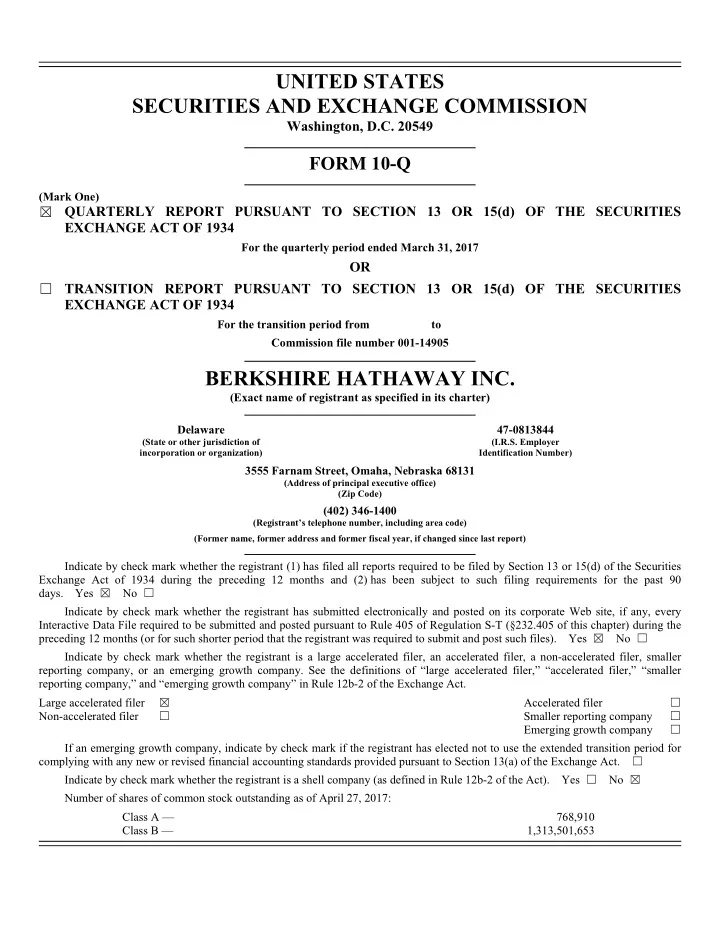
UNITED STATES SECURITIES AND EXCHANGE COMMISSION Washington, D.C. 20549 FORM 10-Q (Mark One) QUARTERLY REPORT PURSUANT TO SECTION 13 OR 15(d) OF THE SECURITIES EXCHANGE ACT OF 1934 For the quarterly period ended March 31, 2017 OR


slide-1
SLIDE 1

UNITED STATES SECURITIES AND EXCHANGE COMMISSION

Washington, D.C. 20549

FORM 10-Q

(Mark One)

☒ QUARTERLY REPORT PURSUANT TO SECTION 13 OR 15(d) OF THE SECURITIES EXCHANGE ACT OF 1934

For the quarterly period ended March 31, 2017

OR ☐ TRANSITION REPORT PURSUANT TO SECTION 13 OR 15(d) OF THE SECURITIES EXCHANGE ACT OF 1934

For the transition period from to Commission file number 001-14905

BERKSHIRE HATHAWAY INC.

(Exact name of registrant as specified in its charter) Delaware 47-0813844

(State or other jurisdiction of incorporation or organization) (I.R.S. Employer Identification Number)

3555 Farnam Street, Omaha, Nebraska 68131

(Address of principal executive office) (Zip Code)

(402) 346-1400

(Registrant’s telephone number, including area code) (Former name, former address and former fiscal year, if changed since last report)

Indicate by check mark whether the registrant (1) has filed all reports required to be filed by Section 13 or 15(d) of the Securities Exchange Act of 1934 during the preceding 12 months and (2) has been subject to such filing requirements for the past 90

  • days. Yes ☒ No ☐

Indicate by check mark whether the registrant has submitted electronically and posted on its corporate Web site, if any, every Interactive Data File required to be submitted and posted pursuant to Rule 405 of Regulation S-T (§232.405 of this chapter) during the preceding 12 months (or for such shorter period that the registrant was required to submit and post such files). Yes ☒ No ☐ Indicate by check mark whether the registrant is a large accelerated filer, an accelerated filer, a non-accelerated filer, smaller reporting company, or an emerging growth company. See the definitions of “large accelerated filer,” “accelerated filer,” “smaller reporting company,” and “emerging growth company” in Rule 12b-2 of the Exchange Act. Large accelerated filer ☒ Accelerated filer ☐ Non-accelerated filer ☐ Smaller reporting company ☐ Emerging growth company ☐ If an emerging growth company, indicate by check mark if the registrant has elected not to use the extended transition period for complying with any new or revised financial accounting standards provided pursuant to Section 13(a) of the Exchange Act. ☐ Indicate by check mark whether the registrant is a shell company (as defined in Rule 12b-2 of the Act). Yes ☐ No ☒ Number of shares of common stock outstanding as of April 27, 2017: Class A — 768,910 Class B — 1,313,501,653

slide-2
SLIDE 2

BERKSHIRE HATHAWAY INC.

Page No.

Part I – Financial Information Item 1. Financial Statements Consolidated Balance Sheets—March 31, 2017 and December 31, 2016 2 Consolidated Statements of Earnings—First Quarter 2017 and 2016 4 Consolidated Statements of Comprehensive Income—First Quarter 2017 and 2016 5 Consolidated Statements of Changes in Shareholders’ Equity—First Quarter 2017 and 2016 5 Consolidated Statements of Cash Flows—First Quarter 2017 and 2016 6 Notes to Consolidated Financial Statements 7-24 Item 2. Management’s Discussion and Analysis of Financial Condition and Results of Operations 25-42 Item 3. Quantitative and Qualitative Disclosures About Market Risk 43 Item 4. Controls and Procedures 43 Part II – Other Information Item 1. Legal Proceedings 43 Item 1A. Risk Factors 43 Item 2. Unregistered Sales of Equity Securities and Use of Proceeds and Issuer Repurchases of Equity Securities 43 Item 3. Defaults Upon Senior Securities 43 Item 4. Mine Safety Disclosures 43 Item 5. Other Information 43 Item 6. Exhibits 44 Signature 44 1

slide-3
SLIDE 3

Part I Financial Information Item 1. Financial Statements BERKSHIRE HATHAWAY INC. and Subsidiaries CONSOLIDATED BALANCE SHEETS (dollars in millions) March 31, 2017 December 31, 2016 (Unaudited)

ASSETS Insurance and Other: Cash and cash equivalents and U.S. Treasury Bills: Cash and cash equivalents $ 18,362 $ 23,581 U.S. Treasury Bills 61,052 47,338 Total cash, cash equivalents and U.S. Treasury Bills 79,414 70,919 Investments: Fixed maturity securities 22,902 23,432 Equity securities 133,393 120,471 Other 15,293 14,364 Investment in The Kraft Heinz Company (Fair Value: March 31, 2017 – $29,553; December 31, 2016 – $28,418) 15,431 15,345 Receivables 28,870 27,097 Inventories 16,115 15,727 Property, plant and equipment 19,645 19,325 Goodwill 54,333 53,994 Other intangible assets 33,472 33,481 Deferred charges reinsurance assumed 13,830 8,047 Other 7,417 7,126 440,115 409,328 Railroad, Utilities and Energy: Cash and cash equivalents 5,584 3,939 Property, plant and equipment 124,277 123,759 Goodwill 24,234 24,111 Regulatory assets 4,617 4,457 Other 13,557 13,550 172,269 169,816 Finance and Financial Products: Cash and cash equivalents and U.S. Treasury Bills: Cash and cash equivalents 2,017 528 U.S. Treasury Bills 9,449 10,984 Total cash, cash equivalents and U.S. Treasury Bills 11,466 11,512 Investments in equity and fixed maturity securities 410 408 Other investments 3,119 2,892 Loans and finance receivables 13,365 13,300 Property, plant and equipment and assets held for lease 9,723 9,689 Goodwill 1,384 1,381 Other 2,600 2,528 42,067 41,710 $ 654,451 $ 620,854

See accompanying Notes to Consolidated Financial Statements 2

slide-4
SLIDE 4

BERKSHIRE HATHAWAY INC. and Subsidiaries CONSOLIDATED BALANCE SHEETS (dollars in millions) March 31, 2017 December 31, 2016 (Unaudited)

LIABILITIES AND SHAREHOLDERS’ EQUITY Insurance and Other: Losses and loss adjustment expenses $ 93,898 $ 76,918 Unearned premiums 16,106 14,245 Life, annuity and health insurance benefits 16,375 15,977 Other policyholder liabilities 7,056 6,714 Accounts payable, accruals and other liabilities 20,627 22,164 Notes payable and other borrowings 27,416 27,175 181,478 163,193 Railroad, Utilities and Energy: Accounts payable, accruals and other liabilities 11,031 11,434 Regulatory liabilities 3,095 3,121 Notes payable and other borrowings 60,925 59,085 75,051 73,640 Finance and Financial Products: Accounts payable, accruals and other liabilities 1,465 1,444 Derivative contract liabilities 2,430 2,890 Notes payable and other borrowings 15,615 15,384 19,510 19,718 Income taxes, principally deferred 82,132 77,944 Total liabilities 358,171 334,495 Shareholders’ equity: Common stock 8 8 Capital in excess of par value 35,699 35,681 Accumulated other comprehensive income 43,070 37,298 Retained earnings 215,837 211,777 Treasury stock, at cost (1,763) (1,763) Berkshire Hathaway shareholders’ equity 292,851 283,001 Noncontrolling interests 3,429 3,358 Total shareholders’ equity 296,280 286,359 $ 654,451 $ 620,854

See accompanying Notes to Consolidated Financial Statements 3

slide-5
SLIDE 5

BERKSHIRE HATHAWAY INC. and Subsidiaries CONSOLIDATED STATEMENTS OF EARNINGS (dollars in millions except per share amounts)

First Quarter 2017 2016 (Unaudited)

Revenues: Insurance and Other: Insurance premiums earned $ 21,753 $ 11,124 Sales and service revenues 30,229 28,279 Interest, dividend and other investment income 1,162 1,151 Investment gains/losses 312 1,846 53,456 42,400 Railroad, Utilities and Energy: Revenues 9,404 8,845 Finance and Financial Products: Sales and service revenues 1,514 1,392 Interest, dividend and other investment income 350 332 Investment gains/losses 3 4 Derivative gains/losses 460 (810) 2,327 918 Total revenues 65,187 52,163 Costs and expenses: Insurance and Other: Insurance losses and loss adjustment expenses 18,566 7,532 Life, annuity and health insurance benefits 1,227 1,167 Insurance underwriting expenses 2,339 2,077 Cost of sales and services 24,360 22,796 Selling, general and administrative expenses 4,116 3,722 Interest expense 270 387 50,878 37,681 Railroad, Utilities and Energy: Cost of sales and operating expenses 6,754 6,319 Interest expense 693 685 7,447 7,004 Finance and Financial Products: Cost of sales and services 867 768 Selling, general and administrative expenses 442 393 Interest expense 104 101 1,413 1,262 Total costs and expenses 59,738 45,947 Earnings before income taxes and equity in earnings of Kraft Heinz Company 5,449 6,216 Equity in earnings of Kraft Heinz Company 239 240 Earnings before income taxes 5,688 6,456 Income tax expense 1,549 799 Net earnings 4,139 5,657 Less: Earnings attributable to noncontrolling interests 79 68 Net earnings attributable to Berkshire Hathaway shareholders $ 4,060 $ 5,589 Net earnings per equivalent Class A share outstanding * $ 2,469 $ 3,401 Average equivalent Class A Shares outstanding * 1,644,425 1,643,487

* Equivalent Class B shares outstanding are 1,500 times the equivalent Class A amount. Net earnings per equivalent Class B share outstanding are

  • ne-fifteen-hundredth (1/1,500) of the equivalent Class A amount.

See accompanying Notes to Consolidated Financial Statements 4

slide-6
SLIDE 6

BERKSHIRE HATHAWAY INC. and Subsidiaries CONSOLIDATED STATEMENTS OF COMPREHENSIVE INCOME (dollars in millions)

First Quarter 2017 2016 (Unaudited)

Net earnings $ 4,139 $ 5,657 Other comprehensive income: Net change in unrealized appreciation of investments 8,377 (2,691) Applicable income taxes (2,872) 899 Reclassification of investment appreciation in net earnings (305) (1,807) Applicable income taxes 107 632 Foreign currency translation 558 493 Applicable income taxes (69) (30) Prior service cost and actuarial gains/losses of defined benefit pension plans (10) 4 Applicable income taxes 7 — Other, net 3 (22) Other comprehensive income, net 5,796 (2,522) Comprehensive income 9,935 3,135 Comprehensive income attributable to noncontrolling interests 103 74 Comprehensive income attributable to Berkshire Hathaway shareholders $ 9,832 $ 3,061 CONSOLIDATED STATEMENTS OF CHANGES IN SHAREHOLDERS’ EQUITY (Unaudited) (dollars in millions)

Berkshire Hathaway shareholders’ equity Total Common stock and capital in excess of par value Accumulated

  • ther

comprehensive income Retained earnings Treasury stock Non- controlling interests

Balance at December 31, 2015 $ 35,628 $ 33,982 $187,703 $ (1,763) $ 3,077 $ 258,627 Net earnings — — 5,589 — 68 5,657 Other comprehensive income, net — (2,528) — — 6 (2,522) Issuance of common stock 34 — — — — 34 Transactions with noncontrolling interests 16 — — — 25 41 Balance at March 31, 2016 $ 35,678 $ 31,454 $193,292 $ (1,763) $ 3,176 $ 261,837 Balance at December 31, 2016 $ 35,689 $ 37,298 $211,777 $ (1,763) $ 3,358 $286,359 Net earnings — — 4,060 — 79 4,139 Other comprehensive income, net — 5,772 — — 24 5,796 Issuance of common stock 34 — — — — 34 Transactions with noncontrolling interests (16) — — — (32) (48) Balance at March 31, 2017 $ 35,707 $ 43,070 $215,837 $ (1,763) $ 3,429 $ 296,280 See accompanying Notes to Consolidated Financial Statements 5

slide-7
SLIDE 7

BERKSHIRE HATHAWAY INC. and Subsidiaries CONSOLIDATED STATEMENTS OF CASH FLOWS (dollars in millions)

First Quarter 2017 2016 (Unaudited) Cash flows from operating activities: Net earnings $ 4,139 $ 5,657 Adjustments to reconcile net earnings to operating cash flows: Investment gains/losses (315) (1,850) Depreciation and amortization 2,243 2,125 Other 120 228 Changes in operating assets and liabilities: Losses and loss adjustment expenses 16,900 1,454 Deferred charges reinsurance assumed (5,783) (111) Unearned premiums 1,829 1,476 Receivables and originated loans (1,197) (1,987) Derivative contract assets and liabilities (460) 810 Income taxes 1,451 497 Other (622) (845) Net cash flows from operating activities 18,305 7,454 Cash flows from investing activities: Purchases of U.S. Treasury Bills and fixed maturity securities (45,342) (14,359) Purchases of equity securities (10,590) (3,059) Sales of U.S. Treasury Bills and fixed maturity securities 10,048 1,124 Redemptions and maturities of U.S. Treasury Bills and fixed maturity securities 23,990 3,689 Sales and redemptions of equity securities 3,452 2,258 Purchases of loans and finance receivables (52) (175) Collections of loans and finance receivables 97 80 Acquisitions of businesses, net of cash acquired (1,599) (30,185) Purchases of property, plant and equipment (2,355) (2,843) Other (115) (390) Net cash flows from investing activities (22,466) (43,860) Cash flows from financing activities: Proceeds from borrowings of insurance and other businesses 1,203 8,539 Proceeds from borrowings of railroad, utilities and energy businesses 2,094 — Proceeds from borrowings of finance businesses 1,298 3,493 Repayments of borrowings of insurance and other businesses (1,130) (381) Repayments of borrowings of railroad, utilities and energy businesses (446) (522) Repayments of borrowings of finance businesses (1,068) (88) Changes in short term borrowings, net 87 547 Other (23) 25 Net cash flows from financing activities 2,015 11,613 Effects of foreign currency exchange rate changes 61 7 Increase (decrease) in cash and cash equivalents (2,085) (24,786) Cash and cash equivalents at beginning of year 28,048 67,161 Cash and cash equivalents at end of first quarter * $ 25,963 $ 42,375 * Cash and cash equivalents are comprised of the following: Beginning of year— Insurance and Other $ 23,581 $ 56,612 Railroad, Utilities and Energy 3,939 3,437 Finance and Financial Products 528 7,112 $ 28,048 $ 67,161 End of first quarter— Insurance and Other $ 18,362 $ 37,620 Railroad, Utilities and Energy 5,584 2,692 Finance and Financial Products 2,017 2,063 $ 25,963 $ 42,375

See accompanying Notes to Consolidated Financial Statements 6
slide-8
SLIDE 8

BERKSHIRE HATHAWAY INC. and Subsidiaries NOTES TO CONSOLIDATED FINANCIAL STATEMENTS March 31, 2017 Note 1. General The accompanying unaudited Consolidated Financial Statements include the accounts of Berkshire Hathaway Inc. (“Berkshire” or “Company”) consolidated with the accounts of all its subsidiaries and affiliates in which Berkshire holds controlling financial interests as of the financial statement date. In these notes the terms “us,” “we” or “our” refer to Berkshire and its consolidated subsidiaries. Reference is made to Berkshire’s most recently issued Annual Report on Form 10-K (“Annual Report”) which includes information necessary or useful to understanding Berkshire’s businesses and financial statement presentations. Our significant accounting policies and practices were presented as Note 1 to the Consolidated Financial Statements included in the Annual Report. At December 31, 2016, we began presenting U.S. Treasury Bills with maturity dates greater than three months from their purchase dates separately in our Consolidated Balance Sheets. Accordingly, we revised the first quarter of 2016 Consolidated Statement of Cash Flows to reflect this change. Financial information in this Quarterly Report reflects all adjustments (consisting only of normal recurring adjustments) that are, in the opinion of management, necessary to a fair statement of results for the interim periods in accordance with accounting principles generally accepted in the United States (“GAAP”). For a number of reasons, our results for interim periods are not normally indicative

  • f results to be expected for the year. The timing and magnitude of catastrophe losses incurred by insurance subsidiaries and the

estimation error inherent to the process of determining liabilities for unpaid losses of insurance subsidiaries can be more significant to results of interim periods than to results for a full year. Variations in the amount and timing of investment gains/losses can cause significant variations in periodic net earnings. Investment gains/losses are recorded when investments are disposed or are other-than- temporarily impaired. In addition, changes in the fair values of liabilities associated with derivative contracts can cause significant variations in periodic net earnings. Note 2. New accounting pronouncements In May 2014, the Financial Accounting Standards Board (“FASB”) issued ASU 2014-09 “Revenue from Contracts with Customers.” ASU 2014-09 applies to contracts with customers, excluding, most notably, insurance and leasing contracts. ASU 2014-09 prescribes a framework in accounting for revenues from contracts within its scope, including (a) identifying the contract, (b) identifying the performance obligations under the contract, (c) determining the transaction price, (d) allocating the transaction price to the identified performance obligations and (e) recognizing revenues as the identified performance obligations are satisfied. ASU 2014-09 also prescribes additional financial statement presentations and disclosures. We currently expect to adopt ASU 2014-09 as of January 1, 2018, under the modified retrospective method where the cumulative effect is recognized at the date of initial application. Our evaluation of ASU 2014-09 is ongoing and not complete. While we anticipate some changes to revenue recognition for certain customer contracts, we do not currently believe the adoption of ASU 2014-09 will have a material effect on our Consolidated Financial Statements. In January 2016, the FASB issued ASU 2016-01 “Financial Instruments—Recognition and Measurement of Financial Assets and Financial Liabilities.” ASU 2016-01 generally requires that equity securities (excluding equity method investments) be measured at fair value with changes in fair value recognized in net income. Under existing GAAP, changes in fair value of available-for-sale equity investments are recorded in other comprehensive income. Given the current magnitude of our equity securities, the adoption of ASU 2016-01 will likely have a significant impact on the periodic net earnings reported in our Consolidated Statement of Earnings, although it will not significantly affect our comprehensive income or total shareholders’ equity. ASU 2016-01 is effective for reporting periods beginning after December 15, 2017, with the cumulative effect of the adoption made to the balance sheet as of the date of adoption. Thus, the adoption will result in a reclassification of the related accumulated unrealized appreciation currently included in accumulated

  • ther comprehensive income to retained earnings.

In February 2016, the FASB issued ASU 2016-02 “Leases.” ASU 2016-02 requires a lessee to recognize in the statement of financial position a liability to make lease payments and a right-of-use asset representing its right to use the underlying asset for the lease term, along with additional qualitative and quantitative disclosures. ASU 2016-02 is effective for reporting periods beginning after December 15, 2018, with early adoption permitted. We are currently evaluating the effect this standard will have on our Consolidated Financial Statements. In June 2016, the FASB issued ASU 2016-13 “Financial Instruments—Credit Losses,” which provides for the recognition and measurement at the reporting date of all expected credit losses for financial assets held at amortized cost and available-for-sale debt

  • securities. Currently, credit losses are recognized and measured when such losses become probable based on the prevailing facts and
  • circumstances. ASU 2016-13 is effective for reporting periods beginning after December 15, 2019. We are currently evaluating the

effect this standard will have on our Consolidated Financial Statements. 7

slide-9
SLIDE 9

Notes to Consolidated Financial Statements (Continued) Note 2. New accounting pronouncements (Continued) In January 2017, the FASB issued ASU 2017-04 “Simplifying the Test for Goodwill Impairment.” ASU 2017-04 eliminates the requirement to determine the implied goodwill in measuring an impairment loss. Upon adoption, a goodwill impairment will be measured as the excess of the reporting unit’s carrying value over fair value, limited to the carrying value of goodwill. ASU 2017-04 is effective for goodwill impairment tests in fiscal years beginning after December 15, 2019, with early adoption permitted. We are currently evaluating the effect this standard will have on our Consolidated Financial Statements. Note 3. Significant business acquisitions Our long-held acquisition strategy is to acquire businesses at sensible prices that have consistent earning power, good returns on equity and able and honest management. Financial results attributable to business acquisitions are included in our Consolidated Financial Statements beginning on their respective acquisition dates. On January 29, 2016, Berkshire acquired all outstanding common stock of Precision Castparts Corp. (“PCC”) for $235 per share in cash pursuant to a definitive merger agreement dated August 8, 2015. The aggregate consideration paid was approximately $32.7 billion, which included the value of PCC shares we already owned. We funded the acquisition with a combination of existing cash balances and proceeds from a short-term credit facility. PCC is a worldwide, diversified manufacturer of complex metal components and products. It serves the aerospace, power and general industrial markets. PCC is a market leader in manufacturing complex structural investment castings and forged components for aerospace markets, machined airframe components and highly engineered critical fasteners for aerospace applications, and in manufacturing airfoil castings for the aerospace and industrial gas turbine

  • markets. PCC also is a leading producer of titanium and nickel superalloy melted and mill products for the aerospace, chemical

processing, oil and gas and pollution control industries, and manufactures extruded seamless pipe, fittings and forgings for power generation and oil and gas applications. On February 29, 2016, we acquired the Duracell business from The Procter & Gamble Company (“P&G”) pursuant to a definitive agreement entered into in November 2014. Duracell is a leading manufacturer of high-performance alkaline batteries and is an innovator in wireless charging technologies. Pursuant to the agreement, we received a recapitalized Duracell Company in exchange for shares of P&G common stock held by Berkshire subsidiaries, which had a fair value of approximately $4.2 billion. Pro forma consolidated revenues and net earnings data for 2016 was not materially different from the amounts reflected in the accompanying Consolidated Financial Statements. Goodwill from these acquisitions is not amortizable for income tax purposes. The fair values of identified assets acquired and liabilities assumed and residual goodwill of PCC and Duracell at their respective acquisition dates are summarized as follows (in millions).

PCC Duracell

Cash and cash equivalents $ 250 $1,807 Inventories 3,430 319 Property, plant and equipment 2,765 359 Goodwill 16,011 866 Other intangible assets 23,527 1,550 Other assets 1,916 242 Assets acquired $47,899 $5,143 Accounts payable, accruals and other liabilities $ 2,442 $ 410 Notes payable and other borrowings 5,251 — Income taxes, principally deferred 7,548 494 Liabilities assumed $15,241 $ 904 Net assets $32,658 $4,239 8

slide-10
SLIDE 10

Notes to Consolidated Financial Statements (Continued) Note 4. Investments in fixed maturity securities Investments in securities with fixed maturities as of March 31, 2017 and December 31, 2016 are summarized by type below (in millions).

Amortized Cost Unrealized Gains Unrealized Losses Fair Value

March 31, 2017 U.S. Treasury, U.S. government corporations and agencies $ 4,636 $ 14 $ (9) $ 4,641 States, municipalities and political subdivisions 1,051 55 (1) 1,105 Foreign governments 8,480 224 (35) 8,669 Corporate bonds 6,787 687 (7) 7,467 Mortgage-backed securities 937 121 (7) 1,051 $ 21,891 $ 1,101 $ (59) $22,933 December 31, 2016 U.S. Treasury, U.S. government corporations and agencies $ 4,519 $ 16 $ (8) $ 4,527 States, municipalities and political subdivisions 1,159 58 (1) 1,216 Foreign governments 8,860 207 (66) 9,001 Corporate bonds 6,899 714 (9) 7,604 Mortgage-backed securities 997 126 (6) 1,117 $ 22,434 $ 1,121 $ (90) $23,465 Investments in fixed maturity securities are reflected in our Consolidated Balance Sheets as follows (in millions).

March 31, 2017 December 31, 2016

Insurance and other $ 22,902 $ 23,432 Finance and financial products 31 33 $ 22,933 $ 23,465 Investments in foreign government securities include securities issued by national and provincial government entities as well as instruments that are unconditionally guaranteed by such entities. As of March 31, 2017, approximately 92% of foreign government holdings were rated AA or higher by at least one of the major rating agencies. Approximately 81% of foreign government holdings were issued or guaranteed by the United Kingdom, Germany, Australia or Canada. The amortized cost and estimated fair value of securities with fixed maturities at March 31, 2017 are summarized below by contractual maturity dates. Actual maturities may differ from contractual maturities due to early call or prepayment rights held by

  • issuers. Amounts are in millions.

Due in one year or less Due after one year through five years Due after five years through ten years Due after ten years Mortgage- backed securities Total

Amortized cost $8,117 $ 9,898 $ 756 $2,183 $ 937 $21,891 Fair value 8,191 10,204 815 2,672 1,051 22,933 9

slide-11
SLIDE 11

Notes to Consolidated Financial Statements (Continued) Note 5. Investments in equity securities Investments in equity securities as of March 31, 2017 and December 31, 2016 are summarized based on the primary industry of the investee in the table below (in millions).

Cost Basis Unrealized Gains Unrealized Losses Fair Value

March 31, 2017 * Banks, insurance and finance $ 20,431 $ 31,725 $ — $ 52,156 Consumer products 19,320 21,020 — 40,340 Commercial, industrial and other 32,707 9,973 (156) 42,524 $ 72,458 $ 62,718 $ (156) $135,020 * Approximately 65% of the aggregate fair value was concentrated in the equity securities of five companies: American Express Company - $12.0 billion, Apple Inc. - $19.2 billion, The Coca-Cola Company - $17.0 billion, International Business Machines Corporation (“IBM”) - $11.2 billion and Wells Fargo & Company - $27.8 billion.

Cost Basis Unrealized Gains Unrealized Losses Fair Value

December 31, 2016* Banks, insurance and finance $ 19,852 $ 30,572 $ — $ 50,424 Consumer products 10,657 16,760 (9) 27,408 Commercial, industrial and other 35,868 9,033 (701) 44,200 $ 66,377 $ 56,365 $ (710) $122,032 * Approximately 62% of the aggregate fair value was concentrated in the equity securities of five companies: American Express Company - $11.2 billion, Apple Inc. - $7.1 billion, The Coca-Cola Company - $16.6 billion, IBM - $13.5 billion and Wells Fargo & Company - $27.6 billion. As of March 31, 2017 and December 31, 2016, we concluded that the unrealized losses shown in the tables above were temporary. As of March 31, 2017 and December 31, 2016, unrealized losses on equity securities in a continuous unrealized loss position for more than twelve consecutive months were $39 million and $551 million, respectively. Investments in equity securities are reflected in our Consolidated Balance Sheets as follows (in millions).

March 31, 2017 December 31, 2016

Insurance and other $133,393 $ 120,471 Railroad, utilities and energy * 1,248 1,186 Finance and financial products 379 375 $135,020 $ 122,032 * Included in other assets. Note 6. Other investments Other investments include preferred stock of Bank of America Corporation (“BAC”), warrants to purchase common stock of BAC and preferred stock of Restaurant Brands International, Inc. (“RBI”). Other investments are classified as available-for-sale and carried at fair value and are shown in our Consolidated Balance Sheets as follows (in millions).

Cost Fair Value March 31, 2017 December 31, 2016 March 31, 2017 December 31, 2016

Insurance and other $ 6,720 $ 6,720 $ 15,293 $ 14,364 Finance and financial products 1,000 1,000 3,119 2,892 $ 7,720 $ 7,720 $ 18,412 $ 17,256 10

slide-12
SLIDE 12

Notes to Consolidated Financial Statements (Continued) Note 6. Other investments (Continued) We currently own 50,000 shares of 6% Non-Cumulative Perpetual Preferred Stock of BAC (“BAC Preferred”) with a liquidation value of $100,000 per share and warrants to purchase 700,000,000 shares of common stock of BAC (“BAC Warrants”). The BAC Preferred is redeemable at the option of BAC beginning on May 7, 2019 at a redemption price of $105,000 per share (or $5.25 billion in aggregate). The BAC Warrants expire in 2021 and are exercisable for an additional aggregate cost of $5 billion ($7.142857/share). We currently own Class A 9% Cumulative Compounding Perpetual Preferred Shares of RBI (“RBI Preferred”) having a stated value of $3 billion. RBI, domiciled in Canada, franchises and operates quick service restaurants. The RBI Preferred is entitled to dividends on a cumulative basis of 9% per annum plus an additional amount, if necessary, to produce an after-tax yield to Berkshire as if the dividends were paid by a U.S.-based company. The RBI Preferred is redeemable at the option of RBI beginning on December 12,

  • 2017. If not redeemed prior to December 12, 2024, we can cause RBI to redeem the RBI Preferred. In either case, the redemption price

will be 109.9% of the stated value of such shares. Note 7. Investments in The Kraft Heinz Company In June 2013, Berkshire invested $12.25 billion in a newly-formed company, H.J. Heinz Holding Corporation (“Heinz Holding”), consisting of 425 million shares of common stock, warrants to acquire approximately 46 million additional shares of common stock at $0.01 per share and cumulative compounding preferred stock (“Preferred Stock”) with a liquidation preference of $8 billion. An affiliate of the global investment firm 3G Capital (such affiliate, “3G”) also acquired 425 million shares of Heinz Holding common stock for $4.25 billion. At that time, Berkshire and 3G each owned a 50% share of Heinz Holding common stock. Heinz Holding then acquired H.J. Heinz Company. In March 2015, Heinz Holding entered into an agreement to acquire all of the outstanding common stock of Kraft Foods Group,

  • Inc. (“Kraft”). In June 2015, Berkshire exercised the aforementioned common stock warrants. On July 1, 2015, Berkshire and 3G also

acquired new shares of Heinz Holding common stock for $5.26 billion and $4.74 billion, respectively. After these transactions, Berkshire owned approximately 52.5% of the outstanding shares of Heinz Holding. On July 2, 2015, Heinz Holding completed its acquisition of Kraft, at which time Heinz Holding was renamed The Kraft Heinz Company (“Kraft Heinz”). In connection with its acquisition of Kraft, Kraft Heinz issued one new share of Kraft Heinz common stock for each share of Kraft common stock, which reduced Berkshire’s and 3G’s ownership of outstanding shares of Kraft Heinz common stock to 26.8% and 24.2%, respectively. Berkshire currently owns 26.7% of the outstanding shares of Kraft Heinz common stock. We account for our investment in Kraft Heinz common stock pursuant to the equity method. The carrying value of this investment was approximately $15.4 billion at March 31, 2017 and $15.3 billion at December 31, 2016. Our earnings determined under the equity method for the first quarter were $239 million in 2017 and $240 million in 2016. We received dividends on the common stock of $195 million in the first quarter of 2017 and $187 million in the first quarter of 2016, which were recorded as reductions of our investment. On June 7, 2016, Kraft Heinz redeemed our Preferred Stock investment for cash of $8.32 billion. Kraft Heinz is one of the world’s largest manufacturers and marketers of food and beverage products, including condiments and sauces, cheese and dairy, meals, meats, refreshment beverages, coffee, and other grocery products. Summarized consolidated financial information of Kraft Heinz follows (in millions).

April 1, 2017 December 31, 2016

Assets $120,802 $120,480 Liabilities 62,858 62,906

First Quarter 2017 2016

Sales $ 6,364 $ 6,570 Net earnings attributable to Kraft Heinz common shareholders $ 893 $ 896 11

slide-13
SLIDE 13

Notes to Consolidated Financial Statements (Continued) Note 8. Income taxes Our consolidated effective income tax rates for the first quarter of 2017 and 2016 were 27.2% and 12.4%, respectively. Our effective income tax rate normally reflects benefits from the recurring impact of: (a) dividends received deductions applicable to certain investments in equity securities, (b) income production tax credits related to wind-powered electricity generation placed in service in the U.S. and (c) lower income tax rates applicable to earnings of certain foreign subsidiaries. On February 29, 2016, we exchanged our long-held investment in P&G common stock for the common stock of Duracell. This exchange produced a pre-tax gain of $1.1 billion for financial reporting purposes. The exchange transaction was structured as a tax-free reorganization under the Internal Revenue Code. As a result, no income taxes were payable on the excess of the fair value of the business received over the tax basis of the P&G shares exchanged and we recorded a one-time reduction of certain deferred income tax liabilities (approximately $750 million) that were recorded in 2005 in connection with our exchange of The Gillette Company common stock for P&G common stock upon the merger of those two companies. The P&G/Duracell exchange produced a 17.7 percentage point reduction in our consolidated effective income tax rate for the first quarter of 2016. Note 9. Investment gains/losses Investment gains/losses included in earnings are summarized below (in millions).

First Quarter 2017 2016

Fixed maturity securities— Gross gains from sales and other disposals $ 11 $ 19 Gross losses from sales and other disposals (6) (3) Equity securities— Gross gains from sales and redemptions 425 1,807 Gross losses from sales and redemptions (125) (10) Other 10 37 $ 315 $ 1,850 We record investments in equity and fixed maturity securities classified as available-for-sale at fair value and record the difference between fair value and cost in other comprehensive income. Investment gains and losses are recognized when we sell or otherwise dispose such securities. Gains from sales and redemptions of equity securities in the first quarter of 2016 included approximately $1.1 billion from the exchange of our P&G common stock in the acquisition of Duracell. Note 10. Inventories Inventories are comprised of the following (in millions).

March 31, 2017 December 31, 2016

Raw materials $ 2,857 $ 2,789 Work in process and other 2,676 2,506 Finished manufactured goods 4,195 4,033 Goods acquired for resale 6,387 6,399 $ 16,115 $ 15,727 Note 11. Receivables Receivables of insurance and other businesses are comprised of the following (in millions).

March 31, 2017 December 31, 2016

Insurance premiums receivable $11,022 $ 10,462 Reinsurance recoverable on unpaid losses 3,221 3,338 Trade and other receivables 14,944 13,630 Allowances for uncollectible accounts (317) (333) $28,870 $ 27,097 12

slide-14
SLIDE 14

Notes to Consolidated Financial Statements (Continued) Note 11. Receivables (Continued) Loans and finance receivables of finance and financial products businesses are summarized as follows (in millions).

March 31, 2017 December 31, 2016

Loans and finance receivables before allowances and discounts $ 13,776 $ 13,728 Allowances for uncollectible loans (177) (182) Unamortized acquisition discounts (234) (246) $ 13,365 $ 13,300 Loans and finance receivables are predominantly installment loans originated or acquired by our manufactured housing business. Provisions for loan losses in the first quarter of 2017 and 2016 were $38 million and $37 million, respectively. Loan charge-offs, net of recoveries, in the first quarter were $43 million in 2017 and $38 million in 2016. At March 31, 2017, approximately 98% of the loan balances were evaluated collectively for impairment. As a part of the evaluation process, credit quality indicators are reviewed and loans are designated as performing or non-performing. At March 31, 2017, approximately 98% of the loan balances were determined to be performing and approximately 95% of the loan balances were current as to payment status. Note 12. Property, plant and equipment and assets held for lease A summary of property, plant and equipment of our insurance and other businesses follows (in millions).

Ranges of estimated useful life March 31, 2017 December 31, 2016

Land — $ 2,133 $ 2,108 Buildings and improvements 5 – 40 years 8,461 8,360 Machinery and equipment 3 – 25 years 20,983 20,463 Furniture, fixtures and other 2 – 15 years 4,214 4,080 35,791 35,011 Accumulated depreciation (16,146) (15,686) $ 19,645 $ 19,325 A summary of property, plant and equipment of our railroad and our utilities and energy businesses follows (in millions).

Ranges of estimated useful life March 31, 2017 December 31, 2016

Railroad: Land — $ 6,073 $ 6,063 Track structure and other roadway 7 – 100 years 49,917 48,277 Locomotives, freight cars and other equipment 6 – 41 years 12,172 12,075 Construction in progress — 810 965 68,972 67,380 Accumulated depreciation (7,583) (6,130) 61,389 61,250 Utilities and energy: Utility generation, transmission and distribution systems 5 – 80 years 71,308 71,536 Interstate natural gas pipeline assets 3 – 80 years 6,944 6,942 Independent power plants and other assets 3 – 30 years 6,937 6,596 Construction in progress — 2,350 2,098 87,539 87,172 Accumulated depreciation (24,651) (24,663) 62,888 62,509 $124,277 $ 123,759 13

slide-15
SLIDE 15

Notes to Consolidated Financial Statements (Continued) Note 12. Property, plant and equipment (Continued) The utility generation, transmission and distribution systems and interstate natural gas pipeline assets are owned by regulated public utility and natural gas pipeline subsidiaries. Assets held for lease and property, plant and equipment of our finance and financial products businesses are summarized below (in millions).

Ranges of estimated useful life March 31, 2017 December 31, 2016

Assets held for lease 5 – 35 years $11,993 $ 11,902 Land — 224 224 Buildings, machinery and other 3 – 50 years 1,335 1,302 13,552 13,428 Accumulated depreciation (3,829) (3,739) $ 9,723 $ 9,689 A summary of depreciation expense for the first quarters of 2017 and 2016 follows (in millions).

First Quarter 2017 2016

Insurance and other $ 542 $ 493 Railroad, utilities and energy 1,175 1,141 Finance and financial products 159 152 $1,876 $1,786 Note 13. Goodwill and other intangible assets A reconciliation of the change in the carrying value of goodwill is as follows (in millions).

March 31, 2017 December 31, 2016

Balance at beginning of year $ 79,486 $ 62,708 Acquisitions of businesses 540 17,650 Other, including foreign currency translation (75) (872) Balance at end of period $ 79,951 $ 79,486 Other intangible assets are summarized as follows (in millions).

March 31, 2017 December 31, 2016 Gross carrying amount Accumulated amortization Gross carrying amount Accumulated amortization

Insurance and other $40,334 $6,862 $39,976 $6,495 Railroad, utilities and energy 901 298 898 293 $41,235 $7,160 $40,874 $6,788 Trademarks and trade names $ 5,264 $ 634 $ 5,175 $ 616 Patents and technology 4,393 2,424 4,341 2,328 Customer relationships 28,449 3,099 28,243 2,879 Other 3,129 1,003 3,115 965 $41,235 $7,160 $40,874 $6,788 Amortization expense in the first quarter was $367 million in 2017 and $339 million in 2016. Intangible assets with indefinite lives were approximately $18.7 billion as of March 31, 2017 and December 31, 2016. 14

slide-16
SLIDE 16

Notes to Consolidated Financial Statements (Continued) Note 14. Derivative contracts We are party to derivative contracts primarily through our finance and financial products and our utilities and energy businesses. Currently, the derivative contracts of our finance and financial products include equity index put option contracts written between 2004 and 2008. The liabilities and related notional values of such contracts follows (in millions).

March 31, 2017 December 31, 2016 Liabilities Notional Value Liabilities Notional Value

Equity index put options $ 2,430 $26,868(1) $ 2,890 $26,497(1)

(1)

Represents the aggregate undiscounted amounts payable assuming that the value of each index is zero at each contract’s expiration date. Certain of these contracts are denominated in foreign currencies. Notional amounts are based on the foreign currency exchange rates as of each balance sheet date. We record derivative contract liabilities at fair value and include the changes in the fair values of such contracts in earnings as derivative gains/losses. We entered into these contracts with the expectation that the premiums received would exceed the amounts ultimately paid to counterparties. A summary of the derivative gains/losses included in our Consolidated Statements of Earnings follows (in millions).

First Quarter 2017 2016

Equity index put options $ 460 $(796) Other — (14) $ 460 $(810) The equity index put option contracts are European style options written on four major equity indexes and expire between June 2018 and January 2026. Future payments, if any, under any given contract will be required if the prevailing index value is below the contract strike price at the expiration date. We received the premiums on these contracts at the inception dates and therefore we have no counterparty credit risk. The aggregate intrinsic value (the undiscounted liability assuming the contracts are settled based on the index values and foreign currency exchange rates as of the balance sheet date) of our equity index put option contracts was approximately $700 million at March 31, 2017 and $1.0 billion at December 31, 2016. However, these contracts may not be unilaterally terminated or fully settled before the expiration dates. Therefore, the ultimate amount of cash basis gains or losses on these contracts will not be determined for several years. The remaining weighted average life of all contracts was approximately 3.7 years at March 31, 2017. A limited number of our equity index put option contracts contain collateral posting requirements with respect to changes in the fair value or intrinsic value of the contracts and/or a downgrade of Berkshire’s credit ratings. As of March 31, 2017, we did not have any collateral posting requirements. If Berkshire’s credit ratings (currently AA from Standard & Poor’s and Aa2 from Moody’s) are downgraded below either A- by Standard & Poor’s or A3 by Moody’s, collateral of up to $1.1 billion could be required to be posted. Our regulated utility subsidiaries are exposed to variations in the prices of fuel required to generate electricity, wholesale electricity purchased and sold and natural gas supplied for customers. Derivative instruments, including forward purchases and sales, futures, swaps and options, are used to manage a portion of these price risks. Derivative contract assets are included in other assets and were $128 million as of March 31, 2017 and $142 million as of December 31, 2016. Derivative contract liabilities are included in accounts payable, accruals and other liabilities and were $156 million as of March 31, 2017 and $145 million as of December 31, 2016. Net derivative contract assets or liabilities of our regulated utilities that are probable of recovery through rates, are offset by regulatory liabilities or assets. Unrealized gains or losses on contracts accounted for as cash flow or fair value hedges are recorded in other comprehensive income or in net earnings, as appropriate. 15

slide-17
SLIDE 17

Notes to Consolidated Financial Statements (Continued) Note 15. Supplemental cash flow information A summary of supplemental cash flow information is presented in the following table (in millions).

First Quarter 2017 2016

Cash paid during the period for: Income taxes $ 26 $ 231 Interest: Insurance and other businesses 306 181 Railroad, utilities and energy businesses 737 731 Finance and financial products businesses 78 63 Non-cash investing and financing activities: Liabilities assumed in connection with business acquisitions 142 16,842 Equity securities exchanged in connection with business acquisition — 4,239 Note 16. Unpaid losses and loss adjustment expenses The liabilities for unpaid losses and loss adjustment expenses (also referred to as “claim liabilities”) under our short duration property and casualty insurance and reinsurance contracts are based upon estimates of the ultimate claim costs associated with claim

  • ccurrences as of the balance sheet date and include estimates for incurred-but-not-reported (“IBNR”) claims. Reconciliations of the

changes in claim liabilities for the three months ending March 31, 2017 and 2016 follows (in millions).

2017 2016

Unpaid losses and loss adjustment expenses—beginning of year: Gross liabilities $ 76,918 $ 73,144 Reinsurance recoverable and deferred charges (11,385) (10,994) Net balance 65,533 62,150 Incurred losses and loss adjustment expenses recorded during the period: Current accident year events 8,165 7,192 Prior accident years’ events 118 (372) Retroactive reinsurance and discount accretion 10,283 712 Total incurred losses and loss adjustment expenses 18,566 7,532 Paid losses and loss adjustment expenses during the period with respect to: Current accident year events (2,678) (2,421) Prior accident years’ events (4,222) (3,828) Retroactive reinsurance (429) (158) Total payments (7,329) (6,407) Foreign currency translation adjustment 77 (21) Unpaid losses and loss adjustment expenses—March 31: Net balance 76,847 63,254 Reinsurance recoverable and deferred charges 17,051 11,308 Gross liabilities $ 93,898 $ 74,562 Incurred losses and loss adjustment expenses in the preceding table reflect the losses and loss adjustment expenses recorded in earnings in each period related to insured events occurring in the current year and in prior years. We present incurred and paid losses under retroactive reinsurance contracts and discount accretion separately. Such amounts relate to prior years’ underlying loss events. 16

slide-18
SLIDE 18

Notes to Consolidated Financial Statements (Continued) Note 16. Unpaid losses and loss adjustment expenses (Continued) Incurred losses and loss adjustment expenses in the first quarter of 2017 reflected increases of $118 million for prior accident years’ events compared to decreases of $372 million in the first quarter of 2016. In 2017, incurred losses for prior years’ events included increases related to our reinsurance businesses, partly offset by reductions attributable to our primary insurance operations. Incurred losses for prior years’ events in 2017 of our reinsurance operations included increases in the estimated liabilities for certain personal injury claims in the United Kingdom due to a regulatory decision that increases calculated lump sum settlement amounts. In addition, we increased liability estimates for claims under certain reinsurance contracts due to reported hurricane and earthquake losses from events in 2016, as well as for estimates of IBNR losses. Incurred losses and loss adjustment expenses in 2016 for prior accident years’ events derived primarily from our direct insurance businesses, and to a lesser extent, from our reinsurance businesses. In January 2017, Berkshire’s subsidiary, National Indemnity Company (“NICO”), entered into a retroactive reinsurance agreement with various subsidiaries of American International Group, Inc. (collectively, “AIG”). Under the agreement, NICO agreed to indemnify AIG for 80% of up to $25 billion, excess of $25 billion retained by AIG, of losses and allocated loss adjustment expenses with respect to certain commercial insurance loss events occurring in years prior to 2016, for cash consideration of $10.2 billion. The transaction became effective on February 2, 2017. Berkshire agreed to guarantee the timely payment of all amounts due to AIG under the agreement. We account for the AIG agreement as retroactive reinsurance of short-duration insurance contracts. As of the effective date, we recorded premiums earned and losses and loss adjustment expenses incurred of $10.2 billion from this contract. We also recorded unpaid losses and loss adjustment expenses of $16.4 billion, representing the estimated ultimate liabilities assumed and a deferred charge reinsurance assumed asset of $6.2 billion, representing the excess of those liabilities over the premiums earned. The deferred charge asset will be amortized over the estimated claims settlement period using the interest method based on the estimated timing and amount of future loss payments. Amortization charges are included in losses and loss adjustment expenses in the Consolidated Statements of Earnings. Note 17. Notes payable and other borrowings Notes payable and other borrowings are summarized below (in millions). The weighted average interest rates and maturity date ranges shown in the following tables are based on borrowings as of March 31, 2017.

Weighted Average Interest Rate March 31, 2017 December 31, 2016

Insurance and other: Issued by Berkshire due 2017-2047 2.1% $17,845 $17,703 Short-term subsidiary borrowings 2.7% 2,135 2,094 Other subsidiary borrowings due 2017-2045 4.0% 7,436 7,378 $27,416 $27,175 In January 2017, Berkshire issued €1.1 billion in senior unsecured notes. The notes consisted of €550 million of 0.25% notes due in 2021 and €550 million of 0.625% notes due in 2023. In January 2017, senior notes of $1.1 billion matured. 17

slide-19
SLIDE 19

Notes to Consolidated Financial Statements (Continued) Note 17. Notes payable and other borrowings (Continued)

Weighted Average Interest Rate March 31, 2017 December 31, 2016

Railroad, utilities and energy: Issued by Berkshire Hathaway Energy Company (“BHE”) and its subsidiaries: BHE senior unsecured debt due 2017-2045 5.1% $ 7,819 $ 7,818 Subsidiary and other debt due 2017-2064 4.7% 29,865 29,223 Issued by BNSF due 2017-2097 4.8% 23,241 22,044 $60,925 $ 59,085 BHE subsidiary debt represents amounts issued pursuant to separate financing agreements. Substantially all of the assets of certain BHE subsidiaries are, or may be, pledged or encumbered to support or otherwise secure debt. These borrowing arrangements generally contain various covenants including, but not limited to, leverage ratios, interest coverage ratios and debt service coverage ratios. During the first three months of 2017, BHE subsidiaries issued approximately $850 million of debt with maturity dates ranging from 2027 to 2047 and a weighted average interest rate of 3.6%. BNSF’s borrowings are primarily senior unsecured debentures. In March 2017, BNSF issued $1.25 billion of senior unsecured debentures consisting of $500 million of 3.25% debentures due in 2027 and $750 million of 4.125% debentures due in 2047. As of March 31, 2017, BNSF, BHE and their subsidiaries were in compliance with all applicable debt covenants. Berkshire does not guarantee any debt, borrowings or lines of credit of BNSF, BHE or their subsidiaries.

Weighted Average Interest Rate March 31, 2017 December 31, 2016

Finance and financial products: Issued by Berkshire Hathaway Finance Corporation (“BHFC”) due 2017-2043 2.6% $14,672 $ 14,423 Issued by other subsidiaries due 2017-2036 4.9% 943 961 $15,615 $ 15,384 In January 2017, BHFC issued $1.3 billion of senior notes consisting of $950 million of floating rate notes due in 2019 and $350 million of floating rate notes due in 2020. In January 2017, senior notes of $1.05 billion matured. The borrowings of BHFC, a wholly owned finance subsidiary of Berkshire, are fully and unconditionally guaranteed by Berkshire. As of March 31, 2017, our subsidiaries had unused lines of credit and commercial paper capacity aggregating approximately $7.4 billion to support short-term borrowing programs and provide additional liquidity. Such unused lines of credit included about $3.9 billion related to BHE and its subsidiaries. In addition to BHFC’s borrowings, at March 31, 2017, Berkshire guaranteed approximately $3.3 billion of other subsidiary borrowings. Generally, Berkshire’s guarantee of a subsidiary’s debt obligation is an absolute, unconditional and irrevocable guarantee for the full and prompt payment when due of all payment obligations. 18

slide-20
SLIDE 20

Notes to Consolidated Financial Statements (Continued) Note 18. Fair value measurements Our financial assets and liabilities are summarized below as of March 31, 2017 and December 31, 2016 with fair values shown according to the fair value hierarchy (in millions). The carrying values of cash and cash equivalents, U.S. Treasury Bills, receivable and accounts payable, accruals and other liabilities are considered to be reasonable estimates of their fair values.

Carrying Value Fair Value Quoted Prices (Level 1) Significant Other Observable Inputs (Level 2) Significant Unobservable Inputs (Level 3)

March 31, 2017 Investments in fixed maturity securities: U.S. Treasury, U.S. government corporations and agencies $ 4,641 $ 4,641 $ 3,187 $ 1,454 $ — States, municipalities and political subdivisions 1,105 1,105 — 1,105 — Foreign governments 8,669 8,669 6,835 1,834 — Corporate bonds 7,467 7,467 — 7,405 62 Mortgage-backed securities 1,051 1,051 — 1,051 — Investments in equity securities 135,020 135,020 135,012 8 — Investment in Kraft Heinz common stock 15,431 29,553 29,553 — — Other investments 18,412 18,412 — — 18,412 Loans and finance receivables 13,365 13,639 — 14 13,625 Derivative contract assets (1) 128 128 1 20 107 Derivative contract liabilities: Railroad, utilities and energy (1) 156 156 3 127 26 Equity index put options 2,430 2,430 — — 2,430 Notes payable and other borrowings: Insurance and other 27,416 28,022 — 28,022 — Railroad, utilities and energy 60,925 67,655 — 67,655 — Finance and financial products 15,615 16,064 — 15,725 339 December 31, 2016 Investments in fixed maturity securities: U.S. Treasury, U.S. government corporations and agencies $ 4,527 $ 4,527 $ 3,099 $1,428 $ — States, municipalities and political subdivisions 1,216 1,216 — 1,216 — Foreign governments 9,001 9,001 7,237 1,764 — Corporate bonds 7,604 7,604 — 7,540 64 Mortgage-backed securities 1,117 1,117 — 1,117 — Investments in equity securities 122,032 122,032 122,031 — 1 Investment in Kraft Heinz common stock 15,345 28,418 28,418 — — Other investments 17,256 17,256 — — 17,256 Loans and finance receivables 13,300 13,717 — 13 13,704 Derivative contract assets (1) 142 142 5 43 94 Derivative contract liabilities: Railroad, utilities and energy (1) 145 145 3 114 28 Equity index put options 2,890 2,890 — — 2,890 Notes payable and other borrowings: Insurance and other 27,175 27,712 — 27,712 — Railroad, utilities and energy 59,085 65,774 — 65,774 — Finance and financial products 15,384 15,825 — 15,469 356

(1)

Assets are included in other assets and liabilities are included in accounts payable, accruals and other liabilities. 19

slide-21
SLIDE 21

Notes to Consolidated Financial Statements (Continued) Note 18. Fair value measurements (Continued) The fair values of substantially all of our financial instruments were measured using market or income approaches. Considerable judgment may be required in interpreting market data used to develop the estimates of fair value. Accordingly, the fair values presented are not necessarily indicative of the amounts that could be realized in an actual current market exchange. The use of alternative market assumptions and/or estimation methodologies may have a material effect on the estimated fair value. The hierarchy for measuring fair value consists of Levels 1 through 3, which are described below. Level 1—Inputs represent unadjusted quoted prices for identical assets or liabilities exchanged in active markets. Level 2—Inputs include directly or indirectly observable inputs (other than Level 1 inputs) such as quoted prices for similar assets

  • r liabilities exchanged in active or inactive markets; quoted prices for identical assets or liabilities exchanged in inactive markets;
  • ther inputs that may be considered in fair value determinations of the assets or liabilities, such as interest rates and yield curves,

volatilities, prepayment speeds, loss severities, credit risks and default rates; and inputs that are derived principally from or corroborated by observable market data by correlation or other means. Pricing evaluations generally reflect discounted expected future cash flows, which incorporate yield curves for instruments with similar characteristics, such as credit ratings, estimated durations and yields for other instruments of the issuer or entities in the same industry sector. Level 3—Inputs include unobservable inputs used in the measurement of assets and liabilities. Management is required to use its

  • wn assumptions regarding unobservable inputs because there is little, if any, market activity in the assets or liabilities and it may

be unable to corroborate the related observable inputs. Unobservable inputs require management to make certain projections and assumptions about the information that would be used by market participants in valuing assets or liabilities. Reconciliations of assets and liabilities measured and carried at fair value on a recurring basis with the use of significant unobservable inputs (Level 3) for the three months ending March 31, 2017 and 2016 follow (in millions).

Investments in fixed maturity securities Investments in equity securities and other investments Net derivative contract liabilities

Three months ending March 31, 2017 Balance at December 31, 2016 $ 64 $ 17,257 $(2,824) Gains (losses) included in: Earnings — — 499 Other comprehensive income 1 1,156 (2) Regulatory assets and liabilities — — 1 Acquisitions, dispositions and settlements (3) — (23) Transfers into/out of Level 3 — (1) — Balance at March 31, 2017 $ 62 $ 18,412 $(2,349) Three months ending March 31, 2016 Balance at December 31, 2015 $ 100 $ 21,403 $(3,785) Gains (losses) included in: Earnings — — (766) Other comprehensive income 2 (1,920) (6) Regulatory assets and liabilities — — (6) Acquisitions, dispositions and settlements 4 — (14) Transfers into/out of Level 3 (1) — — Balance at March 31, 2016 $ 105 $ 19,483 $(4,577) Gains and losses included in earnings are included as components of investment gains/losses, derivative gains/losses and other revenues, as appropriate and are primarily related to changes in the values of derivative contracts and settlement transactions. Gains and losses included in other comprehensive income are primarily the net change in unrealized appreciation of investments and the reclassification of investment appreciation in net earnings, as appropriate in our Consolidated Statements of Comprehensive Income. 20

slide-22
SLIDE 22

Notes to Consolidated Financial Statements (Continued) Note 18. Fair value measurements (Continued) Quantitative information as of March 31, 2017, with respect to assets and liabilities measured and carried at fair value on a recurring basis with the use of significant unobservable inputs (Level 3) follows (in millions).

Fair Value Principal Valuation Techniques Unobservable Inputs Weighted Average

Other investments: Preferred stocks $ 7,730 Discounted cash flow Expected duration 7 years Discount for transferability restrictions and subordination 145 basis points Common stock warrants 10,682 Warrant pricing model Discount for transferability and hedging restrictions 4% Net derivative liabilities: Equity index put options 2,430 Option pricing model Volatility 19% Our other investments currently include preferred stocks and common stock warrants that we acquired in private placement

  • transactions. These investments are subject to contractual restrictions on transferability and may contain provisions that prevent us from

economically hedging our investments. In applying discounted estimated cash flow techniques in valuing the preferred stocks, we made assumptions regarding the expected durations of the investments, as the issuers may have redemption rights. We also made estimates regarding the impact of subordination, as the preferred stocks have a lower priority in liquidation than debt instruments of the issuers. In valuing the common stock warrants, we used a warrant valuation model. While most of the inputs to the model are observable, we are subject to the aforementioned contractual restrictions and we have applied discounts with respect to such restrictions. Increases or decreases to these inputs would result in decreases or increases to the fair values of the investments. Our equity index put option contracts are illiquid and contain contract terms that are not standard in derivatives markets. For example, we are not required to post collateral under most of our contracts and certain of the contracts have relatively long durations. For these and other reasons, we classified these contracts as Level 3. The methods we use to value these contracts are those that we believe market participants would use in determining exchange prices with respect to our contracts. We value equity index put option contracts based on the Black-Scholes option valuation model. Inputs to this model include index price, contract duration and dividend and interest rate inputs (including a Berkshire non-performance input) which are observable. However, we believe that the valuation of long-duration options using any model is inherently subjective and, given the lack of

  • bservable transactions and prices, acceptable values may be subject to wide ranges. Volatility inputs represent our expectations, which

consider the remaining duration of each contract and assume that the contracts will remain outstanding until the expiration dates. Increases or decreases in the volatility inputs will produce increases or decreases in the fair values of the liabilities. Note 19. Common stock Changes in Berkshire’s issued, treasury and outstanding common stock during the first quarter of 2017 are shown in the table below.

Class A, $5 Par Value (1,650,000 shares authorized) Class B, $0.0033 Par Value (3,225,000,000 shares authorized) Issued Treasury Outstanding Issued Treasury Outstanding

Balance at December 31, 2016 788,058 (11,680) 776,378 1,303,323,927 (1,409,762) 1,301,914,165 Conversions of Class A common stock to Class B common stock and exercises of replacement stock options issued in a business acquisition (7,258) — (7,258) 11,244,753 — 11,244,753 Balance at March 31, 2017 780,800 (11,680) 769,120 1,314,568,680 (1,409,762) 1,313,158,918 21

slide-23
SLIDE 23

Notes to Consolidated Financial Statements (Continued) Note 19. Common stock (Continued) Each Class A common share is entitled to one vote per share. Class B common stock possesses dividend and distribution rights equal to one-fifteen-hundredth (1/1,500) of such rights of Class A common stock. Each Class B common share possesses voting rights equivalent to one-ten-thousandth (1/10,000) of the voting rights of a Class A share. Unless otherwise required under Delaware General Corporation Law, Class A and Class B common shares vote as a single class. Each share of Class A common stock is convertible, at the

  • ption of the holder, into 1,500 shares of Class B common stock. Class B common stock is not convertible into Class A common stock.

On an equivalent Class A common stock basis, there were 1,644,559 shares outstanding as of March 31, 2017 and 1,644,321 shares

  • utstanding as of December 31, 2016. In addition to our common stock, 1,000,000 shares of preferred stock are authorized, but none are

issued. Berkshire’s Board of Directors (“Berkshire’s Board”) has approved a common stock repurchase program under which Berkshire may repurchase its Class A and Class B shares at prices no higher than a 20% premium over the book value of the shares. Berkshire may repurchase shares in the open market or through privately negotiated transactions. Berkshire’s Board authorization does not specify a maximum number of shares to be repurchased. However, repurchases will not be made if they would reduce the total value of Berkshire’s consolidated cash, cash equivalents and U.S. Treasury Bills holdings below $20 billion. The repurchase program does not

  • bligate Berkshire to repurchase any dollar amount or number of Class A or Class B shares and there is no expiration date to the

program. Note 20. Accumulated other comprehensive income A summary of the net changes in after-tax accumulated other comprehensive income attributable to Berkshire Hathaway shareholders and significant amounts reclassified out of accumulated other comprehensive income for the three months ending March 31, 2017 and 2016 follows (in millions).

Unrealized appreciation of investments, net Foreign currency translation Prior service and actuarial gains/losses of defined benefit pension plans Other Accumulated

  • ther

comprehensive income

Three months ending March 31, 2017 Balance at December 31, 2016 $43,176 $(5,268) $ (593) $(17) $37,298 Other comprehensive income, net before reclassifications 5,497 475 (22) (6) 5,944 Reclassifications from accumulated other comprehensive income (198) — 18 8 (172) Balance at March 31, 2017 $48,475 $(4,793) $ (597) $(15) $43,070 Reclassifications from other comprehensive income into net earnings: Investment gains/losses $ (305) $ — $ — $— $ (305) Other — — 24 14 38 Reclassifications before income taxes (305) — 24 14 (267) Applicable income taxes (107) — 6 6 (95) $ (198) $ — $ 18 $ 8 $ (172) 22

slide-24
SLIDE 24

Notes to Consolidated Financial Statements (Continued) Note 20. Accumulated other comprehensive income (Continued)

Unrealized appreciation of investments, net Foreign currency translation Prior service and actuarial gains/losses of defined benefit pension plans Other Accumulated

  • ther

comprehensive income

Three months ending March 31, 2016 Balance at December 31, 2015 $38,598 $(3,856) $(762) $ 2 $33,982 Other comprehensive income, net before reclassifications (1,791) 456 (14) (32) (1,381) Reclassifications from accumulated other comprehensive income (1,175) — 16 12 (1,147) Balance at March 31, 2016 $35,632 $(3,400) $(760) $ (18) $31,454 Reclassifications from other comprehensive income into net earnings: Investment gains/losses $(1,807) $ — $ — $ — $(1,807) Other — — 21 21 42 Reclassifications before income taxes (1,807) — 21 21 (1,765) Applicable income taxes (632) — 5 9 (618) $(1,175) $ — $ 16 $ 12 $(1,147) Note 21. Contingencies and Commitments We are parties in a variety of legal actions that routinely arise out of the normal course of business, including legal actions seeking to establish liability directly through insurance contracts or indirectly through reinsurance contracts issued by Berkshire subsidiaries. Plaintiffs occasionally seek punitive or exemplary damages. We do not believe that such normal and routine litigation will have a material effect on our financial condition or results of operations. Berkshire and certain of its subsidiaries are also involved in other kinds of legal actions, some of which assert or may assert claims or seek to impose fines and penalties. We believe that any liability that may arise as a result of other pending legal actions will not have a material effect on our consolidated financial condition or results of

  • perations.

In the third quarter of 2016, NICO entered into a definitive agreement to acquire Medical Liability Mutual Insurance Company (“MLMIC”), a writer of medical professional liability insurance domiciled in New York. MLMIC’s assets and policyholders’ surplus determined under statutory accounting principles as of December 31, 2016 were approximately $5.5 billion and $2.1 billion,

  • respectively. The acquisition price will be an amount equal to the sum of: (i) the tangible book value of MLMIC at the closing date

(determined under U.S. GAAP); plus (ii) $100 million. The acquisition will involve the conversion of MLMIC from a mutual company to a stock company. The closing of the transaction is subject to various regulatory approvals, customary closing conditions and the approval of the MLMIC policyholders eligible to vote on the proposed demutualization and sale. The transaction is expected to be completed in late 2017. We own a 50% interest in a joint venture, Berkadia Commercial Mortgage LLC (“Berkadia”), with Leucadia National Corporation (“Leucadia”) owning the other 50% interest. Berkadia is a servicer of commercial real estate loans in the U.S. A significant source of funding for Berkadia’s operations is through the issuance of commercial paper, which is limited to $1.5 billion. Berkadia’s commercial paper outstanding is supported by a surety policy issued by a Berkshire insurance subsidiary. Leucadia has agreed to indemnify us for

  • ne-half of any losses we incur under the policy.

23

slide-25
SLIDE 25

Notes to Consolidated Financial Statements (Continued) Note 22. Business segment data Our operating businesses include a large and diverse group of insurance, finance, manufacturing, service and retailing businesses. Our reportable business segments are organized in a manner that reflects how management views those business activities. Certain businesses have been grouped together for segment reporting based upon similar products or product lines, marketing, selling and distribution characteristics, even though those business units are operated under separate local management. Revenues by segment for the first quarter of 2017 and 2016 were as follows (in millions).

First Quarter 2017 2016

Operating Businesses: Insurance: Underwriting: GEICO $ 6,845 $ 6,050 General Re 1,391 1,390 BHRG 11,841 2,243 BH Primary 1,676 1,441 Investment income 1,132 1,149 Total insurance 22,885 12,273 BNSF 5,185 4,767 Berkshire Hathaway Energy 4,257 4,118 Manufacturing 12,097 10,554 McLane Company 12,101 11,801 Service and retailing 6,093 5,891 Finance and financial products 1,865 1,726 64,483 51,130 Reconciliation of segments to consolidated amount: Investment and derivative gains/losses 775 1,040 Corporate, eliminations and other (71) (7) $ 65,187 $ 52,163 Earnings before income taxes by segment for the first quarter of 2017 and 2016 were as follows (in millions).

First Quarter 2017 2016

Operating Businesses: Insurance: Underwriting: GEICO $ 175 $ 264 General Re (143) 42 BHRG (600) (79) BH Primary 189 121 Investment income 1,129 1,142 Total insurance 750 1,490 BNSF 1,345 1,258 Berkshire Hathaway Energy 615 569 Manufacturing 1,487 1,482 McLane Company 88 136 Service and retailing 393 324 Finance and financial products 466 478 5,144 5,737 Reconciliation of segments to consolidated amount: Investment and derivative gains/losses 775 1,040 Interest expense, not allocated to segments (211) (348) Investments in Kraft Heinz 239 240 Corporate, eliminations and other (259) (213) $ 5,688 $ 6,456 24

slide-26
SLIDE 26

Item 2. Management’s Discussion and Analysis of Financial Condition and Results of Operations Results of Operations Net earnings attributable to Berkshire Hathaway shareholders are disaggregated in the table that follows. Amounts are after deducting income taxes and exclude earnings attributable to noncontrolling interests (in millions).

First Quarter 2017 2016

Insurance – underwriting $ (267) $ 213 Insurance – investment income 908 919 Railroad 838 784 Utilities and energy 501 441 Manufacturing, service and retailing 1,317 1,266 Finance and financial products 303 311 Investment and derivative gains/losses 504 1,852 Other (44) (197) Net earnings attributable to Berkshire Hathaway shareholders $ 4,060 $ 5,589 Through our subsidiaries, we engage in a number of diverse business activities. We manage our operating businesses on an unusually decentralized basis. There are essentially no centralized or integrated business functions (such as sales, marketing, purchasing, legal or human resources) and there is minimal involvement by our corporate headquarters in the day-to-day business activities of the operating businesses. Our senior corporate management team participates in and is ultimately responsible for significant capital allocation decisions, investment activities and the selection of the Chief Executive to head each of the operating businesses. It also is responsible for establishing and monitoring Berkshire’s corporate governance practices, including, but not limited to, communicating the appropriate “tone at the top” messages to employees and associates, monitoring governance efforts, including those at the operating businesses, and participating in the resolution of governance-related issues as needed. The business segment data (Note 22 to the accompanying Consolidated Financial Statements) should be read in conjunction with this discussion. Our insurance businesses generated an after-tax loss from underwriting in the first quarter of 2017 due primarily to increased loss estimates for prior years’ loss events, higher losses from current year catastrophe events and increased deferred charge amortization related to our property and casualty reinsurance businesses. Our railroad business generated increased earnings in the first quarter of 2017 compared to 2016, reflecting an increase in unit volume, partly offset by increased fuel and other costs. Our utility and energy business produced higher earnings in the first quarter of 2017 compared to 2016, reflecting a lower effective income tax rate and an

  • verall increase in pre-tax earnings from the various operating businesses within this group. Earnings from our manufacturing, service

and retailing businesses in 2017 increased 4.0% over the first quarter of 2016, reflecting increases from businesses acquired in the first quarter of 2016 (PCC and Duracell), partly offset by losses and impairment charges related to the disposition of a prior bolt-on acquisition by one of our manufacturing businesses. Investment and derivative gains/losses in the first quarter of 2017 included after-tax gains of approximately $300 million from changes in the fair values of derivative contracts. In the first quarter of 2016, changes in derivative contract liabilities produced after-tax losses of approximately $525 million. After-tax gains from investments were approximately $200 million in 2017 and of $2.4 billion in

  • 2016. After-tax investment gains in the first quarter of 2016 included a non-cash gain of approximately $1.9 billion related to the

exchange of P&G common stock for 100% of the common stock of Duracell. We believe that investment and derivative gains/losses are

  • ften meaningless in terms of understanding our reported results or evaluating our economic performance. These gains and losses have

caused and will likely continue to cause significant volatility in our periodic earnings. Insurance—Underwriting We engage in both primary insurance and reinsurance of property/casualty, life and health risks. In primary insurance activities, we assume defined portions of the risks of loss from persons or organizations that are directly subject to the risks. In reinsurance activities, we assume defined portions of similar or dissimilar risks that other insurers or reinsurers have subjected themselves to in their

  • wn insuring activities. Our insurance and reinsurance businesses are disaggregated as follows: GEICO, General Re, Berkshire

Hathaway Reinsurance Group (“BHRG”) and Berkshire Hathaway Primary Group. Our management views insurance businesses as possessing two distinct operations – underwriting and investing. Underwriting decisions are the responsibility of the unit managers; investing decisions, with limited exceptions, are the responsibility of Berkshire’s Chairman and CEO, Warren E. Buffett. Accordingly, we evaluate performance of underwriting operations without any allocation of investment income or investment gains/losses. 25

slide-27
SLIDE 27

Item 2. Management’s Discussion and Analysis of Financial Condition and Results of Operations (Continued) Insurance—Underwriting (Continued) The timing and amount of catastrophe losses can produce significant volatility in our periodic underwriting results, particularly with respect to our reinsurance businesses. Our periodic underwriting results may be affected significantly by changes in estimates for unpaid losses and loss adjustment expenses, including amounts established for occurrences in prior years. Actual claim settlements and revised loss estimates will develop over time and the unpaid loss estimates recorded as of the balance sheet date will develop upward or downward in future periods, producing a corresponding decrease or increase to pre-tax earnings. Our periodic underwriting results may also include significant gains and losses arising from the changes in the valuation of non-U.S. Dollar denominated reinsurance liabilities

  • f our U.S. based insurance subsidiaries as a result of foreign currency exchange rate fluctuations. Foreign currency exchange rates can

be volatile and the resulting impact on our underwriting earnings can be relatively significant. Underwriting results of our insurance businesses are summarized below. Amounts are in millions.

First Quarter 2017 2016

Underwriting gain (loss) attributable to: GEICO $ 175 $ 264 General Re (143) 42 Berkshire Hathaway Reinsurance Group (600) (79) Berkshire Hathaway Primary Group 189 121 Pre-tax underwriting gain (loss) (379) 348 Income taxes and noncontrolling interests (112) 135 Net underwriting gain (loss) $ (267) $ 213 GEICO GEICO writes private passenger automobile insurance, offering coverages to insureds in all 50 states and the District of Columbia. GEICO’s policies are marketed mainly by direct response methods in which most customers apply for coverage directly to the company via the Internet or over the telephone. GEICO’s underwriting results are summarized below (dollars in millions).

First Quarter 2017 2016 Amount % Amount %

Premiums written $ 7,587 $ 6,565 Premiums earned $ 6,845 100.0 $ 6,050 100.0 Losses and loss adjustment expenses 5,590 81.7 4,823 79.7 Underwriting expenses 1,080 15.7 963 15.9 Total losses and expenses 6,670 97.4 5,786 95.6 Pre-tax underwriting gain $ 175 $ 264 26

slide-28
SLIDE 28

Item 2. Management’s Discussion and Analysis of Financial Condition and Results of Operations (Continued) Insurance—Underwriting (Continued) GEICO (Continued) Premiums written and earned in the first quarter of 2017 were $7,587 million and $6,845 million, respectively, and represented increases of 15.6% and 13.1%, respectively, compared to 2016. These increases reflected voluntary auto policy-in-force growth of 9.2% and increased premiums per auto policy of approximately 4.7% over the past twelve months, which was attributable to rate increases, coverage changes and changes in state and risk mix. Voluntary auto new business sales in the first quarter of 2017 increased 30.2% compared to the first quarter of 2016. Voluntary auto policies-in-force increased approximately 568,000 during the first quarter of 2017. Losses and loss adjustment expenses in the first quarter of 2017 increased $767 million (15.9%) over 2016. Incurred losses and loss adjustment expenses were reduced $93 million in 2017 and $143 million in 2016 from the re-estimation of unpaid liabilities for prior years’ claims. Claims frequencies in the first quarter of 2017 for property damage and collision coverages were relatively unchanged compared to 2016, and increased two to three percent for bodily injury coverage. Claim frequencies for personal injury protection coverage decreased approximately one percent in the first quarter of 2017. Average claims severities were higher in the first quarter of 2017 for property damage, collision and bodily injury coverages (four to six percent range). In addition, in each period, we experienced storm losses of approximately $100 million representing approximately 1.5% and 1.7%, respectively, of premiums earned. Underwriting expenses in the first quarter of 2017 were $1,080 million, an increase of $117 million (12.1%) over 2016. Our expense ratio (underwriting expenses to premiums earned) in the first quarter of 2017 decreased 0.2 percentage points compared to

  • 2016. The largest components of underwriting expenses are employee-related expenses (salaries and benefits) and advertising costs.

The increase in underwriting expenses reflects the increase in policies-in-force. General Re General Re conducts a reinsurance business offering property and casualty coverages to clients worldwide through General Reinsurance Corporation, Germany-based General Reinsurance AG, Faraday Holdings in London and other wholly-owned affiliates. We write life and health reinsurance primarily on a direct basis through General Re Life Corporation and General Reinsurance AG. We strive to generate underwriting profits in essentially all of our product lines. General Re’s underwriting results are summarized in the following table (in millions).

First Quarter Premiums written Premiums earned Pre-tax underwriting gain (loss) 2017 2016 2017 2016 2017 2016

Property/casualty $ 1,130 $ 992 $ 654 $ 652 $ (143) $ 30 Life/health 742 740 737 738 — 12 $ 1,872 $ 1,732 $ 1,391 $ 1,390 $ (143) $ 42 Property/casualty Property/casualty premiums written in the first quarter of 2017 increased $138 million (14%) compared to 2016. Adjusting for changes in foreign currency exchange rates, premiums written in 2017 increased 16% compared to 2016, reflecting higher volume in both direct and broker markets. Premiums earned in the first quarter of 2017 were essentially unchanged from 2016 and increased 2% before the effects of foreign currency exchange rate changes. Industry capacity dedicated to property and casualty markets remains high and price competition in most reinsurance markets persists. While we continue to decline business when we believe prices are inadequate, we remain prepared to write substantially more business, when appropriate prices are attainable. 27

slide-29
SLIDE 29

Item 2. Management’s Discussion and Analysis of Financial Condition and Results of Operations (Continued) Insurance—Underwriting (Continued) General Re (Continued) Property/casualty (Continued) Our property/casualty operations generated a pre-tax underwriting loss of $143 million in the first quarter of 2017 compared to a pre-tax underwriting gain of $30 million in 2016. In the first quarter of 2017, we increased our estimates for unpaid losses by $142 million with respect to certain United Kingdom (“U.K.”) liability business written in prior years. The increase was the result of the U.K. Ministry of Justice’s decision to reduce the fixed discount rate required in lump sum settlement calculations of U.K. personal injury claims, referred to as the Ogden rate, from 2.5% to negative 0.75%. We expect the Ogden rate decrease will significantly increase claim costs associated with currently unsettled cases, as well as for future cases. Underwriting results for the first quarter of 2017 also included $50 million of estimated losses from a cyclone in Australia in March 2017. There were no significant catastrophe loss events in the first quarter of 2016. Life/health Life/health premiums written and earned in the first quarter of 2017 were relatively unchanged from 2016. The life/health

  • perations produced pre-tax break-even results in the first quarter of 2017, compared to pre-tax underwriting gains of $12 million in
  • 2016. First quarter results in 2017 reflected a comparative decline in pre-tax gains from international life business of $3 million and a

comparative increase in pre-tax losses from business in North America of $9 million. The increase in pre-tax losses in North America was primarily attributable to an increase in large individual and group life claims. Underwriting results also include pre-tax losses from the recurring discount accretion on long-term care liabilities. Berkshire Hathaway Reinsurance Group BHRG underwrites excess-of-loss reinsurance and quota-share coverages on property and casualty risks for insurers and reinsurers worldwide, including property catastrophe insurance and reinsurance. BHRG also writes retroactive reinsurance on property/casualty exposures as well as life reinsurance and periodic payment annuity business. A summary of BHRG’s underwriting results follows (in millions).

First Quarter Premiums written Premiums earned Pre-tax underwriting gain (loss) 2017 2016 2017 2016 2017 2016

Property/casualty $ 1,461 $ 1,612 $ 1,088 $ 1,127 $ (269) $ 126 Retroactive reinsurance 10,185 580 10,185 580 (259) (91) Life and annuity 568 536 568 536 (72) (114) $ 12,214 $ 2,728 $ 11,841 $ 2,243 $ (600) $ (79) Property/casualty Premiums written and earned in the first quarter of 2017 decreased 9% and 3%, respectively, compared to 2016. Our premium volume is generally constrained for most property/casualty reinsurance coverages, as rates, in our view, are generally inadequate. We have the capacity and desire to write more business when prices are appropriate. Our property/casualty business generated pre-tax underwriting losses of $269 million in the first quarter of 2017 compared to pre- tax gains of $126 million in 2016. The comparative decline in first quarter underwriting results was primarily due to increases in estimated ultimate liabilities for prior years’ loss events and an increase in current year catastrophe losses. In 2017, we incurred losses

  • f approximately $270 million related to prior years’ loss events and estimated losses of $52 million from a cyclone in Australia in
  • March. The losses for prior years’ loss events primarily related to unanticipated reported claims from hurricane and earthquake events

in 2016 and from increases in estimated incurred-but-not reported losses. In the first quarter of 2016, changes in our estimated ultimate liabilities for prior years’ loss events were insignificant and we incurred no significant losses from catastrophe loss events. 28

slide-30
SLIDE 30

Item 2. Management’s Discussion and Analysis of Financial Condition and Results of Operations (Continued) Insurance—Underwriting (Continued) Berkshire Hathaway Reinsurance Group (Continued) Retroactive reinsurance We periodically write retroactive reinsurance contracts, which provide indemnification of losses and loss adjustment expenses with respect to past loss events. In January 2017, NICO entered into an aggregate excess-of-loss retroactive reinsurance agreement with AIG (the “AIG Agreement”) that became effective on February 2, 2017. We received cash premiums of $10.2 billion in connection with the AIG Agreement and we also recorded losses and loss adjustment expenses incurred of $10.2 billion, representing our initial estimate of the unpaid losses and loss adjustment expenses assumed of $16.4 billion, partly offset by a deferred charge asset of $6.2

  • billion. Thus, on the effective date, the AIG Agreement had no effect on our pre-tax underwriting results. See Note 16 to the

accompanying Consolidated Financial Statements. Pre-tax underwriting losses from retroactive reinsurance contracts in the first quarter were $259 million in 2017 and $91 million in

  • 2016. In each period, underwriting results included deferred charge amortization and foreign currency transaction gains and losses

associated with the revaluation of foreign currency denominated liabilities of U.S.-based subsidiaries. Exchange rate changes in the first quarter produced pre-tax losses of $89 million in 2017 and pre-tax gains of $19 million in 2016. Before such foreign currency gains/losses, retroactive reinsurance contracts produced first quarter pre-tax losses of $170 million in 2017 and $110 million in 2016. The increase in pre-tax underwriting losses was primarily due to deferred charge amortization related to the AIG contract and another retroactive reinsurance contract written in December 2016, partly offset by a net gain in the first quarter of 2017 from the commutation

  • f an unrelated retroactive reinsurance contract. We currently estimate deferred charge amortization for the year ending December 31,

2017 will be approximately $975 million, which includes amortization related to the aforementioned AIG Agreement. Liabilities for losses and loss adjustment expenses associated with our retroactive reinsurance contracts were approximately $40.3 billion at March 31, 2017 and $24.7 billion at December 31, 2016. Unamortized deferred charges related to these contracts were approximately $13.8 billion at March 31, 2017 and $8.0 billion at December 31, 2016. Life and annuity A summary of BHRG’s life and annuity underwriting results follows (in millions).

First Quarter Premiums earned Pre-tax underwriting gain (loss) 2017 2016 2017 2016

Periodic payment annuity $ 220 $ 209 $ (145) $ (70) Life reinsurance 344 323 (5) 11 Variable annuity 4 4 78 (55) $ 568 $ 536 $ (72) $ (114) Periodic payment annuity contracts generated pre-tax underwriting losses of $145 million and $70 million in the first quarter of 2017 and 2016, respectively. Liabilities under certain contracts of a U.S. domiciled subsidiary are denominated in foreign currencies, primarily the British Pound. Changes in the exchange rates produce changes in the values of related liabilities, which are reflected in pre-tax earnings. Exchange rate changes in the first quarter produced pre-tax losses of $24 million in 2017 and pre-tax gains of $40 million in 2016. Before such foreign currency revaluation gains and losses, pre-tax underwriting losses were $121 million in 2017 compared to $110 million in 2016. We expect these contracts will generate pre-tax underwriting losses attributable to the recurring accretion of discounted annuity liabilities. The increase in underwriting losses in 2017 reflected increased average liabilities from new business written. Discounted periodic payment annuity liabilities were approximately $10.2 billion at March 31, 2017 and the weighted average interest rate of these contracts was approximately 4.1%. The life reinsurance business produced pre-tax underwriting losses of $5 million in the first quarter of 2017, compared to pre-tax underwriting gains of $11 million in 2016. The deterioration in underwriting results was attributable to increased liabilities for future policyholder benefits, reflecting lower expected net cash flow with respect to a certain block of business. The variable annuity business primarily consists of reinsurance contracts that provide guarantees on closed blocks of variable annuity business written by other insurers. In the first quarter, these contracts produced pre-tax underwriting gains of $78 million in 2017 and pre-tax underwriting losses of $55 million in 2016. Underwriting gains and losses in each period reflected changes in liabilities for guaranteed benefits, which were affected by changes in securities markets and interest rates, as well as from the periodic amortization of expected profit margins included in our liabilities estimates. 29

slide-31
SLIDE 31

Item 2. Management’s Discussion and Analysis of Financial Condition and Results of Operations (Continued) Insurance—Underwriting (Continued) Berkshire Hathaway Primary Group The Berkshire Hathaway Primary Group (“BH Primary”) consists of a wide variety of independently managed insurance underwriting businesses that primarily provide a variety of commercial insurance products, including healthcare malpractice, workers’ compensation, automobile, general liability, property and various specialty coverages for small, medium and large clients. The largest

  • f these insurers include the MedPro Group, National Indemnity Company (“NICO Primary”), Berkshire Hathaway Homestate

Companies (“BHHC”), Berkshire Hathaway Specialty Insurance (“BH Specialty”) and Berkshire Hathaway GUARD Insurance Companies (“GUARD”). Other BH Primary insurers include U.S. Liability Insurance Company, Applied Underwriters and Central States Indemnity Company. A summary of BH Primary’s underwriting results follows (dollars in millions).

First Quarter 2017 2016 Amount % Amount %

Premiums written $ 1,849 $ 1,569 Premiums earned $ 1,676 100.0 $ 1,441 100.0 Losses and loss adjustment expenses 1,037 61.9 911 63.2 Underwriting expenses 450 26.8 409 28.4 Total losses and expenses 1,487 88.7 1,320 91.6 Pre-tax underwriting gain $ 189 $ 121 Premiums written and earned in the first quarter of 2017 increased $280 million (18%) and $235 million (16%), respectively, compared to 2016. These increases were primarily attributable to volume increases from BH Specialty, BHHC and GUARD. The BH Primary insurers produced aggregate pre-tax underwriting gains of $189 million in the first quarter of 2017 and $121 million in 2016. In the first quarter, losses and loss adjustment expenses included reductions of estimated ultimate liabilities for prior years’ loss events of $168 million in 2017 and $119 million in 2016, which produced corresponding increases in pre-tax underwriting gains. Insurance—Investment Income A summary of net investment income generated by investments held by our insurance operations follows (in millions).

First Quarter 2017 2016

Interest income $ 246 $ 230 Dividend income 883 912 Investment income before taxes and noncontrolling interests 1,129 1,142 Income taxes and noncontrolling interests 221 223 Net investment income $ 908 $ 919 Pre-tax investment income in the first quarter of 2017 decreased $13 million (1%) from 2016, which reflected decreased dividend income partly offset by increased interest income. We continue to hold significant cash, cash equivalents and U.S. Treasury Bills earning very low yields, although such yields were higher in 2017 than in 2016. We believe that maintaining ample liquidity is paramount and we insist on safety over yield with respect to such balances. The decrease in dividends in 2017 reflected Dow Chemical Company’s redemption of our $3 billion investment in 8.5% preferred stock in December 2016, partly offset by increased dividend income from investments in other equity securities. Invested assets of our insurance businesses derive from shareholder capital, including reinvested earnings, and from net liabilities under insurance contracts or “float.” The major components of float are unpaid losses, life, annuity and health benefit liabilities, unearned premiums and other liabilities to policyholders less premium and reinsurance receivables, deferred charges assumed under retroactive reinsurance contracts and deferred policy acquisition costs. Float approximated $105 billion at March 31, 2017 and $91 billion at December 31, 2016. Our average cost of float was approximately 0.4% in the first quarter of 2017, as we generated an aggregate pre-tax underwriting loss of $379 million. The increase in float in the first quarter of 2017 was primarily attributable to the AIG Agreement. 30

slide-32
SLIDE 32

Item 2. Management’s Discussion and Analysis of Financial Condition and Results of Operations (Continued) Insurance—Investment Income (Continued) A summary of cash and investments held in our insurance businesses follows (in millions).

March 31, 2017 December 31, 2016

Cash, cash equivalents and U.S. Treasury Bills $ 56,090 $ 48,888 Equity securities 132,587 119,780 Fixed maturity securities 22,298 22,778 Other investments 15,293 14,364 $226,268 $205,810 Fixed maturity investments as of March 31, 2017 were as follows (in millions).

Amortized cost Unrealized gains/losses Carrying value

U.S. Treasury, U.S. government corporations and agencies $ 4,361 $ 4 $ 4,365 States, municipalities and political subdivisions 1,037 54 1,091 Foreign governments 8,463 189 8,652 Corporate bonds, investment grade 5,516 459 5,975 Corporate bonds, non-investment grade 1,047 222 1,269 Mortgage-backed securities 835 111 946 $21,259 $ 1,039 $22,298 U.S. government obligations are rated AA+ or Aaa by the major rating agencies and approximately 87% of all state, municipal and political subdivisions, foreign government obligations and mortgage-backed securities were rated AA or higher by the major rating

  • agencies. Non-investment grade securities represent securities rated below BBB- or Baa3. Foreign government securities include
  • bligations issued or unconditionally guaranteed by national or provincial government entities.

Railroad (“Burlington Northern Santa Fe”) Burlington Northern Santa Fe, LLC (“BNSF”) operates one of the largest railroad systems in North America. BNSF operates approximately 32,500 route miles of track in 28 states, as well as in three Canadian provinces. BNSF’s major business groups are classified by type of product shipped and include consumer products, coal, industrial products and agricultural products. A summary of BNSF’s earnings follows (in millions).

First Quarter 2017 2016

Revenues $ 5,185 $ 4,767 Operating expenses: Compensation and benefits 1,283 1,208 Fuel 605 395 Purchased services 626 638 Depreciation and amortization 573 520 Equipment rents, materials and other 501 503 Total operating expenses 3,588 3,264 Interest expense 252 245 3,840 3,509 Pre-tax earnings 1,345 1,258 Income taxes 507 474 Net earnings $ 838 $ 784 31

slide-33
SLIDE 33

Item 2. Management’s Discussion and Analysis of Financial Condition and Results of Operations (Continued) Railroad (“Burlington Northern Santa Fe”) (Continued) Consolidated revenues in the first quarter of 2017 were $5.2 billion, representing an increase of $418 million (8.8%) compared to

  • 2016. Pre-tax earnings in the first quarter of 2017 were $1.3 billion, an increase of $87 million (6.9%) compared to 2016.

In the first quarter of 2017, revenues reflected a 2.7% comparative increase in average revenue per car/unit and a 6.4% increase in

  • volume. Our aggregate volume was 2.5 million cars/units compared to 2.3 million in 2016. The increase in average revenue per car/unit

was primarily attributable to higher fuel surcharge revenue, driven by higher fuel prices, as well as increased rates per car/unit and business mix changes. Freight revenues from consumer products were $1.7 billion in the first quarter of 2017, an increase of 8.8% from 2016. The increase reflected higher average revenue per car/unit and volume increases of 5.6%. Consumer products volumes benefited from higher domestic intermodal, international intermodal, and automotive volumes. The increases were primarily attributable to improving economic conditions, normalizing of retail inventories and higher market share. Freight revenues from industrial products were $1.2 billion in the first quarter of 2017, an increase of 3.9% compared with 2016. The increase was primarily due to higher average revenue per car/unit. Overall, industrial products volumes in the first quarter of 2017 were slightly higher than in 2016. We experienced volume increases in minerals and other commodities that support domestic drilling activity, decreases in petroleum products volume, due primarily to pipeline displacement of U.S. crude traffic, and lower plastics volume. Freight revenues from agricultural products increased to $1.1 billion in the first quarter of 2017, an increase of 5.7% compared to the same period in 2016. The increase was primarily due to higher average revenue per car/unit, as well as volume growth of 1.8%. In the first quarter of 2017, we experienced higher grain exports, partially offset by lower domestic grain shipments. Freight revenues from coal increased 23.2% to $960 million in the first quarter of 2017 compared to 2016, reflecting an 18.5% increase in volumes and higher average revenue per car/unit. The volume increases in 2017 were due to mild winter weather in the first quarter of 2016 and higher natural gas prices in the first quarter of 2017. Together, these factors led to increased utility coal usage in 2017, which was partly offset by the effects of retirements of coal generating facilities. Operating expenses in the first quarter of 2017 were $3.6 billion, an increase of $324 million (9.9%) compared to the first quarter

  • f 2016, and our ratio of operating expenses to revenues increased 0.7 percentage points to 69.2%. Compensation and benefits expenses

increased $75 million (6.2%) compared to 2016. The increase was primarily due to higher health and welfare costs, wage inflation, and volume-related increases, partially offset by productivity improvements. Fuel expenses increased $210 million (53.2%) compared to 2016, due to higher average fuel prices and increased volumes, partially offset by improved efficiency. Depreciation and amortization expense increased $53 million (10.2%) compared to 2016 due to a larger base of depreciable assets in service. Interest expense in the first quarter of 2017 was $252 million, an increase of $7 million (2.9%) compared to 2016, which was primarily due to an increase in average outstanding debt. BNSF funds its capital expenditures with cash flow from operations and new debt issuances. Utilities and Energy (“Berkshire Hathaway Energy Company”) We hold a 90% ownership interest in Berkshire Hathaway Energy Company (“BHE”), which operates a global energy business. BHE’s domestic regulated utility interests are comprised of PacifiCorp, MidAmerican Energy Company (“MEC”) and NV Energy. In Great Britain, BHE subsidiaries operate two regulated electricity distribution businesses referred to as Northern Powergrid. BHE also

  • wns two domestic regulated interstate natural gas pipeline companies. Other energy businesses include AltaLink, L.P. (“AltaLink”), a

regulated electricity transmission-only business in Alberta, Canada and a diversified portfolio of independent power projects. In addition, BHE also operates the second-largest residential real estate brokerage firm and one of the largest residential real estate brokerage franchise networks in the United States. 32

slide-34
SLIDE 34

Item 2. Management’s Discussion and Analysis of Financial Condition and Results of Operations (Continued) Utilities and Energy (“Berkshire Hathaway Energy Company”) (Continued) The rates our regulated businesses charge customers for energy and services are based, in large part, on the costs of business

  • perations, including a return on capital, and are subject to regulatory approval. To the extent these operations are not allowed to

include such costs in the approved rates, operating results will be adversely affected. Revenues and earnings of BHE are summarized below (in millions).

First Quarter Revenues Earnings 2017 2016 2017 2016

PacifiCorp $ 1,292 $ 1,264 $ 265 $ 244 MidAmerican Energy Company 708 632 62 53 NV Energy 594 624 51 32 Northern Powergrid 245 279 103 125 Natural gas pipelines 318 316 200 180 Other energy businesses 513 508 41 54 Real estate brokerage 587 495 3 3 $ 4,257 $ 4,118 Earnings before corporate interest and income taxes (“EBIT”) 725 691 Corporate interest 110 122 Income taxes and noncontrolling interests 114 128 Net earnings attributable to Berkshire Hathaway shareholders $ 501 $ 441 PacifiCorp PacifiCorp operates a regulated electric utility in portions of several Western states, including Utah, Oregon and Wyoming. PacifiCorp’s revenues in the first quarter of 2017 were $1.3 billion, an increase of 2% from 2016. The increase was primarily due to a 2.8% increase in retail customer volume and higher wholesale electricity prices, partly offset by lower average retail prices attributable to changes in mix. EBIT in the first quarter of 2017 were $265 million, an increase of $21 million (9%) compared to 2016. The increase was primarily due to an increase in gross margins ($8 million), reflecting the increase in revenues and lower operating expenses ($13 million), which was primarily due to lower pension and plant maintenance expenses. MidAmerican Energy Company MEC operates a regulated electric and natural gas utility primarily in Iowa and Illinois. Revenues in the first quarter of 2017 were $708 million, an increase of $76 million (12%) compared to 2016. The increase was primarily due to increases in regulated natural gas revenues ($36 million) and electric revenues ($34 million). The comparative increase in first quarter natural gas revenues reflected higher average per-unit costs of gas sold ($40 million), which are offset in cost of sales. In the first quarter of 2017, retail natural gas volumes decreased (5.4%), while wholesale volumes increased (6.9%). The increase in electric revenues was attributable to higher wholesale volumes and prices ($21 million) and increased retail revenues ($13 million). The increase in retail revenues reflected increased recoveries through bill riders (which are substantially offset by increases in costs and expenses) and from non-weather usage and rate factors, partially offset by the impact of warmer winter temperatures in 2017. Electric retail customer volumes in the first quarter of 2017 increased 1.6% compared to 2016. EBIT in the first quarter of 2017 were $62 million, an increase of $9 million (17%) compared to 2016. The increase in 2017 was primarily attributable to an increase in gross margin, partly offset by increased depreciation, maintenance and other operating expenses. NV Energy NV Energy operates regulated electric and natural gas utilities in Nevada. Revenues in the first quarter of 2017 were $594 million, a decrease of $30 million (5%) versus 2016. In the first quarter of 2017, electric revenues declined $19 million and natural gas revenues declined $12 million as compared to 2016. The decline in electric revenues reflected lower retail revenues resulting from lower energy costs and lower revenues from customer efficiency incentive programs, which are both passed on to customers, and from lower commercial and industrial customer volumes. Natural gas operating revenue decreased primarily due to lower energy rates, partially

  • ffset by higher customer usage. EBIT in the first quarter of 2017 were $51 million, an increase of $19 million (59%) compared to
  • 2016. The increase was primarily due to lower other operating expenses and lower interest expense. Operating expenses declined

primarily due to lower planned maintenance and other generating costs. 33

slide-35
SLIDE 35

Item 2. Management’s Discussion and Analysis of Financial Condition and Results of Operations (Continued) Utilities and Energy (“Berkshire Hathaway Energy Company”) (Continued) Northern Powergrid Revenues in the first quarter of 2017 declined $34 million (12%) to $245 million. The decrease was primarily due to the unfavorable impact from a stronger U.S. Dollar ($38 million) and lower distribution revenue ($2 million), partially offset by higher smart metering revenue of $6 million. Distribution revenue decreased due to the recovery in 2016 of the December 2013 customer rebate of $11 million, unfavorable movements in regulatory provisions of $6 million and lower units distributed of $5 million, partially

  • ffset by higher tariff rates of $20 million. EBIT decreased $22 million (18%) compared to 2016, primarily due to the stronger U.S.

Dollar of $16 million and higher depreciation of $7 million from additional assets placed in-service. Natural gas pipelines Revenues in the first quarter of 2017 of $318 million were relatively unchanged from 2016, as higher transportation revenues and higher gas sales of $4 million related to system balancing activities (largely offset in cost of sales) at Northern Natural Gas were offset by lower transportation revenues at Kern River. EBIT in 2017 increased $20 million (11%) compared to 2016, primarily due to a reduction in expenses and regulatory liabilities related to the impact of an alternative rate structure approved by Kern River’s regulators in the first quarter of 2017, as well as from higher transportation revenues. Other energy businesses Revenues in the first quarter of 2017 increased $5 million (1%) to $513 million, reflecting increased revenues from AltaLink (6%) and renewable energy (4%), partially offset by a 9% decline in revenues from the unregulated retail services business. EBIT in the first quarter of 2017 declined $13 million compared to 2016 due to higher operating expenses of $19 million and higher depreciation and amortization of $9 million, primarily due to the additional wind, solar and transmission assets placed in service, and increased interest expense, partially offset by an increase in revenues from AltaLink and renewable energy. Real estate brokerage Revenues in the first quarter of 2017 increased 19% to $587 million compared to 2016, reflecting increases in closed transactions and average home transaction prices and the impact of business acquisitions. EBIT from real estate brokerage activities were $3 million in the first quarter of 2017 and was unchanged from 2016. Corporate interest and income taxes Corporate interest includes interest on unsecured debt issued by BHE and borrowings from certain Berkshire insurance

  • subsidiaries. BHE’s consolidated effective income tax rate for the first quarter was approximately 9% in 2017 and 13% in 2016. The

effective tax rate decreased primarily due to an increase in production tax credits recognized, the favorable impacts of rate making, and lower consolidated deferred state income tax expenses due to changes in the tax status of certain subsidiaries. Manufacturing, Service and Retailing A summary of revenues and earnings of our manufacturing, service and retailing businesses follows (in millions).

First Quarter Revenues Earnings * 2017 2016 2017 2016

Manufacturing $ 12,097 $ 10,554 $ 1,487 $ 1,482 Service and retailing 18,194 17,692 481 460 $ 30,291 $ 28,246 Pre-tax earnings 1,968 1,942 Income taxes and noncontrolling interests 651 676 $ 1,317 $ 1,266 * Excludes certain acquisition accounting expenses, which were primarily from the amortization of identified intangible assets recorded in connection with our business acquisitions. The after-tax acquisition accounting expenses excluded from earnings above were $132 million in 2017 and $91 million in 2016. These expenses are included in “other” in the summary of earnings on page 25 and in the “other” earnings section on page 40. 34

slide-36
SLIDE 36

Item 2. Management’s Discussion and Analysis of Financial Condition and Results of Operations (Continued) Manufacturing, Service and Retailing (Continued) Manufacturing Our manufacturing group includes a variety of businesses that produce industrial, building and consumer products. Industrial products businesses include specialty chemicals (The Lubrizol Corporation (“Lubrizol”)), metal cutting tools/systems (IMC International Metalworking Companies (“IMC”)), equipment and systems for the livestock and agricultural industries ((CTB International (“CTB”)), and a variety of industrial products for diverse markets (Marmon, Scott Fetzer and LiquidPower Specialty Products). Beginning on January 29, 2016, our industrial products group also includes Precision Castparts Corp. (“PCC”), a leading manufacturer of complex metal products for aerospace, power and general industrial markets. Our building products businesses include flooring (Shaw), insulation, roofing and engineered products (Johns Manville), bricks and masonry products (Acme Building Brands), paint and coatings (Benjamin Moore), and residential and commercial construction and engineering products and systems (MiTek). Our consumer products businesses include leisure vehicles (Forest River), several apparel and footwear operations (including Fruit of the Loom, Garan, H.H. Brown Shoe Group and Brooks Sports), and beginning February 29, 2016, the Duracell Company (“Duracell”), a leading manufacturer of high performance alkaline batteries. This group also includes custom picture framing products (Larson Juhl) and jewelry products (Richline). A summary of revenues and pre-tax earnings of our manufacturing operations follows (in millions).

First Quarter Revenues Pre- tax earnings 2017 2016 2017 2016

Industrial products $ 6,508 $ 5,694 $ 994 $ 1,054 Building products 2,734 2,461 249 242 Consumer products 2,855 2,399 244 186 $ 12,097 $ 10,554 $ 1,487 $ 1,482 Aggregate first quarter revenues were approximately $12.1 billion in 2017, an increase of approximately $1.5 billion (15%) from

  • 2016. In 2016, operating results of our industrial products and consumer products businesses included the results of PCC and Duracell

from their respective acquisition dates. Pre-tax earnings in the first quarter was $1.5 billion in 2017, which was relatively unchanged from 2016. Pre-tax earnings in 2017 included pre-tax losses of $184 million in connection with the disposition of an underperforming bolt-on business acquired by Lubrizol in 2014. Excluding these losses, pre-tax earnings of our manufacturing businesses increased 13% compared to 2016. Industrial products Revenues in the first quarter of 2017 increased $814 million (14%) versus 2016. The increase was primarily due to inclusion of PCC for the full three months of 2017 compared to two months in the prior year period. We also experienced revenue increases from Lubrizol (5%), IMC (7%) and CTB (12%). Comparatively higher volumes drove the first quarter revenue increases of Lubrizol and IMC, while business acquisitions generated most of CTB’s increase. Marmon manufacturing revenues increased 3% in the first quarter

  • f 2017 versus 2016, reflecting the mixture of increases from business acquisitions, metal price increases and increased volume in

certain product lines, offset by lower demand at several of its business units. In 2017, while sales volumes were generally higher than the first quarter of 2016, we experienced margin pressures, particularly at Lubrizol and CTB. Pre-tax earnings in the first quarter of 2017 declined $60 million (6%) compared to the first quarter of 2016. Pre-tax earnings in 2017 reflected earnings of PCC for the full three months, which was more than offset by lower earnings from certain of our other

  • businesses. During the first quarter of 2017, Lubrizol recognized pre-tax losses of $184 million related to the disposition of an

underperforming bolt-on business and the recognition of intangible asset impairments and restructuring charges. In the first quarter of 2017, Lubrizol, CTB, as well as other businesses, also experienced higher manufacturing costs derived from increased prices for petroleum-based materials and certain metals, which contributed to a comparative pre-tax margin decline. We continue to implement cost containment and other initiatives intended to improve productivity at several of our businesses. 35

slide-37
SLIDE 37

Item 2. Management’s Discussion and Analysis of Financial Condition and Results of Operations (Continued) Manufacturing, Service and Retailing (Continued) Manufacturing (Continued) Building products Revenues in the first quarter of 2017 increased $273 million (11%) compared to 2016. The increase reflected the effect of bolt-on business acquisitions (Shaw and MiTek) and sales volume increases (MiTek and Johns Manville), partly offset by lower average sales prices and changes in product mix. Pre-tax earnings in the first quarter of 2017 increased $7 million (3%) compared to 2016. The increase in earnings was primarily attributable to the aforementioned increases in revenues and lower restructuring charges, largely offset by lower gross sales margin rates in most of our businesses. The declines in gross sales margin rates were primarily due to increases in average raw material prices and contributed to an overall decline in the first quarter pre-tax margin from approximately 9.8% in 2016 to 9.1% in 2017. Consumer products Revenues were approximately $2.9 billion in the first quarter of 2017, an increase of $456 million (19%) over 2016. The increase reflected the impact of the Duracell acquisition on February 29, 2016 and a 6.7% increase in Forest River’s revenues, due to an increase in unit sales. Apparel revenues were relatively unchanged compared to 2016. Pre-tax earnings in the first quarter of 2017 increased $58 million (31%) compared to 2016, reflecting increased earnings from Duracell and Forest River, partly offset by lower apparel earnings. Duracell’s results in 2016 included significant transition and integration costs arising from the acquisition. Service and retailing Our service and retailing businesses are comprised of a large group of independently managed businesses engaged in a variety of

  • activities. A summary of revenues and pre-tax earnings of these operations follows (in millions).

First Quarter Revenues Pre-tax earnings 2017 2016 2017 2016

Service $ 2,617 $ 2,361 $ 260 $ 225 Retailing 3,476 3,530 133 99 McLane Company 12,101 11,801 88 136 $ 18,194 $ 17,692 $ 481 $ 460 Service Our service businesses offer fractional ownership programs for general aviation aircraft (NetJets) and high technology training to

  • perators of aircraft (FlightSafety). We also distribute electronic components (TTI) and franchise and service a network of quick service

restaurants (Dairy Queen). Services also include the electronic distribution of corporate news, multimedia and regulatory filings (Business Wire), publication of newspapers and other publications (Buffalo News and the BH Media Group) and operation of a television station in Miami, Florida (WPLG). We also offer third party logistics services that primarily serve the petroleum and chemical industries (Charter Brokerage). 36

slide-38
SLIDE 38

Item 2. Management’s Discussion and Analysis of Financial Condition and Results of Operations (Continued) Manufacturing, Service and Retailing (Continued) Service (Continued) Revenues in the first quarter of 2017 increased $256 million (11%) as compared to 2016, primarily due to revenue increases of NetJets (19%) and TTI (10%). The increase at NetJets was primarily due to an increase in fractional aircraft sold and, to a lesser degree, an increase in services revenues, attributable to increases in pass-through costs and a 2% increase in flight hours. The increase in TTI’s revenues was primarily due to volume increases in most of its markets. Pre-tax earnings in the first quarter of 2017 increased $35 million (16%) compared to 2016. The increase in earnings was primarily attributable to increased earnings of NetJets and TTI, partly

  • ffset by lower earnings from media businesses and FlightSafety.

Retailing Our retailing businesses include four distinct home furnishings retailing businesses (Nebraska Furniture Mart, R.C. Willey, Star Furniture and Jordan’s), which sell furniture, appliances, flooring and electronics. Our retailers also include Berkshire Hathaway Automotive (“BHA”). BHA includes 83 auto dealerships, which sell new and pre-owned automobiles and offer repair and other related services and products. BHA also includes two related insurance businesses, two auto auctions and a distributor of automotive fluid maintenance products. Our other retailing businesses include three jewelry retailing businesses (Borsheims, Helzberg and Ben Bridge), See’s Candies (confectionary products), Pampered Chef (high quality kitchen tools), Oriental Trading Company (party supplies, school supplies and toys and novelties) and Detlev Louis Motorrad (“Louis”), a Germany-based retailer of motorcycle accessories. Revenues of our retailing businesses in the first quarter of 2017 decreased $54 million (2%) as compared to 2016. The decrease reflected a 2% decline in revenues at BHA, due primarily to lower vehicle units sold, and lower revenues at See’s attributable to the timing of Easter, partly offset by a slight increase in revenues of our home furnishings retailers and increased revenues of Pampered

  • Chef. Pre-tax earnings in the first quarter of 2017 from retailing increased $34 million (34%) over 2016. The increase was primarily due

to BHA and Nebraska Furniture Mart. The earnings increase at BHA reflected lower amortization and operating expenses, as well as a slight increase in gross margin rates due to changes in sales mix. The earnings increase of Nebraska Furniture Mart reflected an increase in the gross sales margin rate and lower operating and depreciation expenses. McLane Company McLane operates a wholesale distribution business that provides grocery and non-food consumer products to retailers and convenience stores (“grocery”) and to restaurants (“foodservice”). McLane also operates businesses that are wholesale distributors of distilled spirits, wine and beer (“beverage”). The grocery and foodservice units are marked by high sales volumes and very low profit margins and have several significant customers, including Wal-Mart, 7-Eleven and Yum! Brands. A curtailment of purchasing by any

  • f its significant customers could have an adverse impact on McLane’s periodic revenues and earnings.

Revenues for the first quarter of 2017 were $12.1 billion, an increase of 2.5% over the first quarter of 2016. The increase in revenues was primarily due to a 4% increase in grocery sales. Pre-tax earnings in the first quarter of 2017 were $88 million, a decrease

  • f $48 million (35%) compared to 2016, due primarily to a 51% decline in earnings from grocery operations. In the first quarter of

2017, our grocery business results were negatively affected by pricing pressures from an increasingly competitive business

  • environment. In addition, personnel, fuel and depreciation costs increased at greater rates than revenues, negatively affecting our results.

McLane’s consolidated operating margin (ratio of pre-tax earnings to revenues) in the first quarter of 2017 was approximately 0.7% compared to 1.2% in 2016. 37

slide-39
SLIDE 39

Item 2. Management’s Discussion and Analysis of Financial Condition and Results of Operations (Continued) Finance and Financial Products Our finance and financial products businesses include manufactured housing and finance (Clayton Homes), transportation equipment manufacturing and leasing businesses (UTLX and XTRA, and together, “transportation equipment leasing”), as well as other leasing and financing activities. A summary of earnings from our finance and financial products businesses follows (in millions).

First Quarter Revenues Earnings 2017 2016 2017 2016

Manufactured housing and finance $ 1,074 $ 893 $ 176 $ 170 Transportation equipment leasing 624 683 209 251 Other 167 150 81 57 $ 1,865 $ 1,726 Pre-tax earnings 466 478 Income taxes and noncontrolling interests 163 167 $ 303 $ 311 Manufactured housing and finance Clayton Homes’ revenues in the first quarter of 2017 were approximately $1.1 billion, an increase of $181 million (20%) compared to 2016. The increase was primarily due to a 31% increase in home sales, attributable a 20% increase in unit sales, and higher average prices, primarily due to sales mix changes. In 2017, home sales included a higher mix of site built homes, which have a higher land content and therefore unit prices tend to be higher. In addition, the increased land content generally results in lower gross sales margin rates for site built homes than for typical sales of manufactured homes. Revenues from financial services in the first quarter of 2017 increased 2% compared to 2016. Pre-tax earnings increased $6 million (4%) in the first quarter of 2017 as compared to

  • 2016. Earnings in 2017 included a gain of $11 million from a legal settlement and higher earnings from manufacturing and retail
  • perations, partly offset by lower earnings from lending and finance activities. In 2017, the increase in financial services revenues was

more than offset by increased operating and interest expenses. Transportation equipment leasing Transportation equipment leasing revenues in the first quarter of 2017 decreased $59 million (9%) compared to 2016, primarily due to lower railcar sales, lower railcar and trailer fleet utilization rates, and lower volume and demand for cranes and other products and services. Pre-tax earnings were $209 million in the first quarter of 2017, a decline of $42 million (17%) compared to 2016. The decrease was primarily attributable to the demand driven decline in revenues discussed previously, as well as from higher railcar repair and storage costs and additional interest costs attributable to borrowings from a Berkshire financing subsidiary. A significant portion of the transportation leasing business costs, such as depreciation, do not vary proportionately to revenue changes and therefore changes in revenues can disproportionately impact earnings. Other Other earnings from finance activities include CORT furniture leasing, our share of the earnings of a commercial mortgage servicing business (“Berkadia”) in which we own a 50% joint venture interest, and interest and dividends from a portfolio of

  • investments. In 2017, other earnings increased $24 million compared to 2016, reflecting increased interest income and earnings from

Berkadia, partly offset by lower earnings from CORT. Other earnings also includes income from interest rate spreads charged on borrowings by a Berkshire financing subsidiary that are used to finance loans and assets held for lease. Corresponding expenses are included in the results of our manufactured housing and finance and transportation equipment business groups. Interest rate spreads charged to these businesses were $20 million in 2017 and $16 million in 2016. 38

slide-40
SLIDE 40

Item 2. Management’s Discussion and Analysis of Financial Condition and Results of Operations (Continued) Investment and Derivative Gains/Losses A summary of investment and derivative gains and losses follows (in millions).

First Quarter 2017 2016

Investment gains/losses $ 315 $ 1,850 Derivative gains/losses 460 (810) Gains/losses before income taxes and noncontrolling interests 775 1,040 Income taxes and noncontrolling interests 271 (812) Net gains/losses $ 504 $ 1,852 Investment gains/losses Investment gains/losses arise primarily from the sale, redemption or exchange of investments. The timing of gains or losses can have a material effect on periodic earnings. Investment gains and losses included in earnings usually have minimal impact on the periodic changes in our consolidated shareholders’ equity since most of our investments are recorded at fair value with the unrealized gains and losses included in shareholders’ equity as a component of accumulated other comprehensive income. We believe the amount of investment gains/losses included in earnings in any given period typically has little analytical or predictive value. Our decisions to sell securities are not motivated by the impact that the resulting gains or losses will have on our reported earnings. Although we do not consider investment gains and losses as necessarily meaningful or useful in evaluating our periodic results, we are providing information to explain the nature of such gains and losses when reflected in our earnings. Pre-tax investment gains in the first quarter were $315 million in 2017 and $1.85 billion in 2016. Pre-tax investment gains in the first quarter of 2016 included $1.1 billion realized in connection with the tax-free exchange of shares of P&G common stock for 100%

  • f the common stock of Duracell. Income tax expense allocated to investment gains included a benefit from the reduction of certain

deferred income tax liabilities in connection with the exchange of P&G common stock for Duracell. Our after-tax gain from this transaction was approximately $1.9 billion. We recorded no other-than-temporary impairment (“OTTI”) charges in the first quarters of 2017 or 2016. Although we have periodically recorded OTTI charges in earnings in the past, we continue to hold some of the related securities. If the market values of those securities subsequently increase, such increases are not reflected in earnings but are instead included in shareholders’ equity as a component of accumulated other comprehensive income. When recorded, OTTI charges have no impact whatsoever on the asset values

  • therwise recorded in our Consolidated Balance Sheets or on our consolidated shareholders’ equity. In addition, the recognition of such

losses in earnings rather than in accumulated other comprehensive income does not necessarily indicate that sales are planned and ultimately sales may not occur for a number of years. Furthermore, the recognition of an OTTI charge does not necessarily indicate that the loss in value of the security is permanent or that the market price of the security will not subsequently increase to and ultimately exceed our original cost. At the beginning of 2018, we will adopt a new accounting standard that, among its provisions, changes the reporting of unrealized gains and losses related to investments in equity securities and certain other investments. Upon adoption of this accounting standard, we will reclassify the net unrealized gains for such investments presently reflected in accumulated other comprehensive income to retained

  • earnings. The amount of the reclassification will be based on our equity investments at December 31, 2017. As of March 31, 2017,

accumulated after-tax net unrealized gains related to equity securities and other investments was approximately $47.8 billion. Thereafter, the changes in the accumulated unrealized gains and losses on equity securities, as well as realized gains and losses from sales and dispositions, will be included in our periodic Consolidated Statements of Earnings. We do not expect the adoption of this standard will affect our total consolidated shareholders’ equity. However, it will likely produce a very significant increase in the volatility of our periodic net earnings given the magnitude of our existing equity securities portfolio and the inherent volatility of equity securities prices. 39

slide-41
SLIDE 41

Item 2. Management’s Discussion and Analysis of Financial Condition and Results of Operations (Continued) Investment and Derivative Gains/Losses (Continued) Derivative gains/losses Derivative gains/losses currently represent the changes in fair value of our equity index put option contract liabilities. The periodic changes in the fair values of these contracts are recorded in earnings and can be significant, reflecting the volatility of underlying equity markets and the changes in the inputs used to measure such liabilities. Derivative contracts produced pre-tax gains in the first quarter of 2017 of $460 million and pre-tax losses of $810 million in 2016, substantially all of which derived from our equity index put options. The gains in 2017 related to these contracts were primarily attributable to increased index values and the passage of time, while the losses in 2016 were driven by lower index values and interest

  • rates. As of March 31, 2017, equity index put option intrinsic values were approximately $700 million and our recorded liabilities at fair

value were approximately $2.43 billion. Our ultimate payment obligations, if any, under our equity index put option contracts will be determined as of the contract expiration dates (beginning in 2018), and will be based on the intrinsic value as defined under the contracts. Other A summary of after-tax other earnings (losses) follows (in millions).

First Quarter 2017 2016

Kraft Heinz earnings $ 222 $ 159 Acquisition accounting expenses (142) (134) Corporate interest expense (124) (213) Other — (9) Net earnings (losses) attributable to Berkshire Hathaway shareholders $ (44) $ (197) Kraft Heinz earnings includes Berkshire’s share of Kraft Heinz’s earnings attributable to common shareholders determined pursuant to the equity method. Other earnings also include charges from the application of the acquisition method in connection with Berkshire’s business acquisitions. Such charges were primarily from the amortization of intangible assets recorded in connection with those business acquisitions, which we view as corporate expenses. Corporate interest expense included after-tax foreign exchange losses in the first quarter of $57 million in 2017 and $161 million in 2016 with respect to Euro denominated debt issued by Berkshire during the last three years. Such debt is currently €6.85 billion, and thus changes in foreign currency exchange rates can produce sizable remeasurement gains and losses. Excluding foreign currency effects, after-tax corporate interest expense was $67 million in 2017 and $52 million in 2016. The increase in interest expense was attributable to increased average outstanding borrowings. Financial Condition Our balance sheet reflects significant liquidity and a strong capital base. Our consolidated shareholders’ equity at March 31, 2017 was approximately $292.8 billion, an increase of about $9.8 billion since December 31, 2016. Net earnings attributable to Berkshire shareholders in the first quarter of 2017 were $4.1 billion and net unrealized appreciation of investments, after taxes, increased approximately $5.3 billion during the first quarter. At March 31, 2017, our insurance and other businesses held cash, cash equivalents and U.S. Treasury Bills of $79.4 billion and investments (excluding our investment in Kraft Heinz) of $171.6 billion. In January 2017, Berkshire issued new senior notes aggregating €1.1 billion and repaid $1.1 billion of maturing senior notes. There are no other Berkshire term debt maturities in 2017. Berkshire’s debt outstanding at March 31, 2017 was $17.8 billion. 40

slide-42
SLIDE 42

Item 2. Management’s Discussion and Analysis of Financial Condition and Results of Operations (Continued) Financial Condition (Continued) Our railroad, utilities and energy businesses (conducted by BNSF and BHE) maintain very large investments in capital assets (property, plant and equipment) and will regularly make significant capital expenditures in the normal course of business. In the first quarter of 2017, capital expenditures were $865 million by BHE and $674 million by BNSF. We estimate that aggregate forecasted capital expenditures of these businesses for the remainder of 2017 will be approximately $6.5 billion and we currently expect to fund such future capital expenditures with cash flows from operations and debt issuances. BNSF’s outstanding debt approximated $23.2 billion as of March 31, 2017, an increase of approximately $1.2 billion since December 31, 2016. In March 2017, BNSF issued $1.25 billion of senior unsecured debentures with $500 million due in 2027 and $750 million due in 2047. Approximately $650 million of BNSF debentures mature in May 2017, and another $650 million mature in March

  • 2018. Outstanding borrowings of BHE and its subsidiaries, excluding its borrowings from Berkshire insurance subsidiaries, were

approximately $37.7 billion at March 31, 2017, an increase of $643 million since December 31, 2016. During the first three months of 2017, BHE subsidiaries issued approximately $850 million of debt with maturity dates ranging from 2027 to 2047. BHE has $656 million of debt maturities during the remainder of 2017. Berkshire does not guarantee the repayment of debt issued by BNSF, BHE or any of their subsidiaries and is not committed to provide capital to support BNSF, BHE or any of their subsidiaries. Finance and financial products assets were approximately $42.1 billion as of March 31, 2017, relatively unchanged since December 31, 2016. Finance assets consist primarily of loans and finance receivables, various types of property held for lease, cash, cash equivalents, U.S. Treasury Bills and other investments. Finance and financial products liabilities were approximately $19.5 billion as of March 31, 2017, relatively unchanged compared to December 31, 2016. Liabilities at March 31, 2017 included approximately $14.7 billion of senior unsecured notes issued by a wholly-owned financing subsidiary, Berkshire Hathaway Finance Corporation (“BHFC”). The proceeds of BHFC’s senior notes are used to fund loans originated and acquired by Clayton Homes and a portion of assets held for lease by our UTLX railcar leasing business. In January 2017, BHFC issued new senior notes aggregating $1.3 billion due in 2019 and 2020 and repaid $1.05 billion of maturing notes. Over the remainder of 2017, an additional $1.75 billion of BHFC senior notes will mature. Berkshire guarantees the full and timely payment of principal and interest with respect to BHFC’s senior notes. Berkshire’s Board of Directors has authorized Berkshire management to repurchase, at its discretion, Berkshire Class A and Class B common stock at prices no higher than a 20% premium over book value. There is no obligation to repurchase any stock and the program is expected to continue indefinitely. We will not repurchase our stock if it reduces the total amount of Berkshire’s consolidated cash, cash equivalents and U.S. Treasury Bills holdings below $20 billion. Financial strength and redundant liquidity will always be of paramount importance at Berkshire. There were no repurchases in 2017. Contractual Obligations We are party to contracts associated with ongoing business and financing activities, which will result in cash payments to counterparties in future periods. Certain obligations are included in our Consolidated Balance Sheets, such as notes payable, which require future payments on contractually specified dates and in fixed and determinable amounts. Other obligations pertain to the acquisition of goods or services in the future, such as minimum rentals under operating leases and certain purchase obligations, and are not currently reflected in the financial statements, but will be recognized in future periods as the goods are delivered or services are provided. The timing and amount of the payments under certain contracts, such as insurance and reinsurance contracts, are contingent upon the outcome of future events and claim settlements. Actual payments will likely vary, perhaps materially, from the estimated liabilities currently recorded in our Consolidated Balance Sheet. As previously discussed, we entered into a retroactive reinsurance agreement with AIG, which became effective in February 2017. In connection with this agreement, we recorded liabilities of $16.4 billion for unpaid losses and loss adjustment expenses, representing our current estimate of the claims we ultimately expect to pay under the

  • agreement. Based on our current estimates, we project future payments under this agreement as follows: 2020-2021 – $3.6 billion and

thereafter – $12.8 billion; however, as generally noted above, actual payments under this agreement will likely vary, perhaps materially, from these estimates. Except as otherwise disclosed herein, our contractual obligations as of March 31, 2017 were, in the aggregate, not materially different from those disclosed in the “Contractual Obligations” section of “Management’s Discussion and Analysis of Financial Condition and Results of Operations” contained in Berkshire’s Annual Report on Form 10-K for the year ended December 31, 2016. 41

slide-43
SLIDE 43

Item 2. Management’s Discussion and Analysis of Financial Condition and Results of Operations (Continued) Critical Accounting Policies Certain accounting policies require us to make estimates and judgments that affect the amounts reflected in the Consolidated Financial Statements. Such estimates and judgments necessarily involve varying, and possibly significant, degrees of uncertainty. Accordingly, certain amounts currently recorded in the financial statements will likely be adjusted in the future based on new available information and changes in other facts and circumstances. Reference is made to “Critical Accounting Policies” discussed in “Management’s Discussion and Analysis of Financial Condition and Results of Operations” included in Berkshire’s Annual Report on Form 10-K for the year ended December 31, 2016. Our Consolidated Balance Sheet as of March 31, 2017 includes estimated liabilities for unpaid losses from property and casualty insurance and reinsurance contracts of approximately $94 billion. Due to the inherent uncertainties in the process of establishing loss reserve amounts, the actual ultimate claim amounts will likely differ from the currently recorded amounts. A very small percentage change in estimates of this magnitude will result in a material effect on periodic earnings. The effects from changes in these estimates are recorded as a component of insurance losses and loss adjustment expenses in the period of the change. Our Consolidated Balance Sheet as of March 31, 2017 includes goodwill of acquired businesses of approximately $80 billion. We evaluate goodwill for impairment at least annually and we conducted our most recent annual review during the fourth quarter of 2016. Although we believe that the goodwill reflected in the Consolidated Balance Sheet is not impaired, goodwill may subsequently become impaired as a result of changes in facts and circumstances affecting the valuation of the reporting unit. A goodwill impairment charge could have a material effect on periodic earnings. Our Consolidated Balance Sheets include significant derivative contract liabilities with respect to our long-duration equity index put option contracts. The fair values recorded for these liabilities are based on valuation models that utilize various inputs and assumptions that we believe are used by market participants. We further believe that fair values based on such models are inherently subjective and the values in an actual transaction may differ significantly from the model values. Changes in the assumptions utilized within the valuation models may have a significant effect on recorded fair values and periodic earnings. Information concerning new accounting pronouncements is included in Note 2 to the accompanying Consolidated Financial Statements. Forward-Looking Statements Investors are cautioned that certain statements contained in this document as well as some statements in periodic press releases and some oral statements of Berkshire officials during presentations about Berkshire or its subsidiaries are “forward-looking” statements within the meaning of the Private Securities Litigation Reform Act of 1995 (the “Act”). Forward-looking statements include statements which are predictive in nature, which depend upon or refer to future events or conditions, which include words such as “expects,” “anticipates,” “intends,” “plans,” “believes,” “estimates” or similar expressions. In addition, any statements concerning future financial performance (including future revenues, earnings or growth rates), ongoing business strategies or prospects and possible future Berkshire actions, which may be provided by management, are also forward-looking statements as defined by the Act. Forward- looking statements are based on current expectations and projections about future events and are subject to risks, uncertainties and assumptions about Berkshire and its subsidiaries, economic and market factors and the industries in which we do business, among other

  • things. These statements are not guarantees of future performance and we have no specific intention to update these statements.

Actual events and results may differ materially from those expressed or forecasted in forward-looking statements due to a number

  • f factors. The important risk factors that could cause our actual performance and future events and actions to differ materially from

such forward-looking statements include, but are not limited to, changes in market prices of our investments in fixed maturity and equity securities, losses realized from derivative contracts, the occurrence of one or more catastrophic events, such as an earthquake, hurricane, act of terrorism or cyber attack that causes losses insured by our insurance subsidiaries and/or losses to our business

  • perations, changes in laws or regulations affecting our insurance, railroad, utilities and energy and finance subsidiaries, changes in

federal income tax laws, and changes in general economic and market factors that affect the prices of securities or the industries in which we do business. 42

slide-44
SLIDE 44

Item 3. Quantitative and Qualitative Disclosures About Market Risk Reference is made to Berkshire’s most recently issued Annual Report and in particular the “Market Risk Disclosures” included in “Management’s Discussion and Analysis of Financial Condition and Results of Operations.” As of March 31, 2017, there were no material changes in the market risks described in Berkshire’s Annual Report on Form 10-K for the year ended December 31, 2016. Item 4. Controls and Procedures As of the end of the period covered by this Quarterly Report on Form 10-Q, the Company carried out an evaluation, under the supervision and with the participation of the Company’s management, including the Chairman (Chief Executive Officer) and the Senior Vice President (Chief Financial Officer), of the effectiveness of the design and operation of the Company’s disclosure controls and procedures pursuant to Exchange Act Rule 13a-15. Based upon that evaluation, the Chairman (Chief Executive Officer) and the Senior Vice President (Chief Financial Officer) concluded that the Company’s disclosure controls and procedures are effective in timely alerting them to material information relating to the Company (including its consolidated subsidiaries) required to be included in the Company’s periodic SEC filings. During the quarter, there have been no significant changes in the Company’s internal control over financial reporting or in other factors that could significantly affect internal control over financial reporting. Part II Other Information Item 1. Legal Proceedings Berkshire and its subsidiaries are parties in a variety of legal actions that routinely arise out of the normal course of business, including legal actions seeking to establish liability directly through insurance contracts or indirectly through reinsurance contracts issued by Berkshire subsidiaries. Plaintiffs occasionally seek punitive or exemplary damages. We do not believe that such normal and routine litigation will have a material effect on our financial condition or results of operations. Berkshire and certain of its subsidiaries are also involved in other kinds of legal actions, some of which assert or may assert claims or seek to impose fines and penalties. We believe that any liability that may arise as a result of other pending legal actions will not have a material effect on our consolidated financial condition or results of operations. Item 1A. Risk Factors Our significant business risks are described in Item 1A to Form 10-K for the year ended December 31, 2016 to which reference is made herein. Item 2. Unregistered Sales of Equity Securities and Use of Proceeds and Issuer Repurchases of Equity Securities Berkshire’s Board of Directors (“Berkshire’s Board”) has approved a common stock repurchase program under which Berkshire may repurchase its Class A and Class B shares at prices no higher than a 20% premium over the book value of the shares. Berkshire may repurchase shares in the open market or through privately negotiated transactions. Berkshire’s Board authorization does not specify a maximum number of shares to be repurchased. However, repurchases will not be made if they would reduce the total value of Berkshire’s consolidated cash, cash equivalents and U.S. Treasury Bills holdings below $20 billion. The repurchase program is expected to continue indefinitely and the amount of repurchases will depend entirely upon the level of cash available, the attractiveness

  • f investment and business opportunities either at hand or on the horizon, and the degree of discount of the market price relative to

management’s estimate of intrinsic value. The repurchase program does not obligate Berkshire to repurchase any dollar amount or number of Class A or Class B shares and there is no expiration date to the program. There were no share repurchases under the program in the first three months of 2017. Item 3. Defaults Upon Senior Securities None Item 4. Mine Safety Disclosures Information regarding the Company’s mine safety violations and other legal matters disclosed in accordance with Section 1503(a)

  • f the Dodd-Frank Reform Act is included in Exhibit 95 to this Form 10-Q.

Item 5. Other Information None 43

slide-45
SLIDE 45

Item 6. Exhibits

  • a. Exhibits

3(ii) By-Laws Incorporated by reference to Exhibit 3(ii) to Form 8-K filed on May 4, 2016. 12 Calculation of Ratio of Consolidated Earnings to Consolidated Fixed Charges 31.1 Rule 13a-14(a)/15d-14(a) Certifications 31.2 Rule 13a-14(a)/15d-14(a) Certifications 32.1 Section 1350 Certifications 32.2 Section 1350 Certifications 95 Mine Safety Disclosures 101 The following financial information from Berkshire Hathaway Inc.’s Quarterly Report on Form 10-Q for the quarter ended March 31, 2017, formatted in XBRL (Extensible Business Reporting Language) includes: (i) the Consolidated Balance Sheets as of March 31, 2017 and December 31, 2016, (ii) the Consolidated Statements of Earnings for each of the three- month periods ended March 31, 2017 and 2016, (iii) the Consolidated Statements of Comprehensive Income for each of the three-month periods ended March 31, 2017 and 2016, (iv) the Consolidated Statements of Changes in Shareholders’ Equity for each of the three-month periods ended March 31, 2017 and 2016, (v) the Consolidated Statements of Cash Flows for each

  • f the three-month periods ended March 31, 2017 and 2016, and (vi) the Notes to Consolidated Financial Statements, tagged

in summary and detail. SIGNATURE Pursuant to the requirement of the Securities Exchange Act of 1934, the Registrant has duly caused this Report to be signed on its behalf by the undersigned thereunto duly authorized. BERKSHIRE HATHAWAY INC. (Registrant) Date: May 5, 2017 /S/ MARC D. HAMBURG (Signature) Marc D. Hamburg, Senior Vice President and Principal Financial Officer 44

slide-46
SLIDE 46

Exhibit 12 BERKSHIRE HATHAWAY INC. Calculation of Ratio of Consolidated Earnings to Consolidated Fixed Charges (Dollars in millions)

Three Months Ending Year Ended December 31, March 31, 2017 2016 2015 2014 2013 2012

Net earnings attributable to Berkshire Hathaway shareholders $4,060 $24,074 $24,083 $19,872 $19,476 $14,824 Income tax expense 1,549 9,240 10,532 7,935 8,951 6,924 Earnings attributable to noncontrolling interests 79 353 331 298 369 488 Equity in net (earnings) loss of Kraft Heinz Company (239) (923) 122 26 262 — Dividends from Kraft Heinz Company 195 952 366 — — — Fixed charges 1,215 4,195 4,134 3,882 3,386 3,304 Earnings available for fixed charges $6,859 $37,891 $39,568 $32,013 $32,444 $25,540 Fixed charges Interest expense, including amortization(1) $1,067 $ 3,497 $ 3,515 $ 3,253 $ 2,801 $ 2,744 Rentals representing interest and capitalized interest 148 698 619 629 585 560 $1,215 $ 4,195 $ 4,134 $ 3,882 $ 3,386 $ 3,304 Ratio of earnings to fixed charges 5.65x 9.03x 9.57x 8.25x 9.58x 7.73x (1) Includes non-cash foreign currency exchange losses of $88 million for the first quarter of 2017, gains of $244 million in 2016 and losses of $69 million in 2015 with respect to Berkshire’s Euro denominated debt.

slide-47
SLIDE 47

EXHIBIT 31.1 Quarter ended March 31, 2017 Rule 13a-14(a)/15d-14(a) Certifications CERTIFICATIONS I, Warren E. Buffett, certify that: 1. I have reviewed this quarterly report on Form 10-Q of Berkshire Hathaway Inc.; 2. Based on my knowledge, this report does not contain any untrue statement of a material fact or omit to state a material fact necessary to make the statements made, in light of the circumstances under which such statements were made, not misleading with respect to the period covered by this report; 3. Based on my knowledge, the financial statements, and other financial information included in this report, fairly present in all material respects the financial condition, results of operations and cash flows of the registrant as of, and for, the periods presented in this report; 4. The registrant’s other certifying officer(s) and I are responsible for establishing and maintaining disclosure controls and procedures (as defined in Exchange Act Rules 13a-15(e) and 15d-15(e)) and internal control over financial reporting (as defined in Exchange Act Rules 13a-15(f) and 15d-15(f)) for the registrant and have: a) Designed such disclosure controls and procedures, or caused such disclosure controls and procedures to be designed under our supervision, to ensure that material information relating to the registrant, including its consolidated subsidiaries, is made known to us by others within those entities, particularly during the period in which this report is being prepared; b) Designed such internal control over financial reporting, or caused such internal control over financial reporting to be designed under our supervision, to provide reasonable assurance regarding the reliability of financial reporting and the preparation of financial statements for external purposes in accordance with generally accepted accounting principles; c) Evaluated the effectiveness of the registrant’s disclosure controls and procedures and presented in this report our conclusions about the effectiveness of the disclosure controls and procedures, as of the end of the period covered by this report based on such evaluation; and d) Disclosed in this report any change in the registrant’s internal control over financial reporting that occurred during the registrant’s most recent fiscal quarter (the registrant’s fourth fiscal quarter in the case of an annual report) that has materially affected, or is reasonably likely to materially affect, the registrant’s internal control over financial reporting; and 5. The registrant’s other certifying officer(s) and I have disclosed, based on our most recent evaluation of internal control over financial reporting, to the registrant’s auditors and the audit committee of the registrant’s board of directors (or persons performing the equivalent functions): a) All significant deficiencies and material weaknesses in the design or operation of internal control over financial reporting which are reasonably likely to adversely affect the registrant’s ability to record, process, summarize and report financial information; and b) Any fraud, whether or not material, that involves management or other employees who have a significant role in the registrant’s internal control over financial reporting. Date: May 5, 2017 /S/ WARREN E. BUFFETT Chairman—Principal Executive Officer

slide-48
SLIDE 48

EXHIBIT 31.2 Quarter ended March 31, 2017 Rule 13a-14(a)/15d-14(a) Certifications CERTIFICATIONS I, Marc D. Hamburg, certify that: 1. I have reviewed this quarterly report on Form 10-Q of Berkshire Hathaway Inc.; 2. Based on my knowledge, this report does not contain any untrue statement of a material fact or omit to state a material fact necessary to make the statements made, in light of the circumstances under which such statements were made, not misleading with respect to the period covered by this report; 3. Based on my knowledge, the financial statements, and other financial information included in this report, fairly present in all material respects the financial condition, results of operations and cash flows of the registrant as of, and for, the periods presented in this report; 4. The registrant’s other certifying officer(s) and I are responsible for establishing and maintaining disclosure controls and procedures (as defined in Exchange Act Rules 13a-15(e) and 15d-15(e)) and internal control over financial reporting (as defined in Exchange Act Rules 13a-15(f) and 15d-15(f)) for the registrant and have: a) Designed such disclosure controls and procedures, or caused such disclosure controls and procedures to be designed under our supervision, to ensure that material information relating to the registrant, including its consolidated subsidiaries, is made known to us by others within those entities, particularly during the period in which this report is being prepared; b) Designed such internal control over financial reporting, or caused such internal control over financial reporting to be designed under our supervision, to provide reasonable assurance regarding the reliability of financial reporting and the preparation of financial statements for external purposes in accordance with generally accepted accounting principles; c) Evaluated the effectiveness of the registrant’s disclosure controls and procedures and presented in this report our conclusions about the effectiveness of the disclosure controls and procedures, as of the end of the period covered by this report based on such evaluation; and d) Disclosed in this report any change in the registrant’s internal control over financial reporting that occurred during the registrant’s most recent fiscal quarter (the registrant’s fourth fiscal quarter in the case of an annual report) that has materially affected, or is reasonably likely to materially affect, the registrant’s internal control over financial reporting; and 5. The registrant’s other certifying officer(s) and I have disclosed, based on our most recent evaluation of internal control over financial reporting, to the registrant’s auditors and the audit committee of the registrant’s board of directors (or persons performing the equivalent functions): a) All significant deficiencies and material weaknesses in the design or operation of internal control over financial reporting which are reasonably likely to adversely affect the registrant’s ability to record, process, summarize and report financial information; and b) Any fraud, whether or not material, that involves management or other employees who have a significant role in the registrant’s internal control over financial reporting. Date: May 5, 2017 /S/ MARC D. HAMBURG Senior Vice President—Principal Financial Officer

slide-49
SLIDE 49

EXHIBIT 32.1 Section 1350 Certifications Quarter ended March 31, 2017 I, Warren E. Buffett, Chairman and Chief Executive Officer of Berkshire Hathaway Inc. (the “Company”), certify, pursuant to Section 906 of the Sarbanes-Oxley Act of 2002, 18 U.S.C. Section 1350, that to the best of my knowledge: (1) the Quarterly Report on Form 10-Q of the Company for the period ended March 31, 2017 (the “Report”) fully complies with the requirements of Section 13(a) or 15(d) of the Securities Exchange Act of 1934 (15 U.S.C. 78m or 78o(d)); and (2) the information contained in the Report fairly presents, in all material respects, the financial condition and results of operations

  • f the Company.

Dated: May 5, 2017 /S/ WARREN E. BUFFETT Warren E. Buffett Chairman and Chief Executive Officer

slide-50
SLIDE 50

EXHIBIT 32.2 Section 1350 Certifications Quarter ended March 31, 2017 I, Marc D. Hamburg, Senior Vice President and Chief Financial Officer of Berkshire Hathaway Inc. (the “Company”), certify, pursuant to Section 906 of the Sarbanes-Oxley Act of 2002, 18 U.S.C. Section 1350, that to the best of my knowledge: (1) the Quarterly Report on Form 10-Q of the Company for the period ended March 31, 2017 (the “Report”) fully complies with the requirements of Section 13(a) or 15(d) of the Securities Exchange Act of 1934 (15 U.S.C. 78m or 78o(d)); and (2) the information contained in the Report fairly presents, in all material respects, the financial condition and results of operations

  • f the Company.

Dated: May 5, 2017 /S/ MARC D. HAMBURG Marc D. Hamburg Senior Vice President and Chief Financial Officer

slide-51
SLIDE 51

EXHIBIT 95 MINE SAFETY VIOLATIONS AND OTHER LEGAL MATTER DISCLOSURES PURSUANT TO SECTION 1503(a) OF THE DODD-FRANK WALL STREET REFORM AND CONSUMER PROTECTION ACT PacifiCorp and its subsidiaries operate coal mines and coal processing facilities and Acme Brick and its affiliates operate clay, shale and limestone excavation facilities (collectively, the “mining facilities”) that are regulated by the Federal Mine Safety and Health Administration (“MSHA”) under the Federal Mine Safety and Health Act of 1977 (the “Mine Safety Act”). MSHA inspects mining facilities on a regular basis. The total number of reportable Mine Safety Act citations, orders, assessments and legal actions for the three-month period ended March 31, 2017 are summarized in the table below and are subject to contest and appeal. The severity and assessment of penalties may be reduced or, in some cases, dismissed through the contest and appeal process. Amounts are reported regardless of whether PacifiCorp or Acme has challenged or appealed the matter. Clay and other reserves that are not yet mined and mines that are closed or idled are not included in the information below as no reportable events occurred at those locations during the three-month period ended March 31, 2017. PacifiCorp and Acme have not received any notice of a pattern, or notice of the potential to have a pattern, of violations of mandatory health or safety standards that are of such nature as could have significantly and substantially contributed to the cause and effect of coal or other mine health or safety hazards under Section 104(e) of the Mine Safety Act during the three-month period ended March 31, 2017.

Mine Safety Act Total Value of Proposed MSHA Assessments (in thousands) Total Number of Mining Related Fatalities Legal Actions Mining Facilities Section 104 Significant and Substantial Citations(1) Section 104(b) Orders(2) Section 104(d) Citations/ Orders(3) Section 110(b)(2) Violations(4) Section 107(a) Imminent Danger Orders(5) Pending as of Last Day of Period(6) Instituted During Period Resolved During Period Coal: Bridger (surface) — — — — — $ 1 — — — 5 Bridger (underground) 9 — — — 1 22 — 8 4 — Wyodak Coal Crushing Facility — — — — — — — — — — Clay, shale and limestone: Malvern — — — — — — — — — — Wheeler — — — — — — — — — — Fort Smith — — — — — — — — — — Oklahoma City — — — — — — — — — — Tulsa — — — — — — — — — — Denver — — — — — — — — — — Bennett — — — — — — — — — — Denton — — — — — — — — — — Elgin — — — — — — — — — — Sealy — — — — — — — — — — Texas Clay — — — — — — — — — — Leeds — — — — — — — — — — Montgomery — — — — — — — — — — Lueders — — — — — — — — — — Cordova — — — — — — — — — — (1) Citations for alleged violations of mandatory health and safety standards that could significantly or substantially contribute to the cause and effect of a safety or health hazard under Section 104 of the Mine Safety Act. (2) For alleged failure to totally abate the subject matter of a Mine Safety Act Section 104(a) citation within the period specified in the citation. (3) For alleged unwarrantable failure (i.e., aggravated conduct constituting more than ordinary negligence) to comply with a mandatory health or safety standard. (4) For alleged flagrant violations (i.e., reckless or repeated failure to make reasonable efforts to eliminate a known violation of a mandatory health or safety standard that substantially and proximately caused, or reasonably could have been expected to cause, death or serious bodily injury). (5) For the existence of any condition or practice in a coal or other mine which could reasonably be expected to cause death or serious physical harm before such condition or practice can be abated. The imminent danger order under Section 107(a) of the Mine Safety Act at Bridger underground mine was abated and subsequently terminated by MSHA. (6) Amounts include six contests of proposed penalties under Subpart C and two contests of citations or orders under Subpart B of the Federal Mine Safety and Health Review Commission’s procedural rules. The pending legal actions are not exclusive to citations, notices, orders and penalties assessed by MSHA during the reporting period.