Understanding Impact The role of qualitative methods of evaluation - - PowerPoint PPT Presentation

understanding impact
SMART_READER_LITE
LIVE PREVIEW

Understanding Impact The role of qualitative methods of evaluation - - PowerPoint PPT Presentation

Understanding Impact The role of qualitative methods of evaluation Aims of the workshop To explore what qualitative methods are and how they differ from quantitative methods To examine the advantages and disadvantages of qualitative


slide-1
SLIDE 1

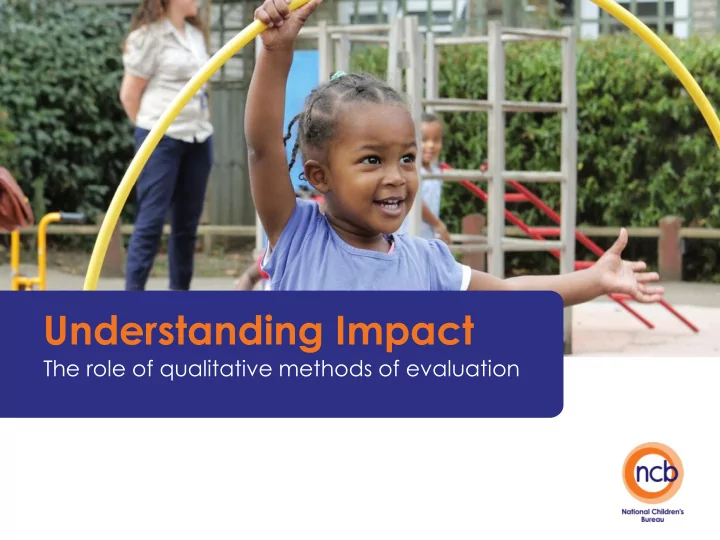
Understanding Impact

The role of qualitative methods of evaluation
slide-2
SLIDE 2

Aims of the workshop

  • To explore what qualitative methods are

and how they differ from quantitative methods

  • To examine the advantages and

disadvantages of qualitative methods

  • To explore different types of qualitative

methods for use with both young people and adults

slide-3
SLIDE 3

Workshop structure

  • What is evaluation?
  • The role of qualitative methods
  • Types of qualitative methods and their

advantages & disadvantages

  • Design & implementation of qualitative

methods

  • Analysis and reporting
slide-4
SLIDE 4

Evaluation: 3D Jigsaw

slide-5
SLIDE 5

Evaluation: 360 Degree Process

young people workers/volunteers, parents/carers or

  • ther significant

adults in their lives Other stakeholders (e.g. referral agents; schools; PSNI; VSC

  • rgs

Systems such as our education, justice, health and social care system

slide-6
SLIDE 6

Evaluation: Quantitative Vs Qualitative

  • About numbers,

measurement, quantifying things

  • In OBA we discussed

How much did we do? How well did we do it? Is anyone better off?

  • Statistics generated
  • About how people

understand what is going on , the meanings they give to things and how they behave’

  • ‘Tells a story’ – in

depth; rich

  • Usually narrative but

can be visual too

slide-7
SLIDE 7

Why use qualitative methods of evaluation?

  • To help tell the story of what

happened and its impact

  • To get ‘behind’ statistics - the why/why

not; how

  • To understand the nature of an

issue/problem or intervention

slide-8
SLIDE 8

Types of qualitative methods

  • Interviews
  • Focus groups
  • Participant observation
  • Non-participant observation
  • Case studies
  • Free text questions in surveys
slide-9
SLIDE 9

Things to consider

  • Ethics
  • Type of method
  • Skillset required
  • Analysis
  • Reporting
slide-10
SLIDE 10

Designing Questions for qualitative methods

  • Topic guide for interviews & focus

groups

  • Need open questions as much as

possible

  • It is essential to probe – why is that?

Can you say a bit more about this? etc

slide-11
SLIDE 11

Analysis & reporting of qualitative data

  • Themes
  • Audience
  • Reporting formats
slide-12
SLIDE 12

Creative tools for evaluation with young people

Small group exercise

slide-13
SLIDE 13

Tools Testing Feedback

  • How useful was the tool you were

testing for your audience?

  • What worked well?
  • What didn’t work so well?
  • What, if anything, would you change

about this tool?

slide-14
SLIDE 14

Some real life examples

slide-15
SLIDE 15

Summing up and evaluation

Resource list in packs Please complete evaluation forms

slide-16
SLIDE 16

Keep in touch with LINKS:

www.ncb.org.uk/links-programme Twitter: ncb_ni_tweets #ncblinks

National Children’s Bureau www.ncb.org.uk ncbtweets ncbfb