Uncle Sam is Watching Multinational corporations operating in China - - PDF document

uncle sam is watching
SMART_READER_LITE
LIVE PREVIEW

Uncle Sam is Watching Multinational corporations operating in China - - PDF document

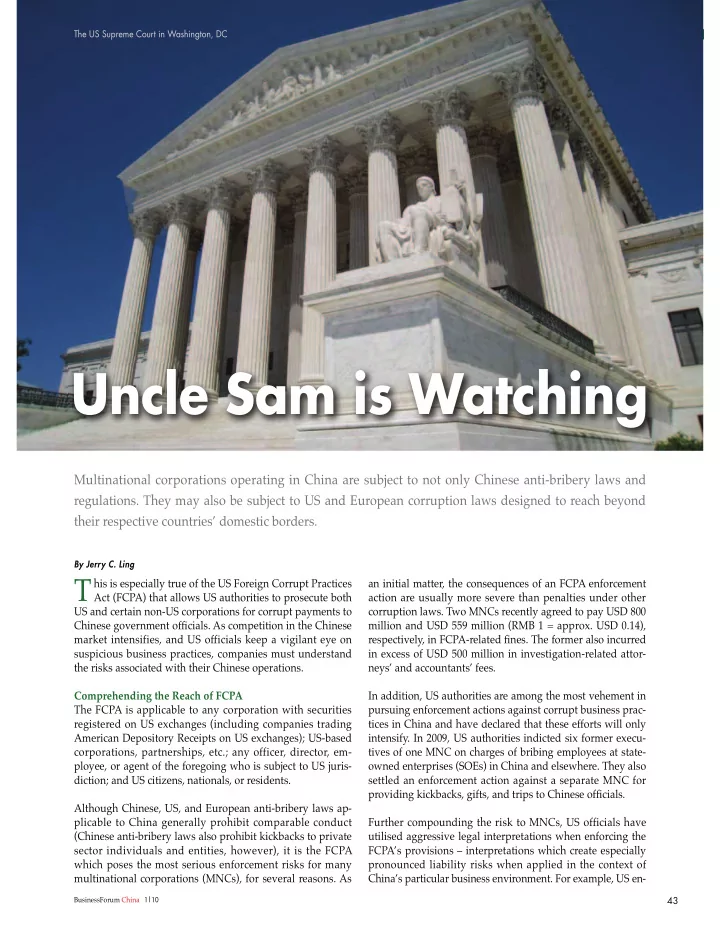
The US Supreme Court in Washington, DC Legal Issues Uncle Sam is Watching Multinational corporations operating in China are subject to not only Chinese anti-bribery laws and regulations. They may also be subject to US and European corruption


slide-1
SLIDE 1

43

BusinessForum China 1|10

Legal Issues

T

his is especially true of the US Foreign Corrupt Practices Act (FCPA) that allows US authorities to prosecute both US and certain non-US corporations for corrupt payments to Chinese government officials. As competition in the Chinese market intensifies, and US officials keep a vigilant eye on suspicious business practices, companies must understand the risks associated with their Chinese operations. Comprehending the Reach of FCPA The FCPA is applicable to any corporation with securities registered on US exchanges (including companies trading American Depository Receipts on US exchanges); US-based corporations, partnerships, etc.; any officer, director, em- ployee, or agent of the foregoing who is subject to US juris- diction; and US citizens, nationals, or residents. Although Chinese, US, and European anti-bribery laws ap- plicable to China generally prohibit comparable conduct (Chinese anti-bribery laws also prohibit kickbacks to private sector individuals and entities, however), it is the FCPA which poses the most serious enforcement risks for many multinational corporations (MNCs), for several reasons. As an initial matter, the consequences of an FCPA enforcement action are usually more severe than penalties under other corruption laws. Two MNCs recently agreed to pay USD 800 million and USD 559 million (RMB 1 = approx. USD 0.14), respectively, in FCPA-related fines. The former also incurred in excess of USD 500 million in investigation-related attor- neys’ and accountants’ fees. In addition, US authorities are among the most vehement in pursuing enforcement actions against corrupt business prac- tices in China and have declared that these efforts will only

  • intensify. In 2009, US authorities indicted six former execu-

tives of one MNC on charges of bribing employees at state-

  • wned enterprises (SOEs) in China and elsewhere. They also

settled an enforcement action against a separate MNC for providing kickbacks, gifts, and trips to Chinese officials. Further compounding the risk to MNCs, US officials have utilised aggressive legal interpretations when enforcing the FCPA’s provisions – interpretations which create especially pronounced liability risks when applied in the context of China’s particular business environment. For example, US en-

Uncle Sam is Watching

By Jerry C. Ling

Multinational corporations operating in China are subject to not only Chinese anti-bribery laws and

  • regulations. They may also be subject to US and European corruption laws designed to reach beyond

their respective countries’ domestic borders.

The US Supreme Court in Washington, DC

slide-2
SLIDE 2

44

BusinessForum China 1|10

forcement authorities consider all employees of SOEs to con- stitute government officials under the FCPA. Because China’s private sector contains a high proportion of SOEs, many com- mercial transactions may now trigger FCPA liability. Can You Trust Your Partners? China’s business realities also collide with the US authori- ties’ aggressive legal interpretations in the area of vicarious

  • liability. Chinese laws and regulations require foreign cor-

porations to establish Chinese subsidiaries (often via joint venture with Chinese corporations) before they can engage directly in business within China. As a result, these sub- sidiaries may inherit improper business practices from their Chinese partners who are completely unfamiliar or uncon- cerned with FCPA requirements. These foreign corporations may also lack the operational capacity or exper- tise necessary to navigate the Chinese cul- ture and market. Thus, they may rely heavily on joint venture partners or third party intermediaries while maintaining little on-the- ground supervision and control

  • ver such partners and agents.

Meanwhile, US authorities regularly apply vicarious liability theories to hold parents liable for the misconduct of their subsidiaries and agents. Not surprisingly, MNCs subject to the FCPA often unwittingly incur FCPA li- ability through the misconduct of their Chinese subsidiaries and agents, without ever operating in China themselves. Although non-US subsidiaries, including Chinese subsidiar- ies, are usually not directly subject to the FCPA, if the parent is a US corporation or issues US securities, and authorised the subsidiary’s illegal acts, the parent may incur liability. In

  • ne notable example, a US corporation agreed to pay a total
  • f USD 22 million in FCPA penalties for, among other things,

allegedly using its subsidiary to process payments to agents and Chinese officials associated with SOEs. According to US authorities, even if the parent corporation does not explicitly authorise the illegal acts by the subsidi- ary, the parent may nonetheless incur liability if it was aware

  • f and failed to stop the illegal acts (which may constitute

implicit authorisation); if it acted with “wilful blindness” (being aware of a high probability that a bribe will be paid and taking steps to avoid learning that fact); or if it discov- ered the illegal acts after the fact and then accepted mon- etary benefits arising from such acts. Nor can the parent es- cape liability simply because it is a minority shareholder in a Sino-Foreign joint venture. If the parent corporation cannot control the actions of the joint venture, it is still obligated to

  • bject to illegal acts, take reasonable actions to prevent the

joint venture from continuing future criminal activity, and refuse benefits arising from the same. Books and Records Additional risk exists for a corporation that issues US secu- rities and has reporting obligations to US securities regula-

  • tors. Such a corporation is subject not only to provisions

prohibiting corrupt payments, but also to the FCPA’s “books and records” and “internal controls” provisions. These provisions require the corporation to keep accurate records to reflect transactions and assets, and demand adequate controls to ensure that assets are utilised in accordance with management authorisation and transactions are recorded

  • properly. These accounting provisions also apply directly to

the books and records of any majority-owned subsidiary of an issuer. If the parent holds less than a 50 per cent interest in the subsidiary, it must use good faith efforts to influence the subsidiary to devise and maintain a system of internal accounting controls. The practical consequences of the books and records and in- ternal controls provision is that issuers of US securities may be liable for a subsidiary’s FCPA violations despite being unaware of the misconduct. For example, if the subsidiary makes illegal payments and then disguises those payments in its records, the parent corporation may be liable for fail- ing to cause the subsidiary to devise and maintain effective internal accounting controls. It may also be found liable for incorporating the subsidiary’s inaccurate entries into the par- ent’s own books, regardless of whether it knew of the illegal payments or of the accounting misfeasance.

Legal Issues 44

re and ma h i mai ground

  • ver such

Meanwhile, U ce These lack th tise nece tu ture

German Company

Directory

Supported by
  • US enforcement authorities have brought actions against

corporations that failed to monitor their Chinese agents...

slide-3
SLIDE 3

45

BusinessForum China 1|10

Profile Tracing its origins to 1893, Jones Day is an international, full-service commercial law firm recognised for its excellence in the provision of legal services through over 2,400 lawyers located in 32 offices worldwide. Jones Day is an integrated partnership that operates as one firm worldwide. Jerry Ling is an associate in Jones Day’s Shanghai office. He regularly assists multinational companies in disputes and internal investigations in or relating to China, including investigations regarding potential FCPA and PRC anti-bribery law violations and other employee misconduct. Jerry also has extensive experience representing PRC companies and multinationals in patent and commercial disputes in US courts. In addition, Jerry handles mergers and acquisitions, foreign direct investment, corporate transactions, and regulatory compliance relating to China. Contact Jerry C. Ling | Associate | Jones Day 30/F The Kerry Centre | 1515 Nanjing Road West | 200004 Shanghai | P.R. China Tel: +86 21 2201 8000 | Fax: +86 21 5298 6569 E-mail: jling@jonesday.com | Web: www.jonesday.com

Even if the corporation and its subsidiaries are not directly en- gaged in illegal activity, the use of third party intermediaries in China such as sales agents, consultants, and technical service agents can result in an FCPA violation. A corporation can neither explicitly authorise the agent to make an illegal payment, nor can it pay an agent with the knowledge that a portion of the pay- ment will ultimately be passed on as a bribe. Moreover, a corpo- ration without actual knowledge of illegal acts may nonetheless be liable if it remains wilfully blind to corrupt payments. Watch for Red Flags Circumstances that might be considered to constitute wilful blindness include paying excessive commissions or paying an agent who performs no services except to “maintain rela- tionships” with end customers. Similarly, hiring a current or former government official, or an official’s family member as an agent might suggest that corruption is the underlying basis for the engagement. The risks associated with these “red flags” are not hypothetical. US enforcement authorities have brought enforcement actions against corporations that failed to monitor their Chinese agents or that failed to detect and prevent illegal

  • payments. Enforcement authorities have also taken the position

that vicarious liability can arise even absent wilful blindness if the agent’s actions (i) were within the scope of its duties and (ii) were intended, at least in part, to benefit the corporation. Use of independent distributors can likewise give rise to FCPA liability, if the corporation knows that its distributor is making illegal payments to government officials. Enforce- ment authorities have taken the position that the FCPA is violated even if the distributor is not reimbursed for the cor- rupt payments and instead funds them entirely out of its own profit margins. As with agents, actual knowledge of illegal acts is not necessary, and the corporation may be liable if it took steps to avoid learning of corrupt activity. Red flags for problematic distributor relationships can include agreements that allow a particular distributor to make more favourable profits than is otherwise justifiable under market norms. Terms that provide a distributor discounted prices for certain end customers but not others are also considered suspicious. Enforcement actions based on relationships with Chinese distributors are not uncommon. One MNC paid FCPA fines after it was alleged to have violated the books and records and internal controls provisions by inaccurately booking sales to Chinese distributors at inflated profit margins, which the distributor used to make corrupt payments to Chinese SOEs. A separate MNC agreed to pay a USD 2 mil- lion criminal penalty after allegedly using a distributor to pay kickbacks in China to doctors in government hospitals and to patent-office officials. Precautionary Measures A corporation subject to the FCPA must therefore take meas- ures to ensure that it and its Chinese subsidiaries properly monitor their transactions with and payments to distribu- tors and third party agents. This includes tasks such as: Investigating whether there are close or family relationships between intermediaries and government officials; checking that profit margins and commissions are proportionate to services actually performed and are within market norms; guaranteeing that services are accurately described in in- voices; and demanding adequate warranties from interme- diaries regarding understanding of and compliance with the FCPA. Simply inserting FCPA provisions into agent and distributor contracts will likely be insufficient to protect a corporation from FCPA liability. In short, there are many ways pursuant to which a corpora- tion, such as an issuer of US secu- rities, could find itself entangled in an FCPA investigation despite having never conducted business in China itself. Such an eventuality could easily arise given the coupling of China’s unique business environment with the US authorities’ uncompro- mising application

  • f vicarious li-
  • ability. Careful

training, control, and monitoring of Chinese subsidiaries and intermediaries should thus be a priority for all corpo- rations subject to the FCPA. < ’ uncompro- ation rol, ng of idiaries ries should ty for all corpo- to the FCPA. < te s in could China’s th the

Legal Issues ...or that failed to detect and prevent illegal payments