UML-Based Statistical Test Case Generation Matthias Riebisch, Ilka - - PDF document

uml based statistical test case generation
SMART_READER_LITE
LIVE PREVIEW

UML-Based Statistical Test Case Generation Matthias Riebisch, Ilka - - PDF document

UML-Based Statistical Test Case Generation Matthias Riebisch, Ilka Philippow, Marco Gtze Ilmenau Technical University; Germany http://www.theoinf.tu-ilmenau.de/~pld ALEXANDRIA NetObjectDays02, Erfurt, October 10, 2002 ALEXANDRIA Research


slide-1
SLIDE 1

ALEXANDRIA

UML-Based Statistical Test Case Generation

Matthias Riebisch, Ilka Philippow, Marco Götze Ilmenau Technical University; Germany

http://www.theoinf.tu-ilmenau.de/~pld NetObjectDays‘02, Erfurt, October 10, 2002

  • M. Riebisch et al.: UML-Based Statistical Test Case Generation

2

ALEXANDRIA

Generative Programming

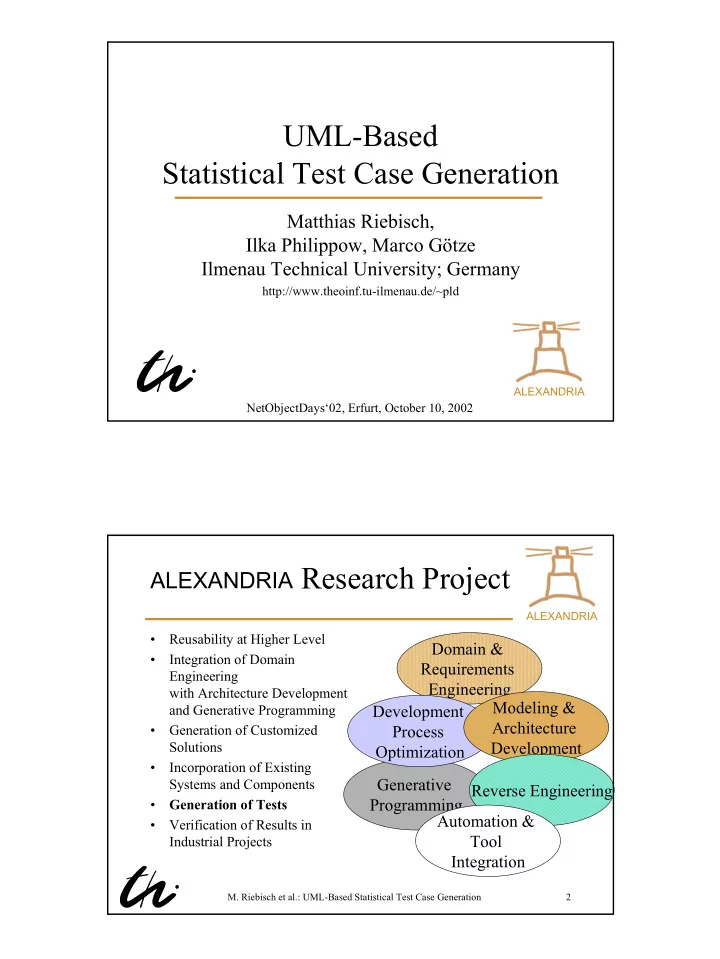
ALEXANDRIA Research Project

  • Reusability at Higher Level
  • Integration of Domain

Engineering with Architecture Development and Generative Programming

  • Generation of Customized

Solutions

  • Incorporation of Existing

Systems and Components

  • Generation of Tests
  • Verification of Results in

Industrial Projects

Domain & Requirements Engineering Development Process Optimization Modeling & Architecture Development Reverse Engineering Automation & Tool Integration

slide-2
SLIDE 2
  • M. Riebisch et al.: UML-Based Statistical Test Case Generation

3

ALEXANDRIA

Outline

  • Introduction: Model-Based Statistical

Testing

  • The Approach
  • Scenario for Practical Use
  • UsageTester – a Proof-of-Concept Tool
  • Next Steps
  • M. Riebisch et al.: UML-Based Statistical Test Case Generation

4

ALEXANDRIA

Introduction: Testing Strategies

Type:

  • Black Box -functional- testing vs.
  • White Box -structural- testing

Goal:

  • Tests for error detection -coverage- vs.
  • Statistical testing -reliability-
slide-3
SLIDE 3
  • M. Riebisch et al.: UML-Based Statistical Test Case Generation

5

ALEXANDRIA

Statistical Usage Testing

  • Check for reliability at system level

Approach:

  • Different probability of execution of modules
  • Testing effort dispensed due to probability
  • Execution probability derived from usage

probability

Usage Model

  • M. Riebisch et al.: UML-Based Statistical Test Case Generation

6

ALEXANDRIA

Motivation & Aim

  • Incremental development needs short cycles
  • Early tests for process maturity

– Feedback for developer and for project management – Early failure detection reduces re-work

Time and costs reduction Test case quality improvement Encouragement for model quality

slide-4
SLIDE 4
  • M. Riebisch et al.: UML-Based Statistical Test Case Generation

7

ALEXANDRIA

Outline

Introduction: Model-Based Statistical Testing

  • The Approach
  • Scenario for Practical Use
  • UsageTester – a Proof-of-Concept Tool
  • Next Steps
  • M. Riebisch et al.: UML-Based Statistical Test Case Generation

8

ALEXANDRIA

Model-Based Statistical Testing

  • Black-box, system-level testing
  • Statistical testing for reliability
  • Test case derivation from specification

domain of the real world Test model UML model Usage model fault detection & reliability measures analysis, verification, and fault detection generation, systematization verification modeling generation, automation

slide-5
SLIDE 5
  • M. Riebisch et al.: UML-Based Statistical Test Case Generation

9

ALEXANDRIA

Model Refinement Steps Detailed

Refinement by Use Case Templates Definition of State Diagrams Definition of Use Cases Definition of Logical Structure Transformation to Usage Graphs Test Cases Imple- mentation

  • M. Riebisch et al.: UML-Based Statistical Test Case Generation

10

ALEXANDRIA

Use Case Templates

  • Refining use case diagrams
  • Semi-formal description
  • State & transition information covered
  • Not (yet) defined by OMG standard

see example …

Lend a Book

Display books lent by a user; Collect payment from a user. Included use cases 2a) User has to pay a fee or a fine. 2a1) Message: no lending allowed 2a2) Successful - return to lending dialog. 2a3) Not successful - return to new user selection Extensions None Variations 1) The librarian opens the user selection dialog with selected user. 2) He opens the lending dialog for selecting a book, a return date is shown. 3) He. Main Success scenario None Invariants The book was lent to the user. A due date for return is defined. Postconditions Library system is running. The user is valid to the library Preconditions Librarian Actors Lend a book to a user of this library for a limited time. Goal Lend a book Name

slide-6
SLIDE 6
  • M. Riebisch et al.: UML-Based Statistical Test Case Generation

11

ALEXANDRIA

Display books lent by a user; Collect payment from a user. Included use cases 2a) User has to pay a fee or a fine. 2a1) Message: no lending allowed 2a2) Successful - return to lending dialog. 2a3) Not successful - return to new user selection 2b) The book of interest is already lent or is for reference only. 2b1) Message - return to book selection 3a) Cancelled by librarian 3a1) Return to book selection. Extensions None Variations 1) The librarian opens the user selection dialog with selected user. 2) He opens the lending dialog for selecting a book, a return date is shown. 3) He confirms the operation. 4) The book is marked as lent, the lent-book-list of the user is updated. Main Success scenario None Invariants The book was lent to the user. A due date for return is defined. Postconditions Library system is running. The user is valid to the library Preconditions Librarian Actors Lend a book to a user of this library for a limited time. Goal Lend a book Name

  • M. Riebisch et al.: UML-Based Statistical Test Case Generation

12

ALEXANDRIA

State Diagrams

  • Defined by UML
  • Intended for object behavior
  • Hierarchy for mastering complexity

Showing system states and transitions according to refined Use Cases Transformable to Usage Graphs

see example …

slide-7
SLIDE 7
  • M. Riebisch et al.: UML-Based Statistical Test Case Generation

13

ALEXANDRIA

State Diagram Example

Book selection Select User Screen /Entry: the user is subscribed to the library Updated status and lists the book is added to the users’s lent-book-list

2

termination Confirm lending ...

2b

  • M. Riebisch et al.: UML-Based Statistical Test Case Generation

14

ALEXANDRIA

State Book Selection Refined

Book selection dialog No lending possible Collect payment …

2 2b

N/A to pay ... success no success reference only

slide-8
SLIDE 8
  • M. Riebisch et al.: UML-Based Statistical Test Case Generation

15

ALEXANDRIA

Usage Graphs

  • Special form of Automata graph
  • Transitions labeled

– with user actions for triggered transitions – with epsilon ε for transitions performed automatically

  • References to state diagram and use cases

via state label prefix

  • M. Riebisch et al.: UML-Based Statistical Test Case Generation

16

ALEXANDRIA

Usage Models

  • State diagrams extended by usage

information

  • Probabilities of user actions derived by

requirements or customer data

  • Probabilities annotated to outbound

transitions of each state

  • ε transitions: probability of 1.0

see example …

slide-9
SLIDE 9
  • M. Riebisch et al.: UML-Based Statistical Test Case Generation

17

ALEXANDRIA

Usage Model Example

Select User Screen select and display user Collect Payment collect the fine or fee completely Select Book select a book for lending Confirm Procedure OK 0.98 U 1.0 PM 0.7 S 1.0 P 0.1 Not invoked Terminated Message Lending not possible C 0.02 /PM 0.3 /P 0.78 OK 1.0 R 0.1 NA 0.02

  • M. Riebisch et al.: UML-Based Statistical Test Case Generation

18

ALEXANDRIA

Test Cases

  • Usually: test cases programmed as scripts or

built by teach-in

  • Now: Input Values + Expected Results

derived from the models

  • Input for Test Automation tools
slide-10
SLIDE 10
  • M. Riebisch et al.: UML-Based Statistical Test Case Generation

19

ALEXANDRIA

Outline

Introduction: Model-Based Statistical Testing The Approach

  • Scenario for Practical Use
  • UsageTester – a Proof-of-Concept Tool
  • Next Steps
  • M. Riebisch et al.: UML-Based Statistical Test Case Generation

20

ALEXANDRIA

Scenario for Practical Use

  • Development of test cases independently

from programming

  • Test cases based on requirements to system

behavior

  • Test cases prior to design
  • Test tool available for developer –

early feedback with low effort

slide-11
SLIDE 11
  • M. Riebisch et al.: UML-Based Statistical Test Case Generation

21

ALEXANDRIA

UsageTester – a Proof-of-Concept Tool

Goal: verification of the approach in practical application

– Supported: model refinement & conversion – Manual activities: model completion – Automated: test case generation

  • XML interface for model input and test case
  • utput
  • Portable implementation with Java, Swing,

DOM4J

  • M. Riebisch et al.: UML-Based Statistical Test Case Generation

22

ALEXANDRIA

UsageTester – Snapshot

slide-12
SLIDE 12
  • M. Riebisch et al.: UML-Based Statistical Test Case Generation

23

ALEXANDRIA

Conclusion

  • Test cases derived from requirements

specification and usage behavior

  • Tool support; no automation intended
  • Model exploitation encourages modeling

effort

  • Providing test cases early supports

programmers

  • M. Riebisch et al.: UML-Based Statistical Test Case Generation

24

ALEXANDRIA

Next Steps

  • Next 2 years: project funded by DFG
  • Cooperation with UCF Orlando, Florida
  • Application of Sequence Diagrams for

deriving State Diagrams

  • Hierarchical models for scalability
  • How to acquire usage information
  • How to derive expected test result date
  • How to add user profiles and product variants
  • Experiences from practical usage
slide-13
SLIDE 13

ALEXANDRIA

Questions and Comments

More information about ALEXANDRIA:

http://www.theoinf.tu-ilmenau.de/~pld/