U.S.C. Title 15 - COMMERCE AND TRADE CHAPTER 53 - TOXIC SUBSTANCES - - PDF document

u s c title 15 commerce and trade chapter 53 toxic
SMART_READER_LITE
LIVE PREVIEW

U.S.C. Title 15 - COMMERCE AND TRADE CHAPTER 53 - TOXIC SUBSTANCES - - PDF document

U.S.C. Title 15 - COMMERCE AND TRADE CHAPTER 53 - TOXIC SUBSTANCES CONTROL SUBCHAPTER ICONTROL OF TOXIC SUBSTANCES Statute TSCA Section Header Page Section 15. U.S.C. 2601 2 Findings, policy, and intent. 2 15. U.S.C. 2602 3


slide-1
SLIDE 1

1

This document represents the amended version of the Toxic Substances Control Act (15 U.S.C. 2601) if the Chemical Safety Improvement Act (S.1009) as introduced on May 22, 2013 were to become law. A preliminary copy of the bill is available at the Keller and Heckman TSCA Reform Center.

U.S.C. Title 15 - COMMERCE AND TRADE CHAPTER 53 - TOXIC SUBSTANCES CONTROL SUBCHAPTER I—CONTROL OF TOXIC SUBSTANCES Statute TSCA Section Section Header Page

  • 15. U.S.C. 2601

2 Findings, policy, and intent. 2

  • 15. U.S.C. 2602

3 Definitions. 4

  • 15. U.S.C. 2603

4 Chemical assessment framework; prioritization screening; testing. (nee Testing of chemical substances and mixtures.) 8

  • 15. U.S.C. 2604

5 New chemicals and significant new uses. (nee Manufacturing and processing notices.) 31

  • 15. U.S.C. 2605

6 Safety assessments and determinations. (nee Regulation of hazardous chemical substances and mixtures.) 43

  • 15. U.S.C. 2606

7 Imminent hazards. 53

  • 15. U.S.C. 2607

8 Information collection and reporting. (nee Reporting and retention of information.) 56

  • 15. U.S.C. 2608

9 Relationship to other Federal laws. 66

  • 15. U.S.C. 2609

10 Research, development, collection, dissemination, and utilization of data. 69

  • 15. U.S.C. 2610

11 Inspections and subpoenas. 71

  • 15. U.S.C. 2611

12 Exports. 73

  • 15. U.S.C. 2612

13 Imports. (nee Entry into customs territory of the United States.) 77

  • 15. U.S.C. 2613

14 Confidential information. (nee Disclosure of data.) 80

  • 15. U.S.C. 2614

15 Prohibited acts. 88

  • 15. U.S.C. 2615

16 Penalties. 89

  • 15. U.S.C. 2616

17 Specific enforcement and seizure. 91

  • 15. U.S.C. 2617

18 Preemption. 93

  • 15. U.S.C. 2618

19 Judicial review. 97

  • 15. U.S.C. 2619

20 Citizens’ civil actions. 100

  • 15. U.S.C. 2620

21 Citizens’ petitions. 102

  • 15. U.S.C. 2621

22 National defense waiver. 105

  • 15. U.S.C. 2622

23 Employee protection. 106

  • 15. U.S.C. 2623

24 Employment effects. 108

  • 15. U.S.C. 2624

25 Studies. 110

  • 15. U.S.C. 2625

26 Administration. 111

  • 15. U.S.C. 2626

27 Development and evaluation of test methods. 114

  • 15. U.S.C. 2627

28 State programs. 115

  • 15. U.S.C. 2628

29 Authorization of appropriations. 117

  • 15. U.S.C. 2629

30 Annual report. 118

slide-2
SLIDE 2

2

This document represents the amended version of the Toxic Substances Control Act (15 U.S.C. 2601) if the Chemical Safety Improvement Act (S.1009) as introduced on May 22, 2013 were to become law. A preliminary copy of the bill is available at the Keller and Heckman TSCA Reform Center.

Original TSCA Statute Sections amended by CSIA §2601 [Section 2]. Findings, policy, and intent (a) Findings The Congress finds that— (1) human beings and the environment are being exposed each year to a large number of chemical substances and mixtures; (2) among the many chemical substances and mixtures which are constantly being developed and produced, there are some whose manufacture, processing, distribution in commerce, use, or disposal may present an unreasonable risk of injury to health or the environment; and (3) the effective regulation of interstate commerce in such chemical substances and mixtures also necessitates the regulation of intrastate commerce in such chemical substances and mixtures. (b) Policy It is the policy of the United States that— (1) adequate data should be developed with respect to the effect of chemical substances and mixtures on health and the environment and that the development

  • f such data should be the responsibility of those who

manufacture and those who process such chemical substances and mixtures; (2) adequate authority should exist to regulate chemical substances and mixtures which present an unreasonable risk of injury to health or the environment, and to take action with respect to chemical substances and mixtures which are imminent hazards; and (3) authority over chemical substances and mixtures should be exercised in such a manner as not to impede unduly or create unnecessary economic barriers to technological innovation while fulfilling the primary purpose of this chapter to assure that such innovation and commerce in such chemical substances and mixtures do not present an unreasonable risk of injury to health or the environment. (c) Intent of Congress It is the intent of Congress that the Administrator shall carry out this chapter in a reasonable and prudent manner, and that the Administrator shall consider the environmental, economic, and social impact of any action the Administrator takes or proposes to take under this chapter. §2601 [Section 2]. Findings, policy, and intent (a) FINDINGS.— Congress finds that— (1) chemicals should be safe for the intended use of the chemicals; (2) the unmanaged risks of chemical substances may pose a danger to human health and the environment; (3) public confidence in the Federal chemical regulatory program has diminished over time; (4) scientific understanding of chemicals and the possible risks of the chemicals has evolved greatly since 1976, requiring that Congress update the law to ensure that chemical regulation in the United States reflects modern science, technology and knowledge; (5) this Act should be modernized to create a robust Federal system for assessing and managing chemical risks; (6) chemicals are used in diverse manufacturing industries and other valuable commercial, institutional, and consumer applications that have benefitted society; (7) for the purposes of promoting uniform protections through regulation of chemical substances in commerce, to minimize undue burdens on commerce, and to minimize burdens on States, specified actions by the Administrator should preempt requirements by States and political subdivisions of States that relate to the effects of or exposure to a chemical substance under the intended conditions of use; and (8) innovation in the development of new chemical substances, especially safer chemical substances, should be encouraged to reduce risk, provide improved products, stimulate the economy, create jobs, and protect interstate commerce. (b) POLICY.— It is the policy of the United States (1) this Act (A) should protect the health of people and the environment from the unmanaged risks of chemical substances; and (B) should be modernized to build public confidence in the ability of the Federal regulatory system to protect health and the environment, promote innovation, and sustain a globally competitive chemical industry in the United States; (2) the Administrator (A) should have the appropriate hazard, use, and exposure information necessary to make safety determinations; (B) should minimize the use of animal testing

slide-3
SLIDE 3

3

This document represents the amended version of the Toxic Substances Control Act (15 U.S.C. 2601) if the Chemical Safety Improvement Act (S.1009) as introduced on May 22, 2013 were to become law. A preliminary copy of the bill is available at the Keller and Heckman TSCA Reform Center.

through the use of scientifically reliable and relevant test methods, where appropriate; (C) should encourage the use of best laboratory practices to ensure high quality, relevant, and reliable results from test methods and studies; (D) should have the authority to share confidential business information with States and political subdivisions of the States, subject to appropriate safeguards against inappropriate disclosure; (E) should have the resources and tools necessary to implement this Act; and (F) should implement this Act in a manner that promotes transparency of information and decisionmaking, protects substantiated confidential business information, and promotes innovation, including innovation in chemical substances that have reduced hazard, exposure, and risk patterns; (3) adequate data and information should be available with respect to the effect of and exposure to chemical substances and mixtures on health and the environment, to the extent necessary for safety assessments and determinations, and that, where necessary, the development of such test data and information should be the primary responsibility of those who manufacture or process such chemical substances and mixtures; and (4) States have an important role in protecting health and the environment from the unmanaged risks of chemical substances in commerce, particularly in recommending priorities for Federal assessment and regulation, providing safety assessment information, and fostering programs to protect consumers. (c) INTENT OF CONGRESS.— It is the intent of Congress that the Administrator shall (1) rely on robust scientific evidence to implement this Act in a way that balances the mutual goals of promoting the safety of American consumers and preventing harm to American innovation, manufacturing, and the economy; and (2) implement this Act to protect the health of the people of the United States and the environment in such a manner as not to unduly impede commerce or create unnecessary economic barriers to technological innovation, including safer chemistry.

slide-4
SLIDE 4

4

This document represents the amended version of the Toxic Substances Control Act (15 U.S.C. 2601) if the Chemical Safety Improvement Act (S.1009) as introduced on May 22, 2013 were to become law. A preliminary copy of the bill is available at the Keller and Heckman TSCA Reform Center.

§2602 [Section 3]. Definitions As used in this chapter: (1) the 1 term “Administrator” means the Administrator of the Environmental Protection Agency. (2) Paragraphs (2) through (6) will be moved to paragraphs (3) through (7). (3) (A) Except as provided in subparagraph (B), the term “chemical substance” means any organic or inorganic substance of a particular molecular identity, including— (i) any combination of such substances occurring in whole or in part as a result of a chemical reaction or occurring in nature and (ii) any element or uncombined radical. (B) Such term does not include— (i) any mixture, (ii) any pesticide (as defined in the Federal Insecticide, Fungicide, and Rodenticide Act [7 U.S.C. 136 et seq.]) when manufactured, processed, or distributed in commerce for use as a pesticide, (iii) tobacco or any tobacco product, (iv) any source material, special nuclear material,

  • r byproduct material (as such terms are defined in

the Atomic Energy Act of 1954 [42 U.S.C. 2011 et seq.] and regulations issued under such Act), (v) any article the sale of which is subject to the tax imposed by section 4181 of the Internal Revenue Code of 1986 [26 U.S.C. 4181] (determined without regard to any exemptions from such tax provided by section 4182 or 4221 or any other provision of such Code), and (vi) any food, food additive, drug, cosmetic, or device (as such terms are defined in section 201 of the Federal Food, Drug, and Cosmetic Act [21 U.S.C. 321]) when manufactured, processed, or distributed in commerce for use as a food, food additive, drug, cosmetic, or device. The term “food” as used in clause (vi) of this subparagraph includes poultry and poultry products (as defined in sections 4(e) and 4(f) of the Poultry Products Inspection Act [21 U.S.C. 453(e) and (f)]), meat and meat food products (as defined in section 1(j)

  • f the Federal Meat Inspection Act [21 U.S.C.

601(j)]), and eggs and egg products (as defined in §2602 [Section 3]. Definitions As used in this chapter: (2) BEST AVAILABLE SCIENCE. The term 'best available science' means science that — (A) maximizes the quality, objectivity, and integrity of information, including statistical information; (B) uses peer reviewed and publically available data; and (C) clearly documents and communicates risks and uncertainties in the scientific basis for decisions.

slide-5
SLIDE 5

5

This document represents the amended version of the Toxic Substances Control Act (15 U.S.C. 2601) if the Chemical Safety Improvement Act (S.1009) as introduced on May 22, 2013 were to become law. A preliminary copy of the bill is available at the Keller and Heckman TSCA Reform Center.

section 4 of the Egg Products Inspection Act [21 U.S.C. 1033]). (4) The term “commerce” means trade, traffic, transportation, or other commerce (A) between a place in a State and any place outside of such State, or (B) which affects trade, traffic, transportation, or commerce described in clause (A). (5) The terms “distribute in commerce” and “distribution in commerce” when used to describe an action taken with respect to a chemical substance or mixture or article containing a substance or mixture mean to sell, or the sale

  • f, the substance, mixture, or article in commerce; to

introduce or deliver for introduction into commerce, or the introduction or delivery for introduction into commerce of, the substance, mixture, or article; or to hold, or the holding of, the substance, mixture, or article after its introduction into commerce. (6) The term “environment” includes water, air, and land and the interrelationship which exists among and between water, air, and land and all living things. (7) The term “health and safety study” means any study of any effect of a chemical substance or mixture on health or the environment or on both, including underlying data and epidemiological studies, studies of occupational exposure to a chemical substance or mixture, toxicological, clinical, and ecological studies of a chemical substance or mixture, and any test performed pursuant to this chapter. (8) The text of (7) through (11) has been moved to section (9) through (13). (9) The term “manufacture” means to import into the customs territory of the United States (as defined in general note 2 of the Harmonized Tariff Schedule of the United States), produce, or manufacture. (10) The term “mixture” means any combination of two

  • r more chemical substances if the combination does not
  • ccur in nature and is not, in whole or in part, the result of

a chemical reaction; except that such term does include any combination which occurs, in whole or in part, as a result of a chemical reaction if none of the chemical substances comprising the combination is a new chemical substance and if the combination could have been manufactured for commercial purposes without a chemical reaction at the time the chemical substances comprising the combination were combined. (11) The term “new chemical substance” means any (8) INTENDED CONDITIONS OF USE. — The term 'intended conditions of use' means the circumstances under which a chemical substance is intended or reasonably anticipated to be manufactured, processed, distributed in commerce, used, and disposed

  • f.
slide-6
SLIDE 6

6

This document represents the amended version of the Toxic Substances Control Act (15 U.S.C. 2601) if the Chemical Safety Improvement Act (S.1009) as introduced on May 22, 2013 were to become law. A preliminary copy of the bill is available at the Keller and Heckman TSCA Reform Center.

chemical substance which is not included in the chemical substance list compiled and published under section 2607(b) of this title. (12) The term “process” means the preparation of a chemical substance or mixture, after its manufacture, for distribution in commerce— (A) in the same form or physical state as, or in a different form or physical state from, that in which it was received by the person so preparing such substance or mixture, or (B) as part of an article containing the chemical substance or mixture. (13) The term “processor” means any person who processes a chemical substance or mixture. (14) The text of (12) through (14) has been moved to section (17) through (19). (17) The term “standards for the development of test data” means a prescription of— (A) the— (i) health and environmental effects, and (ii) information relating to toxicity, persistence, and other characteristics which affect health and the environment, for which test data for a chemical substance or mixture are to be developed and any analysis that is to be performed on such data, and (B) to the extent necessary to assure that data respecting such effects and characteristics are reliable and adequate— (i) the manner in which such data are to be developed, (ii) the specification of any test protocol or (14) SAFETY ASSESSMENT. — The term 'safety assessment' means a risk-based assessment of the safety of a chemical substance that (A) integrates hazard; use; and exposure information about a chemical substance; and (B) includes (i) an assessment of exposure under the intended conditions of use; and (ii) reference parameters that may be appropriate with regard to a specific chemical substance (such as a margin of exposure). (15) SAFETY DETERMINATION.— The term 'safety determination' means a determination by the Administrator as to whether a chemical substance meets the safety standard under the intended conditions of use. (16) SAFETY STANDARD.— The term 'safety standard' means a standard that ensures that no unreasonable risk of harm to human health or the environment will result from exposure to a chemical substance.

slide-7
SLIDE 7

7

This document represents the amended version of the Toxic Substances Control Act (15 U.S.C. 2601) if the Chemical Safety Improvement Act (S.1009) as introduced on May 22, 2013 were to become law. A preliminary copy of the bill is available at the Keller and Heckman TSCA Reform Center.

methodology to be employed in the development

  • f such data, and

(iii) such other requirements as are necessary to provide such assurance. (18) The term “State” means any State of the United States, the District of Columbia, the Commonwealth of Puerto Rico, the Virgin Islands, Guam, the Canal Zone, American Samoa, the Northern Mariana Islands, or any

  • ther territory or possession of the United States.

(19) The term “United States”, when used in the geographic sense, means all of the States.

slide-8
SLIDE 8

8

This document represents the amended version of the Toxic Substances Control Act (15 U.S.C. 2601) if the Chemical Safety Improvement Act (S.1009) as introduced on May 22, 2013 were to become law. A preliminary copy of the bill is available at the Keller and Heckman TSCA Reform Center.

§2603 [Section 4]. Testing of chemical substances and mixtures (a) Testing requirements If the Administrator finds that— (1) (A) (i) the manufacture, distribution in commerce, processing, use, or disposal of a chemical substance or mixture, or that any combination

  • f such activities, may present an unreasonable

risk of injury to health or the environment, (ii) there are insufficient data and experience upon which the effects of such manufacture, distribution in commerce, processing, use, or disposal of such substance or mixture or of any combination of such activities on health or the environment can reasonably be determined or predicted, and (iii) testing of such substance or mixture with respect to such effects is necessary to develop such data; or (B) (i) a chemical substance or mixture is or will be produced in substantial quantities, and (I) it enters or may reasonably be anticipated to enter the environment in substantial quantities or (II) there is or may be significant or substantial human exposure to such substance or mixture, (ii) there are insufficient data and experience upon which the effects of the manufacture, distribution in commerce, processing, use, or disposal of such substance or mixture or of any combination of such activities on health or the environment can reasonably be determined or predicted, and (iii) testing of such substance or mixture with respect to such effects is necessary to develop such data; and (2) in the case of a mixture, the effects which the mixture's manufacture, distribution in commerce, processing, use, or disposal or any combination of such activities may have on health or the environment may not be reasonably and more efficiently determined or predicted by testing the chemical substances which comprise the mixture; the Administrator shall by rule require that testing be conducted on such substance or mixture to develop data with respect to the health and environmental effects for which there is an insufficiency of data and experience and which are relevant to a determination that the manufacture, distribution in commerce, §2603 [Section 4]. CHEMICAL ASSESSMENT FRAMEWORK; PRIORITIZATION SCREENING; TESTING (a) CHEMICAL ASSESSMENT FRAMEWORK.— (1) IN GENERAL.— The Administrator shall develop a framework in accordance with subsection (e) and sections 5 and 6 for evaluating the safety of chemical substances in commerce that shall employ the best available science and risk assessment principles in existence at the time the Administrator is developing the framework. (2) POLICIES AND PROCEDURES.— (A) IN GENERAL.— After the date of enactment of the Chemical Safety Improvement Act, the Administrator shall promptly develop appropriate policies and procedures for implementing the framework, including procedures on the collection, evaluation, and development

  • f data and information.

(B) CONTENTS.— The policies and procedures shall require— (i) the collection of existing data and information from manufacturers and processors

  • f chemical substances and other sources,

including the use of voluntary agreements to provide the data and information; (ii) an evaluation of the quality of existing data and information; (iii) an analysis of data and information; (iv) a determination of the need for additional data and information, including information related to the exposures of different subpopulations; and (v) subject to section 14, transparency of data and information considered by the Administrator, including both positive and negative findings. (3) TRANSPARENCY AND VALIDITY.— The Administrator shall ensure that the evaluation frame work described in subsection (a)(1)— (A) is transparent; (B) assures that data and information are valid; (C) addresses the strengths and limitations of— (i) the design of the framework, (ii) the reliability of the test methods; and (iii) the quality of the data and information; and (D) pursues the goal of maximizing the quality,

  • bjectivity, utility, and integrity of the data and

information. (b) DATA AND INFORMATION QUALITY.— (1) IN GENERAL.— The Administrator shall establish and publish

slide-9
SLIDE 9

9

This document represents the amended version of the Toxic Substances Control Act (15 U.S.C. 2601) if the Chemical Safety Improvement Act (S.1009) as introduced on May 22, 2013 were to become law. A preliminary copy of the bill is available at the Keller and Heckman TSCA Reform Center.

processing, use, or disposal of such substance or mixture, or that any combination of such activities, does or does not present an unreasonable risk of injury to health or the environment. (b) Testing requirement rule (1) A rule under subsection (a) of this section shall include— (A) identification of the chemical substance or mixture for which testing is required under the rule, (B) standards for the development of test data for such substance or mixture, and (C) with respect to chemical substances which are not new chemical substances and to mixtures, a specification of the period (which period may not be of unreasonable duration) within which the persons required to conduct the testing shall submit to the Administrator data developed in accordance with the standards referred to in subparagraph (B). In determining the standards and period to be included, pursuant to subparagraphs (B) and (C), in a rule under subsection (a) of this section, the Administrator's considerations shall include the relative costs of the various test protocols and methodologies which may be required under the rule and the reasonably foreseeable availability of the facilities and personnel needed to perform the testing required under the rule. Any such rule may require the submission to the Administrator of preliminary data during the period prescribed under subparagraph (C). (2) (A) The health and environmental effects for which standards for the development of test data may be prescribed include carcinogenesis, mutagenesis, teratogenesis, behavioral disorders, cumulative or synergistic effects, and any other effect which may present an unreasonable risk of injury to health or the environment. The characteristics of chemical substances and mixtures for which such standards may be prescribed include persistence, acute toxicity, subacute toxicity, chronic toxicity, and any other characteristic which may present such a risk. The methodologies that may be prescribed in such standards include epidemiologic studies, serial or hierarchical tests, in vitro tests, and whole animal tests, except that before prescribing epidemiologic studies of employees, the Administrator shall consult with the Director of the National Institute scientifically sound criteria for evaluating all of the data and information, including the results of animal and nonanimal testing, regardless of affiliation or funding source, on which the Administrator relies in making a decision under this Act. (2) DISCLOSURE OF SOURCES OF FUNDING.— The Administrator shall require that the submitter of any health and safety study disclose to the Administrator and to the public the sources of any funding used for the study or publication of the study received by the researcher who conducted the study, to the extent reasonably ascertainable. (3) TEST DATA.— For test data developed under this Act, the Administrator shall encourage the use of good laboratory practices, peer review, scientifically reliable and relevant test methods, standardized protocols, and

  • ther methods to ensure scientific quality for all data

and information submitted under this Act. (4) DATA AND INFORMATION THAT DO NOT MEET CRITERIA.— (A) IN GENERAL.— Nothing in this subsection shall preclude the Administrator from considering data and information which do not meet the quality criteria established under paragraph (1). (B) IDENTIFICATION.— The Administrator shall— (i) identify any data and information described in subparagraph (A) on which the Administrator relies; (ii) describe the quality of the data and information described in subparagraph (A) and the extent to which the data and information depart from those criteria; (iii) indicate any limitations on the usefulness

  • f the data and information described in

subparagraph (A); and (iv) explain how the data and information described in subparagraph (A) was used and the basis for reliance on the data and information. (5) EVALUATIVE FRAMEWORK FOR DECISIONMAKING.— (A) IN GENERAL.— The Administrator shall develop and use a structured evaluative framework consisting of science-based criteria, consistent with the protection of human health and the environment, for making any decision under this Act, and for determining the relevance, quality, and reliability

  • f data and information.
slide-10
SLIDE 10

10

This document represents the amended version of the Toxic Substances Control Act (15 U.S.C. 2601) if the Chemical Safety Improvement Act (S.1009) as introduced on May 22, 2013 were to become law. A preliminary copy of the bill is available at the Keller and Heckman TSCA Reform Center.

for Occupational Safety and Health. (B) From time to time, but not less than once each 12 months, the Administrator shall review the adequacy of the standards for development of data prescribed in rules under subsection (a) of this section and shall, if necessary, institute proceedings to make appropriate revisions of such standards. (3) (A) A rule under subsection (a) of this section respecting a chemical substance or mixture shall require the persons described in subparagraph (B) to conduct tests and submit data to the Administrator on such substance or mixture, except that the Administrator may permit two or more of such persons to designate one such person

  • r a qualified third party to conduct such tests and

submit such data on behalf of the persons making the designation. (B) The following persons shall be required to conduct tests and submit data on a chemical substance or mixture subject to a rule under subsection (a) of this section: (i) Each person who manufactures or intends to manufacture such substance or mixture if the Administrator makes a finding described in subsection (a)(1)(A)(ii) or (a)(1)(B)(ii) of this section with respect to the manufacture of such substance or mixture. (ii) Each person who processes or intends to process such substance or mixture if the Administrator makes a finding described in subsection (a)(1)(A)(ii) or (a)(1)(B)(ii) of this section with respect to the processing of such substance or mixture. (iii) Each person who manufactures or processes or intends to manufacture or process such substance or mixture if the Administrator makes a finding described in subsection (a)(1)(A)(ii) or (a)(1)(B)(ii) of this section with respect to the distribution in commerce, use, or disposal of such substance or mixture. (4) Any rule under subsection (a) of this section requiring the testing of and submission of data for a particular chemical substance or mixture shall expire at the end of the reimbursement period (as defined in subsection (c)(3)(B) of this section) which is applicable to test data for such substance or mixture unless the Administrator repeals the rule before such date; and a rule under subsection (a) of this section requiring the testing of and submission of data for a category of chemical substances or mixtures shall (B) CONTENTS.— The framework described in subparagraph (A) shall, at a minimum— (i) use sound and objective scientific practices in assessing risks; (ii) consider the current best available science (including peer-reviewed studies); (iii) when consistent with the underlying data, consider, for both cancer and noncancer endpoints, whether available data support or do not support the identification of threshold doses

  • f a chemical substance below which no

adverse effects can be expected to occur; and (iv) include a description of the weight of the scientific evidence concerning risks, including mechanistic information (such as appropriate modes of action). (c) DATA AND INFORMATION SOURCES.— In making any decision with respect to a chemical substance under subsection (e) and sections 5 and 6, the Administrator shall consider data and information relevant to the sub stance that are reasonably available to the Administrator at that time, including data and information that are— (1) submitted to the Administrator by— (A) manufacturers and processors of the substance; (B) the public; or (C) a Governor of a State or a State agency with responsibility for protecting health or the environment; (2) submitted to a governmental body in another jurisdiction under a governmental requirement relating to the protection of human health and the environment, if the information is accessible to the Administrator; (3) derived through the application of scientifically reliable and relevant structure-activity relationship, or

  • ther methods or models to estimate the

environmental and human health effects, environmental and biological fate and behavior, and exposure potential for the substance; (4) inferred based on the degree of structural similarity

  • r properties of the substance, or categories of

substances, to those of 1 or more other chemical substances for which reliable information exists that is relevant to predicting the potential environmental or human health effects, environmental or biological fate and behavior, or exposure potential for the chemical substance; and (5) identified through an active search by the Administrator of information sources that are publicly available or otherwise accessible to the Administrator.

slide-11
SLIDE 11

11

This document represents the amended version of the Toxic Substances Control Act (15 U.S.C. 2601) if the Chemical Safety Improvement Act (S.1009) as introduced on May 22, 2013 were to become law. A preliminary copy of the bill is available at the Keller and Heckman TSCA Reform Center.

expire with respect to a chemical substance or mixture included in the category at the end of the reimbursement period (as so defined) which is applicable to test data for such substance or mixture unless the Administrator before such date repeals the application of the rule to such substance or mixture or repeals the rule. (5) Rules issued under subsection (a) of this section (and any substantive amendment thereto or repeal thereof) shall be promulgated pursuant to section 553

  • f title 5 except that (A) the Administrator shall give

interested persons an opportunity for the oral presentation of data, views, or arguments, in addition to an opportunity to make written submissions; (B) a transcript shall be made of any oral presentation; and (C) the Administrator shall make and publish with the rule the findings described in paragraph (1)(A) or (1)(B) of subsection (a) of this section and, in the case

  • f a rule respecting a mixture, the finding described in

paragraph (2) of such subsection. (c) Exemption (1) Any person required by a rule under subsection (a)

  • f this section to conduct tests and submit data on a

chemical substance or mixture may apply to the Administrator (in such form and manner as the Administrator shall prescribe) for an exemption from such requirement. (2) If, upon receipt of an application under paragraph (1), the Administrator determines that— (A) the chemical substance or mixture with respect to which such application was submitted is equivalent to a chemical substance or mixture for which data has been submitted to the Administrator in accordance with a rule under subsection (a) of this section or for which data is being developed pursuant to such a rule, and (B) submission of data by the applicant on such substance or mixture would be duplicative of data which has been submitted to the Administrator in accordance with such rule or which is being developed pursuant to such rule, the Administrator shall exempt, in accordance with paragraph (3) or (4), the applicant from conducting tests and submitting data on such substance or mixture under the rule with respect to which such application was submitted. (3) (A) If the exemption under paragraph (2) of any person from the requirement to conduct tests and submit test data on a chemical substance or mixture is granted on the basis of the existence of previously submitted test data and if such (d) TRANSPARENCY.— (1) IN GENERAL.— Subject to section 14, the data and information considered by the Administrator in taking action under this Act shall be available to the public. (2) TYPES OF INFORMATION AVAILABLE TO THE PUBLIC.— The Administrator shall make available to the public the guidance, procedures, and tools used in evaluating data and information under this section, including models, studies, and, as appropriate, the data underlying any study. (3) GUIDANCE.— Any written guidance of general applicability prepared by the Administrator under this Act shall be subject to public notice and an opportunity for comment.

slide-12
SLIDE 12

12

This document represents the amended version of the Toxic Substances Control Act (15 U.S.C. 2601) if the Chemical Safety Improvement Act (S.1009) as introduced on May 22, 2013 were to become law. A preliminary copy of the bill is available at the Keller and Heckman TSCA Reform Center.

exemption is granted during the reimbursement period for such test data (as prescribed by subparagraph (B)), then (unless such person and the persons referred to in clauses (i) and (ii) agree

  • n the amount and method of reimbursement) the

Administrator shall order the person granted the exemption to provide fair and equitable reimbursement (in an amount determined under rules of the Administrator)— (i) to the person who previously submitted such test data, for a portion of the costs incurred by such person in complying with the requirement to submit such data, and (ii) to any other person who has been required under this subparagraph to contribute with respect to such costs, for a portion of the amount such person was required to contribute. In promulgating rules for the determination of fair and equitable reimbursement to the persons described in clauses (i) and (ii) for costs incurred with respect to a chemical substance

  • r mixture, the Administrator shall, after

consultation with the Attorney General and the Federal Trade Commission, consider all relevant factors, including the effect on the competitive position of the person required to provide reimbursement in relation to the person to be reimbursed and the share of the market for such substance or mixture of the person required to provide reimbursement in relation to the share of such market of the persons to be

  • reimbursed. An order under this subparagraph

shall, for purposes of judicial review, be considered final agency action. (B) For purposes of subparagraph (A), the reimbursement period for any test data for a chemical substance or mixture is a period— (i) beginning on the date such data is submitted in accordance with a rule promulgated under subsection (a) of this section, and (ii) ending— (I) five years after the date referred to in clause (i), or (II) at the expiration of a period which begins on the date referred to in clause (i) and which is equal to the period which the Administrator determines was necessary to develop such data, whichever is later. (4) (A) If the exemption under paragraph (2) of any person from the requirement to conduct tests and submit test data on a chemical substance or

slide-13
SLIDE 13

13

This document represents the amended version of the Toxic Substances Control Act (15 U.S.C. 2601) if the Chemical Safety Improvement Act (S.1009) as introduced on May 22, 2013 were to become law. A preliminary copy of the bill is available at the Keller and Heckman TSCA Reform Center.

mixture is granted on the basis of the fact that test data is being developed by one or more persons pursuant to a rule promulgated under subsection (a) of this section, then (unless such person and the persons referred to in clauses (i) and (ii) agree on the amount and method of reimbursement) the Administrator shall order the person granted the exemption to provide fair and equitable reimbursement (in an amount determined under rules of the Administrator)— (i) to each such person who is developing such test data, for a portion of the costs incurred by each such person in complying with such rule, and (ii) to any other person who has been required under this subparagraph to contribute with respect to the costs of complying with such rule, for a portion of the amount such person was required to contribute. In promulgating rules for the determination of fair and equitable reimbursement to the persons described in clauses (i) and (ii) for costs incurred with respect to a chemical substance or mixture, the Administrator shall, after consultation with the Attorney General and the Federal Trade Commission, consider the factors described in the second sentence of paragraph (3)(A). An

  • rder under this subparagraph shall, for

purposes of judicial review, be considered final agency action. (B) If any exemption is granted under paragraph (2) on the basis of the fact that one or more persons are developing test data pursuant to a rule promulgated under subsection (a) of this section and if after such exemption is granted the Administrator determines that no such person has complied with such rule, the Administrator shall (i) after providing written notice to the person who holds such exemption and an opportunity for a hearing, by order terminate such exemption, and (ii) notify in writing such person of the requirements of the rule with respect to which such exemption was granted. (d) Notice Upon the receipt of any test data pursuant to a rule under subsection (a) of this section, the Administrator shall publish a notice of the receipt of such data in the Federal Register within 15 days of its receipt. Subject to section 2613 of this title, each such notice shall (1) identify the chemical substance or mixture for which data have been received; (2) list the uses or intended uses of such substance or mixture and the information required by the applicable standards for the development of test data;

slide-14
SLIDE 14

14

This document represents the amended version of the Toxic Substances Control Act (15 U.S.C. 2601) if the Chemical Safety Improvement Act (S.1009) as introduced on May 22, 2013 were to become law. A preliminary copy of the bill is available at the Keller and Heckman TSCA Reform Center.

and (3) describe the nature of the test data developed. Except as otherwise provided in section 2613 of this title, such data shall be made available by the Administrator for examination by any person. (e) The text of Section (e) has been moved to Section (l). (e) PRIORITIZATION SCREENING PROCESS.— (1) IN GENERAL.— (A) PROCESS.— Not later than 1 year after the date of enactment of the Chemical Safety Improvement Act, the Administrator shall establish a risk-based screening process for identifying existing chemical substances that are— (i) a high priority for a safety assessment and determination under section 6, to be known as ‘high-priority substances’; and (ii) a low priority for a safety assessment and determination, to be known as ‘low-priority substances’. (B) CONSIDERATION OF ACTIVE AND INACTIVE SUBSTANCES.— (i) CONSIDERATION OF ACTIVE SUBSTANCES.— In implementing the process described in subparagraph (A), the Administrator shall only consider active substances, as determined under section 8(b)(6), as either high-priority substances or low-priority substances. (ii) CONSIDERATION OF INACTIVE SUBSTANCES.— In implementing the process described in subparagraph (A), the Administrator shall only consider inactive substances, as determined under section 8(b)(7), that the Administrator determines, on the basis of credible scientific evidence that— (I) have not been subject to a regulatory or

  • ther enforceable action by the Administrator

to ban or phase out the substances; and (II) demonstrate high hazard and high exposure. (C) TIMELY COMPLETION OF PRIORITIZATION PROCESS.— (i) IN GENERAL.—The Administrator shall make every effort to complete the prioritization

  • f all active substances in a timely manner.

(ii) CONSIDERATION.—The Administrator shall prioritize substances taking into consideration the ability of the Administrator to schedule and complete safety assessments and determinations under section 6 in a timely manner. (D) USE OF DATA.—

slide-15
SLIDE 15

15

This document represents the amended version of the Toxic Substances Control Act (15 U.S.C. 2601) if the Chemical Safety Improvement Act (S.1009) as introduced on May 22, 2013 were to become law. A preliminary copy of the bill is available at the Keller and Heckman TSCA Reform Center.

In making a decision under the prioritization screening process, the Administrator shall use reasonably available data and information concerning the hazard, exposure, and use characteristics of chemical substances on the list developed by the Administrator under section 8(b)(1) at the time the decision is made. (E) SCREENING OF CATEGORIES OR CLASSES OF SUBSTANCES.— The Administrator may screen categories or classes of chemical substances to ensure an efficient prioritization screening process to allow for timely and adequate safety assessments and determinations. (F) PUBLICATION OF LIST OF CHEMICAL SUBSTANCES.— From time to time the Administrator shall— (i) publish a list of chemical substances being considered in the prioritization screening process; and (ii) request the submission of data and information on the chemical substances. (2) PROPOSED PROCESS.— (A) IN GENERAL.— The Administrator shall— (i) publish for public comment a proposed prioritization screening process; and (ii) establish criteria for determining whether a substance is a high or low priority for a safety assessment and determination. (B) INITIAL LIST.— (i) IN GENERAL.— The proposal shall include an initial list of chemical substances that includes, at a minimum, those substances prioritized by the Administrator before the date of enactment of the Chemical Safety Improvement Act and for which assessments or safety determinations have not been completed, and proposed prioritization outcomes based on the proposed criteria. (ii) CONTENTS.— The initial list shall contain as many chemical substances as the Administrator determines appropriate. (iii) MODIFICATION.— The Administrator may modify the initial list

  • n the basis of comments received on the

proposed process and criteria. (C) CRITERIA.—The criteria described in subparagraph (A) shall consider— (i) the recommendation of a Governor of a

slide-16
SLIDE 16

16

This document represents the amended version of the Toxic Substances Control Act (15 U.S.C. 2601) if the Chemical Safety Improvement Act (S.1009) as introduced on May 22, 2013 were to become law. A preliminary copy of the bill is available at the Keller and Heckman TSCA Reform Center.

State or a State agency with responsibility for protecting health or the environment from chemical substances appropriate for prioritization screening; (ii) the hazard and exposure potential of the chemical substance (or category or class of substances), including specific scientific classifications and designations by authoritative governmental entities; (iii) the intended conditions of use or significant changes in the conditions of use of the chemical substance; (iv) evidence and indicators of exposure potential to humans or the environment from the chemical substance; (v) the volume of a chemical substance manufactured or processed; (vi) whether the volume of a chemical substance as reported under a regulation issued under section 8(a) (as in effect on the date on which the criteria are proposed) has significantly increased or decreased since a previous report or since the date on which a notice has been submitted under section 5(a); (vii) the availability of information about potential hazards and exposures needed for conducting a safety assessment or determination, with limited availability of relevant data and information to be a factor in designating a substance as a high priority; and (viii) the extent of Federal or State regulation

  • f the chemical substance or the extent of the

impact of State regulation of the chemical substance on the United States, with existing Federal or State regulation of any uses evaluated in the prioritization screening process as a factor in designating a chemical substance to be a low priority. (3) PRIORITIZATION SCREENING DECISIONS.— (A) IN GENERAL.— For the chemical substances considered for prioritization screening, the Administrator shall apply the criteria identified in paragraph (2), using the information identified in subsection (c), to identify a chemical substance as a high-priority substance or a low-priority substance. (B) ADDITIONAL TEST DATA.— If the Administrator determines that additional test data and information are needed to establish the priority of a chemical substance, the Administrator shall provide an opportunity for interested persons to submit data and information to the extent that it

slide-17
SLIDE 17

17

This document represents the amended version of the Toxic Substances Control Act (15 U.S.C. 2601) if the Chemical Safety Improvement Act (S.1009) as introduced on May 22, 2013 were to become law. A preliminary copy of the bill is available at the Keller and Heckman TSCA Reform Center.

is reasonably ascertainable. (C) DEFERRING A DECISION.— If the Administrator determines that it is appropriate, the Administrator may defer a prioritization screening decision for a chemical substance under subparagraph (A) for a reasonable period to allow for the submission and evaluation

  • f additional data and information.

(D) INTEGRATION OF DATA AND INFORMATION.— During the prioritization screening of a chemical substance, the Administrator shall integrate any hazard and exposure data and information related to a chemical substance available to the Administrator. (E) IDENTIFICATION OF HIGH-PRIORITY SUBSTANCES.—The Administrator— (i) shall identify as a high-priority substance a chemical substance that, relative to other substances, has the potential for high hazard and high exposure; (ii) may identify as a high-priority substance a chemical substance that, relative to other substances, has the potential for high hazard or high exposure; and (iii) may identify as a high-priority substance an inactive substance, as determined under section 8(b)(7), that the Administrator determines, on the basis of credible scientific evidence that— (I) has not been subject to a regulatory action by the Administrator to ban or phase

  • ut the substance; and

(II) demonstrates high hazard and high exposure. (F) IDENTIFICATION OF LOW-PRIORITY SUBSTANCES.— The Administrator shall identify as a low-priority substance a chemical substance that the Administrator on the basis of the available information determines is likely to meet the safety standard under the intended conditions of use. (G) NOTICE AND COMMENT.— The identifications made under subparagraphs (E) and (F) shall be subject to notice and an

  • pportunity for comment.

(H) ORDER OF SAFETY ASSESSMENTS.— (i) HIGH-PRIORITY SUBSTANCES.— The Administrator— (I) shall determine the order for performing safety assessments on high-priority substances under section 6; and

slide-18
SLIDE 18

18

This document represents the amended version of the Toxic Substances Control Act (15 U.S.C. 2601) if the Chemical Safety Improvement Act (S.1009) as introduced on May 22, 2013 were to become law. A preliminary copy of the bill is available at the Keller and Heckman TSCA Reform Center.

(II) may revise the order as the Administrator determines appropriate. (ii) LOW-PRIORITY SUBSTANCE.— The Administrator shall not perform safety assessments on low-priority substances, unless a low-priority substance is redesignated under subparagraph (I). (I) REVISION BASED ON NEW DATA.— (i) IN GENERAL.—Subject to subparagraph (D), at any time the Administrator may revise the identification of a chemical substance as a high-priority substance or a low-priority substance based on consideration of data or information made available to the Administrator after the date on which the Administrator makes the identification under subparagraphs (E) and (F). (ii) REEVALUATION.— (I) IN GENERAL.— The Administrator shall evaluate the data or information described in clause (i) on a high-priority substance or a low-priority substance for possible reevaluation of the priority of the substance. (II) LIMITED AVAILABILITY.— If limited availability of relevant data and information was a factor in the original identification of a chemical substance as a high-priority substance, the Administrator shall reevaluate the prioritization screening

  • f the substance on receiving the relevant

data and information. (J) PUBLICATION OF A LIST OF HIGHPRIORITY AND LOW-PRIORITY SUBSTANCES.— (i) IN GENERAL.— The Administrator shall publish and keep current a list of high-priority substances and a list of lowpriority substances. (ii) JUSTIFICATION.— Whenever the Administrator places a chemical substance on one of the lists described in clause (i) or changes the priority of the chemical substance, the Administrator shall include a justification for the decision in accordance with paragraph (2)(C). (K) REMOVAL.— The Administrator shall remove a chemical substance from the list of high-priority substances

  • n the date on which a safety determination for the

chemical substance is published. (L) EFFECT.—

slide-19
SLIDE 19

19

This document represents the amended version of the Toxic Substances Control Act (15 U.S.C. 2601) if the Chemical Safety Improvement Act (S.1009) as introduced on May 22, 2013 were to become law. A preliminary copy of the bill is available at the Keller and Heckman TSCA Reform Center.

(f) Required actions Upon the receipt of— (1) any test data required to be submitted under this chapter, or (2) any other information available to the Administrator, which indicates to the Administrator that there may be a reasonable basis to conclude that a chemical substance or mixture presents or will present a significant risk of serious

  • r widespread harm to human beings from cancer,

gene mutations, or birth defects, the Administrator shall, within the 180-day period beginning on the date of the receipt of such data or information, initiate appropriate action under section 2604, Subject to section 18, a decision by the Administrator under this paragraph with respect to a chemical substance shall not affect the manufacture, processing, distribution, use, or disposal of the chemical substance, or regulation of those activities. (4) EXPEDITED PRIORITIZATION SCREENING.— (A) IN GENERAL.— Not later than 180 days after the date on which the Administrator receives a recommendation and relevant data and information from a Governor of a State or a State agency with responsibility for protecting health and the environment that an active chemical substance be identified as a high- priority or low-priority substance, the Administrator shall make a prioritization screening decision for the substance. (B) NOTICE AND COMMENT.— The public shall be provided notice and an

  • pportunity to comment on the recommendation

described in subparagraph (A). (C) EXPLANATION OF REASONS.— The Administrator shall— (i) make available to the Governor or the appropriate State agency, as applicable, and to the public a brief explanation of reasons for identifying a chemical substance recommended by the Governor or the agency for prioritization screening as either a high-priority substance or a lowpriority substance; and (ii) identify the information relied upon in making that identification. (5) FINAL AGENCY ACTION.— Any action by the Administrator under this subsection shall not be— (A) considered to be a final agency action; or (B) subject to judicial review. (f) DEVELOPMENT OF NEW TEST DATA AND INFORMATION.— (1) IN GENERAL.— The Administrator may require the development of new test data and information related to a chemical substance or mixture in accordance with this section if the Administration determines that the data and information are needed— (A) to perform a safety assessment; (B) to make a safety determination; or (C) to meet the testing needs of the implementing authority under another Federal statute. (2) FORM.—The Administrator may require the development of test data and information described in

slide-20
SLIDE 20

20

This document represents the amended version of the Toxic Substances Control Act (15 U.S.C. 2601) if the Chemical Safety Improvement Act (S.1009) as introduced on May 22, 2013 were to become law. A preliminary copy of the bill is available at the Keller and Heckman TSCA Reform Center.

2605, or 2606 of this title to prevent or reduce to a sufficient extent such risk or publish in the Federal Register a finding that such risk is not

  • unreasonable. For good cause shown the

Administrator may extend such period for an additional period of not more than 90 days. The Administrator shall publish in the Federal Register notice of any such extension and the reasons

  • therefor. A finding by the Administrator that a risk

is not unreasonable shall be considered agency action for purposes of judicial review under chapter 7 of title 5. This subsection shall not take effect until two years after January 1, 1977. paragraph (1) by— (A) promulgating a rule; (B) entering into a testing consent agreement; or (C) issuing an order. (3) REQUIREMENTS.— (A) IN GENERAL.— In promulgating a rule, adopting a testing consent agreement, or issuing an order described in paragraph (2), the Administrator shall require the use of— (i) an evaluation framework that, prior to requiring additional testing of vertebrate animals, integrates relevant information from multiple sources, including, to the extent reliable— (I) toxicity information; (II) computational toxicology; (III) bioinformatics; (IV) high-throughput screening methods; and (V) scientifically reliable and relevant alternatives to vertebrate animal tests; and (ii) tiered testing in accordance with subsection (h), wherein the results of a screening level tier

  • f tests relating to a toxicity pathway or target
  • rgan or target system inform the decision of

the Administrator as to whether tests from a higher tier related to that pathway or organ or system are necessary. (B) STATEMENT TO THE PUBLIC.— The Administrator shall explain the basis for a decision made in subparagraph (A)(ii) in a statement made available to the public. (4) CONTENTS.— (A) IN GENERAL.— A rule, testing consent agreement, or order issued under paragraph (2) shall include— (i) identification of the chemical substance or mixture for which testing is required; (ii) identification of the persons required to conduct the testing; (iii) procedures for the development of test data and information for the chemical substance or mixture, including specific reference to reliable nonanimal test procedures; and (iv) specification of the period within which persons required to conduct the testing shall submit to the Administrator test data and information developed in accordance with the procedures described in clause (iii). (B) DURATION.— The period described in subparagraph (A)(iv) shall

slide-21
SLIDE 21

21

This document represents the amended version of the Toxic Substances Control Act (15 U.S.C. 2601) if the Chemical Safety Improvement Act (S.1009) as introduced on May 22, 2013 were to become law. A preliminary copy of the bill is available at the Keller and Heckman TSCA Reform Center.

(g) Petition for standards for the development of test data A person intending to manufacture or process a chemical substance for which notice is required under section 2604(a) of this title and who is not required under a rule under subsection (a) of this section to conduct tests and submit data on such substance may petition the Administrator to prescribe standards for the development

  • f test data for such substance. The Administrator shall by
  • rder either grant or deny any such petition within 60 days
  • f its receipt. If the petition is granted, the Administrator

shall prescribe such standards for such substance within 75 days of the date the petition is granted. If the petition is denied, the Administrator shall publish, subject to section 2613 of this title, in the Federal Register the reasons for such denial. not be of an unreasonable duration. (C) CONSIDERATIONS.— In determining the procedures and period to be required under subparagraph (A), the Administrator shall consider— (i) the relative costs of the various test protocols and methodologies that may be required; and (ii) the reasonably foreseeable availability of facilities and personnel needed to perform the testing. (g) STATEMENT OF NEED.— (1) IN GENERAL.— In promulgating a rule, entering into a testing consent agreement, or issuing an order for development of additional data and information (including information

  • n exposure or exposure potential) under subsection

(f)(2), the Administrator shall issue a statement— (A) identifying the need intended to be met by the rule, agreement, or order; (B) explaining why existing data and information reasonably available to the Administrator at that time are inadequate to meet that need; and (C) encouraging, to the extent possible, the use of nonanimal test methods to develop additional data and information. (2) CONTENTS OF STATEMENT IN CASE OF ORDER.— (A) IN GENERAL.— If the Administrator issues an order, the statement described in paragraph (1) shall explain why good cause exists for issuance of an order instead of promulgating a rule or entering into a testing consent agreement. (B) CONTENTS.— A statement described in subparagraph (A) shall contain a discussion of— (i) data and information that are readily accessible to the Administrator, including data and information submitted under any other provision of law; (ii) the extent to which the Administrator has

  • btained or attempted to obtain the data and

information through voluntary submissions; (iii) the extent to which the Administrator may use available data and information for structurally related substances (grouping or read-across), or use valid structure-activity relationship models or nonanimal test alternatives; and (iv) safety assessments, and the data and information relied on in the assessments, on

slide-22
SLIDE 22

22

This document represents the amended version of the Toxic Substances Control Act (15 U.S.C. 2601) if the Chemical Safety Improvement Act (S.1009) as introduced on May 22, 2013 were to become law. A preliminary copy of the bill is available at the Keller and Heckman TSCA Reform Center.

  • ther chemical substances to the extent relevant

to the chemical substances that would be the subject of the rule or order. (h) TIERED TOXICITY TESTING AND EVALUATION.— (1) IN GENERAL.—The Administrator shall develop an evidence-based review system for conducting consistent evaluations of the relevance and reliability

  • f studies of chemical substances and their exposure

(including exposure pathways), and a structured evaluative framework to provide a systematic and transparent approach for assessing the overall weight

  • f the evidence for observed biological or other

effects, mechanistic information, and exposure. (2) TIERS.—Subject to subsections (b) and (c), the framework shall have 2 tiers. (A) TIER 1.— (i) IN GENERAL.—Tier 1 shall include both a screening level exposure assessment, including modeling if appropriate, and screening tests for hazard. (ii) USES OF SCREENING TESTS AND MODELING.—Screening tests for hazard (which may include, as appropriate, scientifically reliable and relevant in silico, in vitro, and focused in vivo tests) and exposure information and modeling shall be used— (I) to screen chemical substances or mixtures for major toxic effects (including acute toxicity, subchronic toxicity, chronic toxicity, carcinogenicity, genotoxicity, developmental toxicity, and neurotoxicity); and (II) to direct planning for more complex and targeted testing in tier 2, if necessary. (B) TIER 2.—If the Administrator determines that additional testing is necessary, based on the results

  • f tier 1 testing and modeling and any other

available relevant information, tier 2 shall include— (i) an exposure assessment and tests for specific endpoints triggered on the basis of biologically based decisions; and (ii) an assessment of potential exposure using scientifically valid approaches. (3) GUIDANCE.— The Administrator shall prepare guidance for implementing this subsection and review that guidance not less than once every 5 years thereafter. (i) REDUCTION OF ANIMAL-BASED TESTING.— (1) IN GENERAL.— The Administrator shall minimize the use of animals

slide-23
SLIDE 23

23

This document represents the amended version of the Toxic Substances Control Act (15 U.S.C. 2601) if the Chemical Safety Improvement Act (S.1009) as introduced on May 22, 2013 were to become law. A preliminary copy of the bill is available at the Keller and Heckman TSCA Reform Center.

in testing of chemical substances or mixtures, including by— (A) encouraging and facilitating, to the maximum extent practicable— (i) the use of integrated and tiered testing and assessment strategies; (ii) the use of data and information of sufficient scientific quality in existence on the date on which the test is conducted; (iii) the use of test methods that eliminate or reduce the use of animals while providing test data and information of high scientific quality; (iv) the grouping of 2 or more chemical substances into scientifically appropriate categories in cases in which testing of a chemical substance would provide reliable and useful test data and information on others in the category; (v) the formation of industry consortia to jointly conduct testing to avoid unnecessary duplication of tests; (vi) the submission of test data and information from animal-based studies and from emerging methods and models; and (vii) the use of exposure potential as a factor in decisions to require new testing; and (B) funding research and validation studies to reduce, refine, and replace the use of animal tests in accordance with this subsection. (2) IMPLEMENTATION OF ALTERNATIVE TESTING METHODS.— To promote the development and timely incorporation

  • f new testing methods that are not laboratory animal-

based, the Administrator shall— (A) after providing an opportunity for public comment, develop a strategic plan to promote the development and implementation of alternative test methods and testing strategies to generate information used for any safety-standard determination made that reduce, refine, or replace the use of laboratory animals, including toxicity pathway-based risk assessment, in vitro studies, systems biology, computational toxicology, bioinformatics, and high-throughput screening; (B) beginning on the date that is 5 years after the date of enactment of the Chemical Safety Improvement Act and every 5 years thereafter, submit to Congress a report that describes the progress made in implementing this section; and (C) fund and carry out research, development, performance assessment, and translational studies to accelerate the development of test methods and

slide-24
SLIDE 24

24

This document represents the amended version of the Toxic Substances Control Act (15 U.S.C. 2601) if the Chemical Safety Improvement Act (S.1009) as introduced on May 22, 2013 were to become law. A preliminary copy of the bill is available at the Keller and Heckman TSCA Reform Center.

testing strategies that reduce, refine, or replace the use of laboratory animals in any safety-standard determination made under this section. (3) CRITERIA FOR ADAPTING OR WAIVING ANIMAL TESTING REQUIREMENTS.—On request from a manufacturer or processor that is required to conduct animal-based testing of a chemical substance

  • r mixture under this title, the Administrator may

adapt or waive the animal-testing requirement if the Administrator determines that— (A) there is sufficient evidence from several independent sources of information to support a conclusion that a chemical substance or mixture has, or does not have, a particular property if the information from each individual source alone is insufficient to support the conclusion; (B) because of 1 or more physical or chemical properties of the chemical substance or mixture or

  • ther toxicokinetic considerations—

(i) the material cannot be absorbed; or (ii) testing for a specific endpoint is technically not practicable to conduct; or (C) a chemical substance or mixture cannot be tested in animals at concentrations that do not result in significant pain or distress, because of physical or chemical properties of the chemical substance or mixture, such as a potential to cause severe corrosion or severe irritation to the tissues

  • f the animal.

(j) TESTING REQUIREMENTS.— (1) PERSONS REQUIRED TO DEVELOP TEST DATA AND INFORMATION.— (A) IN GENERAL.—The Administrator may require the following persons to develop test data and information: (i) Manufacturers and processors of the chemical substance or mixture identified in subsection (f)(4)(A)(i). (ii) Persons who begin to manufacture or process such chemical substance or mixture— (I) after the effective date of the rule, testing consent agreement, or order; but (II) subject to subparagraph (C), before the period ending 180 days after the end of the period identified in subsection (f)(4)(A)(iv). (B) DESIGNATION.— The Administrator may permit 2 or more of the persons identified in subparagraph (A) to designate a person or a qualified third party— (i) to develop the data and information; and (ii) to submit the data and information on behalf of the persons making the designation.

slide-25
SLIDE 25

25

This document represents the amended version of the Toxic Substances Control Act (15 U.S.C. 2601) if the Chemical Safety Improvement Act (S.1009) as introduced on May 22, 2013 were to become law. A preliminary copy of the bill is available at the Keller and Heckman TSCA Reform Center.

(C) EXEMPTIONS.— (i) IN GENERAL.— A person otherwise subject to a rule, testing consent agreement, or order under subsection (f) may submit to the Administrator an application for an exemption on the basis that the data and information are being developed by a person designated under subparagraph (B). (ii) FAIR AND EQUITABLE REIMBURSEMENT TO DESIGNEE.— (I) IN GENERAL.— If the Administrator accepts an application submitted under clause (i), the Administrator shall direct the applicant to provide to the person designated under subparagraph (B) fair and equitable reimbursement, as agreed to between the applicant and the person designated. (II) ARBITRATION.— If the applicant and a person designated under subparagraph (B) cannot reach agreement on the amount of fair and equitable reimbursement, the amount shall be determined by arbitration. (iii) TERMINATION.— If, after granting an exemption under this subparagraph, the Administrator determines that no person has complied with the rule, testing consent agreement, or order, the Administrator shall— (I) by order terminate the exemption; and (II) notify in writing each person who received an exemption of the requirements with respect to which the exemption was granted. (2) TYPES OF HEALTH AND ENVIRONMENTAL DATA AND INFORMATION.— (A) IN GENERAL.— The Administrator may prescribe guidelines for the development of test data and information under subsection (f) for health and environmental information, including— (i) test data pertaining to acute toxicity, subchronic toxicity, chronic toxicity, carcinogenicity, genotoxicity, developmental toxicity, and neurotoxicity that may be indicative of an adverse effect; (ii) test data and information pertaining to exposure to the chemical substance or mixture, including information regarding bioaccumulation, persistence, and the presence

  • f the chemical substance or mixture in human
slide-26
SLIDE 26

26

This document represents the amended version of the Toxic Substances Control Act (15 U.S.C. 2601) if the Chemical Safety Improvement Act (S.1009) as introduced on May 22, 2013 were to become law. A preliminary copy of the bill is available at the Keller and Heckman TSCA Reform Center.

(l) Priority list (1) There is established a committee to make recommendations to the Administrator respecting the chemical substances and mixtures to which the Administrator should give priority consideration for the promulgation of a rule under subsection (a)

  • f this section. In making such a recommendation

with respect to any chemical substance or mixture, the committee shall consider all relevant factors, including— (A) blood, fluids, or tissue; and (iii) information pertaining to aggregate exposure, or other effects that may be considered in a safety assessment. (B) METHODOLOGIES.— (i) IN GENERAL.— The Administrator— (I) may prescribe methodologies in guidelines for the development of data and information; and (II) shall encourage the use of nonanimal methodologies. (ii) DEVELOPMENT OF GUIDELINES.— The Administrator may develop guidelines for evaluating data from biomonitoring studies. (iii) REQUIREMENT.— Prior to prescribing epidemiologic studies of employees, the Administrator shall coordinate with the Director of the National Institute for Occupational Safety and Health. (C) REVIEW.— Periodically, but not less frequently than once every 5 years, the Administrator shall— (i) review the adequacy of the guidelines for development of data and information prescribed under subparagraph (B); (ii) if necessary, institute proceedings to make appropriate revisions of the guidelines; and (iii) revise the guidelines as appropriate, particularly to— (I) reflect the availability of scientifically reliable and relevant nonanimal test methods; and (II) eliminate obsolete methodologies that do not produce reliable and relevant results. (k) TRANSPARENCY.— Subject to section 14, the Administrator shall make available to the public all testing consent agreements and

  • rders and all data and information submitted under this

section. (l) “rule” will be replaced by “rule, testing consent agreement, or order”. “under subsection (a)” will be replaced by “under this subsection’’. .

slide-27
SLIDE 27

27

This document represents the amended version of the Toxic Substances Control Act (15 U.S.C. 2601) if the Chemical Safety Improvement Act (S.1009) as introduced on May 22, 2013 were to become law. A preliminary copy of the bill is available at the Keller and Heckman TSCA Reform Center.

(i) the quantities in which the substance or mixture is or will be manufactured, (ii) the quantities in which the substance or mixture enters or will enter the environment, (iii) the number of individuals who are or will be exposed to the substance or mixture in their places of employment and the duration of such exposure, (iv) the extent to which human beings are or will be exposed to the substance or mixture, (v) the extent to which the substance or mixture is closely related to a chemical substance or mixture which is known to present an unreasonable risk of injury to health or the environment, (vi) the existence of data concerning the effects

  • f the substance or mixture on health or the

environment, (vii) the extent to which testing of the substance or mixture may result in the development of data upon which the effects of the substance or mixture on health or the environment can reasonably be determined or predicted, and (viii) the reasonably foreseeable availability of facilities and personnel for performing testing

  • n the substance or mixture. The

recommendations of the committee shall be in the form of a list of chemical substances and mixtures which shall be set forth, either by individual substance or mixture or by groups of substances or mixtures, in the order in which the committee determines the Administrator should take action under subsection (a) of this section with respect to the substances and

  • mixtures. In establishing such list, the

committee shall give priority attention to those chemical substances and mixtures which are known to cause or contribute to or which are suspected of causing or contributing to cancer, gene mutations, or birth defects. The committee shall designate chemical substances and mixtures on the list with respect to which the committee determines the Administrator should, within 12 months of the date on which such substances and mixtures are first designated, initiate a proceeding under subsection (a) of this section. The total number

  • f chemical substances and mixtures on the list

which are designated under the preceding sentence may not, at any time, exceed 50. (B) As soon as practicable but not later than nine

slide-28
SLIDE 28

28

This document represents the amended version of the Toxic Substances Control Act (15 U.S.C. 2601) if the Chemical Safety Improvement Act (S.1009) as introduced on May 22, 2013 were to become law. A preliminary copy of the bill is available at the Keller and Heckman TSCA Reform Center.

months after January 1, 1977, the committee shall publish in the Federal Register and transmit to the Administrator the list and designations required by subparagraph (A) together with the reasons for the committee's inclusion of each chemical substance

  • r mixture on the list. At least every six months

after the date of the transmission to the Administrator of the list pursuant to the preceeding 1 sentence, the committee shall make such previsions in the list as it determines to be necessary and shall transmit them to the Administrator together with the committee's reasons for the revisions. Upon receipt of any such revision, the Administrator shall publish in the Federal Register the list with such revision, the reasons for such revision, and the designations made under subparagraph (A). The Administrator shall provide reasonable opportunity to any interested person to file with the Administrator written comments on the committee's list, any revision of such list by the committee, and designations made by the committee, and shall make such comments available to the public. Within the 12-month period beginning on the date

  • f the first inclusion on the list of a chemical

substance or mixture designated by the committee under subparagraph (A) the Administrator shall with respect to such chemical substance or mixture either initiate a rulemaking proceeding under subsection (a) of this section or if such a proceeding is not initiated within such period, publish in the Federal Register the Administrator's reason for not initiating such a proceeding. (2) (A)The committee established by paragraph (1)(A) shall consist of eight members as follows: (i)One member appointed by the Administrator from the Environmental Protection Agency. (ii) One member appointed by the Secretary of Labor from officers or employees of the Department of Labor engaged in the Secretary's activities under the Occupational Safety and Health Act of 1970 [29 U.S.C. 651 et seq.]. (iii) One member appointed by the Chairman of the Council on Environmental Quality from the Council or its officers or employees. (iv) One member appointed by the Director of the National Institute for Occupational Safety and Health from officers or employees of the Institute. (v) One member appointed by the Director of the National Institute of Environmental Health Sciences from officers or employees of the

slide-29
SLIDE 29

29

This document represents the amended version of the Toxic Substances Control Act (15 U.S.C. 2601) if the Chemical Safety Improvement Act (S.1009) as introduced on May 22, 2013 were to become law. A preliminary copy of the bill is available at the Keller and Heckman TSCA Reform Center.

Institute. (vi) One member appointed by the Director of the National Cancer Institute from officers or employees of the Institute. (vii) One member appointed by the Director of the National Science Foundation from officers or employees of the Foundation. (viii) One member appointed by the Secretary of Commerce from officers or employees of the Department of Commerce. (B) (i) An appointed member may designate an individual to serve on the committee on the member's behalf. Such a designation may be made

  • nly with the approval of the applicable appointing

authority and only if the individual is from the entity from which the member was appointed. (ii) No individual may serve as a member of the committee for more than four years in the

  • aggregate. If any member of the committee leaves

the entity from which the member was appointed, such member may not continue as a member of the committee, and the member's position shall be considered to be vacant. A vacancy in the committee shall be filled in the same manner in which the original appointment was made. (iii) Initial appointments to the committee shall be made not later than the 60th day after January 1,

  • 1977. Not later than the 90th day after such date

the members of the committee shall hold a meeting for the selection of a chairperson from among their number. (C) (i) No member of the committee, or designee of such member, shall accept employment or compensation from any person subject to any requirement of this chapter or of any rule promulgated or order issued thereunder, for a period of at least 12 months after termination of service on the committee. (ii) No person, while serving as a member of the committee, or designee of such member, may own any stocks or bonds, or have any pecuniary interest, of substantial value in any person engaged in the manufacture, processing, or distribution in commerce of any chemical substance or mixture subject to any requirement of this chapter or of any rule promulgated or order issued thereunder. (iii) The Administrator, acting through attorneys of the Environmental Protection Agency, or the Attorney General may bring an action in the appropriate district court of the United States to

slide-30
SLIDE 30

30

This document represents the amended version of the Toxic Substances Control Act (15 U.S.C. 2601) if the Chemical Safety Improvement Act (S.1009) as introduced on May 22, 2013 were to become law. A preliminary copy of the bill is available at the Keller and Heckman TSCA Reform Center.

restrain any violation of this subparagraph. (D) The Administrator shall provide the committee such administrative support services as may be necessary to enable the committee to carry out its function under this subsection.

slide-31
SLIDE 31

31

This document represents the amended version of the Toxic Substances Control Act (15 U.S.C. 2601) if the Chemical Safety Improvement Act (S.1009) as introduced on May 22, 2013 were to become law. A preliminary copy of the bill is available at the Keller and Heckman TSCA Reform Center.

§2604 [Section 5]. Manufacturing and processing notices (a) In general (1) Except as provided in subsection (h) of this section, no person may— (A) manufacture a new chemical substance on or after the 30th day after the date on which the Administrator first publishes the list required by section 2607(b) of this title, or (B) manufacture or process any chemical substance for a use which the Administrator has determined, in accordance with paragraph (2), is a significant new use, unless such person submits to the Administrator, at least 90 days before such manufacture or processing, a notice, in accordance with subsection (d)(b) of this section, of such person's intention to manufacture or process such substance and such person complies with any applicable requirement of subsection (b) of this section. (2) A determination by the Administrator that a use of a chemical substance is a significant new use with respect to which notification is required under paragraph (1) shall be made by a rule promulgated after a consideration of all relevant factors, including— (A) the projected volume of manufacturing and processing of a chemical substance, (B) the extent to which a use changes the type or form of exposure of human beings or the environment to a chemical substance, (C) the extent to which a use increases the magnitude and duration of exposure of human beings or the environment to a chemical substance, and (D) the reasonably anticipated manner and methods of manufacturing, processing, distribution in commerce, and disposal of a chemical substance. (b) Section (b) of the original statute will be removed. (b) Submission of test data (1) (A) If (i) a person is required by subsection (a)(1) of this section to submit a notice to the Administrator before beginning the manufacture or processing of a chemical substance, and (ii) such person is required to submit test data for such substance pursuant to a rule promulgated under section 2603 of this title before the submission of such notice, such person shall submit to the Administrator such §2604 [Section 5]. NEW CHEMICALS AND SIGNIFICANT NEW USES.

slide-32
SLIDE 32

32

This document represents the amended version of the Toxic Substances Control Act (15 U.S.C. 2601) if the Chemical Safety Improvement Act (S.1009) as introduced on May 22, 2013 were to become law. A preliminary copy of the bill is available at the Keller and Heckman TSCA Reform Center.

data in accordance with such rule at the time notice is submitted in accordance with subsection (a)(1) of this section. (B) If— (i) a person is required by subsection (a)(1) of this section to submit a notice to the Administrator, and (ii) such person has been granted an exemption under section 2603(c) of this title from the requirements of a rule promulgated under section 2603 of this title before the submission

  • f such notice, such person may not, before the

expiration of the 90 day period which begins

  • n the date of the submission in accordance

with such rule of the test data the submission or development of which was the basis for the exemption, manufacture such substance if such person is subject to subsection (a)(1)(A) of this section or manufacture or process such substance for a significant new use if the person is subject to subsection (a)(1)(B) of this section. (2) (A) If a person— (i) is required by subsection (a)(1) of this section to submit a notice to the Administrator before beginning the manufacture or processing

  • f a chemical substance listed under paragraph

(4), and (ii) is not required by a rule promulgated under section 2603 of this title before the submission

  • f such notice to submit test data for such

substance, such person shall submit to the Administrator data prescribed by subparagraph (B) at the time notice is submitted in accordance with subsection (a)(1) of this section. (B) Data submitted pursuant to subparagraph (A) shall be data which the person submitting the data believes show that— (i) in the case of a substance with respect to which notice is required under subsection (a)(1)(A) of this section, the manufacture, processing, distribution in commerce, use, and disposal of the chemical substance or any combination of such activities will not present an unreasonable risk of injury to health or the environment, or (ii) in the case of a chemical substance with respect to which notice is required under subsection (a)(1)(B) of this section, the intended significant new use of the chemical

slide-33
SLIDE 33

33

This document represents the amended version of the Toxic Substances Control Act (15 U.S.C. 2601) if the Chemical Safety Improvement Act (S.1009) as introduced on May 22, 2013 were to become law. A preliminary copy of the bill is available at the Keller and Heckman TSCA Reform Center.

substance will not present an unreasonable risk

  • f injury to health or the environment.

(3) Data submitted under paragraph (1) or (2) shall be made available, subject to section 2613 of this title, for examination by interested persons. (4) (A) (i) The Administrator may, by rule, compile and keep current a list of chemical substances with respect to which the Administrator finds that the manufacture, processing, distribution in commerce, use, or disposal, or any combination

  • f such activities, presents or may present an

unreasonable risk of injury to health or the environment. (ii) In making a finding under clause (i) that the manufacture, processing, distribution in commerce, use, or disposal of a chemical substance or any combination of such activities presents or may present an unreasonable risk of injury to health or the environment, the Administrator shall consider all relevant factors, including— (I) the effects of the chemical substance on health and the magnitude of human exposure to such substance; and (II) the effects of the chemical substance on the environment and the magnitude of environmental exposure to such substance. (B) The Administrator shall, in prescribing a rule under subparagraph (A) which lists any chemical substance, identify those uses, if any, which the Administrator determines, by rule under subsection (a)(2) of this section, would constitute a significant new use of such substance. (C) Any rule under subparagraph (A), and any substantive amendment or repeal of such a rule, shall be promulgated pursuant to the procedures specified in section 553 of title 5, except that (i) the Administrator shall give interested persons an

  • pportunity for the oral presentation of data, views,
  • r arguments, in addition to an opportunity to

make written submissions, (ii) a transcript shall be kept of any oral presentation, and (iii) the Administrator shall make and publish with the rule the finding described in subparagraph (A). (b) Section (d) of the original statute will be moved to section (b). (b) Content of notice; publications in the Federal Register (1) The notice required by subsection (a) of this section shall include— (A) insofar as known to the person submitting the (b) (1) IN GENERAL.— The notice required by subsection (a) shall include, with respect to a chemical substance—

slide-34
SLIDE 34

34

This document represents the amended version of the Toxic Substances Control Act (15 U.S.C. 2601) if the Chemical Safety Improvement Act (S.1009) as introduced on May 22, 2013 were to become law. A preliminary copy of the bill is available at the Keller and Heckman TSCA Reform Center.

notice or insofar as reasonably ascertainable, the information described in subparagraphs (A), (B), (C), (D), (F), and (G) of section 2607(a)(2) of this title, and (B) in such form and manner as the Administrator may prescribe, any test data in the possession or control of the person giving such notice which are related to the effect of any manufacture, processing, distribution in commerce, use, or disposal of such substance or any article containing such substance, or of any combination of such activities, on health or the environment, and (C) a description of any other data concerning the environmental and health effects of such substance, insofar as known to the person making the notice or insofar as reasonably ascertainable. Such a notice shall be made available, subject to section 2613 of this title, for examination by interested persons. (2) Subject to section 2613 of this title, not later than five days (excluding Saturdays, Sundays and legal holidays) after the date of the receipt of a notice under subsection (a) of this section or of data under subsection (b) of this section, the Administrator shall publish in the Federal Register a notice which— (A) identifies the chemical substance for which notice or data has been received; and (B) lists the uses or intended uses of such substance; and. (C) in the case of the receipt of data under subsection (b) of this section, describes the nature

  • f the tests performed on such substance and any

data which was developed pursuant to subsection (b) of this section or a rule under section 2603 of this title. A notice under this paragraph respecting a chemical substance shall identify the chemical substance by generic class unless the Administrator determines that more specific identification is required in the public interest. (3) At the beginning of each month the Administrator shall publish a list in the Federal Register of (A) each chemical substance for which notice has been received under subsection (a) of this section and for which the notification period prescribed by subsection (a), (b), or (c) of this section has not expired, and (B) each chemical substance for which such notification period has expired since the last publication in the Federal Register of such list. (c) Extension of notice period The Administrator may for good cause extend for additional periods (not to exceed in the aggregate 90 days) the period, prescribed by subsection (a) or (b) of this (A) the information required by sections 720.45 and 720.50 of title 40, Code of Federal Regulations (or successor regulations); and (B) information regarding intended conditions of use and reasonably anticipated exposure. (c) REVIEW OF NOTICE.— (1) INITIAL REVIEW.— (A) IN GENERAL.— Subject to subparagraph (B), not later than 90 days

slide-35
SLIDE 35

35

This document represents the amended version of the Toxic Substances Control Act (15 U.S.C. 2601) if the Chemical Safety Improvement Act (S.1009) as introduced on May 22, 2013 were to become law. A preliminary copy of the bill is available at the Keller and Heckman TSCA Reform Center.

section before which the manufacturing or processing of a chemical substance subject to such subsection may begin. Subject to section 2613 of this title, such an extension and the reasons therefor shall be published in the Federal Register and shall constitute a final agency action subject to judicial review. (e) Regulation pending development of information (1) (A) If the Administrator determines that— (i) the information available to the Administrator is insufficient to permit a reasoned evaluation of the health and environmental effects of a chemical substance with respect to which notice is required by subsection (a) of this section; and (ii) (I) in the absence of sufficient information to permit the Administrator to make such an evaluation, the manufacture, processing, distribution in commerce, use, or disposal

  • f such substance, or any combination of

such activities, may present an unreasonable risk of injury to health or the environment, or (II) such substance is or will be produced in substantial quantities, and such substance either enters or may reasonably be anticipated to enter the environment in substantial quantities or there is or may be significant or substantial human exposure to the substance, the Administrator may issue a proposed order, to take effect on the expiration of the notification period applicable to the manufacturing or processing of such substance under subsection (a), (b), or (c) of this section, to prohibit or limit the manufacture, processing, distribution in commerce, use,

  • r disposal of such substance or to prohibit
  • r limit any combination of such activities.

(B) A proposed order may not be issued under subparagraph (A) respecting a chemical substance (i) later than 45 days before the expiration of the notification period applicable to the manufacture or processing of such substance under subsection (a), (b), or (c) of this section, and (ii) unless the Administrator has, on or before the issuance of the proposed order, notified, in writing, each manufacturer or processor, as the case may be, of such substance of the determination which underlies such order. after the date of receipt of a notice submitted under subsection (a), the Administrator shall— (i) conduct an initial review of the notice; (ii) as needed, develop a profile of the relevant chemical substance and the potential for exposure to humans and the environment; and (iii) make any necessary determination under paragraph (4). (B) EXTENSION.— Except as provided in paragraph (6), the Administrator may extend the period described in subparagraph (A) for good cause for 1 or more periods, the total of which shall be not more than 90 days. (2) NOTICE OF COMMENCEMENT.— Unless the Administrator determines under paragraph (4)(A) that a chemical substance is not likely to meet the safety standard, at the end of the applicable period for review under paragraph (1), a chemical substance may be the subject of a notice of commencement under subsection (d). (3) INFORMATION SOURCES.— In evaluating a notice under paragraph (1), the Administrator shall take into consideration— (A) the information identified in section 4(c); and (B) any additional information provided by the submitter. (4) DETERMINATIONS.— Before the end of the applicable period for review under paragraph (1), based on the information described in paragraph (3), the Administrator shall determine that— (A) the relevant chemical substance is not likely to meet the safety standard under the intended conditions of use, in which case the Administrator shall take appropriate action under paragraph (5); (B) the relevant chemical substance is likely to meet the safety standard under the intended conditions of use, in which case the Administrator shall allow the review period to expire without additional restrictions; or (C) additional information is necessary in order to make a determination under subparagraph (A) or (B), in which case the Administrator shall take appropriate action under paragraph (6). (5) PROHIBITIONS AND LIMITATIONS.— (A) IN GENERAL.— If the Administrator makes a determination under paragraph (4)(A) with respect to a notice, before the end of the applicable period for review under paragraph (1), the Administrator shall, by consent agreement or order, as appropriate—

slide-36
SLIDE 36

36

This document represents the amended version of the Toxic Substances Control Act (15 U.S.C. 2601) if the Chemical Safety Improvement Act (S.1009) as introduced on May 22, 2013 were to become law. A preliminary copy of the bill is available at the Keller and Heckman TSCA Reform Center.

(C) If a manufacturer or processor of a chemical substance to be subject to a proposed order issued under subparagraph (A) files with the Administrator (within the 30-day period beginning

  • n the date such manufacturer or processor

received the notice required by subparagraph (B)(ii)) objections specifying with particularity the provisions of the order deemed objectionable and stating the grounds therefor, the proposed order shall not take effect. (2) (A) (i) Except as provided in clause (ii), if with respect to a chemical substance with respect to which notice is required by subsection (a) of this section, the Administrator makes the determination described in paragraph (1)(A) and if— (I) the Administrator does not issue a proposed order under paragraph (1) respecting such substance, or (II) the Administrator issues such an order respecting such substance but such order does not take effect because objections were filed under paragraph (1)(C) with respect to it, the Administrator, through attorneys of the Environmental Protection Agency, shall apply to the United States District Court for the District of Columbia

  • r the United States district court for the

judicial district in which the manufacturer

  • r processor, as the case may be, of such

substance is found, resides, or transacts business for an injunction to prohibit or limit the manufacture, processing, distribution in commerce, use, or disposal

  • f such substance (or to prohibit or limit

any combination of such activities). (ii) If the Administrator issues a proposed order under paragraph (1)(A) respecting a chemical substance but such order does not take effect because objections have been filed under paragraph (1)(C) with respect to it, the Administrator is not required to apply for an injunction under clause (i) respecting such substance if the Administrator determines, on the basis of such objections, that the determinations under paragraph (1)(A) may not be made. (B) A district court of the United States which receives an application under subparagraph (A)(i) for an injunction respecting a chemical substance (i) prohibit manufacture of the chemical substance, or prohibit such manufacture without compliance with restrictions specified in a relevant consent agreement or order; or (ii) prohibit manufacture or processing of the chemical substance for a significant new use,

  • r prohibit such manufacture or processing

without compliance with restrictions specified in a relevant consent agreement or order. (B) INCLUSIONS.— A prohibition or limitation under subparagraph (A) may include, as appropriate— (i) a requirement that a chemical substance be marked with, or accompanied by, clear and adequate warnings and instructions with respect to use, distribution in commerce, or disposal, or any combination of those activities, with the form and content of the warnings and instructions to be prescribed by the Administrator; (ii) a requirement that manufacturers or processors, as applicable, of the chemical substance make and retain records of the processes used to manufacture or process the chemical substance; (iii) a requirement that manufacturers or processors, as applicable, monitor or conduct such additional tests as are reasonably necessary to ensure compliance with this Act, subject to section 4(g); (iv) a limitation on the quantity of the chemical substance that may be manufactured, processed, or distributed in commerce; (v) a limitation on the quantity of the chemical substance that may be manufactured, processed, or distributed in commerce for a particular use; (vi) a prohibition or other regulation of the manufacture, processing, or distribution in commerce of the chemical substance for a significant new use; (vii) a prohibition or other regulation of any method of commercial use of the chemical substance; (viii) a prohibition or other regulation of any method of disposal of the chemical substance; (ix) a prohibition on the manufacture, processing, or distribution in commerce of the chemical substance; (x) a prohibition on the manufacture, processing, or distribution in commerce of the chemical substance for a particular use; or
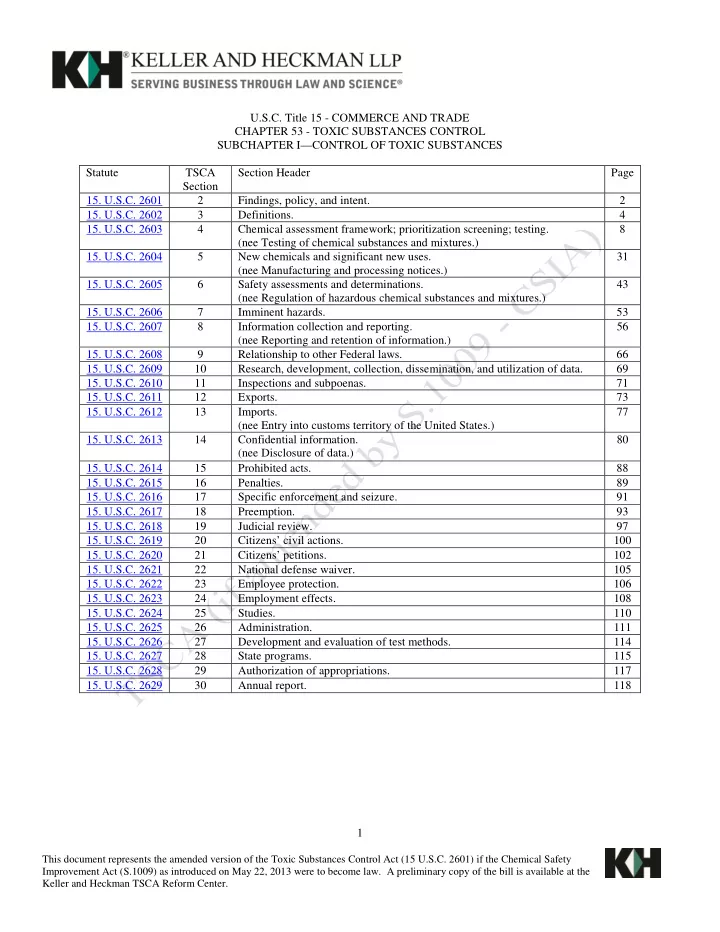
slide-37
SLIDE 37

37

This document represents the amended version of the Toxic Substances Control Act (15 U.S.C. 2601) if the Chemical Safety Improvement Act (S.1009) as introduced on May 22, 2013 were to become law. A preliminary copy of the bill is available at the Keller and Heckman TSCA Reform Center.

shall issue such injunction if the court finds that— (i) the information available to the Administrator is insufficient to permit a reasoned evaluation of the health and environmental effects of a chemical substance with respect to which notice is required by subsection (a) of this section; and (ii) (I) in the absence of sufficient information to permit the Administrator to make such an evaluation, the manufacture, processing, distribution in commerce, use, or disposal

  • f such substance, or any combination of

such activities, may present an unreasonable risk of injury to health or the environment, or (II) such substance is or will be produced in substantial quantities, and such substance either enters or may reasonably be anticipated to enter the environment in substantial quantities or there is or may be significant or substantial human exposure to the substance. (C) Pending the completion of a proceeding for the issuance of an injunction under subparagraph (B) respecting a chemical substance, the court may, upon application of the Administrator made through attorneys of the Environmental Protection Agency, issue a temporary restraining order or a preliminary injunction to prohibit the manufacture, processing, distribution in commerce, use, or disposal of such a substance (or any combination

  • f such activities) if the court finds that the

notification period applicable under subsection (a), (b), or (c) of this section to the manufacturing or processing of such substance may expire before such proceeding can be completed. (D) After the submission to the Administrator of test data sufficient to evaluate the health and environmental effects of a chemical substance subject to an injunction issued under subparagraph (B) and the evaluation of such data by the Administrator, the district court of the United States which issued such injunction shall, upon petition dissolve the injunction unless the Administrator has initiated a proceeding for the issuance of a rule under section 2605(a) of this title respecting the substance. If such a proceeding has been initiated, such court shall continue the injunction in effect until the effective date of the rule promulgated in such proceeding or, if such proceeding is terminated without the promulgation (xi) such other requirements as the Administrator determines to be necessary. (6) ADDITIONAL DATA AND INFORMATION.— If the Administrator determines under paragraph (4)(C) that additional data and information (including, for example, information on exposure or exposure potential) are needed in order to conduct a review under this subsection, the Administrator— (A) shall provide an opportunity for the submitter

  • f the notice to submit such additional information;

(B) may, by agreement with the submitter, extend the review period for a reasonable time to allow the development and submission of the additional information; (C) on receipt of the information, shall promptly make a determination under paragraph (4); and (D) may take action under paragraph (5) pending receipt of the additional data and information, which may, as appropriate, permit the submitter of the notice to file a notice of commencement under subsection (d). (d) NOTICE OF COMMENCEMENT.— (1) IN GENERAL.— Not later than 30 days after the date on which a manufacturer or processor that has submitted a notice under subsection (a) commences nonexempt commercial manufacture of a chemical substance or nonexempt commercial manufacture or processing of a chemical substance for a significant new use, as applicable, the manufacturer or processor shall submit to the Administrator a notice of commencement that identifies— (A) the name of the manufacturer or processor; and (B) the initial date of nonexempt commercial manufacture or nonexempt commercial manufacture or processing for a significant new use. (2) WITHDRAWAL.— A manufacturer or processor that has submitted a notice under subsection (a), but that has not commenced nonexempt commercial manufacture or processing of the chemical substance, may withdraw the notice. (e) FURTHER EVALUATION.— The Administrator may review a chemical substance under section 4(e) at anytime after the Administrator receives— (1) a notice of commencement for a chemical substance under subsection (d); or (2) significant new information regarding the chemical substance. (f) TRANSPARENCY.—

slide-38
SLIDE 38

38

This document represents the amended version of the Toxic Substances Control Act (15 U.S.C. 2601) if the Chemical Safety Improvement Act (S.1009) as introduced on May 22, 2013 were to become law. A preliminary copy of the bill is available at the Keller and Heckman TSCA Reform Center.

  • f a rule, upon the termination of the proceeding,

whichever occurs first. (f) Protection against unreasonable risks (1) If the Administrator finds that there is a reasonable basis to conclude that the manufacture, processing, distribution in commerce, use, or disposal of a chemical substance with respect to which notice is required by subsection (a) of this section, or that any combination of such activities, presents or will present an unreasonable risk of injury to health or environment before a rule promulgated under section 2605 of this title can protect against such risk, the Administrator shall, before the expiration of the notification period applicable under subsection (a), (b), or (c) of this section to the manufacturing or processing of such substance, take the action authorized by paragraph (2) or (3) to the extent necessary to protect against such risk. (2) The Administrator may issue a proposed rule under section 2605(a) of this title to apply to a chemical substance with respect to which a finding was made under paragraph (1)— (A) a requirement limiting the amount of such substance which may be manufactured, processed,

  • r distributed in commerce,

(B) a requirement described in paragraph (2), (3), (4), (5), (6), or (7) of section 2605(a) of this title,

  • r

(C) any combination of the requirements referred to in subparagraph (B). Such a proposed rule shall be effective upon its publication in the Federal

  • Register. Section 2605(d)(2)(B) of this title shall

apply with respect to such rule. (3) (A) The Administrator may— (i) issue a proposed order to prohibit the manufacture, processing, or distribution in commerce of a substance with respect to which a finding was made under paragraph (1), or (ii) apply, through attorneys of the Environmental Protection Agency, to the United States District Court for the District of Columbia or the United States district court for the judicial district in which the manufacturer,

  • r processor, as the case may be, of such

substance, is found, resides, or transacts business for an injunction to prohibit the manufacture, processing, or distribution in commerce of such substance. A proposed order issued under clause (i) respecting a chemical substance shall take effect on the expiration of the notification period applicable under Subject to section 14, the Administrator shall make available to the public all notices, rules and orders of the Administrator, and all data and information submitted or issued under this section.

slide-39
SLIDE 39

39

This document represents the amended version of the Toxic Substances Control Act (15 U.S.C. 2601) if the Chemical Safety Improvement Act (S.1009) as introduced on May 22, 2013 were to become law. A preliminary copy of the bill is available at the Keller and Heckman TSCA Reform Center.

subsection (a), (b), or (c) of this section to the manufacture or processing of such substance. (B) If the district court of the United States to which an application has been made under subparagraph (A)(ii) finds that there is a reasonable basis to conclude that the manufacture, processing, distribution in commerce, use, or disposal of the chemical substance with respect to which such application was made, or that any combination of such activities, presents or will present an unreasonable risk of injury to health or the environment before a rule promulgated under section 2605 of this title can protect against such risk, the court shall issue an injunction to prohibit the manufacture, processing, or distribution in commerce of such substance or to prohibit any combination of such activities.(C) The provisions

  • f subparagraphs (B) and (C) of subsection (e)(1)
  • f this section shall apply with respect to an order

issued under clause (i) of subparagraph (A); and the provisions of subparagraph (C) of subsection (e)(2) of this section shall apply with respect to an injunction issued under subparagraph (B). (D) If the Administrator issues an order pursuant to subparagraph (A)(i) respecting a chemical substance and objections are filed in accordance with subsection (e)(1)(C) of this section, the Administrator shall seek an injunction under subparagraph (A)(ii) respecting such substance unless the Administrator determines, on the basis

  • f such objections, that such substance does not or

will not present an unreasonable risk of injury to health or the environment. (g) Section (g) of the original statute will be removed. (g) Statement of reasons for not taking action If the Administrator has not initiated any action under this section or section 2605 or 2606 of this title to prohibit or limit the manufacture, processing, distribution in commerce, use, or disposal of a chemical substance, with respect to which notification or data is required by subsection (a)(1)(B) or (b) of this section, before the expiration of the notification period applicable to the manufacturing or processing of such substance, the Administrator shall publish a statement of the Administrator's reasons for not initiating such action. Such a statement shall be published in the Federal Register before the expiration of such period. Publication

  • f such statement in accordance with the preceding

sentence is not a prerequisite to the manufacturing or processing of the substance with respect to which the statement is to be published. (g) Section (h) of the original statute will be moved to

slide-40
SLIDE 40

40

This document represents the amended version of the Toxic Substances Control Act (15 U.S.C. 2601) if the Chemical Safety Improvement Act (S.1009) as introduced on May 22, 2013 were to become law. A preliminary copy of the bill is available at the Keller and Heckman TSCA Reform Center.

section (g). (g) Exemptions (1) The Administrator may, upon application, exempt any person from any requirement of subsection (a) or (b) of this section to permit such person to manufacture or process a chemical substance for test marketing purposes— (A) upon a showing by such person satisfactory to the Administrator that the manufacture, processing, distribution in commerce, use, and disposal of such substance, and that any combination of such activities, for such purposes will not present any unreasonable risk of injury to health or the environment, and (B) under such restrictions as the Administrator considers appropriate. (2) Paragraph (2) of the original statute will be removed. (2) (A) The Administrator may, upon application, exempt any person from the requirement of subsection (b)(2) of this section to submit data for a chemical substance. If, upon receipt of an application under the preceding sentence, the Administrator determines that— (i) the chemical substance with respect to which such application was submitted is equivalent to a chemical substance for which data has been submitted to the Administrator as required by subsection (b)(2) of this section, and (ii) submission of data by the applicant on such substance would be duplicative of data which has been submitted to the Administrator in accordance with such subsection, the Administrator shall exempt the applicant from the requirement to submit such data on such

  • substance. No exemption which is granted

under this subparagraph with respect to the submission of data for a chemical substance may take effect before the beginning of the reimbursement period applicable to such data. (B) If the Administrator exempts any person, under subparagraph (A), from submitting data required under subsection (b)(2) of this section for a chemical substance because of the existence of previously submitted data and if such exemption is granted during the reimbursement period for such data, then (unless such person and the persons referred to in clauses (i) and (ii) agree on the amount and method of reimbursement) the Administrator shall order the person granted the

slide-41
SLIDE 41

41

This document represents the amended version of the Toxic Substances Control Act (15 U.S.C. 2601) if the Chemical Safety Improvement Act (S.1009) as introduced on May 22, 2013 were to become law. A preliminary copy of the bill is available at the Keller and Heckman TSCA Reform Center.

exemption to provide fair and equitable reimbursement (in an amount determined under rules of the Administrator)— (i) to the person who previously submitted the data on which the exemption was based, for a portion of the costs incurred by such person in complying with the requirement under subsection (b)(2) of this section to submit such data, and (ii) to any other person who has been required under this subparagraph to contribute with respect to such costs, for a portion of the amount such person was required to contribute. In promulgating rules for the determination of fair and equitable reimbursement to the persons described in clauses (i) and (ii) for costs incurred with respect to a chemical substance, the Administrator shall, after consultation with the Attorney General and the Federal Trade Commission, consider all relevant factors, including the effect on the competitive position

  • f the person required to provide

reimbursement in relation to the persons to be reimbursed and the share of the market for such substance of the person required to provide reimbursement in relation to the share of such market of the persons to be reimbursed. For purposes of judicial review, an order under this subparagraph shall be considered final agency action. (C) For purposes of this paragraph, the reimbursement period for any previously submitted data for a chemical substance is a period— (i) beginning on the date of the termination of the prohibition, imposed under this section, on the manufacture or processing of such substance by the person who submitted such data to the Administrator, and (ii) ending— (I) five years after the date referred to in clause (i), or (II) at the expiration of a period which begins on the date referred to in clause (i) and is equal to the period which the Administrator determines was necessary to develop such data, whichever is later. (2) Paragraphs (3) through (6) of the original statute will be moved to Paragraphs (2) through (5). (2) The requirements of subsections (a) and (b) of this section do not apply with respect to the manufacturing

  • r processing of any chemical substance which is

manufactured or processed, or proposed to be

slide-42
SLIDE 42

42

This document represents the amended version of the Toxic Substances Control Act (15 U.S.C. 2601) if the Chemical Safety Improvement Act (S.1009) as introduced on May 22, 2013 were to become law. A preliminary copy of the bill is available at the Keller and Heckman TSCA Reform Center.

manufactured or processed, only in small quantities (as defined by the Administrator by rule) solely for purposes of— (A) scientific experimentation or analysis, or (B) chemical research on, or analysis of such substance or another substance, including such research or analysis for the development of a product, if all persons engaged in such experimentation, research, or analysis for a manufacturer or processor are notified (in such form and manner as the Administrator may prescribe) of any risk to health which the manufacturer, processor, or the Administrator has reason to believe may be associated with such chemical substance. (3) The Administrator may, upon application and by rule, exempt the manufacturer of any new chemical substance from all or part of the requirements of this section if the Administrator determines that the manufacture, processing, distribution in commerce, use, or disposal of such chemical substance, or that any combination of such activities, will not present an unreasonable risk of injury to health or the

  • environment. A rule promulgated under this paragraph

(and any substantive amendment to, or repeal of, such a rule) shall be promulgated in accordance with paragraphs (2) and (3) of section 2605(c) of this title. (4) The Administrator may, upon application, make the requirements of subsections (a) and (b) of this section inapplicable with respect to the manufacturing

  • r processing of any chemical substance (A) which

exists temporarily as a result of a chemical reaction in the manufacturing or processing of a mixture or another chemical substance, and (B) to which there is no, and will not be, human or environmental exposure. (5) Immediately upon receipt of an application under paragraph (1) or (5)(4) the Administrator shall publish in the Federal Register notice of the receipt of such

  • application. The Administrator shall give interested

persons an opportunity to comment upon any such application and shall, within 45 days of its receipt, either approve or deny the application. The Administrator shall publish in the Federal Register notice of the approval or denial of such an application. (h) Section (i) of the original statute will be moved to section (h). (h) “Manufacture” and “process” defined For purposes of this section, the terms “manufacture” and “process” mean manufacturing or processing for commercial purposes (3) “will not present an unreasonable risk of injury to health or the environment” will be replaced by “is expected to meet the safety standard under the intended conditions of use”.

slide-43
SLIDE 43

43

This document represents the amended version of the Toxic Substances Control Act (15 U.S.C. 2601) if the Chemical Safety Improvement Act (S.1009) as introduced on May 22, 2013 were to become law. A preliminary copy of the bill is available at the Keller and Heckman TSCA Reform Center.

§2605 [Section 6]. Regulation of hazardous chemical substances and mixtures (a) Scope of regulation If the Administrator finds that there is a reasonable basis to conclude that the manufacture, processing, distribution in commerce, use,

  • r disposal of a chemical substance or mixture, or that any

combination of such activities, presents or will present an unreasonable risk of injury to health or the environment, the Administrator shall by rule apply one or more of the following requirements to such substance or mixture to the extent necessary to protect adequately against such risk using the least burdensome requirements: (1) A requirement (A) prohibiting the manufacturing, processing, or distribution in commerce of such substance or mixture, or (B) limiting the amount of such substance or mixture which may be manufactured, processed, or distributed in commerce. (2) A requirement— (A) prohibiting the manufacture, processing, or distribution in commerce of such substance or mixture for (i) a particular use or (ii) a particular use in a concentration in excess of a level specified by the Administrator in the rule imposing the requirement, or (B) limiting the amount of such substance or mixture which may be manufactured, processed, or distributed in commerce for (i) a particular use or (ii) a particular use in a concentration in excess of a level specified by the Administrator in the rule imposing the requirement. (3) A requirement that such substance or mixture or any article containing such substance or mixture be marked with or accompanied by clear and adequate warnings and instructions with respect to its use, distribution in commerce, or disposal or with respect to any combination of such activities. The form and content of such warnings and instructions shall be prescribed by the Administrator. (4) A requirement that manufacturers and processors

  • f such substance or mixture make and retain records
  • f the processes used to manufacture or process such

substance or mixture and monitor or conduct tests which are reasonable and necessary to assure compliance with the requirements of any rule applicable under this subsection. (5) A requirement prohibiting or otherwise regulating any manner or method of commercial use of such substance or mixture. (6) (A) A requirement prohibiting or otherwise regulating any manner or method of disposal of such substance or mixture, or of any article §2605 [Section 6]. SAFETY ASSESSMENTS AND DETERMINATIONS (a) IN GENERAL.—The Administrator shall— (1) conduct a safety assessment of each highpriority substance in accordance with subsection (b); (2) make a safety determination for each highpriority substance; and (3) as appropriate based on the results of a safety determination, establish requirements for risk management of a high-priority substance. (b) SAFETY ASSESSMENTS.— (1) IN GENERAL.— The Administrator shall conduct a risk-based safety assessment of each highpriority substance, in accordance with such schedule as the Administrator establishes, to be based solely on considerations of risk to human health and the environment. (2) PROCEDURAL RULES.— (A) IN GENERAL.— The Administrator shall establish procedural rules for safety assessments and determinations under this subsection, including schedules for the submission of relevant data and information and the initiation and completion of safety assessments and safety determinations. (B) REQUIREMENTS.— (i) IN GENERAL.— The rules under subparagraph (A) shall— (I) identify the basis on which the Administrator shall decide which high-priority substances take precedence in the safety assessment and determination process; (II) require the Administrator to inform the public regarding— (aa) the approximate order in which safety assessments and determinations will be performed; (bb) the informational needs of the Administrator relating to the safety assessment and determination process; (cc) the importance of expeditiously completing safety assessments and determinations and the need for rigorous evaluation of the data and information; (dd) the schedule by which each assessment and determination will be conducted; and (ee) subject to clause (ii), the deadline for the completion of each assessment and determination; (III) allow interested persons, including States, to submit information, including safety assessments, regarding high-priority substances

slide-44
SLIDE 44

44

This document represents the amended version of the Toxic Substances Control Act (15 U.S.C. 2601) if the Chemical Safety Improvement Act (S.1009) as introduced on May 22, 2013 were to become law. A preliminary copy of the bill is available at the Keller and Heckman TSCA Reform Center.

containing such substance or mixture, by its manufacturer or processor or by any other person who uses, or disposes of, it for commercial purposes. (B) A requirement under subparagraph (A) may not require any person to take any action which would be in violation of any law or requirement of,

  • r in effect for, a State or political subdivision, and

shall require each person subject to it to notify each State and political subdivision in which a required disposal may occur of such disposal. (7) A requirement directing manufacturers or processors of such substance or mixture (A) to give notice of such unreasonable risk of injury to distributors in commerce of such substance or mixture and, to the extent reasonably ascertainable, to other persons in possession of such substance or mixture or exposed to such substance or mixture, (B) to give public notice of such risk of injury, and (C) to replace

  • r repurchase such substance or mixture as elected by

the person to which the requirement is directed. Any requirement (or combination of requirements) imposed under this subsection may be limited in application to specified geographic areas. (b) Quality control If the Administrator has a reasonable basis to conclude that a particular manufacturer or processor is manufacturing or processing a chemical substance or mixture in a manner which unintentionally causes the chemical substance or mixture to present or which will cause it to present an unreasonable risk of injury to health or the environment— (1) the Administrator may by order require such manufacturer or processor to submit a description of the relevant quality control procedures followed in the manufacturing or processing of such chemical substance or mixture; and (2) if the Administrator determines— (A) that such quality control procedures are inadequate to prevent the chemical substance or mixture from presenting such risk of injury, the Administrator may order the manufacturer or processor to revise such quality control procedures to the extent necessary to remedy such inadequacy;

  • r

(B) that the use of such quality control procedures has resulted in the distribution in commerce of chemical substances or mixtures which present an unreasonable risk of injury to health or the environment, the Administrator may order the manufacturer or processor to (i) give notice of such risk to processors or distributors in commerce of any such substance or mixture, or to both, and, to that may facilitate the safety assessment and determination process; and (IV) subject to section 14, require the Administrator— (aa) to make available to the public the information taken into consideration in preparing each safety assessment and determination; (bb) to publish and provide an opportunity for comment on proposed safety assessments and determinations; and (cc) to publish final safety assessments and determinations. (ii) DEADLINES.— (I) IN GENERAL.— The rules described in subparagraph (A) shall also include— (aa) a schedule by which each safety assessment and determination is expected to be conducted; and (bb) a deadline for the completion of each assessment and determination. (II) FLEXIBILITY AND REASONABLE EXTENSIONS.— The deadlines described in subclause (I)(bb)— (aa) may vary among chemical substances to grant the Administrator flexibility; and (bb) shall allow for reasonable extensions after an adequate public justification. (C) INCLUSIONS IN FINAL ASSESSMENTS.— Each safety assessment under this subsection shall include— (i) a weight-of-the evidence summary; and (ii) a nontechnical summary explaining what the relevant information demonstrates in the context of the intended conditions of use and exposure patterns of the chemical substance. (3) DATA AND INFORMATION SOURCES.—In conducting a safety assessment under this subsection, the Administrator shall, at a minimum, take into consideration— (A) the information described in section 4(c); and (B) any additional information submitted under paragraph (5). (4) METHODOLOGY.— (A) IN GENERAL.— The Administrator shall— (i) develop an appropriate science based methodology for conducting safety assessments under this subsection, which shall include consideration of the weight of the evidence for

  • bserved effects, mechanistic information, and
slide-45
SLIDE 45

45

This document represents the amended version of the Toxic Substances Control Act (15 U.S.C. 2601) if the Chemical Safety Improvement Act (S.1009) as introduced on May 22, 2013 were to become law. A preliminary copy of the bill is available at the Keller and Heckman TSCA Reform Center.

the extent reasonably ascertainable, to any other person in possession of or exposed to any such substance, (ii) to give public notice of such risk, and (iii) to provide such replacement or repurchase

  • f any such substance or mixture as is necessary to

adequately protect health or the environment. A determination under subparagraph (A) or (B) of paragraph (2) shall be made on the record after

  • pportunity for hearing in accordance with section

554 of title 5. Any manufacturer or processor subject to a requirement to replace or repurchase a chemical substance or mixture may elect either to replace or repurchase the substance or mixture and shall take either such action in the manner prescribed by the Administrator. (c) Promulgation of subsection (a) rules (1) In promulgating any rule under subsection (a) of this section with respect to a chemical substance or mixture, the Administrator shall consider and publish a statement with respect to— (A) the effects of such substance or mixture on health and the magnitude of the exposure of human beings to such substance or mixture, (B) the effects of such substance or mixture on the environment and the magnitude of the exposure of the environment to such substance or mixture, (C) the benefits of such substance or mixture for various uses and the availability of substitutes for such uses, and (D) the reasonably ascertainable economic consequences of the rule, after consideration of the effect on the national economy, small business, technological innovation, the environment, and public health. If the Administrator determines that a risk of injury to health or the environment could be eliminated or reduced to a sufficient extent by actions taken under another Federal law (or laws) administered in whole or in part by the Administrator, the Administrator may not promulgate a rule under subsection (a) of this section to protect against such risk of injury unless the Administrator finds, in the Administrator's discretion, that it is in the public interest to protect against such risk under this chapter. In making such a finding the Administrator shall consider (i) all relevant aspects of the risk, as determined by the Administrator in the Administrator's discretion, (ii) a comparison of the estimated costs of complying with actions taken under this chapter and under such law (or laws), and (iii) the relative efficiency of actions under this chapter and under such law (or laws) to protect against such risk of exposure evaluations; and (ii) make the proposed methodology available for public comment and scientific peer review. (B) REVIEW AND REVISIONS.—Not later than 5 years after the date of enactment of the Chemical Safety Improvement Act, and not less frequently than

  • nce every 5 years thereafter, the Administrator—

(i) shall review the methodology developed under subparagraph (A); and (ii) may revise the methodology to reflect new scientific developments or understandings, in accordance with subparagraph (A). (C) REQUIREMENTS.— The methodology shall apply scientifically recognized factors to address the following topics: (i) Strengths and limitations of study design. (ii) Reliability and relevance of test methods to human health and the environment. (iii) Quality of data. (iv) Use of good laboratory practices. (v) Peer review and peer review processes. (vi) Use of standardized protocols. (vii) Structured evaluative frameworks to determine the overall weight of the evidence, based on a review of positive and negative findings. (D) HAZARD, USE, AND EXPOSURE INFORMATION.— (i) IN GENERAL.—A safety assessment under this subsection shall evaluate existing hazard, use, and exposure information for the chemical substance under the intended conditions of use of the chemical substance, including information submitted by interested persons. (ii) EXPOSURE.— For purposes of evaluating exposure under clause (i), a safety assessment shall take into consideration— (I) exposures or significant subsets of exposures; (II) exposure duration, intensity, frequency, and number; and (III) the vulnerability of exposed subpopulations. (E) BEST AVAILABLE SCIENCE.— The Administrator shall use the best available science in conducting a safety assessment under this subsection. (5) ADDITIONAL TEST INFORMATION.— If the Administrator determines that additional test information is needed in order to make a safety assessment for a high-priority substance, the

slide-46
SLIDE 46

46

This document represents the amended version of the Toxic Substances Control Act (15 U.S.C. 2601) if the Chemical Safety Improvement Act (S.1009) as introduced on May 22, 2013 were to become law. A preliminary copy of the bill is available at the Keller and Heckman TSCA Reform Center.

injury. (2) When prescribing a rule under subsection (a) the Administrator shall proceed in accordance with section 553 of title 5 (without regard to any reference in such section to sections 556 and 557 of such title), and shall also (A) publish a notice of proposed rulemaking stating with particularity the reason for the proposed rule; (B) allow interested persons to submit written data, views, and arguments, and make all such submissions publicly available; (C) provide an

  • pportunity for an informal hearing in accordance

with paragraph (3); (D) promulgate, if appropriate, a final rule based on the matter in the rulemaking record (as defined in section 2618(a) of this title), and (E) make and publish with the rule the finding described in subsection (a) of this section. (3) Informal hearings required by paragraph (2)(C) shall be conducted by the Administrator in accordance with the following requirements: (A) Subject to subparagraph (B), an interested person is entitled— (i) to present such person's position orally or by documentary submissions (or both), and (ii) if the Administrator determines that there are disputed issues of material fact it is necessary to resolve, to present such rebuttal submissions and to conduct (or have conducted under subparagraph (B)(ii)) such cross- examination of persons as the Administrator determines (I) to be appropriate, and (II) to be required for a full and true disclosure with respect to such issues. (B) The Administrator may prescribe such rules and make such rulings concerning procedures in such hearings to avoid unnecessary costs or delay. Such rules or rulings may include (i) the imposition of reasonable time limits on each interested person's oral presentations, and (ii) requirements that any cross-examination to which a person may be entitled under subparagraph (A) be conducted by the Administrator on behalf of that person in such manner as the Administrator determines (I) to be appropriate, and (II) to be required for a full and true disclosure with respect to disputed issues of material fact. (C) (i) Except as provided in clause (ii), if a group

  • f persons each of whom under subparagraphs

(A) and (B) would be entitled to conduct (or have conducted) cross-examination and who are determined by the Administrator to have the same or similar interests in the proceeding Administrator— (A) shall provide an opportunity for interested persons to submit the additional information; (B) may promulgate a rule, enter into a testing consent agreement, or issue an order under section 4 to require the development of the information; and (C) may defer, for a reasonable period, a safety assessment until after receipt of the information. (6) TREATMENT.— A safety assessment under this subsection— (A) shall not be considered to be a final agency action; and (B) shall not be subject to judicial review. (c) SAFETY DETERMINATION.— (1) IN GENERAL.— As soon as possible after the date on which the safety assessment is completed for a high-priority substance under subsection (b), the Administrator shall determine whether the chemical substance meets the safety standard under the intended conditions of use of the chemical substance. (2) DETERMINATIONS.— Based on a review of the information described in paragraph (3), the Administrator shall determine, based solely on considerations of risk to human health and the environment, that— (A) the relevant chemical substance meets the safety standard under intended conditions of use; (B) the relevant chemical substance does not meet the safety standard under intended conditions of use, in which case the Administrator shall impose additional restrictions, as appropriate, under paragraph (9); or (C) additional information is necessary in order to make a determination under subparagraph (A) or (B), in which case the Administrator shall take appropriate action under paragraph (8). (3) CONSIDERATIONS.— In making a safety determination under this subsection, the Administrator shall take into consideration and publish a statement that includes, at a minimum— (A) the safety assessment for the chemical substance, including the uses considered in the assessment and any uses that are considered critical or essential; (B) the range of exposure to the chemical substance under the intended conditions of use of the chemical substance and appropriate reference parameters; (C) the weight of the evidence of risk posed by the chemical substance under the intended conditions of use of the chemical substance; and (D) the magnitude of the risk posed by the chemical substance under the intended conditions of use of the chemical substance.

slide-47
SLIDE 47

47

This document represents the amended version of the Toxic Substances Control Act (15 U.S.C. 2601) if the Chemical Safety Improvement Act (S.1009) as introduced on May 22, 2013 were to become law. A preliminary copy of the bill is available at the Keller and Heckman TSCA Reform Center.

cannot agree upon a single representative of such interests for purposes of cross- examination, the Administrator may make rules and rulings (I) limiting the representation of such interest for such purposes, and (II) governing the manner in which such cross- examination shall be limited. (ii) When any person who is a member of a group with respect to which the Administrator has made a determination under clause (i) is unable to agree upon group representation with the other members of the group, then such person shall not be denied under the authority

  • f clause (i) the opportunity to conduct (or

have conducted) cross-examination as to issues affecting the person's particular interests if (I) the person satisfies the Administrator that the person has made a reasonable and good faith effort to reach agreement upon group representation with the other members of the group and (II) the Administrator determines that there are substantial and relevant issues which are not adequately presented by the group representative. (D) A verbatim transcript shall be taken of any oral presentation made, and cross-examination conducted in any informal hearing under this

  • subsection. Such transcript shall be available to the

public. (4) (A) The Administrator may, pursuant to rules prescribed by the Administrator, provide compensation for reasonable attorneys’ fees, expert witness fees, and other costs of participating in a rulemaking proceeding for the promulgation of a rule under subsection (a) of this section to any person— (i) who represents an interest which would substantially contribute to a fair determination

  • f the issues to be resolved in the proceeding,

and (ii) if— (I) the economic interest of such person is small in comparison to the costs of effective participation in the proceeding by such person, or (II) such person demonstrates to the satisfaction of the Administrator that such person does not have sufficient resources adequately to participate in the proceeding without compensation under this

  • subparagraph. In determining for purposes

(4) INFORMATION SOURCES.— In making a safety determination under this subsection, the Administrator shall take into consideration, at a minimum— (A) the information described in section 4(c); and (B) the safety assessment conducted with respect to the chemical substance under subsection (b). (5) BEST AVAILABLE SCIENCE.— The Administrator shall use the best available science in making a safety determination under this subsection. (6) NOTICE AND COMMENT.—Subject to section 14, the Administrator shall provide notice and an

  • pportunity for public comment on each proposed safety

determination under this subsection. (7) TRANSPARENCY.— Subject to section 14, the Administrator shall publish— (A) each safety determination under this subsection, together with a summary of the information considered in the determination; (B) a summary of the evaluation by the Administrator

  • f the information; and

(C) an explanation of the reasons for the determination. (8) ADDITIONAL TEST DATA AND INFORMATION.— If the Administrator determines that additional test data and information is needed in order to make a safety determination for a high-priority substance, the Administrator— (A) shall provide an opportunity for interested persons to submit the additional data and information; (B) may promulgate a rule, enter into a testing consent agreement, or issue an order under section 4 to require the development of the data and information; (C) may defer, for a reasonable period, a safety determination until after receipt of the data and information; and (D) on receipt of the data and information, shall make a determination under paragraph (2). (9) ADDITIONAL RESTRICTIONS.— (A) IN GENERAL.— (i) DETERMINATION.— If the Administrator makes a determination under paragraph (2)(B) with respect to a chemical substance, the Administrator shall promulgate a rule establishing necessary restrictions (based on the weight of the evidence of risk and the magnitude of risk), including if appropriate, a ban

  • r phase out of the manufacture, processing, or use
  • f the chemical substance in accordance with

subparagraph (C). (ii) RULES.—

slide-48
SLIDE 48

48

This document represents the amended version of the Toxic Substances Control Act (15 U.S.C. 2601) if the Chemical Safety Improvement Act (S.1009) as introduced on May 22, 2013 were to become law. A preliminary copy of the bill is available at the Keller and Heckman TSCA Reform Center.

  • f clause (i) if an interest will substantially

contribute to a fair determination of the issues to be resolved in a proceeding, the Administrator shall take into account the number and complexity of such issues and the extent to which representation of such interest will contribute to widespread public participation in the proceeding and representation of a fair balance of interests for the resolution of such issues. (B) In determining whether compensation should be provided to a person under subparagraph (A) and the amount of such compensation, the Administrator shall take into account the financial burden which will be incurred by such person in participating in the rulemaking proceeding. The Administrator shall take such action as may be necessary to ensure that the aggregate amount of compensation paid under this paragraph in any fiscal year to all persons who, in rulemaking proceedings in which they receive compensation, are persons who either— (i) would be regulated by the proposed rule, or (ii) represent persons who would be so regulated, may not exceed 25 per centum of the aggregate amount paid as compensation under this paragraph to all persons in such fiscal year. (5) Paragraph (1), (2), (3), and (4) of this subsection apply to the promulgation of a rule repealing, or making a substantive amendment to, a rule promulgated under subsection (a) of this section. (d) Effective date (1) The Administrator shall specify in any rule under subsection (a) of this section the date on which it shall take effect, which date shall be as soon as feasible. (2) (A) The Administrator may declare a proposed rule under subsection (a) of this section to be effective upon its publication in the Federal Register and until the effective date of final action taken, in accordance with subparagraph (B), respecting such rule if— (i) the Administrator determines that— (I) the manufacture, processing, distribution in commerce, use, or disposal of the chemical substance or mixture subject to such proposed rule or any combination of such activities is likely to result in an unreasonable risk of serious or widespread injury to health or the environment before such effective date; and Rules promulgated under this section may apply to mixtures containing the chemical substance, as appropriate. (B) INCLUSIONS.— A restriction under subparagraph (A) may include, as appropriate— (i) a requirement that a chemical substance be marked with, or accompanied by, clear and adequate warnings and instructions with respect to use, distribution in commerce, or disposal, or any combination of those activities, with the form and content of the warnings and instructions to be prescribed by the Administrator; (ii) a requirement that manufacturers and processors of the chemical substance— (I) make and retain records of the processes used to manufacture or process the chemical substance; and (II) subject to section 4(f), develop test information that is reasonably necessary to ensure compliance with this Act; (iii) a limitation on the quantity of the chemical substance that may be manufactured, processed, or distributed in commerce; (iv) a requirement to ban or phase out or other regulation on the manufacture, processing, or distribution in commerce of the chemical substance— (I) for a particular use; or (II) for a particular use at a concentration in excess of a level specified by the Administrator; (v) a limitation on the quantity of the chemical substance that may be manufactured, processed, or distributed in commerce— (I) for a particular use; or (II) for a particular use at a concentration in excess of a level specified by the Administrator; (vi) a requirement to ban or phase out or other regulation of any method of commercial use of the chemical substance; (vii) a requirement to ban or phase out or other regulation of any method of disposal of the chemical substance or any article containing the chemical substance; (viii) a requirement directing manufacturers or processors of the chemical substance to give notice

  • f unreasonable risks of harm to distributors in

commerce of the chemical substance and, to the extent reasonably ascertainable, to other persons in the chain of commerce in possession of the

slide-49
SLIDE 49

49

This document represents the amended version of the Toxic Substances Control Act (15 U.S.C. 2601) if the Chemical Safety Improvement Act (S.1009) as introduced on May 22, 2013 were to become law. A preliminary copy of the bill is available at the Keller and Heckman TSCA Reform Center.

(II) making such proposed rule so effective is necessary to protect the public interest; and (ii) in the case of a proposed rule to prohibit the manufacture, processing, or distribution of a chemical substance or mixture because of the risk determined under clause (i)(I), a court has in an action under section 2606 of this title granted relief with respect to such risk associated with such substance or mixture. Such a proposed rule which is made so effective shall not, for purposes of judicial review, be considered final agency action. (B) If the Administrator makes a proposed rule effective upon its publication in the Federal Register, the Administrator shall, as expeditiously as possible, give interested persons prompt notice

  • f such action, provide reasonable opportunity, in

accordance with paragraphs (2) and (3) of subsection (c) of this section, for a hearing on such rule, and either promulgate such rule (as proposed

  • r with modifications) or revoke it; and if such a

hearing is requested, the Administrator shall commence the hearing within five days from the date such request is made unless the Administrator and the person making the request agree upon a later date for the hearing to begin, and after the hearing is concluded the Administrator shall, within ten days of the conclusion of the hearing, either promulgate such rule (as proposed or with modifications) or revoke it. chemical substance; and (ix) such other requirements as the Administrator determines to be necessary. (C) BANS AND PHASE OUTS.— The Administrator shall base a determination under subparagraph (A) that a ban or phase out of the manufacture, processing, or use of a chemical substance is necessary on the considerations described in subparagraph (D). (D) DETERMINATION THAT CHEMICAL SUBSTANCE DOES NOT MEET SAFETY STANDARD.— If the Administrator determines that the chemical substance does not meet the safety standard under the intended conditions of use, the Administrator shall consider and publish a statement on— (i) the availability of technically and economically feasible alternatives for the chemical substance under the intended conditions of use; (ii) the risks posed by those alternatives as compared to those of the chemical substance; (iii) the economic and social costs and benefits of the proposed regulatory action and options considered, and of potential alternatives; and (iv) the economic and social benefits and costs

  • f—

(I) the chemical substance; (II) alternatives to the chemical substance; and (III) any necessary restrictions on the chemical substance or alternatives. (10) EXEMPTIONS.— The Administrator may exempt the use of a chemical substance from any additional restriction established under paragraph (9) if the Administrator determines that— (A) the exemption is in the interest of national security; (B) the lack of availability of the chemical substance would cause significant disruption in the national economy; (C) the use for which the exemption is sought is a critical or essential use for which— (i) no feasible alternative for the use would materially reduce risk to health or the environment;

  • r

(ii) no feasible alternative for the use is economically, technically, or efficiently available;

  • r

(D) the use, as compared to reasonably available alternatives, provides a net benefit to human health, the environment, or public safety. (11) FINAL AGENCY ACTION.—

slide-50
SLIDE 50

50

This document represents the amended version of the Toxic Substances Control Act (15 U.S.C. 2601) if the Chemical Safety Improvement Act (S.1009) as introduced on May 22, 2013 were to become law. A preliminary copy of the bill is available at the Keller and Heckman TSCA Reform Center.

(d) Section (e) of the original statute will be moved to section (d). (d) Polychlorinated biphenyls (1) Within six months after January 1, 1977, the Administrator shall promulgate rules to— (A) prescribe methods for the disposal of polychlorinated biphenyls, and (B) require polychlorinated biphenyls to be marked with clear and adequate warnings, and instructions with respect to their processing, distribution in commerce, use, or disposal or with respect to any combination of such activities. Requirements prescribed by rules under this paragraph shall be consistent with the requirements of paragraphs (2) and (3). (2) (A) Except as provided under subparagraph (B), effective one year after January 1, 1977, no person may manufacture, process, or distribute in commerce or use any polychlorinated biphenyl in any manner other than in a totally enclosed manner. (B) The Administrator may by rule authorize the manufacture, processing, distribution in commerce

  • r use (or any combination of such activities) of

any polychlorinated biphenyl in a manner other than in a totally enclosed manner if the Administrator finds that such manufacture, processing, distribution in commerce, or use (or combination of such activities) will not present an unreasonable risk of injury to health or the environment. (C) For the purposes of this paragraph, the term “totally enclosed manner” means any manner which will ensure that any exposure of human beings or the environment to a polychlorinated biphenyl will be insignificant as determined by the Administrator by rule. (3) (A) Except as provided in subparagraphs (B), (C), and (D)— (i) no person may manufacture any polychlorinated biphenyl after two years after January 1, 1977, and (ii) no person may process or distribute in commerce any polychlorinated biphenyl after two and one-half years after such date. (B) Any person may petition the Administrator for A safety determination under this subsection shall be— (A) considered to be a final agency action; and (B) subject to judicial review, including review of the associated safety assessment under this subsection.

slide-51
SLIDE 51

51

This document represents the amended version of the Toxic Substances Control Act (15 U.S.C. 2601) if the Chemical Safety Improvement Act (S.1009) as introduced on May 22, 2013 were to become law. A preliminary copy of the bill is available at the Keller and Heckman TSCA Reform Center.

an exemption from the requirements of subparagraph (A), and the Administrator may grant by rule such an exemption if the Administrator finds that— (i) an unreasonable risk of injury to health or environment would not result, and (ii) good faith efforts have been made to develop a chemical substance which does not present an unreasonable risk of injury to health

  • r the environment and which may be

substituted for such polychlorinated biphenyl. An exemption granted under this subparagraph shall be subject to such terms and conditions as the Administrator may prescribe and shall be in effect for such period (but not more than 1 year from the date it is granted, except as provided in subparagraph (D)) as the Administrator may prescribe. (C) Subparagraph (A) shall not apply to the distribution in commerce of any polychlorinated biphenyl if such polychlorinated biphenyl was sold for purposes other than resale before two and one half years after October 11, 1976. (D) The Administrator may extend an exemption granted pursuant to subparagraph (B) that has not yet expired for a period not to exceed 60 days for the purpose of authorizing the Secretary of Defense and the Secretaries of the military departments to provide for the transportation into the customs territory of the United States of polychlorinated biphenyls generated by or under the control of the Department of Defense for purposes of their disposal, treatment, or storage in the customs territory of the United States if those polychlorinated biphenyls are already in transit from their storage locations but the Administrator determines, in the sole discretion of the Administrator, they would not otherwise arrive in the customs territory of the United States within the period of the original exemption. The Administrator shall promptly publish notice of such extension in the Federal Register. (4) Any rule under paragraph (1), (2)(B), or (3)(B) shall be promulgated in accordance with paragraphs (2), (3), and (4) of subsection (c) of this section. Paragraph (5) of the original statute will be moved to paragraph (4). (4) This subsection does not limit the authority of the Administrator, under any other provision of this chapter or any other Federal law, to take action respecting any polychlorinated biphenyl. (e) Section (f) of the original statute will be moved to

slide-52
SLIDE 52

52

This document represents the amended version of the Toxic Substances Control Act (15 U.S.C. 2601) if the Chemical Safety Improvement Act (S.1009) as introduced on May 22, 2013 were to become law. A preliminary copy of the bill is available at the Keller and Heckman TSCA Reform Center.

section (e). (e) Mercury (1) Prohibition on sale, distribution, or transfer of elemental mercury by Federal agencies Except as provided in paragraph (2), effective beginning on October 14, 2008, no Federal agency shall convey, sell, or distribute to any other Federal agency, any State or local government agency, or any private individual or entity any elemental mercury under the control or jurisdiction of the Federal agency. (2) Exceptions Paragraph (1) shall not apply to— (A) a transfer between Federal agencies of elemental mercury for the sole purpose of facilitating storage of mercury to carry out this chapter; or (B) a conveyance, sale, distribution, or transfer of coal. (3) Leases of Federal coal Nothing in this subsection prohibits the leasing of coal.

slide-53
SLIDE 53

53

This document represents the amended version of the Toxic Substances Control Act (15 U.S.C. 2601) if the Chemical Safety Improvement Act (S.1009) as introduced on May 22, 2013 were to become law. A preliminary copy of the bill is available at the Keller and Heckman TSCA Reform Center.

§2606 [Section 7]. Imminent hazards (a) Actions authorized and required (1) The Administrator may commence a civil action in an appropriate district court of the United States— (A) for seizure of an imminently hazardous chemical substance or mixture or any article containing such a substance or mixture, (B) for relief (as authorized by subsection (b) of this section) against any person who manufactures, processes, distributes in commerce, or uses, or disposes of, an imminently hazardous chemical substance or mixture or any article containing such a substance or mixture, or (C) for both such seizure and relief. A civil action may be commenced under this paragraph notwithstanding the existence of a rule under section 2603 of this title, 2604 of this title, 2605 of this title, or subchapter IV of this chapter or an

  • rder under section 2604 of this title or subchapter

IV of this chapter, and notwithstanding the pendency of any administrative or judicial proceeding under any provision of this chapter. (2) If the Administrator has not made a rule under section 2605(a) of this title immediately effective (as authorized by section 2605(d)(2)(A)(i) of this title) with respect to an imminently hazardous chemical substance or mixture, the Administrator shall commence in a district court of the United States with respect to such substance or mixture or article containing such substance or mixture a civil action described in subparagraph (A), (B), or (C) of paragraph (1). (b) Relief authorized (1) The district court of the United States in which an action under subsection (a) of this section is brought shall have jurisdiction to grant such temporary or permanent relief as may be necessary to protect health

  • r the environment from the unreasonable risk

associated with the chemical substance, mixture, or article involved in such action. (2) In the case of an action under subsection (a) of this section brought against a person who manufactures, processes, or distributes in commerce a chemical substance or mixture or an article containing a chemical substance or mixture, the relief authorized by paragraph (1) may include the issuance of a mandatory

  • rder requiring (A) in the case of purchasers of such

substance, mixture, or article known to the defendant, notification to such purchasers of the risk associated with it; (B) public notice of such risk; (C) recall; (D) the replacement or repurchase of such substance, mixture, or article; or (E) any combination of the §2606 [Section 7]. Imminent hazards (a) CIVIL ACTIONS.— (1) IN GENERAL.— The Administrator may commence a civil action in an appropriate district court of the United States for— (A) seizure of an imminently hazardous chemical substance or mixture or any article containing the substance or mixture; (B) relief (as authorized by subsection (b)) against any person who manufactures, processes, distributes in commerce, uses, or disposes of, an imminently hazardous chemical substance or mixture or any article containing the substance or mixture; or (C) both seizure described in subparagraph (A) and relief described in subparagraph (B). (2) RULE, ORDER, OR OTHER PROCEEDING.— A civil action may be commenced under this paragraph notwithstanding— (A) the existence of— (i) a decision by the Administrator under section 4(c)(3), 5(c)(4), or 6(c)(2); or (ii) a rule, testing consent agreement, or order under section 4(f), 5(g), 6(b)(5), 6(c)(8), 6(c)(9), or 6(d); or (B) the pendency of any administrative or judicial proceeding under any provision of this Act.

slide-54
SLIDE 54

54

This document represents the amended version of the Toxic Substances Control Act (15 U.S.C. 2601) if the Chemical Safety Improvement Act (S.1009) as introduced on May 22, 2013 were to become law. A preliminary copy of the bill is available at the Keller and Heckman TSCA Reform Center.

actions described in the preceding clauses. (3) In the case of an action under subsection (a) of this section against a chemical substance, mixture, or article, such substance, mixture, or article may be proceeded against by process of libel for its seizure and condemnation. Proceedings in such an action shall conform as nearly as possible to proceedings in rem in admiralty. (c) Venue and consolidation (1) (A) An action under subsection (a) of this section against a person who manufactures, processes, or distributes a chemical substance or mixture or an article containing a chemical substance or mixture may be brought in the United States District Court for the District of Columbia, or for any judicial district in which any of the defendants is found, resides, or transacts business; and process in such an action may be served on a defendant in any

  • ther district in which such defendant resides or

may be found. An action under subsection (a) of this section against a chemical substance, mixture,

  • r article may be brought in any United States

district court within the jurisdiction of which the substance, mixture, or article is found. (B) In determining the judicial district in which an action may be brought under subsection (a) of this section in instances in which such action may be brought in more than one judicial district, the Administrator shall take into account the convenience of the parties. (C) Subpeonas 1 requiring attendance of witnesses in an action brought under subsection (a) of this section may be served in any judicial district. (2) Whenever proceedings under subsection (a) of this section involving identical chemical substances, mixtures, or articles are pending in courts in two or more judicial districts, they shall be consolidated for trial by order of any such court upon application reasonably made by any party in interest, upon notice to all parties in interest. (d) Action under section 2605 Where appropriate, concurrently with the filing of an action under subsection (a) of this section or as soon thereafter as may be practicable, the Administrator shall initiate a proceeding for the promulgation of a rule under section 2605(a)(c) of this title. (e) Representation Notwithstanding any other provision of law, in any action under subsection (a) of this section, the Administrator may direct attorneys of the Environmental Protection Agency to appear and represent the Administrator in such

slide-55
SLIDE 55

55

This document represents the amended version of the Toxic Substances Control Act (15 U.S.C. 2601) if the Chemical Safety Improvement Act (S.1009) as introduced on May 22, 2013 were to become law. A preliminary copy of the bill is available at the Keller and Heckman TSCA Reform Center.

an action. (f) “Imminently hazardous chemical substance or mixture” defined For the purposes of subsection (a) of this section, the term “imminently hazardous chemical substance or mixture” means a chemical substance or mixture which presents an imminent and unreasonable risk of serious or widespread injury to health or the environment. Such a risk to health

  • r the environment shall be considered imminent if it is

shown that the manufacture, processing, distribution in commerce, use, or disposal of the chemical substance or mixture, or that any combination of such activities, is likely to result in such injury to health or the environment before a final rule under section 2605 of this title can protect against such risk.

slide-56
SLIDE 56

56

This document represents the amended version of the Toxic Substances Control Act (15 U.S.C. 2601) if the Chemical Safety Improvement Act (S.1009) as introduced on May 22, 2013 were to become law. A preliminary copy of the bill is available at the Keller and Heckman TSCA Reform Center.

§2607 [Section 8]. Reporting and retention of information (a) Reports (1) The Administrator shall promulgate rules under which— (A) each person (other than a small manufacturer

  • r processor) who manufactures or processes or

proposes to manufacture or process a chemical substance (other than a chemical substance described in subparagraph (B)(ii)) shall maintain such records, and shall submit to the Administrator such reports, as the Administrator may reasonably require, and (B) each person (other than a small manufacturer

  • r processor) who manufactures or processes or

proposes to manufacture or process— (i) a mixture, or (ii) a chemical substance in small quantities (as defined by the Administrator by rule) solely for purposes of scientific experimentation or analysis or chemical research on, or analysis of, such substance or another substance, including any such research or analysis for the development of a product, shall maintain records and submit to the Administrator reports but only to the extent the Administrator determines the maintenance of records or submission of reports, or both, is necessary for the effective enforcement of this chapter. The Administrator may not require in a rule promulgated under this paragraph the maintenance of records or the submission of reports with respect to changes in the proportions of the components of a mixture unless the Administrator finds that the maintenance of such records or the submission

  • f such reports, or both, is necessary for the

effective enforcement of this chapter. For purposes of the compilation of the list of chemical substances required under subsection (b) of this section, the Administrator shall promulgate rules pursuant to this subsection not later than 180 days after January 1, 1977. (2) The Administrator may require under paragraph (1) maintenance of records and reporting with respect to the following insofar as known to the person making the report or insofar as reasonably ascertainable: (A) The common or trade name, the chemical identity, and the molecular structure of each chemical substance or mixture for which such a report is required. (B) The categories or proposed categories of use of §2607 [Section 8]. INFORMATION COLLECTION AND REPORTING

slide-57
SLIDE 57

57

This document represents the amended version of the Toxic Substances Control Act (15 U.S.C. 2601) if the Chemical Safety Improvement Act (S.1009) as introduced on May 22, 2013 were to become law. A preliminary copy of the bill is available at the Keller and Heckman TSCA Reform Center.

each such substance or mixture. (C) The total amount of each such substance and mixture manufactured or processed, reasonable estimates of the total amount to be manufactured

  • r processed, the amount manufactured or

processed for each of its categories of use, and reasonable estimates of the amount to be manufactured or processed for each of its categories of use or proposed categories of use. (D) A description of the byproducts resulting from the manufacture, processing, use, or disposal of each such substance or mixture. (E) All existing data concerning the environmental and health effects of such substance or mixture. (F) The number of individuals exposed, and reasonable estimates of the number who will be exposed, to such substance or mixture in their places of employment and the duration of such exposure. (G) In the initial report under paragraph (1) on such substance or mixture, the manner or method

  • f its disposal, and in any subsequent report on

such substance or mixture, any change in such manner or method. To the extent feasible, the Administrator shall not require under paragraph (1), any reporting which is unnecessary or duplicative. (3) (A) (i) The Administrator may by rule require a small manufacturer or processor of a chemical substance to submit to the Administrator such information respecting the chemical substance as the Administrator may require for publication of the first list of chemical substances required by subsection (b) of this section. (ii) The Administrator may by rule require a small manufacturer or processor of a chemical substance or mixture— (I) subject to a rule proposed or promulgated under section 2603, 2604(b)(4), or 2605 of this title, or an order in effect under section 2604(e) of this title,

  • r

(II) with respect to which relief has been granted pursuant to a civil action brought under section 2604 or 2606 of this title, to maintain such records on such substance or mixture, and to submit to the Administrator such reports on such substance or mixture, as the Administrator may reasonably

slide-58
SLIDE 58

58

This document represents the amended version of the Toxic Substances Control Act (15 U.S.C. 2601) if the Chemical Safety Improvement Act (S.1009) as introduced on May 22, 2013 were to become law. A preliminary copy of the bill is available at the Keller and Heckman TSCA Reform Center.

  • require. A rule under this clause requiring

reporting may require reporting with respect to the matters referred to in paragraph (2). (B) The Administrator, after consultation with the Administrator of the Small Business Administration, shall by rule prescribe standards for determining the manufacturers and processors which qualify as small manufacturers and processors for purposes of this paragraph and paragraph (1). (b) Inventory (1) The Administrator shall compile, keep current, and publish a list of each chemical substance which is manufactured or processed in the United States. Such list shall at least include each chemical substance which any person reports, under section 2604 of this title or subsection (a) of this section, is manufactured

  • r processed in the United States. Such list may not

include any chemical substance which was not manufactured or processed in the United States within three years before the effective date of the rules promulgated pursuant to the last sentence of (4) REGULATIONS.— (A) IN GENERAL.— The Administrator shall promulgate rules requiring the reporting of information known by, or reasonably ascertainable by, the person making the report, including rules requiring processors to report information, so that the Administrator has the information necessary to carry out sections 4 and 6. (B) CONTENTS.— The rules promulgated under subparagraph (A)— (i) may impose different reporting requirements

  • n manufacturers and processors;

(ii) shall be limited to active substances or mixtures containing active substances as designated under subsection (b); and (iii) shall apply only to the extent the Administrator determines the submission of reports is necessary for the effective enforcement of this Act. (5) GUIDANCE.— The Administrator shall develop guidance relating to the information required to be reported under the rules promulgated under this subsection that— (A) include the level of detail necessary to be reported; and (B) describes the manner by which manufacturers and processors may report use and exposure information on a voluntary basis.

slide-59
SLIDE 59

59

This document represents the amended version of the Toxic Substances Control Act (15 U.S.C. 2601) if the Chemical Safety Improvement Act (S.1009) as introduced on May 22, 2013 were to become law. A preliminary copy of the bill is available at the Keller and Heckman TSCA Reform Center.

subsection (a)(1) of this section. In the case of a chemical substance for which a notice is submitted in accordance with section 2604 of this title, such chemical substance shall be included in such list as of the earliest date (as determined by the Administrator)

  • n which such substance was manufactured or

processed in the United States. The Administrator shall first publish such a list not later than 315 days after January 1, 1977. The Administrator shall not include in such list any chemical substance which is manufactured or processed only in small quantities (as defined by the Administrator by rule) solely for purposes of scientific experimentation or analysis or chemical research on, or analysis of, such substance or another substance, including such research or analysis for the development of a product. (2) To the extent consistent with the purposes of this chapter, the Administrator may, in lieu of listing, pursuant to paragraph (1), a chemical substance individually, list a category of chemical substances in which such substance is included. (3) NOMENCLATURE.— (A) IN GENERAL.— In carrying out paragraph (1), the Administrator shall— (i) maintain the use of Class 2 nomenclature in use on date of enactment of the Chemical Safety Improvement Act; (ii) maintain the use of the Soap and Detergent Association Nomenclature System, published in March 1978 by the Administrator in section 1 of addendum III of the document entitled ‘Candidate List of Chemical Substances’, and further described in the appendix A of volume I

  • f the 1985 edition of the Toxic Substances

Control Act Substances Inventory (EPA Document No. EPA-560/7-85-002a); and (iii) treat all components of categories that are considered to be statutory mixtures under this Act as being included on the list published under paragraph (1) under the Chemical Abstracts Service numbers for the respective categories, including, without limitation— (I) cement, Portland, chemicals, CAS No. 65997–15–1; (II) cement, alumina, chemicals, CAS No. 65997–16–2; (III) glass, oxide, chemicals, CAS No. 65997–17–3; (IV) frits, chemicals, CAS No. 65997–18– 4; (V) steel manufacture, chemicals, CAS No.

slide-60
SLIDE 60

60

This document represents the amended version of the Toxic Substances Control Act (15 U.S.C. 2601) if the Chemical Safety Improvement Act (S.1009) as introduced on May 22, 2013 were to become law. A preliminary copy of the bill is available at the Keller and Heckman TSCA Reform Center.

65997–19–5; and (VI) ceramic materials and wares, chemicals, CAS No. 66402– 68–4. (B) MULTIPLE NOMENCLATURE CONVENTIONS.— (i) IN GENERAL.— In the event that existing guidance allows for multiple nomenclature conventions, the Administrator shall— (I) maintain the nomenclature conventions for substances; and (II) develop new guidance that— (aa) establishes equivalency between the nomenclature conventions for chemical substances on the list published under paragraph (1); and (bb) permits persons to rely on that new guidance for purposes of determining whether a chemical substance is on the list published under paragraph (1). (ii) MULTIPLE CAS NUMBERS.— For any chemical substance appearing multiple times on the list under different Chemical Abstracts Service numbers, the Administrator shall develop guidance recognizing the multiple listings as a single chemical substance. (4) CANDIDATE LIST OF ACTIVE SUBSTANCES IN COMMERCE.— (A) IN GENERAL.— Subject to section 14, the Administrator shall make publicly available a candidate list of active chemical substances, which shall include— (i) any chemical substance reported under part 711 of title 40, Code of Federal Regulations, as in effect on the date of enactment of the Chemical Safety Improvement Act, during the period beginning on the date that is 10 years before the date of enactment of the Chemical Safety Improvement Act and ending on the date of enactment of the Chemical Safety Improvement Act; (ii) any chemical substance for which a notice

  • f commencement of manufacture has been

submitted; (iii) any chemical substance for which a significant new use notice has been submitted; (iv) any chemical substance for which an export notification has been submitted during the period beginning on the date that is 10 years before the date of enactment of the Chemical Safety Improvement Act and ending

  • n the date of enactment of the Chemical
slide-61
SLIDE 61

61

This document represents the amended version of the Toxic Substances Control Act (15 U.S.C. 2601) if the Chemical Safety Improvement Act (S.1009) as introduced on May 22, 2013 were to become law. A preliminary copy of the bill is available at the Keller and Heckman TSCA Reform Center.

Safety Improvement Act; and (v) any other chemical substance identified by the Administrator as likely to qualify as active. (B) RULE.— The Administrator shall, by rule, require manufacturers and processors to notify the Administrator that the manufacturer or processor, as applicable, has manufactured or processed a chemical substance on the list described in subparagraph (A), or the list published under paragraph (1) for a nonexempt commercial purpose during the 5-year period prior to the date

  • f enactment of the Chemical Safety Improvement

Act. (C) GUIDANCE.— Before issuing a final rule under subparagraph (A), the Administrator shall make publicly available guidance relating to the rule for chemical substances on the confidential portion of the candidate list of active substances and of the list published under paragraph (1), including — (i) accession numbers; (ii) premanufacture notice case numbers, if applicable; and (iii) generic names. (D) CONFIDENTIAL CHEMICAL SUBSTANCES.— The rule under subparagraph (B) shall require a manufacturer or processor that is reporting information relating to a chemical substance on the confidential portion of the list published under paragraph (1) to indicate whether the manufacturer

  • r processor claims the specific identity of the

substance as confidential pursuant to section 14. (E) CERTIFICATION.— The rule under subparagraph (B) shall require a manufacturer or processor— (i) to certify the accuracy of each report of the manufacturer or processor carried out under the rule; and (ii) to retain a record supporting that certification for a period of 5 years beginning

  • n the last day of the submission period.

(F) APPLICABILITY.— Nothing in this paragraph requires the resubstantiation of a claim for protection against disclosure for information submitted to the Administrator prior to the date of enactment of the Chemical Safety Improvement Act. (5) LIST.— (A) IN GENERAL.— Based on the notifications received in response to

slide-62
SLIDE 62

62

This document represents the amended version of the Toxic Substances Control Act (15 U.S.C. 2601) if the Chemical Safety Improvement Act (S.1009) as introduced on May 22, 2013 were to become law. A preliminary copy of the bill is available at the Keller and Heckman TSCA Reform Center.

the rule under paragraph (4), the Administrator shall designate each chemical substance that is on the list published under paragraph (1) on the date

  • f enactment of the Chemical Safety Improvement

Act as active or inactive. (B) UPDATE.— The Administrator shall update the list of chemicals designated as active or inactive as soon as practicable following the publication of the most recent data reported under part 711 of title 40, Code of Federal Regulations. (6) ACTIVE SUBSTANCES.— The Administrator shall designate as an active substance— (A) a chemical substance that has been manufactured or processed for a nonexempt commercial purposes at any point during the year period prior to the date of enactment of the Chemical Safety Improvement Act; (B) a chemical substance that is added to the list published under paragraph (1) after the date of enactment of the Chemical Safety Improvement Act; (C) a chemical substance for which a notice is received under paragraph (7)(C); and (D) a chemical substance reported under part 711

  • f title 40, Code of Federal Regulations, after the

date of enactment of the Chemical Safety Improvement Act. (7) INACTIVE SUBSTANCES.— (A) IN GENERAL.— The Administrator shall designate as an inactive substance each chemical substance on the list published under paragraph (1) that has not been manufactured or processed for a nonexempt commercial purpose in the 5-year period ending on the date of enactment of the Chemical Safety Improvement Act. (B) TREATMENT.— Each inactive substance shall remain on the list published under paragraph (1). (C) CHANGE TO ACTIVE STATUS.— (i) IN GENERAL.— Any person who intends to manufacture or process for a nonexempt commercial purpose a chemical substance that is designated as an inactive substance shall notify the Administrator before the date on which the substance is manufactured or processed. (ii) ACTIVE STATUS.— On receiving notification under clause (i), the Administrator—

slide-63
SLIDE 63

63

This document represents the amended version of the Toxic Substances Control Act (15 U.S.C. 2601) if the Chemical Safety Improvement Act (S.1009) as introduced on May 22, 2013 were to become law. A preliminary copy of the bill is available at the Keller and Heckman TSCA Reform Center.

(I) shall designate the chemical substance as an active substance; and (II) shall, pursuant to section 4(e), review the priority of the chemical substance as the Administrator determines necessary. (D) CATEGORY STATUS.— The list of inactive chemical substances shall not be considered a category for purposes of section 26(c). (8) PUBLIC PARTICIPATION.— (A) IN GENERAL.— Subject to subparagraph (B), the Administrator shall make available to the public— (i) the specific identity of each chemical substance on the nonconfidential portion of the list published under paragraph (5) that the Administrator has designated as an active substance; (ii) the specific identity of each chemical substance on the nonconfidential portion of the list published under paragraph (1) that the Administrator has designated as an inactive substance; (iii) the accession number, generic name, and, if applicable, premanufacture notice case number for each chemical substance on the confidential portion of the list published under paragraph (1) for which a claim of confidentiality was received; and (iv) the specific identity of any active or inactive substance on the confidential portion

  • f the list published under paragraph (1) for

which no claim of confidentiality was received, subject to the condition that, before revealing the specific identity of the substance, the Administrator shall— (I) publish a notice in the Federal Register identifying the accession number, generic name, and, if applicable, premanufacture notice case number for that substance; and (II) provide an opportunity for any person— (aa) to certify to the Administrator that the person intends to manufacture or process the substance at any point in the subsequent 4-year period; and (bb) to claim confidentiality for the specific identity of the substance. (B) CONFIDENTIALITY.— Subject section 14, the Administrator shall not make available to the public the specific chemical identity of any substance for which the

slide-64
SLIDE 64

64

This document represents the amended version of the Toxic Substances Control Act (15 U.S.C. 2601) if the Chemical Safety Improvement Act (S.1009) as introduced on May 22, 2013 were to become law. A preliminary copy of the bill is available at the Keller and Heckman TSCA Reform Center.

(c) Records Any person who manufactures, processes, or distributes in commerce any chemical substance or mixture shall maintain records of significant adverse reactions to health

  • r the environment, as determined by the Administrator

by rule, alleged to have been caused by the substance or

  • mixture. Records of such adverse reactions to the health
  • f employees shall be retained for a period of 30 years

from the date such reactions were first reported to or known by the person maintaining such records. Any other record of such adverse reactions shall be retained for a period of five years from the date the information contained in the record was first reported to or known by the person maintaining the record. Records required to be maintained under this subsection shall include records of consumer allegations of personal injury or harm to health, reports of occupational disease or injury, and reports or complaints of injury to the environment submitted to the manufacturer, processor, or distributor in commerce from any source. Upon request of any duly designated representative of the Administrator, each person who is required to maintain records under this subsection shall permit the inspection of such records and shall submit copies of such records. (d) Health and safety studies The Administrator shall promulgate rules under which the Administrator shall require any person who manufactures, processes, or distributes in commerce or who proposes to manufacture, process, or distribute in commerce any chemical substance or mixture (or with respect to paragraph (2), any person who has possession of a study) to submit to the Administrator— (1) lists of health and safety studies (A) conducted or initiated by or for such person with respect to such substance or mixture at any time, (B) known to such person, or (C) reasonably ascertainable by such person, except that the Administrator may exclude certain types or categories of studies from the requirements of this subsection if the Administrator finds that submission of lists of such studies are unnecessary to carry out the purposes

  • f this chapter; and

(2) copies of any study contained on a list submitted pursuant to paragraph (1) or otherwise known by such person. (e) Notice to Administrator of substantial risks (1) IN GENERAL.—Any person Any person who manufactures, processes, or distributes in commerce as Administrator receives a notice under subparagraph (A)(iv).

slide-65
SLIDE 65

65

This document represents the amended version of the Toxic Substances Control Act (15 U.S.C. 2601) if the Chemical Safety Improvement Act (S.1009) as introduced on May 22, 2013 were to become law. A preliminary copy of the bill is available at the Keller and Heckman TSCA Reform Center.

chemical substance or mixture and who obtains information which reasonably supports the conclusion that such substance or mixture presents a substantial risk of injury to health or the environment shall immediately inform the Administrator of such information unless such person has actual knowledge that the Administrator has been adequately informed

  • f such information.

(f) “Manufacture” and “process” defined For purposes of this section, the terms “manufacture” and “process” mean manufacture or process for commercial purposes. (2) APPLICABILITY.— Any person may submit to the Administrator data and information reasonably supporting the conclusion that a chemical substance or mixture does not present a substantial risk of injury to health and the environment.

slide-66
SLIDE 66

66

This document represents the amended version of the Toxic Substances Control Act (15 U.S.C. 2601) if the Chemical Safety Improvement Act (S.1009) as introduced on May 22, 2013 were to become law. A preliminary copy of the bill is available at the Keller and Heckman TSCA Reform Center.

§2608 [Section 9]. Relationship to other Federal laws (a) Laws not administered by the Administrator (1) If the Administrator has reasonable basis to conclude that the manufacture, processing, distribution in commerce, use, or disposal of a chemical substance

  • r mixture, or that any combination of such activities,

presents or will present an unreasonable risk of injury to health or the environment and determines, in the Administrator's discretion, that such risk may be prevented or reduced to a sufficient extent by action taken under a Federal law not administered by the Administrator, the Administrator shall submit to the agency which administers such law a report which describes such risk and includes in such description a specification of the activity or combination of activities which the Administrator has reason to believe so presents such risk. Such report shall also request such agency— (A) (i) to determine if the risk described in such report may be prevented or reduced to a sufficient extent by action taken under such law, and (ii) if the agency determines that such risk may be so prevented or reduced, to issue an order declaring whether or not the activity or combination of activities specified in the description of such risk presents such risk; and (B) to respond to the Administrator with respect to the matters described in subparagraph (A). Any report of the Administrator shall include a detailed statement of the information on which it is based and shall be published in the Federal Register. The agency receiving a request under such a report shall make the requested determination, issue the requested order, and make the requested response within such time as the Administrator specifies in the request, but such time specified may not be less than 90 days from the date the request was made. The response of an agency shall be accompanied by a detailed statement of the findings and conclusions of the agency and shall be published in the Federal Register. (2) If the Administrator makes a report under paragraph (1) with respect to a chemical substance or mixture and the agency to which such report was made either— (A) issues an order declaring that the activity or combination of activities specified in the description of the risk described in the report does not present the risk described in the report, or (B) initiates, within 90 days of the publication in §2608 [Section 9]. Relationship to other Federal laws (a) (1) “presents or will present an unreasonable risk of injury to health or the environment” will be replaced by “does not meet the safety standard under the intended conditions of use”. “such risk” will be replaced by “the risk posed by the substance or mixture”.

slide-67
SLIDE 67

67

This document represents the amended version of the Toxic Substances Control Act (15 U.S.C. 2601) if the Chemical Safety Improvement Act (S.1009) as introduced on May 22, 2013 were to become law. A preliminary copy of the bill is available at the Keller and Heckman TSCA Reform Center.

the Federal Register of the response of the agency under paragraph (1), action under the law (or laws) administered by such agency to protect against such risk associated with such activity or combination of activities, the Administrator may not take any action under section 2605 or 2606 paragraph (8) or (9) of subsection (c) of section 6

  • r 7 of this title with respect to such risk.

(3) If the Administrator has initiated action under section 2605 or 2606 paragraph (8) or (9) of subsection (c) of section 6 or 7 of this title with respect to a risk associated with a chemical substance

  • r mixture which was the subject of a report made to

an agency under paragraph (1), such agency shall before taking action under the law (or laws) administered by it to protect against such risk consult with the Administrator for the purpose of avoiding duplication of Federal action against such risk. (b) Laws administered by the Administrator The Administrator shall coordinate actions taken under this chapter with actions taken under other Federal laws administered in whole or in part by the Administrator. If the Administrator determines that a risk to health or the environment associated with a chemical substance or mixture could be eliminated or reduced to a sufficient extent by actions taken under the authorities contained in such other Federal laws, the Administrator shall use such authorities to protect against such risk unless the Administrator determines, in the Administrator's discretion, that it is in the public interest to protect against such risk by actions taken under this chapter. This subsection shall not be construed to relieve the Administrator of any requirement imposed on the Administrator by such other Federal laws. (c) Occupational safety and health In exercising any authority under this chapter, the Administrator shall not, for purposes of section 653(b)(1)

  • f title 29, be deemed to be exercising statutory authority

to prescribe or enforce standards or regulations affecting

  • ccupational safety and health.

(d) Coordination In administering this chapter, the Administrator shall consult and coordinate with the Secretary of Health and Human Services and the heads of any other appropriate Federal executive department or agency, any relevant independent regulatory agency, and any other appropriate instrumentality of the Federal Government for the purpose

  • f achieving the maximum enforcement of this chapter

while imposing the least burdens of duplicative requirements on those subject to the chapter and for other

  • purposes. The Administrator shall, in the report required

by section 2629 of this title, report annually to the

slide-68
SLIDE 68

68

This document represents the amended version of the Toxic Substances Control Act (15 U.S.C. 2601) if the Chemical Safety Improvement Act (S.1009) as introduced on May 22, 2013 were to become law. A preliminary copy of the bill is available at the Keller and Heckman TSCA Reform Center.

Congress on actions taken to coordinate with such other Federal departments, agencies, or instrumentalities, and

  • n actions taken to coordinate the authority under this

chapter with the authority granted under other Acts referred to in subsection (b) of this section.

slide-69
SLIDE 69

69

This document represents the amended version of the Toxic Substances Control Act (15 U.S.C. 2601) if the Chemical Safety Improvement Act (S.1009) as introduced on May 22, 2013 were to become law. A preliminary copy of the bill is available at the Keller and Heckman TSCA Reform Center.

§2609 [Section 10]. Research, development, collection, dissemination, and utilization of data (a) Authority The Administrator shall, in consultation and cooperation with the Secretary of Health and Human Services and with other heads of appropriate departments and agencies, conduct such research, development, and monitoring as is necessary to carry out the purposes of this chapter. The Administrator may enter into contracts and may make grants for research, development, and monitoring under this subsection. Contracts may be entered into under this subsection without regard to section 3324(a) and (b) of title 31 and section 6101 of title 41. (b) Data systems (1) The Administrator shall establish, administer, and be responsible for the continuing activities of an interagency committee which shall design, establish, and coordinate an efficient and effective system, within the Environmental Protection Agency, for the collection, dissemination to other Federal departments and agencies, and use of data submitted to the Administrator under this chapter. (2) (A) The Administrator shall, in consultation and cooperation with the Secretary of Health and Human Services and other heads of appropriate departments and agencies design, establish, and coordinate an efficient and effective system for the retrieval of toxicological and other scientific data which could be useful to the Administrator in carrying out the purposes of this chapter. Systematized retrieval shall be developed for use by all Federal and other departments and agencies with responsibilities in the area of regulation or study of chemical substances and mixtures and their effect on health or the environment. (B) The Administrator, in consultation and cooperation with the Secretary of Health and Human Services, may make grants and enter into contracts for the development of a data retrieval system described in subparagraph (A). Contracts may be entered into under this subparagraph without regard to section 3324(a) and (b) of title 31 and section 6101 of title 41. (c) Screening techniques The Administrator shall coordinate, with the Assistant Secretary for Health of the Department of Health and Human Services, research undertaken by the Administrator and directed toward the development of rapid, reliable, and economical screening techniques for carcinogenic, mutagenic, teratogenic, and ecological effects of chemical substances and mixtures. §2609 [Section 10]. Research, development, collection, dissemination, and utilization of data No changes.

slide-70
SLIDE 70

70

This document represents the amended version of the Toxic Substances Control Act (15 U.S.C. 2601) if the Chemical Safety Improvement Act (S.1009) as introduced on May 22, 2013 were to become law. A preliminary copy of the bill is available at the Keller and Heckman TSCA Reform Center.

(d) Monitoring The Administrator shall, in consultation and cooperation with the Secretary of Health and Human Services, establish and be responsible for research aimed at the development, in cooperation with local, State, and Federal agencies, of monitoring techniques and instruments which may be used in the detection of toxic chemical substances and mixtures and which are reliable, economical, and capable of being implemented under a wide variety of conditions. (e) Basic research The Administrator shall, in consultation and cooperation with the Secretary of Health and Human Services, establish research programs to develop the fundamental scientific basis of the screening and monitoring techniques described in subsections (c) and (d) of this section, the bounds of the reliability of such techniques, and the opportunities for their improvement. (f) Training The Administrator shall establish and promote programs and workshops to train or facilitate the training of Federal laboratory and technical personnel in existing or newly developed screening and monitoring techniques. (g) Exchange of research and development results The Administrator shall, in consultation with the Secretary of Health and Human Services and other heads

  • f appropriate departments and agencies, establish and

coordinate a system for exchange among Federal, State, and local authorities of research and development results respecting toxic chemical substances and mixtures, including a system to facilitate and promote the development of standard data format and analysis and consistent testing procedures.

slide-71
SLIDE 71

71

This document represents the amended version of the Toxic Substances Control Act (15 U.S.C. 2601) if the Chemical Safety Improvement Act (S.1009) as introduced on May 22, 2013 were to become law. A preliminary copy of the bill is available at the Keller and Heckman TSCA Reform Center.

§2610 [Section 11]. Inspections and subpoenas (a) In general For purposes of administering this chapter, the Administrator, and any duly designated representative of the Administrator, may inspect any establishment, facility,

  • r other premises in which chemical substances, mixtures,
  • r products subject to subchapter IV of this chapter are

manufactured, processed, stored, or held before or after their distribution in commerce and any conveyance being used to transport chemical substances, mixtures, such products, or such articles in connection with distribution in commerce. Such an inspection may only be made upon the presentation of appropriate credentials and of a written notice to the owner, operator, or agent in charge of the premises or conveyance to be inspected. A separate notice shall be given for each such inspection, but a notice shall not be required for each entry made during the period covered by the inspection. Each such inspection shall be commenced and completed with reasonable promptness and shall be conducted at reasonable times, within reasonable limits, and in a reasonable manner. (b) Scope (1) Except as provided in paragraph (2), an inspection conducted under subsection (a) of this section shall extend to all things within the premises or conveyance inspected (including records, files, papers, processes, controls, and facilities) bearing on whether the requirements of this chapter applicable to the chemical substances, mixtures, or products subject to subchapter IV of this chapter within such premises or conveyance have been complied with. (2) No inspection under subsection (a) of this section shall extend to— (A) financial data, (B) sales data (other than shipment data), (C) pricing data, (D) personnel data, or (E) research data (other than data required by this chapter or under a rule promulgated thereunder), unless the nature and extent of such data are described with reasonable specificity in the written notice required by subsection (a) of this section for such inspection. (c) Subpoenas In carrying out this chapter, the Administrator may by subpoena require the attendance and testimony of witnesses and the production of reports, papers, documents, answers to questions, and other information that the Administrator deems necessary. Witnesses shall be paid the same fees and mileage that are paid witnesses in the courts of the United States. In the event of contumacy, failure, or refusal of any person to obey any §2610 [Section 11]. Inspections and subpoenas No changes.

slide-72
SLIDE 72

72

This document represents the amended version of the Toxic Substances Control Act (15 U.S.C. 2601) if the Chemical Safety Improvement Act (S.1009) as introduced on May 22, 2013 were to become law. A preliminary copy of the bill is available at the Keller and Heckman TSCA Reform Center.

such subpoena, any district court of the United States in which venue is proper shall have jurisdiction to order any such person to comply with such subpoena. Any failure to

  • bey such an order of the court is punishable by the court

as a contempt thereof.

slide-73
SLIDE 73

73

This document represents the amended version of the Toxic Substances Control Act (15 U.S.C. 2601) if the Chemical Safety Improvement Act (S.1009) as introduced on May 22, 2013 were to become law. A preliminary copy of the bill is available at the Keller and Heckman TSCA Reform Center.

§2611 [Section 12]. Exports (a) In general (1) Except as provided in paragraph (2) and subsections (b) and (c) of this section, this chapter (other than section 2607 of this title) shall not apply to any chemical substance, mixture, or to an article containing a chemical substance or mixture, if— (A) it can be shown that such substance, mixture,

  • r article is being manufactured, processed, or

distributed in commerce for export from the United States, unless such substance, mixture, or article was, in fact, manufactured, processed, or distributed in commerce, for use in the United States, and (B) such substance, mixture, or article (when distributed in commerce), or any container in which it is enclosed (when so distributed), bears a stamp or label stating that such substance, mixture,

  • r article is intended for export.

(2) Paragraph (1) shall not apply to any chemical substance, mixture, or article if the Administrator finds that the substance, mixture, or article will present an unreasonable risk of injury to health within the United States or to the environment of the United

  • States. The Administrator may require, under section

2603 of this title, testing of any chemical substance or mixture exempted from this chapter by paragraph (1) for the purpose of determining whether or not such substance or mixture presents an unreasonable risk of injury to health within the United States or to the environment of the United States. (b) Notice (1) If any person exports or intends to export to a foreign country a chemical substance or mixture for which the submission of data is required under section 2603 or 2604(b) of this title, such person shall notify the Administrator of such exportation or intent to export and the Administrator shall furnish to the government of such country notice of the availability

  • f the data submitted to the Administrator under such

section for such substance or mixture. (2) If any person exports or intends to export to a foreign country a chemical substance or mixture for which an order has been issued under section 2604 of this title or a rule has been proposed or promulgated under section 2604 or 2605 of this title, or with respect to which an action is pending, or relief has been granted under section 2604 or 2606 of this title, such §2611 [Section 12]. Exports (2) EXCEPTION.— Paragraph (1) shall not apply to any chemical substance that the Administrator determines— (A) under section 5 is not likely to meet the safety standard under the intended conditions of use of the chemical substance; or (B) under section 6 does not meet the safety standard under the intended conditions of use of the chemical substance. (3) WAIVERS.—For a mixture or article containing a chemical substance described in paragraph (2), the Administrator may— (A) determine that paragraph (1) shall not apply to that mixture or article; and (B) establish a threshold concentration in a mixture

  • r article at which paragraph (1) shall not apply.

(b) NOTICE.— (1) IN GENERAL.— A person shall notify the Administrator that the person is exporting or intends to export to a foreign country— (A) a chemical substance or a mixture containing a chemical substance that the Administrator has determined under section 5 is not likely to meet the safety standard under the intended conditions of use of the chemical substance; (B) a chemical substance or a mixture containing a chemical substance that the Administrator has determined under section 6 does not meet the safety standard under the intended conditions of use of the chemical substance; or (C) a chemical substance for which the United States is obligated by treaty to provide export notification.

slide-74
SLIDE 74

74

This document represents the amended version of the Toxic Substances Control Act (15 U.S.C. 2601) if the Chemical Safety Improvement Act (S.1009) as introduced on May 22, 2013 were to become law. A preliminary copy of the bill is available at the Keller and Heckman TSCA Reform Center.

person shall notify the Administrator of such exportation or intent to export and the Administrator shall furnish to the government of such country notice

  • f such rule, order, action, or relief.

(c) Prohibition on export of elemental mercury (1) Prohibition Effective January 1, 2013, the export

  • f elemental mercury from the United States is

prohibited. (2) Inapplicability of subsection (a) Subsection (a) shall not apply to this subsection. (3) Report to Congress on mercury compounds (A) Report Not later than one year after October 14, 2008, the Administrator shall publish and submit to Congress a report on mercuric chloride, mercurous chloride or calomel, mercuric oxide, and other mercury compounds, if any, that may currently be used in significant quantities in products or processes. Such report shall include an analysis of— (i) the sources and amounts of each of the mercury compounds imported into the United States or manufactured in the United States annually; (ii) the purposes for which each of these compounds are used domestically, the amount

  • f these compounds currently consumed

annually for each purpose, and the estimated (2) REGULATIONS.— (A) IN GENERAL.— The Administrator shall promulgate regulations to carry out paragraph (1). (B) CONTENTS.— The regulations promulgated under subparagraph (A) shall— (i) include any exemptions the Administrator determines to be appropriate, which may include exemptions identified under section 5(g); and (ii) indicate whether or to what extent the regulations apply to articles containing a chemical substance or mixture described in paragraph (1). (3) NOTIFICATION.— The Administrator shall submit to the government of each country to which a chemical substance or mixture is exported— (A) for a chemical substance or mixture described in subparagraph (A) or (B) of paragraph (1), a notice that information on the chemical substance

  • r mixture can be obtained from the Administrator,

unless the Administrator determines that good cause exists not to provide the notice; and (B) for a chemical substance described in paragraph (1)(C), a notice that satisfies the

  • bligation of the United States under the applicable

treaty.

slide-75
SLIDE 75

75

This document represents the amended version of the Toxic Substances Control Act (15 U.S.C. 2601) if the Chemical Safety Improvement Act (S.1009) as introduced on May 22, 2013 were to become law. A preliminary copy of the bill is available at the Keller and Heckman TSCA Reform Center.

amounts to be consumed for each purpose in 2010 and beyond; (iii) the sources and amounts of each mercury compound exported from the United States annually in each of the last three years; (iv) the potential for these compounds to be processed into elemental mercury after export from the United States; and (v) other relevant information that Congress should consider in determining whether to extend the export prohibition to include one or more of these mercury compounds. (B) Procedure For the purpose of preparing the report under this paragraph, the Administrator may utilize the information gathering authorities of this subchapter, including sections 2609 and 2610 of this title. (3) Paragraphs (4) through (6) of the original statute will be moved to Paragraphs (3) through (5). (3) Essential use exemption (A) Any person residing in the United States may petition the Administrator for an exemption from the prohibition in paragraph (1), and the Administrator may grant by rule, after notice and

  • pportunity for comment, an exemption for a

specified use at an identified foreign facility if the Administrator finds that— (i) nonmercury alternatives for the specified use are not available in the country where the facility is located; (ii) there is no other source of elemental mercury available from domestic supplies (not including new mercury mines) in the country where the elemental mercury will be used; (iii) the country where the elemental mercury will be used certifies its support for the exemption; (iv) the export will be conducted in such a manner as to ensure the elemental mercury will be used at the identified facility as described in the petition, and not otherwise diverted for

  • ther uses for any reason;

(v) the elemental mercury will be used in a manner that will protect human health and the environment, taking into account local, regional, and global human health and environmental impacts; (vi) the elemental mercury will be handled and managed in a manner that will protect human health and the environment, taking into account local, regional, and global human health and environmental impacts; and

slide-76
SLIDE 76

76

This document represents the amended version of the Toxic Substances Control Act (15 U.S.C. 2601) if the Chemical Safety Improvement Act (S.1009) as introduced on May 22, 2013 were to become law. A preliminary copy of the bill is available at the Keller and Heckman TSCA Reform Center.

(vii) the export of elemental mercury for the specified use is consistent with international

  • bligations of the United States intended to

reduce global mercury supply, use, and pollution. (B) Each exemption issued by the Administrator pursuant to this paragraph shall contain such terms and conditions as are necessary to minimize the export of elemental mercury and ensure that the conditions for granting the exemption will be fully met, and shall contain such other terms and conditions as the Administrator may prescribe. No exemption granted pursuant to this paragraph shall exceed three years in duration and no such exemption shall exceed 10 metric tons of elemental mercury. (C) The Administrator may by order suspend or cancel an exemption under this paragraph in the case of a violation described in subparagraph (D). (D) A violation of this subsection or the terms and conditions of an exemption, or the submission of false information in connection therewith, shall be considered a prohibited act under section 2614 of this title, and shall be subject to penalties under section 2615 of this title, injunctive relief under section 2616 of this title, and citizen suits under section 2619 of this title. (4) Consistency with trade obligations Nothing in this subsection affects, replaces, or amends prior law relating to the need for consistency with international trade obligations. (5) Export of coal Nothing in this subsection shall be construed to prohibit the export of coal.

slide-77
SLIDE 77

77

This document represents the amended version of the Toxic Substances Control Act (15 U.S.C. 2601) if the Chemical Safety Improvement Act (S.1009) as introduced on May 22, 2013 were to become law. A preliminary copy of the bill is available at the Keller and Heckman TSCA Reform Center.

§2612 [Section 13]. Entry into customs territory of the United States (a) In general (1) The Secretary of the Treasury shall refuse entry into the customs territory of the United States (as defined in general note 2 of the Harmonized Tariff Schedule of the United States) of any chemical substance, mixture, or article containing a chemical substance or mixture offered for such entry if— (A) it fails to comply with any rule in effect under this chapter, or (B) it is offered for entry in violation of section 2604 of this title, 2605 of this title, or subchapter IV of this chapter, a rule or order under section 2604 of this title, 2605 of this title, or subchapter IV of this chapter, or an order issued in a civil action brought under section 2604 of this title, 2606 of this title or subchapter IV of this chapter. (2) If a chemical substance, mixture, or article is refused entry under paragraph (1), the Secretary of the Treasury shall notify the consignee of such entry refusal, shall not release it to the consignee, and shall cause its disposal or storage (under such rules as the Secretary of the Treasury may prescribe) if it has not been exported by the consignee within 90 days from the date of receipt of notice of such refusal, except that the Secretary of the Treasury may, pending a review by the Administrator of the entry refusal, release to the consignee such substance, mixture, or article on execution of bond for the amount of the full invoice of such substance, mixture, or article (as such value is set forth in the customs entry), together with the duty

  • thereon. On failure to return such substance, mixture,
  • r article for any cause to the custody of the Secretary
  • f the Treasury when demanded, such consignee shall

be liable to the United States for liquidated damages equal to the full amount of such bond. All charges for storage, cartage, and labor on and for disposal of substances, mixtures, or articles which are refused entry or release under this section shall be paid by the

  • wner or consignee, and in default of such payment

shall constitute a lien against any future entry made by such owner or consignee. (b) Rules The Secretary of the Treasury, after consultation with the Administrator, shall issue rules for the administration of subsection (a) of this section. §2612 [Section 13]. Imports (a) DEFINITION OF CHEMICAL SUBSTANCE OR MIX TURE.— In this section, the term ‘chemical substance or mixture’ includes— (1) a mixture containing a chemical substance or mixture; and (2) an article containing a chemical substance or mixture. (b) REFUSAL OF ENTRY.— (1) IN GENERAL.— The Secretary of Homeland Security shall refuse entry into the customs territory of the United States (as defined in general note 2 to the Harmonized Tariff Schedule of the United States) any chemical substance

  • r mixture offered for such entry if—

(A) the Administrator has determined under section 6(c) that the chemical substance or mixture does not meet the safety standard under the intended conditions of use of the chemical substance; or (B) the chemical substance or mixture is offered for entry in violation of a rule or order in effect under this Act. (2) PROCEDURE.— (A) IN GENERAL.— Subject to subparagraph (B), if a chemical substance or mixture is refused entry under paragraph (1), the Secretary of Homeland Security— (i) shall notify the consignee of the entry of the refusal; (ii) shall not release the chemical substance or mixture to the consignee; and (iii) shall cause the disposal or storage of the chemical substance or mixture under such rules as the Secretary may prescribe, if the chemical substance or mixture has not been exported by the consignee in the 90-day period beginning

  • n the date of receipt of the notice of the

refused entry. (B) EXCEPTION.— (i) IN GENERAL.— The Secretary of Homeland Security may, pending a review by the Administrator, release to the consignee the chemical substance or mixture if the consignee— (I) executes a bond for the amount of the full invoice of the chemical substance or mixture (as set forth in the customs entry); and (II) pays a duty on the chemical substance

slide-78
SLIDE 78

78

This document represents the amended version of the Toxic Substances Control Act (15 U.S.C. 2601) if the Chemical Safety Improvement Act (S.1009) as introduced on May 22, 2013 were to become law. A preliminary copy of the bill is available at the Keller and Heckman TSCA Reform Center.

  • r mixture.

(ii) ADMINISTRATION.— If a consignee fails to return a chemical substance or mixture released to that consignee under clause (i) for any cause to the custody of the Secretary of Homeland Security when demanded, the consignee shall be liable to the United States for liquidated damages equal to the full amount of the bond. (C) STORAGE.— All charges for storage, cartage, and labor on and for the disposal of a chemical substance or mixture that is refused entry or released under this subsection shall be paid by the owner or consignee, and a default on that payment shall constitute a lien against any future entry made by the owner or consignee. (c) NOTICE.— (1) IN GENERAL.— A person offering a chemical substance or mixture subject to this Act for entry into the customs territory

  • f the United States shall—

(A) certify to the Secretary of Homeland Security that, after reasonable inquiry and to the best knowledge and belief of the person, the chemical substance or mixture is— (i) in compliance with any applicable rule, consent agreement, or order under section 5 or 6; and (ii) (I) included on the list under section 8(b);

  • r

(II) exempt from any requirement to be included on that list; and (B) provide to the Secretary of Homeland Security any notice required under paragraph (2). (2) NOTICE.—A person offering a chemical substance or mixture for entry into the customs territory of the United States shall notify the Secretary

  • f Homeland Security if—

(A) the chemical substance is a high-priority substance; (B) the chemical substance is a chemical for which the United States is obligated to provide export notification by treaty; or (C) the chemical substance or mixture or any article containing the substance or mixture— (i) is the subject of a safety assessment and safety determination conducted pursuant to section 6 and has been found not to meet the safety standard; and (ii) is identified in a rule promulgated by the

slide-79
SLIDE 79

79

This document represents the amended version of the Toxic Substances Control Act (15 U.S.C. 2601) if the Chemical Safety Improvement Act (S.1009) as introduced on May 22, 2013 were to become law. A preliminary copy of the bill is available at the Keller and Heckman TSCA Reform Center.

Secretary of Homeland Security pursuant to subsection (c) as meriting notification due to the potential impact of the chemical substance

  • r mixture or any article containing the

substance or mixture on human health or the environment. (d) RULES.— The Secretary of Homeland Security, after consultation with the Administrator, shall issue rules for the administration of subsection (c), including whether, or to what extent, the provisions of subsections (b) and (c) apply.

slide-80
SLIDE 80

80

This document represents the amended version of the Toxic Substances Control Act (15 U.S.C. 2601) if the Chemical Safety Improvement Act (S.1009) as introduced on May 22, 2013 were to become law. A preliminary copy of the bill is available at the Keller and Heckman TSCA Reform Center.

§2613 [Section 14]. Disclosure of data (a) In general Except as provided by subsection (b) of this section, any information reported to, or otherwise obtained by, the Administrator (or any representative of the Administrator) under this chapter, which is exempt from disclosure pursuant to subsection (a) of section 552 of title 5 by reason of subsection (b)(4) of such section, shall, notwithstanding the provisions of any other section of this chapter, not be disclosed by the Administrator or by any

  • fficer or employee of the United States, except that such

information— (1) shall be disclosed to any officer or employee of the United States— (A) in connection with the official duties of such

  • fficer or employee under any law for the

protection of health or the environment, or (B) for specific law enforcement purposes; (2) shall be disclosed to contractors with the United States and employees of such contractors if in the

  • pinion of the Administrator such disclosure is

necessary for the satisfactory performance by the contractor of a contract with the United States entered into on or after October 11, 1976, for the performance

  • f work in connection with this chapter and under

such conditions as the Administrator may specify; (3) shall be disclosed if the Administrator determines it necessary to protect health or the environment against an unreasonable risk of injury to health or the environment; or (4) may be disclosed when relevant in any proceeding under this chapter, except that disclosure in such a proceeding shall be made in such manner as to preserve confidentiality to the extent practicable without impairing the proceeding. In any proceeding under section 552(a) of title 5 to obtain information the disclosure of which has been denied because of the provisions of this subsection, the Administrator may not rely on section 552(b)(3) of such title to sustain the Administrator's action. (b) Data from health and safety studies (1) Subsection (a) does not prohibit the disclosure

  • f—

(A) any health and safety study which is submitted under this chapter with respect to— (i) any chemical substance or mixture which,

  • n the date on which such study is to be

disclosed has been offered for commercial distribution, or (ii) any chemical substance or mixture for which testing is required under section 2603 of this title or for which notification is required §2613 [Section 14]. CONFIDENTIAL INFORMATION (a) IN GENERAL.— Except as provided in subsections (c) and (e), the Administrator shall not disclose information described in subsection (b)— (1) that is reported to, or otherwise obtained by, the Administrator under this Act; and (2) for which the requirements of subsection (d) are met. (b) INFORMATION GENERALLY PROTECTED FROMDISCLOSURE.— (1) IN GENERAL.— Information referred to in subsection (a) includes confidential information that is exempt from disclosure pursuant to subsection (a) of section 552 of title 5, United States Code, under subsection (b)(4) of that section. (2) PRESUMPTION OF PROTECTION.— The following information submitted by a manufacturer, processor, or distributor is presumed to be protected from disclosure: (A) Specific information describing the manufacture, processing, or distribution in commerce of a chemical substance, mixture, or article. (B) Marketing and sales information. (C) Information identifying suppliers or customers. (D) The identity of constituents in a mixture and the respective percentages of those constituents. (E) Specific information about the use, function, or application of a chemical substance or mixture in a process, mixture, or product. (F) Specific production or import volumes of a manufacturer and specific volumes aggregated across manufacturers if the Administrator determines that disclosure of the aggregated data could reveal confidential information. (G) The specific identity of a chemical substance, including the chemical name, molecular formula, Chemical Abstracts Service number, and other information that would identify a specific chemical substance, if— (i) the specific identity was claimed as confidential information at the time it was submitted; and (ii) the claim has not subsequently been withdrawn or found by the Administrator not to warrant protection as confidential information under subsection (g). (c) INFORMATION NOT PROTECTED FROM DISCLO SURE.— (1) IN GENERAL.—

slide-81
SLIDE 81

81

This document represents the amended version of the Toxic Substances Control Act (15 U.S.C. 2601) if the Chemical Safety Improvement Act (S.1009) as introduced on May 22, 2013 were to become law. A preliminary copy of the bill is available at the Keller and Heckman TSCA Reform Center.

under section 2604 of this title, and (B) any data reported to, or otherwise obtained by, the Administrator from a health and safety study which relates to a chemical substance or mixture described in clause (i) or (ii) of subparagraph (A). This paragraph does not authorize the release of any data which discloses processes used in the manufacturing or processing of a chemical substance or mixture or, in the case of a mixture, the release of data disclosing the portion of the mixture comprised by any of the chemical substances in the mixture. (2) If a request is made to the Administrator under subsection (a) of section 552 of title 5 for information which is described in the first sentence of paragraph (1) and which is not information described in the second sentence of such paragraph, the Administrator may not deny such request on the basis of subsection (b)(4) of such section. (c) Designation and release of confidential data (1) In submitting data under this chapter, a manufacturer, processor, or distributor in commerce may (A) designate the data which such person believes is entitled to confidential treatment under subsection (a) of this section, and (B) submit such designated data separately from

  • ther data submitted under this chapter. A

designation under this paragraph shall be made in writing and in such manner as the Administrator may prescribe. (2) (A) Except as provided by subparagraph (B), if the Administrator proposes to release for inspection data which has been designated under paragraph (1)(A), the Administrator shall notify, in writing and by certified mail, the manufacturer, processor,

  • r distributor in commerce who submitted such

data of the intent to release such data. If the release

  • f such data is to be made pursuant to a request

made under section 552(a) of title 5, such notice shall be given immediately upon approval of such request by the Administrator. The Administrator may not release such data until the expiration of 30 days after the manufacturer, processor, or distributor in commerce submitting such data has received the notice required by this subparagraph. (B) (i) Subparagraph (A) shall not apply to the release of information under paragraph (1), (2), (3), or (4) of subsection (a) of this section, except that the Administrator may Notwithstanding subsections (a) and (b), and except as provided in paragraph (2), the following information shall not be protected from disclosure: (A) For information submitted after the date of enactment of the Chemical Safety Improvement Act, the identity of a chemical substance if the person submitting the information does not meet the requirements of subsection (d). (B) A safety assessment developed or a safety determination made under section 6. (C) Health and safety data that are submitted under this Act with respect to a chemical substance or mixture that has been offered for commercial distribution as of the date on which the study is to be disclosed or for which testing is required under section 4. (D) Health and safety data in notices of substantial risk submitted under section 8(e) and in the underlying studies. (E) General information describing the manufacturing volumes, expressed in ranges would not reveal confidential information. (F) General descriptions of industrial, commercial,

  • r consumer functions and uses of a chemical

substance or mixture. (2) EXCEPTION.— Information elements contained in submissions described in paragraph (1) that are otherwise eligible for protection under this section shall be protected from disclosure if the submitter complies with subsection (d). (d) REQUIREMENTS FOR CONFIDENTIALITY CLAIMS.— (1) CLAIMS.— (A) IN GENERAL.— For information to be protected from disclosure under this section, a person who submits information to the Administrator under this Act shall— (i) indicate the information that the person believes is entitled to protection from disclosure under this section in a submission to the Administrator in such manner and at such time as the Administrator shall prescribe; and (ii) except in the case of information described in subparagraphs (A) through (F) of subsection (b)(2), submit written documentation justifying why the information qualifies for protection from disclosure. (B) CERTIFICATION.— An authorized official of the person described in subparagraph (A) shall certify that the information

slide-82
SLIDE 82

82

This document represents the amended version of the Toxic Substances Control Act (15 U.S.C. 2601) if the Chemical Safety Improvement Act (S.1009) as introduced on May 22, 2013 were to become law. A preliminary copy of the bill is available at the Keller and Heckman TSCA Reform Center.

not release data under paragraph (3) of subsection (a) of this section unless the Administrator has notified each manufacturer, processor, and distributor in commerce who submitted such data of such

  • release. Such notice shall be made in

writing by certified mail at least 15 days before the release of such data, except that if the Administrator determines that the release of such data is necessary to protect against an imminent, unreasonable risk of injury to health or the environment, such notice may be made by such means as the Administrator determines will provide notice at least 24 hours before such release is made. (ii) Subparagraph (A) shall not apply to the release of information described in subsection (b)(1) of this section other than information described in the second sentence of such subsection. (d) Criminal penalty for wrongful disclosure (1) Any officer or employee of the United States or former officer or employee of the United States, who by virtue of such employment or official position has

  • btained possession of, or has access to, material the

disclosure of which is prohibited by subsection (a) of this section, and who knowing that disclosure of such material is prohibited by such subsection, willfully discloses the material in any manner to any person not entitled to receive it, shall be guilty of a misdemeanor and fined not more than $5,000 or imprisoned for not more than one year, or both. Section 1905 of title 18 does not apply with respect to the publishing, divulging, disclosure, or making known of, or making available, information reported or otherwise obtained under this chapter. (2) For the purposes of paragraph (1), any contractor with the United States who is furnished information as authorized by subsection (a)(2) of this section, and any employee of any such contractor, shall be considered to be an employee of the United States. (e) Access by Congress Notwithstanding any limitation contained in this section or any other provision of law, all information reported to or otherwise obtained by the Administrator (or any representative of the Administrator) under this chapter shall be made available, upon written request of any duly authorized committee of the Congress, to such committee. that has been submitted is true and correct. (2) ADDITIONAL REQUIREMENTS FOR CONFIDENTIALITY CLAIMS FOR CHEMICAL IDENTITIES.— A person submitting information under this Act related to a chemical identity and who claims protection from disclosure for that identity shall provide the Administrator with— (A) information establishing that— (i) the person takes reasonable measures to protect the confidentiality of the chemical identity; (ii) the chemical identity is not required to be disclosed, or otherwise made available, to the public under any other Federal law in connection with 1 or more uses subject to this Act; (iii) disclosure of the chemical identity is likely to cause substantial harm to the competitive position of the person; and (iv) the chemical identity is not reasonably believed to be readily discoverable through reverse engineering; (B) the time period for which protection of the chemical identity from disclosure is necessary; (C) a generic name for the chemical substance that the Administrator may disclose to the public, subject to the condition that the generic name discloses a maximum amount of information on the chemical structure of the substance while protecting those features of the chemical structure that are considered confidential and the disclosure

  • f which would potentially harm the competitive

position of the person; and (D) in the event the Administrator makes a request under subsection (f)— (i) redocumentation and recertification of the information submitted under subsection (a); or (ii) withdrawal of the claim for protection of the chemical identity from disclosure. (3) GUIDANCE.— The Administrator shall develop guidance, after notice and opportunity to comment, on the determination of generic names for confidential chemical identities. (e) EXCEPTIONS TO PROTECTION FROM DISCLO SURE.— Subsection (a) shall not apply if— (1) the information is to be disclosed to an officer or employee of the United States in connection with the

  • fficial duties of that person under any law for the

protection of human health or the environment or for specific law enforcement purposes;

slide-83
SLIDE 83

83

This document represents the amended version of the Toxic Substances Control Act (15 U.S.C. 2601) if the Chemical Safety Improvement Act (S.1009) as introduced on May 22, 2013 were to become law. A preliminary copy of the bill is available at the Keller and Heckman TSCA Reform Center.

(2) the information is to be disclosed to a contractor with the United States and employees of that contractor if, in the opinion of the Administrator, the disclosure is necessary for the satisfactory performance by the contractor of a contract with the United States for the performance of work in connection with this Act and under such conditions as the Administrator shall specify; (3) the Administrator determines that disclosure is necessary to protect human health or the environment; (4) the information is to be disclosed to a State or political subdivision of a State, on written request, for the purpose of development, administration, or enforcement of a law, if— (A) 1 or more applicable agreements with the Administrator ensure that the recipient government will take appropriate steps, and has adequate authority, to maintain the confidentiality of the information in accordance with procedures as stringent as those which the Administrator uses to safeguard the information; and (B) the Administrator notifies the person who submitted the information that the information has been disclosed to a State or political subdivision of a State; (5) a health professional employed by a Federal or State agency or a treating physician or nurse in a nonemergency situation provides a written statement

  • f need and a written confidentiality agreement,

subject to the conditions that— (A) the written statement of need is a statement that the person has a reasonable basis to suspect that— (i) the information is needed for purposes of diagnosis or treatment of 1 or more individuals; (ii) 1or more individuals being diagnosed or treated have been exposed to the chemical substance concerned; and (iii) knowledge of the specific chemical identity of the chemical substance will assist in diagnosis or treatment; and (B) the confidentiality agreement provides that the person will not use the specific chemical identity for any purpose other than the health needs asserted in the statement of need, except as may

  • therwise be authorized by the terms of the

agreement or by the person submitting the specific chemical identity to the Administrator; (6) a treating physician or nurse requests the information, subject to the conditions that— (A) the treating physician or nurse determines that—

slide-84
SLIDE 84

84

This document represents the amended version of the Toxic Substances Control Act (15 U.S.C. 2601) if the Chemical Safety Improvement Act (S.1009) as introduced on May 22, 2013 were to become law. A preliminary copy of the bill is available at the Keller and Heckman TSCA Reform Center.

(i) a medical emergency exists; (ii) the specific chemical identity of the chemical substance concerned is necessary for

  • r will assist in emergency or first-aid

diagnosis or treatment; and (iii) the 1 or more individuals being diagnosed

  • r treated have likely been exposed to the

chemical substance concerned; (B) if requested by the person submitting the specific chemical identity to the Administrator, the treating physician or nurse provides a written statement of need and a confidentiality agreement as described in paragraph (5); and (C) the written confidentiality agreement or statement of need is submitted as soon as practicable, but not necessarily before the information is disclosed; (7) the Administrator determines that disclosure is necessary in a proceeding under this Act, subject to the condition that the disclosure is made in such a manner as to preserve confidentiality to the maximum extent practicable without impairing the proceeding;

  • r

(8) the information is to be disclosed, on written request of any duly authorized committee of the Congress, to that committee. (f) DURATION OF PROTECTION FROM DISCLO SURE.— (1) IN GENERAL.— The Administrator shall protect from disclosure information described in subsection (b) that meets the requirements of subsection (d)(2) for the period of time requested by the person submitting the claim or for such period of time as the Administrator, after reviewing the request for confidential treatment and the documentation, otherwise determines to be reasonable, unless— (A) prior to the expiration of the period, the person notifies the Administrator that the person is withdrawing the confidentiality claim, in which case, the Administrator shall promptly make the information available to the public; or (B) prior to the expiration of the period, the Administrator otherwise becomes aware that the need for protection from disclosure can no longer be substantiated, in which case the Administrator shall take the actions described in subsection (g)(2). (2) REDOCUMENTATION.— The Administrator may request— (A) at any time, a person who has requested protection from disclosure for the identity of a

slide-85
SLIDE 85

85

This document represents the amended version of the Toxic Substances Control Act (15 U.S.C. 2601) if the Chemical Safety Improvement Act (S.1009) as introduced on May 22, 2013 were to become law. A preliminary copy of the bill is available at the Keller and Heckman TSCA Reform Center.

substance under subsection (d) to redocument the confidentiality claim of the person; and (B) any person who has requested that confidential information be protected from disclosure under section 8(b) to reassert the confidentiality claim of the person after the chemical substance is identified as a high-priority substance under section 4(e). (g) DUTIES OF THE ADMINISTRATOR.— (1) DETERMINATION.— (A) IN GENERAL.— Except as provided in subsection (b)(2), the Administrator shall— (i) review a request received under this section to maintain the confidentiality of information submitted under this Act; and (ii) determine whether to approve, modify, or deny that request. (B) DENIAL OR MODIFICATION.— (i) IN GENERAL.— The Administrator shall deny a claim to protect a chemical identity from disclosure only if the person who has submitted the request fails to meet the requirements of subsection (d). (ii) REASONS FOR DENIAL OR MODIFICATION.— The Administrator shall provide to the person who has submitted the request a written statement of the reasons for the denial or modification of the claim. (C) SUBSETS.— If it is not feasible for the Administrator to review each request under this section, the Administrator shall review a representative subset. (2) NOTIFICATION.— (A) IN GENERAL.— Except as provided in subsections (c) and (e), if the Administrator denies a request under paragraph (1), the Administrator shall notify, in writing and by certified mail, the person who submitted the request of the intent of the Administrator to release the information. (B) RELEASE OF INFORMATION.— (i) IN GENERAL.— Except as provided in clause (ii), the Administrator may not release information under this subsection until the date that is 30 days after the date on which the person who submitted the request receives notification under subparagraph (A).10 (ii) EXCEPTIONS.— (I) IN GENERAL.—

slide-86
SLIDE 86

86

This document represents the amended version of the Toxic Substances Control Act (15 U.S.C. 2601) if the Chemical Safety Improvement Act (S.1009) as introduced on May 22, 2013 were to become law. A preliminary copy of the bill is available at the Keller and Heckman TSCA Reform Center.

For information under paragraph (3) or (8)

  • f subsection (e), the Administrator may

not release that information until the date that is 15 days after the date on which the person who submitted the request receives a notification, unless the Administrator determines that release of the information is necessary to protect against an imminent and substantial harm to human health or the environment, in which case, no prior notification is necessary. (II) NO NOTIFICATION.— For information under paragraph (6) or (7)

  • f subsection (e), no prior notification is

necessary. (3) APPEALS.— (A) IN GENERAL.— A person who receives notification under this subsection may, if the person believes disclosure

  • f the information is prohibited under subsection

(a), before the date on which the information is to be released, bring an action to restrain disclosure

  • f the information in—

(i) the district court of the United States in the district in which— (I) the complainant resides or has the principal place of business; or (II) the information is located; or (ii) the United States District Court for the District of Columbia. (B) NO DISCLOSURE.— The Administrator shall not disclose any information under this section prior to the date on which the applicable court rules on an action under subparagraph (A). (4) ADMINISTRATION.— In carrying out this subsection, the Administrator shall employ the procedures in part 2 of title 40, Code of Federal Regulations (or successor regulations). (h) CRIMINAL PENALTY FOR WRONGFUL DISCLOSURE.— (1) IN GENERAL.— Subject to paragraph (2), any officer or employee of the United States or former officer or employee of the United States, who— (A) by virtue of that employment or official position has obtained possession of, or has access to, material the disclosure of which is prohibited by subsection (a); and (B) knowing that disclosure of that material is prohibited by subsection (a), willfully discloses the material in any manner to any person not entitled

slide-87
SLIDE 87

87

This document represents the amended version of the Toxic Substances Control Act (15 U.S.C. 2601) if the Chemical Safety Improvement Act (S.1009) as introduced on May 22, 2013 were to become law. A preliminary copy of the bill is available at the Keller and Heckman TSCA Reform Center.

to receive that material, shall be— (i) guilty of a misdemeanor and fined under title 18, United States Code, imprisoned for not more than 1 year, or both; and (ii) removed from office or employment. (2) OTHER LAWS.— Section 1905 of title 18, United States Code, shall not apply with respect to the publishing, divulging, disclosure, making known of, or making available, information reported or otherwise obtained under this Act. (3) CONTRACTORS.— For the purposes of this subsection, any contractor of the United States who is furnished information in accordance with subsection (e)(2), including any employee of that contractor, shall be considered to be an employee of the United States. (i) APPLICABILITY.— Except as otherwise provided in this section, the Administrator shall have no authority— (1) to require the documentation or redocumentation

  • f a claim for the protection from disclosure of

information submitted to the Administrator under this Act prior to the date of enactment of the Chemical Safety Improvement Act; or (2) to impose redocumentation requirements under this Act that are more extensive than those required under this section.

slide-88
SLIDE 88

88

This document represents the amended version of the Toxic Substances Control Act (15 U.S.C. 2601) if the Chemical Safety Improvement Act (S.1009) as introduced on May 22, 2013 were to become law. A preliminary copy of the bill is available at the Keller and Heckman TSCA Reform Center.

§2614 [Section 15]. Prohibited acts It shall be unlawful for any person to— (1) fail or refuse to comply with (A) any rule promulgated or order issued under section 2603 of this title, (B) any requirement prescribed by section 2604 or 2605 of this title, (C) any rule promulgated or order issued under section 2604 or 2605 of this title, or (D) any requirement of subchapter II of this chapter or any rule promulgated or order issued under subchapter II of this chapter; (2) use for commercial purposes a chemical substance or mixture which such person knew or had reason to know was manufactured, processed, or distributed in commerce in violation of section 2604 or 2605 of this title, a rule or

  • rder under section 2604 or 2605 of this title, or an order

issued in action brought under section 2604 or 2606 of this title; (3) fail or refuse to (A) establish or maintain records, (B) submit reports, notices, or other information, or (C) permit access to or copying of records, as required by this chapter or a rule thereunder; or (4) fail or refuse to permit entry or inspection as required by section 2610 of this title. §2614 [Section 15]. Prohibited acts It shall be unlawful for any person to— (1) fail or refuse to comply with— (A) any rule promulgated, consent agreement entered into, or order issued under section 4; (B) any requirement prescribed by section 5 or 6; (C) any rule promulgated, consent agreement entered into, or order issued under section 5 or 6; (D) any requirement of title II or any rule promulgated

  • r order issued under title II; or

(E) any requirement of title VII or any rule promulgated or order issued under title VII;

slide-89
SLIDE 89

89

This document represents the amended version of the Toxic Substances Control Act (15 U.S.C. 2601) if the Chemical Safety Improvement Act (S.1009) as introduced on May 22, 2013 were to become law. A preliminary copy of the bill is available at the Keller and Heckman TSCA Reform Center.

§2615 [Section 16]. Penalties (a) Civil (1) Any person who violates a provision of section 2614 or 2689 of this title shall be liable to the United States for a civil penalty in an amount not to exceed $25,000 for each such violation. Each day such a violation continues shall, for purposes of this subsection, constitute a separate violation of section 2614 or 2689 of this title. (2) (A) A civil penalty for a violation of section section 2614 or 2689 of this title shall be assessed by the Administrator by an order made on the record after opportunity (provided in accordance with this subparagraph) for a hearing in accordance with section 554 of title 5. Before issuing such an

  • rder, the Administrator shall give written notice

to the person to be assessed a civil penalty under such order of the Administrator's proposal to issue such order and provide such person an opportunity to request, within 15 days of the date the notice is received by such person, such a hearing on the

  • rder.

(B) In determining the amount of a civil penalty, the Administrator shall take into account the nature, circumstances, extent, and gravity of the violation or violations and, with respect to the violator, ability to pay, effect on ability to continue to do business, any history of prior such violations, the degree of culpability, and such other matters as justice may require. (C) The Administrator may compromise, modify,

  • r remit, with or without conditions, any civil

penalty which may be imposed under this

  • subsection. The amount of such penalty, when

finally determined, or the amount agreed upon in compromise, may be deducted from any sums

  • wing by the United States to the person charged.

(3) Any person who requested in accordance with paragraph (2)(A) a hearing respecting the assessment

  • f a civil penalty and who is aggrieved by an order

assessing a civil penalty may file a petition for judicial review of such order with the United States Court of Appeals for the District of Columbia Circuit or for any

  • ther circuit in which such person resides or transacts
  • business. Such a petition may only be filed within the

30-day period beginning on the date the order making such assessment was issued. (4) If any person fails to pay an assessment of a civil penalty— (A) after the order making the assessment has become a final order and if such person does not §2615 [Section 16]. Penalties No changes.

slide-90
SLIDE 90

90

This document represents the amended version of the Toxic Substances Control Act (15 U.S.C. 2601) if the Chemical Safety Improvement Act (S.1009) as introduced on May 22, 2013 were to become law. A preliminary copy of the bill is available at the Keller and Heckman TSCA Reform Center.

file a petition for judicial review of the order in accordance with paragraph (3), or (B) after a court in an action brought under paragraph (3) has entered a final judgment in favor

  • f the Administrator, the Attorney General shall

recover the amount assessed (plus interest at currently prevailing rates from the date of the expiration of the 30-day period referred to in paragraph (3) or the date of such final judgment, as the case may be) in an action brought in any appropriate district court of the United States. In such an action, the validity, amount, and appropriateness of such penalty shall not be subject to review. (b) Criminal Any person who knowingly or willfully violates any provision of section 2614 or 2689 of this title, shall, in addition to or in lieu of any civil penalty which may be imposed under subsection (a) of this section for such violation, be subject, upon conviction, to a fine of not more than $25,000 for each day of violation, or to imprisonment for not more than one year, or both.

slide-91
SLIDE 91

91

This document represents the amended version of the Toxic Substances Control Act (15 U.S.C. 2601) if the Chemical Safety Improvement Act (S.1009) as introduced on May 22, 2013 were to become law. A preliminary copy of the bill is available at the Keller and Heckman TSCA Reform Center.

§2616 [Section 17]. Specific enforcement and seizure (a) Specific enforcement (1) The district courts of the United States shall have jurisdiction over civil actions to— (A) restrain any violation of section 2614 or 2689

  • f this title,

(B) restrain any person from taking any action prohibited by section 2604 of this title, 2605 of this title, or subchapter IV of this chapter, or by a rule

  • r order under section 2604 of this title, 2605 of

this title, or subchapter IV of this chapter, (C) compel the taking of any action required by or under this chapter, or (D) direct any manufacturer or processor of a chemical substance, mixture, or product subject to subchapter IV of this chapter manufactured or processed in violation of section 2604 of this title, 2605 of this title, or subchapter IV of this chapter,

  • r a rule or order under section 2604 of this title,

2605 of this title, or subchapter IV of this chapter, and distributed in commerce, (i) to give notice of such fact to distributors in commerce of such substance, mixture, or product and, to the extent reasonably ascertainable, to other persons in possession of such substance, mixture, or product

  • r exposed to such substance, mixture, or product,

(ii) to give public notice of such risk of injury, and (iii) to either replace or repurchase such substance, mixture, or product, whichever the person to which the requirement is directed elects. (2) A civil action described in paragraph (1) may be brought— (A) in the case of a civil action described in subparagraph (A) of such paragraph, in the United States district court for the judicial district wherein any act, omission, or transaction constituting a violation of section 2614 of this title occurred or wherein the defendant is found or transacts business, or (B) in the case of any other civil action described in such paragraph, in the United States district court for the judicial district wherein the defendant is found or transacts business. In any such civil action process may be served on a defendant in any judicial district in which a defendant resides or may be found. Subpoenas requiring attendance of witnesses in any such action may be served in any judicial district. (b) Seizure Any chemical substance, mixture, or product subject to subchapter IV of this chapter which was manufactured, processed, or distributed in commerce in violation of this chapter or any rule promulgated or order §2616 [Section 17]. Specific enforcement and seizure No changes.

slide-92
SLIDE 92

92

This document represents the amended version of the Toxic Substances Control Act (15 U.S.C. 2601) if the Chemical Safety Improvement Act (S.1009) as introduced on May 22, 2013 were to become law. A preliminary copy of the bill is available at the Keller and Heckman TSCA Reform Center.

issued under this chapter or any article containing such a substance or mixture shall be liable to be proceeded against, by process of libel, for the seizure and condemnation of such substance, mixture, product, or article, in any district court of the United States within the jurisdiction of which such substance, mixture, product, or article is found. Such proceedings shall conform as nearly as possible to proceedings in rem in admiralty.

slide-93
SLIDE 93

93

This document represents the amended version of the Toxic Substances Control Act (15 U.S.C. 2601) if the Chemical Safety Improvement Act (S.1009) as introduced on May 22, 2013 were to become law. A preliminary copy of the bill is available at the Keller and Heckman TSCA Reform Center.

§2617 [Section 18]. Preemption (a) Effect on State law (1) Except as provided in paragraph (2), nothing in this chapter shall affect the authority of any State or political subdivision of a State to establish or continue in effect regulation of any chemical substance, mixture, or article containing a chemical substance or mixture. (2) Except as provided in subsection (b) of this section— (A) if the Administrator requires by a rule promulgated under section 2603 of this title the testing of a chemical substance or mixture, no State or political subdivision may, after the effective date of such rule, establish or continue in effect a requirement for the testing of such substance or mixture for purposes similar to those for which testing is required under such rule; and (B) if the Administrator prescribes a rule or order under section 2604 or 2605 of this title (other than a rule imposing a requirement described in subsection (a)(6) of section 2605 of this title) which is applicable to a chemical substance or mixture, and which is designed to protect against a risk of injury to health or the environment associated with such substance or mixture, no State

  • r political subdivision of a State may, after the

effective date of such requirement, establish or continue in effect, any requirement which is applicable to such substance or mixture, or an article containing such substance or mixture, and which is designed to protect against such risk unless such requirement (i) is identical to the requirement prescribed by the Administrator, (ii) is adopted under the authority of the Clean Air Act [42 U.S.C. 7401 et seq.] or any other Federal law,

  • r (iii) prohibits the use of such substance or

mixture in such State or political subdivision (other than its use in the manufacture or processing

  • f other substances or mixtures).

(b) Exemption Upon application of a State or political subdivision of a State the Administrator may by rule exempt from subsection (a)(2) of this section, under such conditions as may be prescribed in such rule, a requirement of such State or political subdivision designed to protect against a risk of injury to health or the environment associated with a chemical substance, mixture, or article containing a chemical substance or mixture if— (1) compliance with the requirement would not cause the manufacturing, processing, distribution in commerce, or use of the substance, mixture, or article §2617 [Section 18]. Preemption (a) IN GENERAL.— Except as provided in subsections (c) and (d), no State or political subdivision of a State may establish or continue to enforce— (1) a requirement for the development of test data or information on a chemical substance or category of substances that is reasonably likely to produce the same data and information required under section 4, 5,

  • r 6 by—

(A) a rule promulgated by the Administrator; (B) a consent agreement entered into by the Administrator; or (C) an order issued by the Administrator; (2) a prohibition or restriction on the manufacture, processing, or distribution in commerce or use of a chemical substance after issuance of a completed safety determination for a chemical substance under section 6, consistent with the scope of the review and decisions addressed by the Administrator; or (3) a requirement for the notification of a use of a chemical substance that the Administrator has specified as a significant new use and for which the Administrator has required notification pursuant to a rule promulgated under section 5. (b) NEW PROHIBITIONS OR RESTRICTIONS.— Except as provided in subsections (c) and (d), no State or political subdivision of a State may establish (after the date of enactment of the Chemical Safety Improvement Act)— (1) a prohibition or restriction on the manufacture, processing, distribution in commerce or use of a chemical substance that is a high-priority substance identified under section 4(e)(3) (as of the date on which the Administrator publishes a schedule under section 6(b)); or (2) a prohibition or restriction on the manufacture, processing, distribution in commerce or use of a chemical substance that is a low-priority substance identified under section 4(e)(3). (c) EXCEPTIONS.— Subsections (a) and (b) shall not apply to a requirement, prohibition, or restriction of a State or a political subdivision of a State that— (1) is adopted under the authority of any other Federal law; (2) implements a reporting or information collection requirement not otherwise required by the Administrator under this Act or required under any

  • ther Federal law; or

(3) is adopted pursuant to authority under a law of the State or political subdivision of the State related to

slide-94
SLIDE 94

94

This document represents the amended version of the Toxic Substances Control Act (15 U.S.C. 2601) if the Chemical Safety Improvement Act (S.1009) as introduced on May 22, 2013 were to become law. A preliminary copy of the bill is available at the Keller and Heckman TSCA Reform Center.

to be in violation of the applicable requirement under this chapter described in subsection (a)(2) of this section, and (2) the State or political subdivision requirement (A) provides a significantly higher degree of protection from such risk than the requirement under this chapter described in subsection (a)(2) of this section and (B) does not, through difficulties in marketing, distribution, or other factors, unduly burden interstate commerce. water quality, air quality, or waste treatment or disposal that— (A) does not impose a restriction on the manufacture, processing, distribution in commerce,

  • r use of a chemical substance; and

(B) is not otherwise required by or inconsistent with an action by the Administrator under section 5 or 6. (d) STATE WAIVERS.— Upon application of a State or political subdivision of a State, the Administrator may provide a waiver from subsection (a) and subsection(b)(1), regarding a requirement of that State or political subdivision of the State that relates to the effects or exposure to any chemical substance under the intended conditions of use if— (1) (A) the State or political subdivision of the State determines it cannot wait until the end of the period specified in the established schedule and deadline for the completion of a full safety assessment and determination established under section 6(b)(2)(B)(ii); and (B) the Administrator determines that— (i) compelling State or local conditions warrant granting the waiver to protect human health or the environment; (ii) compliance with the proposed requirement

  • f the State or political subdivision of the State

does not unduly burden interstate and foreign commerce in the manufacture, processing, distribution in commerce, or use of a chemical substance; (iii) compliance with the proposed requirement

  • f the State or political subdivision of the State

would not cause a violation of any applicable Federal law, rule, or order; and (iv) the proposed requirement of the State or political subdivision of the State is based on the best available science and is supported by the weight of the evidence; or (2) (A) the Administrator finds a safety assessment or determination has been unreasonably delayed; and (B) the State certifies that— (i) the State has a compelling local interest to protect human health or the environment; (ii) compliance with the proposed requirement

  • f the State does not unduly burden interstate

and foreign commerce in the manufacture, processing, distribution in commerce, or use of a chemical substance;

slide-95
SLIDE 95

95

This document represents the amended version of the Toxic Substances Control Act (15 U.S.C. 2601) if the Chemical Safety Improvement Act (S.1009) as introduced on May 22, 2013 were to become law. A preliminary copy of the bill is available at the Keller and Heckman TSCA Reform Center.

(iii) compliance with the proposed requirement would not cause a violation of any applicable Federal law, rule, or order; and (iv) the proposed requirement is grounded in reasonable scientific concern. (3) APPROVAL OF A STATE WAIVER REQUEST.— The Administrator shall grant or deny a waiver application— (A) not later than 180 days after the date on which an application under paragraph (1) is submitted; and (B) not later than 90 days after the date on which an application under paragraph (2) is submitted. (4) NOTICE AND COMMENT.— The application of a State or political subdivision of the State shall be subject to public notice and comment. (5) FINAL AGENCY ACTION.— The decision of the Administrator on the application

  • f a State or political subdivision of the State shall

be— (A) considered to be a final agency action; and (B) subject to judicial review. (6) DURATION OF STATE WAIVERS.— A State waiver— (A) granted under paragraph (1) shall remain in effect unless the waiver is found to be in conflict with a completed safety assessment and determination; and (B) granted under paragraph (2) shall remain in effect until such time as the safety assessment and determination is completed. (7) JUDICIAL REVIEW.— Not later than 60 days after the date on which the Administrator makes a determination on an application of a State or political subdivision of the State under paragraph (1), any person may file a petition for judicial review in the United States Court

  • f Appeals for the District of Columbia Circuit, which

shall have exclusive jurisdiction over the determination. (e) EFFECT ON PRIVATE REMEDIES.— (1) IN GENERAL.— If the Administrator completes a safety determination for a high-priority substance under section 6, the determination shall be admissible as evidence in any public or private action in any court of the United States or State court for recovery of damages or for equitable relief relating to injury to human health or the environment from exposure to a chemical substance.

slide-96
SLIDE 96

96

This document represents the amended version of the Toxic Substances Control Act (15 U.S.C. 2601) if the Chemical Safety Improvement Act (S.1009) as introduced on May 22, 2013 were to become law. A preliminary copy of the bill is available at the Keller and Heckman TSCA Reform Center.

(2) SAFETY STANDARD.— The safety determination shall be determinative of whether the substance meets the safety standard under the conditions of use addressed in the safety determination.

slide-97
SLIDE 97

97

This document represents the amended version of the Toxic Substances Control Act (15 U.S.C. 2601) if the Chemical Safety Improvement Act (S.1009) as introduced on May 22, 2013 were to become law. A preliminary copy of the bill is available at the Keller and Heckman TSCA Reform Center.

§2618 [Section 19]. Judicial review (a) In general (1) (A) Not later than 60 days after the date of the promulgation of a rule under section 2603(a), 2604(a)(2), 2604(b)(4), 2605(a), 2605(e), or 2607

  • f this title, or under subchapter II or IV of this

chapter, any person may file a petition for judicial review of such rule with the United States Court of Appeals for the District of Columbia Circuit or for the circuit in which such person resides or in which such person's principal place of business is located. Courts of appeals of the United States shall have exclusive jurisdiction of any action to obtain judicial review (other than in an enforcement proceeding) of such a rule if any district court of the United States would have had jurisdiction of such action but for this subparagraph. (B) Courts of appeals of the United States shall have exclusive jurisdiction of any action to obtain judicial review (other than in an enforcement proceeding) of an order issued under subparagraph (A) or (B) of section 2605(b)(1) of this title if any district court of the United States would have had jurisdiction of such action but for this subparagraph. (2) Copies of any petition filed under paragraph (1)(A) shall be transmitted forthwith to the Administrator and to the Attorney General by the clerk of the court with which such petition was filed. The provisions of section 2112 of title 28 shall apply to the filing of the rulemaking record of proceedings on which the Administrator based the rule being reviewed under this section and to the transfer of proceedings between United States courts of appeals. (3) For purposes of this section, the term “rulemaking record” means— (A) the rule being reviewed under this section; (B) in the case of a rule under section 2603(a) of this title, the finding required by such section, in the case of a rule under section 2604(b)(4) of this title, the finding required by such section, in the case of a rule under section 2605(a) of this title the finding required by section 2604(f) or 2605(a) of this title, as the case may be, in the case of a rule under section 2605(a) of this title, the statement required by section 2605(c)(1) of this title, and in the case of a rule under section 2605(e) of this title, the findings required by paragraph (2)(B) or (3)(B)

  • f such section, as the case may be 1 and in the

case of a rule under subchapter IV of this chapter, the finding required for the issuance of such a rule; §2618 [Section 19]. Judicial review (a) In general (1) FILING OF PETITION.— (A) IN GENERAL.— Not later than 60 days after the date of the promulgation of a rule under section 4(f), 6(c), 6(e), or 8, any person may file a petition for judicial review of the rule in— (i) the United States Court of Appeals for the District of Columbia Circuit; (ii) the circuit in which the person resides; or (iii) the circuit in which the principal place of business of the person is located. (B) EXCLUSIVE JURISDICTION OF COURTS OF APPEALS.— The courts of appeals of the United States shall have exclusive jurisdiction of any action to obtain judicial review (other than in an enforcement proceeding) under subparagraph (A) if any district court of the United States would have had jurisdiction of the action but for this paragraph.

slide-98
SLIDE 98

98

This document represents the amended version of the Toxic Substances Control Act (15 U.S.C. 2601) if the Chemical Safety Improvement Act (S.1009) as introduced on May 22, 2013 were to become law. A preliminary copy of the bill is available at the Keller and Heckman TSCA Reform Center.

(C) any transcript required to be made of oral presentations made in proceedings for the promulgation of such rule; (D) any written submission of interested parties respecting the promulgation of such rule; and (E) any other information which the Administrator considers to be relevant to such rule and which the Administrator identified, on or before the date of the promulgation of such rule, in a notice published in the Federal Register. (b) Additional submissions and presentations; modifications If in an action under this section to review a rule the petitioner or the Administrator applies to the court for leave to make additional oral submissions or written presentations respecting such rule and shows to the satisfaction of the court that such submissions and presentations would be material and that there were reasonable grounds for the submissions and failure to make such submissions and presentations in the proceeding before the Administrator, the court may order the Administrator to provide additional opportunity to make such submissions and presentations. The Administrator may modify or set aside the rule being reviewed or make a new rule by reason of the additional submissions and presentations and shall file such modified or new rule with the return of such submissions and presentations. The court shall thereafter review such new or modified rule. (c) Standard of review (1) (A) Upon the filing of a petition under subsection (a)(1) of this section for judicial review of a rule, the court shall have jurisdiction (i) to grant appropriate relief, including interim relief, as provided in chapter 7 of title 5, and (ii) except as

  • therwise provided in subparagraph (B), to review

such rule in accordance with chapter 7 of title 5. (B) Section 706 of title 5 shall apply to review of a rule under this section, except that— (i) in the case of review of a rule under section 2603(a), 2604(b)(4), 2605(a), or 2605(e) of this title, the standard for review prescribed by paragraph (2)(E) of such section 706 shall not apply and the court shall hold unlawful and set aside such rule if the court finds that the rule is not supported by substantial evidence in the rulemaking record (as defined in subsection (a)(3) of this section) taken as a whole; (ii) in the case of review of a rule under section 2605(a) of this title, the court shall hold unlawful and set aside such rule if it finds (B) APPLICABILITY OF SECTION 706 OF TITLE 5, UNITED STATES CODE.— (i) DEFINITION OF EVIDENCE.— In this subparagraph, the term ‘evidence’ means any matter in the rulemaking record. (ii) APPLICABILITY.— Section 706 of title 5, United States Code, shall apply to review of a rule under this section, except that— (I) in the case of a rule under section 4(f), 6(c), or 6(e)— (aa) the standard of review prescribed in section 706(2)(E) of title 5, United

slide-99
SLIDE 99

99

This document represents the amended version of the Toxic Substances Control Act (15 U.S.C. 2601) if the Chemical Safety Improvement Act (S.1009) as introduced on May 22, 2013 were to become law. A preliminary copy of the bill is available at the Keller and Heckman TSCA Reform Center.

that— (I) a determination by the Administrator under section 2605(c)(3) of this title that the petitioner seeking review of such rule is not entitled to conduct (or have conducted) cross-examination or to present rebuttal submissions, or (II) a rule of, or ruling by, the Administrator under section 2605(c)(3) of this title limiting such petitioner's cross- examination or oral presentations, has precluded disclosure of disputed material facts which was necessary to a fair determination by the Administrator of the rulemaking proceeding taken as a whole; and section 706(2)(D) shall not apply with respect to a determination, rule, or ruling referred to in subclause (I) or (II); and (iii) the court may not review the contents and adequacy of— (I) any statement required to be made pursuant to section 2605(c)(1) of this title,

  • r

(II) any statement of basis and purpose required by section 553(c) of title 5 to be incorporated in the rule except as part of a review of the rulemaking record taken as a

  • whole. The term “evidence” as used in

clause (i) means any matter in the rulemaking record. (C) A determination, rule, or ruling of the Administrator described in subparagraph (B)(ii) may be reviewed only in an action under this section and only in accordance with such subparagraph. (2) The judgment of the court affirming or setting aside, in whole or in part, any rule reviewed in accordance with this section shall be final, subject to review by the Supreme Court of the United States upon certiorari or certification, as provided in section 1254 of title 28. (d) Fees and costs The decision of the court in an action commenced under subsection (a) of this section, or of the Supreme Court of the United States on review of such a decision, may include an award of costs of suit and reasonable fees for attorneys and expert witnesses if the court determines that such an award is appropriate. (e) Other remedies The remedies as provided in this section shall be in addition to and not in lieu of any other remedies provided by law. States Code, shall not apply; and (bb) the court shall hold as unlawful and set aside the rule if the court finds that the rule is not supported by substantial evidence in the rulemaking record; and (II) the court shall not review the contents and adequacy of the statement of basis and purpose required by section 553(c) of title 5, United States Code, to be incorporated in the rule except as part of a review of the rulemaking record taken as a whole.

slide-100
SLIDE 100

100

This document represents the amended version of the Toxic Substances Control Act (15 U.S.C. 2601) if the Chemical Safety Improvement Act (S.1009) as introduced on May 22, 2013 were to become law. A preliminary copy of the bill is available at the Keller and Heckman TSCA Reform Center.

§2619 [Section 20]. Citizens’ civil actions (a) In general Except as provided in subsection (b) of this section, any person may commence a civil action— (1) against any person (including (A) the United States, and (B) any other governmental instrumentality

  • r agency to the extent permitted by the eleventh

amendment to the Constitution) who is alleged to be in violation of this chapter or any rule promulgated under section 2603, 2604, or 2605 of this title, or subchapter II or IV of this chapter, or order issued under section 2604 of this title or subchapter II or IV of this chapter to restrain such violation, or (2) against the Administrator to compel the Administrator to perform any act or duty under this chapter which is not discretionary. Any civil action under paragraph (1) shall be brought in the United States district court for the district in which the alleged violation occurred or in which the defendant resides or in which the defendant's principal place of business is

  • located. Any action brought under paragraph (2) shall

be brought in the United States District Court for the District of Columbia, or the United States district court for the judicial district in which the plaintiff is

  • domiciled. The district courts of the United States

shall have jurisdiction over suits brought under this section, without regard to the amount in controversy

  • r the citizenship of the parties. In any civil action

under this subsection process may be served on a defendant in any judicial district in which the defendant resides or may be found and subpoenas for witnesses may be served in any judicial district. (b) Limitation No civil action may be commenced— (1) under subsection (a)(1) of this section to restrain a violation of this chapter or rule or order under this chapter— (A) before the expiration of 60 days after the plaintiff has given notice of such violation (i) to the Administrator, and (ii) to the person who is alleged to have committed such violation, or (B) if the Administrator has commenced and is diligently prosecuting a proceeding for the issuance of an order under section 2615(a)(2) of this title to require compliance with this chapter or with such rule or order or if the Attorney General has commenced and is diligently prosecuting a civil action in a court of the United States to require compliance with this chapter or with such rule or order, but if such proceeding or civil action is commenced after the giving of notice, any person giving such notice may intervene as a matter of right in such proceeding or action; or §2619 [Section 20]. Citizens’ civil actions No changes.

slide-101
SLIDE 101

101

This document represents the amended version of the Toxic Substances Control Act (15 U.S.C. 2601) if the Chemical Safety Improvement Act (S.1009) as introduced on May 22, 2013 were to become law. A preliminary copy of the bill is available at the Keller and Heckman TSCA Reform Center.

(2) under subsection (a)(2) of this section before the expiration of 60 days after the plaintiff has given notice to the Administrator of the alleged failure of the Administrator to perform an act or duty which is the basis for such action or, in the case of an action under such subsection for the failure of the Administrator to file an action under section 2606 of this title, before the expiration of ten days after such notification. Notice under this subsection shall be given in such manner as the Administrator shall prescribe by rule. (c) General (1) In any action under this section, the Administrator, if not a party, may intervene as a matter of right. (2) The court, in issuing any final order in any action brought pursuant to subsection (a) of this section, may award costs of suit and reasonable fees for attorneys and expert witnesses if the court determines that such an award is appropriate. Any court, in issuing its decision in an action brought to review such an order, may award costs of suit and reasonable fees for attorneys if the court determines that such an award is appropriate. (3) Nothing in this section shall restrict any right which any person (or class of persons) may have under any statute or common law to seek enforcement

  • f this chapter or any rule or order under this chapter
  • r to seek any other relief.

(d) Consolidation When two or more civil actions brought under subsection (a) of this section involving the same defendant and the same issues or violations are pending in two or more judicial districts, such pending actions, upon application

  • f such defendants to such actions which is made to a

court in which any such action is brought, may, if such court in its discretion so decides, be consolidated for trial by order (issued after giving all parties reasonable notice and opportunity to be heard) of such court and tried in— (1) any district which is selected by such defendant and in which one of such actions is pending, (2) a district which is agreed upon by stipulation between all the parties to such actions and in which

  • ne of such actions is pending, or

(3) a district which is selected by the court and in which one of such actions is pending. The court issuing such an order shall give prompt notification of the order to the other courts in which the civil actions consolidated under the order are pending.

slide-102
SLIDE 102

102

This document represents the amended version of the Toxic Substances Control Act (15 U.S.C. 2601) if the Chemical Safety Improvement Act (S.1009) as introduced on May 22, 2013 were to become law. A preliminary copy of the bill is available at the Keller and Heckman TSCA Reform Center.

§2620 [Section 21]. Citizens’ petitions (a) In general Any person may petition the Administrator to initiate a proceeding for the issuance, amendment, or repeal of a rule under section 2603, 2605, or 2607 of this title or an

  • rder under section 2604(e) or 2605(b)(2) section 4(f) or

5(c) of this title. (b) Procedures (1) Such petition shall be filed in the principal office

  • f the Administrator and shall set forth the facts which

it is claimed establish that it is necessary to issue, amend, or repeal a rule under section 2603, 2605, or 2607 of this title or an order under section 2604(e), 2605(b)(1)(A), or 2605(b)(1)(B) 4(f) or 5(c) of this title. (2) The Administrator may hold a public hearing or may conduct such investigation or proceeding as the Administrator deems appropriate in order to determine whether or not such petition should be granted. (3) Within 90 days after filing of a petition described in paragraph (1), the Administrator shall either grant

  • r deny the petition. If the Administrator grants such

petition, the Administrator shall promptly commence an appropriate proceeding in accordance with section 2603, 2604, 2605, or 2607 of this title. If the Administrator denies such petition, the Administrator shall publish in the Federal Register the Administrator's reasons for such denial. (4) (A) If the Administrator denies a petition filed under this section (or if the Administrator fails to grant or deny such petition within the 90-day period) the petitioner may commence a civil action in a district court of the United States to compel the Administrator to initiate a rulemaking proceeding as requested in the petition. Any such action shall be filed within 60 days after the Administrator's denial of the petition or, if the Administrator fails to grant or deny the petition within 90 days after filing the petition, within 60 days after the expiration of the 90-day period. (B) In an action under subparagraph (A) respecting a petition to initiate a proceeding to issue a rule under section 2603, 2605, or 2607 of this title or an

  • rder under section 2604(e) or 2605(b)(2) of this

title, the petitioner shall be provided an

  • pportunity to have such petition considered by the

court in a de novo proceeding. If the petitioner demonstrates to the satisfaction of the court by a preponderance of the evidence that— (i) in the case of a petition to initiate a proceeding for the issuance of a rule under §2620 [Section 21]. Citizens’ petitions (B) DE NOVO PROCEEDING.— (i) IN GENERAL.— In an action under subparagraph (A) to initiate a proceeding to issue a rule under section 4(f), 6(b), 6(c), 6(d), or 8 or an order issued under section 4(f) or 5(c), the petitioner shall be provided an opportunity to have the petition considered by the court in a de novo proceeding. (ii) DEMONSTRATION.— (I) IN GENERAL.—

slide-103
SLIDE 103

103

This document represents the amended version of the Toxic Substances Control Act (15 U.S.C. 2601) if the Chemical Safety Improvement Act (S.1009) as introduced on May 22, 2013 were to become law. A preliminary copy of the bill is available at the Keller and Heckman TSCA Reform Center.

section 2603 of this title or an order under section 2604(e) of this title— (I) information available to the Administrator is insufficient to permit a reasoned evaluation of the health and environmental effects of the chemical substance to be subject to such rule or

  • rder; and

(II) in the absence of such information, the substance may present an unreasonable risk to health or the environment, or the substance is or will be produced in substantial quantities and it enters or may reasonably be anticipated to enter the environment in substantial quantities or there is or may be significant or substantial human exposure to it; or (ii) in the case of a petition to initiate a proceeding for the issuance of a rule under section 2605 or 2607 of this title or an order under section 2605(b)(2) of this title, there is a reasonable basis to conclude that the issuance

  • f such a rule or order is necessary to protect

health or the environment against an unreasonable risk of injury to health or the environment.1 the court shall order the Administrator to initiate the action requested by the petitioner. If the court finds that the extent of the risk to health or the environment alleged by the petitioner is less than the extent

  • f risks to health or the environment with

respect to which the Administrator is taking action under this chapter and there are insufficient resources available to the Administrator to take the action requested by the petitioner, the court may permit the Administrator to defer initiating the action requested by the petitioner until such time as the court prescribes. (C) The court in issuing any final order in any action brought pursuant to subparagraph (A) may award costs of suit and reasonable fees for attorneys and expert witnesses if the court determines that such an award is appropriate. Any The court shall order the Administrator to initiate the action requested by the petitioner if the petitioner demonstrates to the satisfaction of the court by a preponderance of the evidence that— (aa) in the case of a petition to initiate a proceeding for the issuance of a rule or

  • rder under section 4(f), the information

available to the Administrator is insufficient for the Administrator to perform an action described in section 4(f), 6(b)(5), or 6(c)(8); (bb) in the case of a petition to issue an

  • rder under section 5(c), there is a

reasonable basis to conclude that the substance is not likely to meet the safety standard under the intended conditions

  • f use;

(cc) in the case of a petition to initiate a proceeding for the issuance of a rule under section 6(c)(9), there is a reasonable basis to conclude that the substance will not meet the safety standard under the intended conditions

  • f use; or

(dd) in the case of a petition to initiate a proceeding for the issuance of a rule under section 6(b)(2), 6(d) or 8, there is a reasonable basis to conclude that the rule is necessary to protect human health or the environment from an unreasonable risk of harm to human health or the environment. (II) DEFERMENT.— The court may permit the Administrator to defer initiating the action requested by the petitioner until such time as the court prescribes if the court finds that— (aa) the extent of the risk to human health or the environment alleged by the petitioner is less than the extent of risks to human health or the environment with respect to which the Administrator is taking action under this Act; and (bb) there are insufficient resources available to the Administrator to take the action requested by the petitioner.

slide-104
SLIDE 104

104

This document represents the amended version of the Toxic Substances Control Act (15 U.S.C. 2601) if the Chemical Safety Improvement Act (S.1009) as introduced on May 22, 2013 were to become law. A preliminary copy of the bill is available at the Keller and Heckman TSCA Reform Center.

court, in issuing its decision in an action brought to review such an order, may award costs of suit and reasonable fees for attorneys if the court determines that such an award is appropriate. (5) The remedies under this section shall be in addition to, and not in lieu of, other remedies provided by law.

slide-105
SLIDE 105

105

This document represents the amended version of the Toxic Substances Control Act (15 U.S.C. 2601) if the Chemical Safety Improvement Act (S.1009) as introduced on May 22, 2013 were to become law. A preliminary copy of the bill is available at the Keller and Heckman TSCA Reform Center.

§2621 [Section 22]. National defense waiver The Administrator shall waive compliance with any provision

  • f this chapter upon a request and determination by the

President that the requested waiver is necessary in the interest

  • f national defense. The Administrator shall maintain a

written record of the basis upon which such waiver was granted and make such record available for in camera examination when relevant in a judicial proceeding under this

  • chapter. Upon the issuance of such a waiver, the

Administrator shall publish in the Federal Register a notice that the waiver was granted for national defense purposes, unless, upon the request of the President, the Administrator determines to omit such publication because the publication itself would be contrary to the interests of national defense, in which event the Administrator shall submit notice thereof to the Armed Services Committees of the Senate and the House

  • f Representatives.

§2621 [Section 22]. National defense waiver No changes.

slide-106
SLIDE 106

106

This document represents the amended version of the Toxic Substances Control Act (15 U.S.C. 2601) if the Chemical Safety Improvement Act (S.1009) as introduced on May 22, 2013 were to become law. A preliminary copy of the bill is available at the Keller and Heckman TSCA Reform Center.

§2622 [Section 23]. Employee protection (a) In general No employer may discharge any employee or otherwise discriminate against any employee with respect to the employee's compensation, terms, conditions, or privileges

  • f employment because the employee (or any person

acting pursuant to a request of the employee) has— (1) commenced, caused to be commenced, or is about to commence or cause to be commenced a proceeding under this chapter; (2) testified or is about to testify in any such proceeding; or (3) assisted or participated or is about to assist or participate in any manner in such a proceeding or in any other action to carry out the purposes of this chapter. (b) Remedy (1) Any employee who believes that the employee has been discharged or otherwise discriminated against by any person in violation of subsection (a) of this section may, within 30 days after such alleged violation

  • ccurs, file (or have any person file on the employee's

behalf) a complaint with the Secretary of Labor (hereinafter in this section referred to as the “Secretary”) alleging such discharge or discrimination. Upon receipt of such a complaint, the Secretary shall notify the person named in the complaint of the filing

  • f the complaint.

(2) (A) Upon receipt of a complaint filed under paragraph (1), the Secretary shall conduct an investigation of the violation alleged in the

  • complaint. Within 30 days of the receipt of such

complaint, the Secretary shall complete such investigation and shall notify in writing the complainant (and any person acting on behalf of the complainant) and the person alleged to have committed such violation of the results of the investigation conducted pursuant to this paragraph. Within ninety days of the receipt of such complaint the Secretary shall, unless the proceeding on the complaint is terminated by the Secretary on the basis of a settlement entered into by the Secretary and the person alleged to have committed such violation, issue an order either providing the relief prescribed by subparagraph (B) or denying the

  • complaint. An order of the Secretary shall be made
  • n the record after notice and opportunity for

agency hearing. The Secretary may not enter into a settlement terminating a proceeding on a complaint without the participation and consent of the complainant. §2622 [Section 23]. Employee protection No changes.

slide-107
SLIDE 107

107

This document represents the amended version of the Toxic Substances Control Act (15 U.S.C. 2601) if the Chemical Safety Improvement Act (S.1009) as introduced on May 22, 2013 were to become law. A preliminary copy of the bill is available at the Keller and Heckman TSCA Reform Center.

(B) If in response to a complaint filed under paragraph (1) the Secretary determines that a violation of subsection (a) of this section has

  • ccurred, the Secretary shall order (i) the person

who committed such violation to take affirmative action to abate the violation, (ii) such person to reinstate the complainant to the complainant's former position together with the compensation (including back pay), terms, conditions, and privileges of the complainant's employment, (iii) compensatory damages, and (iv) where appropriate, exemplary damages. If such an order issued, the Secretary, at the request of the complainant, shall assess against the person against whom the order is issued a sum equal to the aggregate amount of all costs and expenses (including attorney's fees) reasonably incurred, as determined by the Secretary, by the complainant for, or in connection with, the bringing of the complaint upon which the order was issued. (c) Review (1) Any employee or employer adversely affected or aggrieved by an order issued under subsection (b) of this section may obtain review of the order in the United States Court of Appeals for the circuit in which the violation, with respect to which the order was issued, allegedly occurred. The petition for review must be filed within sixty days from the issuance of the Secretary's order. Review shall conform to chapter 7 of title 5. (2) An order of the Secretary, with respect to which review could have been obtained under paragraph (1), shall not be subject to judicial review in any criminal

  • r other civil proceeding.

(d) Enforcement Whenever a person has failed to comply with an order issued under subsection (b)(2) of this section, the Secretary shall file a civil action in the United States district court for the district in which the violation was found to occur to enforce such order. In actions brought under this subsection, the district courts shall have jurisdiction to grant all appropriate relief, including injunctive relief and compensatory and exemplary damages. (e) Exclusion Subsection (a) of this section shall not apply with respect to any employee who, acting without direction from the employee's employer (or any agent of the employer), deliberately causes a violation of any requirement of this chapter.

slide-108
SLIDE 108

108

This document represents the amended version of the Toxic Substances Control Act (15 U.S.C. 2601) if the Chemical Safety Improvement Act (S.1009) as introduced on May 22, 2013 were to become law. A preliminary copy of the bill is available at the Keller and Heckman TSCA Reform Center.

§2623 [Section 24]. Employment effects (a) In general The Administrator shall evaluate on a continuing basis the potential effects on employment (including reductions in employment or loss of employment from threatened plant closures) of— (1) the issuance of a rule or order under section 2603, 2604, or 2605 of this title, or (2) a requirement of section 2604 or 2605 of this title. (b) Investigations (1) Any employee (or any representative of an employee) may request the Administrator to make an investigation of— (A) a discharge or layoff or threatened discharge or layoff of the employee, or (B) adverse or threatened adverse effects on the employee's employment, allegedly resulting from a rule or order under section 2603, 2604, or 2605 of this title or a requirement of section 2604 or 2605

  • f this title. Any such request shall be made in

writing, shall set forth with reasonable particularity the grounds for the request, and shall be signed by the employee, or representative of such employee, making the request. (2) (A) Upon receipt of a request made in accordance with paragraph (1) the Administrator shall (i) conduct the investigation requested, and (ii) if requested by any interested person, hold public hearings on any matter involved in the investigation unless the Administrator, by order issued within 45 days of the date such hearings are requested, denies the request for the hearings because the Administrator determines there are no reasonable grounds for holding such hearings. If the Administrator makes such a determination, the Administrator shall notify in writing the person requesting the hearing of the determination and the reasons therefor and shall publish the determination and the reasons therefor in the Federal Register. (B) If public hearings are to be held on any matter involved in an investigation conducted under this subsection— (i) at least five days’ notice shall be provided the person making the request for the investigation and any person identified in such request, (ii) such hearings shall be held in accordance with section 2605(c)(3) of this title, and (iii) each employee who made or for whom was made a request for such hearings and the §2623 [Section 24]. Employment effects No Changes.

slide-109
SLIDE 109

109

This document represents the amended version of the Toxic Substances Control Act (15 U.S.C. 2601) if the Chemical Safety Improvement Act (S.1009) as introduced on May 22, 2013 were to become law. A preliminary copy of the bill is available at the Keller and Heckman TSCA Reform Center.

employer of such employee shall be required to present information respecting the applicable matter referred to in paragraph (1)(A) or (1)(B) together with the basis for such information. (3) Upon completion of an investigation under paragraph (2), the Administrator shall make findings

  • f fact, shall make such recommendations as the

Administrator deems appropriate, and shall make available to the public such findings and recommendations. (4) This section shall not be construed to require the Administrator to amend or repeal any rule or order in effect under this chapter.

slide-110
SLIDE 110

110

This document represents the amended version of the Toxic Substances Control Act (15 U.S.C. 2601) if the Chemical Safety Improvement Act (S.1009) as introduced on May 22, 2013 were to become law. A preliminary copy of the bill is available at the Keller and Heckman TSCA Reform Center.

§2624 [Section 25]. Studies (a) Indemnification study The Administrator shall conduct a study of all Federal laws administered by the Administrator for the purpose of determining whether and under what conditions, if any, indemnification should be accorded any person as a result of any action taken by the Administrator under any such law. The study shall— (1) include an estimate of the probable cost of any indemnification programs which may be recommended; (2) include an examination of all viable means of financing the cost of any recommended indemnification; and (3) be completed and submitted to Congress within two years from the effective date of enactment of this

  • chapter. The General Accounting Office shall review

the adequacy of the study submitted to Congress pursuant to paragraph (3) and shall report the results

  • f its review to the Congress within six months of the

date such study is submitted to Congress. (b) Classification, storage, and retrieval study The Council on Environmental Quality, in consultation with the Administrator, the Secretary of Health and Human Services, the Secretary of Commerce, and the heads of

  • ther appropriate Federal departments or agencies, shall

coordinate a study of the feasibility of establishing (1) a standard classification system for chemical substances and related substances, and (2) a standard means for storing and for obtaining rapid access to information respecting such

  • substances. A report on such study shall be completed

and submitted to Congress not later than 18 months after the effective date of enactment of this chapter. §2624 [Section 25]. Studies Repealed.

slide-111
SLIDE 111

111

This document represents the amended version of the Toxic Substances Control Act (15 U.S.C. 2601) if the Chemical Safety Improvement Act (S.1009) as introduced on May 22, 2013 were to become law. A preliminary copy of the bill is available at the Keller and Heckman TSCA Reform Center.

§2625 [Section 26]. Administration (a) Cooperation of Federal agencies Upon request by the Administrator, each Federal department and agency is authorized— (1) to make its services, personnel, and facilities available (with or without reimbursement) to the Administrator to assist the Administrator in the administration of this chapter; and (2) to furnish to the Administrator such information, data, estimates, and statistics, and to allow the Administrator access to all information in its possession as the Administrator may reasonably determine to be necessary for the administration of this chapter. (b) Fees (1) The Administrator may, by rule, require the payment of a reasonable fee from any person required to submit data under section 2603 or 2604 of this title to defray the cost of administering this chapter. Such rules shall not provide for any fee in excess of $2,500

  • r, in the case of a small business concern, any fee in

excess of $100. In setting a fee under this paragraph, the Administrator shall take into account the ability to pay of the person required to submit the data and the cost to the Administrator of reviewing such data. Such rules may provide for sharing such a fee in any case in which the expenses of testing are shared under section 2603 or 2604 of this title. (2) The Administrator, after consultation with the Administrator of the Small Business Administration, shall by rule prescribe standards for determining the persons which qualify as small business concerns for purposes of paragraph (1). (c) Action with respect to categories (1) Any action authorized or required to be taken by the Administrator under any provision of this chapter with respect to a chemical substance or mixture may be taken by the Administrator in accordance with that provision with respect to a category of chemical substances or mixtures. Whenever the Administrator takes action under a provision of this chapter with respect to a category of chemical substances or mixtures, any reference in this chapter to a chemical substance or mixture (insofar as it relates to such action) shall be deemed to be a reference to each chemical substance or mixture in such category. (2) For purposes of paragraph (1): (A) The term “category of chemical substances” means a group of chemical substances the members of which are similar in molecular structure, in physical, chemical, or biological properties, in use, or in mode of entrance into the §2625 [Section 26]. Administration No changes.

slide-112
SLIDE 112

112

This document represents the amended version of the Toxic Substances Control Act (15 U.S.C. 2601) if the Chemical Safety Improvement Act (S.1009) as introduced on May 22, 2013 were to become law. A preliminary copy of the bill is available at the Keller and Heckman TSCA Reform Center.

human body or into the environment, or the members of which are in some other way suitable for classification as such for purposes of this chapter, except that such term does not mean a group of chemical substances which are grouped together solely on the basis of their being new chemical substances. (B) The term “category of mixtures” means a group of mixtures the members of which are similar in molecular structure, in physical, chemical, or biological properties, in use, or in the mode of entrance into the human body or into the environment, or the members of which are in some

  • ther way suitable for classification as such for

purposes of this chapter (d) Assistance office The Administrator shall establish in the Environmental Protection Agency an identifiable

  • ffice to provide technical and other nonfinancial

assistance to manufacturers and processors of chemical substances and mixtures respecting the requirements of this chapter applicable to such manufacturers and processors, the policy of the Agency respecting the application of such requirements to such manufacturers and processors, and the means and methods by which such manufacturers and processors may comply with such requirements. (e) Financial disclosures (1) Except as provided under paragraph (3), each

  • fficer or employee of the Environmental Protection

Agency and the Department of Health and Human Services who— (A) performs any function or duty under this chapter, and (B) has any known financial interest (i) in any person subject to this chapter or any rule or order in effect under this chapter, or (ii) in any person who applies for or receives any grant or contract under this chapter, shall, on February 1, 1978, and

  • n February 1 of each year thereafter, file with the

Administrator or the Secretary of Health and Human Services (hereinafter in this subsection referred to as the “Secretary”), as appropriate, a written statement concerning all such interests held by such officer or employee during the preceding calendar year. Such statement shall be made available to the public. (2) The Administrator and the Secretary shall— (A) act within 90 days of January 1, 1977— (i) to define the term “known financial interests” for purposes of paragraph (1), and (ii) to establish the methods by which the requirement to file written statements specified

slide-113
SLIDE 113

113

This document represents the amended version of the Toxic Substances Control Act (15 U.S.C. 2601) if the Chemical Safety Improvement Act (S.1009) as introduced on May 22, 2013 were to become law. A preliminary copy of the bill is available at the Keller and Heckman TSCA Reform Center.

in paragraph (1) will be monitored and enforced, including appropriate provisions for review by the Administrator and the Secretary

  • f such statements; and

(B) report to the Congress on June 1, 1978, and on June 1 of each year thereafter with respect to such statements and the actions taken in regard thereto during the preceding calendar year. (3) The Administrator may by rule identify specific positions with the Environmental Protection Agency, and the Secretary may by rule identify specific positions with the Department of Health and Human Services, which are of a nonregulatory or nonpolicymaking nature, and the Administrator and the Secretary may by rule provide that officers or employees occupying such positions shall be exempt from the requirements of paragraph (1). (4) This subsection does not supersede any requirement of chapter 11 of title 18. (5) Any officer or employee who is subject to, and knowingly violates, this subsection or any rule issued thereunder, shall be fined not more than $2,500 or imprisoned not more than one year, or both. (f) Statement of basis and purpose Any final order issued under this chapter shall be accompanied by a statement of its basis and purpose. The contents and adequacy of any such statement shall not be subject to judicial review in any respect. (g) Assistant Administrator (1) The President, by and with the advice and consent

  • f the Senate, shall appoint an Assistant Administrator

for Toxic Substances of the Environmental Protection

  • Agency. Such Assistant Administrator shall be a

qualified individual who is, by reason of background and experience, especially qualified to direct a program concerning the effects of chemicals on human health and the environment. Such Assistant Administrator shall be responsible for (A) the collection of data, (B) the preparation of studies, (C) the making of recommendations to the Administrator for regulatory and other actions to carry out the purposes and to facilitate the administration of this chapter, and (D) such other functions as the Administrator may assign or delegate. (2) The Assistant Administrator to be appointed under paragraph (1) shall be in addition to the Assistant Administrators of the Environmental Protection Agency authorized by section 1(d) of Reorganization Plan No. 3 of 1970.

slide-114
SLIDE 114

114

This document represents the amended version of the Toxic Substances Control Act (15 U.S.C. 2601) if the Chemical Safety Improvement Act (S.1009) as introduced on May 22, 2013 were to become law. A preliminary copy of the bill is available at the Keller and Heckman TSCA Reform Center.

§2626 [Section 27]. Development and evaluation of test methods (a) In general The Secretary of Health and Human Services, in consultation with the Administrator and acting through the Assistant Secretary for Health, may conduct, and make grants to public and nonprofit private entities and enter into contracts with public and private entities for, projects for the development and evaluation of inexpensive and efficient methods (1) for determining and evaluating the health and environmental effects of chemical substances and mixtures, and their toxicity, persistence, and other characteristics which affect health and the environment, and (2) which may be used for the development of test data to meet the requirements of rules promulgated under section 2603 of this title. The Administrator shall consider such methods in prescribing under section 2603 of this title standards for the development

  • f test data.

(b) Approval by Secretary No grant may be made or contract entered into under subsection (a) of this section unless an application therefor has been submitted to and approved by the

  • Secretary. Such an application shall be submitted in such

form and manner and contain such information as the Secretary may require. The Secretary may apply such conditions to grants and contracts under subsection (a) of this section as the Secretary determines are necessary to carry out the purposes of such subsection. Contracts may be entered into under such subsection without regard to section 3324(a) and (b) of title 31 and section 6101 of title 41. §2626 [Section 27]. Development and evaluation of test methods No changes.

slide-115
SLIDE 115

115

This document represents the amended version of the Toxic Substances Control Act (15 U.S.C. 2601) if the Chemical Safety Improvement Act (S.1009) as introduced on May 22, 2013 were to become law. A preliminary copy of the bill is available at the Keller and Heckman TSCA Reform Center.

§2627 [Section 28]. State programs (a) In general For the purpose of complementing (but not reducing) the authority of, or actions taken by, the Administrator under this chapter, the Administrator may make grants to States for the establishment and operation of programs to prevent or eliminate unreasonable risks within the States to health or the environment which are associated with a chemical substance or mixture and with respect to which the Administrator is unable or is not likely to take action under this chapter for their prevention or elimination. The amount of a grant under this subsection shall be determined by the Administrator, except that no grant for any State program may exceed 75 per centum of the establishment and operation costs (as determined by the Administrator) of such program during the period for which the grant is made. (b) Approval by Administrator (1) No grant may be made under subsection (a) of this section unless an application therefor is submitted to and approved by the Administrator. Such an application shall be submitted in such form and manner as the Administrator may require and shall— (A) set forth the need of the applicant for a grant under subsection (a) of this section, (B) identify the agency or agencies of the State which shall establish or operate, or both, the program for which the application is submitted, (C) describe the actions proposed to be taken under such program, (D) contain or be supported by assurances satisfactory to the Administrator that such program shall, to the extent feasible, be integrated with

  • ther programs of the applicant for environmental

and public health protection, (E) provide for the making of such reports and evaluations as the Administrator may require, and (F) contain such other information as the Administrator may prescribe. (2) The Administrator may approve an application submitted in accordance with paragraph (1) only if the applicant has established to the satisfaction of the Administrator a priority need, as determined under rules of the Administrator, for the grant for which the application has been submitted. Such rules shall take into consideration the seriousness of the health effects in a State which are associated with chemical substances or mixtures, including cancer, birth defects, and gene mutations, the extent of the exposure in a State of human beings and the environment to chemical substances and mixtures, and the extent to which chemical substances and mixtures are §2627 [Section 28]. State programs No changes.

slide-116
SLIDE 116

116

This document represents the amended version of the Toxic Substances Control Act (15 U.S.C. 2601) if the Chemical Safety Improvement Act (S.1009) as introduced on May 22, 2013 were to become law. A preliminary copy of the bill is available at the Keller and Heckman TSCA Reform Center.

manufactured, processed, used, and disposed of in a State. (c) Annual reports Not later than six months after the end of each of the fiscal years 1979, 1980, and 1981, the Administrator shall submit to the Congress a report respecting the programs assisted by grants under subsection (a) of this section in the preceding fiscal year and the extent to which the Administrator has disseminated information respecting such programs. (d) Authorization For the purpose of making grants under subsection (a) of this section, there are authorized to be appropriated $1,500,000 for each of the fiscal years 1982 and 1983. Sums appropriated under this subsection shall remain available until expended.

slide-117
SLIDE 117

117

This document represents the amended version of the Toxic Substances Control Act (15 U.S.C. 2601) if the Chemical Safety Improvement Act (S.1009) as introduced on May 22, 2013 were to become law. A preliminary copy of the bill is available at the Keller and Heckman TSCA Reform Center.

§2628[Section 29]. Authorization of appropriations There are authorized to be appropriated to the Administrator for purposes of carrying out this chapter (other than sections 2626 and 2627 of this title and subsections (a) and (c) through (g) of section 2609 of this title) $58,646,000 for the fiscal year 1982 and $62,000,000 for the fiscal year 1983. No part

  • f the funds appropriated under this section may be used to

construct any research laboratories. §2628 [Section 29]. Authorization of appropriations Repealed.

slide-118
SLIDE 118

118

This document represents the amended version of the Toxic Substances Control Act (15 U.S.C. 2601) if the Chemical Safety Improvement Act (S.1009) as introduced on May 22, 2013 were to become law. A preliminary copy of the bill is available at the Keller and Heckman TSCA Reform Center.

§2629[Section 30]. Annual report The Administrator shall prepare and submit to the President and the Congress on or before January 1, 1978, and on or before January 1 of each succeeding year a comprehensive report on the administration of this chapter during the preceding fiscal year. Such reports shall include— (1) a list of the testing required under section 2603 of this title during the year for which the report is made and an estimate of the costs incurred during such year by the persons required to perform such tests; (2) the number of notices received during such year under section 2604 of this title, the number of such notices received during such year under such section for chemical substances subject to a rule, and a summary of any action taken during such year under section 2604(g) of this title; (3) a list of rules issued during such year under section 2605 of this title; (4) a list, with a brief statement of the issues, of completed or pending judicial actions under this chapter and administrative actions under section 2615 of this title during such year; (5) a summary of major problems encountered in the administration of this chapter; and (6) such recommendations for additional legislation as the Administrator deems necessary to carry out the purposes

  • f this chapter.

§2629 [Section 30]. Annual report (2) (A) the number of notices received during each year under section 5; and (B) the number of the notices described in subparagraph (A) for chemical substances subject to a rule, testing consent agreement, or order under section 4(f);

4837-6266-3700, v. 1