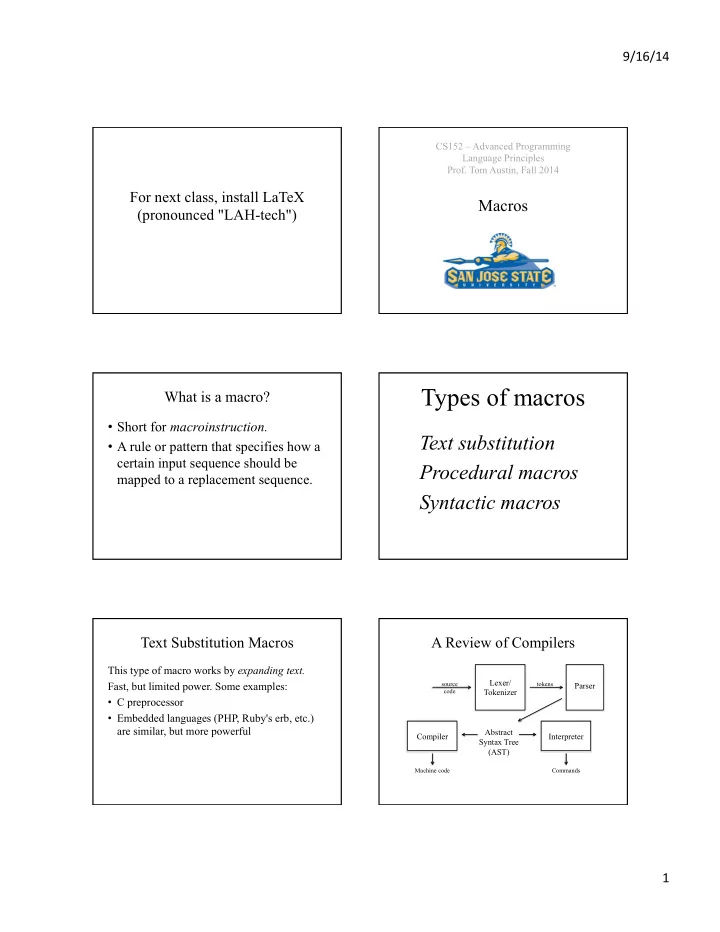
Types of macros What is a macro? Short for macroinstruction. Text - - PDF document

types of macros
SMART_READER_LITE
LIVE PREVIEW

Types of macros What is a macro? Short for macroinstruction. Text - - PDF document

9/16/14 CS152 Advanced Programming Language Principles Prof. Tom Austin, Fall 2014 For next class, install LaTeX Macros (pronounced "LAH-tech") Types of macros What is a macro? Short for macroinstruction. Text


slide-1
SLIDE 1

9/16/14 ¡ 1 ¡

For next class, install LaTeX (pronounced "LAH-tech")

CS152 – Advanced Programming Language Principles

  • Prof. Tom Austin, Fall 2014

Macros

What is a macro?

  • Short for macroinstruction.
  • A rule or pattern that specifies how a

certain input sequence should be mapped to a replacement sequence.

Types of macros

Text substitution Procedural macros Syntactic macros

Text Substitution Macros

This type of macro works by expanding text. Fast, but limited power. Some examples:

  • C preprocessor
  • Embedded languages (PHP, Ruby's erb, etc.)

are similar, but more powerful

A Review of Compilers

Lexer/ Tokenizer Parser

source code tokens

Abstract Syntax Tree (AST) Compiler

Machine code

Interpreter

Commands

slide-2
SLIDE 2

9/16/14 ¡ 2 ¡

Lexer/ Tokenizer Parser

source code tokens

Abstract Syntax Tree (AST) Compiler

Machine code

Interpreter

Commands

Pre- processor

expanded code

Some variants work at the token level, but the concept is the same.

C preprocessor example

#define PI 3.14159 #define SWAP(a,b) {int tmp=a;a=b;b=tmp;} int main(void) { int x=4, y=5, diam=7, circum=diam*PI; SWAP(x,y); } int main(void) { int x=4, y=5, diam=7, circum=diam*PI; SWAP(x,y); } int main(void) { int x=4, y=5, diam=7, circum=diam*3.14159; {int tmp=x;x=y;y=tmp;}; }

Preprocessor

Procedural macros

Procedural macros execute preprocessor statements at compilation time.

  • Allows macros to be written in a procedural

language.

  • More powerful than text substitution…
  • …but slower and more complex compiler.

Syntactic macros

  • Work at the level of abstract syntax trees
  • From the Lisp family (including Scheme)

– Why Lisp? Because Lisp programs are ASTs

  • Powerful, but expensive
  • Where our attention will be focused

Macro expansion process

Abstract Syntax Tree (AST) Abstract Syntax Tree (AST) Macro Expander Essentially this is a source-to-source compiler

slide-3
SLIDE 3

9/16/14 ¡ 3 ¡

Many macro systems suffer from a problem with inadvertent variable capture. Let's look at an example…

Accidental Capture Example

(in class)

Hygiene

Hygienic macros are macros whose expansion is guaranteed not to cause the accidental capture of identifiers.

Macros in Scheme

  • Scheme is noted for its powerful (and

hygienic) macro system.

  • Is it needed? Aren't lambdas enough?

(define (swap x y) (let ([tmp x]) (set! x y) (set! y tmp))) (let ([tmp 7][b 3]) (swap tmp b) (cons tmp b))

What is the result?

Pattern Based Macros

  • Preserves hygiene
  • define-syntax-rule matches the given

pattern and transforms is into the specified template

  • define-syntax is allows you to specify

multiple patters, including those with a variable number of arguments (using the … syntax)

slide-4
SLIDE 4

9/16/14 ¡ 4 ¡ (define-syntax-rule (swap x y) (let ([tmp x]) (set! x y) (set! y tmp))) (let ([tmp 7][b 3]) (swap tmp b) (cons tmp b))

What is the result now?

Define-syntax swap function

(define-syntax swap (syntax-rules () [(swap x y) (let ([tmp x]) (set! x y) (set! y tmp))]))

Lab

Using define-syntax, create a switch statement. Sample usage: (define x 99) (switch x [3 (displayln "x is 3")] [4 (displayln "x is 4")] [5 (displayln "x is 5")] ['default (displayln "none of the above")])

For more reading on macros:

  • Matthew Flatt, "Pattern-based macros", section

16.1 of "The Racket Guide". http://docs.racket-lang.org/guide/pattern- macros.html

  • Greg Hendershott, "Fear of Macros".

http://www.greghendershott.com/fear-of- macros/index.html