txt y Play ) v Fx Fyfe Qlx , y ) n RG , y ) ) given : T Cs , c) has - - PowerPoint PPT Presentation

txt y play v fx fyfe qlx y n rg y
SMART_READER_LITE
LIVE PREVIEW

txt y Play ) v Fx Fyfe Qlx , y ) n RG , y ) ) given : T Cs , c) has - - PowerPoint PPT Presentation

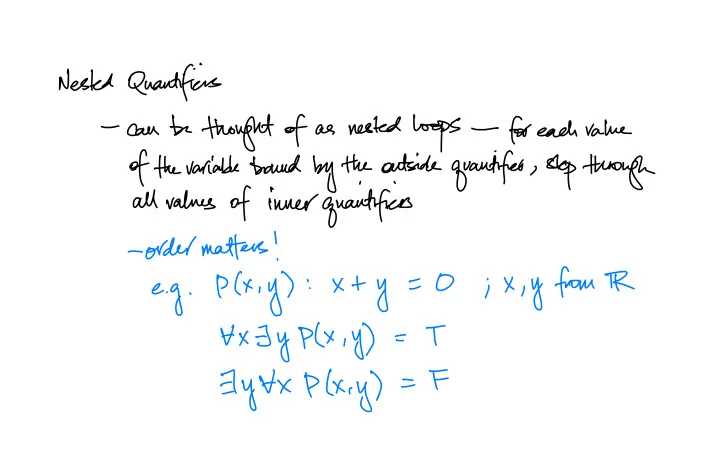
Needed Quantifiers - can be thought of as needed loops - for each value the outside quantifier , step through of the variable bound by all values of inner quaitficis - order matters ! x t y P Cx , y ) ; x , y from IR = 0 : e. g . txt y PG , y ) =


slide-1
SLIDE 1

Needed Quantifiers

  • can be thought of as needed loops
  • for each value
  • f the variable bound by

the outside quantifier , step through

all values of innerquaitficis

  • order matters !

e.g

.

P Cx , y)

:

x t y

= 0

; x , y from IR

txt y PG

, y) = T

F-yhtx Play)

= F

slide-2
SLIDE 2

Given

:

L(x , y)

: " x

loves y

"

Express the following using quantifiers

:
  • "

Everybody loves somebody

"

:

txt y L G .y)

  • "

There is

someone whom everybody

tones

. "

:

Fx Hy ily , x)

  • "

Nobody

loves everybody

"

  • F xTy thx ,y )
  • r txt y
  • LK ,y)
slide-3
SLIDE 3

Negating

needed quantifiers

:
  • rewrite the following

so that negations only appear

directly in front of predicates

it xt y

PG ,y)

F xFyn Play)

  • ftxF yr play) rt x Vy ( Q Cx ,y) v i r Cx ,y)))

txty Play) v FxFyfe Qlx ,y) n RG ,y))

slide-4
SLIDE 4

given

: T Cs ,c) :

students

has taken class c

domain of s

= all

HT students

domain of a = all

CS classes

Translate to English

:

Fx (T (Michael , x) RT(Shannon , x))

" There is a class that both Michael and

Shannon have taken

.

"

slide-5
SLIDE 5

given

: T (s ,c) :

students

has taken class c

domain of s

= all

HT students

domain of a = all

CS classes

Translate to English

:

F * y (x f Michael nG(Michael , y) →T(x , y)))

" There

is a student who has taken all the

classes

Michael

has taken

.

"

slide-6
SLIDE 6

given

: T (s ,c) :

students

has taken class c

domain of s

= all

HT students

domain of a = all

CS classes

Translate to English

:

Fx Fytz ((x ty) n G Gal ⇐ Tly , z)))

"There are two separate students that

have taken precisely the same classes

.

"

slide-7
SLIDE 7

proofs

slide-8
SLIDE 8

what

is

aproof

?

  • mathematical reasoning
  • deductive reasoning
  • valid argument that establishes the truth of a conjecture
  • systematic demonstration that if some set of assumptions

(hypotheses) aretrue , then some conclusion must also be true

  • proofs may leverage

"known fads

" - axioms

.
slide-9
SLIDE 9

There are many techniques we can

use to build proofs

,

but there is

no prescribed recipe for how we go about

coming up up a proof !

Good analogy

: how to solve a Jigsaw puzzle ?
slide-10
SLIDE 10

Rules of inference describe valid transformations of

logical statements based

  • n tautologies
.
  • inference
: Kwun)

a conclusion

reached on the basis

  • f evidence and reasoning
  • what logical assertion can

we make based on some set of premises ?

e.g.

, assuming propositions p , p

→ q aretrue

,

what can we assert ?

q must betrue !

slide-11
SLIDE 11

Rule of lnfrna syntax

:

premise

1

premise

2.

,

}

if all are true ,

premise

n

  • conclusion #

must also be true

slide-12
SLIDE 12

Rule :

modus powers (Latin :

" mode that affirms

")

tautology

: (Cp

→ g) np) → q

p

→ q

e.g. , if the AC is

  • n , I will be cold

f-

the Ac is

  • n
  • f

therefore , I will be add

slide-13
SLIDE 13

Rule

:

modus Tokens (Latin : "mode that denies")

tautology

: (Cp

→g) req) → n p

p

→ of

e.g

. if the AC is
  • n ,

I will be add

^G_

I am

not cold

" P

therefore , the AE is not on

slide-14
SLIDE 14

Rule :

Hypothetical syllogism

tautology :(Cp

→g) nCq→r)) → (per)

p

→ of

if

I eat candy , I will be wired

q

if

I

am

wired ,

I

can't sleep

P

→ ✓

therefore

, if

I eat candy

, I can't sleep
slide-15
SLIDE 15

Rule : Disjunctive syllogism

tautology

: Gpa (prod)→q

"P

e.g. ,

I

will not take

Econ

PI

I will either take Econ or

Soc

  • f

therefore

,

I will take

Soc

slide-16
SLIDE 16

Rule .

.

Resolution

tautology:(Cpvq)nGpvrD→Cqvr)

pug

x do

  • r

y

> 20

  • 102

× 7-10

  • r

2- LO

GV

r

. . . y > 20 or

ECO

slide-17
SLIDE 17

Rule

: Addition

tautology

:

p → Cprg)

I

2+2

= 4

P

✓90

zt 2=4

  • r

I am a rockstar

slide-18
SLIDE 18

Rule : simplification(Decomposition

tautology

: Cprg)

→ p

I left

  • M£115.4

!Ying

P

hypotheses

slide-19
SLIDE 19

Rule : conjunction( construction

tautology

: Kp) nlq)) →prof

P

g-

pig

slide-20
SLIDE 20

Remember that

we can also replace any logical expression

(or part of a compound expression) M

an qui

valent one

.

e -g

. using De Morgan's law

←pvnq

  • (p

n q) n r

slide-21
SLIDE 21

we can also introduce known tautologies based on

preceding

statements

.

E.g.

, using Disjunctive syllogism tautology (tip nlpvql) →g)

Ya

n b) n ((an b) v c)

¥c)→ c

  • C
slide-22
SLIDE 22

A valid argument

is a square of statements , where

each statement either :

  • is

a premise (we can stale apremise at any time)

  • follows from preceding
  • nes based
  • n rules of inference

the last statement is the conclusion

  • sometimes (

but

not always!)

what

we are trying to prove

.
slide-23
SLIDE 23

Eg

. . premises ,

ftp.PIscqr

)

s

prove

  • f

i.

p → s (premise)

2

.

T s (premise) 3 . Tp (modus tokens)

  • 4. Tp

→ (gnr) (premise)

5

. afar (modus powers)

6

.

q (simplification )

slide-24
SLIDE 24

E.g. , premises {I÷¥fqnr )

prone

:

7 s

i .

prof lpnemisr)

7 .

n r (Dis

. syllogism)

z .

P

z .

q }(simplification)

8

.

s → r ( premise)

4

. p

→ 7 (afar) (pneuma)

9

. Is (

modus tokens)

5 .

7 (afar) (modus powers)

  • 6. n que r (Demorgans)
slide-25
SLIDE 25

Rules of inference for quantified statements

: .

t xp Cx)

  • universal instantiation (ul)
.
  • pas
  • universal generalization (UG)
:

PG) for arbitrary c

  • existential instantiation CEI)

: Fx¥

Pk) for some

c

  • existential generalization (EG)
:

PG) for

some c

  • F x PG)
slide-26
SLIDE 26

E.g. premises

txCPCH-s@xxlnscxDJS7txcpcxsrrcxDpronestxCRCx7nsCxDl.V

  • xcptxnrcx))

Cpnemia) 7

.

Scc)

(simp

.)
  • 2. PG) - RG)

Cui)

8

.

Rcc)

(simple)

  • 3. PG)

(simplification

)

9

.

Rcc) nscc)

Canis)

  • 4. tx(Rx)→ (Qcxjnscx)))

Cpnennsi)

10

. ttxlrlxhscx ))
  • 5. Pk) →(

accuses)

Cui )

( UG )

  • 6. QQ ask)

Cmp)

slide-27
SLIDE 27

Note:

mathematical theorems are often

stated using free variables in its hypotheses and conclusion , and

universal quantification

  • vertherefree variables is implied
.

E.g.

, conjecture : if

u > 4

then I

> u

  • Pln)

Qcu)

  • i. e.,

Pcu) → Qcu) for arbitrary

n

universal generalization

:

we want to prove Hn(Pla) → Qcu))

"form

"of proof goal

:

p → of

slide-28
SLIDE 28

Methods of Proof of form p

→ of

1 . Trivial proof : q known to be true

e.g.,

" if it is raining

then

It 2=3

"
  • z. Vacuous proof

: p

known to be false

e.g. ,

"if

z > 3

then Elon musk is a genius

"

slide-29
SLIDE 29

Methods of Proof of form p

→ of 3

. Direct proof : assume pi prone of
  • use axioms , rules of inference , equivalences

4 . Indirect proof

a) proof of the contrapositive (recall p→of ⇒of

→ ap)

  • assume

n q , prone up

b) proof by

contradiction

  • assume p

r eq ; derive a contradiction G.g.,

rn - r)

slide-30
SLIDE 30

Methods of Proof of other forms

  • 5. proof of taconitetonal

p⇐q

  • prone p → q and q→ p

6

. proof of conjunction p ng
  • prone p and q separately
.

7

. if hypothesis is a disjunction , e.g. , Lp, vpar .
  • i v Pk) → q
  • un equivalence Cpr g) → r

= ( p

→ r) n Cq→ r)

  • Cp , v par
. - upe) → of

= Cp, →g)

a Cpa →g)

n

. . . n (pic

→q)

  • prone

each

case IT

  • separately
.
slide-31
SLIDE 31

Methods of proof involving quantifiers

8

. proof of form tx PK)
  • show

PG

) for arbitrary

c

9 . proof of form atxpCx) = Fx n PG )

  • find

a counterexample

c where 7 Pcc)

9

. proof of form Fxpcx)
  • "existence proof

"

  • " constructive

"

proof

: find c

where PG)

  • "
noaconstructive " proof :

assume

no c exists

where PG) i

derive a contradiction

.
slide-32
SLIDE 32

Many

  • thers
' .
  • mathematical induction
  • structural induction
  • cantor diagonalized

voir

  • combinatorial proofs
  • etc .