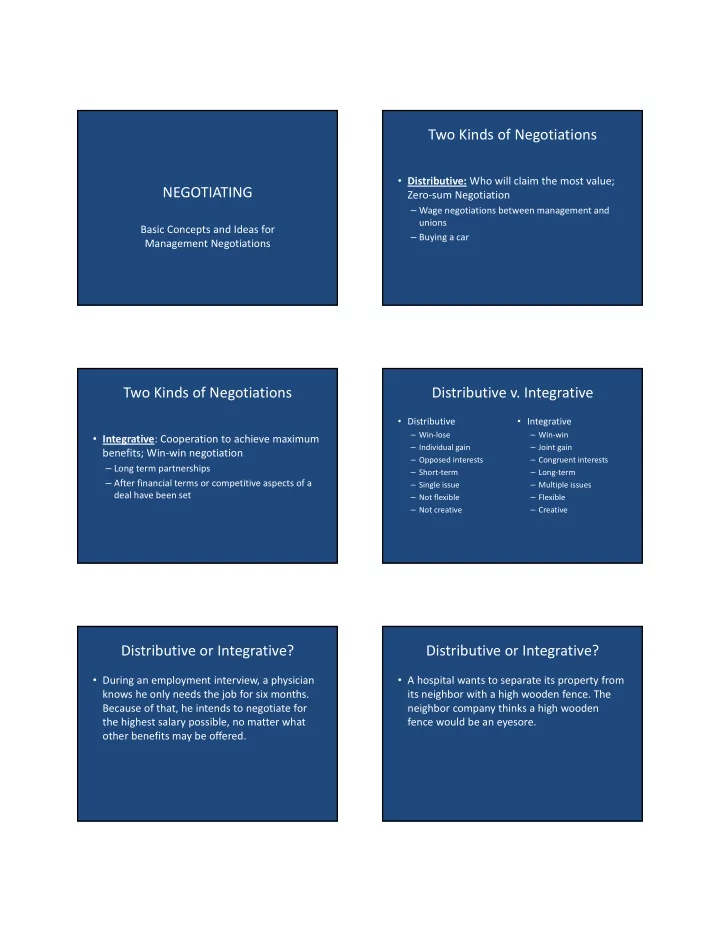
Two Kinds of Negotiations Distributive: Who will claim the most - - PDF document

two kinds of negotiations
SMART_READER_LITE
LIVE PREVIEW

Two Kinds of Negotiations Distributive: Who will claim the most - - PDF document

Two Kinds of Negotiations Distributive: Who will claim the most value; NEGOTIATING Zero sum Negotiation Wage negotiations between management and unions Basic Concepts and Ideas for Buying a car Management Negotiations Two Kinds of


slide-1
SLIDE 1

NEGOTIATING

Basic Concepts and Ideas for Management Negotiations

Two Kinds of Negotiations

  • Distributive: Who will claim the most value;

Zero‐sum Negotiation

– Wage negotiations between management and unions – Buying a car

Two Kinds of Negotiations

  • Integrative: Cooperation to achieve maximum

benefits; Win‐win negotiation

– Long term partnerships – After financial terms or competitive aspects of a deal have been set

Distributive v. Integrative

  • Distributive

– Win‐lose – Individual gain – Opposed interests – Short‐term – Single issue – Not flexible – Not creative

  • Integrative

– Win‐win – Joint gain – Congruent interests – Long‐term – Multiple issues – Flexible – Creative

Distributive or Integrative?

  • During an employment interview, a physician

knows he only needs the job for six months. Because of that, he intends to negotiate for the highest salary possible, no matter what

  • ther benefits may be offered.

Distributive or Integrative?

  • A hospital wants to separate its property from

its neighbor with a high wooden fence. The neighbor company thinks a high wooden fence would be an eyesore.

slide-2
SLIDE 2

Multiphase and Multiparty Negotiations

  • Implemented over time in different phases
  • Context allows parties to negotiate based on

follow‐through and continuing communication

  • One hospital system buying other hospitals
  • A hospital buying group practices

Multiparty Negotiations

  • More than two party's
  • Natural coalitions: Shared interests
  • Single‐issue coalitions: Unite to support or

block a single issue

Strategies for Multiparty Negotiations

  • Your party’s interest and coalition interests
  • If weak, consider forming a coalition with
  • thers
  • Breaking other party coalition: successful

when if is a single issue coalition

Strategies for Multiphase Negotiations

  • Familiarity with other party’s communication

and negotiation style

  • Build trust
  • Monitor other party to insure follow‐up
  • Walk away from disconcerting negotiations

Four Concepts for Establishing a Negotiation Framework

  • “A negotiated solution is only advantageous

when a better option in not available.”

  • Best Alternative to a Negotiated Settlement

(BATNA)

  • Reservation or walk away price
  • Zone of Possible Agreement (ZOPA)
  • Value Creation Through Trades

BATNA

  • Preferred course of action in the absence of a

deal

  • Knowing alternative actions absent of a deal
  • Point of saying “no” to an unfavorable deal
  • Know BATNA before negotiating
slide-3
SLIDE 3

You’re negotiating a lease agreement on office equipment with a salesperson (A) for the supplier.

  • Accept the deal only if the A is lower than the highest monthly

fee you’re willing to pay.

  • Meet with another office equipment supplier to see what

their leasing arrangements cost.

  • Buy used office equipment instead of leasing new equipment.

Reservation Price

  • Walk‐away point
  • Derived from BANTA, but not the same
  • May be similar if it is only about money

BATNA v. Reservation Price

  • When preparing to negotiate with a commercial landlord
  • ver a lease for office space, you consider that you are

currently paying $20 per square foot. This number is your BATNA.

  • You also take into account the fact that the new location

would be closer to clients and provide a more attractive workspace, thus you'd be willing to pay $30 per square

  • foot. That's your reservation price.
  • If more than $30 per square foot is required, you'll walk

away and attempt to lease space in a different building.

  • During the negotiation the landlord insists on $35 per

square foot and won't accept anything lower, thereby indicating that his reservation price is $35 per square foot.

ZOPA

  • Range in which a deal can be made
  • Reservation price determines ZOPA’s

– A buyer has set a reservation price of $275,000 for the purchase of a commercial warehouse and would like to pay as little as possible. The seller has set a reservation price of $250,000 and would like to obtain as much as possible. The ZOPA, – Therefore, is the range between $250,000 and $275,000.

Seller Buyer

  • $250K $275K

‐‐‐‐‐‐ ZOPA‐‐‐‐‐‐‐

Value Creation Through Trades

  • Negotiating parties can improve positions by

trading the values at their disposal

  • Integrated negotiations
  • Each party gets something in return for

something it values much less

  • Book collectors; professional athletes
slide-4
SLIDE 4

Preparing to Negotiate: 9 Steps To A Deal

  • 1. Determine satisfactory outcomes first

Good for you, good for them Motivations, concerns, needs of party's

  • 2. Identify opportunities to create value

Common ground, compromise, trades

  • 3. Identify you BATNA and reservation price

Yours and theirs, if possible Recognize when to hold ‘em, when to fold ‘em

Preparing to Negotiate: 9 Steps To A Deal

  • 4. Improve your BATNA

– Determines “say no” point – Improve BATNA before and during talks

  • 5. Assess who has authority

– Decision maker; authority of negotiator – Establish at the beginning of negotiations

  • 6. Study the other side

– Personality, style, background, culture, goals values; personal connections, research

Preparing to Negotiate: 9 Steps To A Deal

  • 7. Prepare for flexibility in the process

– Be patient, not always as planned – New people, unexpected developments

  • 8. Gather objective criteria for fairness

– Continuing relationship with other side – Explain what is favorable/unfavorable

  • 9. Alter the process in your favor

– Hidden or set agendas; make logistical changes

Negotiation Tactics

  • At the beginning:

– Positive tone, openness to other sides concerns – Review agenda – Discuss expectations – Offer information about interests and concerns, but be cautious

Tactics for Distributive Negotiations

  • Disclose little, learn much
  • Establish an anchor: start first offer in the right

place

  • Make cautious concessionary moves
  • Set time lines
  • Offer multiple proposals and/or packages
  • Signal Interest in closing the deal

Tactics for Integrative Negotiations

“The most important trip in life is meeting people half way.”

  • Inquire about the other sides interests, needs,

concerns

  • Provide significant information about your

circumstances; your interests, issues constraints.

  • Look for differences to create value
  • Take your time
slide-5
SLIDE 5

Barriers to Agreement

  • Die‐hard bargainers

– Know their game – Be guarded in the information you disclose – Suggest alternative options if they do not share information – Be willing to walk away

Barriers to Agreement

  • Lack of trust

– Emphasize the need for integrity – Request documentation – Add contingencies; penalties for noncompliance

  • r incentives for early performance
  • Differences in gender and culture

– Study and realize differences – Consider assumptions each party brought to the table

  • Difficulties in communication

– Ask for a break – Raise the misunderstood issue for clarification

Mental Errors in Negotiations

  • Irrational escalation
  • Partisan perceptions
  • Unreasonable expectations
  • Overconfidence
  • Unchecked emotions