TUNGSTEN RECOVERY AND ARSENIC REMOVAL FROM SECONDARY RESOURCES DEEP - - PowerPoint PPT Presentation

tungsten recovery and arsenic removal from secondary
SMART_READER_LITE
LIVE PREVIEW

TUNGSTEN RECOVERY AND ARSENIC REMOVAL FROM SECONDARY RESOURCES DEEP - - PowerPoint PPT Presentation

28. June. 2019 J. Almeida 1 , R. Craveiro 2 , E.P. Mateus 1 , S. Barreiros 2 , A. Paiva 2 , A.B. Ribeiro 1 1 CENSE, Department of Sciences and Environmental Engineering 2 LAQV@Requimte, Department of Chemistry TUNGSTEN RECOVERY AND ARSENIC REMOVAL


slide-1
SLIDE 1
  • 28. June. 2019

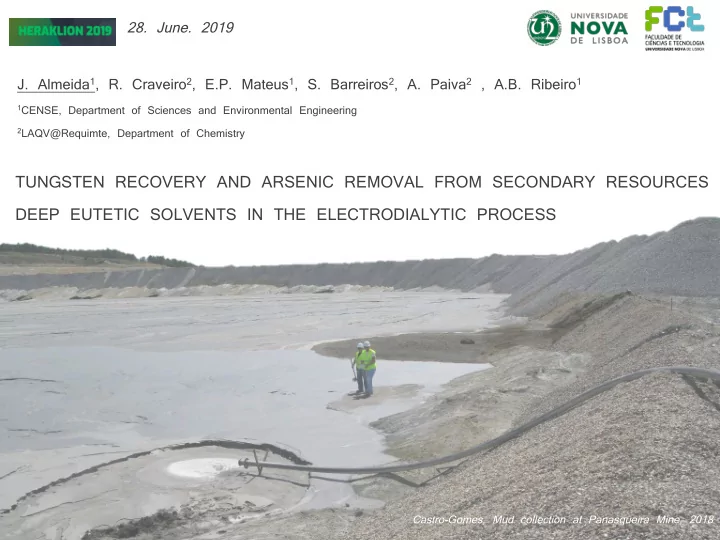
TUNGSTEN RECOVERY AND ARSENIC REMOVAL FROM SECONDARY RESOURCES DEEP EUTETIC SOLVENTS IN THE ELECTRODIALYTIC PROCESS

  • J. Almeida1, R. Craveiro2, E.P. Mateus1, S. Barreiros2, A. Paiva2 , A.B. Ribeiro1

1CENSE, Department of Sciences and Environmental Engineering 2LAQV@Requimte, Department of Chemistry

Castro-Gomes, Mud collection at Panasqueira Mine, 2018

slide-2
SLIDE 2

2

Mining residues SCOPE

  • J. Almeida @ Heraklion 2019

Panasqueira Mine, Covilhã, PT

slide-3
SLIDE 3

2

Mining residues SCOPE Arsenic

  • J. Almeida @ Heraklion 2019

Panasqueira Mine, Covilhã, PT

slide-4
SLIDE 4

2

Mining residues SCOPE Arsenic Tungsten

  • J. Almeida @ Heraklion 2019

Panasqueira Mine, Covilhã, PT

slide-5
SLIDE 5

2

Mining residues How to remove harmful compounds & recover critical raw materials from secondary resources? SCOPE Arsenic Tungsten

  • J. Almeida @ Heraklion 2019

Panasqueira Mine, Covilhã, PT

slide-6
SLIDE 6

2

Mining residues How to remove harmful compounds & recover critical raw materials from secondary resources? Electro-based technologies Deep Eutetic Solvents SCOPE Arsenic Tungsten

  • J. Almeida @ Heraklion 2019

Panasqueira Mine, Covilhã, PT

slide-7
SLIDE 7

2

Mining residues How to remove harmful compounds & recover critical raw materials from secondary resources? Electro-based technologies Deep Eutetic Solvents Both techniques combined! SCOPE Arsenic Tungsten

  • J. Almeida @ Heraklion 2019

Panasqueira Mine, Covilhã, PT

slide-8
SLIDE 8

2

Mining residues How to remove harmful compounds & recover critical raw materials from secondary resources? Electro-based technologies Deep Eutetic Solvents Both techniques combined! Treated mining residues for reuse in the construction sector SCOPE Arsenic Tungsten

  • J. Almeida @ Heraklion 2019

Panasqueira Mine, Covilhã, PT

slide-9
SLIDE 9

➔ Low conductivity 0.8 ± 0.4 mS/cm ➔ Acidic pH 5.3 ± 0.5 ➔ Arsenic content As: 1675 ± 564 mg/kg ➔ Tungsten content W: 130 ± 31 mg/kg ➔ Other elements of interest Cu: 731 ± 270 mg/kg Sn: 38 ± 9 mg/kg

3

Sample Rejected fraction from sludge circuit (tube output; pumped directly to the Panasqueira dam) MATRIX CHARACTERIZATION

  • J. Almeida @ Heraklion 2019

Castro-Gomes, Mud collection at Panasqueira Mine, 2018

slide-10
SLIDE 10

MATRIX ELEMENTS Si 67.6% Al 18.6% 0.4% P, Cr, Mn, Se, Rb, Sr, Y, Zr,

Nb, Cd, Sn, Ba, Pb

13.4%

  • J. Almeida @ Heraklion 2019

S, K, Ca, Ti, Fe, Cu, Zn,

X-Ray Fluorescence (XRF) Semi-Quantitative Data (%)

W As

0.3% 0.6% XRF spectrometer

4

As, W

slide-11
SLIDE 11

5

DEEP EUTETIC SOLVENTS Ionic Liquids Deep Eutetic Solvents

Low price Low toxicity 100% atom economy Biodegradable Low vapor pressure Low volatility

Deep Eutetic Solvents (DES)

Acids, amides, amines and alcohols as liquid ≤ 100 °C

Hydrogen bond donor (HDB) Quaternary ammonium

  • r metal salt
  • J. Almeida @ Heraklion 2019

= +

X X X X ✓ ✓ ✓ ✓ ✓ ✓ ✓ ✓

(natural products)

slide-12
SLIDE 12

5

DEEP EUTETIC SOLVENTS Ionic Liquids Deep Eutetic Solvents

Low price Low toxicity 100% atom economy Biodegradable Low vapor pressure Low volatility Why DES?

Deep Eutetic Solvents (DES)

Acids, amides, amines and alcohols as liquid ≤ 100 °C

Hydrogen bond donor (HDB) Quaternary ammonium

  • r metal salt
  • J. Almeida @ Heraklion 2019

= +

X X X X ✓ ✓ ✓ ✓ ✓ ✓ ✓ ✓

(natural products)

slide-13
SLIDE 13

6

ELECTRO-BASED TREATMENT ➔ Electrokinetic (EK) and Electrodialytic (ED) treatments consist in a low current density (mA/cm2) application between a pair

  • f

electrodes to promote removal/separation of substances, with an ionic exchange membrane interposed in the ED treatment

+ AEM

  • H+

OH-

  • CEM

+

OH- H+

+

  • AEM

CEM

H+ OH-

(A) (B) (C)

(A) 3 compartments ED cell (B) & (C) 2 compartments ED cell

AEM – Anionic exchange membrane CEM – Cationic Exchange membrane

  • J. Almeida @ Heraklion 2019
slide-14
SLIDE 14

7

GOALS

  • J. Almeida @ Heraklion 2019

Mining residues (MR) Arsenic Tungsten

slide-15
SLIDE 15

GOALS Mining residues (MR) Arsenic Tungsten

7

  • J. Almeida @ Heraklion 2019
slide-16
SLIDE 16

GOALS Mining residues (MR) Arsenic Tungsten Selection of the most efficient DES for As and W extraction from the matrix

1

7

  • J. Almeida @ Heraklion 2019
slide-17
SLIDE 17

GOALS Mining residues (MR) Arsenic Tungsten Potential of the EK process combined with DES to improve As and W extraction from the matrix Selection of the most efficient DES for As and W extraction from the matrix

1 2

7

  • J. Almeida @ Heraklion 2019
slide-18
SLIDE 18

7

GOALS

  • J. Almeida @ Heraklion 2019

Mining residues (MR) Arsenic Tungsten

  • J. Almeida @ Heraklion 2019

Potential of the EK process combined with DES to improve As and W extraction from the matrix Feasibility of the ED process to separate As and W in a compartment apart from the matrix Selection of the most efficient DES for As and W extraction from the matrix

1 2 3

slide-19
SLIDE 19

8

METHODOLOGY

  • J. Almeida @ Heraklion 2019

➔ ChCl:MA - Choline Chloride:Malonic Acid (1:2) ➔ ChCl:OA - Choline Chloride:Oxalic Acid (1:1) ➔ ChCl:LA - Choline Chloride:Latic Acid (1:2) ➔ PA:U - Propionic Acid:Urea (2:1) Liquid/solid = 9 Stirring 10 days DES + MR

DES tested Selection of the most efficient DES for As and W extraction from the matrix

1

slide-20
SLIDE 20

9

METHODOLOGY

  • J. Almeida @ Heraklion 2019

➔ ChCl:MA - Choline Chloride:Malonic Acid (1:2) ➔ ChCl:OA - Choline Chloride:Oxalic Acid (1:1)

50 & 100 mA Liquid/Solid=9 Stirring 4 days

+

  • mA

+

  • DES + MR +H20

(1.5% ChCl:MA & 1.5% ChCl:OA)

DES tested with higher As and W extraction As W Potential of the EK process combined with DES to improve As and W extraction from the matrix

2

slide-21
SLIDE 21

10

METHODOLOGY

  • J. Almeida @ Heraklion 2019

+ AEM

  • H+

OH-

mA

+

  • 50 & 100 mA

Liquid/Solid=9 Electrolyte 0.01 M NaNO3 Stirring 4 days DES + MR +H20 (1.5% ChCl:MA & 1.5% ChCl:OA)

➔ ChCl:MA - Choline Chloride:Malonic Acid (1:2) ➔ ChCl:OA - Choline Chloride:Oxalic Acid (1:1)

DES tested with higher As and W extraction As W Feasibility of the ED process to separate As and W in a compartment apart from the matrix

3

slide-22
SLIDE 22

11

RESULTS & DISCUSSION

12,1% 6,6% 2,4% 6,5% 5,0% 8,6% 1,0% 4,8%

ChCl:Acid malonic (1:2) ChCl: Oxalic Acid (1:1) ChCl: Latic Acid (1:2) Propionic Acid:urea (2:1)

Arsenic and Tungsten extraction

As W

  • J. Almeida @ Heraklion 2019

ChCl:MA ChCl:OA ChCl:LA ChCl:PA 12% 5% 7% 9% 2% 1% 7% 5%

Selection of the most efficient DES for As and W extraction from the matrix

1

slide-23
SLIDE 23

11

RESULTS & DISCUSSION

12,1% 6,6% 2,4% 6,5% 5,0% 8,6% 1,0% 4,8%

ChCl:Acid malonic (1:2) ChCl: Oxalic Acid (1:1) ChCl: Latic Acid (1:2) Propionic Acid:urea (2:1)

Arsenic and Tungsten extraction

As W

  • J. Almeida @ Heraklion 2019

ChCl:MA ChCl:OA ChCl:LA ChCl:PA 12% 5% 7% 9% 2% 1% 7% 5%

Selection of the most efficient DES for As and W extraction from the matrix

1

slide-24
SLIDE 24

12

  • J. Almeida @ Heraklion 2019
  • 2%

21% 6%

  • 2%

3% 7% 0% 10%

Extraction percentages in relation to DES experiments without current

As W 0.4% 50 mA – ChCl:OA 100 mA – ChCl:OA 50 mA– ChCl:MA 100 mA – ChCl:MA

RESULTS & DISCUSSION Potential of the EK process combined with DES to improve As and W extraction from the matrix

2

+ + + + + +

slide-25
SLIDE 25

12

  • J. Almeida @ Heraklion 2019
  • 2%

21% 6%

  • 2%

3% 7% 0% 10%

Extraction percentages in relation to DES experiments without current

As W 0.4% 50 mA – ChCl:OA 100 mA – ChCl:OA 50 mA– ChCl:MA 100 mA – ChCl:MA

RESULTS & DISCUSSION Potential of the EK process combined with DES to improve As and W extraction from the matrix

2

+ + + + + +

slide-26
SLIDE 26

13

VOLTAGE, pH & CONDUCTIVITY CONTROL

10 24 48 72 96 Voltage (V) Time (hours)

Voltage

50 mA - ChCl:OA 50 mA - ChCl:MA 100 mA - ChCl:OA 100 mA - ChCl:MA

5 10 15 pH

pH

5 24 48 72 96 Conductivity (mS/cm) Time (hours)

Conductivity

  • J. Almeida @ Heraklion 2019
slide-27
SLIDE 27

14

  • J. Almeida @ Heraklion 2019

Removed – Liquid phase + electrolyte contents; Separated – electrolyte content

4% 2% 18% 15% 6% 4% 3% 6% 5% 17% 7% 5% 21% 4% 0% 10% 20% 30% 40% As W As W As W As W 50 mA - ChCl:OA 100 mA - ChCl:OA 50 mA - ChCl:MA 100 mA - ChCl:MA

Compartments distribution of As and W extracted contents

Sample compartment (Liquid phase) Electrolyte compartment 1% 1%

RESULTS & DISCUSSION Feasibility of the ED process to separate As and W in a compartment apart from the matrix

3

slide-28
SLIDE 28

14

  • J. Almeida @ Heraklion 2019

Removed – Liquid phase + electrolyte contents; Separated – electrolyte content

4% 2% 18% 15% 6% 4% 3% 6% 5% 17% 7% 5% 21% 4% 0% 10% 20% 30% 40% As W As W As W As W 50 mA - ChCl:OA 100 mA - ChCl:OA 50 mA - ChCl:MA 100 mA - ChCl:MA

Compartments distribution of As and W extracted contents

Sample compartment (Liquid phase) Electrolyte compartment

Higher W separation

1% 1%

RESULTS & DISCUSSION Feasibility of the ED process to separate As and W in a compartment apart from the matrix

3

Higher As separation

slide-29
SLIDE 29

14

  • J. Almeida @ Heraklion 2019

Removed – Liquid phase + electrolyte contents; Separated – electrolyte content

4% 2% 18% 15% 6% 4% 3% 6% 5% 17% 7% 5% 21% 4% 0% 10% 20% 30% 40% As W As W As W As W 50 mA - ChCl:OA 100 mA - ChCl:OA 50 mA - ChCl:MA 100 mA - ChCl:MA

Compartments distribution of As and W extracted contents

Sample compartment (Liquid phase) Electrolyte compartment

Total of 35% of As extracted Total of 22% of W extracted

1% 1%

RESULTS & DISCUSSION Feasibility of the ED process to separate As and W in a compartment apart from the matrix

3

slide-30
SLIDE 30

15

ELECTROLYTE BEHAVIOR

Mass and Percentage of elements reaching the electrolyte along the experiments

ELECTROLYTE BEHAVIOR

0,00E+00 4,00E+03 8,00E+03 1,20E+04 mg

Arsenic content

100 200 300 400 24 48 72 96 mg Time (hours)

Tungsten content

50 mA - ChCl:MA 50 mA - ChCl:OA 100 mA - ChCl:MA 100 mA - ChCl:OA 0% 25% 50% 75% 100% Arsenic accumulated percentage in the electrolyte 0% 30% 60% 90% 120% 24 48 72 96 Time (hours) Tungsten accumulated percentage in the electrolyte 50 mA - ChCl:MA 50 mA - ChCl:AO 100 mA - ChCl:MA 100 mA - ChCl:AO

  • J. Almeida @ Heraklion 2019
slide-31
SLIDE 31

16

ELECTROLYTE BEHAVIOR

61% 48% 45% 82% 75% 32% 38% 58%

50 mA - ChCl:OA 100 mA - ChCl:OA 50 mA - ChCl:MA 100 mA - ChCl:MA

As W

Percentage of elements from the total As and W extracted that reached the electrolyte

  • J. Almeida @ Heraklion 2019
slide-32
SLIDE 32

16

ELECTROLYTE BEHAVIOR

61% 48% 45% 82% 75% 32% 38% 58%

50 mA - ChCl:OA 100 mA - ChCl:OA 50 mA - ChCl:MA 100 mA - ChCl:MA

As W

Percentage of elements from the total As and W extracted that reached the electrolyte

  • J. Almeida @ Heraklion 2019
slide-33
SLIDE 33

17

CONCLUSIONS

  • J. Almeida @ Heraklion 2019

➔ Different DES demonstrated higher extraction efficiencies for different elements

  • ChCl:MA (1:2) extracted a maximum of 12% for As
  • ChCl:OA (1:1) extracted a maximum of 9% for W

Selection of the most efficient DES for As and W extraction from the matrix

1

slide-34
SLIDE 34

18

CONCLUSIONS

  • J. Almeida @ Heraklion 2019

➔ Deep Eutetic solvents and EK treatment synergy potentiated the extraction

  • As extraction increased 21% (100 mA, ChCl:OA)
  • W extraction increased 10% (100 mA, ChCl:MA)

Compared to DES experiments with no current

+

  • mA

+

  • Potential of the EK process combined with DES to improve As and W

extraction from the matrix

2

slide-35
SLIDE 35

19

CONCLUSIONS

  • J. Almeida @ Heraklion 2019

➔ ED treatment enable to separate As and W, improving the migration of the elements from the matrix to the electrolyte compartment

  • From the total As extracted, 82% (100 mA, ChCl:MA) migrated to the electrolyte
  • From the total W extracted, 75% (50 mA, ChCl:OA) migrated to the electrolyte

Feasibility of the ED process to separate As and W in a compartment apart from the matrix

3

+ AEM

  • H+

OH-

mA

+

slide-36
SLIDE 36

Thank you!

js.almeida@campus.fct.unl.pt

ACKNOWLEDGMENTS

  • This PhD work is part of the EcoCoRe Doctoral Program. The author acknowledges the PhD fellowship awarded by

the Portuguese Foundation for Science and Technology (PD\BD\135170\2017)

  • This work has received funding from the European Union’s Horizon 2020 research and innovation programme under

the Marie Skłodowska-Curie grant agreement No.778045 (e.THROUGH - H2020-MSCA-RISE-2017-778045)

  • J. Almeida acknowledges her PhD supervisor team: Professor Paulina Faria, Professor Alexandra Ribeiro and Doctor

António Santos Silva

  • J. Almeida @ Heraklion 2019