Truck Shipment Example: Periodic 11. Continuing with the example: - - PowerPoint PPT Presentation

truck shipment example periodic
SMART_READER_LITE
LIVE PREVIEW

Truck Shipment Example: Periodic 11. Continuing with the example: - - PowerPoint PPT Presentation

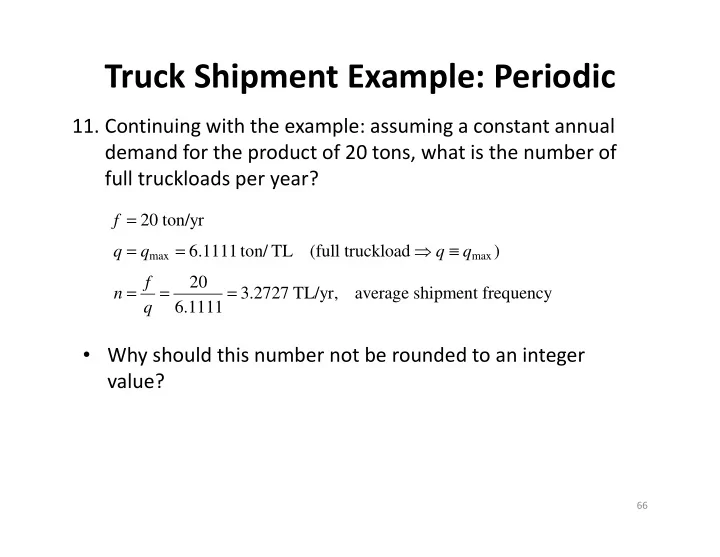
Truck Shipment Example: Periodic 11. Continuing with the example: assuming a constant annual demand for the product of 20 tons, what is the number of full truckloads per year? = f 20 ton/yr = = q q 6.1111 ton/ TL (full


slide-1
SLIDE 1

Truck Shipment Example: Periodic

  • 11. Continuing with the example: assuming a constant annual

demand for the product of 20 tons, what is the number of full truckloads per year?

max max

20 ton/yr 6.1111 ton/ TL (full truckload ) 20 3.2727 TL/yr, average shipment frequency 6.1111 f q q q q f n q = = =  ≡ = = =

  • Why should this number not be rounded to an integer

value?

66

slide-2
SLIDE 2

Truck Shipment Example: Periodic

  • 12. What is the shipment interval?

1 6.1111 0.3056 yr/TL, average shipment interval 20 q t n f = = = =

  • How many days are there between shipments?

365.25 day/yr 365.25 365.25 111.6042 day/TL t n × = =

67

slide-3
SLIDE 3

Truck Shipment Example: Periodic

  • 13. What is the annual full-truckload transport cost?

( )

max

532 mi, $2.5511/ mi 2.5511 $0.4175 / ton-mi 6.1111 , monetary weight in $/mi 3.2727(2.5511)532 $4,441.73/yr

TL TL FTL FTL FTL TL

d r r r q TC f r d nr d wd w = = = = = = = = = = =

  • What would be the cost if the shipments were to be made

at least every three months?

{ } { } { }

max min max min min

3 1 yr/TL 4 TL/yr 12 max , max , max 3.2727, 4 2.5511(532) $5,428.78/yr

FTL TL

f t n q t n n TC n n r d =  = =  = ′ = = =

68

slide-4
SLIDE 4

Truck Shipment Example: Periodic

  • Independent and allocated full-truckload charges:

Transport Charge for a Shipment

[ ] [ ]

max

, c ( ),

FTL

q q UB LB q qr d ≤  =

69 150/2000 87.51 4072 2714 1357 0.7960 6.11 12.22 Shipment Size (tons) Transport Charge ($)

MC

1 TL 2 TL 3 TL

slide-5
SLIDE 5

Truck Shipment Example: Periodic

  • Total Logistics Cost (TLC) includes all costs that could change

as a result of a logistics-related decision

cycle pipeline safety

transport cost inventory cost purchase cost TLC TC IC PC TC IC IC IC IC PC = + + = = = + + =

  • Cycle inventory: held to allow cheaper large shipments
  • Pipeline inventory: goods in transit or awaiting transshipment
  • Safety stock: held due to transport uncertainty
  • Purchase cost: can be different for different suppliers

70

slide-6
SLIDE 6

Truck Shipment Example: Periodic

  • Same units of inventory can serve multiple roles at each

position in a production process

  • Working stock: held as part of production process
  • (in-process, pipeline, in-transit, presentation)
  • Economic stock: held to allow cheaper production
  • (cycle, anticipation)
  • Safety stock: held to buffer effects of uncertainty
  • (decoupling, MRO (maintenance, repair, and operations))

71

slide-7
SLIDE 7

Truck Shipment Example: Periodic

  • 14. Since demand is constant throughout the year, one half of a

shipment is stored at the destination, on average. Assuming that the production rate is also constant, one half of a shipment will also be stored at the origin, on average. Assuming each ton of the product is valued at $25,000, what is a “reasonable estimate” for the total annual cost for this cycle inventory?

cycle

(annualcost of holding one ton)(average annual inventory level) ( )( ) unit value of shipment ($/ton) inventory carrying rate, the cost per dollar of inventory per year (1/yr) average int IC vh q v h α α = = = = = er-shipment inventory fraction at Origin and Destination shipment size (ton) q =

72

slide-8
SLIDE 8

Truck Shipment Example: Periodic

  • Inv. Carrying Rate (h) = interest + warehousing + obsolescence
  • Interest: 5% per Total U.S. Logistics Costs
  • Warehousing: 6% per Total U.S. Logistics Costs
  • Obsolescence: default rate (yr) h = 0.3  hobs ≈ 0.2 (mfg product)

– Low FGI cost (yr): h = hint + hwh + hobs – High FGI cost (hr): h ≈ hobs, can ignore interest & warehousing

  • (hint+hwh)/H = (0.05+0.06)/2000 = 0.000055 (H = oper. hr/yr)

– Estimate hobs using “percent-reduction interval” method: given time th when product loses xh-percent of its original value v, find hobs – Example: If a product loses 80% of its value after 2 hours 40 minutes: – Important: th should be in same time units as production time, tCT

73

  • bs
  • bs
  • bs
  • bs

, and

h h h h h h h h

x x h t v x v h t x h t t h =  =  = = 40 0.8 2 2.67 hr 0.3 60 2.67

h h h

x t h t = + =  = = =

slide-9
SLIDE 9

Truck Shipment Example: Periodic

  • Note: Cycle inventory is FGI at Origin and RMI at Destination

2 q q q 2 q

1 1 (1) 1 2 2 2 2 q q q q α   = + = + =  =    

74

  • Avg. annual cycle inventory level
slide-10
SLIDE 10

Truck Shipment Example: Periodic

  • Inter-shipment inventory fraction alternatives:

2 q 2 q ≈ 2 q 2 q ≈

≈ ≈

1 1 1 2 2 α = + = 1 1 2 2 α = + = 1 1 2 2 α = + = α = + = α α α = +

O D

75

slide-11
SLIDE 11

Truck Shipment Example: Periodic

  • “Reasonable estimate” for the total annual cost for the

cycle inventory:

cycle max

(1)(25,000)(0.3)6.1111 $45,833.33/ yr where 1 1 at Origin + at Destination 1 2 2 $25,000 unit value of shipment ($/ton) 0.3 estimated carrying rate for manufactured products (1/yr) = 6. IC vhq v h q q α α = = = = = = = = = = 111 FTL shipment size (ton) =

76

slide-12
SLIDE 12

Truck Shipment Example: Periodic

  • 15. What is the annual total logistics cost (TLC) for these

(necessarily P2P) full-truckload TL shipments?

cycle

3.2727(2.5511)532 (1)(25,000)(0.3)6.1111 4,441.73 45,833.33 $50,275.06 /

FTL FTL TL

TLC TC IC nr d vhq yr α = + = + = + = + =

77

  • Problem: FTL may not minimize TLC

 Can assume, for any periodic shipment, q ≤ qmax  Assuming P2P TL, what to find q, q*, that minimizes TLC 

max

( )

TL TL TL

q c q r d r d q   = =    

slide-13
SLIDE 13

Truck Shipment Example: Periodic

  • 16. What is minimum possible annual total logistics cost for P2P

TL shipments, where the shipment size can now be less than a full truckload?

( ) ( ) ( ) ( )

TL TL TL

f f TLC q TC q IC q c q vhq rd vhq q q α α = + = + = +

*

( ) 20(2.5511)532 1.9024 ton (1)25000(0.3)

TL TL TL

dTLC q f r d q dq vh α =  = = =

* * *

( ) 20 (2.5511)532 (1)25000(0.3)1.8553 1.8553 14,268.12 14,268.12 $28,536.25 / yr

TL TL TL TL TL

f TLC q r d vhq q α = + = + = + =

78

slide-14
SLIDE 14

Truck Shipment Example: Periodic

  • Including the minimum charge and maximum payload

restrictions:

  • What is the TLC if this size shipment could be made as a

(not-necessarily P2P) allocated full-truckload?

{ }

* max

max , min ,

TL TL TL TL

f r d MC f r d q q vh vh α α     = ≈      

79

( )

( )

* * * * * max

( ) 2.5511 20 532 (1)25000(0.3)1.9024 6.1111 4,441.73 14,268.12 $18,709.85 / yr

  • vs. $28,536.25 as independent P2P TL

TL AllocFTL TL TL FTL TL TL TL

f r TLC q q r d vhq f d vhq q q α α = + = + = + = + =

slide-15
SLIDE 15

Truck Shipment Example: Periodic

  • 17. What is the optimal LTL shipment size?

( ) ( ) ( ) ( ) α = + = +

LTL LTL LTL

f TLC q TC q IC q c q vhq q

  • Must be careful in picking starting point for optimization

since LTL formula only valid for limited range of values:

( )

2 1 15 2 7 29 3

37 3354 (dist) 14 150 10,000 (wt) 8 , 2,000 2,000 7 2 14 2000 650 ft (cube) 2

LTL LTL

d s q r PPI q s s q d s ≤ ≤     +   ≤ ≤    =       + + −     ≤      

80

*

arg min ( ) 0.7622 ton = =

LTL LTL q

q TLC q 150 10,000 650 min , 0.075 1.44 2000 2,000 2000   ≤ ≤  ≤ ≤     s q q

slide-16
SLIDE 16

Truck Shipment Example: Periodic

  • 18. Should the product be shipped TL or LTL?

* * *

( ) ( ) ( ) 34,349.19 5,716.40 $40,065.59 / yr = + = + =

LTL LTL LTL LTL LTL

TLC q TC q IC q

81

0.76 1.90 Shipment weight (tons) 28536 40066 TLCTL TLCLTL TCTL TCLTL IC