
SLIDE 1
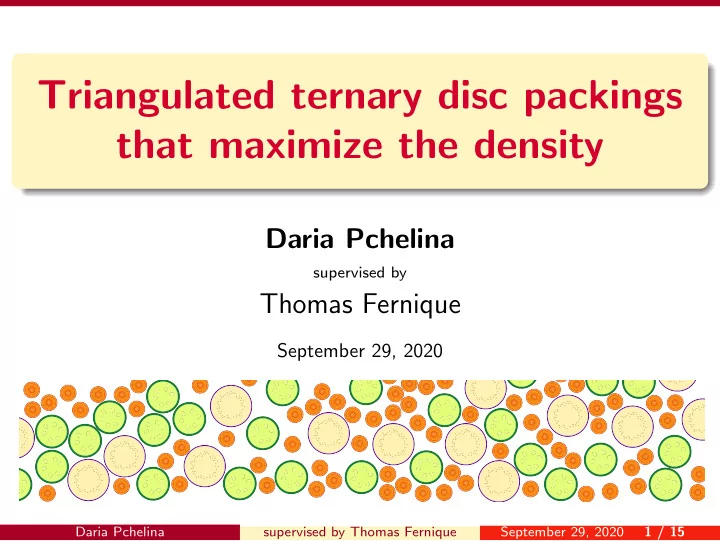
Triangulated ternary disc packings that maximize the density
Daria Pchelina
supervised by
Thomas Fernique
September 29, 2020
Daria Pchelina supervised by Thomas Fernique September 29, 2020 1 / 15
Triangulated ternary disc packings that maximize the density Daria - - PowerPoint PPT Presentation
Triangulated ternary disc packings that maximize the density Daria Pchelina supervised by Thomas Fernique September 29, 2020 Daria Pchelina supervised by Thomas Fernique September 29, 2020 1 / 15 What is a packing? Discs: r s 1 Packing
supervised by
September 29, 2020
Daria Pchelina supervised by Thomas Fernique September 29, 2020 1 / 15
Discs: Packing P: (in R2)
1 r s Daria Pchelina supervised by Thomas Fernique September 29, 2020 2 / 15
Discs: Packing P: (in R2) Density:
1 r s
δ(P) = lim sup
n→∞
area([−n, n]2 ∩ P) area([−n, n]2)
Daria Pchelina supervised by Thomas Fernique September 29, 2020 2 / 15
Discs: Packing P: (in R2) Density:
1 r s
δ(P) = lim sup
n→∞
area([−n, n]2 ∩ P) area([−n, n]2)
Daria Pchelina supervised by Thomas Fernique September 29, 2020 2 / 15
Discs: Packing P: (in R2) Density:
1 r s
δ(P) = lim sup
n→∞
area([−n, n]2 ∩ P) area([−n, n]2)
Daria Pchelina supervised by Thomas Fernique September 29, 2020 2 / 15
Discs: Packing P: (in R2) Density:
1 r s
δ(P) = lim sup
n→∞
area([−n, n]2 ∩ P) area([−n, n]2)
Daria Pchelina supervised by Thomas Fernique September 29, 2020 2 / 15
Discs: Packing P: (in R2) Density:
1 r s
δ(P) = lim sup
n→∞
area([−n, n]2 ∩ P) area([−n, n]2)
Daria Pchelina supervised by Thomas Fernique September 29, 2020 2 / 15
Discs: Packing P: (in R2) Density:
1 r s
δ(P) = lim sup
n→∞
area([−n, n]2 ∩ P) area([−n, n]2)
Daria Pchelina supervised by Thomas Fernique September 29, 2020 2 / 15
Discs: Packing P: (in R2) Density:
1 r s
δ(P) = lim sup
n→∞
area([−n, n]2 ∩ P) area([−n, n]2)
Daria Pchelina supervised by Thomas Fernique September 29, 2020 2 / 15
Discs: Packing P: (in R2) Density:
1 r s
δ(P) = lim sup
n→∞
area([−n, n]2 ∩ P) area([−n, n]2)
Daria Pchelina supervised by Thomas Fernique September 29, 2020 2 / 15
To pack fruits
Daria Pchelina supervised by Thomas Fernique September 29, 2020 3 / 15
To pack fruits and vegetables
Daria Pchelina supervised by Thomas Fernique September 29, 2020 3 / 15
To pack fruits and vegetables To make compact materials
Binary and ternary superlattices self-assembled from colloidal nanodisks and nanorods. Journal of the American Chemical Society, 137(20):6662–6669, 2015.
Daria Pchelina supervised by Thomas Fernique September 29, 2020 3 / 15
2D hexagonal
δ =
π 2 √ 3
Lagrange, 1772 Hexagonal packing maximize the density among lattice packings. Thue, 1910 (Toth, 1940) Hexagonal packing maximize the density.
Daria Pchelina supervised by Thomas Fernique September 29, 2020 4 / 15
2D hexagonal
δ =
π 2 √ 3
Lagrange, 1772 Hexagonal packing maximize the density among lattice packings. Thue, 1910 (Toth, 1940) Hexagonal packing maximize the density. 3D hexagonal
δ =
π 3 √ 2
Gauss, 1831 Hexagonal packing maximize the density among lattice packings. Hales, Ferguson, 1998–2014 (Conjectured by Kepler, 1611) Hexagonal packing maximize the density.
Daria Pchelina supervised by Thomas Fernique September 29, 2020 4 / 15
Two discs of radii 1 and r: Lower bound on the density:
π 2 √ 3 (hexagonal packing with only 1 disc used) Daria Pchelina supervised by Thomas Fernique September 29, 2020 5 / 15
Two discs of radii 1 and r: Lower bound on the density:
π 2 √ 3 (hexagonal packing with only 1 disc used)
Upper bound on the density: Florian, 1960 The density of a packing never exceeds the density in the following triangle:
Daria Pchelina supervised by Thomas Fernique September 29, 2020 5 / 15
A packing is called triangulated if each “hole” is bounded by three tangent discs. Kennedy, 2006 There are 9 values of r allowing triangulated packings.
Daria Pchelina supervised by Thomas Fernique September 29, 2020 6 / 15
A packing is called triangulated if each “hole” is bounded by three tangent discs. Kennedy, 2006 There are 9 values of r allowing triangulated packings. Heppes 2000,2003 Kennedy 2004 Bedaride, Fernique, 2019: All these 9 packings maximize the density
1 Daria Pchelina supervised by Thomas Fernique September 29, 2020 6 / 15
Conjecture (Connelly, 2018) If a finite set of discs allows a saturated triangulated packing then the density is maximized on a saturated triangulated packing. True for and .
Daria Pchelina supervised by Thomas Fernique September 29, 2020 7 / 15
Conjecture (Connelly, 2018) If a finite set of discs allows a saturated triangulated packing then the density is maximized on a saturated triangulated packing. True for and .
Daria Pchelina supervised by Thomas Fernique September 29, 2020 7 / 15
3 discs
1 r s
164 (r, s) with triangulated packings:
(Fernique, Hashemi, Sizova 2019)
15 non saturated Case 53 is proved
(Fernique 2019)
14 more cases
(the internship)
r s r
supervised by Thomas Fernique September 29, 2020 8 / 15
3 discs
1 r s
164 (r, s) with triangulated packings:
(Fernique, Hashemi, Sizova 2019)
15 non saturated Case 53 is proved
(Fernique 2019)
14 more cases
(the internship)
The others?
r s r
supervised by Thomas Fernique September 29, 2020 8 / 15
A Delaunay triangulation of a packing: no points inside a circumscribed circle δ∗ = δ△∗ =
π 2 √ 3
∀ △, δ△ ≤ δ△∗ = δ∗
π
Daria Pchelina supervised by Thomas Fernique September 29, 2020 9 / 15
A Delaunay triangulation of a packing: no points inside a circumscribed circle δ∗ = δ△∗ =
π 2 √ 3
∀ △, δ△ ≤ ≤ ≤ δ△∗ = δ∗
π
Daria Pchelina supervised by Thomas Fernique September 29, 2020 9 / 15
A Delaunay triangulation of a packing: no points inside a circumscribed circle δ∗ = δ△∗ =
π 2 √ 3
∀ △, δ△ ≤ ≤ ≤ δ△∗ = δ∗
A B C
> 3
_
2π
The largest angle of any △ is between π
3 and 2π 3
R =
|AC| 2 sin ˆ B ≥ 1 sin ˆ B Daria Pchelina supervised by Thomas Fernique September 29, 2020 9 / 15
A Delaunay triangulation of a packing: no points inside a circumscribed circle δ∗ = δ△∗ =
π 2 √ 3
∀ △, δ△ ≤ ≤ ≤ δ△∗ = δ∗
A B C
> 3
_
2π
The largest angle of any △ is between π
3 and 2π 3
R =
|AC| 2 sin ˆ B ≥ 1 sin ˆ B
The density of a triangle △: δ△ =
π/2 area(△) Daria Pchelina supervised by Thomas Fernique September 29, 2020 9 / 15
A Delaunay triangulation of a packing: no points inside a circumscribed circle δ∗ = δ△∗ =
π 2 √ 3
∀ △, δ△ ≤ ≤ ≤ δ△∗ = δ∗
A B C
> 3
_
2π
The largest angle of any △ is between π
3 and 2π 3
R =
|AC| 2 sin ˆ B ≥ 1 sin ˆ B
The density of a triangle △: δ△ =
π/2 area(△)
The area of a triangle ABC with the largest angle ˆ B is 1
2|AB|·|BC|· sin ˆ
B which is at least 1
2·2·2· √ 3 2 =
√ 3
Daria Pchelina supervised by Thomas Fernique September 29, 2020 9 / 15
A Delaunay triangulation of a packing: no points inside a circumscribed circle δ∗ = δ△∗ =
π 2 √ 3
∀ △, δ△ ≤ ≤ ≤ δ△∗ = δ∗
A B C
> 3
_
2π
The largest angle of any △ is between π
3 and 2π 3
R =
|AC| 2 sin ˆ B ≥ 1 sin ˆ B
The density of a triangle △: δ△ =
π/2 area(△)
The area of a triangle ABC with the largest angle ˆ B is 1
2|AB|·|BC|· sin ˆ
B which is at least 1
2·2·2· √ 3 2 =
√ 3 Thus the density of ABC is less or equal to π/2
√ 3 Daria Pchelina supervised by Thomas Fernique September 29, 2020 9 / 15
Delaunay triangulation → weighted by the disc radii Triangles have different densities: δ( ) = δ( ) What to do?
Daria Pchelina supervised by Thomas Fernique September 29, 2020 10 / 15
Delaunay triangulation → weighted by the disc radii Triangles have different densities: δ( ) = δ( ) What to do? Redistribution of the densities:
Daria Pchelina supervised by Thomas Fernique September 29, 2020 10 / 15
Delaunay triangulation → weighted by the disc radii Triangles have different densities: δ( ) = δ( ) What to do? Redistribution of the densities: Some triangles “share their density” with neighbors
Daria Pchelina supervised by Thomas Fernique September 29, 2020 10 / 15
Delaunay triangulation → weighted by the disc radii Triangles have different densities: δ( ) = δ( ) What to do? Redistribution of the densities: Some triangles “share their density” with neighbors
Daria Pchelina supervised by Thomas Fernique September 29, 2020 10 / 15
Delaunay triangulation → weighted by the disc radii Triangles have different densities: δ( ) = δ( ) What to do? Redistribution of the densities: Some triangles “share their density” with neighbors
Daria Pchelina supervised by Thomas Fernique September 29, 2020 10 / 15
T ∗ – saturated triangulated packing of density δ T – any other saturated packing with the same discs
Daria Pchelina supervised by Thomas Fernique September 29, 2020 11 / 15
T ∗ – saturated triangulated packing of density δ T – any other saturated packing with the same discs The sparsity of a triangle △∈ T : S(△) = δ × area(△) − cov(△) S(△) > 0 iff the density of covering of △ is less than δ S(△) < 0 iff the density of covering of △ is greater than δ To prove that T is no denser than T ∗, we show that
T S(△) ≥ 0 Daria Pchelina supervised by Thomas Fernique September 29, 2020 11 / 15
T ∗ – saturated triangulated packing of density δ T – any other saturated packing with the same discs The sparsity of a triangle △∈ T : S(△) = δ × area(△) − cov(△) S(△) > 0 iff the density of covering of △ is less than δ S(△) < 0 iff the density of covering of △ is greater than δ To prove that T is no denser than T ∗, we show that
T S(△) ≥ 0
1: Introduce a potential U such that for any triangle △∈ T , S(△) ≥ U(△) (△) and
U(△) ≥ 0 (U)
Daria Pchelina supervised by Thomas Fernique September 29, 2020 11 / 15
2: Instead of proving a global inequality
U(△) ≥ 0 (U) we define the vertex potential: for a triangle △ with vertices A, B and C, U(△) = ˙ UA
△ + ˙
UB
△ + ˙
UC
△
and prove a local inequality for each vertex v ∈ T :
˙ Uv
△ ≥ 0
(•)
Δ Δ Δ
Δ
Δ Δ Δ
Daria Pchelina supervised by Thomas Fernique September 29, 2020 12 / 15
2: Instead of proving a global inequality
U(△) ≥ 0 (U) we define the vertex potential: for a triangle △ with vertices A, B and C, U(△) = ˙ UA
△ + ˙
UB
△ + ˙
UC
△
and prove a local inequality for each vertex v ∈ T :
˙ Uv
△ ≥ 0
(•)
Δ Δ Δ1
2 3
4 ˙ Uv
△1 + 2 ˙
Uv
△2 + ˙
Uv
△3 = 0
Δ2
Δ3 Δ4 Δ1
' ' ' '
˙ Uv ′
△′
1 + ˙
Uv ′
△′
2 + ˙
Uv ′
△′
3 + ˙
Uv ′
△′
4 > 0
Delaunay triangulation properties → finite number of cases → verification by computer
Daria Pchelina supervised by Thomas Fernique September 29, 2020 12 / 15
To store and perform computations on transcendental numbers (like π), we use intervals. A representation of a number x is an interval I whose endpoints are exact values representable in a computer memory and such that x ∈ I. sage: x = RIF(0,1) # Interval [0,1] sage: (x+x).endpoints() (0.0, 2.0) # [0,1]+[0,1] sage: x < 2 True # ∀t ∈ [0, 1], t < 2
Daria Pchelina supervised by Thomas Fernique September 29, 2020 13 / 15
To store and perform computations on transcendental numbers (like π), we use intervals. A representation of a number x is an interval I whose endpoints are exact values representable in a computer memory and such that x ∈ I. sage: x = RIF(0,1) # Interval [0,1] sage: (x+x).endpoints() (0.0, 2.0) # [0,1]+[0,1] sage: x < 2 True # ∀t ∈ [0, 1], t < 2 sage: Ipi = RIF(pi) # Interval for π (3.14159265358979, 3.14159265358980) sage: sin(Ipi).endpoints() # Interval for sin(π) (-3.21624529935328e-16, 1.22464679914736e-16) sage: sin(Ipi) >= 0 False # Interval for sin(π) contains 0
Daria Pchelina supervised by Thomas Fernique September 29, 2020 13 / 15
Defining U, we try to make it as small as possible keeping it locally positive around any vertrex (•). 3: How to check S(△) ≥ U(△) (△)
Daria Pchelina supervised by Thomas Fernique September 29, 2020 14 / 15
Defining U, we try to make it as small as possible keeping it locally positive around any vertrex (•). 3: How to check S(△) ≥ U(△) (△)
Interval arithmetic! Delaunay triangulation properties → uniform bound on edge length: Verify S(△e1,e2,e3) ≥ U(△e1,e2,e3) where e1 = [ra+rb, ra+rb+2s] e2 = [rc+rb, rc+rb+2s] e3 = [ra+rc, ra+rc+2s] Not precise enough → dichotomy
Daria Pchelina supervised by Thomas Fernique September 29, 2020 14 / 15
What was done and what will be done... 14 cases proved 133 cases to prove (Connelly’s conjecture) maximal density for other disc sizes (which do not allow triangulated
packings)
various techniques: computer-assisted proofs, interval arithmetic, optimisation, combinatorics, discrete geometry for this: good comprehension of the density redistribution, more optimisation deformations of triangulated packings keep the density high → good lower bound on the maximal density
Daria Pchelina supervised by Thomas Fernique September 29, 2020 15 / 15