Tri Oceans Credentials Tri Ocean is a full service EPCM contractor - - PowerPoint PPT Presentation

tri ocean s credentials
SMART_READER_LITE
LIVE PREVIEW

Tri Oceans Credentials Tri Ocean is a full service EPCM contractor - - PowerPoint PPT Presentation

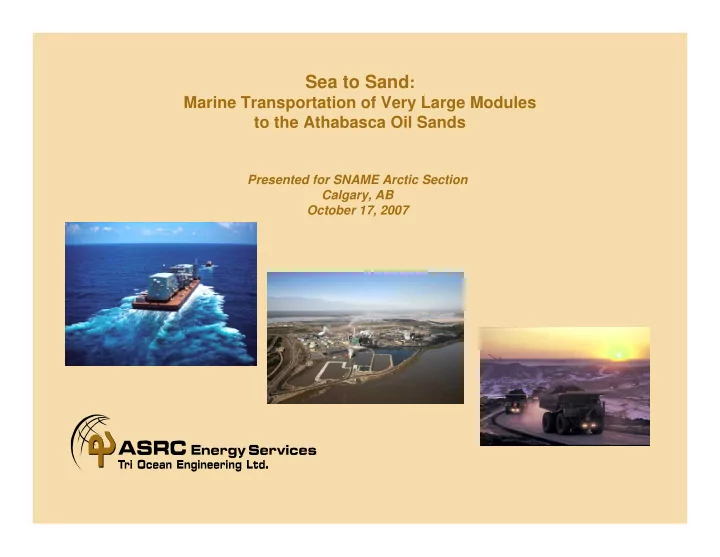
Sea to Sand : Marine Transportation of Very Large Modules to the Athabasca Oil Sands Presented for SNAME Arctic Section Calgary, AB October 17, 2007 Tri Oceans Credentials Tri Ocean is a full service EPCM contractor specialising in design

slide-1
SLIDE 1

Sea to Sand:

Marine Transportation of Very Large Modules to the Athabasca Oil Sands

Presented for SNAME Arctic Section Calgary, AB October 17, 2007

slide-2
SLIDE 2

Tri Ocean’s Credentials

Tri Ocean is a full service EPCM contractor specialising in design and construction of modularised onshore and

  • ffshore facilities for the oil and gas industry.

The company’s experience in designing and building major projects for remote, cold weather locations such as Arctic Russia, Norway, the Mackenzie Delta, Northern Alberta, North-eastern B.C. and Alaska, together with the expertise in transportation and logistics built around these projects, makes it uniquely qualified to undertake this study. Further information on Tri Ocean’s expertise and capabilities can be found at www.tri www.tri-

  • ocean.com
  • cean.com
slide-3
SLIDE 3

National Quality Institute recognizes Tri Ocean with Award for Excellence

Tri Ocean’s unflagging efforts to continually improve service delivery standards have been recognised by the National Quality Institute. Tri Ocean has received the 2007 Canada Awards for Excellence Bronze Award.

slide-4
SLIDE 4

Objective

Discuss integration of marine transportation

planning and engineering design of very large modules (1,000MT and greater) for future developments in the Athabasca Oil Sands

Discuss the key parameters of the marine route,

the typical marine equipment available for such an operation and the affect of these parameters

  • n engineering design and project capital cost
slide-5
SLIDE 5

Marine Transportation

Overview

Review design constraints

associated with the marine transportation route

Overview of applicable

marine equipment

Possible transportation

scenario

Discussion of module

design considerations

Next Steps

Presentation Overview

slide-6
SLIDE 6

Why Large Module Design?

slide-7
SLIDE 7

Optimization Considerations

A B C D

Heavy Lift Vessel River / Ocean Barges Permanent Road / Rail Transport Ice Road/ Transport

5 4 3 2 1

Module Size & Weight, Design & Layout Local/ Regional Content Infrastructure Requirements/ Logistics Constraints Module Transport / Schedule

I II III IV

50 tonne 500 tonne 1000 tonne 5000 tonne

Example Transport from Fabrication Sites Example Module Sizes Project Elements

Shop/Yard Fab/ Site Construction Productivities & Costs

slide-8
SLIDE 8

Developing the Athabasca Oil Sands

The current construction scenario for Athabasca Oil Sands

projects relies on a combination of module assembly on site or transportation of southerly constructed small modules by road and rail

These methods have some of the following drawbacks: high labour rates during the fabrication and on-site

hook-up

limited labor market module size is limited by transportation restrictions

slide-9
SLIDE 9

Developing the Athabasca Oil Sands – Marine Transport Option

Access to marine transportation allows Oil

Sands Projects to:

Take advantage of international fabrication market

rates

Reduce reliance on the stressed Canadian labor

market

Potential capital cost savings and improved project

schedule through application of Very Large Module Design

slide-10
SLIDE 10

Marine Transportation for Athabasca Oil Sands Projects

  • 1. Pacific Transportation
  • 2. Arctic Transportation
  • 3. River Transportation
slide-11
SLIDE 11

Pacific Transportation

Far East Fabrication

slide-12
SLIDE 12

Pacific Transportation

Gulf of Mexico Fabrication

slide-13
SLIDE 13

Pacific Transportation Design Parameters

Environmental criteria

Design sea state (ie. wind speed, wave height, wave period) Tropical storms Arctic ice-free season

Voyage route

Panama canal restrictions Draft limitations

Marine equipment

Transportation loads / accelerations Transit speed and duration Cargo capacity Stability Availability

slide-14
SLIDE 14

Arctic Transportation: Point Barrow to Mackenzie Bay

slide-15
SLIDE 15

Arctic Transit Design Parameters

  • Environmental criteria

Less severe design sea state (ie. wind speed, wave height, wave

period)

Arctic ice-free season

  • Marine equipment

Ice Breaker / Ice Management Vessel Air ice reconnaissance and surveillance program Ice monitoring and forecasting program Equipment selection and availability

  • Inside passage

Draft limitations (shallow water) 6 weeks long, typically starting August 1st 6 days dependent on ice concentration

  • Outside passage

No draft limitation (deeper water) 5 weeks long, typically starting August 15th 6 days dependent on ice concentration

slide-16
SLIDE 16

River Transportation

River Voyage Stage 1:

Beaufort Sea to Bell

Rock, NWT

River Voyage Stage 2:

Slave River rapids

portage

River Voyage Stage 3:

Fort Fitzgerald, AB to

Athabasca Oil Sands

slide-17
SLIDE 17

River Voyage Stage 1: Mackenzie River

Design Considerations

Ramparts and Sans

Sault rapids

Fort Providence

rapids

Deh Cho Bridge

restrictions

Marine equipment

selection and availability

slide-18
SLIDE 18

River Voyage Stage 1: Great Slave Lake / Lower Slave River

Design Considerations

Possible dredging

requirements in Res. Delta Channel

slide-19
SLIDE 19

River Voyage Stage 2: Slave River Rapids Portage

Design Considerations

Infrastructure

development at Bell Rock and Fort Fitzgerald

development of put-in and

take-out locations

upgrade of portage road

Availability of land

transportation equipment

Availability of marine

equipment on both sides

  • f portage
slide-20
SLIDE 20

Bell Rock to Fort Fitzgerald Portage

slide-21
SLIDE 21

1,200 TONNE MODULE ON ICEROAD 900 TONNE MODULE ON ALL-SEASON ROAD

Typical Land Transportation

slide-22
SLIDE 22

River Voyage Stage 3: Upper Slave River

slide-23
SLIDE 23

River Voyage Stage 3: Peace River and Quatre Fourche Channel to Athabasca Delta

Design Considerations

Quatre Fourches

Channel to Fort Chipewyan

Possible dredging

requirements in Athabasca Delta

slide-24
SLIDE 24

River Voyage Stage 3: Athabasca River

Design Considerations

Peter Lougheed

Bridge at Fort Mackay

Take out location and

land transportation to site

slide-25
SLIDE 25

Transportation Durations

15 – 30 Pacific Voyage: Dependent on fabrication yard selection and marine equipment selection 6 Arctic Voyage: Point Barrow to Mackenzie Bay Area 4 Stage 3: Fort Fitzgerald to Athabasca Oil Sands (Fort Mackay) 4 Stage 2: Slave River Rapids Portage 17 River Voyage Stage 1: Mackenzie River Delta to Bell Rock Days

  • River durations may be conservative, but are meant to account for expected delays along route due to

weather and river conditions.

slide-26
SLIDE 26

Conventional Marine Equipment

Pacific Transportation

Ocean Tugs Ocean Barges (ex. semi-submersible, deck cargo) Heavy Transportation Vessel

Arctic Transportation

Ice Breaker / Ice Management Vessel

River Transportation

River Tugs Inland Barges Purpose Built Barge (PBB)

slide-27
SLIDE 27

Heavy Transport Vessels

slide-28
SLIDE 28

Heavy Transport Vessels

slide-29
SLIDE 29

Heavy Transport Vessels “Float-on”, “Float-off”

slide-30
SLIDE 30

Semi - submersible Barges

slide-31
SLIDE 31

Ocean Deck Cargo Barges

slide-32
SLIDE 32

Inland Deck Cargo Barges

slide-33
SLIDE 33

Tugs

slide-34
SLIDE 34

Ice Management Vessels

slide-35
SLIDE 35

Why Large Module Design?

slide-36
SLIDE 36

Next Steps

slide-37
SLIDE 37

Optimization Study

Logistics Scope:

Identify logistics options and transport routes Determine associated maximum module weights, dimensions,

and allowable COG

Modularization / Engineering Scope:

Equipment list Grouping of equipment for different module size options Module density selection/equipment spacing requirements Conceptual level layouts Module weight prediction Preliminary structural design Weight and COG verification Cost, schedule, and execution risk evaluation

slide-38
SLIDE 38

Questions? Thanks…!