
SLIDE 1
02/06/2006 Trees 1
Trees
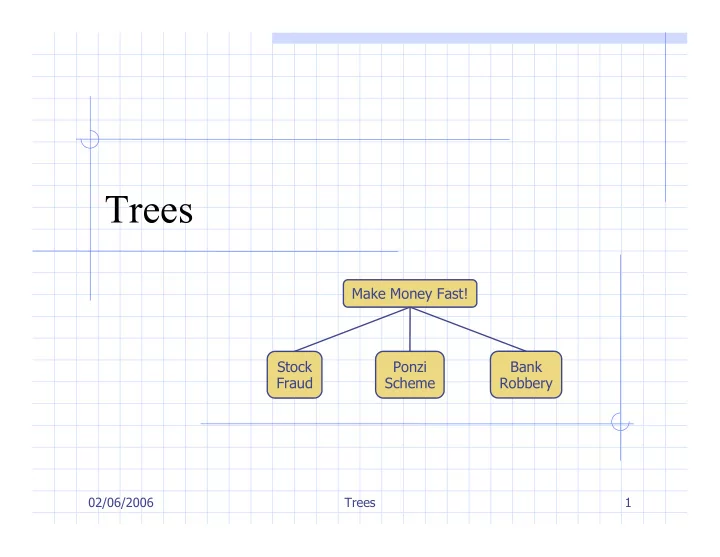
Make Money Fast! Stock Fraud Ponzi Scheme Bank Robbery
Trees Make Money Fast! Stock Ponzi Bank Robbery Fraud Scheme - - PowerPoint PPT Presentation
Trees Make Money Fast! Stock Ponzi Bank Robbery Fraud Scheme 02/06/2006 Trees 1 Outline and Reading Tree ADT (7.1.2) Preorder and postorder traversals (7.2.2-3) BinaryTree ADT (7.3.1) Inorder traversal (7.3.6) Euler Tour
02/06/2006 Trees 1
Make Money Fast! Stock Fraud Ponzi Scheme Bank Robbery
2/6/2006 Trees 2
2/6/2006 Trees 3
In computer science, a tree is an abstract model
structure A tree consists of nodes with a parent-child relation Applications:
Organization charts File systems Programming
environments
Computers”R”Us Sales R&D Manufacturing Laptops Desktops US International Europe Asia Canada
2/6/2006 Trees 4
Root: node without parent (A) Internal node: node with at least
External node (a.k.a. leaf ): node without children (E, I, J, K, G, H, D) Ancestors of a node: parent, grandparent, grand-grandparent, etc. Depth of a node: number of ancestors Height of a tree: maximum depth
Descendant of a node: child, grandchild, grand-grandchild, etc. Subtree: tree consisting of a node and its descendants
A B D C G H E F I J K
2/6/2006 Trees 5
We use positions to abstract nodes Generic methods:
integer size() boolean isEmpty()
positionIterator positions()
Accessor methods:
position root() position parent(p) positionIterator children(p)
Query methods:
boolean isInternal(p) boolean isExternal(p) boolean isRoot(p)
Update methods:
swapElements(p, q)
Additional update methods may be defined by data structures implementing the Tree ADT
2/6/2006 Trees 6
A traversal visits the nodes of a tree in a systematic manner In a preorder traversal, a node is visited before its descendants Application: print a structured document (like the cs16 book)
Make Money Fast!
References
2.1 Stock Fraud 2.2 Ponzi Scheme 1.1 Greed 1.2 Avidity 2.3 Bank Robbery
1 2 3 5 4 6 7 8 9
2/6/2006 Trees 7
In a postorder traversal, a node is visited after its descendants Application: compute space used by files in a directory and its subdirectories
cs16/ homeworks/ todo.txt 1K programs/ DDR.java 10K Stocks.java 25K h1c.doc 3K h1nc.doc 2K Robot.java 20K
9 3 1 7 2 4 5 6 8
2/6/2006 Trees 8
A binary tree is a tree with the following properties:
Each internal node has two
children
The children of a node are an
We call the children of an internal node left child and right child Alternative recursive definition: a binary tree is either
a tree consisting of a single node,
a tree whose root has an ordered
pair of children, each of which is a binary tree
Applications:
arithmetic expressions decision processes searching
A B C F G D E H I
2/6/2006 Trees 9
internal nodes: operators external nodes: operands
2/6/2006 Trees 10
internal nodes: questions with yes/no answer external nodes: decisions
Yes No Yes No Yes No
2/6/2006 Trees 11
n number of nodes e number of external nodes i number of internal nodes h height
e = i + 1 n = 2e − 1 h ≤
h ≤
e ≤ 2h h ≥ log2 e h ≥ log2 (n + 1) − 1
2/6/2006 Trees 12
position leftChild(p) position rightChild(p) position sibling(p)
2/6/2006 Trees 13
In an inorder traversal a node is visited after its left subtree and before its right subtree Application: draw a binary tree
x(v) = inorder rank of v y(v) = depth of v
3 1 2 5 6 7 9 8 4
2/6/2006 Trees 14
Specialization of an inorder traversal
when visiting node
subtree
subtree
2/6/2006 Trees 15
Specialization of a postorder traversal
recursive method returning
the value of a subtree
when visiting an internal
node, combine the values
Algorithm evalExpr(v) if isExternal (v) return v.element () else x ← evalExpr(leftChild (v)) y ← evalExpr(rightChild (v)) ◊ ← operator stored at v return x ◊ y
2/6/2006 Trees 16
Generic traversal of a binary tree Includes as special cases the preorder, postorder and inorder traversals Walk around the tree and visit each node three times:
from below (inorder)
L B R
2/6/2006 Trees 17
Generic algorithm that can be specialized by redefining certain steps Implemented by means of an abstract Java class Visit methods that can be redefined by subclasses Template method eulerTour
Recursively called on the
left and right children
A Result object with fields
leftResult, rightResult and finalResult keeps track of the output of the recursive calls to eulerTour
public abstract class EulerTour<E,R> { protected BinaryTree<E> tree; public abstract R execute(BinaryTree<E> t); protected void init(BinaryTree<E> t){ tree = t;} protected void visitLeft(Position<E> v, TourResult<R> r) { } protected void visitBelow(Position<E> v, TourResult<R> r){ } protected void visitRight(Position<E> v, TourResult<R> r) { } protected E eulerTour(Position<E> v) { TourResult<R> r = new TourResult<R>( ); visitLeft(v,r) ; if (tree.hasLeft(v)) r.left=eulerTour(tree.left(v)); visitBelow(v, r); if (tree.hasRight(v)) r.left=eulerTour(tree.right(v)); visitRight(v, r); return r.out; } …
2/6/2006 Trees 18
We show how to specialize class EulerTour to evaluate an arithmetic expression Assumptions
External nodes store
Integer objects
Internal nodes store
ExpressionOperator
method setOperands (Integer, Integer) and getValue()
public class EvaluateExpressionTour extends EulerTour<ExpressionTerm,Integer> { public Integer execute(BinaryTree<ExpressionTerm> T){ init(T); return eulerTour(tree.root()); } protected void visitRight(Position<ExpressionTerm> v, TourResult<Integer> r) { ExpressionTerm term = v.element(); if (tree.isInternal(v)){ ExpressionOperator op = (ExpressionOperator) term;
} r.out = term.getValue(); } } …
2/6/2006 Trees 19
A node is represented by an object storing
nodes
Node objects implement the Position ADT
B
A D F
C
E
2/6/2006 Trees 20
A node is represented by an object storing
Node objects implement the Position ADT
∅ ∅ ∅ ∅ ∅ ∅ ∅ ∅ ∅ ∅ B A D C E ∅
2/6/2006 Trees 21
Tree interface BinaryTree interface extending Tree Classes implementing Tree and BinaryTree and providing
Constructors Update methods Print methods
Examples of updates for binary trees
expandExternal(v) removeAboveExternal(w)
A ∅ ∅
expandExternal(v)
A C B B
removeAboveExternal(w)
A
2/6/2006 Trees 22
NDS4 is the Library of Data Structures in Java Tree interfaces in NDS4
CompleteBinaryTree BinaryTree Tree
Tree classes in JDSL
LinkedBinaryTree ArrayListCompleteBinaryTree AVLTree BinarySearchTree LinkedTree RBTree
NDS4 was developed at Brown and UC Irvine See the JDSL documentation and tutorials at http://net3.datastructures.net /doc4/index.html
LinkedTree LinkedBinaryTree Tree BinaryTree