Trees Overview We have discussed linear data structures Linear Vs - - PowerPoint PPT Presentation

trees overview
SMART_READER_LITE
LIVE PREVIEW

Trees Overview We have discussed linear data structures Linear Vs - - PowerPoint PPT Presentation

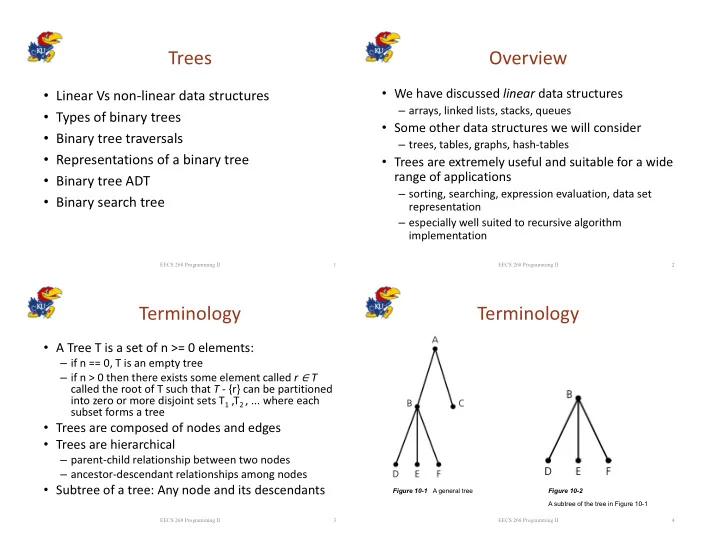
Trees Overview We have discussed linear data structures Linear Vs non-linear data structures arrays, linked lists, stacks, queues Types of binary trees Some other data structures we will consider Binary tree traversals


slide-1
SLIDE 1

Trees

Linear Vs non-linear data structures Types of binary trees Binary tree traversals Representations of a binary tree Binary tree ADT Binary search tree

EECS 268 Programming II 1

Overview

We have discussed linear data structures

arrays, linked lists, stacks, queues

Some other data structures we will consider

trees, tables, graphs, hash-tables

Trees are extremely useful and suitable for a wide range of applications

sorting, searching, expression evaluation, data set representation especially well suited to recursive algorithm implementation

EECS 268 Programming II 2

Terminology

A Tree T is a set of n >= 0 elements:

if n == 0, T is an empty tree if n > 0 then there exists some element called r T called the root of T such that T - {r} can be partitioned into zero or more disjoint sets T1 ,T2 , ... where each subset forms a tree

Trees are composed of nodes and edges Trees are hierarchical

parent-child relationship between two nodes ancestor-descendant relationships among nodes

Subtree of a tree: Any node and its descendants

3 EECS 268 Programming II

Terminology

4

Figure 10-1 A general tree Figure 10-2 A subtree of the tree in Figure 10-1

EECS 268 Programming II

slide-2
SLIDE 2

Terminology

Parent of node n

The node directly above node n in the tree

Child of node n

A node directly below node n in the tree

Root

The only node in the tree with no parent

Subtree of node n

A tree that consists of a child (if any) of node n

  • 5

EECS 268 Programming II

Terminology

Leaf

A node with no children

Siblings

Nodes with a common parent

Ancestor of node n

A node on the path from the root to n

Descendant of node n

A node on a path from n to a leaf

6 EECS 268 Programming II

A Binary Tree

A binary tree is a set T of nodes such that

T is empty, or T is partitioned into three disjoint subsets:

a single node r, the root two possibly empty sets that are binary trees, called the left subtree of r and the right subtree of r

Binary trees are ordered These trees are not equal

7 EECS 268 Programming II

A B B A R L

A General Tree & A Binary Tree

8 EECS 268 Programming II

slide-3
SLIDE 3

More Binary Trees

9

Figure 10-4 Binary trees that represent algebraic expressions

A Binary Search Tree

A binary search tree is a binary tree that has the following properties for each node n

subtree TL subtree TR both TL and TR are binary search trees

10 EECS 268 Programming II

The Height of Trees

Height of a tree

Number of nodes along the longest path from the root to a leaf Height 3 Height 5 Height 7

11

Figure 10-6 Binary trees with the same nodes but different heights

The Height of Trees

Level of a node n in a tree T

If n is the root of T, it is at level 1 If n is not the root of T, its level is 1 greater than the level of its parent

Height of a tree T defined in terms of the levels of its nodes

If T is empty, its height is 0 If T is not empty, its height is equal to the maximum level of its nodes

12 EECS 268 Programming II

slide-4
SLIDE 4

The Height of Trees

A recursive definition of height

If T is empty, its height is 0 If T is not empty, height(T) = 1 + max{height(TL), height(TR)} r / \ TL TR

13 EECS 268 Programming II

Full Binary Trees

A binary tree of height h is full if

Nodes at levels < h have two children each

Recursive definition

If T is empty, T is a full binary tree of height 0 If T is not empty and has height h > 0, T is a full

  • subtrees are both full

binary trees of height h 1

14

Figure 10-7 A full binary tree of height 3

Complete Binary Trees

A binary tree of height h is complete if

It is full to level h 1, and Level h is filled from left to right

15 EECS 268 Programming II

Complete Binary Trees

Another definition: A binary tree of height h is complete if

All nodes at levels <= h 2 have two children each, and When a node at level h 1 has children, all nodes to its left at the same level have two children each, and When a node at level h 1 has one child, it is a left child

16 EECS 268 Programming II

slide-5
SLIDE 5

Balanced Binary Trees

A binary tree is balanced if the heights of any

  • Complete binary trees are balanced

Full binary trees are complete and balanced

17 EECS 268 Programming II

Traversals of a Binary Tree

A traversal visits each node in a tree

to do something with or to the node during a visit for example, display the data in the node

General form of a recursive traversal algorithm

traverse (in binTree:BinaryTree)

if (binTree is not empty)

  • }

18 EECS 268 Programming II

Traversals of a Binary Tree

Preorder traversal

Visit root before visiting its subtrees

  • i. e. Before the recursive calls

Inorder traversal

Visit root between visiting its subtrees

  • i. e. Between the recursive calls

Postorder traversal

Visit root after visiting its subtrees

  • i. e. After the recursive calls

19 EECS 268 Programming II

Traversals of a Binary Tree

20

Figure 10-10 Traversals of a binary tree: (a) preorder; (b) inorder; (c) postorder

EECS 268 Programming II

slide-6
SLIDE 6

Traversals of a Binary Tree

A traversal operation can call a function to perform a task on each item in the tree

the client defines and passes this function as an argument to the traversal operation

Tree traversal orders correspond to algebraic expressions

infix, prefix, and postfix

21 EECS 268 Programming II

The ADT Binary Tree

+createBinaryTree() +createBinaryTree(in rootItem: TreeItemType) +createBinaryTree(in rootItem: TreeItemType, inout leftTree: BinaryTree, inout rightTree: BinaryTree) +destroyBinaryTree() +isEmpty(): boolean {query} +getRootData(): TreeItemType throw TreeException +setRootData(in newItem: TreeItemType) throw TreeException +attachLeft(in newItem: TreeItemType) throw TreeException +attachRight(in newItem: TreeItemType) throw TreeException +attachLeftSubtree(inout leftTree: BinaryTree) throw TreeException +attachRightSubtree(inout rightTree: BinaryTree) throw TreeException +detachLeftSubtree(out leftTree: BinaryTree) throw TreeException +detachRightSubtree(out rightTree: BinaryTree) throw TreeException +getLeftSubtree(): BinaryTree +getRightSubtree(): BinaryTree +preorderTraverse(in visit:FunctionType) +inorderTraverse(in visit:FunctionType) +postorderTraverse(in visit:FunctionType)

EECS 268 Programming II 22

The ADT Binary Tree

Building the ADT binary tree in Fig. 10-6b

  • tree2.attachLeftSubtree(tree1)
  • tree3.attachLeftSubtree(tree2)
  • 23

Possible Representations of a Binary Tree

An array-based representation

Uses an array of tree nodes Requires the creation of a free list that keeps track

  • f available nodes
  • nly suitable for complete binary trees

A pointer-based representation

Nodes have two pointers that link the nodes in the tree

24 EECS 268 Programming II

slide-7
SLIDE 7

Array Based Binary Tree

Given a complete binary tree T with n nodes, T can be represented using an array A[0:n-1] such that

root of T is in A[0] for node A[i], its left child is at A[2i+1] and its right child at A[2i+2] if it exists

Completeness of the tree is important because it minimizes the size of the array required Note that

parent of node A[i] is at A[(i-1)/2] for n > 1, A[i] is a leaf node iff n <= 2i

Balanced requirement makes an array representation unsuitable for binary search tree implementation

EECS 268 Programming II 25

Array Based Binary Tree

Complete tree fits in minimum size array

space efficient

Nodes do not need child or parent pointers

index of these can be calculated from the index of the current node

EECS 268 Programming II 26

A B C D E F G H I J A B C D E F G H I J

Array Based Binary Tree

Advantages

space saving through direct computation of child and parent indices rather than pointers O(1) access time through direct computation

pointers are also O(1) access but with larger K

Disadvantages

  • nly useful when tree is complete
  • r, complete enough that unused cells do not waste much memory

sparse tree representation is too memory intensive

If a complete tree is of height h, it requires an array of size 2h-1

a skewed BST of 10 nodes is of height 10, requiring an array of size 210-1 = 1023

EECS 268 Programming II 27

Pointer-based ADT Binary Tree

28

Figure 10-14 A pointer-based implementation of a binary tree

EECS 268 Programming II

slide-8
SLIDE 8

Pointer-based ADT Binary Tree

TreeException and TreeNode classes BinaryTree class

Several constructors, including a

Protected constructor whose argument is a pointer to a root node; prohibits client access Copy constructor that calls a private function to copy each node during a traversal of the tree

Destructor

29 EECS 268 Programming II

Binary Tree ADT TreeNode.h

// TreeNode.h typedef string TreeItemType; // node in the tree class TreeNode { private: TreeNode() {}; TreeNode(const TreeItemType& nodeItem, TreeNode *left = NULL, TreeNode *right = NULL): item(nodeItem), leftChildPtr(left), rightChildPtr(right) {} TreeItemType item; // data portion TreeNode *leftChildPtr; // pointer to left child TreeNode *rightChildPtr; // pointer to right child friend class BinaryTree; // friend class };

EECS 268 Programming II 30

Binary Tree ADT TreeException.h

// TreeException.h #include <stdexcept> #include <string> using namespace std; Class Tree Exception : public logic_error { public: TreeException(const logic_error(message.c_str()) {} };

EECS 268 Programming II 31

Binary Tree ADT BinaryTree.h

//Begin BinaryTree.h #include "TreeException.h" #include "TreeNode.h" // This function pointer is used by the client // to customize what happens when a node is visited typedef void (*FunctionType)(TreeItemType& anItem); class BinaryTree { public: // constructors and destructor: BinaryTree(); BinaryTree(const TreeItemType& rootItem); BinaryTree(const TreeItemType& rootItem, BinaryTree& leftTree, BinaryTree& rightTree); BinaryTree(const BinaryTree& tree); virtual ~BinaryTree();

EECS 268 Programming II 32

slide-9
SLIDE 9

Binary Tree ADT BinaryTree.h

// binary tree operations: virtual bool isEmpty() const; virtual TreeItemType getRootData() const throw(TreeException); virtual void setRootData(const TreeItemType& newItem) throw (TreeException); virtual void attachLeft(const TreeItemType& newItem) throw(TreeException); virtual void attachRight(const TreeItemType& newItem) throw(TreeException); virtual void attachLeftSubtree(BinaryTree& leftTree) throw(TreeException); virtual void attachRightSubtree(BinaryTree& rightTree) throw(TreeException); virtual void detachLeftSubtree(BinaryTree& leftTree) throw(TreeException); virtual void detachRightSubtree(BinaryTree& rightTree) throw(TreeException); virtual BinaryTree getLeftSubtree() const; virtual BinaryTree getRightSubtree() const; virtual void preorderTraverse(FunctionType visit); virtual void inorderTraverse(FunctionType visit); virtual void postorderTraverse(FunctionType visit);

EECS 268 Programming II 33

Binary Tree ADT BinaryTree.h

// overloaded assignment operator: virtual BinaryTree& operator=(const BinaryTree& rhs); protected: BinaryTree(TreeNode *nodePtr); // constructor // Copies the tree rooted at treePtr into a tree rooted // at newTreePtr. Throws TreeException if a copy of the // tree cannot be allocated. void copyTree(TreeNode *treePtr, TreeNode* & newTreePtr) const throw(TreeException);; // Deallocate memory for a tree. void destroyTree(TreeNode * &treePtr); // The next two functions retrieve and set the value // of the private data member root. TreeNode *rootPtr( ) const; void setRootPtr(TreeNode *newRoot);

EECS 268 Programming II 34

Binary Tree ADT BinaryTree.h

// The next two functions retrieve and set the values // of the left and right child pointers of a tree node. void getChildPtrs(TreeNode *nodePtr, TreeNode * &leftChildPtr, TreeNode * &rightChildPtr) const; void setChildPtrs(TreeNode *nodePtr, TreeNode *leftChildPtr, TreeNode *rightChildPtr); void preorder(TreeNode *treePtr, FunctionType visit); void inorder(TreeNode *treePtr, FunctionType visit); void postorder(TreeNode *treePtr, FunctionType visit); private: TreeNode *root; // pointer to root of tree }; // end class // End of header file. BinaryTree.h

EECS 268 Programming II 35

Binary Tree ADT BinaryTree.cpp

// Implementation file BinaryTree.cpp for the ADT binary tree. #include "BinaryTree.h" // header file #include <cstddef> // definition of NULL #include <cassert> // for assert() BinaryTree::BinaryTree() : root(NULL) { } BinaryTree::BinaryTree(const TreeItemType& rootItem) { root = new TreeNode(rootItem, NULL, NULL); assert(root != NULL); } BinaryTree::BinaryTree(const TreeItemType& rootItem, BinaryTree& leftTree, BinaryTree& rightTree) { root = new TreeNode(rootItem, NULL, NULL); assert(root != NULL); attachLeftSubtree(leftTree); attachRightSubtree(rightTree); }

EECS 268 Programming II 36

slide-10
SLIDE 10

Binary Tree ADT BinaryTree.cpp

BinaryTree::BinaryTree(const BinaryTree& tree) { copyTree(tree.root, root); } BinaryTree::BinaryTree(TreeNode *nodePtr): root(nodePtr) { } BinaryTree::~BinaryTree() { destroyTree(root); } bool BinaryTree::isEmpty() const { return (root == NULL); } TreeItemType BinaryTree::getRootData() const { if (isEmpty()) throw TreeException("TreeException: Empty tree"); return root>item; }

EECS 268 Programming II 37

Binary Tree ADT BinaryTree.cpp

void BinaryTree::setRootData(const TreeItemType& newItem) { if (!isEmpty()) { root>item = newItem; } else { root = new TreeNode(newItem, NULL, NULL); if (root == NULL) throw TreeException("TreeException: Cannot allocate memory"); } } void BinaryTree::attachLeft(const TreeItemType& newItem) { if (isEmpty()) { throw TreeException("TreeException: Empty tree"); } else if (root>leftChildPtr != NULL) { throw TreeException("TreeException: Cannot overwrite left subtree"); } else { // Assertion: nonempty tree; no left child root>leftChildPtr = new TreeNode(newItem, NULL, NULL); if (root>leftChildPtr == NULL) throw TreeException("TreeException: Cannot allocate memory"); } }

EECS 268 Programming II 38

Binary Tree ADT BinaryTree.cpp

void BinaryTree::attachRight(const TreeItemType& newItem) { if (isEmpty()) throw TreeException("TreeException: Empty tree"); else if (root>rightChildPtr != NULL) throw TreeException("TreeException: Cannot overwrite right subtree"); else { // Assertion: nonempty tree; no right child root>rightChildPtr = new TreeNode(newItem, NULL, NULL); if (root>rightChildPtr == NULL) throw TreeException("TreeException: Cannot allocate memory"); } } void BinaryTree::attachLeftSubtree(BinaryTree& leftTree) { if (isEmpty()) throw TreeException("TreeException: Empty tree"); else if (root>leftChildPtr != NULL) throw TreeException("TreeException: Cannot overwrite left subtree"); else { // Assertion: nonempty tree; no left child root>leftChildPtr = leftTree.root; leftTree.root = NULL; } }

EECS 268 Programming II 39

Binary Tree ADT BinaryTree.cpp

void BinaryTree::attachRightSubtree(BinaryTree& rightTree) { if (isEmpty()) throw TreeException("TreeException: Empty tree"); else if (root>rightChildPtr != NULL) throw TreeException("TreeException: Cannot overwrite right subtree"); else { // Assertion: nonempty tree; no right child root>rightChildPtr = rightTree.root; rightTree.root = NULL; } } void BinaryTree::detachLeftSubtree(BinaryTree& leftTree) { if (isEmpty()) throw TreeException("TreeException: Empty tree"); else { leftTree = BinaryTree(root>leftChildPtr); // constructor taking node * not tree * root>leftChildPtr = NULL; } }

EECS 268 Programming II 40

slide-11
SLIDE 11

Binary Tree ADT BinaryTree.cpp

void BinaryTree::detachRightSubtree(BinaryTree& rightTree) { if (isEmpty()) throw TreeException("TreeException: Empty tree"); else { rightTree = BinaryTree(root>rightChildPtr); // node * to tree conversion root>rightChildPtr = NULL; // this tree no longer holds that subtree } } BinaryTree BinaryTree::getLeftSubtree() const { TreeNode *subTreePtr; if (isEmpty()) return BinaryTree(); else { copyTree(root>leftChildPtr, subTreePtr); return BinaryTree(subTreePtr); } }

EECS 268 Programming II 41

Binary Tree ADT BinaryTree.cpp

BinaryTree BinaryTree::rightSubtree() const { TreeNode *subTreePtr; if (isEmpty()) return BinaryTree(); else { copyTree(root>rightChildPtr, subTreePtr); return BinaryTree(subTreePtr); } } void BinaryTree::preorderTraverse(FunctionType visit) { preorder(root, visit); // preorder written with respect to a tree ptr } void BinaryTree::inorderTraverse(FunctionType visit) { inorder(root, visit); }

EECS 268 Programming II 42

Binary Tree ADT BinaryTree.cpp

void BinaryTree::postorderTraverse(FunctionType visit) { postorder(root, visit); } BinaryTree& BinaryTree::operator=(const BinaryTree& rhs) { if (this != &rhs) { destroyTree(root); // deallocate lefthand side copyTree(rhs.root, root); // copy righthand side } return *this; } void BinaryTree::destroyTree(TreeNode *& treePtr) { if (treePtr != NULL) { destroyTree(treePtr>leftChildPtr); destroyTree(treePtr>rightChildPtr); delete treePtr; // postorder traversal treePtr = NULL; } }

EECS 268 Programming II 43

Binary Tree ADT BinaryTree.cpp

void BinaryTree::copyTree(TreeNode *treePtr, TreeNode *& newTreePtr) const { // preorder traversal if (treePtr != NULL) { // copy node newTreePtr = new TreeNode(treePtr>item, NULL, NULL); if (newTreePtr == NULL) throw TreeException("TreeException: Cannot allocate memory"); copyTree(treePtr>leftChildPtr, newTreePtr>leftChildPtr); copyTree(treePtr>rightChildPtr, newTreePtr>rightChildPtr); } else newTreePtr = NULL; // copy empty tree } TreeNode *BinaryTree::rootPtr() const { return root; }

EECS 268 Programming II 44

slide-12
SLIDE 12

Binary Tree ADT BinaryTree.cpp

void BinaryTree::setRootPtr(TreeNode *newRoot) { root = newRoot; } void BinaryTree::getChildPtrs(TreeNode *nodePtr, TreeNode *& leftPtr, TreeNode *& rightPtr) const { leftPtr = nodePtr>leftChildPtr; rightPtr = nodePtr>rightChildPtr; } void BinaryTree::setChildPtrs(TreeNode *nodePtr, TreeNode *leftPtr, TreeNode *rightPtr) { nodePtr>leftChildPtr = leftPtr; nodePtr>rightChildPtr = rightPtr; }

EECS 268 Programming II 45

Binary Tree ADT BinaryTree.cpp

void BinaryTree::preorder(TreeNode *treePtr, FunctionType visit) { if (treePtr != NULL) { visit(treePtr>item); preorder(treePtr>leftChildPtr, visit); preorder(treePtr>rightChildPtr, visit); } } void BinaryTree::inorder(TreeNode *treePtr, FunctionType visit) { if (treePtr != NULL) { inorder(treePtr>leftChildPtr, visit); visit(treePtr>item); inorder(treePtr>rightChildPtr, visit); } }

EECS 268 Programming II 46

Binary Tree ADT BinaryTree.cpp

void BinaryTree::postorder(TreeNode *treePtr, FunctionType visit) { if (treePtr != NULL) { postorder(treePtr>leftChildPtr, visit); postorder(treePtr>rightChildPtr, visit); visit(treePtr>item); } } // End of implementation file.

EECS 268 Programming II 47

Binary Tree ADT Client Code

// Example client code #include <iostream> #include "BinaryTree.h" using namespace std; void display(TreeItemType& anItem); int main() { BinaryTree tree1, tree2, left; // tree with only a root 70 BinaryTree tree3(70); // build the tree in Figure 10-10 tree1.setRootData(40); tree1.attachLeft(30); tree1.attachRight(50);

EECS 268 Programming II 48

tree2.setRootData(20); tree2.attachLeft(10); tree2.attachRightSubtree(tree1); // tree in Fig 10-10 BinaryTree binTree(60, tree2, tree3); binTree.inorderTraverse(display); binTree.getLeftSubtree().inorderTraverse (display); binTree.detachLeftSubtree(left); left.inorderTraverse(display); binTree.inorderTraverse(display); return 0; } // end main

slide-13
SLIDE 13

Pointer-based ADT Binary Tree: Tree Traversals

BinaryTree class (continued)

Public methods for traversals so that visiting a node remains

  • void inorderTraverse(FunctionType visit);

typedef void (*FunctionType)(TreeItemType& item); Protected methods, such as inorder, that enable the recursion void inorder(TreeNode *treeptr, FunctionType visit); inorderTraverse calls inorder, passing it a node pointer and the client-defined function visit

49 EECS 268 Programming II

Recursive Inorder Traversal

50 EECS 268 Programming II

Nonrecursive Inorder Traversal

An iterative method and an explicit stack can mimic the actions

  • f a return from a

recursive call to inorder

51

Figure 10-16 Traversing (a) the left and (b) the right subtrees of 20

Copying a Binary Tree

To copy a tree

traverse it in preorder insert each item visited into a new tree use in copy constructor

To deallocate a tree

traverse in postorder delete each node visited use in destructor

EECS 268 Programming II 52

slide-14
SLIDE 14

The ADT Binary Search Tree

The ADT binary tree is not suitable when you need to search for a particular item

binary search tree (BST) is more suitable

A data item in a BST has specially designated search key

search key is the part of a record that identifies it within a collection of records

Assume that the set of all keys can be linearly ordered

a comparison function for two keys cmp(k2, k2) distinguishes 3 cases: (1) k1 < k2, (2) k1 == k2, or (3) k1 > k2

If we use a binary search tree to organize the set of records, then each record must be a node in the tree

Record is a class instance held by tree node Record field is a member variable Key is the record field used as search tag

53 EECS 268 Programming II

Binary Search Trees

Binary tree H such that key of any node x, key(x), is greater than the keys of all nodes in its left subtree and is less than or equal to keys of all nodes in its right sub- tree

  • ften called the BST property

Equal elements could as easily be in the left subtree

but some standard definition is required!

EECS 268 Programming II 54

X < >= 6 2 1 4 7 9 7 4 6 5

Binary Search Trees Observations

BST may not be a balanced binary tree

choice of root node is important with respect to the set of all key values present in the tree

Leftmost descendant of root = minimum item Rightmost descendant of root = maximum item Inorder traversal of BST = sorted key order BST strongly analogous to binary search of an array in sorted order Pointer based implementation dynamically allocating tree nodes is the most obvious approach

nodes are wrappers for records, might point to records BST template would use record type as parameter

EECS 268 Programming II 55

The ADT Binary Search Tree

Simple BST API

similar to 10-18 in book

Assumes method RecordT.get_key( ) exists for all possible record types Logic of BST find( ) closely resembles binary search in an array Logic of insertion is essentially search for the right place for the inserted record in the tree

EECS 268 Programming II 56

class BST { public: BST(); ~BST(); boolean is_empty(); boolean insert( RecordT& r); RecordT* find( KeyT key); boolean delete(KeyT key); void preorder(); void inorder(); void postorder(); private: BST_Node *lchild; BST_Node *rchild; RecordT *record; };

slide-15
SLIDE 15

ADT Binary Search Tree find

find the record with search key skey first checks the current node and then recursively searches the relevant subtree if it exists If relevant subtree does not exist, the search has fails

57 EECS 268 Programming II

RecordT * BST::find(const KeyT& skey) { if ( record == NULL ) { return(NULL); } else if ( record>get_key() == skey ) { return(record); // key found } else if ( record>get_key() > skey ) { // search left tree if ( lchild == NULL ) { return(NULL); } return(lchild>find(skey)); } else { // search right tree if ( rchild == NULL ) { return(NULL); } return(rchild>find(skey)); } }

ADT Binary Search Tree: Insertion

BST::insert() method looks for proper place and adds the record in the right spot

insert 7, 3, 1, 8, 13 15, 6, 9, 10 using this algorithm

58 EECS 268 Programming II

boolean BST::insert(constRecordT& inr) { if ( record == NULL ) { // This will be the first record in empty tree record = &inr; return True; } else if ( inr>get_key() < record>get_key() ) { if ( lchild == NULL ) lchild = new BST; return(lchild>insert(inr)); } else { if ( rchild == NULL ) rchild = new BST; return(rchild>insert(inr)); } }

ADT Binary Search Tree: Insertion

59

Figure 10-23 (a) Insertion into an empty tree; (b) search terminates at a leaf; (c) insertion at a leaf

EECS 268 Programming II

ADT Binary Search Tree Delete

Delete operation on node N is a bit more complicated If N is a leaf

both lchild and rchild are NULL parent node pointer referring to N should be set to NULL

need a pointer to parent node to do this

If N has only 1 child

replace N with its only child

If N has two children

replace N with minimum item of its right subtree

EECS 268 Programming II 60

slide-16
SLIDE 16

ADT Binary Search Tree: Delete

Deleting the item in node N when N has two children (continued)

locate another node M that is easier to delete

M will have no more than one child search key

copy the item that is in M to N remove the node M from the tree

61 EECS 268 Programming II

ADT Binary Search Tree: Delete

Deleting node x is simple because it has only one child and can be replaced by the root of its child without violating any of the BST constraints Deleting R is harder, but c can replace it because it is the smallest (leftmost) element of the right sub-tree

EECS 268 Programming II 62

R Y X C R Y C C Y

ADT Binary Search Tree: Delete

Delete 3, 7, 8 in order

EECS 268 Programming II 63

6 7 6 3 6 8 6 13 6 9 6 15 6 10 6 1 6 6 6 7 6 6 6 8 6 13 6 9 6 15 6 10 6 1 6 8 6 3 6 13 6 9 6 15 6 10 6 1 6 6 6 9 6 3 6 13 6 10 6 15 6 1 6 6

ADT Binary Search Tree: Retrieval and Traversal

The retrieval operation can be implemented by refining the search algorithm

return the item with the desired search key if it exists

  • therwise, throw TreeException

Traversals for a binary search tree are the same as the traversals for a binary tree Theorem 10-1

the inorder traversal of a binary search tree T will visit its nodes in sorted search-key order

64 EECS 268 Programming II

slide-17
SLIDE 17

Height of a Binary Tree

Theorem 10-2

A full binary tree of height h 0 has 2h 1 nodes

Theorem 10-3

The maximum number of nodes that a binary tree of height h can have is 2h 1

Theorem 10-4

The minimum height of a binary tree with n nodes is log2(n+1) Complete trees and full trees have minimum height

The maximum height of a binary tree with n nodes is n

65 EECS 268 Programming II

Height of a Binary Tree

66

Figure 10-32 Counting the nodes in a full binary tree of height h

The Efficiency of Binary Search Tree Operations

The maximum number of comparisons required by any b. s. t. operation is the number of nodes along the longest path from root to a leaf The order in which insertion and deletion

  • perations are performed on a binary search

tree affects its height Insertion in random order produces a binary search tree that has near-minimum height

67 EECS 268 Programming II

The Efficiency of Binary Search Tree Operations

68

Figure 10-34 The order of the retrieval, insertion, deletion, and traversal operations for the pointer-based implementation of the ADT binary search tree

EECS 268 Programming II

slide-18
SLIDE 18

Saving and Restoring a BST

Saving/restoring any data structure to/from a file requires us to serialize the data structure files store data linearly arrays and linked lists are linear

69 EECS 268 Programming II

6 7 6 3 6 8 6 13 6 9 6 15 6 10 6 1 6 6

Preorder, postorder and inorder traversals produce a linear tree listings

what order makes restoration easiest?

Preorder: 7,3,1,6,8,13,9,10,15 Insert nodes in an empty BST in this order and it reproduces the original

Applications

Treesort

Uses the ADT binary search tree to sort an array of records into search-key order

Average case: O(n * log n) Worst case: O(n2)

70 EECS 268 Programming II

n-ary Trees

An n-ary tree is a general tree whose nodes can have no more than n children each

a generalization of a binary tree

71

Figure 10-38 A general tree Figure 10-41 An implementation of the n-ary tree in Figure 10-38

n-ary Trees

A binary tree can represent an n-ary tree

seems a bit odd, but good when the number of children is highly variable and especially when there is no upper bound

  • n the number of children

Lchild is used to point to the first of its children

Rchild pointers are used to link siblings together

72

Figure 10-39 Another implementation of the tree in Figure 10-38 Figure 10-40 The binary tree that Figure 10-39 represents

slide-19
SLIDE 19

Summary

Binary trees provide a hierarchical organization of data The implementation of a binary tree is usually pointer-based If the binary tree is complete, an efficient array- based implementation is possible that is, do something to or witheach node is useful You pass a client- traversal operation to customize its effect on the items in the tree

73 EECS 268 Programming II

Summary

The binary search tree allows you to use a binary search-like algorithm to search for an item having a specified value Binary search trees come in many shapes

The height of a binary search tree with n nodes can range from a minimum of log2(n + 1) to a maximum of n The shape of a binary search tree determines the efficiency of its operations

74 EECS 268 Programming II

Summary

An inorder traversal of a binary search tree

  • key
  • rder

The treesort algorithm efficiently sorts an

  • insertion and traversal operations

75 EECS 268 Programming II

Summary

Saving a binary search tree to a file while performing

An inorder traversal enables you to restore the tree as a binary search tree of minimum height A preorder traversal enables you to restore the tree to its original form

76 EECS 268 Programming II