Translational Research From Laboratory to Marketplace: University - - PowerPoint PPT Presentation

translational research from laboratory to marketplace
SMART_READER_LITE
LIVE PREVIEW

Translational Research From Laboratory to Marketplace: University - - PowerPoint PPT Presentation

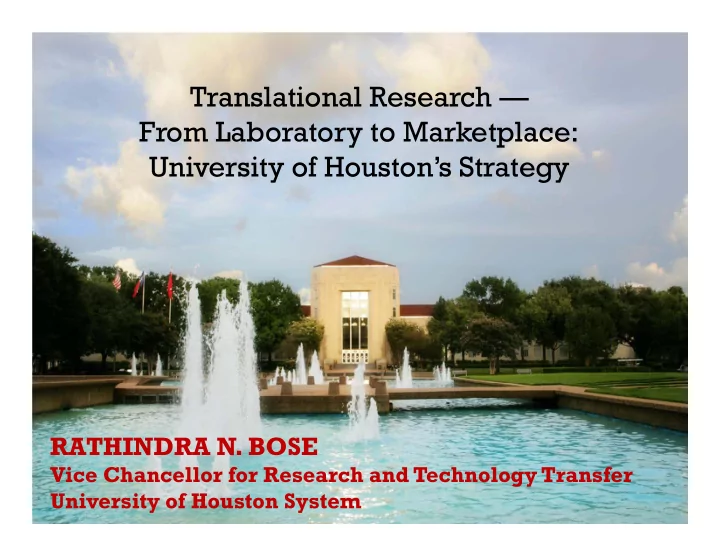
Translational Research From Laboratory to Marketplace: University of Houstons Strategy RATHINDRA N. BOSE Vice Chancellor for Research and Technology Transfer 1 University of Houston System Division of Research Functions Strategic


slide-1
SLIDE 1

1

RATHINDRA N. BOSE

Vice Chancellor for Research and Technology Transfer University of Houston System

Translational Research —― From Laboratory to Marketplace: University of Houston’‚s Strategy

slide-2
SLIDE 2

Division of Research Functions Structures

Strategic investment & Fostering multidisciplinary research Securing and managing external grants and contracts Economic development through translational research

  • Pre-Award
  • Post-Award
  • Compliance
  • Animal Care
  • Technology

Commercialization

  • Centers and

Institutes

slide-3
SLIDE 3

Productivity at a Glance FY 2011

Harold Kohn, Diana Chow, Alexandre Freundlich, Paul Chu, Venkat Selvamanickam

Inventors (over $100,000)

1,386 478 482 49 proposal submitted awards managed IRB protocol reviewed IACUC protocol reviewed 47 29 25 141 42 15 16 invention disclosed provisional patents filed utility patents filed active U.S. patents issued active licenses active startups revenue sources

slide-4
SLIDE 4

HEART OF ACADEMIC INSTITUTIONS CREATOR OF:

  • New knowledge
  • New technology
  • Tomorrow’s Scholars
  • New world

THE CAPITAL OF KNOWLEDGE-BASED ECONOMY

Ever-expanding Faculty Roles

slide-5
SLIDE 5

Security Prosperity Health Sustainability Jobs

  • Prepare highly skilled and

educated citizens

  • Create new knowledge

(understanding, ideas, innovation)

  • Create jobs
  • Technologies
  • Processes
  • Products
  • Contribute to economic growth and

global competitiveness Benefits to the nation and world

Source: Part from ASTRA

Institutions are knowledge capitals

The University: An Economic Engine!

slide-6
SLIDE 6

Major Functions: Technology Transfer and Economic Development Manage Patent Portfolio License Intellectual Property Start-up companies

Liaison with regional economic planning and development

  • rganization
slide-7
SLIDE 7

Stages of Technology Transfer

Source: The Ohio Third Frontier Program

Imagining

the Commercial Opportunity

Incubating

to Define Commercial Potential

Demonstr- ating

Products & Processes in Commercial Context

Market Entry

to Prove Commercial Viability

Growth &

Sustainability

to Generate Financial Returns

  • Mobilizing

Resources for Incubating

  • Mobilizing

Resources for Demonstrating

  • Mobilizing

Resources for Market Entry

  • Mobilizing

Resources for Growth & Sustainability

slide-8
SLIDE 8

Letter signed by 135 Presidents/Chancellors, including Chancellor Khator.

slide-9
SLIDE 9

Re-engineer Tech Transfer Operations

  • Invest to create prototypes

(valley of death!)

  • Expedite transfer of laboratory research to market place

(support faculty entrepreneurs, develop partnership with industries, create advisory board, explore IP assignment to research park)

  • Pursue aggressive licensing agenda

(adopt sound marketing strategies)

  • Expand IP portfolios

(hold regular workshops, seminars by successful faculty role models, rewards)

  • Attract venture capitals for new spin-off companies

(Organize tech shows, invite venture capitalists, publicize success stories etc.)

  • Enhance public-private partnership in pursuing marketable research

projects

slide-10
SLIDE 10

Memoranda of understanding parties scope of work responsibilities timelines deliverables

Balancing the Need for an Open Science Regime vs. the Desire for Confidentiality and Exclusivity

IP agreements

  • wnership

patenting licensing rights confidentiality/ publishing rights

slide-11
SLIDE 11

Industry Reasons for Participating in Partnerships:

  • Access to new research
  • Development of new products
  • Maintaining a relationship with the university
  • Obtaining new patents
  • Solving technical problems
  • Viewed as less important: Improving products and recruiting students

University Reasons:

  • Obtaining funding for research assistants, lab equipment and research
  • Obtaining insights into their research by field testing theory and empirical

research

  • Viewed as less important: Acquiring practical knowledge useful for teaching,

student internships and job placement, and obtaining patentable inventions and business opportunities.

Source: Lee, Y.S. (2000) The Sustainability of University-Industry Research Collaboration. J. Tech. Transfer, 25(2), 111-133.

Conflicting Views: Differences in Motives, Processes and Working Practices

slide-12
SLIDE 12

Technology Foundation & Incubator Valuation & Market Analysis Technology-Specific Teams Development Work Faculty’s Lab

Market Entry Company Formation License Out

Proceeds

Technology Commercialization Ecosystem

IP Assignment Proceeds

slide-13
SLIDE 13

Expected Benefits

  • Increased Research Expenditure
  • Increased Royalty Revenue
  • Increased Postdoctoral Appointments
  • Increased Translational Research
  • Recruitment of Entrepreneurial Faculty
  • Creation of Jobs
slide-14
SLIDE 14
  • 1. Total Research Expenditures
  • 2. Federal Research Expenditures
  • 3. National Academy Membership
  • 4. Faculty Awards
  • 5. Doctorates Awarded
  • 6. Postdoctoral Appointees
  • 7. National Merit and Achievement Scholars
  • 8. Endowment Assets
  • 9. Annual Giving

10.SAT Scores

Source: The Center: The Top American Research Universities

Ten Measures for Top 50 U.S. Universities

slide-15
SLIDE 15

Thank you.