Transitions Pathways and Risk Analysis for Climate Change Mitigation - - PowerPoint PPT Presentation

transitions pathways and risk analysis for climate change
SMART_READER_LITE
LIVE PREVIEW

Transitions Pathways and Risk Analysis for Climate Change Mitigation - - PowerPoint PPT Presentation

Transitions Pathways and Risk Analysis for Climate Change Mitigation and Adaptation Strategies TRANS RISK P ARTNERSHIP : W HO WE ARE 12 partners 70+ researchers Interdisciplinary team R ESEARCH Q UESTIONS Overarching Research Question


slide-1
SLIDE 1

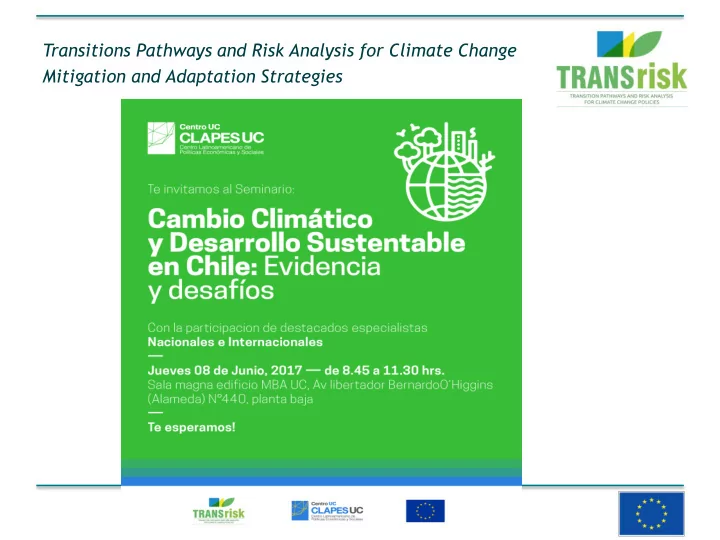
Transitions Pathways and Risk Analysis for Climate Change Mitigation and Adaptation Strategies

slide-2
SLIDE 2

TRANS RISK PARTNERSHIP: W HO WE ARE

  • 12 partners
  • 70+ researchers
  • Interdisciplinary

team

slide-3
SLIDE 3

R ESEARCH Q UESTIONS

Overarching Research Question (RQ): What are the costs, benefits and risks & uncertainties associated with transitions pathways for climate change mitigation policies?

  • RQ1. How should the future look like and how might we get there?
  • RQ2. What changes are required for us to get to our desired future(s)?
  • RQ3. What are the policy options based on the (sub/national) context?
slide-4
SLIDE 4

C ASE S TUDY C OUNTRIES: A REAS STUDIED

Americas

  • 1. Canada

(SPRU)

  • 2. Chile

(CLAPESUC)

Europe

  • 3. Sweden (SEI)
  • 4. Netherlands (JIN)
  • 5. UK (SPRU)
  • 6. Poland (IBS)
  • 7. Austria (Uni Graz)
  • 8. Switzerland (ETHZ)
  • 9. Spain (BC3)
  • 10. Greece (NTUA/ UPRC)

Africa

  • 11. Kenya (SEI)

Asia

  • 12. China (SPRU)
  • 13. India (SPRU)
  • 14. Indonesia

(SEI)

slide-5
SLIDE 5

5

Global overview

(risk & uncertainty in climate change policies)

Regional

  • verview

National overview

Base line scenario Current pathways Potential scenarios

Energy Policy

Consumer behaviour (demand) Demand side policies Energy Technology (supply): Resource base policies Supply (energy, electricity) policies

Interactions with other policies areas

Food, building, transport, services (healthcare, education), & manufacturing Consumer behaviour Demand policies Firm behaviour Supply policies

  • FirInterdisciplinary, cross perspective, multi-level perspective
slide-6
SLIDE 6

How can science, technology and innovation and [behavioural change] contribute to the implementation of the goals of Sustainable Development?

PART I: SUSTAINABLE DEVELOPMENT GOALS

Source: https://sustainabledevelopment.un.org/sdgs

slide-7
SLIDE 7

What kind of relationships have been analysed between renewable energy policies and the SDGs?

  • There will be synergies, conflicts, trade-offs in meeting Sustainable

Development Goals

PART I: S USTAINABLE D EVELOPMENT G OALS

Technological, socio-economical perspective: commonly analysed Behavioural change ?? Energy justice ?? Governance ???

slide-8
SLIDE 8

#7 SDG: A FFORDABLE AND CLEAN ENERGY

Global Energy Research Expenditures in the Organization of Economic Cooperation and Development, 1974–2014 (Millions of U.S. Dollars)

Source: IEA, 2016 quoted in Sovacool, B. 2017. Reviewing, Reforming, and Rethinking Global Energy Subsidies: Towards a Political Economy Research

  • Agenda. Ecological Economics. 135 pp. 150–163

What types of science technology and innovations are supported globally?

slide-9
SLIDE 9

Transitions Pathways and Risk Analysis for Climate Change Mitigation and Adaptation Strategies