Transition - Transfer Process - Prepare at time Transition - - PowerPoint PPT Presentation

transition transfer process prepare at time
SMART_READER_LITE
LIVE PREVIEW

Transition - Transfer Process - Prepare at time Transition - - PowerPoint PPT Presentation

4/21/2018 1982 Transitioning Pediatric PH to Adult care 1992 Tilman Humpl, MD, PhD The Hospital for Sick Children, Toronto Critical Care Medicine and Cardiology Director, Pulmonary Hypertension Service 1993 Transition - Transfer Process -


slide-1
SLIDE 1

4/21/2018 1

Transitioning Pediatric PH to Adult care

Tilman Humpl, MD, PhD

The Hospital for Sick Children, Toronto Critical Care Medicine and Cardiology Director, Pulmonary Hypertension Service 1982 1992 1993
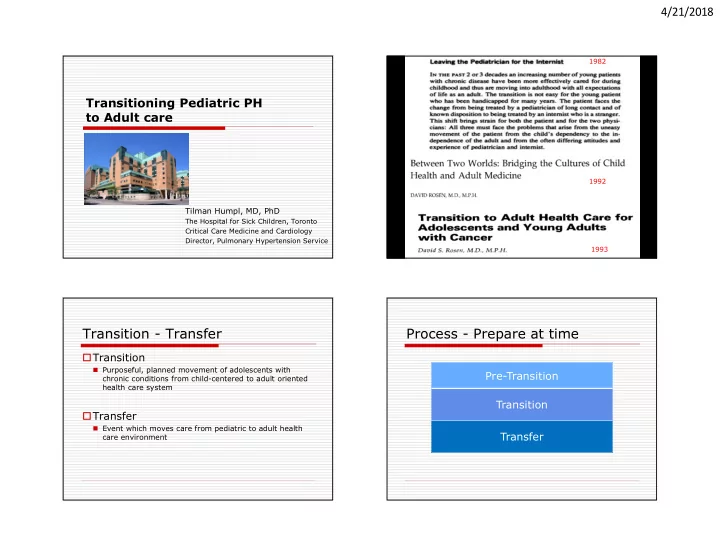
Transition - Transfer

Transition

 Purposeful, planned movement of adolescents with chronic conditions from child-centered to adult oriented health care system

Transfer

 Event which moves care from pediatric to adult health care environment

Process - Prepare at time

Pre-Transition Transition Transfer

slide-2
SLIDE 2

4/21/2018 2

Differences

Pediatrics Focus on

 Growth  Development

Information directed towards parents/guardians Adult Partnership with patient Information directed to patient

Problems

 Anxiety – caregivers and patients

 Different environment  Different health care providers  Different frequency of visits  Different procedures  Different treatment

 Transfer of medical records

 Incomplete  Delayed

 Registering at new institution/timely first appointment

slide-3
SLIDE 3

4/21/2018 3

Transition Workshop

slide-4
SLIDE 4

4/21/2018 4

Transition Workshop

11:00 – 11:15 Meet and Greet 11:15 – 11:30 Welcome - Agenda 11:30 – 11:50 Good 2 Go 11:50 – 12:10 Adult PH Program 12:10 – 12:30 Introduction of Adult team

University Health Network

Adult Pulmonary hypertension team

Transition Workshop

11:00 – 11:15 Meet and Greet 11:15 – 11:30 Welcome - Agenda 11:30 – 11:50 Good 2 Go 11:50 – 12:10 Adult PH Program 12:10 – 12:30 Introduction of Adult team 12:30 – 13:00 Break Out Sessions: Parents – Teens 13:00 – 13:30 Wrap Up, Tour at Toronto General Hospital 13:30 – 14:00 My Health passport, Certificate

slide-5
SLIDE 5

4/21/2018 5

Transition Clinic

 Adult team comes to Sickkids  Patient/parents  Advantage

 History/current treatment reviewed  Next appointment clearly scheduled  No major changes to be expected

Good bye!

slide-6
SLIDE 6

4/21/2018 6

slide-7
SLIDE 7

4/21/2018 7

Problem Statement

  • There is a mismatch between the number of adult PH Centres and

pediatric PH Centres (many possible routes for transition creates complexity)

  • Some adolescents are not effectively transitioned (arrive at adult

centre unprepared/with inappropriate expectations)

  • Some never arrive to the first adult appointment
  • Some are lost to follow-up after the first adult appointment
  • Some are at risk of PH and not effectively monitored

Introducing the PAH Centre and Clinic

 Our team

 Meet Our Admin Assistant  Meet Our Doctors  Meet Our Nurses

 About appointments

 What to bring to an appointment

 Other information…  Our environment

 Hospital entrance  Check-In Desk  Our floor  Floor plan of Clinic  The Check-In Desk  An exam room  Where echos happen…  Where caths happen…

“Checklist”

 Introduce PHA Canada  Assess knowledge about PH – evaluate gaps  Age appropriate education material  Introduce messages about care in adult facilities  Involve patient in scheduling appointments  Explore emotional status about transition/transfer  Consent for medical record transfer  Ensure 1st appointment is made at adult PH center  Confirm that 1st visit has happened at adult PH center

Transfer of care - UHN

Pulmonary hypertension without cardiac defect Pulmonary hypertension with cardiac defect Pulmonary hypertension program Respiratory Medicine Adult CHD program Cardiology

Family physician

slide-8
SLIDE 8

4/21/2018 8

Take home

Transition/Transfer is important Continuous process – needs preparation One model does not fit all Tailor to local environment

Lifestyle

 Understanding responsibilities  Self advocacy  Exercise  Physical activities  Medication  Nutrition  School/Career  Travel  Anxiety  End-of-life