Transformational Priors The Big Concept Over Grammars Want to - - PDF document

transformational priors the big concept over grammars
SMART_READER_LITE
LIVE PREVIEW

Transformational Priors The Big Concept Over Grammars Want to - - PDF document

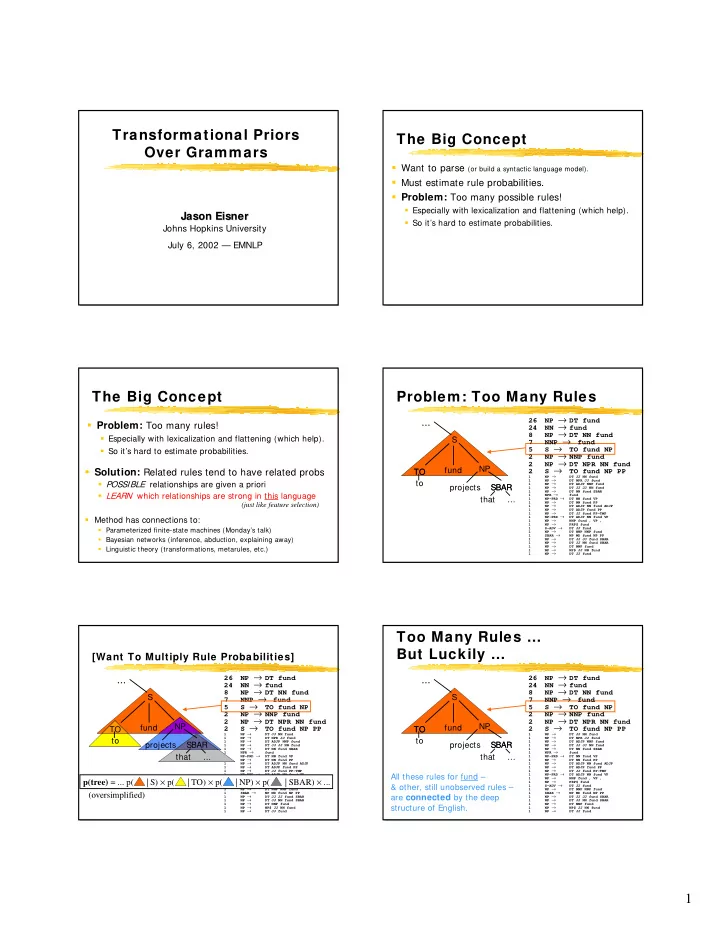
Transformational Priors The Big Concept Over Grammars Want to parse (or build a syntactic language model). Must estimate rule probabilities. Problem: Too many possible rules! Especially with lexicalization and flattening (which


slide-1
SLIDE 1

1 Transformational Priors Over Grammars

Jason Eisner Jason Eisner

Johns Hopkins University July 6, 2002 — EMNLP

The Big Concept

Want to parse (or build a syntactic language model). Must estimate rule probabilities. Problem: Too many possible rules!

Especially with lexicalization and flattening (which help). So it’s hard to estimate probabilities.

The Big Concept

Problem: Too many rules!

Especially with lexicalization and flattening (which help). So it’s hard to estimate probabilities.

Solution: Related rules tend to have related probs

POSSIBLE relationships are given a priori LEARN which relationships are strong in this language

(just like feature selection)

Method has connections to:

Parameterized finite-state machines (Monday’s talk) Bayesian networks (inference, abduction, explaining away) Linguistic theory (transformations, metarules, etc.)

Problem: Too Many Rules

26 NP → DT fund 24 NN → fund 8 NP → DT NN fund 7 NNP → fund 5 S → TO fund NP 2 NP → NNP fund 2 NP → DT NPR NN fund 2 S → TO fund NP PP

1 NP → DT JJ NN fund 1 NP → DT NPR JJ fund 1 NP → DT ADJP NNP fund 1 NP → DT JJ JJ NN fund 1 NP → DT NN fund SBAR 1 NPR → fund 1 NP-PRD → DT NN fund VP 1 NP → DT NN fund PP 1 NP → DT ADJP NN fund ADJP 1 NP → DT ADJP fund PP 1 NP → DT JJ fund PP-TMP 1 NP-PRD → DT ADJP NN fund VP 1 NP → NNP fund , VP , 1 NP → PRP$ fund 1 S-ADV → DT JJ fund 1 NP → DT NNP NNP fund 1 SBAR → NP MD fund NP PP 1 NP → DT JJ JJ fund SBAR 1 NP → DT JJ NN fund SBAR 1 NP → DT NNP fund 1 NP → NP$ JJ NN fund 1 NP → DT JJ fund

... fund NP TO to TO projects SBAR S that SBAR

...

[Want To Multiply Rule Probabilities]

26 NP → DT fund 24 NN → fund 8 NP → DT NN fund 7 NNP → fund 5 S → TO fund NP 2 NP → NNP fund 2 NP → DT NPR NN fund 2 S → TO fund NP PP

1 NP → DT JJ NN fund 1 NP → DT NPR JJ fund 1 NP → DT ADJP NNP fund 1 NP → DT JJ JJ NN fund 1 NP → DT NN fund SBAR 1 NPR → fund 1 NP-PRD → DT NN fund VP 1 NP → DT NN fund PP 1 NP → DT ADJP NN fund ADJP 1 NP → DT ADJP fund PP 1 NP → DT JJ fund PP-TMP 1 NP-PRD → DT ADJP NN fund VP 1 NP → NNP fund , VP , 1 NP → PRP$ fund 1 S-ADV → DT JJ fund 1 NP → DT NNP NNP fund 1 SBAR → NP MD fund NP PP 1 NP → DT JJ JJ fund SBAR 1 NP → DT JJ NN fund SBAR 1 NP → DT NNP fund 1 NP → NP$ JJ NN fund 1 NP → DT JJ fund

fund TO NP to TO NP projects SBAR S that ... SBAR

...

p(tree) = ... p( | S) × p( | TO) × p( | NP) × p( | SBAR) × ... (oversimplified)

Too Many Rules … But Luckily …

26 NP → DT fund 24 NN → fund 8 NP → DT NN fund 7 NNP → fund 5 S → TO fund NP 2 NP → NNP fund 2 NP → DT NPR NN fund 2 S → TO fund NP PP

1 NP → DT JJ NN fund 1 NP → DT NPR JJ fund 1 NP → DT ADJP NNP fund 1 NP → DT JJ JJ NN fund 1 NP → DT NN fund SBAR 1 NPR → fund 1 NP-PRD → DT NN fund VP 1 NP → DT NN fund PP 1 NP → DT ADJP NN fund ADJP 1 NP → DT ADJP fund PP 1 NP → DT JJ fund PP-TMP 1 NP-PRD → DT ADJP NN fund VP 1 NP → NNP fund , VP , 1 NP → PRP$ fund 1 S-ADV → DT JJ fund 1 NP → DT NNP NNP fund 1 SBAR → NP MD fund NP PP 1 NP → DT JJ JJ fund SBAR 1 NP → DT JJ NN fund SBAR 1 NP → DT NNP fund 1 NP → NP$ JJ NN fund 1 NP → DT JJ fund

... fund NP TO to TO projects SBAR S that SBAR

...

All these rules for fund – & other, still unobserved rules – are connected by the deep structure of English.

slide-2
SLIDE 2

2 Rules Are Related

fund behaves like a typical singular noun …

26 NP → DT fund 24 NN → fund 8 NP → DT NN fund 7 NNP → fund 5 S → TO fund NP 2 NP → NNP fund 2 NP → DT NPR NN fund 2 S → TO fund NP PP

1 NP → DT JJ NN fund 1 NP → DT NPR JJ fund 1 NP → DT ADJP NNP fund 1 NP → DT JJ JJ NN fund 1 NP → DT NN fund SBAR 1 NPR → fund 1 NP-PRD → DT NN fund VP 1 NP → DT NN fund PP 1 NP → DT ADJP NN fund ADJP 1 NP → DT ADJP fund PP 1 NP → DT JJ fund PP-TMP 1 NP-PRD → DT ADJP NN fund VP 1 NP → NNP fund , VP , 1 NP → PRP$ fund 1 S-ADV → DT JJ fund 1 NP → DT NNP NNP fund 1 SBAR → NP MD fund NP PP 1 NP → DT JJ JJ fund SBAR 1 NP → DT JJ NN fund SBAR 1 NP → DT NNP fund 1 NP → NP$ JJ NN fund 1 NP → DT JJ fund

  • ne fact!

though PCFG represents it as many apparently unrelated rules.

Rules Are Related

fund behaves like a typical singular noun … … or transitive verb …

26 NP → DT fund 24 NN → fund 8 NP → DT NN fund 7 NNP → fund 5 S → TO fund NP 2 NP → NNP fund 2 NP → DT NPR NN fund 2 S → TO fund NP PP

1 NP → DT JJ NN fund 1 NP → DT NPR JJ fund 1 NP → DT ADJP NNP fund 1 NP → DT JJ JJ NN fund 1 NP → DT NN fund SBAR 1 NPR → fund 1 NP-PRD → DT NN fund VP 1 NP → DT NN fund PP 1 NP → DT ADJP NN fund ADJP 1 NP → DT ADJP fund PP 1 NP → DT JJ fund PP-TMP 1 NP-PRD → DT ADJP NN fund VP 1 NP → NNP fund , VP , 1 NP → PRP$ fund 1 S-ADV → DT JJ fund 1 NP → DT NNP NNP fund

1 SBAR → NP MD fund NP PP

1 NP → DT JJ JJ fund SBAR 1 NP → DT JJ NN fund SBAR 1 NP → DT NNP fund 1 NP → NP$ JJ NN fund 1 NP → DT JJ fund

  • ne more fact!

even if several more rules. Verb rules are RELATED.

... fund NP TO to TO projects SBAR S that SBAR

... Should be able to PREDI CT the ones we haven’t seen.

Rules Are Related

fund behaves like a typical singular noun … … or transitive verb … … but as noun, has an idiosyncratic fondness for purpose clauses …

26 NP → DT fund 24 NN → fund 8 NP → DT NN fund 7 NNP → fund 5 S → TO fund NP 2 NP → NNP fund 2 NP → DT NPR NN fund 2 S → TO fund NP PP

1 NP → DT JJ NN fund 1 NP → DT NPR JJ fund 1 NP → DT ADJP NNP fund 1 NP → DT JJ JJ NN fund 1 NP → DT NN fund SBAR 1 NPR → fund

1 NP-PRD → DT NN fund VP

1 NP → DT NN fund PP 1 NP → DT ADJP NN fund ADJP 1 NP → DT ADJP fund PP 1 NP → DT JJ fund PP-TMP

1 NP-PRD→DT ADJP NN fund VP 1 NP → NNP fund , VP ,

1 NP → PRP$ fund 1 S-ADV → DT JJ fund 1 NP → DT NNP NNP fund 1 SBAR → NP MD fund NP PP

1 NP → DT JJ JJ fund SBAR 1 NP → DT JJ NN fund SBAR

1 NP → DT NNP fund 1 NP → NP$ JJ NN fund

  • ne more fact!

predicts dozens of unseen rules

the old ACL fund for students to attend ACL the ACL fund to put proceedings online 26 NP → DT fund 24 NN → fund 8 NP → DT NN fund 7 NNP → fund 5 S → TO fund NP 2 NP → NNP fund 2 NP → DT NPR NN fund 2 S → TO fund NP PP

1 NP → DT JJ NN fund 1 NP → DT NPR JJ fund 1 NP → DT ADJP NNP fund 1 NP → DT JJ JJ NN fund 1 NP → DT NN fund SBAR 1 NPR → fund 1 NP-PRD → DT NN fund VP 1 NP → DT NN fund PP 1 NP → DT ADJP NN fund ADJP 1 NP → DT ADJP fund PP 1 NP → DT JJ fund PP-TMP 1 NP-PRD → DT ADJP NN fund VP 1 NP → NNP fund , VP , 1 NP → PRP$ fund 1 S-ADV → DT JJ fund 1 NP → DT NNP NNP fund 1 SBAR → NP MD fund NP PP 1 NP → DT JJ JJ fund SBAR 1 NP → DT JJ NN fund SBAR 1 NP → DT NNP fund 1 NP → NP$ JJ NN fund 1 NP → DT JJ fund

Rules Are Related

fund behaves like a typical singular noun … … or transitive verb … … but as noun, has an idiosyncratic fondness for purpose clauses … … and maybe other idiosyncrasies to be discovered, like unaccusativity …

NSF issued the grant The grant issued today

unlikely sentence, but if we do see it, is unaccusativity plausible? (vs. other parse)

NSF funded the grant The grant funded today ???

26 NP → DT fund 24 NN → fund 8 NP → DT NN fund 7 NNP → fund 5 S → TO fund NP 2 NP → NNP fund 2 NP → DT NPR NN fund 2 S → TO fund NP PP

1 NP → DT JJ NN fund 1 NP → DT NPR JJ fund 1 NP → DT ADJP NNP fund 1 NP → DT JJ JJ NN fund 1 NP → DT NN fund SBAR 1 NPR → fund 1 NP-PRD → DT NN fund VP 1 NP → DT NN fund PP 1 NP → DT ADJP NN fund ADJP 1 NP → DT ADJP fund PP 1 NP → DT JJ fund PP-TMP 1 NP-PRD → DT ADJP NN fund VP 1 NP → NNP fund , VP , 1 NP → PRP$ fund 1 S-ADV → DT JJ fund 1 NP → DT NNP NNP fund 1 SBAR → NP MD fund NP PP 1 NP → DT JJ JJ fund SBAR 1 NP → DT JJ NN fund SBAR 1 NP → DT NNP fund 1 NP → NP$ JJ NN fund 1 NP → DT JJ fund

and how does that tell us p(rule)?

All This Is Quantitative!

fund behaves like a typical singular noun … … or transitive verb … … but as noun, has an idiosyncratic fondness for purpose clauses … … and maybe other idiosyncrasies to be discovered, like unaccusativity …

how often?

Format of the Rules

S → NP put NP PP

S NP Jim in the oven PP NP pizza put S NP Jim in the oven PP NP pizza put V VP VP

S

→ NP VP

VP → VP PP VP → V NP V

→ put

(put) (put) (put) (put)

slide-3
SLIDE 3

3 Format of the Rules

Why use flat rules? Avoids silly independence assumptions: a win

Johnson 1998 New experiments

Our method likes them

Traditional rules aren’t systematically related But relationships exist among wide, flat rules that express different ways of filling same roles

S → NP put NP PP

S NP Jim in the oven PP NP pizza put

Format of the Rules

Why use flat rules? Avoids silly independence assumptions: a win

Johnson 1998 New experiments

Our method likes them

Traditional rules aren’t systematically related But relationships exist among wide, flat rules that express different ways of filling same roles

S → NP put PP NP

S NP Jim in the oven PP NP a very heavy pizza put

Format of the Rules

Why use flat rules? Avoids silly independence assumptions: a win

Johnson 1998 New experiments

Our method likes them

Traditional rules aren’t systematically related But relationships exist among wide, flat rules that express different ways of filling same roles

S → NP , NP put PP

S NP Jim in the oven PP NP a pizza put ,

Format of the Rules

Why use flat rules? Avoids silly independence assumptions: a win

Johnson 1998 New experiments

Our method likes them

Traditional rules aren’t systematically related But relationships exist among wide, flat rules that express different ways of filling same roles S NP Jim in the oven PP NP a pizza put , in short, flat rules are the locus of transformations

Format of the Rules

Why use flat rules? Avoids silly indep. assumptions: a win

Johnson 1998 New experiments

Our method likes them

Traditional rules aren’t systematically related But relationships exist among wide, flat rules that express different ways of filling same roles flat rules are the locus of exceptions

(e.g., put is exceptionally likely to take a PP, but not a second PP)

in short, flat rules are the locus of transformations

Hey – Just Like Linguistics!

Explain “coincidental” patterns

  • f lexical entries: metarules/

transformations/lexical redundancy rules flat rules are the locus of exceptions

(e.g., put is exceptionally likely to take a PP, but not a second PP)

in short, flat rules are the locus of transformations Grammar = set of “lexical entries” very like flat rules Exceptional entries OK Lexicalized syntactic formalisms: CG, LFG, TAG, HPSG, LCFG … listed entries derived entries I ntuition: Listing is costly and hard to learn. Most rules are derived.

slide-4
SLIDE 4

4 The Rule Smoothing Task

I nput: Rule counts (from parses or putative parses) Output: Probability distribution over rules Evaluation: Perplexity of held-out rule counts

That is, did we assign high probability to the rules needed to correctly parse test data?

The Rule Smoothing Task

I nput: Rule counts (from parses or putative parses) Output: Probability distribution over rules Evaluation: Perplexity of held-out rule counts

Rule probabilities: p(S→ NP put NP PP | S,put)

Infinite set of possible rules; so we will estimate

p(S→ NP Adv PP put PP PP NP AdjP S | S, put) = a very tiny number > 0 To —— NP To —— NP PP To AdvP —— NP To AdvP —— NP PP To —— PP To —— S NP —— NP . NP —— NP PP . NP Md —— NP NP Md —— NP PPTmp NP Md —— PP PP NP —— SBar . (etc.)

Grid of Lexicalized Rules

S → → → → ... encourage question fund merge repay remove S → → → → To merge NP PP (“to merge projects with ease”) S → → → → To fund NP PP (“to fund projects with ease”)

Training Counts

To —— NP 1 1 5 1 3 2 To —— NP PP 1 1 2 2 1 1 To AdvP —— NP 1 To AdvP —— NP PP 1 NP —— NP . 2 NP —— NP PP . 1 NP Md —— NP 1 NP Md —— NP PPTmp 1 NP Md —— PP PP 1 To —— PP 1 To —— S 1 NP —— SBar . 2 (other) S → → → → ... encourage question fund merge repay remove Count of (word, frame)

Naive prob. estimates (MLE model)

To —— NP 200 167 714 250 600 333 To —— NP PP 200 167 286 500 200 167 To AdvP —— NP 167 To AdvP —— NP PP 167 NP —— NP . 333 NP —— NP PP . 200 NP Md —— NP 200 NP Md —— NP PPTmp 200 NP Md —— PP PP 167 To —— PP 250 To —— S 200 NP —— SBar . 333 (other) S → → → → ... encourage question fund merge repay remove Estimate of p(frame | word) * 1000

TASK: counts → probs

(“smoothing”)

To —— NP 142 117 397 210 329 222 To —— NP PP 77 64 120 181 88 80 To AdvP —— NP 0.55 0.47 1.1 0.82 0.91 79 To AdvP —— NP PP 0.18 0.15 0.33 0.37 0.26 50 NP —— NP . 22 161 7.8 7.5 7.9 7.5 NP —— NP PP . 79 8.5 2.6 2.7 2.6 2.6 NP Md —— NP 90 2.1 2.4 2.0 24 2.6 NP Md —— NP PPTmp 1.8 0.16 0.17 0.16 69 0.19 NP Md —— PP PP 0.1 0.027 0.027 0.038 0.078 59 To —— PP 9.2 6.5 12 126 10 9.1 To —— S 98 1.6 4.3 3.9 3.6 2.7 NP —— SBar . 3.4 190 3.2 3.2 3.2 3.2 (other) 478 449 449 461 461 482 S → → → → ... encourage question fund merge repay remove Estimate of p(frame | word) * 1000

slide-5
SLIDE 5

5

Smooth Matrix via LSA / SVD, or SBS?

To —— NP 1 1 5 1 3 2 To —— NP PP 1 1 2 2 1 1 To AdvP —— NP 1 To AdvP —— NP PP 1 NP —— NP . 2 NP —— NP PP . 1 NP Md —— NP 1 NP Md —— NP PPTmp 1 NP Md —— PP PP 1 To —— PP 1 To —— S 1 NP —— SBar . 2 (other) S → → → → ... encourage question fund merge repay remove Count of (word, frame)

Smoothing via a Bayesian Prior

Choose grammar to maximize p(observed rule counts | grammar)* p(grammar) grammar = probability distribution over rules Our job: Define p(grammar) Question: What makes a grammar likely, a priori? This paper’s answer: Systematicity. Rules are mainly derivable from other rules. Relatively few stipulations (“deep facts”).

26 NP → DT fund 24 NN → fund 8 NP → DT NN fund 7 NNP → fund 5 S → TO fund NP 2 NP → NNP fund 2 NP → DT NPR NN fund 2 S → TO fund NP PP

1 NP → DT JJ NN fund 1 NP → DT NPR JJ fund 1 NP → DT ADJP NNP fund 1 NP → DT JJ JJ NN fund 1 NP → DT NN fund SBAR 1 NPR → fund 1 NP-PRD → DT NN fund VP 1 NP → DT NN fund PP 1 NP → DT ADJP NN fund ADJP 1 NP → DT ADJP fund PP 1 NP → DT JJ fund PP-TMP 1 NP-PRD → DT ADJP NN fund VP 1 NP → NNP fund , VP , 1 NP → PRP$ fund 1 S-ADV → DT JJ fund 1 NP → DT NNP NNP fund 1 SBAR → NP MD fund NP PP 1 NP → DT JJ JJ fund SBAR 1 NP → DT JJ NN fund SBAR 1 NP → DT NNP fund 1 NP → NP$ JJ NN fund 1 NP → DT JJ fund

fund behaves like a transitive verb 10% of time … and noun 90% of time … … takes purpose clauses 5 times as often as typical noun.

Only a Few Deep Facts Smoothing via a Bayesian Prior

Previous work (several papers in past decade):

Rules should be few, short, and approx. equiprobable These priors try to keep rules out of grammar Bad idea for lexicalized grammars …

This work:

Prior tries to get related rules into grammar transitive passive

NSF spraggles the project The project is spraggled by NSF Would be weird for the passive to be missing, and prior knows it! In fact, weird if p(passive) is too far from 1/20 * p(active)

at ≈1/20 the probability Few facts, not few rules!

for now , stick to

Simple Edit Transformations

Delete NP S→ NP see I see S→ NP see NP I see you I nsert PP S→ NP see NP PP I see you with my own eyes S→ NP see SBAR I see that it’s love Subst

N P → S B A R

S→ NP see SBAR PP I see that it’s love with my own eyes S→ NP see PP SBAR I see with my own eyes that it’s love Swap

SBAR,PP

I n s e r t P P do fancier things by a sequence of edits See paper for various evidence that these should be predictive. Halt Delete NP S→ NP see I see S→ NP see NP I see you I nsert PP S→ NP see NP PP I see you with my own eyes S→ NP see SBAR I see that it’s love Subst

N P → S B A R

S→ NP see PP SBAR I see with my own eyes that it’s love Halt Halt

0.2 0.6 0.1 0.1

Halt I n s e r t P P H a l t

. 1 0.9 SBAR,PP

Swap Halt Halt

0.6 0.4

S→ NP see SBAR PP I see that it’s love with my own eyes p(S→ NP see SBAR PP) = 0.5* 0.1* 0.1* 0.4 + … START

0.5 0.3 0.1 0.1

0.1* 0.4+ …

slide-6
SLIDE 6

6

S→ NP see I see S→ NP see NP I see you S→ NP see SBAR PP I see that it’s love with my own eyes START

0.5 0.3 0.1 0.1 Could get mixture behavior by adjusting start probs. But not quite right - can’t handle negative exceptions within a paradigm. And what of the language’s transformation probs?

whole transitive verb paradigm (with probs) S→ DT JJ see the holy see noun paradigm intransitive verb paradigm

S→ NP Adv PP see PP PP NP AdjP S graph goes on forever …

Infinitely Many Arc Probabilities: Derive From Finite Parameter Set

S→ NP see NP I nsert PP S→ NP see NP PP S→ NP see I nsert PP S→ NP see PP Why not just give any two PP-insertion arcs the same probability? PP more places to insert so probability is split among more options

Arc Probabilities: A Conditional Log-Linear Model

S→ NP see NP I nsert PP S→ NP see NP PP 1 Z exp θ3+ θ5+ θ6 Halt I n s e r t PP 1 Z

e x p …

1 Z exp … To make sure outgoing arcs sum to 1, introduce a normalizing factor Z (at each vertex). Models p(arc | vertex) inserted into slightly different context

Arc Probabilities: A Conditional Log-Linear Model

S→ NP see NP I nsert PP S→ NP see NP PP S→ NP see I nsert PP S→ NP see PP Both are PP-adjunction arcs. Same probability? Almost but not quite … PP more places to insert

Arc Probabilities: A Conditional Log-Linear Model

S→ NP see NP I nsert PP S→ NP see NP PP 1 Z exp θ3+ θ6+ θ7

Not enough just to say “Insert PP.” Each arc bears several features, whose weights determine its probability.

feature weights a feature of weight 0 has no effect raising a feature’s weight strengthens all arcs with that feature

Arc Probabilities: A Conditional Log-Linear Model

1 Z exp θ3+ θ6+ θ7

θ3 : appears on arcs that insert PP into S θ5 : appears on arcs that insert PP just after head θ6 : appears on arcs that insert PP just after NP θ7 : appears on arcs that insert PP just before edge

S→ NP see NP I nsert PP S→ NP see NP PP 1 Z’ exp θ3+ θ5+ θ7 S→ NP see I nsert PP S→ NP see PP

slide-7
SLIDE 7

7

Arc Probabilities: A Conditional Log-Linear Model

1 Z exp θ3

+ θ6 + θ7 θ3 : appears on arcs that insert PP into S θ5 : appears on arcs that insert PP just after head θ6 : appears on arcs that insert PP just after NP θ7 : appears on arcs that insert PP just before edge

1 Z’ exp θ3 + θ5

+ θ7

S→ NP see NP I nsert PP S→ NP see NP PP S→ NP see I nsert PP S→ NP see PP 1 Z exp θ3

+ θ6 + θ7

Arc Probabilities: A Conditional Log-Linear Model

These arcs share most features. So their probabilities tend to rise and fall together. To fit data, could manipulate them independently (via θ5,θ6). 1 Z’ exp θ3 + θ5

+ θ7

S→ NP see NP I nsert PP S→ NP see NP PP S→ NP see I nsert PP S→ NP see PP

Prior Distribution

PCFG grammar is determined by θ θ θ θ0

,

, , , θ θ θ θ1

1 1 1,

, , , θ θ θ θ2

2 2 2,

, , , …

Universal Grammar Instantiated Grammar Prior Distribution

Grammar is determined by θ θ θ θ0

,

, , , θ θ θ θ1

1 1 1,

, , , θ θ θ θ2

2 2 2,

, , , … Our prior: θ θ θ θi ~ N(0, σ2), IID Thus: -log p(grammar) = c+ (θ θ θ θ0

02 2 2 2+

+ + +θ θ θ θ1

1 1 12 2 2 2+

+ + +θ θ θ θ2

2 2 22 2 2 2+

+ + +…)/σ2 So good grammars have few large weights. Prior prefers one generalization to many exceptions.

slide-8
SLIDE 8

8

1 Z exp θ3

+ θ6 + θ7

Arc Probabilities: A Conditional Log-Linear Model

To raise both rules’ probs, cheaper to use θ3 than both θ5 & θ6. This generalizes – also raises other cases of PP-insertion! 1 Z’ exp θ3 + θ5

+ θ7

S→ NP see NP I nsert PP S→ NP see NP PP S→ NP see I nsert PP S→ NP see PP 1 Z exp θ3

+ θ84 + θ6 + θ7

Arc Probabilities: A Conditional Log-Linear Model

1 Z’’ exp θ3 + θ82 + θ6 + θ7 S→ NP see NP I nsert PP S→ NP see NP PP S→ NP fund NP I nsert PP S→ NP fund NP PP To raise both probs, cheaper to use θ3 than both θ82 & θ84. This generalizes – also raises other cases of PP-insertion!

Reparameterization

Grammar is determined by θ θ θ θ0

0,

, , , θ θ θ θ1

1 1 1,

, , , θ θ θ θ2

2 2 2,

, , , … A priori, the θ θ θ θi are normally distributed We’ve reparameterized! The parameters are feature weights θ θ θ θi, not rule probabilities Important tendencies captured in big weights

Similarly: Fourier transform – find the formants Similarly: SVD – find the principal components It’s on this deep level that we want to compare events, impose priors, etc.

Other models of this string: max-likelihood n-gram Collins arg/adj hybrids

slide-9
SLIDE 9

9

Simple Bigram Model (Eisner 1996)

  • Markov process, 1 symbol of memory; conditioned on L, w, side of ——
  • One-count backoff to handle sparse data (Chen & Goodman 1996)

p(L → → → → A B C —— D | w) = p(L | w)• p(A B C —— D | L,w)

A B C —— D

  • Try assuming rule is probable if its component bigrams are:
  • A parser assumes tree is probable if its component rules are:

p(A | start) × p(B | A) × p(C | B) × p(—— | C) × p(D | ——) × p(stop | D) Use “non-flat” frames? Extra training info. For test, sum over all bracketings.

Perplexity: Predicting test frames

from previous lit. 20% further reduction Can get big perplexity reduction just by flattening.

Perplexity: Predicting test frames

best model with transformations best model without transformations from previous lit

test rules with 0 training observations best model without transformations best model with transformations p(rule | head, S) test rules with 1 training observation best model without transformations best model with transformations p(rule | head, S)

slide-10
SLIDE 10

10

test rules with 2 training observations best model without transformations best model with transformations p(rule | head, S)

Forced matching task

i.e., does frame A look more like word 1’s known frames or word 2’s?

20% fewer errors than bigram model

Test model’s ability to extrapolate novel frames for a word Randomly select two (word, frame) pairs from test data

... ensuring that neither frame was ever seen in training

Ask model to choose a matching: word 1 frame A word 2 frame B word 1 frame A word 2 frame B

Twice as much data But no transformations

Graceful degradation

Summary: Reparameterize PCFG in terms of deep transformation w eights, to be learned under a simple prior. Problem: Too many rules!

Especially with lexicalization and flattening (which help). So it’s hard to estimate probabilities.

Solution: Related rules tend to have related probs

POSSIBLE relationships are given a priori LEARN which relationships are strong in this language

(just like feature selection)

Method has connections to:

Parameterized finite-state machines (Monday’s talk) Bayesian networks (inference, abduction, explaining away) Linguistic theory (transformations, metarules, etc.)

FIN