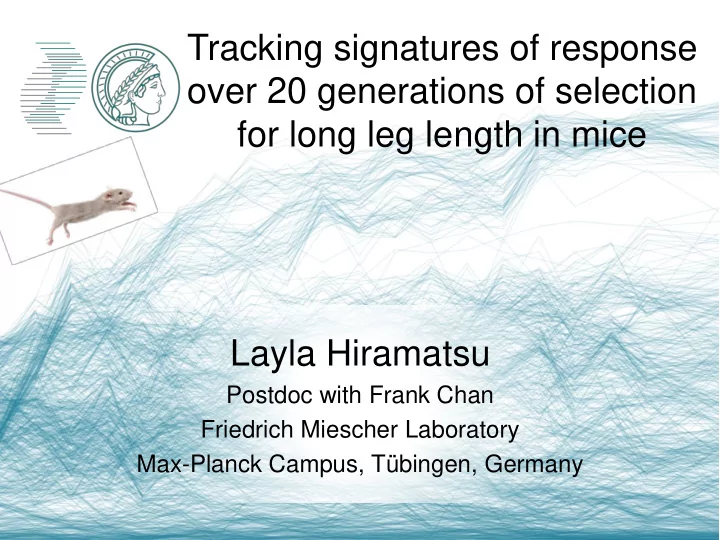
Tracking signatures of response over 20 generations of selection - - PowerPoint PPT Presentation

tracking signatures of response
SMART_READER_LITE
LIVE PREVIEW

Tracking signatures of response over 20 generations of selection - - PowerPoint PPT Presentation

Tracking signatures of response over 20 generations of selection for long leg length in mice Layla Hiramatsu Postdoc with Frank Chan Friedrich Miescher Laboratory Max-Planck Campus, Tbingen, Germany How do small populations respond to


slide-1
SLIDE 1

Tracking signatures of response

  • ver 20 generations of selection

for long leg length in mice Layla Hiramatsu

Postdoc with Frank Chan Friedrich Miescher Laboratory Max-Planck Campus, Tübingen, Germany

slide-2
SLIDE 2

How do small populations respond to selection?

  • Selection vs. genetic drift
  • Hard vs. soft sweeps
  • Allelic interactions
  • How many genes
  • Effect sizes
  • How repeatable is the response

Replicated, controlled, pedigreed selection experiments

Quantitative genetics Population genetics

1

slide-3
SLIDE 3

Longshanks selection experiment for long tibiae

Three lines of CD-1 outbred mice, 16 pairs per generation

Marta Marchini, Campbell Rolian (U. of Calgary)

 bioRxiv link! 2 2.5 mm

Ctrl LS113.1% LS212.7%

slide-4
SLIDE 4

Longshanks selection experiment for long tibiae

Three lines of CD-1 outbred mice, 16 pairs per generation

  • M. Marchini, C. Rolian (U. of Calgary) & QG estimates N. Barton (IST Austria)

Ctrl

N=1331

LS1

N=3060

LS2

N=3098

3

ℎ2 = 0.51 𝑇 = 0.02* Ne = 46

slide-5
SLIDE 5

All breeders whole-genome sequenced N = 1,550

Founders (F0) and F17 at 100x coverage (~5x / individual) All other generations 30x coverage (~0.5x / individual)

F0F17: João Castro, Mish Yancoskie et al., eLIFE, in revision

Ctrl LS1 LS2

4

Ctrl

N=1331 NWGS= 25 (F0) +33 (F17) + 316

LS1

N=3060 NWGS = 26 + 32+ 546

LS2

N=3098 NWGS = 25 + 32 + 514

slide-6
SLIDE 6

Change in allele frequencies in Ctrl line

Castro, Yancoskie et al., eLIFE, in revision

Genetic drift chr 5

Ctrl F0 vs. F17

∆z2/π2

slide-7
SLIDE 7

Broad polygenic response, parallel and line-specific

Castro, Yancoskie et al., eLIFE, in revision

chr 6

F0 vs. F17

∆z2/π2

slide-8
SLIDE 8

8 loci of major effect, top 2 are in parallel

Nick Barton, Stefanie Belohlavy (IST Austria)

Significant threshold from pedigree-calibrated infinitesimal model with LD

Castro, Yancoskie et al., eLIFE, in revision

7

Hitchhiking filtered

LS1 LS2

slide-9
SLIDE 9

8 loci of major effect, top 2 are in parallel

Significant threshold from pedigree-calibrated infinitesimal model with LD

Castro, Yancoskie et al., eLIFE, in revision

8

>5Mb region in chr10 Nkx3-2 in chr5 LS1 LS2

slide-10
SLIDE 10

8 loci of major effect, top 2 are in parallel

Significant threshold from pedigree-calibrated infinitesimal model with LD

Castro, Yancoskie et al., eLIFE, in revision

9

>5Mb region in chr10 Nkx3-2 in chr5 No coding changes Functional test of enhancers F0 allele vs. F17 allele (3 SNPs) F0 F17

Loss of bone growth repression

LS1 LS2

slide-11
SLIDE 11

How did the Longshanks respond to selection?

  • Selection vs. genetic drift

Drift strong, selection stronger Near fixation by F17

  • How many genes

Very polygenic 8 major loci

  • Effect sizes

Nkx3-2 : 10%

  • Can we model the response

Yes! Linkage important

Quantitative genetics Population genetics DevBio

Nkx3-2 region No coding changes Cis-regulatory Loss of function

Castro, Yancoskie et al., eLIFE, in review

10  bioRxiv link!

slide-12
SLIDE 12

Reconstruction of selection response generation-to-generation

Ctrl LS1 LS2

generations 11

slide-13
SLIDE 13

Reconstruction of selection response generation-to-generation

Ctrl LS1 LS2 30x coverage (~0.5x / individual)

generations 12

slide-14
SLIDE 14

Reconstruction of selection response generation-to-generation

Allele trajectories

  • Allelic interactions (e.g., dominance)
  • Timing and relative importance of genes

Haplotype reconstruction with pedigree

  • Compare against models of linkage

Ctrl LS1 LS2

13

slide-15
SLIDE 15

Average each 100kb window across all chromosomes

Frequency of minor allele at each of 2133 SNPs

chr 1 || 2133 SNPs

Average frequency LS1

14

slide-16
SLIDE 16

Average each 100kb window across all chromosomes

Frequency of minor allele at each of 2133 SNPs Average frequency

chr 1 || 2133 SNPs * Reduces noise due to low coverage but haplotypes are likely larger than 100kb

LS1

15

slide-17
SLIDE 17

Trajectories of windows which started at 20-25% in founding population

LS1

16

slide-18
SLIDE 18

Trajectories of windows which started at 20-25% in founding population

LS1

Selected windows in chr 10

17

slide-19
SLIDE 19

Trajectories of windows which started at 20-25% in founding population

LS1

Selected windows in chr 10

LS2

18

slide-20
SLIDE 20

Side story. Late alleles: recessive or broke linkage with deleterious allele?

multi-locus adaptation

LS1

19

slide-21
SLIDE 21

Side story. Chr 6 region broke from deleterious allele at generation 11?

Or seeing many background haplotypes?

LS1

20

slide-22
SLIDE 22

“Drift zone” by simple Wright-Fisher simulation, 95% of 1000 simulations

LS1

21

slide-23
SLIDE 23

Estimate selection coefficient for a window

LS1

22

slide-24
SLIDE 24

Estimate selection coefficient for a window

LS1

23

slide-25
SLIDE 25

Change in allele frequency with selection

AA Aa aa p2 2pq q2 1+s 1+hs 1 p2(1+s) 2pq(1+hs) q2 Genotypes Frequency before selection Fitness Frequency after selection

iterate for 20 generations

dominance coefficient h = 0 : recessive A h = 0.5 : additive h = 1 : dominant A 24

pt+1 p2 (1 + s) + pq (1 + hs ) 1 + sp2 + 2hspq

=

slide-26
SLIDE 26

Change in allele frequency with selection

pt+1 p2 (1 + s) + pq (1 + hs ) 1 + sp2 + 2hspq

=

AA Aa aa p2 2pq q2 1+s 1+hs 1 p2(1+s) 2pq(1+hs) q2 Genotypes Frequency before selection Fitness Frequency after selection

iterate for 20 generations

Try many h and s combinations and calculate the likelihood that they would produce the observed trajectory

dominance coefficient h = 0 : recessive A h = 0.5 : additive h = 1 : dominant A 25

with help from Felicity Jones

slide-27
SLIDE 27

This allele in chr10 acts partially dominantly and selection is strong

LS1 Selection coefficient s Dominance coefficient h

best likelihood at s, h =

  • loglik

26

slide-28
SLIDE 28

LS1

pt+1 p2 (1 + s) + pq (1 + hs ) 1 + sp2 + 2hspq

=

Calculated coefficients fit the observed data well

s = 0.43 h = 0.73

27

slide-29
SLIDE 29

LS1

Estimate selection coefficient for Nkx3-2 selected alleles

28

F0 F17

Loss of bone growth repression

slide-30
SLIDE 30

LS1

Overdominance in Nkx3-2 allele: reached an equilibrium

s = 0.35, h = 1.60, freqeq = 0.73

29

slide-31
SLIDE 31

LS1

Overdominance in Nkx3-2 allele: reached an equilibrium

s = 0.35, h = 1.60, freqeq = 0.73

30

Check allelic interactions (e.g., dominance) with genotype frequencies

slide-32
SLIDE 32

LS1

Genome-wide: Most windows are not under selection Windows under selection tend to act in dominance (?)

31

slide-33
SLIDE 33

LS1

Genome-wide: Most windows are not under selection Windows under selection tend to act in dominance (?)

32 Windows outside “drift zone” for at least 5 generations 1.6%

slide-34
SLIDE 34

LS1

Genome-wide: Most windows are not under selection Windows under selection tend to act in dominance (?)

Windows outside “drift zone” for at least 5 generations 1.6% Selected windows in chr 10 Nkx3-2 33 Side story Recessive(?) alleles

slide-35
SLIDE 35

Genome-wide: Most windows are not under selection Windows under selection tend to act in dominance Similar pattern genome-wide for replicate lines

LS1 LS2

34

slide-36
SLIDE 36

Single-locus simulation with within-family selection

35

slide-37
SLIDE 37

Reconstruction of selection response generation-to-generation

Allele trajectories

  • Allelic interactions (i.e., dominance)
  • Timing and relative importance of genes

Haplotype reconstruction with pedigree

  • Compare against models of linkage

?

Can we fully map the timing and location of the selection response? How does strong selection distort the recombination landscape?

Founding haplotypes Selected haplotypes

time

36

slide-38
SLIDE 38

How did the Longshanks respond to selection?

  • Selection vs. genetic drift

Drift strong, selection stronger Near fixation by F17

  • How many genes

Very polygenic 8 major loci

  • Effect sizes

Nkx3-2 : 10%

  • Can we model the response

Yes, and linkage important

  • How do the alleles increase tibia length

cis - regulatory “breaking enhancers”

  • Allelic interactions

Most selected alleles act dominantly (?)

  • Haplotype segregation

Coming soon!

Castro, Yancoskie et al., eLIFE, in review

 bioRxiv link!

Quantitative genetics Population genetics DevBio

37

slide-39
SLIDE 39

Thank you!

 bioRxiv link!

Quantitative genetics Population genetics DevBio

Acknowledgements Frank Chan João Castro Mish Yancoskie Marek Kuçka Felicity Jones Bill Beluch Chan Lab Jones Lab Campbell Rolian Marta Marchini Isabella Skuplik John Cobb Nick Barton Stefanie Belohlavy Ronald Naumann

WE’RE HIRING!

  • Selection vs. genetic drift

Drift strong, selection stronger Near fixation by F17

  • How many genes

Very polygenic 8 major loci

  • Effect sizes

Nkx3-2 : 10%

  • Can we model the response

Yes, and linkage important

  • How do the alleles increase tibia length

cis - regulatory “breaking enhancers”

  • Allelic interactions

Most selected alleles act dominantly (?)

  • Haplotype segregation

Coming soon!

38