
SLIDE 1
A Computer Science Tapestry 8.1
Vectors
- Vectors are homogeneous collections with random access
➤ Store the same type/class of object, e.g., int, string, … ➤ The 1000th object in a vector can be accessed just as quickly
as the 2nd object
- We’ve used files to store text and StringSets to store sets of
strings; vectors are more general and more versatile, but are simply another way to store objects
➤ We can use vectors to count how many times each letter of
the alphabet occurs in Hamlet or any text file
➤ We can use vectors to store CD tracks, strings, or any type
- Vectors are a class-based version of arrays, which in C++ are
more low-level and more prone to error than are Vectors
A Computer Science Tapestry 8.2
Vector basics
- We’re using the class tvector, need #include”tvector.h”
➤ Based on the standard C++ (STL) class vector, but safe ➤ Safe means programming errors are caught rather than
ignored: sacrifice some speed for correctness
➤ In general correct is better than fast, programming plan:
- Make it run
- Make it right
- Make it fast
- Vectors are typed, when defined must specify the type being
stored, vectors are indexable, get the 1st, 3rd, or 105th element tvector<int> ivals(10); // store 10 ints vals[0] = 3; tvector<string> svals(20); // store 20 strings svals[0] = “applesauce”;
A Computer Science Tapestry 8.3
Tracking Dice, see dieroll2.cpp
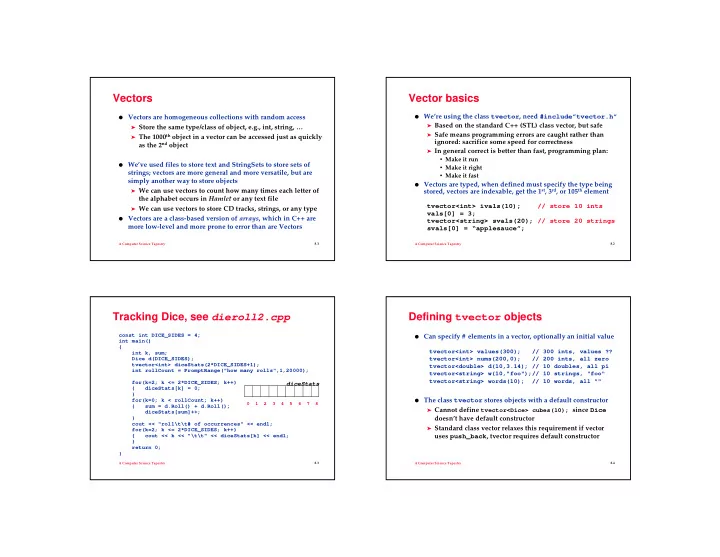
const int DICE_SIDES = 4; int main() { int k, sum; Dice d(DICE_SIDES); tvector<int> diceStats(2*DICE_SIDES+1); int rollCount = PromptRange("how many rolls",1,20000); for(k=2; k <= 2*DICE_SIDES; k++) { diceStats[k] = 0; } for(k=0; k < rollCount; k++) { sum = d.Roll() + d.Roll(); diceStats[sum]++; } cout << "roll\t\t# of occurrences" << endl; for(k=2; k <= 2*DICE_SIDES; k++) { cout << k << "\t\t" << diceStats[k] << endl; } return 0; }
0 1 2 3 4 5 6 7 8
diceStats
A Computer Science Tapestry 8.4
Defining tvector objects
- Can specify # elements in a vector, optionally an initial value
tvector<int> values(300); // 300 ints, values ?? tvector<int> nums(200,0); // 200 ints, all zero tvector<double> d(10,3.14); // 10 doubles, all pi tvector<string> w(10,"foo");// 10 strings, "foo" tvector<string> words(10); // 10 words, all ""
- The class tvector stores objects with a default constructor
➤ Cannot define tvector<Dice> cubes(10); since Dice
doesn’t have default constructor
➤ Standard class vector relaxes this requirement if vector