
SLIDE 1
Hamilton Technical Assistance Panel, June 22, 2015
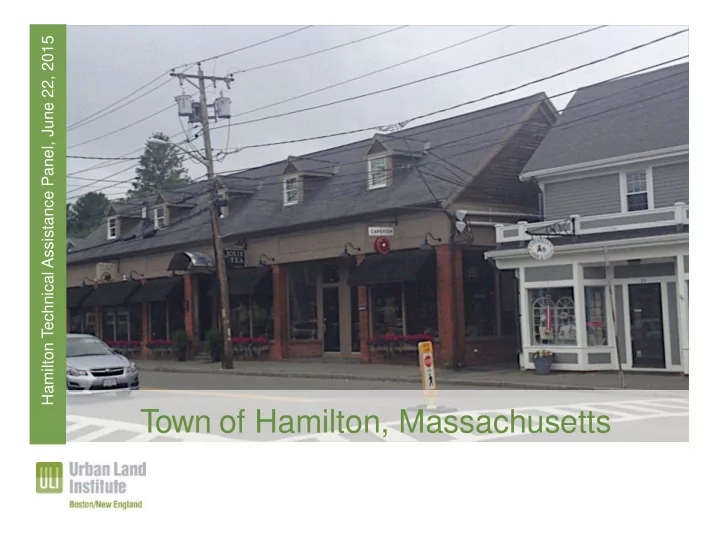
Town of Hamilton, Massachusetts Hamilton Technical Assistance Panel, - - PowerPoint PPT Presentation
Hamilton Technical Assistance Panel, June 22, 2015 Town of Hamilton, Massachusetts Hamilton Technical Assistance Panel, June 22, 2015 About ULI the Urban Land Institute Mission T o provide leadership in the responsible use of land and in
Hamilton Technical Assistance Panel, June 22, 2015
Hamilton Technical Assistance Panel, June 22, 2015
Mission T
creating and sustaining thriving communities worldwide. ULI is a research and education institution with nearly 30,000 members worldwide representing the entire spectrum of land use and real estate development disciplines, working in private enterprise and public service. ULI at the local level
New England
public officials, financiers, students, etc.
A U L L I I TTechnical Assistance Panel A TECHNICAL ASSISTANCE PANEL REPORT Advancing Resiliency in East Boston East Boston, Massachusetts June 2015 A TECHNICAL ASSISTANCE PANEL REPORT Cliftondale Square Saugus, MA January 12, 2015 B2
Hamilton Technical Assistance Panel, June 22, 2015
ULI Boston/New England is committed to supporting communities in making sound land use decisions and creating better places. A TAP brings together of a groupof ULI members with a range of professional expertise to provide focused, collaborative consultation to a local government or qualifying non-profit organization. This TAP Sponsored by the Hamilton Development Corp.
unbiased perspective.
development, design, planning, and transportation planning. Panelists have donated their time
available at http://boston.uli.org
3
A TECHNICAL ASSISTANCE PANEL REPORT Redevelopment Options for Central Square and Downtown Lynn, MA December 2, 2014 B Hamilton Technical Assistance Panel, June 22, 2015
The Panel
Dick Lampman, Chair Barr and Barr Framingham,MA Sarah Barnat ULI Boston/Residential Developer Boston, MA Phil Colleran Principal CRJA Boston, MA Ed Hodges Principal Dimella Shaffer Boston, MA Ryan Leeming Senior Designer New England Development Boston, MA David Linhart Associate Goulston & Storrs Boston, MA
4
Craig Lizotte Principal VHB Watertown,MA Frank Valdes Associate Principal Dimella Shaffer Boston, MA ULI Boston/New England Staff Michelle Landers Director Boston, MA Ileana Tauscher Associate Boston, MA Report Writer Jeanne Haffner Boston, MA
Hamilton Technical Assistance Panel, June 22, 2015
The Process
Briefing
briefing materials Site Visit:
Panel interviewed stakeholders today including:
5
Hamilton Technical Assistance Panel, June 22, 2015
What we heard
7
Common themes
school-‐agechildren
development
housing
and downtown
Hamilton Technical Assistance Panel, June 22, 2015
Assets
8
pedestrian friendly
beaches
planning process
Hamilton Technical Assistance Panel, June 22, 2015
Opportunities
9
Hamilton Technical Assistance Panel, June 22, 2015
Constraints
10
Hamilton Technical Assistance Panel, June 22, 2015
Panel Assignment – Address these questions
11
poten8al of the business district that s8ll retains the Village’s historic quali8es for the three 8ers of development listed below? a) under the exis8ng zoning bylaws b) Under mixed-‐use bylaw with no infrastructure improvements, c) Under new mixed-‐used bylaw assuming infrastructure improvements
the three 8ers of development?
Hamilton Technical Assistance Panel, June 22, 2015
Analysis
12
Op8on 1 Economic benefits under exis1ng bylaw
VIEW OF RAILROAD A EBAY ROAD FROM ABOVE SHOPPING CEN ER PARKING LOT
Hamilton Technical Assistance Panel, June 22, 2015
14
Op8on 2 Economic benefits under changed zoning & no infrastructure improvements
Analysis
SHOPP! G CENTER PAAKlNG LOT
Hamilton Technical Assistance Panel, June 22, 2015
16
Op8on 3 Economic benefits under changed zoning & infrastructure investment
wai8ng to be unlocked, but adding height affects character
Analysis
E "I OF RAILROAD.AVE BAY ROAD FROM ABOVE SHOPPING CEN ER PAR NO LOT
Hamilton Technical Assistance Panel, June 22, 2015
20
Economic Potential
Assump&ons Per Unit Tax Assessed Value Tax Rate Per Unit $6,000 $352,941 20 Year Bond using incremental taxes at 4% 4% Bond over 20 years # of units Poten&alTax Revenue 20 Year Bond 10 $60,000 $815,420 30 $180,000 $2,446,259Bylaw change 50 $300,000 $4,077,098 100 $600,000 $8,154,196Public Private Partnership 200 $1,200,000 $16,308,392Market Demand 300 $1,800,000 $24,462,587
Hamilton Technical Assistance Panel, June 22, 2015
21
Recommendations
Hamilton Technical Assistance Panel, June 22, 2015
16