Toward a MIP cut meta-scheme Matteo Fischetti, DEI, University of - - PowerPoint PPT Presentation

toward a mip cut meta scheme
SMART_READER_LITE
LIVE PREVIEW

Toward a MIP cut meta-scheme Matteo Fischetti, DEI, University of - - PowerPoint PPT Presentation

Toward a MIP cut meta-scheme Matteo Fischetti, DEI, University of Padova 1 CPAIOR 2010 Looking inside Gomory Aussois, January 7-11 2008 Mixed-Integer Programs (MIPs) We will concentrate on general MIPs of the form min { c x : A x = b, x


slide-1
SLIDE 1

Looking inside Gomory Aussois, January 7-11 2008

CPAIOR 2010 1
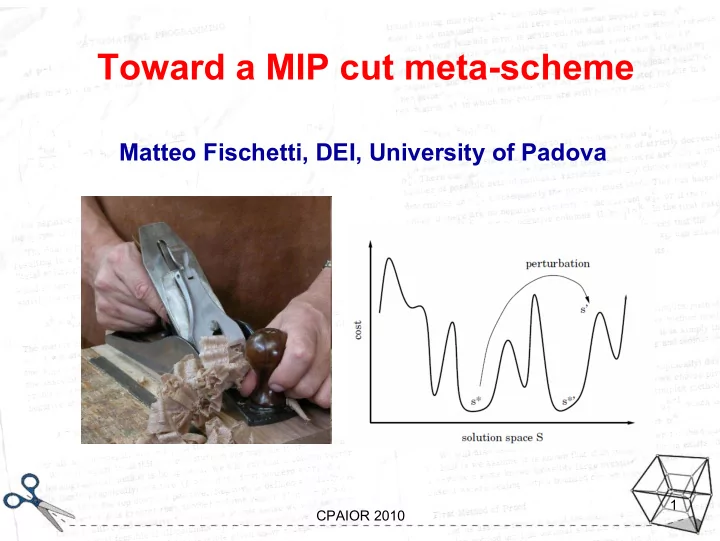
Toward a MIP cut meta-scheme

Matteo Fischetti, DEI, University of Padova

slide-2
SLIDE 2

Looking inside Gomory Aussois, January 7-11 2008

CPAIOR 2010 2

Mixed-Integer Programs (MIPs)

  • We will concentrate on general MIPs of the form

min { c x : A x = b, x ≥ 0, xj integer for some j }

  • Two main story characters

– The LP relaxation (beauty): easy to solve – The integer hull (the beast): convex hull of MIP sol.s, hard to describe

slide-3
SLIDE 3

Looking inside Gomory Aussois, January 7-11 2008

CPAIOR 2010 3

Cutting planes (cuts)

  • Cuts: linear inequalities valid

for the integer hull (but not for the LP relaxation)

  • Questions:

– How to compute? – Are they really useful? – If potentially useful, how to use them?

slide-4
SLIDE 4

Looking inside Gomory Aussois, January 7-11 2008

CPAIOR 2010 4

How to compute the cuts?

  • Problem-specific classes of cuts (with

nice theoretical properties) – Knapsack: cover inequalities, … – TSP: subtour elimination, comb, clique tree, …

  • General MIP cuts only derived from

the input model – Cover inequalities – Flow-cover inequalities – … – Gomory cuts (perhaps the most famous class of MIP cuts)

slide-5
SLIDE 5

Looking inside Gomory Aussois, January 7-11 2008

CPAIOR 2010 5

Gomory cuts: basic version

  • Basic version for pure-integer MIPs (no continuous var.s): Gomory fractional

cuts, also known as Chvàtal-Gomory cuts

  • Given any equation satisfied

by the LP-relaxation points – 1. relax to its ≤ form – 2. relax again by rounding down all left-hand-side coeff.s – 3. improve by rounding down the right-hand-side value

  • Note: all-integer coefficients (good for numerical stability)
slide-6
SLIDE 6

Looking inside Gomory Aussois, January 7-11 2008

CPAIOR 2010 6

Gomory cuts: improved version

  • Gomory Mixed-Integer Cuts (GMICs):

– Some left-hand side coefficients can be increased by a fractional quantity εj ≥ 0 better cuts, though potentially less numerically stable – Can handle continuous variables, if any (a must for MIPs)

slide-7
SLIDE 7

Looking inside Gomory Aussois, January 7-11 2008

CPAIOR 2010 7

GMICs read from LP tableaux

  • GMICs apply a simple formula to the coefficients of a starting equation

– Q. How to define this starting equation (crucial step)? – A. The LP optimal tableau is plenty of equations, just use them!

slide-8
SLIDE 8

Looking inside Gomory Aussois, January 7-11 2008

CPAIOR 2010 8

The two available modules

  • The LP solver

– Input: a set of linear constraints & objective function – Output: an optimal LP tableau (or basis)

  • The GMIC generator

– Input: an LP tableau (or a vertex x* with its associated basis) – Output: a round of GMICs (potentially, one for each tableau row with fractional right-hand side)

slide-9
SLIDE 9

Looking inside Gomory Aussois, January 7-11 2008

CPAIOR 2010 9

How to combine the two modules?

  • A natural (??) interconnection scheme (Kelley, 1960):
  • In theory, this scheme could produce

a finitely-convergent cutting plane scheme, i.e., an exact solution alg.

  • nly based on cuts (no branching)
slide-10
SLIDE 10

Looking inside Gomory Aussois, January 7-11 2008

CPAIOR 2010 10 10

In theory, but … in practice?

  • Stein15: toy set covering instance from MIPLIB
  • LP bound

= 5

  • MIP optimum

= 8

  • multi cut generates rounds of cuts before each LP reopt.
slide-11
SLIDE 11

Looking inside Gomory Aussois, January 7-11 2008

CPAIOR 2010 11 11

LP solution trajectories

  • Plot of the LP-sol. trajectories for single-cut (red) and multi-cut (blue)

versions (multidimensional scaling)

(X,Y) = 2D representation of the x-space (multidimensional scaling)

Both versions collapse after a while why?

slide-12
SLIDE 12

Looking inside Gomory Aussois, January 7-11 2008

CPAIOR 2010 12 12

LP-basis determinant

Exponential growth unstable behavior!

slide-13
SLIDE 13

Looking inside Gomory Aussois, January 7-11 2008

CPAIOR 2010 13 13

Intuition about saturation

  • Cuts work reasonably well on the initial LP polyhedron

… however they create artificial vertices … that tend to be very close one to each other … hence they differ by small quantities and have “weird entries” very like using a smoothing plane on wood

  • LP theory tells that small entries in LP basic sol.s x*

… require a large basis determinant to be described … and large determinants amplify the issue and create numerically unstable tableaux

  • Kind of driving a car on ice with flat tires :
  • Initially you have some grip
  • … but soon wheels warm the ice and start sliding
  • … and the more gas you give the worse!
slide-14
SLIDE 14

Looking inside Gomory Aussois, January 7-11 2008

CPAIOR 2010 14

Gomory’s convergent method

  • For pure integer problems (all-integer data) Gomory

proved the existence of a finitely-convergent solution method only based on cuts, but one has to follow a rigid recipe: – use lexicographic optimization (a must!) – use the objective function as a source for GMICs – be really patient (don’t unplug your PC if nothing seems to happen…)

  • Finite convergence

guaranteed by an enumeration scheme hidden in lexicographic reoptimization (this adds anti-slip chains to Gomory’s wheels…) safe but slow (like driving on a highway with chains…)

slide-15
SLIDE 15

Looking inside Gomory Aussois, January 7-11 2008

CPAIOR 2010 15 15

The underlying enumeration tree

  • Any LP solution x* can be visualized on a lex-tree (xo = c x = objective)
  • The structure of the tree is fixed (for a given lex-order of the var.s)
  • Leaves correspond to integer sol.s of increasing lex-value (left to right)
slide-16
SLIDE 16

Looking inside Gomory Aussois, January 7-11 2008

CPAIOR 2010 16 16

The “good” Gomory (+ lex)

slide-17
SLIDE 17

Looking inside Gomory Aussois, January 7-11 2008

CPAIOR 2010 17 17

The “bad” Gomory (no lex)

lex-value z may decrease risk of loop in case of naïve cut purging!

slide-18
SLIDE 18

Looking inside Gomory Aussois, January 7-11 2008

CPAIOR 2010 18 18

Good Gomory: Stein15 (LP bound)

LP bound = 5; ILP optimum = 8 TB = no-lex multi-cut vers. (as before) LEX = single-cut with lex-optimization

slide-19
SLIDE 19

Looking inside Gomory Aussois, January 7-11 2008

CPAIOR 2010 19 19

Good Gomory: Stein15 (LP sol.s)

Plot of the LP-sol. trajectories for TB (red) and LEX (black) versions

slide-20
SLIDE 20

Looking inside Gomory Aussois, January 7-11 2008

CPAIOR 2010 20 20

Good Gomory: Stein15 (determinant)

TB = multi-cut vers. (as before) LEX = single-cut with lex-opt.

slide-21
SLIDE 21

Looking inside Gomory Aussois, January 7-11 2008

CPAIOR 2010 21

So, what is wrong with Gomory?

  • GMICs are not bad by themselves
  • What is problematic is their use in a naïve

Kelley’s scheme

  • A main issue with Kelley is the closed-loop

nature of the interconnection scheme

  • Closed-loop systems are intrinsically prone

to instability…

  • … unless a filter (like lex-reopt) is used for

input-output decoupling

slide-22
SLIDE 22

Looking inside Gomory Aussois, January 7-11 2008

CPAIOR 2010 22

Brainstorming about GMICs

  • Ok, let’s think “laterally” about

this cutting plane stuff

  • We have a cut-generation module

that needs an LP tableau on input

  • … but we cannot short-cut it directly
  • nto the LP-solver module (soon the

LP determinant burns!)

  • Shall we forget about GMICs and look for more fancy cuts,
  • … or we better design a different scheme to exploit them?
slide-23
SLIDE 23

Looking inside Gomory Aussois, January 7-11 2008

CPAIOR 2010 23

Brainstorming about GMICs

  • This sounds like déjà vu…

… we have a simple module that works well in the beginning … but soon it gets stuck in a corner

  • … Where did I hear this?
  • Oh yeah! It was about heuristics and metaheuristics…

We need a META-SCHEME for cut generation !

slide-24
SLIDE 24

Looking inside Gomory Aussois, January 7-11 2008

CPAIOR 2010 24

Toward a meta-scheme for MIP cuts

  • We stick with simple cut-generation modules; if we get

into trouble… … we don’t give-up but apply a diversification step (isn’t this the name, Fred?) to perturb the problem and explore a different “cut neighborhood”

slide-25
SLIDE 25

Looking inside Gomory Aussois, January 7-11 2008

CPAIOR 2010 25

A diving meta-scheme for GMICs

  • A kick-off (very simple)

scheme: Dive & Gomory Idea: Simulate enumeration by adding/subtracting a bigM to the cost of some var.s and apply a classical GMIC generator to each LP … but don’t add the cuts to the LP (just store them in a cut pool for future use…)

  • A main source of feedback is the presence of previous GMICs in the

LP avoid modifying the input constr.s, use the obj. function instead

slide-26
SLIDE 26

Looking inside Gomory Aussois, January 7-11 2008

CPAIOR 2010 26

D&G results

cl.gap = integrality gap (MIP opt. – LP opt.) closed by the methods

slide-27
SLIDE 27

Looking inside Gomory Aussois, January 7-11 2008

CPAIOR 2010 27

A Lagrangian filter for GMICs

  • As in Dive&Gomory, diversification can

be obtained by changing the objective function passed to the LP-solver module so as to produce LP tableaux that are

  • nly weakly correlated with the LP
  • ptimal solution x* that we want to cut
  • A promising framework is relax-and-cut

where GMICs are not added to the LP but immediately relaxed in a Lagrangian fashion very interesting results to be reported by Domenico (Salvagnin) in his Friday’s talk about “LaGromory cuts”…

slide-28
SLIDE 28

Looking inside Gomory Aussois, January 7-11 2008

CPAIOR 2010 28

Thank you for your attention…

slide-29
SLIDE 29

Looking inside Gomory Aussois, January 7-11 2008

CPAIOR 2010 29

… and of course for not sleeping…

slide-30
SLIDE 30

Looking inside Gomory Aussois, January 7-11 2008

CPAIOR 2010 30

… (is it over … already?)