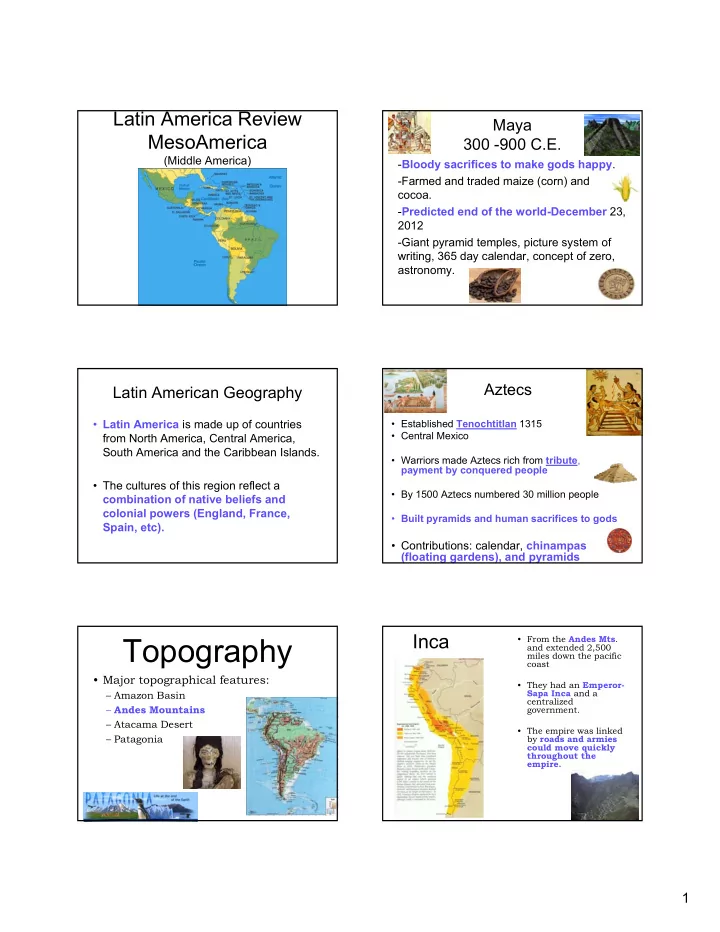
Topography From the Andes Mts . and extended 2,500 miles down the - - PDF document

topography
SMART_READER_LITE
LIVE PREVIEW

Topography From the Andes Mts . and extended 2,500 miles down the - - PDF document

Latin America Review Maya MesoAmerica 300 -900 C.E. (Middle America) - Bloody sacrifices to make gods happy . -Farmed and traded maize (corn) and cocoa. - Predicted end of the world-December 23, 2012 -Giant pyramid temples, picture system of


slide-1
SLIDE 1

1

Latin America Review MesoAmerica

(Middle America)

Latin American Geography

  • Latin America is made up of countries

from North America, Central America, South America and the Caribbean Islands.

  • The cultures of this region reflect a

combination of native beliefs and colonial powers (England, France, Spain, etc).

Topography

  • Major topographical features:

– Amazon Basin – Andes Mountains – Atacama Desert – Patagonia

Maya 300 -900 C.E.

  • Bloody sacrifices to make gods happy.
  • Farmed and traded maize (corn) and

cocoa.

  • Predicted end of the world-December 23,

2012

  • Giant pyramid temples, picture system of

writing, 365 day calendar, concept of zero, astronomy.

Aztecs

  • Established Tenochtitlan 1315
  • Central Mexico
  • Warriors made Aztecs rich from tribute,

payment by conquered people

  • By 1500 Aztecs numbered 30 million people
  • Built pyramids and human sacrifices to gods
  • Contributions: calendar, chinampas

(floating gardens), and pyramids

Inca

  • From the Andes Mts.

and extended 2,500 miles down the pacific coast

  • They had an Emperor-

Sapa Inca and a centralized government.

  • The empire was linked

by roads and armies could move quickly throughout the empire.

slide-2
SLIDE 2

2

Inca

  • Religion: Polytheistic-their chief god was

the Sun God.

  • Contributions: 12,000 miles of roads,

terrace farming, Machu Picchu.

  • Quipus: records kept by colored strings

and knots.

Machu Picchu

Exploration and European Conquest

  • Motives for Exploration: Europeans

looking for routes to riches of Asia

  • New technology: gunpowder, faster

ships, better maps, armaments helped exploration.

The New World

  • Ferdinand and Isabella of Spain

financed Columbus in 1492.

  • Columbus reached the Americas and

in 1494 Spain and Portugal split the Americas in the Treaty of Tordesillas at the Line of Demarcation.

Spain sent over Conquistadors looking for Gold, God & Glory

  • 1519-1521
  • Hernan Cortes

conquered the Aztec empire

  • C-Cortez
  • A-Aztecs
  • M-Mexico
  • 1532
  • Francisco Pizarro

destroyed the Incan Empire in Peru

  • P-Pizarro
  • I-Incas
  • P-Peru

Missionaries spread the Roman Catholic religion in the New World.

Reasons for Spanish Success

  • Spanish used armor, horses and

weapons

  • Spanish formed alliances with other

Native American groups

  • Disease brought by Spanish killed millions
  • f native peoples.
slide-3
SLIDE 3

3 Social Structure of the Spanish Colonies

Peninsulares People born in Spain Creoles Mestizos: People of mixed European and native descent Mulattoes: people of mixed African and European descent Native peoples and peoples of African descent

Columbian Exchange

Wheat Sugar Rice Banana Pig Horse Wine Chicken Small pox Measles typhus Exchanges from the Americas to Europe Maize potato sweet potato Peanut squash beans Tomato Tobacco avocado

Exchange of people, plants, animals, ideas, and technology between “old world” and “new world” – CULTURAL DIFFUSION

Slave Trade

  • Causes

– Disease and Death of Natives – Labor needed for the plantations

  • Middle Passage

– Brutal voyage from Africa to the Americas.

  • Effects

– Local wars in Africa – Strong taken from Africa – Diversity in Latin America

$$Mercantilism$$

  • Mercantilism = Colonies used to

benefit the Parent Nation

  • Exporting more than importing
  • Building up the supply of gold and

silver

Long Term Causes of Latin American Independence Movements

  • European domination of Latin

America.

  • Enlightenment ideas of Locke,

Voltaire & Montesquieu.

  • American and French Revolutions
  • Growth of nationalism

Immediate Causes of the Latin American Independence Movements

  • Creoles, Mestizos & Indians resent

colonial rule.

  • Revolutionary leaders emerge.
  • Napoleon invades Spain & colonies

saw Spain’s weakness as an

  • pportunity to revolt.
slide-4
SLIDE 4

4

Haiti’s Struggle

  • Haiti’s sugar

plantations made it a valuable colony

  • f France

Toussaint L’Ouverture

  • Born into slavery
  • Son of a Noble West

African Family

  • Learned to read
  • Inspired by stories
  • f revolt in ancient

Rome and Julius Caesar

Uprising of 1791

  • Toussaint with support of slaves vs. France,

Spain, Britain and Mulattoes

  • More lives lost than in any other Revolution

in the Americas

Rebuilding Haiti

  • By 1798 enslaved Haitians free
  • Toussaint controlled most of the island
  • Attempted to heal bad feelings between

classes

  • Offered government jobs to whites,

mulattoes & Africans.

Death of Toussaint

  • Toussaint was

betrayed and seized by Napoleon’s men

  • Ten months later in a

French prison Toussaint died

  • 1804 Haitian leaders

declared independence

  • 1820 Haiti a republic

& the only non slave nation in Western Hemisphere

Simon Bolivar

  • Simon Bolivar, an

educated Creole, saw Napoleon’s occupation

  • f Spain the signal to

act.

  • In 1810 he led an

uprising that established a republic in Venezuela

  • Civil war raged &

Bolivar forced into exile

slide-5
SLIDE 5

5

“The Liberator”

  • 1819 Bolivar

marched his army across the Andes and attacked Bogotá

  • Joined forces with

Jose de San Martin

  • By 1824 wars of independence had ended
  • Bolivar’s dream for Gran Columbia

vanished as rivalries flared

  • Gran Columbia split into Venezuela,

Columbia and Ecuador

  • Violent civil wars emerged
  • Long struggle for stability and even longer

for democracy

Cuba

  • Cuba won independence from Spain in

1898.

  • 1952: Batista seized power with a

repressive & corrupt government.

  • Fidel Castro organized a guerrilla army &

fought Batista.

  • 1959: Castro set up a communist

government in Cuba.

Effects of the Cuban Revolution

  • Communist Dictatorship under FIDEL

CASTRO

  • Collective Farms
  • Government control of Industry –

Command economy

  • Seizure of foreign property

Cuban Missile Crisis

  • 1961: U.S. backed a plot by Cuban exiles to

invade Cuba- Bay of Pigs failed.

  • 1962: U.S. trade embargo on Cuba.
  • U.S.S.R. built nuclear missile bases on Cuba (90

miles off coast of Florida).

  • 1962: President Kennedy demanded Soviet

removal of nuclear weapons & blockaded Cuba.

  • U.S.S.R. removed weapons & U.S. promised not

to invade Cuba.

  • The closest we have come to nuclear war!!!!
slide-6
SLIDE 6

6

Hot Spot in the Cold War Augusto Pinochet

  • Oppressive, military dictator in Chili.
  • Human rights abuses- tortured and killed

political dissenters.

  • 1974-1990

Add me…I have been showing up on the exam.

U.S. involvement in Latin America

  • Organization of American States 1948: L.A. &

U.S. created O.A.S. to promote democracy, economic cooperation & human rights.

  • North American Free Trade Agreement:

1990’s U.S., Mexico, & Canada signed NAFTA to allow free trade among the 3 nations. Goal: to bring prosperity to Mexico.

Problems facing Latin America

  • Poverty
  • Political instability
  • Overpopulation – Mexico city
  • Deforestation –Brazilian Rain Forests
  • Endangered species
slide-7
SLIDE 7

7

Regents Questions

slide-8
SLIDE 8

8

slide-9
SLIDE 9

9