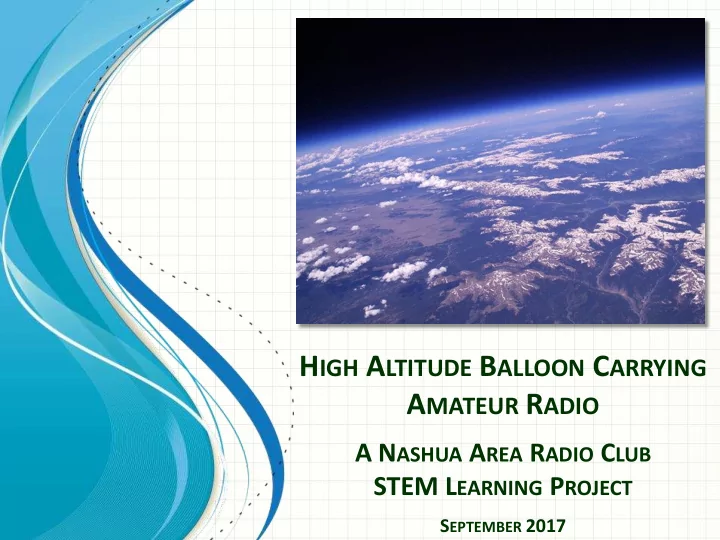
Topics View from our HAB at 90.000+ ft. Project Goals Actual - - PowerPoint PPT Presentation

topics
SMART_READER_LITE
LIVE PREVIEW

Topics View from our HAB at 90.000+ ft. Project Goals Actual - - PowerPoint PPT Presentation

H IGH A LTITUDE B ALLOON C ARRYING A MATEUR R ADIO A N ASHUA A REA R ADIO C LUB STEM L EARNING P ROJECT S EPTEMBER 2017 Topics View from our HAB at 90.000+ ft. Project Goals Actual Flight Path Analysis STEM Learning Elements Our


slide-1
SLIDE 1

HIGH ALTITUDE BALLOON CARRYING AMATEUR RADIO

A NASHUA AREA RADIO CLUB STEM LEARNING PROJECT

SEPTEMBER 2017

slide-2
SLIDE 2

Topics

2

Not to Scale

  • Project Goals
  • STEM Learning Elements
  • HAB Flight Planning & Flight

Path Modeling

  • Actual Flight Path Analysis
  • Our HAB’s Flight
  • Q&A

View from our HAB at 90.000+ ft.

slide-3
SLIDE 3

What Were We Trying To Do?

Goals

3

Not to Scale

  • Assemble and launch a High-Altitude Balloon(HAB)

carrying Amateur Radio

  • Get young people involved in the project and in

STEM Learning via Amateur Radio

  • Planning
  • Platform testing
  • Launch, tracking and recovery
  • Analysis of flight data
  • Learn and develop HAB technology across multiple

launches

Balloon Just Before Burst

slide-4
SLIDE 4

Timeline To First Launch

4

Not to Scale

Project Start Minimum Funding

  • Req. Met

Set Launch Date & Site Phase I Launch!

Analyze, Learn and Present Build & Launch! Detailed Planning Funding Feasibility Startup Planning

  • Prelim. Flight Plan

Refine Budget

  • Dev. Fund Raising

Package & Plan Youth Engagement Plan/School Signup Raise Money Form Youth Teams & Set Final Goals/Plan Purchase Equipment Begin Phase I Build & Test Data Analysis, Preso, Prep & Presentations

Youth Teams In Place

Late May, Early June

  • Feb. 2nd

March 2nd

Project Launch Go/No Go

  • Jan. 5th
slide-5
SLIDE 5

Our Students and Teachers

5

Not to Scale

Bishop Guertin HS STEM Club Merrimack HS Physics Students Independent Students

slide-6
SLIDE 6

HAB Project

What Our Students Did

6

Not to Scale

  • Determine flight parameters for

Helium Balloon Platform < 4 lb.

  • Target altitude: 90,000+ ft
  • Parachute controls decent rate after balloon bursts
  • Launch and Track HAB via the Internet using On-board 2m APRS

Radio Transmitter

  • Flight computer records data throughout the flight
  • Capture Video of flight using on-board GoPro Cameras
  • Analyze HAB telemetry and sensor data to learn about the

atmosphere

  • Hands-on activities included –
  • Planning the flight path
  • Making HAB flight design decisions
  • Planning science experiments
  • Testing the payload
  • HAB launch, tracking & recovery
  • Analyzing telemetry results
  • Helping to define our goals for

additional launches after the initial one

slide-7
SLIDE 7

STEM Learning Outline

Atmospheric Sci. Terminal Physics

Flight Path Predictions

Flight Physics

7

Radio Telemetry and Sensor Technology Filing a Flight Plan

Open House at Member’s Station to Test HAB and Explore Amateur Radio Taught Over Five 1 ½ – 2 hour Classroom Sessions

slide-8
SLIDE 8

Pressure Phenomena

Example STEM Learning Topic

8

  • The molecules that make up the

atmosphere are pulled close to the earth's surface by gravity.

  • The atmosphere is concentrated

at the surface and thins rapidly with altitude.

  • Air pressure is a measure of the

weight of the molecules above you.

  • As you move higher, there are

fewer molecules above you, so the air pressure is lower.

  • At 10 miles up, 90% of the

atmosphere is below you.

Burst

HAB Sensors Measure Pressure Enabling Students to Compare Actual Flight Conditions to Model

slide-9
SLIDE 9

9

Not to Scale

  • The troposphere is warmer near the

Earth’s surface because heat from the Earth warms this air.

  • As the altitude increases the number of air

molecules decreases, thus the average of their kinetic energy decreases. The results is a decrease in air temperature with an increase of altitude.

  • From 10-20 km the atmosphere is stable.

This region is called the tropopause.

  • From 20-50 km is the stratosphere. Ozone

is concentrated in this layer and it absorbs UV light from the Sun.

  • More light is absorbed at higher altitudes

compared to the lower stratosphere, so the temperature increases.

Burst

Temperature Changes

Example STEM Learning Topic

HAB Sensors Measure Temperature Enabling Students to Compare Actual Flight Conditions to Model

slide-10
SLIDE 10
  • Closest VOR beacon is

Keene, NH (Call sign E-E-N)

  • Launch site heading from

this VOR is 260O

  • Distance from VOR beacon

is approx. 8.6 km or 4.6 nautical miles

– 1 km = 0.54 nautical mi.

  • Launch time and 60 ft.

altitude windows

  • Direction and estimated

landing times

10

“Launching Echo-Echo-November VOR, Radial Two-Six- Zero, at 4.6 Nautical Miles”

Filing a Flight Plan

Learning Element

slide-11
SLIDE 11

Amateur Radio

Open House

  • Test the HAB’s radios and

computer; test with an APRS ground station

  • Tour an active Amateur Radio station and learn

more about Amateur Radio Communications

  • Get on the air and talk to Amateurs around the

world

  • Make a contact through a satellite in space
  • Locate a hidden radio transmitter

11

slide-12
SLIDE 12

High Altitude Balloon

Our Approach

12

Not to Scale

HAB During Ascent Flight Platform & Parachute

slide-13
SLIDE 13

High Altitude Balloon Project

Weather Balloons

13

Not to Scale

Large Balloon (6-8 ft in diameter on ground) Burst Diameter (30+ ft at final altitude)

slide-14
SLIDE 14

HAB Flight Platform

Lightweight Components

14

Flight Computer GoPro Cameras Commercial Satellite Tracker APRS Transmitter

slide-15
SLIDE 15

Flight Planning

What’s Involved?

15

  • Based upon payload weight, select

balloon size, target altitude and flight time

  • Balloon Performance Calculator
  • Predict flight path based upon Jetstream conditions
  • Estimate balloon direction and downrange distance Launch

site/date selection, recovery planning

  • Launch date and location choice important to avoid ocean

landing

  • File a Flight Plan with the FAA
  • Contingencies – spare balloon & helium, plan to locate payload

after dark, GPS/Compass, spare batteries, ….

slide-16
SLIDE 16

16

Flight Planning

Balloon Calculator

Launch Site: Winchester, NH elem. School: Lat = 42.767896 / Lon = -72.377026

Balloon Calculator Input Window

155

Average ascent speed Burst altitude Descent rate (at impact) Launch date and time Define launch location

slide-17
SLIDE 17

17

Flight Planning

Flight Path Modeling Tool

We used an online software package from a HAB prediction site: http://predict.habhub.org/

slide-18
SLIDE 18

APRS Telemetry

HAB Packets (From our HAB Test Session via aprs.fi)

18

  • Call Sign – identifies the person or group licensed to transmit

− May include information about the type of station they are using

N1FD -11

The Nashua Area Radio Club Type for Balloon, Aircraft or Spacecraft

2017-04-07 21:16:50 EDT: N1FD-11>CQ,WIDE1-1,WIDE2-2,qAR,NX1W:!4242.70N/07135.41WO148/000/A=000351RadBug,16C,984mb,3,001 2017-04-07 21:17:50 EDT: N1FD-11>CQ,WIDE1-1,WIDE2-2,qAR,AB1OC-10:!4242.70N/07135.41WO148/000/A=000354RadBug,10C,984mb,3,002 2017-04-07 21:18:50 EDT: N1FD-11>CQ,WIDE1-1,WIDE2-2,qAR,NX1W:!4242.70N/07135.41WO148/000/A=000360RadBug,08C,985mb,3,003 2017-04-07 21:19:50 EDT: N1FD-11>CQ,WIDE1-1,WIDE2-2,qAR,AB1OC-10:!4242.70N/07135.41WO148/000/A=000360RadBug,06C,985mb,3,004 2017-04-07 21:20:50 EDT: N1FD-11>CQ,WIDE1-1,WIDE2-2,qAR,NX1W:!4242.70N/07135.41WO148/000/A=000347RadBug,05C,985mb,3,005 2017-04-07 21:21:51 EDT: N1FD-11>CQ,WIDE1-1,WIDE2-2,qAR,NX1W:!4242.70N/07135.41WO148/000/A=000344RadBug,05C,985mb,3,006 2017-04-07 21:22:51 EDT: N1FD-11>CQ,WIDE1-1,WIDE2-2,qAR,NX1W:!4242.70N/07135.41WO174/000/A=000347RadBug,04C,985mb,3,007 2017-04-07 21:23:51 EDT: N1FD-11>CQ,WIDE1-1,WIDE2-2,qAR,NX1W:!4242.70N/07135.41WO174/000/A=000344RadBug,04C,985mb,3,008 2017-04-07 21:24:51 EDT: N1FD-11>CQ,WIDE1-1,WIDE2-2,qAR,NX1W:!4242.70N/07135.41WO325/000/A=000347RadBug,04C,985mb,3,009 2017-04-07 21:25:52 EDT: N1FD-11>CQ,WIDE1-1,WIDE2-2,qAR,NX1W:!4242.70N/07135.41WO325/000/A=000351RadBug,04C,985mb,3,010 2017-04-07 21:26:52 EDT: N1FD-11>CQ,WIDE1-1,WIDE2-2,qAR,AB1OC-10:!4242.70N/07135.41WO325/000/A=000351RadBug,04C,985mb,3,011 2017-04-07 21:27:52 EDT: N1FD-11>CQ,WIDE1-1,WIDE2-2,qAR,NX1W:!4242.70N/07135.41WO325/000/A=000351RadBug,04C,985mb,3,012 2017-04-07 21:28:51 EDT: N1FD-11>CQ,WIDE1-1,WIDE2-2,qAR,NX1W:!4242.70N/07135.41WO325/000/A=000351RadBug,04C,985mb,3,013 2017-04-07 21:29:52 EDT: N1FD-11>CQ,WIDE1-1,WIDE2-2,qAR,AB1OC-10:!4242.70N/07135.41WO109/000/A=000351RadBug,04C,985mb,3,014 2017-04-07 21:30:51 EDT: N1FD-11>CQ,WIDE1-1,WIDE2-2,qAR,NX1W:!4242.70N/07135.41WO109/000/A=000347RadBug,04C,985mb,3,015 2017-04-07 21:31:51 EDT: N1FD-11>CQ,WIDE1-1,WIDE2-2,qAR,NX1W:!4242.70N/07135.41WO109/000/A=000351RadBug,04C,985mb,3,016 2017-04-07 21:32:51 EDT: N1FD-11>CQ,WIDE1-1,WIDE2-2,qAR,NX1W:!4242.70N/07135.41WO266/000/A=000360RadBug,04C,985mb,3,017 2017-04-07 21:33:51 EDT: N1FD-11>CQ,WIDE1-1,WIDE2-2,qAR,NX1W:!4242.70N/07135.41WO266/000/A=000360RadBug,04C,985mb,3,018 2017-04-07 21:34:51 EDT: N1FD-11>CQ,WIDE1-1,WIDE2-2,qAR,NX1W:!4242.70N/07135.41WO266/000/A=000360RadBug,04C,985mb,3,019 2017-04-07 21:35:51 EDT: N1FD-11>CQ,WIDE1-1,WIDE2-2,qAR,NX1W:!4242.70N/07135.41WO269/000/A=000364RadBug,04C,985mb,3,020 2017-04-07 21:36:51 EDT: N1FD-11>CQ,WIDE1-1,WIDE2-2,qAR,NX1W:!4242.71N/07135.41WO269/000/A=000367RadBug,08C,985mb,3,021 2017-04-07 21:37:52 EDT: N1FD-11>CQ,WIDE1-1,WIDE2-2,qAR,AB1OC-10:!4242.71N/07135.41WO045/001/A=000364RadBug,13C,984mb,3,022 2017-04-07 21:38:52 EDT: N1FD-11>CQ,WIDE1-1,WIDE2-2,qAR,AB1OC-10:!4242.71N/07135.41WO056/000/A=000367RadBug,15C,984mb,3,023

Actual Packets from our HAB during a test

HAB Packets on aprs.fi

slide-19
SLIDE 19

HAB’s Flight Path – Predicted vs. Actual

Tracking via 2m APRS on aprs.fi

19

Predicted Flight Path from Pre-Flight Modeling Actual HAB Flight Track (Tracked via Cell Phones, Tablets, anything with a Web Browser)

Predicted Landing Pt.

slide-20
SLIDE 20

Our HAB’s Flight

Launch, Flight, and Recovery

20

Not to Scale

slide-21
SLIDE 21

21

Thank You!

Nashua Area Radio Club HAB Project Team Members:

  • Anthony, KC1DXL
  • Brian, AB1ZO
  • Curtis, N1CMD
  • Jamey, KC1ENX
  • Anita, AB1QB
  • Fred, AB1OC
  • Wayne, AG1A

We are planning another HAB project this fall and have two schools on-board so far. If you’d like to partner with us this fall, please contact Fred Kemmerer, AB1OC ab1oc@arrl.net More information, pictures, and video are available on The Nashua Area Radio Club’s website at: www.n1fd.org