Topics Interstate Compact for Juveniles (ICJ) NC District Court - - PDF document

topics
SMART_READER_LITE
LIVE PREVIEW

Topics Interstate Compact for Juveniles (ICJ) NC District Court - - PDF document

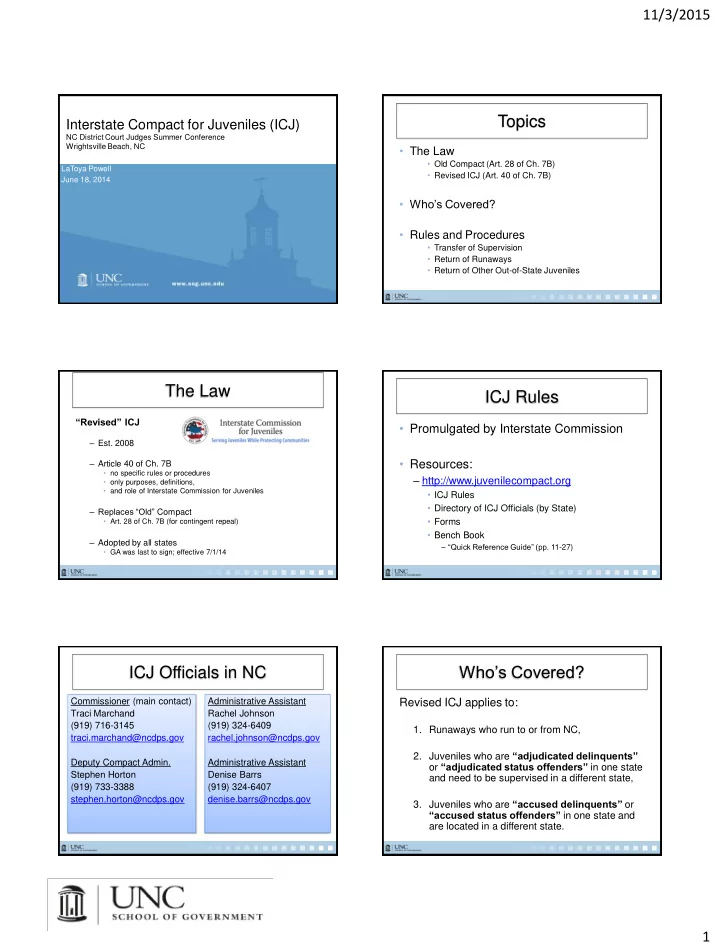
11/3/2015 Topics Interstate Compact for Juveniles (ICJ) NC District Court Judges Summer Conference Wrightsville Beach, NC The Law Old Compact (Art. 28 of Ch. 7B) LaToya Powell Revised ICJ (Art. 40 of Ch. 7B) June 18, 2014


slide-1
SLIDE 1

11/3/2015 1

Interstate Compact for Juveniles (ICJ)

NC District Court Judges Summer Conference Wrightsville Beach, NC LaToya Powell June 18, 2014

Topics

  • The Law
  • Old Compact (Art. 28 of Ch. 7B)
  • Revised ICJ (Art. 40 of Ch. 7B)
  • Who’s Covered?
  • Rules and Procedures
  • Transfer of Supervision
  • Return of Runaways
  • Return of Other Out-of-State Juveniles

The Law

“Revised” ICJ

– Est. 2008 – Article 40 of Ch. 7B

  • no specific rules or procedures
  • only purposes, definitions,
  • and role of Interstate Commission for Juveniles

– Replaces “Old” Compact

  • Art. 28 of Ch. 7B (for contingent repeal)

– Adopted by all states

  • GA was last to sign; effective 7/1/14

ICJ Rules

  • Promulgated by Interstate Commission
  • Resources:

– http://www.juvenilecompact.org

  • ICJ Rules
  • Directory of ICJ Officials (by State)
  • Forms
  • Bench Book

– “Quick Reference Guide” (pp. 11-27)

ICJ Officials in NC

Commissioner (main contact) Traci Marchand (919) 716-3145 traci.marchand@ncdps.gov Deputy Compact Admin. Stephen Horton (919) 733-3388 stephen.horton@ncdps.gov Administrative Assistant Rachel Johnson (919) 324-6409 rachel.johnson@ncdps.gov Administrative Assistant Denise Barrs (919) 324-6407 denise.barrs@ncdps.gov

Who’s Covered?

Revised ICJ applies to:

  • 1. Runaways who run to or from NC,
  • 2. Juveniles who are “adjudicated delinquents”
  • r “adjudicated status offenders” in one state

and need to be supervised in a different state,

  • 3. Juveniles who are “accused delinquents” or

“accused status offenders” in one state and are located in a different state.

slide-2
SLIDE 2

11/3/2015 2

Definition of “Juvenile”

Juvenile - Any person defined as a juvenile in any member state or by ICJ rules.

Transfer of Supervision

  • ICJ Officials

– Complete forms

  • Waiver (ICJ Form IA/VI)

– Process referrals – Approve or deny transfer requests District Court Judges have no authority to authorize

  • r deny transfer of supervision.

Transfer Eligibility Requirements

  • defined as “juvenile” in sending state
  • subject to some form of supervision

– adjudicated delinquent, adjudicated status offender – or deferred adjudication

  • still under jurisdiction of sending state
  • length of relocation and supervision are both > 90 days
  • juvenile will either:

– reside with parent, legal guardian, relative, non-relative, or live independently (not in residential facility); or – be a full-time student. ICJ Rule 4-101

Residential Facilities

  • No transfer of supervision for placement in
  • ut-of-state residential treatment facility

– ICJ Rule 4-101(2)(f)

  • But, ICPC may allow placement

– Only certain facilities (e.g., PRTF, YDC) – See, e.g.,

  • G.S. 7B-3800, Art. VI
  • G.S. 7B-3805

Restrictions on Transfer

Transfer may be denied if:

– sole purpose is to collect restitution – home evaluation finds placement “unsuitable” – juvenile is not in “substantial compliance” with terms of supervision

 Except when juvenile’s only parent or legal guardian is located in receiving state

ICJ Rule 4-104

Approval Process

Classified as juvenile in sending state Adjudicated delinquent, adjudicated status

  • ffender, or deferred

adjudication in sending state Under jurisdiction of court or other authority in sending state Minimum residential requirements met Purpose of transfer not merely for collection of restitution Minimum length of supervision met Home evaluation completed & placement approved Juvenile’s supervision may be transferred

slide-3
SLIDE 3

11/3/2015 3

Special Considerations

  • Jurisdiction

– Remains with sending state – Sending state handles:

  • Violations
  • Termination of supervision
  • Transportation
  • Cost of Treatment

– Paid by sending state, if not covered by Medicaid or private insur. (unless provided by supervising agency)

  • Juvenile Sex Offenders

– Laws of receiving state govern

  • Sex offender registration, Victim notification, DNA testing

Retaking / Failed Placement

  • Sending state can:

– Enter and retake juvenile

  • w/o court procedures, if juvenile signed waiver form

(ICJ Form IA/VI)

– Issue warrant for arrest (if retaking not practical)

  • Retaking requires consent of receiving state

– If juvenile has pending charge there

ICJ Rule 5-103

ICJ vs. Extradition

  • Uniform Criminal Extradition Act (UCEA)

permits extradition of juveniles

– If charged/adjudicated offense is a “crime”

» In re Boynton, 302 Mich. App. 632 (2013) » State v. J.M.W., 936 So.2d 555 (Ala. Crim. App. 2005) » But see, People v. Butts, 14 N.Y .S.2d 881 (1939, Supp)

– ICJ Form IA/VI waives any extradition rights

UCEA inapplicable to runaways

Return of Out of State Juveniles

May occur in 1 of 4 ways:

  • 1. Retaking (upon failed placement)
  • 2. Release of Runaway to Parent/Guardian

– w/n 24 hrs (excluding wknds & holidays)

  • 3. Voluntary Return (ICJ Form III)
  • 4. Non-Voluntary Return (Requisition Form I or II)

Release to Parent/Guardian

  • Permitted w/n 24 hrs of

detainment

– unless abuse/neglect suspected

  • Beyond 24 hrs

– Notification of home state’s ICJ Office required – ICJ due process hearing – Secure custody ICJ Rule 6-101

Abuse/Neglect Allegation

“Holding” State must:

  • Notify home state’s ICJ

Office

  • Hold juvenile in secure

custody (max. 90 days) until . . .

– Voluntary return (Form III) – Requisition I

“Home” State must:

  • Facilitate juvenile’s safe

return with appropriate authority (i.e. DSS)

  • Initiate requisition, if

juvenile not returning to parent/guardian and

– does not consent to voluntary return

slide-4
SLIDE 4

11/3/2015 4

Voluntary Return (Form III)

  • Due Process Procedures:
  • Hearing held in holding state
  • Advisement of rights (see ICJ Form)
  • Counsel and/or guardian ad litem appointed
  • Form III (signed by juvenile & judge)
  • Return to home state w/n 5 days

Applies to any out-of-state juvenile

ICJ Rule 6-102

Non-Voluntary Return

Runaways and Accused Status Offenders

Procedure in home state:

– Parent/Guardian files petition w/ ICJ Office – ICJ Office files “Requisition I” – Judge must find:

  • Petitioner entitled to legal custody
  • Juvenile ran away w/o consent
  • Juvenile not emancipated
  • Return is in juvenile’s best interests

– Requisition packet forwarded to holding state

ICJ Rule 6-103

Court in holding state must:

– Hold hearing w/n 30 days of receipt – Decide whether to appoint counsel and/or guardian ad litem – Determine

  • “if the Requisition Form I is in order”

Non-Voluntary Return

Runaways and Accused Status Offenders

Judge “shall order the juvenile’s return” to home state if requisition is found to be in order. ICJ Rule 6-103(5)

Non-Voluntary Return

Escapee, Absconder, Accused Delinquent Procedure in home state:

– ICJ Office files “Requisition II”

  • w/ supporting documentation (petition, orders, etc.)

– Judge signs requisition – Requisition packet forwarded to holding state ICJ Rule 6-103A

Non-Voluntary Return

Escapee, Absconder, Accused Delinquent Court in holding state must:

– Hold hearing w/n 30 days of receipt – Decide whether to appoint counsel and/or guardian ad litem – Determine

  • “if the Requisition Form II is in order”

Judge “shall order the juvenile’s return” to home state if requisition is found to be in order.

ICJ Rule 6-103A(5)

Required Findings

In re Teague, 91 N.C. App. 242 (1988)

– Trial court’s finding that “requisition is in order” was insufficient to return escaped juvenile to SC. – Held that ICJ (implicitly) required trial court to find that the juvenile being requisitioned is same juvenile before the court.

slide-5
SLIDE 5

11/3/2015 5

Non-Voluntary Return

Additional Procedures (applicable to any non-voluntary return):

– Home state returns juvenile w/n 5 days of receipt of order granting requisition – Denial of requisition requires written findings – Juvenile may be held in secure custody for

  • max. of 90 days pending return