Topic 3: Classes Objective for first two weeks: convert skills from - - PowerPoint PPT Presentation

topic 3 classes
SMART_READER_LITE
LIVE PREVIEW

Topic 3: Classes Objective for first two weeks: convert skills from - - PowerPoint PPT Presentation

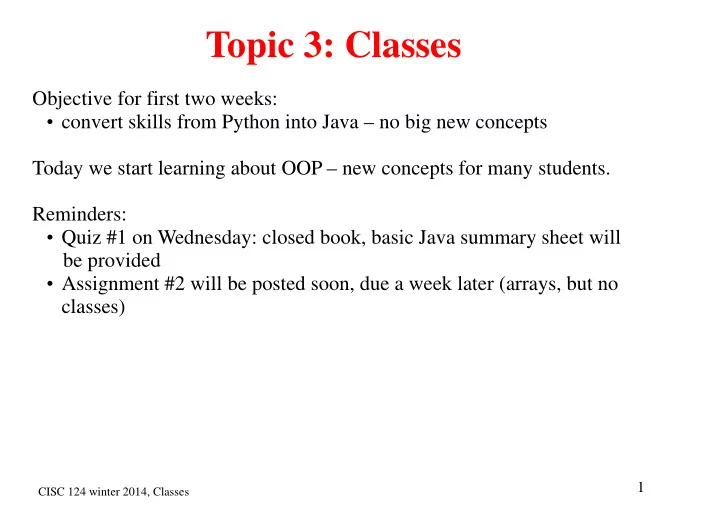
Topic 3: Classes Objective for first two weeks: convert skills from Python into Java no big new concepts Today we start learning about OOP new concepts for many students. Reminders: Quiz #1 on Wednesday: closed book, basic Java


slide-1
SLIDE 1

1

CISC 124 winter 2014, Classes

Objective for first two weeks:

  • convert skills from Python into Java – no big new concepts

Today we start learning about OOP – new concepts for many students. Reminders:

  • Quiz #1 on Wednesday: closed book, basic Java summary sheet will

be provided

  • Assignment #2 will be posted soon, due a week later (arrays, but no

classes)

Topic 3: Classes

slide-2
SLIDE 2

2

CISC 124 winter 2014, Classes

Three important elements:

  • encapsulation (this topic)
  • inheritance
  • polymorphism

Object-Oriented Programming

Encapsulation means: Putting several pieces of data together & viewing them as a unit (an object) Includes "information hiding" – constrains how you can use & change data inside an object (next topic)

slide-3
SLIDE 3

3

CISC 124 winter 2014, Classes

Objective: group several pieces of data together Example: information about a restaurant

  • name (string)
  • rating (integer)
  • average cost of a meal (double)
  • vegetarian choices? (boolean)

Simplest Kind of Class

slide-4
SLIDE 4

4

CISC 124 winter 2014, Classes

Object Example

Restaurant object: name: "River Mill" rating: 5 avgCost: 35.00 hasVeg: false name, rating, avgCost, hasVeg: attributes or "instance variables" Class: template/blueprint for a kind of object Look at Restaurant class....

slide-5
SLIDE 5

5

CISC 124 winter 2014, Classes

Restaurant class goes in file Restaurant.java – a Java requirement One class per file (usually).

Classes & Files

simple example using Restaurant class.... note constructor & "." notation DiningGuide.java and Restaurant.java in same folder. DiningGuide code automatically finds Restaurant class.

slide-6
SLIDE 6

6

CISC 124 winter 2014, Classes

Restaurant = class

  • bject can be an instance of Restaurant

name, rating, etc: instance variables – every instance has them

  • ther terms: attributes, fields

creating an object: instantiating the class

Vocabulary

Every value in Java is either a primitive value (number, char, boolean)

  • r an object.

arrays are special objects with their own syntax String is a predefined Java class – contains characters & length.

slide-7
SLIDE 7

7

CISC 124 winter 2014, Classes

Objects can also contain methods. Anthropomorphize:

  • bject remembers information (instance variables)

also knows how to do things (instance methods)

Instance Methods

Example: add instance methods to Restaurant to increase rating by one (but not go over 5) change name ask if rating is 3 or more Uses for instance methods:

  • return or output information about the object
  • change information inside the object
slide-8
SLIDE 8

8

CISC 124 winter 2014, Classes

Common need: String representation of object for output Convention: create toString method, returning String Add toString to Restaurant....

Special Method: toString

Using toString: System.out.println(rivMill.toString()); shortcut: System.out.println(rivMill); Java knows about toString – special method name. If you try to print an object, Java automatically calls its toString.

slide-9
SLIDE 9

9

CISC 124 winter 2014, Classes

to create and initialize an object: Restaurant hardRock = new Restaurant(); hardRock.name = "Hard Rock Cafe"; hardRock.rating = 4; hardRock.avgCost = 12.50; hardRock.hasVeg = true;

Writing Your Own Constructors

Create a constructor with parameters to do this in one step....

slide-10
SLIDE 10

10

CISC 124 winter 2014, Classes

  • 1. If you don't define any constructors, you get a default constructor

with no parameters.

  • 2. If you define a constructor, you lose the default constructor.
  • 3. If you want your own plus a zero-parameter constructor, you

must write a zero-parameter constructor.

Java Constructor Rules

slide-11
SLIDE 11

11

CISC 124 winter 2014, Classes

Public vs. Private Instance Variables

public class Restaurant { .... private int rating; .... } // in another class: Restaurant r = new... System.out.print(r.rating); r.rating = 3; // not legal!!! public class Restaurant { .... public String name; .... } // in another class: Restaurant r = new... System.out.print(r.name); r.name = "Golden Griddle"; // using r.name is legal

slide-12
SLIDE 12

12

CISC 124 winter 2014, Classes

  • 1. Protect yourself against mistakes – get control over values

(example: rating must be between 1 and 5)

  • 2. Emphasis on what you can do with object, not format of data.
  • 3. Possible to change representations without affecting user.
  • 4. Create a "read-only" attribute.

Why Use Private???

slide-13
SLIDE 13

13

CISC 124 winter 2014, Classes

get method: return value of an attribute set method: change value of an attribute (if you want to allow this)

  • ften includes checks

Get & Set Methods

slide-14
SLIDE 14

14

CISC 124 winter 2014, Classes

useful for a payroll program....

New Example: Employee class

slide-15
SLIDE 15

15

CISC 124 winter 2014, Classes

Interface: How to use the class.

  • names & types of public variables and methods
  • plus comments/external documentation describing use

Class Interface vs. Implementation

Implementation: Inner workings of the class

  • private variables and methods
  • method bodies (how methods work)

Goal of information hiding:

  • Provide abstract view of class for users (only what they need to know)
  • You can change the implementation without affecting users
slide-16
SLIDE 16

16

CISC 124 winter 2014, Classes

Sometimes useful to refer to whole object inside an object method.

“this”

We want to call from an instance method: public void zero() { Accounting.writeCheck(this); payOwed = 0; } // end zero Example: Suppose there's a method in another class that takes an Employee as a parameter: Accounting.writeCheck(Employee e) {...

slide-17
SLIDE 17

17

CISC 124 winter 2014, Classes

Another use for “this”

// Constructor uses awkward parameter names to avoid // confusion public Employee(String theName, String theTitle, double theWage) { name = theName; jobTitle = theTitle; wage = theWage; .... // Alternate version using "this" public Employee(String name, String jobTitle, double wage) { this.name = name; this.jobTitle = jobTitle; this.wage = wage; ....

slide-18
SLIDE 18

18

CISC 124 winter 2014, Classes

// create employee – general case public Employee(String theName, String title, double w) { name = theName; jobTitle = title; payOwed = 0; if (w < 0) { System.out.println("Error"); wage = 0; } else wage = w; } // end constructor

Overloaded Constructors

// create employee with default starting wage public Employee(String theName, String title) { name = theName; jobTitle = title; payOwed = 0; wage = 10.0; } // end constructor

duplicated code

slide-19
SLIDE 19

19

CISC 124 winter 2014, Classes

// create employee – general case public Employee(String theName, String title, double w) { name = theName; jobTitle = title; payOwed = 0; if (w < 0) { System.out.println("Error"); wage = 0; } else wage = w; } // end constructor

A Better Way

// create employee with default starting wage public Employee(String theName, String title) { this(theName, title, 10.0); // call to other constructor } // end constructor

slide-20
SLIDE 20

20

CISC 124 winter 2014, Classes

In constructor from last slide:

Constants

public Employee(String theName, String title) { this(theName, title, 10.0); } // end constructor

Problem with using 10.0 here? Better version using named constant:

public static final double MINIMUM_WAGE = 10.0; public Employee(String theName, String title) { this(theName, title, MINIMUM_WAGE); } // end constructor

Why is it OK for the constant to be public?

slide-21
SLIDE 21

21

CISC 124 winter 2014, Classes

name: instance variable Every Employee object has a name A name is a property of a particular Employee

Class Variables (Static)

A class variable is a property of a whole class. One value, visible to all the instances of the class. Example for Employee: class variable to keep track of maximum wage being paid Initially set to zero (at start of program) Updated when?

slide-22
SLIDE 22

22

CISC 124 winter 2014, Classes

Good information hiding: maxWage is private use public “get” method to access

  • ther classes may not change directly

Class Method

To call a class method from outside the class: use class name, not object name Employee.getMaxWage()

slide-23
SLIDE 23

23

CISC 124 winter 2014, Classes

public static final double MINIMUM_WAGE = 10.0;

constants & static

Why is the constant static?

slide-24
SLIDE 24

24

CISC 124 winter 2014, Classes

Static-Only Classes

Example: Math class contains useful constants and methods: Math.PI Math.sqrt() Math.log() etc. no instance variables everything is static Typical Java program:

  • ne static-only "main" class
  • ther classes containing mix of static & instance data
slide-25
SLIDE 25

25

CISC 124 winter 2014, Classes

Employee e = new Employee(....);

References & Aliases

What does Java do?

  • 1. finds a free spot in memory
  • 2. creates a new Employee object in that memory
  • 3. variable e holds a reference to that object – its address in memory

Possible to have two variables referring to the same object -- two aliases for the object. When you pass an object as a parameter, you're passing a reference. Parameter & argument are two aliases for the same object.

slide-26
SLIDE 26

26

CISC 124 winter 2014, Classes

Employee a = new Employee("Mickey", "mouse", 10); Employee b = new Employee("Donald", "duck", 20); Employee c = b; c.raise(5); b.raise(5); a.raise(5); System.out.println(a); System.out.println(b); System.out.println(c);

Aliasing Example (1)

slide-27
SLIDE 27

27

CISC 124 winter 2014, Classes

Employee d = new Employee("d", "d job", 10); Employee e = new Employee("e", "e job", 10); Employee f = new Employee("f", "f job", 10); f = e; e = d; d = f; d.pay(5); d = e; d.pay(7); d = f; d.pay(3); System.out.println(d); System.out.println(e); System.out.println(f);

Aliasing Example (2)

slide-28
SLIDE 28

28

CISC 124 winter 2014, Classes

A class is immutable if:

  • all instance variables are private
  • there are no methods that change the instance variables

Immutable Classes

How do the instance variables get values? Once an immutable object is created, its contents never change.

slide-29
SLIDE 29

29

CISC 124 winter 2014, Classes

In Java, String is an immutable class. All Strings are immutable – can't be changed.

Example: String

String s = “CISC 124”; s = s.substring(0,4); Have we changed a string??

slide-30
SLIDE 30

30

CISC 124 winter 2014, Classes

Reasons to use packages:

  • organizing large programs
  • distribution
  • name conflicts

Packages

method1 Program Package1 Package2 Package3 Class1 Class2 .... .... method2 method3 ....

slide-31
SLIDE 31

31

CISC 124 winter 2014, Classes

java.lang

Package java.lang contains very commonly used classes. Automatically imported into your program – no import statement needed. Examples: String System Digression: Java API documentation (URL on Resources page of the web site)

slide-32
SLIDE 32

32

CISC 124 winter 2014, Classes

null

Special value: null. Any object type can take the value null: String s = null; Employee e = null; Scanner sc = null; .... Means "no object" -- like None in Python. Usually implemented as an address of zero.

slide-33
SLIDE 33

33

CISC 124 winter 2014, Classes

Default Values

If an instance/class variable isn't explicitly initialized, it gets a default value: numbers: 0 boolean: false characters: '\0'

  • bjects: null

Different rule for local variables (inside methods): If variable isn't initialized before use it's an error.

slide-34
SLIDE 34

34

CISC 124 winter 2014, Classes

One More Example: Time

Things to note:

  • overloaded constructors, including copy constructor
  • use of static methods
  • two kinds of addition methods (one instance, one static)
  • equals method
slide-35
SLIDE 35

35

CISC 124 winter 2014, Classes

Representation Choices

Class as it is:

  • remembers hour, minute, second
  • set/get methods, toString are simple
  • arithmetic is more difficult

Another possibility:

  • replace hour/minute/second with total seconds
  • arithmetic is simple
  • set/get and toString are more difficult
  • saves space

If we changed representation:

  • what would implementor have to change?
  • what would users have to change?
slide-36
SLIDE 36

36

CISC 124 winter 2014, Classes

Convenient Notation: UML

Unified Modeling Language different kinds of diagrams for representing program design UML class diagrams: shows contents of classes ***I will not ask you to write UML for assignments/quizzes/exams. ***I may ask you to read simple UML class diagrams

slide-37
SLIDE 37

37

CISC 124 winter 2014, Classes

Detailed class diagram for the Employee class:

UML

methods name of class

attributes

"+" means public "-" means private “$” means static

Employee

  • name: String
  • jobTitle: String
  • wage: double
  • payOwed: double
  • $maxWage: double

+$Employee(name:String, title:String) +getName(): String +setTitle(newTitle:String) +$getMaxWage(): double .........

slide-38
SLIDE 38

38

CISC 124 winter 2014, Classes

Previous diagram showed lots of detail. Other possible class diagrams for Employee:

UML

Employee name jobTitle wage payOwed Employee Employee +$Employee() +getName() +setTitle() +$getMaxWage() ..... Employee +$Employee(name:String, title:String) +getName(): String +setTitle(newTitle:String) +$getMaxWage(): double .........

Amount of detail depends on:

  • stage of planning
  • audience
  • purpose of diagram
slide-39
SLIDE 39

39

CISC 124 winter 2014, Classes

Class diagrams may also show relationships between classes

UML

"works in" is name of relationship triangle arrow shows direction (an Employee works in an Office)

Employee Office

works in

slide-40
SLIDE 40

40

CISC 124 winter 2014, Classes

Relationships may have multiplicity:

UML

Employee Office

works in 1 1

1-1 correspondence between employees and offices

Employee Office

works in 0..3 1

Every office has 0-3 employees working in it. Every employee has exactly one office.

Employee Office

works in 1..* 0..2

  • some employees with no office or two offices
  • no empty offices
  • no set upper limit on number of people in an office
slide-41
SLIDE 41

41

CISC 124 winter 2014, Classes

Complex Class Diagram