Top of Page: Two inches from the top of the page Title (centered) - - PDF document

top of page two inches from the top of the page title
SMART_READER_LITE
LIVE PREVIEW

Top of Page: Two inches from the top of the page Title (centered) - - PDF document

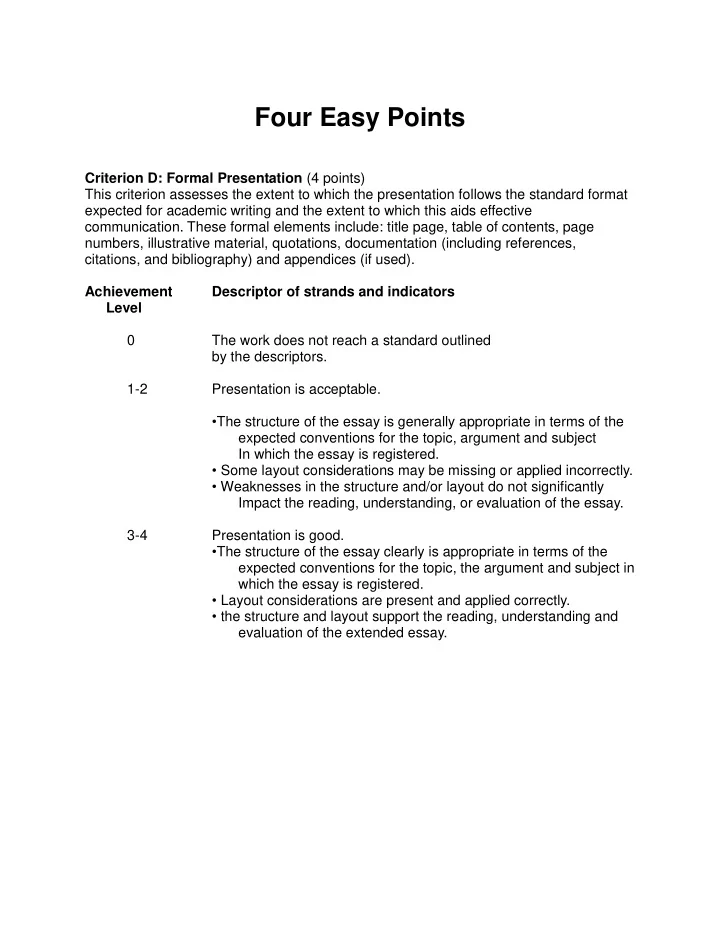
Four Easy Points Criterion D: Formal Presentation (4 points) This criterion assesses the extent to which the presentation follows the standard format expected for academic writing and the extent to which this aids effective communication.


slide-1
SLIDE 1

Four Easy Points

Criterion D: Formal Presentation (4 points) This criterion assesses the extent to which the presentation follows the standard format expected for academic writing and the extent to which this aids effective

  • communication. These formal elements include: title page, table of contents, page

numbers, illustrative material, quotations, documentation (including references, citations, and bibliography) and appendices (if used). Achievement Descriptor of strands and indicators Level The work does not reach a standard outlined by the descriptors. 1-2 Presentation is acceptable.

  • The structure of the essay is generally appropriate in terms of the

expected conventions for the topic, argument and subject In which the essay is registered.

  • Some layout considerations may be missing or applied incorrectly.
  • Weaknesses in the structure and/or layout do not significantly

Impact the reading, understanding, or evaluation of the essay. 3-4 Presentation is good.

  • The structure of the essay clearly is appropriate in terms of the

expected conventions for the topic, the argument and subject in which the essay is registered.

  • Layout considerations are present and applied correctly.
  • the structure and layout support the reading, understanding and

evaluation of the extended essay.

slide-2
SLIDE 2

Formal Presentation of the Extended Essay

Length

The upper limit is 4,000 words. This includes the introduction, the body, the conclusion and any quotations, but does not include:

  • acknowledgments
  • the contents page
  • maps, charts, diagrams, annotated illustrations and tables
  • equations, formulas and calculations
  • footnotes or endnotes
  • the bibliography
  • appendices

Essays containing more than 4,000 words are subject to penalties and examiners are not required to read material in excess of the

word limit.

Order of Presentation

Title page, contents page, essay, works cited page, appendix or appendices if applicable. Begin page numbering with the introduction and continue through any appendices.

slide-3
SLIDE 3

Title

The title should be your research question.

Formatting the Title Page

Top of Page:

  • Two inches from the top of the page
  • Title (centered)
  • Double space
  • Subject area of the extended essay (centered)

Bottom of page: The following information should be typed in this order in the lower right corner. Start each line at the same position on the

  • page. Double space between each item. End two inches from

the bottom of the page.

  • Session: May (followed by the year of your graduation)
  • Extended essay supervisor’s name
  • Word Count
slide-4
SLIDE 4

Title of Extended Essay (Your Research Question) Subject area Session May (20XX) Advisor’s name Word count

slide-5
SLIDE 5

Contents Page

A contents page must be provided at the beginning of the extended essay and all pages beginning with the introduction must be numbered. An index at the end of your essay is not required.

slide-6
SLIDE 6

Contents Page Introduction Why I chose this investigation.........................................................p.1 About Dengue Fever and Aedes Mosquitos................................... p. 2 About Blue-veined Cheese............................................................. p. 5 Aim.......................................................................................................... p. 6 Method Apparatus List................................................................................ p. 7 Chemical List................................................................................. p. 8 Procedure Method used for the preparation of the fish tank Preparation of the mosquito netting................................... p. 9 Making of the mosquito traps............................................. p.10 Method used for obtaining the mosquito larvae................... p.12 Method used for preparation of the agar plates To culture the Penicillium roqueforti fungus....................... p.14 Method of testing................................................................. p.14 Results Raw data: Chart 1................................................................................. p.17 Chart 2................................................................................. p.19 Analysed data Table................................................................................... p. 20 Pie-Chart 1.......................................................................... p. 22 Pie-Chart 2.......................................................................... p. 23 Pie-Chart 3.......................................................................... p. 24 Conclusion Part 1............................................................................................ p. 25 Part 2............................................................................................ p. 26 Evaluation.............................................................................................. p. 28 Acknowledgments................................................................................. p. 30 Appendix................................................................................................ p. 31 Bibliography........................................................................................... p. 32

slide-7
SLIDE 7

Table of Contents Introduction________________________________________________ 1 The Decisive Role of the United States and Soviet Union_____________ 2 Role of the United Nations_____________________________________ 4 Secret Treaties and Military Collusion during the Crisis ______________ 5 The Effect of Suez on The Fourth Republic and British Parliament______ 6 Aftermath of Suez and Arab Nationalism__________________________ 7 The American and Soviet role in The Aftermath of Suez______________ 8 Importance of Middle East As A Cold War Front____________________ 9 Conclusion________________________________________________ 10 Works Cited________________________________________________12

slide-8
SLIDE 8

Table of Contents Methodology.................................................................................................1 Introduction and Starbucks's history.............................................................2

  • I. Veblen goods.............................................................................................3
  • II. Theories behind Veblen Goods—Income effect.......................................4

Graph 1: Number of participants in each income range......................4 Table 1: Number of participants from each district and average income.........................................................................5

  • III. Theories behind Veblen Goods.............................................................7
  • IV. Supply and demand theory on Starbucks coffee in Beijing.....................8

Graph 2: A shift to the right in supply curve and its effect

  • n price......................................................................................8

Table 2: Results to statements in questions 7-10...................................9

  • V. Price elasticity.........................................................................................10

Graph 3: Price elasticity of Starbucks coffee.........................................11 Table 3: Price increase that the customers are willing to pay for in relation to their frequency in visiting Starbucks...............................13 Limitations of research................................................................................14 Conclusion..................................................................................................15 Bibliography................................................................................................17 Appendices.................................................................................................19 Appendix 1: Survey questions (English)............................................19 Appendix 2: Survey questions (Chinese translation sample)............21 Appendix 3: Income chart..................................................................23

slide-9
SLIDE 9

Illustrations

Presentation and overall neatness are important, and it is essential that illustrative material, if included, is well set out and used effectively. Graphs, diagrams, tables and maps are effective

  • nly if they are clearly labeled and can be interpreted with ease.

All such material that is incorporated into the extended essay must be directly related to the text and cited where appropriate. The use of photographs and other images is acceptable only if they are captioned and/or annotated and are used to illustrate a specific point made in the extended essay.

slide-10
SLIDE 10

Bibliographies, References, and Citations

An extended essay must reflect intellectual honesty in research practices and provide the reader with the exact sources of quotations, ideas and points of view through accurate bibliographies and referencing. Producing accurate citations, referencing and a bibliography is a skill that students should be seeking to perfect. Documenting the research in this way is vital: it allows readers to evaluate the evidence for themselves and it shows the student’s understanding of the importance of the sources used. Failure to comply with this requirement will be viewed as plagiarism and will, therefore, be treated as a case of

  • malpractice. In such case an IB diploma will not be awarded.

Sources that are not cited in the body of the essay, but were important in informing the approach taken, should be cited in the introduction or in an acknowledgment. The bibliography (Works Cited Page) should list only those sources cited in the essay.

slide-11
SLIDE 11

The Works Cited Page

When creating your Works Cited Page, remember to:

  • Include only sources actually cited in the essay. Do not include any sources you

examined but did not cite.

  • Begin the Works Cited on a new page, but number consecutively (i.e. if the last

page of your essay is page 8, the Works Cited is page 9.)

  • Center the title, Works Cited, an inch below the top margin.
  • Double space between the title and the first entry.
  • Begin each entry flush with the left margin; if an entry runs more than one line,

indent the subsequent line or lines one-half inch from the left margin, a hanging indent.

  • Double space the entire list, both between and within entries.
  • Alphabetize each entry by first letter of the author’s last name when available. If

you have two authors with the same name, alphabetize these authors by the first letter of their first names.

  • If no author is available, alphabetize by the first letter of the title of the source,

disregarding the articles A, An, and The.

  • Italicize all titles of books, magazines, films, works of art etc.
  • Put quotation marks around the titles of poems, short stories, and articles.
  • Include the medium of each source: print, web, interview etc.
  • To cite two or more books by the same author, give the name in the first entry only.

Thereafter, in place of the name, type three hyphens, followed by a period and the

  • title. If the person edited, translated, or compiled the book, place a comma instead
  • f a period after the three hyphens and write the appropriate abbreviation: ed.,

trans., or comp. before giving the title.

  • When a source does not indicate the publisher, the place or date of publication, or

pagination, use the following abbreviations as noted: n.p. no place of publication given n.p. no publisher given n.d. no date of publication given

  • n. pag.

no pagination given Inserted before the colon, the abbreviation n.p. indicates no place; after the colon, it indicates no publisher. Example: Photographic View Album of Cambridge. n.p.: n.p., n.d. n.pag.

slide-12
SLIDE 12

9 Works Cited Begley, Sharon, et al. "Mapping the Brain." Newsweek 20 Apr. 1992: 66-70. Print. Damasio, Antonio R. "Aphasia." The New England Journal of Medicine 326 (1992): 531-39. Print. Flieger, Ken. "Memories Are Made of This." FDA Consumer Sep. 1989: 14-19. Print.

  • Rpt. in Mental Health. Ed. Eleanor C. Goldstein. Vol. 4. Boca Raton: SIRS, 1989.
  • Art. 16. Print.

Johnson, Keith A., and J. Alex Becker. "The Whole Brain Atlas." Harvard Medical

  • School. 1997. Web. 3 Feb. 2002.

Kotulak, Ronald. Inside the Brain: Revolutionary Discoveries of How the Mind

  • Works. Kansas City: Andrews and McMeel, 1996. Print.

Lehrman, Sally. "Scientists Envision Methods of Mapping the Human Brain." San Francisco Examiner 22 July 1992. A9. Print. "Nurturing Development of the Brain." Editorial. New York Times 28 Apr. 1997, late ed.: A14. Print. Restak, Richard. "Brain." The Encyclopedia Britainica. 1991 ed. Print.

  • --. The Brain. Toronto: Bantam, 1984. Print.
  • --. "Mapping the Mindfields." Omni Jan. 1992: 56-58. Print.

Wurtman, Richard J. "Ways That Foods Can Affect the Brain." The Healing Brain: A Scientific Reader. Eds. Robert E. Ornstein and Charles Swencionis. New York: Guilford, 1990. 106-13. Print.

slide-13
SLIDE 13

Appendices, Footnotes, and Endnotes

Appendices, footnotes and endnotes are not an essential section

  • f the extended essay and examiners are not required to read

them, so care should be taken to include all information of direct relevance to the analysis and argument in the main body of the

  • essay. An essay that attempts to evade the word limit by

including important material in notes or appendices risks losing marks under several criteria. Unless considered essential, complete lists of raw data should not be included in the extended essay. Students should not constantly refer to material presented in an appendix as this may disrupt the continuity of the essay.

slide-14
SLIDE 14

Viva Voce

The viva voce is a short interview between the student and the supervisor, and is the conclusion to the extended essay process. It is the final reflection on your RPPF. Remember that criterion E: Engagement (6 points of your total score) relies solely on your reflections as detailed on the RPPF along with the supervisor’s comments. The viva voce serves the following purposes:

  • A check on plagiarism and malpractice in general
  • An opportunity to reflect on successes and difficulties in the

research process

  • An opportunity to reflect on what has been learned
  • An aid to the supervisor's report
slide-15
SLIDE 15

Extended Essay Check List

Indicate that you have checked your paper for each element on this check list by initialing each item that you can respond to with a “yes” answer. If you have to answer “no” to a question, either fix your essay or be ready to explain why “no” is an acceptable

  • answer. (Your essay may not contain an appendix for example.)

Turn in this check list to the IB Coordinator at the time you submit your paper. Name:_______________________________________________ Subject area:_________________________________________ Title:________________________________________________

  • I. Length of Paper

__Is the paper the required length? (suggested length 3500-3900 words) Be sure not to go over 4000.

  • 2. Title

__ Did you use your research question as the title?

  • 3. Table of Contents

__ Does the paper have a table of contents outlining the main sections of your essay? __ Are your pages correctly numbered?

  • 4. Research Question

__ Is the research question clearly stated and focused on the discussion in the essay

slide-16
SLIDE 16
  • 5. Introduction

__ Does your introduction indicate why this topic is important and worthy of study? __ Does it give some background information and place the topic in an appropriate context? __ Does it indicate whether the topic has been narrowed to a focus that is manageable within the 4000 word scope? __ Does it contain the research question? __ Does it have a clear preview of the thesis and argument that will be developed in the essay? (Remember you need to take a stand on the issue.)

  • 6. Body
  • A. Research

__Did you use both primary and secondary sources? __Are your sources reliable, knowledgeable, and unbiased? __Are your sources relevant to the discussion?

  • B. Analysis and Interpretation of Research

__ Is your interpretation of the research data accurate? __ Is your analysis of the significance of your interpretation __Are your conclusions to individual points of analysis

  • C. Argument and Evaluation

__Is the argument you use to support your response to the __ Is your argument well developed? __ Is your argument well organized? __ Is your argument clearly and logically expressed? __ If an evaluation is appropriate, is it fully substantiated? __ Have you considered and rebutted opposing arguments

slide-17
SLIDE 17
  • D. Structure of the body

__ Have you frequently referred to your research question __ Does the information appropriately address and develop __ Does the organization of your information follow logically __ Do you use quotations judiciously and effectively? Tips: Don’t let your quotations do your thinking for you. Be sure you analyze the significance of each quotation. Don’t

  • verload your paper with unnecessary quotations.
  • E. Documentation

__ Are all ideas and information that are not unique to you __ Are all unique phrases, that are not your own, quoted and __ Did you use MLA documentation consistently throughout the essay?

  • F. Requirements

__ Have you checked your paper against the general assessment criteria applicable to your topic to make sure you have met all the requirements? __ Have you checked your paper against the subject guidelines, to make sure your essay conforms to IB expectations?

slide-18
SLIDE 18
  • 7. Conclusion

__ Is the conclusion clearly stated? __Does it specifically respond to your research question? Is __Is the conclusion a logical outcome of your argument? __ Is it substantiated by the evidence you presented? __Does it indicate issues, unresolved questions and new questions that have emerged from your research? __Does it pull the essay together and sum up the major points that framed your argument?

  • 8. Style

__ Is your writing style crisp, clear, cogent and smooth? __ Is your word choice precise and articulate rather than vague and wordy? __ Is your tone formal and scholarly? __Have you used terminology appropriate to your subject?

  • 9. Graphs, Diagrams, etc.

__ Are the necessary graphs, diagrams etc. well labeled and easily interpreted? __ Are they incorporated into the text rather than placed in an appendix? __Are they documented if they aren’t of your own creation?

slide-19
SLIDE 19
  • 10. Works Cited Page

__ Are all the sources you cited in your paper listed on the Works Cited page? __Are there any sources listed on your Works Cited page that are not cited in your paper? If so, remove them from the Works Cited page. The sources cited must exactly match your Works Cited page. __ Did you use MLA correctly and consistently? __ Is the following information included for each source? __author __title __date of publication __place of publication __name of publisher __date of access for web sites __source medium: print, web, interview, etc.

  • 11. Appendices

__ Is all the material in your appendix directly related to your research question? __ Is all the material in your appendix cross-referenced to the development of your research question?