Todays programme: Predicate Logic Predicate Logic and Program - - PowerPoint PPT Presentation

todays programme predicate logic predicate logic and
SMART_READER_LITE
LIVE PREVIEW

Todays programme: Predicate Logic Predicate Logic and Program - - PowerPoint PPT Presentation

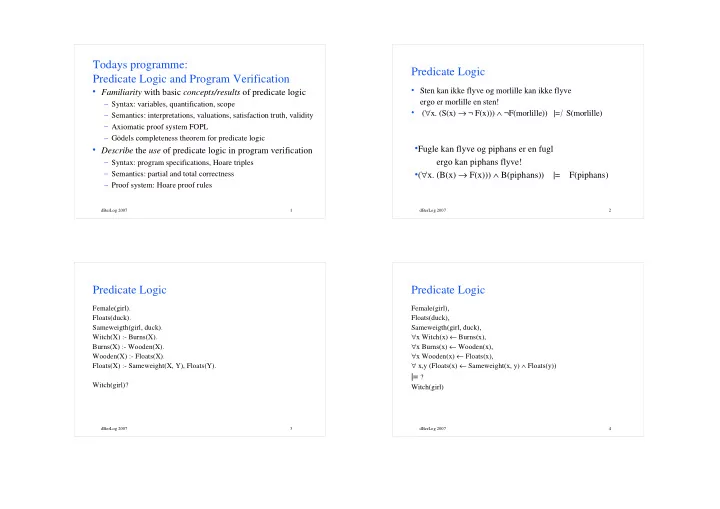
Todays programme: Predicate Logic Predicate Logic and Program Verification Sten kan ikke flyve og morlille kan ikke flyve Familiarity with basic concepts/results of predicate logic ergo er morlille en sten! Syntax: variables,


slide-1
SLIDE 1

1 dBerLog 2007

Todays programme: Predicate Logic and Program Verification

  • Familiarity with basic concepts/results of predicate logic

– Syntax: variables, quantification, scope – Semantics: interpretations, valuations, satisfaction truth, validity – Axiomatic proof system FOPL – Gödels completeness theorem for predicate logic

  • Describe the use of predicate logic in program verification

– Syntax: program specifications, Hoare triples – Semantics: partial and total correctness – Proof system: Hoare proof rules

2 dBerLog 2007

Predicate Logic

  • Sten kan ikke flyve og morlille kan ikke flyve

ergo er morlille en sten!

  • (∀x. (S(x) → ¬ F(x))) ∧ ¬F(morlille)) |= S(morlille)
  • Fugle kan flyve og piphans er en fugl

ergo kan piphans flyve!

  • (∀x. (B(x) → F(x))) ∧ B(piphans)) |= F(piphans)

3 dBerLog 2007

Predicate Logic

Female(girl). Floats(duck). Sameweigth(girl, duck). Witch(X) :- Burns(X). Burns(X) :- Wooden(X). Wooden(X) :- Floats(X). Floats(X) :- Sameweight(X, Y), Floats(Y). Witch(girl)?

4 dBerLog 2007

Predicate Logic

Female(girl), Floats(duck), Sameweigth(girl, duck), ∀x Witch(x) ← Burns(x), ∀x Burns(x) ← Wooden(x), ∀x Wooden(x) ← Floats(x), ∀ x,y (Floats(x) ← Sameweight(x, y) ∧ Floats(y))

|= ?

Witch(girl)

slide-2
SLIDE 2

5 dBerLog 2007

Predicate Logic - syntax examples

  • Constants:

girl, duck

  • Predicate symbols P: Female, Floats,.... with arity 1

Sameweight with arity 2

6 dBerLog 2007

Predicate Logic for Natural Numbers

∀ ∀x. Even(x) → Even(succ(succ(x))) ∀ ∀x. ∀y. (Even(x) ∧ y = x+2) → Even(y) ∀ ∀x. x + 0 = x

  • (A(0) ∧ (∀x. A(x) → A(x+1)) → ∀x. A(x)

7 dBerLog 2007

Predicate Logic - syntax examples

  • Constants:

girl, duck

  • Predicate symbols P: Female, Floats,.... with arity 1

Sameweight with arity 2

  • Constants

0,1,2,...

  • Function symbols F:

+, × both with arity 2

  • Predicate symbols P: = with arity 2

8 dBerLog 2007

Predicate Logic - syntax

  • Variables x,y,z,...
  • Constants C: c1, c2,....
  • Function symbols F: f,g,h... each with some arity n>0
  • Terms

t ::= c | x | f(t1, t2,..tn)

slide-3
SLIDE 3

9 dBerLog 2007

Predicate Logic - first order language, wwf’s

  • Predicate symbols P: P, Q, R each with some arity n 0

  • Well formed formulae wff:

Φ ::= P(t1, t2, .., tn) | ¬ Φ | Φ ∨ Φ | Φ ∧ Φ | Φ → Φ | ∀ x Φ | ∃ x Φ

10 dBerLog 2007

Predicate Logic - Interpretations

  • An interpretation I for a first order predicate logic language

consists of D, a domain of concrete values for each constant cI an element of D for each f ∈ F with arity n, a function fI: Dn → D for each P ∈ P with arity n, a subset PI ⊆ Dn

11 dBerLog 2007

Predicate Logic - interpretations example

  • D:
  • bjects from the real world

girl: the girl in question duck: the duck on the scales Female: those objects which are female Sameweight: those pairs of objects with the same weight I |= ¬Wooden(girl) ∧ ¬Witch(duck) I |= ∃ x Female(x) since I |= Female(girl)

12 dBerLog 2007

Predicate Logic

Female(girl), Floats(duck), Sameweigth(girl, duck), ∀x Witch(x) ← Burns(x), ∀x Burns(x) ← Wooden(x), ∀x Wooden(x) ← Floats(x), ∀ x,y (Floats(x) ← Sameweight(x, y) ∧ Floats(y))

|= ?

Witch(girl)

slide-4
SLIDE 4

13 dBerLog 2007

Predicate Logic - interpretations example

  • D:

Natural numbers, N 0,1,..: the numbers zero, one,... +, × : sum and mutiplication on N =: equality on N I |= ∀x. x + 0 = x I |= ∀ x ∃ y (y = x+1) I |= x + 1 = y?

14 dBerLog 2007

Predicate Logic - valuations

  • A valuation v in an interpretation I of a first order language

is a function from the terms of L to the domain D of I such that v(c) = cI for all constants v(x) ∈ D for all variables x for each f ∈ F with arity n, v(f(t1,..,tn)) = fI(v(t1),..,v(tn))

  • That is essentially a ”look-up table”

v: free variables → D

15 dBerLog 2007

Predicate logic - free and bound variables

  • (∀x (P(x) ∧ Q(x)) → (P(x) → Q(y))

→ →

P Q x y

∀ x ∧

P Q x x free bound

16 dBerLog 2007

Predicate logic - free and bound variables

  • (∀x (P(x) ∧ Q(x)) → (P(x) → Q(y))

→ →

P Q x y

∀ x ∧

P Q x x Scope of

slide-5
SLIDE 5

17 dBerLog 2007

Predicate Logic - satisfaction (semantics)

  • Given an interpretation, I, for a first order language, a

valuation v, and a formula A, v satisfies A

  • I |=v A

iff if A = P(t1, t2,.., tn) then (v(t1), v(t2),.., v(tn)) ∈ PI if A = ∀ x B then I |=v[x←d] B for all d ∈ D if A = ∃ x B then I |=v[x←d] B for some d ∈ D if A = ¬ B, B ∨ C, B ∧ C, B → C then ”as in propositional logic”

18 dBerLog 2007

Predicate Logic - interpretations examples

D: natural numbers 0, 1, 2,... +, ×: adition and multiplication =: equality I |=v ∃ y (y = x+1) ?

19 dBerLog 2007

Predicate Logic - interpretations examples

D: natural numbers 0, 1, 2,... +, ×: adition and multiplication =: equality I |=[0/x] ∃ y (y = x+1) I |=[0/x] ∃ y (x = y+1)

20 dBerLog 2007

Predicate Logic - interpretations examples

  • D:

integers ...-2, -1, 0, 1, 2,... +, ×: adition and multiplication =: equality I |=[0/x] ∃ y (y = x+1) I |=[0/x] ∃ y (x = y+1)

slide-6
SLIDE 6

21 dBerLog 2007

Predicate Logic -Truth and Validity

  • A wwf A is true in an interpretation I iff every valuation in

I satisfies A, notation: I |= A

  • A wwf A is false in an interpretation I iff no valuation in I

satisfies A

  • A wwf A of a first order language L is (logically) valid iff

it is true in every interpretation of L, notation: |= A

  • A wwf A of a first order language L is (logically)

contradictory iff it is false in every interpretation of L

22 dBerLog 2007

Predicate Logic - interpretations examples

D: natural numbers 0, 1, 2,... +, ×: adition and multiplication =: equality I |= ∀x ∃ y (y = x+1) I |= ∀x ∃ y (x = y+1) since I |=[0/x] ∃ y (x = y+1) |= ∀x ∃ y (x = y+1) - follows from above! |= ∀x ∃ y (y = x+1) - why?

23 dBerLog 2007

Predicate Logic - quiz

Truth in N: True False Valid Contr.

  • 1. x+1 = y
  • 2. ∀x (x = x+1)
  • 3. ∀x ∀y (x+y = y+x)
  • 4. ∃ x (P(x) ∧¬ P(x))
  • 5. (∃ x ¬ P(x)) →

(¬ ∀x P(x))

24 dBerLog 2007

Predicate Logic - quiz

Truth in N: True False Valid Contr.

  • 1. x+1 = y
  • 2. ∀x (x = x+1)

  • 3. ∀x ∀y (x+y = y+x)

  • 4. ∃ x (P(x) ∧¬ P(x))

√ √

  • 5. (∃ x ¬ P(x)) →

(¬ ∀x P(x)) √ √

slide-7
SLIDE 7

25 dBerLog 2007

Predicate Logic -Truth and Validity

  • Following Kelly we include the following predicate

constants in our syntax for predicate logic:

  • _|_ standing for the always false predicate, i.e. the

predicate which is false in every interpretation

∀  | standing for the always true predicate, i.e. the

predicate which is true in every interpretation

26 dBerLog 2007

Todays programme: Predicate Logic and Program Verification

  • Familiarity with basic concepts/results of predicate logic

– Syntax: variables, quantification, scope – Semantics: interpretations, valuations, satisfaction truth, validity – Axiomatic proof system FOPL – Gödels completeness theorem for predicate logic

  • Describe the use of predicate logic in program verification

– Syntax: program specifications, Hoare triples – Semantics: partial and total correctness – Proof system: Hoare proof rules

27 dBerLog 2007

Predicate logic - axiomatic proof system

  • Axioms:

– Ax1 A → ( B → A) – Ax2 (A → ( B → C)) → ((A → B) → (A → C)) – Ax3 (¬A → ¬ B) → (B → A)

  • Deduction rules: A, A → B

– Modus ponens MP B

28 dBerLog 2007

Predicate logic - axiomatic proof system

  • Axioms:

– Ax1 A → ( B → A) – Ax2 (A → ( B → C)) → ((A → B) → (A → C)) – Ax3 (¬A → ¬ B) → (B → A) – Ax4 (∀x) A(x) → A(t/x) where t is free for x in A! – Ax5 (∀x) (A → B) → (A → (∀x) B) no free occ’s of x in A!

  • Deduction rules: A, A → B

– Modus ponens MP B

slide-8
SLIDE 8

29 dBerLog 2007

Predicate logic - substitution

A[t/x] notation for ”A with all free occurrences of x substituted by t”

  • Examples

((∀x (P(x) ∧ Q(x)) → (P(x) → Q(y))) [f(y)/x] = (∀x (P(x) ∧ Q(x)) → (P(f(y)) → Q(y)) ((∀y (P(y) ∧ Q(x)) → (P(y) → Q(x))) [f(y)/x] = ??

30 dBerLog 2007

Predicate logic - substitution

  • A[t/x] is only defined if ”t is free for x in A”:

no free occurrence of x in A occurs within the scope of ∀y or ∃y for any variable y occurring in t

  • For all t,x,A, - t can always be made free for x in A

by a suitable renaming of bindings ∀y, ∃y in A

  • Example

((∀y (P(y) ∧ Q(x)) → (P(y) → Q(x))) [f(y)/x] = (∀z (P(z) ∧ Q(f(y))) → (P(y) → Q(f(y)))

31 dBerLog 2007

Predicate logic - axiomatic proof system

  • Axioms:

– Ax1 A → ( B → A) – Ax2 (A → ( B → C)) → ((A → B) → (A → C)) – Ax3 (¬A → ¬ B) → (B → A) – Ax4 (∀x) A(x) → A(t) where t is free for x in A! – Ax5 (∀x) (A → B) → (A → (∀x) B) no free occ’s of x in A!

  • Inference rules: A, A → B

– Modus ponens MP B – Generalisation G A (∀x) A

32 dBerLog 2007

Example of proof

  • Assume that y does not occur in A(x)

Prove (∀x) A(x) → (∀y) A(y) 1. (∀x) A(x) Hyp

  • 2. (∀x) A(x) → A(y)

Ax4 (y free for x in A) 3. A(y) MP 1,2 4. (∀y) A(y) G

slide-9
SLIDE 9

33 dBerLog 2007

  • Pred. Logic - soundness and completeness
  • Gödel’s Completeness Theorem

Our set of proof rules (the 3 axioms and MP from propositional logic plus the 2 extra axioms and G) is sound and complete for predicate logic!

  • Proof

Look for Gödel’s proof!

34 dBerLog 2007

Validity for predicate logic

  • Validity problem for predicate logic:

Given a first order predicate logic formula A, is A valid, i.e. |= A?

  • Theorem

The validity problem for predicate logic is unsolvable Proof: can be shown by a reduction from PCP

  • Corollary

The set of valid formulas in predicate logic is recursively enumerable, but not recursive Proof: ??

35 dBerLog 2007

Validity for predicate logic

  • Validity problem for predicate logic:

Given a first order predicate logic formula A, is A valid, i.e. |= A?

  • Theorem

The validity problem for predicate logic is unsolvable Proof: can be shown by a reduction from PCP

  • Corollary

The set of valid formulas in predicate logic is recursively enumerable, but not recursive Proof: Gödel’s completeness theorem

36 dBerLog 2007

Todays programme: Predicate Logic and Program Verification

  • Familiarity with basic concepts/results of predicate logic

– Syntax: variables, quantification, scope – Semantics: interpretations, valuations, satisfaction truth, validity – Axiomatic proof system FOPL – Gödels completeness theorem for predicate logic

  • Describe the use of predicate logic in program verification

– Syntax: program specifications, Hoare triples – Semantics: partial and total correctness – Proof system: Hoare proof rules

slide-10
SLIDE 10

37 dBerLog 2007

Programming language PLN - syntax

  • Constants:

natural numbers: 0, 1, 2,.. boolean constants: true, false

  • Con ::= 0, 1, 2, ...
  • Var::= x, y, z, ...
  • E::= Con | Var | E + E | E ∗ E | (E)
  • B::= true | false | ¬B | B ∧ B | B∨ B | E = E | (B)
  • C::= x := E | C ; C | if B then C else C | while B do C

38 dBerLog 2007

PLN example C = Fac

y := 1; z := 0; while ¬ (z = x) do z := z + 1 y := y ∗ z

39 dBerLog 2007

PLN semantics

  • A PLN state associates natural numbers to program

variables: States: Var → N

  • The operational semantics of PLN defines the semantics of

a program C as a PARTIAL function Sem[C]: States → States where Sem[C](s) = s’ if C when started in state s terminates in state s’ undefined

  • therwise

40 dBerLog 2007

PLN semantics, example C = Fac

y := 1; z := 0; while ¬ (z = x) do z := z + 1 y := y ∗ z Sem[Fac](x = 4, y = 0, z = 0,...) = (x= 4, y = 24, z = 4,...)

slide-11
SLIDE 11

41 dBerLog 2007

PLN specifications syntax

  • A correctnes specification of a program C is a Hoare triple
  • f the form

{ φ } C { ψ } where φ (precondition) and ψ (postcondition) are first order predicate logic formulae over variables (including PLN program variables) and constants/functions/predicates interpreted in the model of natural numbers.

42 dBerLog 2007

Hoare triples - for Fac

y := 1; z := 0; while ¬ (z = x) do z := z + 1 y := y ∗ z

  • |=par { | } Fac {y = x!}
  • |=par {x>5} Fac {z=x}
  • |=tot { | } Fac {y = x!}

43 dBerLog 2007

Pre/postcondition interpretation

  • Let N be the predicate logic interpretation of natural

numbers with a (yet unspecified) vocabulary of constants, functions and predicates - all interpreted ”in the standard way”.

  • Note that PLN states are nothing but predicate logic

valuations!

44 dBerLog 2007

Hoare triples - semantics

  • { φ } C { ψ } is said to be satisfied under partial correctness

|=par { φ } C { ψ } iff for all states s, if N |=s φ, and Sem[C](s) is defined and equal to s’ then N |=s’ ψ

  • { φ } C { ψ } is said to be satisfied under total correctness

|=tot { φ } C { ψ } iff for all states s, if N |=s φ, then Sem[C](s) is defined, and if Sem[C](s) = s’ then N |=s’ ψ

slide-12
SLIDE 12

45 dBerLog 2007

Hoare proof rules := and ;

{ψ [E/x]} x := E {ψ} Ass-axiom {φ} C1 {η} {η} C2 {ψ} {φ} C1 ; C2 {ψ} Comp-rule

46 dBerLog 2007

Hoare proof rules if and while

{φ} if B then C1 else C2 {ψ} If-rule {ψ ∧ B} C {ψ} {ψ} while B do C {ψ ∧ ¬B} While-rule {φ ∧ B} C1 {ψ} {φ ∧ ¬B} C2 {ψ}

47 dBerLog 2007

A proof of Euclid’s gcd algorithm

{ m = m0 ≥ 1 ∧ n = n0 ≥ 1 } while ¬ (m = n) do if m > n then m:=m-n else n:= n-m; r:= m { r = gcd(m0, n0) }

48 dBerLog 2007

A proof of Euclid’s gcd algorithm

{ m = m0 ≥ 1 ∧ n = n0 ≥ 1 } while ¬ (m = n) do if m > n then m:=m-n else n:= n-m; {η} r:= m { r = gcd(m0, n0) }

slide-13
SLIDE 13

49 dBerLog 2007

A proof of Euclid’s gcd algorithm

{ m = m0 ≥ 1 ∧ n = n0 ≥ 1 } while ¬ (m = n) do if m > n then m:=m-n else n:= n-m; {m = gcd(m0, n0) } r:= m { r = gcd(m0, n0) }

{m = gcd(m0, n0)} r := m {r = gcd(m0, n0) } Ass-axiom

50 dBerLog 2007

A proof of Euclid’s gcd algorithm

{ m = m0 ≥ 1 ∧ n = n0 ≥ 1 } while ¬ (m = n) do { gcd(m,n) = gcd(m0, n0) } if m > n then m:=m-n else n:= n-m; {m = gcd(m0, n0) } r:= m { r = gcd(m0, n0) }

51 dBerLog 2007

A proof of Euclid’s gcd algorithm

{ m = m0 ≥ 1 ∧ n = n0 ≥ 1 } while ¬ (m = n) do { gcd(m,n) = gcd(m0, n0) } if m > n then m:=m-n else n:= n-m; {m = gcd(m0, n0) } r:= m { r = gcd(m0, n0) }

{gcd(m,n) = gcd(m0, n0) ∧ ¬ (m = n) } if m > n then m:=m-n else n:= n-m;

{gcd(m,n) = gcd(m0, n0) }

{gcd(m,n) = gcd(m0, n0) } while ... {gcd(m,n) = gcd(m0, n0) ∧ ¬ ¬(m = n) } While-rule

52 dBerLog 2007

Hoare proof rules - implied

{φ’} C {ψ’} Impl-rule |- N φ’ → φ {φ} C {ψ} |- N ψ→ ψ’ NOTE We assume here that we have some underlying extension of the proof system for predicate logic, in which we prove formulae of the form φ’ → φ which are true in N - the interpretation of natural numbers!!!!

slide-14
SLIDE 14

53 dBerLog 2007

A proof of Euclid’s gcd algorithm

{ m = m0 ≥ 1 ∧ n = n0 ≥ 1 } while ¬ (m = n) do { gcd(m,n) = gcd(m0, n0) } if m > n then m:=m-n else n:= n-m; {m = gcd(m0, n0) } r:= m { r = gcd(m0, n0) }

Proof obligations Comp rule: |-N m = m0 ≥ 1 ∧ n = n0 ≥ 1

  • > gcd(m,n) = gcd(m0,n0)

|-N gcd(m,n)= gcd(m0,n0) ∧¬¬(m=n)

  • > m = gcd(m0, n0)

54 dBerLog 2007

Proofs using Hoare rules

  • Notation:

|-par { φ } C { ψ } iff { φ } C { ψ } has a proof using the Hoare rules and rules for |-N!!

  • Are the Hoare rules sound and complete, i.e

|-par { φ } C { ψ } iff |=par { φ } C { ψ } ???

55 dBerLog 2007

Todays programme: Predicate Logic and Program Verification

  • Familiarity with basic concepts/results of predicate logic

– Syntax: variables, quantification, scope – Semantics: interpretations, valuations, satisfaction truth, validity – Axiomatic proof system FOPL – Gödels completeness theorem for predicate logic

  • Describe the use of predicate logic in program verification

– Syntax: program specifications, Hoare triples – Semantics: partial and total correctness – Proof system: Hoare proof rules

56 dBerLog 2007

Exercises

  • Describe the semantics of predicate logic

– Kelly page 123 6.7 (scope rules) – Kelly page 130 6.9 (expressiveness – Kelly page 136 6.12 (satisfaction) – Kelly page 138 6.19 (satisfiability, truth, validity)

  • Describe and construct deductions in FOPL

– Kelly page 160 7.1 (i) (ii)

  • Describe and construct deductions for Hoare triples

– LimProVer page 10 Exercise 1