
SLIDE 1
Today’s Presenters
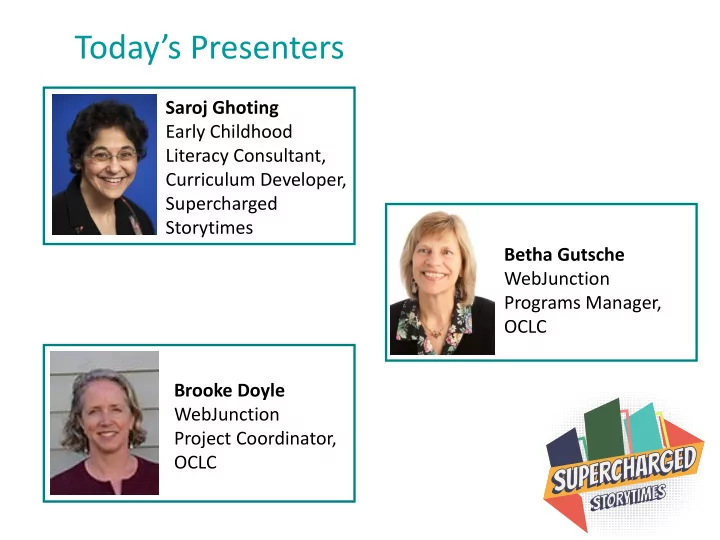
Saroj Ghoting Early Childhood Literacy Consultant, Curriculum Developer, Supercharged Storytimes Betha Gutsche WebJunction Programs Manager, OCLC Brooke Doyle WebJunction Project Coordinator, OCLC
Todays Presenters Saroj Ghoting Early Childhood Literacy - - PowerPoint PPT Presentation
Todays Presenters Saroj Ghoting Early Childhood Literacy Consultant, Curriculum Developer, Supercharged Storytimes Betha Gutsche WebJunction Programs Manager, OCLC Brooke Doyle WebJunction Project Coordinator, OCLC New Ways to
Saroj Ghoting Early Childhood Literacy Consultant, Curriculum Developer, Supercharged Storytimes Betha Gutsche WebJunction Programs Manager, OCLC Brooke Doyle WebJunction Project Coordinator, OCLC
WebJunction OCLC 2018
Saroj Ghoting, Early Literacy Instructor Betha Gutsche, WebJunction Program Manager
▪ What is Supercharged Storytimes? ▪ The Supercharged Storytimes Self-paced Course ▪ The Facilitator Training Opportunity
Put a checkmark next to your primary role:
Early literacy is what children know about reading and writing before they can actually read and write.
Photo: Mother and daughter playing at daycare; Getty Images
VIEWS2 website: http://views2.ischool.uw.edu/
Valuable Initiatives in Early Learning that Work Successfully
content in public library storytimes can increase the children’s early literacy behaviors while at storytime.”
⎯VIEWS2 Research Team
Photo: Dr. Eliza Dresang on VIEWS2 website
From Research to Practical Application
Interactions with children:
Photo: Monkeys, elephants & giraffes in storytime by Harris County Public Library on Flickr/CC BY-NC-SA 2.0
Connecting storytime activities to early literacy skills and development, including:
and caregivers
Photo: Library storytime by Government of Prince Edward Island on Flickr CC BY-NC 2.0
Project Outcome toolkit for early childhood literacy development
Photo: Journal by kulinetto on pixabay
A variety of ways to assess your supercharged storytimes:
Connecting with your peers and colleagues to share and receive ideas and feedback
Image: Rock art by wokandapix on pixabay…
FREE anytime anywhere
6 early literacy components
extend early literacy into the home
assess the impact of your storytimes
through an equity lens
Six modules Instructional videos Learner Guides Certificate of completion Ways to apply learning
▪ being mindful about planning
▪ being purposeful about including key early literacy components ▪ and reflecting afterward on
Photo: Library storytime by Government of Prince Edward Island on Flickr CC BY-NC 2.0
Photo: Story Time by New Jersey Library Assoc on Flickr/CC BY-NC-ND 2.0
▪ Every Child Ready to Read ▪ State Early Learning Guidelines ▪ Head Start Early Learning Outcomes Framework Domains ▪ VIEWS2 Planning Tool Your state’s early learning guidelines
Oral Language
Foundation for all language
Phonological Awareness
Hearing smaller sounds in words
Print Awareness/ Concepts
Knowing that print has meaning
Letter Knowledge
Exploring letters
Vocabulary
Knowing words
Background Knowledge
Prior knowledge about the world
Do you usually say the name of the author and illustrator? Without having to do anything differently, you are now being intentional!
Book: Beep! Beep! Go to Sleep, by Todd Tarpley, illustrated by John Rocco
Book: llama llama red pajama by Anna Dewdney
Intentionally adding an activity to emphasize the connection to early literacy
Book: Something from Nothing by Phoebe Gilman
Incorporate body movement for letter knowledge Can you make your body look like a C? Like an O? Like an h? How about trying with a partner?
Photo: DSCF0743 by JBLM MWR on Flickr CC BY 2.0
▪ Public libraries are bastions of informal learning ▪ Intentionality, interactivity and enjoyment
Photo: Family Storytime & Pizza Party by Rapid City Public Library on Flickr/CC BY-NC 2.0
▪ Disparities in early learning
experiences for young children
▪ Gaps in library programming ▪ Build collaborative
relationships to expand reach
Photo Credit: The Seattle Public Library
Individualized strategies designed to address historical barriers to access
Bringing traditionally under-represented individuals and communities into processes and activities (sharing power)
The ways in which people differ; also includes different ideas, perspectives and values
▪ Community Engagement Best Practices ▪ Pathway to Equity ▪ Library Walk-Through Checklist
Photo: Making moves, creating futures by craftspace on Flickr: CC BY-NC-ND 2.0
▪ A free set of evaluation tools from PLA ▪ Ready-to-go surveys ▪ Easy to use process ▪ Leads to improved programs and evidence of value
FREE
Photo: Success Dress-up Storytime by Cockburn Libraries on Flickr CC BY-NC-ND 2.0
Yes it’s really FREE!
Photo: Mindmap by TeroVesalainen on Pixabay
Motivate each other Share ideas New perspectives Form bonds Boost confidence Set and meet goals
Photo: People with lightbulbs by rawpixel on Pexels
▪ Library storytime practitioner ▪ Training coordinator ▪ LIS student on a children’s services track
Photo: Group fist bumb by rawpixel on Pexels
Photo: Young reader by jutheanh on Pixabay
This project is funded by OCLC and by a grant from the Institute of Museum and Library Services, RE-95-17-0085-17