To what extent can the fundamental spatial concepts of design be - - PowerPoint PPT Presentation

to what extent can the fundamental spatial concepts of
SMART_READER_LITE
LIVE PREVIEW

To what extent can the fundamental spatial concepts of design be - - PowerPoint PPT Presentation

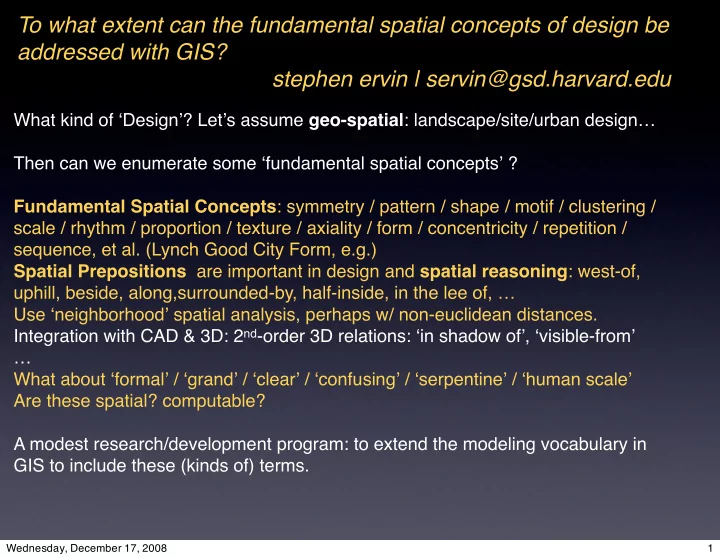
To what extent can the fundamental spatial concepts of design be addressed with GIS? stephen ervin | servin@gsd.harvard.edu What kind of Design ? Let s assume geo-spatial : landscape/site/urban design Then can we enumerate some


slide-1
SLIDE 1

What kind of ʻDesignʼ? Letʼs assume geo-spatial: landscape/site/urban design… Then can we enumerate some ʻfundamental spatial conceptsʼ ? Fundamental Spatial Concepts: symmetry / pattern / shape / motif / clustering / scale / rhythm / proportion / texture / axiality / form / concentricity / repetition / sequence, et al. (Lynch Good City Form, e.g.) Spatial Prepositions are important in design and spatial reasoning: west-of, uphill, beside, along,surrounded-by, half-inside, in the lee of, … Use ʻneighborhoodʼ spatial analysis, perhaps w/ non-euclidean distances. Integration with CAD & 3D: 2nd-order 3D relations: ʻin shadow ofʼ, ʻvisible-fromʼ … What about ʻformalʼ / ʻgrandʼ / ʻclearʼ / ʻconfusingʼ / ʻserpentineʼ / ʻhuman scaleʼ Are these spatial? computable? A modest research/development program: to extend the modeling vocabulary in GIS to include these (kinds of) terms.

To what extent can the fundamental spatial concepts of design be addressed with GIS? stephen ervin | servin@gsd.harvard.edu

1 Wednesday, December 17, 2008

slide-2
SLIDE 2

ʻDesignʼ carries a lot of baggage: is it Art? Science? Problem-Solving? What are its essential skills? Do material, scale, and subject/discipline matter? Is novelty important? Beauty? Simplicity? ʻFitnessʼ? What constitutes design education? There is some literature on design thinking; two cornerstones:

To what extent can the fundamental cognitive operations of design be addressed with GIS?

2 Wednesday, December 17, 2008

slide-3
SLIDE 3

GIS Design rational not repeatable unique science art left brain right “large scale” “small scale” clumsy agile ... interactive, knowledge-based, complex, graphical, social, multi-criteria, multi- dimensional, multi-scale, place-oriented...

3 Wednesday, December 17, 2008

slide-4
SLIDE 4
  • 1. Generate & Test (Herbert Simon) – Trial & Error; Student & Instructor;

Eye-Hand coordination. GIS as test, or first-try generator (suitability map, e.g.)

  • 2. Design by Decomposition (C. Alexander) – disaggregate by sub-

problem, layer, or feature/theme; find overlaps/isolations; re-combine

  • 3. Design with Nature (McHarg) : overlay / aggregate; scientific processes
  • 4. Diagrammatic Design: “A plan is the result of a diagram meeting a site”

(attributed to J. Habraken) : extraction/instantiation/specification of diagrams

  • 5. Landscape Architects Design Process (K. Hanna): Linear... Cyclic
  • 6. Design by Analogy (J. Gero) ; look for ʻsimilarʼ situations in other

conditions / domains; other sources of ʻinventionʼ or ʻsurpriseʼ; emergent form For understanding GIS <-> Design, consider several models of ʻdesignʼ:

4 Wednesday, December 17, 2008

slide-5
SLIDE 5

5 Wednesday, December 17, 2008

slide-6
SLIDE 6

Lawrence Halprin Sea Ranch “Locational Score”

6 Wednesday, December 17, 2008

slide-7
SLIDE 7

Design: Fusion of Form & Function

Design seeks ʻelegantʼ, multi-functional, many-layered solutions

Making ʼsmoothʼ / ʻvisually pleasingʼ designs…(not always a good idea?)

Design invents ; adapts; re-states; integrates; improves ʻfitʼ; pleases… There are rational(defensible) design processes, and irrational ones.

(“the right brain seems to flourish dealing with complexity, ambiguity and paradox”)

7 Wednesday, December 17, 2008

slide-8
SLIDE 8

“Computer Aided Design” What is Design, that we might aid it, with a mindlessly literal, very fast assistant with a relentless memory and no imagination (i.e. a computer) ?

Designers Manipulate Representations (so do programmers) Designers Program – write code; need expressive high-level languages

thanks to mark gross

8 Wednesday, December 17, 2008

slide-9
SLIDE 9

“Design is ..not finding the solution to a problem, but finding a solution to the problem....” Designers donʼt just answer, but ask & (re-)formulate questions.

Design involves both Enlarging and Narrowing the Solution Space. Choosing one-of-many; Remaking the criteria. Accepting partial matches. Pattern Recognition: Visual congruity; finding/making patterns (in representations & in real world) (ʻright-brainʼ operations) Overlaid/Imposed vs inherent/Discovered form / order / pattern / structure / etc Emergent Form : designers read, interpret & transform re-presentations Finding, defining, reversing opportunities / constraints

9 Wednesday, December 17, 2008

slide-10
SLIDE 10

10 Wednesday, December 17, 2008

slide-11
SLIDE 11

Levels of Abstraction: (LOA) need multiple levels, in conception, analysis, and representation; diagrams -> details. Levels of Detail, Multiple Scales: not the same, but equally important Fuzziness: “We need to be able to represent ʻMaybeʼ.” (M. Minsky) Multiplicity; multi-valence: We need to be able to represent ʻBothʼ. Multiple Representations: we need to be able to switch Uncertainty: We need to be able to represent contradiction & ambiguity. Rule-based Design : we need to be able to invoke, and break, rules Design DNA – lineage, history, precedent, family-resemblance Social Design - teamwork/collaborative design & design communication(s)

Design Essentials

11 Wednesday, December 17, 2008

slide-12
SLIDE 12

How can we embed ʻdesignʼ operations in a ʻGISʼ framework?

  • ʻGeneratorʼ: Sketching , Diagramming, Programming:

abstract expression / instantiation / specification / modification tools; access to library, precedents, analogies, agents, rules, algorithms...

  • Real-time feedback – design ʻdashboardʼ concept
  • Incremental refinement – interactive, iterative generate & test
  • Multiple, temporary, linked states, history, seamless switching, recombining

Rather : Embed GIS in a design framework. (e.g., Steinitz framework) primarily: GI management, transformation, analysis, display operations GIS / Design Software, System, or Science; requires:

  • Approaches
  • Attitudes
  • Algorithms
  • Apparatus (Tools, software )

12 Wednesday, December 17, 2008

slide-13
SLIDE 13

Simulations

(dynamics)

Analyses

(measurements)

Constraints

(relationships & conflicts)

Configurations

(plans, designs)

Elements

(objects, classes, properties)

Environment

(topography, etc.)

LOA Mgr Time Mgr Version Mgr Algorithmic

Coding Interface

Text/Media

Hyper-Annotations

Library Input(s)

/Outputs

Viewer(s)

script diagram map plan view VR etc

Computer Aided Geographic Design System

13 Wednesday, December 17, 2008

slide-14
SLIDE 14

14 Wednesday, December 17, 2008

slide-15
SLIDE 15

15 Wednesday, December 17, 2008