TLS/SSL TLS (Transport Layer Security) A suite of protocols to - - PowerPoint PPT Presentation

tls ssl
SMART_READER_LITE
LIVE PREVIEW

TLS/SSL TLS (Transport Layer Security) A suite of protocols to - - PowerPoint PPT Presentation

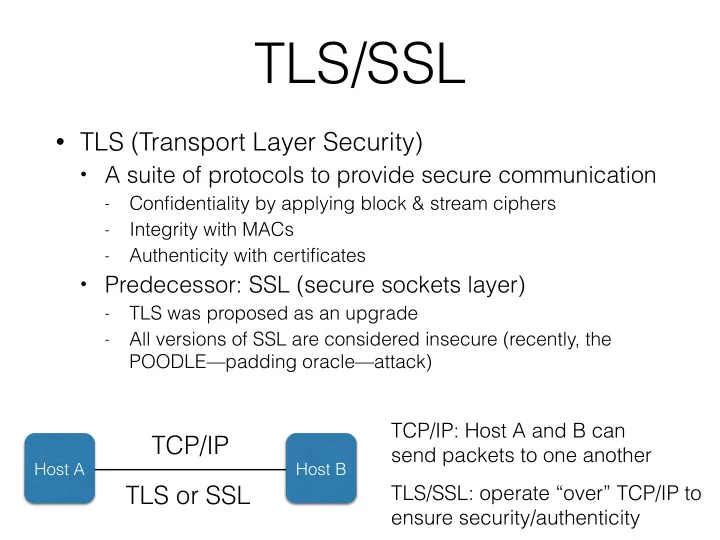
TLS/SSL TLS (Transport Layer Security) A suite of protocols to provide secure communication Confidentiality by applying block & stream ciphers - Integrity with MACs - Authenticity with certificates - Predecessor: SSL (secure


slide-1
SLIDE 1

TLS/SSL

  • TLS (Transport Layer Security)
  • A suite of protocols to provide secure communication
  • Confidentiality by applying block & stream ciphers
  • Integrity with MACs
  • Authenticity with certificates
  • Predecessor: SSL (secure sockets layer)
  • TLS was proposed as an upgrade
  • All versions of SSL are considered insecure (recently, the

POODLE—padding oracle—attack)

Host A Host B

TCP/IP TLS or SSL

TCP/IP: Host A and B can
 send packets to one another TLS/SSL: operate “over” TCP/IP to
 ensure security/authenticity

slide-2
SLIDE 2

TLS/SSL protocol (high level)

Browser

(initiates connection)

Server

(authenticates itself)

~~~~~~~Switch to negotiated cipher~~~~~~~

Data transmission Version, crypto options, nonce Client hello Version, crypto options, nonce, Signed certificate containing
 the server’s public key PKs Server hello + server cert (PKs) Server key exchange (when using DH) PreMaster secret encrypted with server’s PKs Client key exchange

Compute K based


  • n nonces &


PreMaster Compute K based


  • n nonces &


PreMaster

slide-3
SLIDE 3

HTTPS

Host A Host B

TCP/IP TLS or SSL

TCP/IP: Host A and B can
 send packets to one another TLS/SSL: operate “over” TCP/IP to
 ensure security/authenticity HTTPS is HTTP operating on top


  • f TLS/SSL

Why not HTTPS everywhere?

slide-4
SLIDE 4

HTTPS everywhere?

  • Takes more time to initiate connections
  • In-network services want to look at the traffic
  • To compress it (cannot compress encrypted traffic)
  • To cache it (especially if it’s static content)
  • To stick their own ads into it (i.e., there is pushback)
  • Any other ideas?
  • Google has moved its services over to https (even

the ones you’re not logged into)

  • Didn’t want others “transcoding” (reducing the quality
  • f) their videos, or sticking in their own ads
slide-5
SLIDE 5

Certificates in the wild

The lock icon indicates that the browser was able to
 authenticate the other end, i.e., validate its certificate

slide-6
SLIDE 6

Certificate chain Subject (who owns the
 public key) Issuer (who verified the identity and signed this
 certificate) Common name: the URL
 for which this cert is valid
 (can contain wildcards,
 e.g., *.wellsfargo.com)

slide-7
SLIDE 7

Wildcard certificates

Certificates with wildcards are “wildcard certs”. Wildcards (*) only match a single level of a domain

*.bar.com foo.bar.com not.this.bar.com

✔ ✘ The X.509 protocol (which defines the format


  • f these certificates) advises wildcard policies

(e.g., don’t allow *.*)

slide-8
SLIDE 8

Serial number: Uniquely identifies
 this cert with respect to the issuer (look for this in CRLs) Not valid before/after: When to
 start and stop believing this cert (start & expiration dates) The public key: And the issuer’s
 signature of the public key Signature algorithm: How the
 issuer will sign parts of the cert

slide-9
SLIDE 9

Subject Alternate Names: Other URLs for which this cert
 should be considered valid. (wellsfargo.com is not the same
 as www.wellsfargo.com) 
 Can include wildcards, e.g.,
 *.google.com CRL & OCSP: Where to go to check if this
 certificate has been revoked Non-cryptographic checksums

slide-10
SLIDE 10

Root certificates

slide-11
SLIDE 11
slide-12
SLIDE 12

Certificate types

Why are these different? This is an EV (extended validation) certificate; browsers show the
 full name for these kinds of certs

slide-13
SLIDE 13

Proper reaction to Heartbleed

  • 1. Patch the software
  • 2. “Reissue” a new key (get a new one


and load it onto your servers)

  • 3. Revoke the old key

If we reissued and then patched,
 then our new key would be compromised, too. Order matters! If we revoked first, we’d be offline.