Title : Constraint Satisfaction Problems AIMA: Chapter 6 - - PowerPoint PPT Presentation

title constraint satisfaction problems aima chapter 6
SMART_READER_LITE
LIVE PREVIEW

Title : Constraint Satisfaction Problems AIMA: Chapter 6 - - PowerPoint PPT Presentation

B.Y. Choueiry Title : Constraint Satisfaction Problems AIMA: Chapter 6 Required reading: Recommended reading: Introduction to CSPs (Bartaks on-line guide) Algorithms for Constraints Satisfaction problems: A Survey


slide-1
SLIDE 1

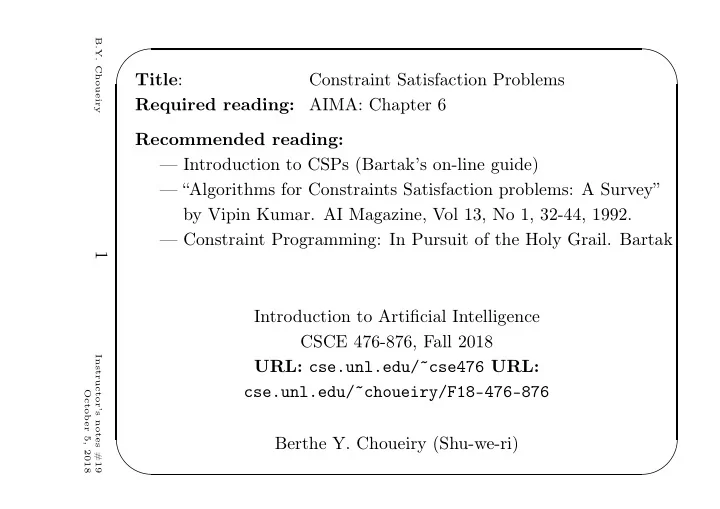
✬ ✫ ✩ ✪ Title: Constraint Satisfaction Problems Required reading: AIMA: Chapter 6 Recommended reading: — Introduction to CSPs (Bartak’s on-line guide) — “Algorithms for Constraints Satisfaction problems: A Survey” by Vipin Kumar. AI Magazine, Vol 13, No 1, 32-44, 1992. — Constraint Programming: In Pursuit of the Holy Grail. Bartak Introduction to Artificial Intelligence CSCE 476-876, Fall 2018 URL: cse.unl.edu/˜cse476 URL: cse.unl.edu/˜choueiry/F18-476-876 Berthe Y. Choueiry (Shu-we-ri)

B.Y. Choueiry

1

Instructor’s notes #19 October 5, 2018

slide-2
SLIDE 2

✬ ✫ ✩ ✪

Constraint Processing

  • Constraint Satisfaction:

– Modeling and problem definition (Constraint Satisfaction Problem, CSP) – Algorithms for constraint propagation – Algorithms for search

  • Constraint Programming: Languages and tools

– logic-based – object-oriented – functional

B.Y. Choueiry

2

Instructor’s notes #19 October 5, 2018

slide-3
SLIDE 3

✬ ✫ ✩ ✪

Courses on Constraint Processing

http://cse.unl.edu/˜choueiry/Constraint-Courses.html

  • CSCE 421/821 Foundations of Constraint Processing
  • CSCE 921 Advanced Constraint Processing

B.Y. Choueiry

3

Instructor’s notes #19 October 5, 2018

slide-4
SLIDE 4

✬ ✫ ✩ ✪

Outline

  • Problem definition and examples
  • Solution techniques: search and constraint propagation
  • Exploiting the structure
  • Research directions

B.Y. Choueiry

4

Instructor’s notes #19 October 5, 2018

slide-5
SLIDE 5

✬ ✫ ✩ ✪

What is this about?

Context: Solving a Kendoku Puzzle Problem: You need to assign numbers to unmarked cells Possibilities: You can choose any number between 1 and 5 Constraints: restrict the choices you can make

Unary: You have to respect predefined cells Binary: No two cells in same row or column have the same value Global: All the cells in each area must summ up to a given value.

You have choices, but are restricted by constraints − → Make the right decisions

B.Y. Choueiry

5

Instructor’s notes #19 October 5, 2018

slide-6
SLIDE 6

✬ ✫ ✩ ✪

Constraint Satisfaction

Given

  • A set of variables: 25 cells
  • For each variable, a set of choices {1,2,3,4,5}
  • A set of constraints that restrict the combinations of values the

variables can take at the same time Questions

  • Does a solution exist?

classical decision problem

  • How two or more solutions differ? How to change specific

choices without perturbing the solution?

  • If there is no solution, what are the sources of conflicts?

Which constraints should be retracted?

  • etc.

B.Y. Choueiry

6

Instructor’s notes #19 October 5, 2018

slide-7
SLIDE 7

✬ ✫ ✩ ✪

Constraint Processing is about

  • solving a decision problem
  • while allowing the user to state arbitrary constraints in an

expressive way and

  • providing concise and high-level feedback about alternatives

and conflicts Power of Constraints Processing

  • flexibility & expressiveness of representations
  • interactivity, users can

   relax reinforce    constraints

Related areas: AI, OR, Algorithmic, DB, Prog. Languages, etc.

B.Y. Choueiry

7

Instructor’s notes #19 October 5, 2018

slide-8
SLIDE 8

✬ ✫ ✩ ✪

Definition

Given P = (V, D, C):

  • V a set of variables

V = {V1, V2, . . . , Vn}

  • D a set of variable domains (domain values)

D = {DV1, DV2, . . . , DVn}

  • C a set of constraints

CVa,Vb,...,Vi = { (x, y, . . . , z)} ⊆ DVa × DVb × . . . × DVi Query: can we find one value for each variable such that all constraints are satisfied? In general, NP-complete

B.Y. Choueiry

8

Instructor’s notes #19 October 5, 2018

slide-9
SLIDE 9

✬ ✫ ✩ ✪

Terminology

  • Instantiating a variable: Vi ← a where a ∈ DVi
  • Variable-value pair (vvp)
  • Partial assignment
  • No good
  • Constraint checking
  • Consistent assignment
  • Constrained optimization problem: Objective function

B.Y. Choueiry

9

Instructor’s notes #19 October 5, 2018

slide-10
SLIDE 10

✬ ✫ ✩ ✪

Representation: Constraint graph

Given P = (V, D, C)        V = {V1, V2, . . . , Vn} D = {DV1, DV2, . . . , DVn} C set of constraints CVi,Vj = { (x, y)} ⊆ DVi × DVj Constraint graph

{ 1, 2, 3, 4 } { 3, 5, 7 } { 3, 4, 9 } { 3, 6, 7 } v2 > v4 V4 V2 v1+v3 < 9 V3 V1 v2 < v3 v1 < v2

B.Y. Choueiry

10

Instructor’s notes #19 October 5, 2018

slide-11
SLIDE 11

✬ ✫ ✩ ✪

Example I: Temporal reasoning

[ 5.... 18] [ 4.... 15] [ 1.... 10 ] B < C A < B B A 2 < C - A < 5 C

− → C-A ∈ [2, 5] is a constraint of bounded differences

B.Y. Choueiry

11

Instructor’s notes #19 October 5, 2018

slide-12
SLIDE 12

✬ ✫ ✩ ✪

Example II: Map coloring

Using 3 colors (R, G, & B), color the US map such that no two adjacent states do have the same color

{ red, green, blue } { red, green, blue } { red, green, blue } { red, green, blue } { red, green, blue }

WY NE KS OK NM TX LA CO UT AZ AR

Variables? Domains? Constraints?

B.Y. Choueiry

12

Instructor’s notes #19 October 5, 2018

slide-13
SLIDE 13

✬ ✫ ✩ ✪

Domain types

Given P = (V, D, C)        V = {V1, V2, . . . , Vn} D = {DV1, DV2, . . . , DVn} C set of constraints CVi,Vj = { (x, y)} ⊆ DVi × DVj Domains: − → restricted to {0, 1}: Boolean CSPs − → Finite (discrete): enumeration techniques works − → Continuous: sophisticated algebraic techniques are needed consistency techniques on domain bounds

B.Y. Choueiry

13

Instructor’s notes #19 October 5, 2018

slide-14
SLIDE 14

✬ ✫ ✩ ✪

Constraint arity

Given P = (V, D, C)        V = {V1, V2, . . . , Vn} D = {DV1, DV2, . . . , DVn} C set of constraints CVk,Vl,Vm = { (x, y, z)} ⊆ DVk × DVl × DVm Constraints: universal, unary, binary, ternary, . . ., global Representation: Constraint network

V3 v1+v2+V4 < 10 v1+v3 < 9 v2 < v3 v1 < v2 V1 V2 v2 > v4 V4 { 3, 5, 7 } { 1, 2, 3, 4 } { 3, 6, 7 } { 3, 4, 9 } B.Y. Choueiry

14

Instructor’s notes #19 October 5, 2018

slide-15
SLIDE 15

✬ ✫ ✩ ✪

Constraint definition

Constraints can be defined

  • Extensionally: all allowed tuples are listed

practical for defining arbitrary constraints CV1,V2 = {(r, g), (r, b), (g, r), (g, b), (b, r), (b, g)}

  • Intensionally: when it is not practical (or even possible) to list

all tuples, define allowed tuples in intension. CV1,V2 = {(x, y) | x ∈ DV1, y ∈ DV2, x = y} → Define types of common constraints, to be used repeatedly Examples: Alldiff (a.k.a. mutex), Atmost, Cumulative, Balance, etc. Other types of constraints: linear constraints, nonlinear constraints, constraints of bounded differences (e.g., in temporal reasoning), etc.

B.Y. Choueiry

15

Instructor’s notes #19 October 5, 2018

slide-16
SLIDE 16

✬ ✫ ✩ ✪

Example III: Cryptarithmetic puzzles

DX1 = DX2 = DX3 = {0, 1} DF = DT = DU = DV = DR = DO = [0, 9]

(a)

O W T F U R

(b)

+ F T T O W W U O O R X3 X1 X2

O + O = R + 10 X1 X1 + W + W = U + 10 X2 X2 + T +T = O + 10 X3 X3 = F Alldiff({F, D, U, V, R, O})

B.Y. Choueiry

16

Instructor’s notes #19 October 5, 2018

slide-17
SLIDE 17

✬ ✫ ✩ ✪

How to solve a CSP? Search!

  • 1. Constructive, systematic search
  • 2. Local search

B.Y. Choueiry

17

Instructor’s notes #19 October 5, 2018

slide-18
SLIDE 18

✬ ✫ ✩ ✪

Incremental formulation: as a search problem

Initial state: empty assignment, all variables are unassigned Successor function: a value is assigned to any unassigned variable, provided that it does not conflict with previously assigned variables (back-checking) Goal test: The current assignment is complete (and consistent) Path cost: a constant cost (e.g., 1) for every step, can be zero

— A solution is a complete, consistent assignment. — Search tree has constant depth n (# of variables) → DFS!! — However, path for reaching a solution is irrelevant

  • Complete-state formulation is OK
  • Solved with local search (ref. SAT)

B.Y. Choueiry

18

Instructor’s notes #19 October 5, 2018

slide-19
SLIDE 19

✬ ✫ ✩ ✪

Systematic search

→ Starting from a root node → Consider all values for a variable V1 → For every value for V1, consider all values for V2 → etc..

S v1 v4 Var 1 Var 2 v3 v2

For n variables, each of domain size d:

  • Maximum depth?

fixed!

  • Maximum number of paths?

size of search space, size of CSP

B.Y. Choueiry

19

Instructor’s notes #19 October 5, 2018

slide-20
SLIDE 20

✬ ✫ ✩ ✪

Back-checking

Systematic search generates dn possibilities Are all possible combinations acceptable?

S v1 v4 Var 1 Var 2 v3 v2 S v1 v4 Var 1 Var 2 v3 v2

→ Expand a partial solution only when consistent − → early pruning

B.Y. Choueiry

20

Instructor’s notes #19 October 5, 2018

slide-21
SLIDE 21

✬ ✫ ✩ ✪

Before looking at search..

Consider

  • 1. Importance of modeling/formulating

to control the size of the search space

  • 2. Preprocessing: consistency filtering

to reduce size of search space

B.Y. Choueiry

21

Instructor’s notes #19 October 5, 2018

slide-22
SLIDE 22

✬ ✫ ✩ ✪

Importance of modeling

N-queens: formulation 1 Variables? Domains? Size of CSP? N-queens: formulation 2 variables? domains? size of csp?

B.Y. Choueiry

22

Instructor’s notes #19 October 5, 2018

slide-23
SLIDE 23

✬ ✫ ✩ ✪

Constraint checking

− → Constraint filtering, constraint checking, etc.. eliminate non-acceptable tuples prior to search

[ 5.... 18] [ 4.... 15] [ 1.... 10 ] B < C A < B B A 2 < C - A < 5 C 2- A: [ 2 .. 10 ] C: [ 6 .. 14 ] 3- B: [ 5 .. 13 ] C: [ 6 .. 15 ] 1- B: [ 5 .. 14 ]

Revise(Vi,Vj) For every value x ∈ DVi If no y ∈ DVj is consistent with x Then DVi ← DVi \ {x}

B.Y. Choueiry

23

Instructor’s notes #19 October 5, 2018

slide-24
SLIDE 24

✬ ✫ ✩ ✪

In AIMA: Remove-Inconsistent-Values(Vi,Vj)

Revise (Vi,Vj)

1: revised ← nil 2: for all x ∈ Dvi do 3:

for all y ∈ Dvj do

4:

if Check((Vi, x), (Vj, y)) then

5:

Return(nil)

6:

end if

7:

end for

8:

DVi ← DVi \ {x}

9:

revised ← t

10: end for 11: Return(revised)

B.Y. Choueiry

24

Instructor’s notes #19 October 5, 2018

slide-25
SLIDE 25

✬ ✫ ✩ ✪

Arc Consistency

− → AC(CV1,V2) = Revise(V1,V2) and Revise(V2,V1) − → CSP is AC when all constraints are AC. − → Algorithms: AC-1, AC-2, AC-3, . . ., AC-7 and back to AC-3 − → AC-3: O(n2d3)

B.Y. Choueiry

25

Instructor’s notes #19 October 5, 2018

slide-26
SLIDE 26

✬ ✫ ✩ ✪ AC-3 (csp)

1: Q ← {(Vi, Vj) | CVi,Vj exists} 2: while Q = ∅ do 3:

(Vi, Vj) ← Pop(Q)

4:

if Revise(Vi, Vj) then

5:

if Domain(Vi) = ∅ then

6:

Return(nil)

7:

else

8:

for all Vk | Vk = Vj and CVi,Vk exists do

9:

Push((Vk,Vi),Q)

10:

end for

11:

end if

12:

end if

13: end while 14: Return(csp)

B.Y. Choueiry

26

Instructor’s notes #19 October 5, 2018

slide-27
SLIDE 27

✬ ✫ ✩ ✪

Warning: arc-consistency does not solve the problem

Example: 3-coloring K4

  • In general, constraint propagation helps, but does not solve the

problem

  • As long as constraint checking is affordable (i.e., cost remains

negligible vis-a-vis cost of search), it is advantageous to apply AC-3 before search

B.Y. Choueiry

27

Instructor’s notes #19 October 5, 2018

slide-28
SLIDE 28

✬ ✫ ✩ ✪

Levels of consistency

Node consistency: every value in the domain of a variable is consistent with the unary constraints defined on the variable Arc-consistency: For any value in the domain of any variable, there is at least one value in the domain of any other variable with which it is consistent. 3-consistency: For any two consistent values in the domains of any two variables, there is at least one value in the domain of any third variable with which they are consistent. k-consistency: (k ≤ n) For any (k-1) consistent values in the domains of any (k-1) variables, there is at least one value in the domain of any kth variable with which they are consistent. Strong k-consistency: k-consistency ∀i ≤ k

B.Y. Choueiry

28

Instructor’s notes #19 October 5, 2018

slide-29
SLIDE 29

✬ ✫ ✩ ✪

Chronological backtracking

What if only one solution is needed?

S v1 v4 Var 1 Var 2 v3 v2 Var 1 v1 v2 S

− → Depth-first search & chronological backtracking − → Terms: current variable Vc, past variables Vp, future variables Vf, current path → DFS: soundness? completeness?

B.Y. Choueiry

29

Instructor’s notes #19 October 5, 2018

slide-30
SLIDE 30

✬ ✫ ✩ ✪

Example of BT

Western Australia Northern Territory South Australia Queensland New South Wales Victoria Tasmania

WA NT SA Q

NSW

V T

WA=red WA=blue WA=green WA=red NT=blue WA=red NT=green WA=red NT=green Q=red WA=red NT=green Q=blue B.Y. Choueiry

30

Instructor’s notes #19 October 5, 2018

slide-31
SLIDE 31

✬ ✫ ✩ ✪

Backtrack(ing) search (BT)

Refer to algorithm Backtracking-Search

  • Implementation: Backtracking-Search

Careful, recursive, do not implement!! Use [Prosser 93] for iterative versions

  • Variable ordering heuristic: Select-Unassigned-Variable
  • Value ordering heuristic: Order-Domain-Values

B.Y. Choueiry

31

Instructor’s notes #19 October 5, 2018

slide-32
SLIDE 32

✬ ✫ ✩ ✪

Improving BT

General purpose methods for:

  • 1. Variable, value ordering
  • 2. Improving backtracking: intelligent backtracking avoids

repeating failure

  • 3. Look-ahead techniques: constraint propagation as

instantiations are made

B.Y. Choueiry

32

Instructor’s notes #19 October 5, 2018

slide-33
SLIDE 33

✬ ✫ ✩ ✪

Ordering heuristics

Which variable to expand first?

Exp: V1, V2, DV1 = {a, b, c, d}, DV2 = {a, b} Sol: {(V1 = c), (V2 = a)} and {(V1 = c), (V2 = b)}

s c a V2 b a b a b b a d V1 V1 s V2 b a b a c d

Heuristics:

   most constrained variable first (reduce branching factor) most promising value first (find quickly first solution)

B.Y. Choueiry

33

Instructor’s notes #19 October 5, 2018

slide-34
SLIDE 34

✬ ✫ ✩ ✪

Examples of ordering heuristics

For variables:

  • least domain (LD), aka minimum remaining values (MRV
  • degree
  • ratio of domain size to degree (DD)
  • width, promise, etc. [Tsang, Chapter 6]

For values:

  • min-conflict [Minton, 92]
  • promise [Geelen, 94], etc.

Strategies for

   variable ordering value ordering    could be    static dynamic

B.Y. Choueiry

34

Instructor’s notes #19 October 5, 2018

slide-35
SLIDE 35

✬ ✫ ✩ ✪

Intelligent backtracking

What if the reason for failure was higher up in the tree? Backtrack to source of conflict!!

Var 1 v1 v2 S S v1 v2 Var 1

→ Backjumping, conflict-directed backjumping, etc. → Additional data structures that keep track of failure encountered during back-checking [Prosser, 93]

B.Y. Choueiry

35

Instructor’s notes #19 October 5, 2018

slide-36
SLIDE 36

✬ ✫ ✩ ✪

Look-ahead strategies: partial or full

As instantiations are made, remove the values from the domain of future variables that are not consistent with the current path Terminology

  • Vc is the current variable
  • Vf is the set of future variables, Vf is a future variable
  • Instantiate Vc, update the domains of (some) future variables

Strategies

  • Forward checking (FC): partial look-ahead
  • Directional arc-consistency checking (DAC): partial look-ahead
  • Maintaining Arc-Consistency (MAC): full look-ahead

→ Special data structures can be used to refresh filtered domains upon backtracking [Prosser, 93]

B.Y. Choueiry

36

Instructor’s notes #19 October 5, 2018

slide-37
SLIDE 37

✬ ✫ ✩ ✪

Forward checking (FC)

→ Apply Revise(Vf, Vc) to the each variable Vf connected to Vc → In AIMA, it is Remove-Inconsistent-Values(Vf, Vc) Procedure:

  • Instantiate Vc
  • Apply Revise(Vf, Vc) to the each variable Vf

B.Y. Choueiry

37

Instructor’s notes #19 October 5, 2018

slide-38
SLIDE 38

✬ ✫ ✩ ✪

Directional Arc-Consistency (DAC)

→ Repeat forward checking on all Vf ∈ Vf while respecting order → Applicable under static ordering Procedure:

  • Choose a variable ordering
  • Instantiate Vc
  • Apply FC to Vc
  • Move to next variable Vf in ordering, and apply FC to Vf.

Repeat for all variables in Vf in the specified order.

B.Y. Choueiry

38

Instructor’s notes #19 October 5, 2018

slide-39
SLIDE 39

✬ ✫ ✩ ✪

Maintaining Arc-Consistency (MAC)

→ Maintain AC in the subproblem induced by Vf ∪ {Vc} → In practice, useful when problem has few, tight constraints Procedure:

  • Instantiate Vc
  • Apply AC-3(Vf ∪ {Vc})

Every constraint revision uses two operations: Revise(Va, Vb) and Revise(Vb, Va) Updates domains of all variables in subproblems

B.Y. Choueiry

39

Instructor’s notes #19 October 5, 2018

slide-40
SLIDE 40

✬ ✫ ✩ ✪

Search (V)

Forward checking Why not filter right away effects of an action?

B.Y. Choueiry

40

Instructor’s notes #19 October 5, 2018

slide-41
SLIDE 41

✬ ✫ ✩ ✪

CSP: a decision problem (NP-complete)

1- Modeling: — abstraction and reformulation 2- Preprocessing techniques: — eliminate non-acceptable tuples prior to search 3- Search: — potentially dn paths of fixed length — chronological backtracking — variable/value ordering heuristics — intelligent backtracking 4- Search ‘hybrids’: — Mixing constraint propagation with search: FC, DAC, MAC

B.Y. Choueiry

41

Instructor’s notes #19 October 5, 2018

slide-42
SLIDE 42

✬ ✫ ✩ ✪

Non-systematic search

  • Methodology: Iterative repair, local search: modifies a global

but inconsistent solution to decrease the number of violated constraints

  • Example: Min-Conflicts algorithm in Fig 5.8, page 151.

Choose (randomly) a variable in a broken constraint, and change its value using the min-conflict heuristic (which is a value ordering heuristic)

  • Other examples: Hill climbing, taboo search, simulated

annealing, etc. − → Anytime algorithm − → Strategies to avoid getting trapped: RandomWalk − → Strategies to recover: Break-Out, Random restart, etc. − → Incomplete & not sound

B.Y. Choueiry

42

Instructor’s notes #19 October 5, 2018

slide-43
SLIDE 43

✬ ✫ ✩ ✪

Exploiting structure: example of deep analysis

  • Tree-structured CSP
  • Cycle-cutset method

B.Y. Choueiry

43

Instructor’s notes #19 October 5, 2018

slide-44
SLIDE 44

✬ ✫ ✩ ✪

Tree-structured CSP

Any tree-structured CSP can be solved in time linear in the number

  • f variables.
  • Apply arc-consistency

Directional arc-consistency is enough: starting from the leaves, revise a parent given the domain of a child; keep going up to the root

  • Proceed, instantiating the variables from the root to the leaves
  • The assignment can be done in a backtrack-free manner
  • Runs in O(nd2), n is #variables and d domain size.

B.Y. Choueiry

44

Instructor’s notes #19 October 5, 2018

slide-45
SLIDE 45

✬ ✫ ✩ ✪

Cycle-cutset method

  • 1. Identify a cycle cutset S in the CSP (nodes that when removed

yield a tree), the remaining variables form the set T

  • 2. Find a solution to the variables in S (S is smaller than initial

problem)

  • 3. For every consistent solution for variables in S:
  • Apply DAC from S to T
  • If no domain is wiped out, solve T (quick) and you have a

solution to the CSP Note:

  • For a cycle cutset |S| = c, time is O(dc.(n − c)d2). If graph is

nearly a tree, c is small, and savings are large. In the worst-case, c = n − 2 :–(.

  • Finding the smallest cutset is NP-hard :–(

B.Y. Choueiry

45

Instructor’s notes #19 October 5, 2018

slide-46
SLIDE 46

✬ ✫ ✩ ✪

Tree decomposition (tree-clustering)

Cluster the nodes of the CSP into subproblems, which are

  • rganized in a tree structure:
  • Every variable appears in at least one subproblem
  • If 2 variables are connected by a constraint, they must appear

together (along with the constraint) in at least one subproblem

  • If a variable appears in 2 subproblems, it must appear in every

suproblem along the path between the 2 subproblems.

WA NT SA Q

NSW

V T

T WA NT SA NT SA Q SA Q

NSW

SA

NSW

V

B.Y. Choueiry

46

Instructor’s notes #19 October 5, 2018

slide-47
SLIDE 47

✬ ✫ ✩ ✪

Solving the tree decomposition (tree-clustering)

  • Each subproblem is a meta-variable, whose domain is the set of

all solutions to the subproblem.

  • Choose a subproblem, find all its solutions.
  • Solve the constraints connecting the subproblem and its

neighbors (common variables must agree).

  • Repeat the process from a node to its descendant.
  • Complexity depends on w, the tree width of the decomposition

= number of nodes in largest subproblem - 1. It is O(ndw+1).

  • Thus, CSPs with a constraint graph of bounded w can be

solved in polynomial time.

  • Finding the decomposition with minimal tree width in

NP-hard..

B.Y. Choueiry

47

Instructor’s notes #19 October 5, 2018

slide-48
SLIDE 48

✬ ✫ ✩ ✪

Research directions

Preceding (i.e., search, backtrack, iterative repair, V/V/ordering,

consistency checking, decomposition, symmetries & interchangeability, deep analysis) + ...

Evaluation of algorithms: worst-case analysis vs. empirical studies random problems? Cross-fertilization: SAT, DB, mathematical programming, interval mathematics, planning, etc. Modeling & Reformulation Multi agents: Distribution and negotiation → decomposition & alliance formation

B.Y. Choueiry

48

Instructor’s notes #19 October 5, 2018

slide-49
SLIDE 49

✬ ✫ ✩ ✪

CSP in a nutshell (I)

Solution technique: Search

   constructive iterative repair

Enhancing search:

                         intelligent backtrack variable/value ordering consistency checking hybrid search ♥ symmetries ♥ decomposition

B.Y. Choueiry

49

Instructor’s notes #19 October 5, 2018

slide-50
SLIDE 50

✬ ✫ ✩ ✪

CSP in a nutshell (II)

Deep analysis: exploit problem structure

       ♥ graph topology ♥ constraint semantics phase transition

Research:

                         k-ary constraints, soft constraints continuous vs. finite domains evaluation of algorithms (empirical) cross-fertilization (mathematical program.) ♥ reformulation and approximation ♥ architectures (multi-agent, negotiation)

B.Y. Choueiry

50

Instructor’s notes #19 October 5, 2018

slide-51
SLIDE 51

✬ ✫ ✩ ✪

Constraint Logic Programming (CLP)

A merger of √ Constraint solving − → Logic Programming, mostly Horn clauses (e.g., Prolog) Building blocks

  • Constraint: primitives

but also user-defined

  • cumulative/capacity (linear ineq), MUTEX, cycle, etc.
  • domain: Booleans, natural/rational/real numbers, finite
  • Rules (declarative): a statement is a conjunction of constraints

and is tested for satisfiability before execution proceeds further

  • Mechanisms: satisfiability, entailment, delaying constraints

B.Y. Choueiry

51

Instructor’s notes #19 October 5, 2018

slide-52
SLIDE 52

✬ ✫ ✩ ✪ Constraint Processing Techniques are the basis of new languages:

Were you to ask me which programming paradigm is likely to gain most in commercial significance over the next 5 years I’d have to pick Constraint Logic Programming (CLP), even though it’s perhaps currently one of the least known and understood. That’s because CLP has the power to tackle those difficult combinatorial problems encountered for instance in job scheduling, timetabling, and routing which stretch conventional programming techniques beyond their breaking point. Though CLP is still the subject of intensive research, it’s already being used by large corporations such as manufacturers Michelin and Dassault, the French railway authority SNCF, airlines Swissair, SAS and Cathay Pacific, and Hong Kong International Terminals, the world’s largest privately-owned container terminal. Byte, Dick Pountain

B.Y. Choueiry

52

Instructor’s notes #19 October 5, 2018